43 children disappeared from a home in 1972 – 36 years later, a hidden room was discovered
43 children disappeared from a home in 1972 – 36 years later, a hidden room was discovered
On the 19th. November 1972, an incident was recorded on the southern outskirts of Hildesheim in Lower Saxony that initially seemed like a poorly documented closure of a care home.
A delivery driver, who regularly supplied the private children’s home Falkenr with food, found the facility deserted.
According to the last occupancy list, there should have been 43 children between the ages of 3 and 16, as well as six employees, present.
There was no traceable sign of any of them that morning.
Clothing, personal belongings, and parts of the ongoing supplies were left behind in the rooms.
There were no bodies, no visible signs of a struggle, and no detectable damage that pointed to a forced evacuation.
At the same time, everything that would have been expected during the short-notice relocation of 43 minors was missing.
Transport lists, handover protocols, destination addresses, and confirmations from receiving facilities .
The most striking finding was therefore not what was found, but what was completely absent.
That very same day, an official explanation was issued .
There had supposedly been a risk of a gas leak in the heating area of Falkenr , which is why the residents had been distributed to other facilities and foster homes as a precaution on short notice.
The incident was treated as a technical safety measure.
A public search for 43 missing children was not initiated.
The owner of the home, Rudolf Hartwig, was 46 years old at the time.
In the documents, he did not appear as someone potentially responsible for the disappearance of the residents, but as an operator who had responded to a danger in time.
Waltenrit was a private institution, and Hartwig had presented himself for years as a businessman with a social commitment.
According to his own description, he took in children for whom other institutions could not find suitable places.
However, it was exactly at this point that the official version began to fall apart.
There was no complete list of the homes or foster families that were supposed to have taken the children in.
No youth welfare office could later prove a cohesive handover of all 43 minors.
Names of drivers, vehicle license plates, and written receipts were also missing.
Nevertheless, the incident was not treated as a missing persons case.
Falkenr remained closed.
The children did not reappear in local records.
The six employees also vanished from the home’s cohesive documentation.
In the records, a night in which 49 people disappeared from a facility became a completed evacuation measure.
In the following years, the building lost its function.
Individual file collections disappeared, others remained incomplete .
Walkenr was not reopened as a children’s home and increasingly faded from public view.
For the administration, there was no longer an open case.
For some people in Hildesheim, however, the matter was not settled.
Older residents who had lived in the area in the early 70s remembered the abrupt closure but avoided making precise statements.
The official explanation of a heating defect was repeated without anyone being able to name where even one specific group of the children had actually been taken.
For decades, this contradiction remained without triggering any new investigations.
In October 2008, Falkenried appeared in a file once again.
Ines Vogel gained access to a portion of her adoption records for the first time.
She was 35 years old and had known since her youth that she had not grown up with her biological family .
She had received only minimal information about her mother.
The woman had been very young and died shortly after giving birth.
For a long time, Ines had not even known a name.
Now, the accessible papers finally provided a concrete identity.
Elfriede Vogel, 16 years old, had been housed in Falkenried in 1972.
Next to her name was a medical note indicating an existing pregnancy.
Ines had been born in January 1973.
This created a chronological gap that could not be explained by her family history to date .
If Elfriede had died after the birth, a death certificate should exist.
If she had been in Falkenried just weeks before the birth, it should also have been documented where she was taken after its closure.
Ines found neither one nor the other.
The documents only confirmed that Elfriede had lived in Falkenried in the fall of 1972 and had been pregnant.
After that, her traceable trail ended.
The same pattern applied to the other children at the home.
For Ines, Falkenried was no longer just a name from an old file, but the last verified location of her mother.
She traveled to Hildesheim and began a limited search for Elfriede.
Even after the first conversations, it became clear that the name Falkenried was treated differently by older residents than that of ordinary closed institutions.
Some stated they had no memory left.
Others referred exclusively to the technical emergency of 1972.
She hardly received any concrete information.
No one could name an institution that had taken in several Falkenried children at that time.
No one remembered any public return of individual children, subsequent visits, or relatives picking up personal belongings.
A home with 43 minors had been closed, yet in the local memory, no discernible path out of the city existed for these children.
Through several clues, Ines came across Otto Kalweit.
Kalweit had taken on maintenance and janitorial work at Falkenried in the early 70s.
By 2008, he was already old, but regarding the date of November 18…November 1972, his memory remained unusually precise.
Rudolf Hartwig had released him from work that evening.
According to Kalweit’s account, such an instruction had been neither planned nor customary.
The following morning, the children were gone.
Kalweit explained that the later narrative of a spontaneous evacuation did not fit with the home’s operational procedures.
Relocating more than 40 children would have required several vehicles, support staff, lists, and prepared destination sites.
There had been no indication of this in the technical organizational documents he knew at the time.
He was convinced that the 18th. of November had been prepared .
He would go no further for now.
However, Kalwald made it clear that Rudolf Hartwig was still alive and his name continued to carry economic weight in the region.
For Ines, this restraint was just as striking as the statement itself.
For the first time, a former employee was contradicting the official version, not just generally, but by citing a specific sequence of events.
Shortly thereafter, Ines learned that the former home property was to be sold and the building repurposed.
This threatened to lose a final opportunity to secure any remaining traces.
Before major work began, she gained access to parts of the old facility.
Her goal remained, for now, Elfriede.
The former administrative offices contained little of use.
Cabinets had been cleared out, documents removed, and some of the old inventory had long since vanished.
However, in the area formerly assigned to the home’s management, a wood paneling stood out, the depth of which did not match the floor plan of the room.
Behind it lay a partitioned side room.
It was not immediately visible from the other rooms.
There were shelves along the walls.
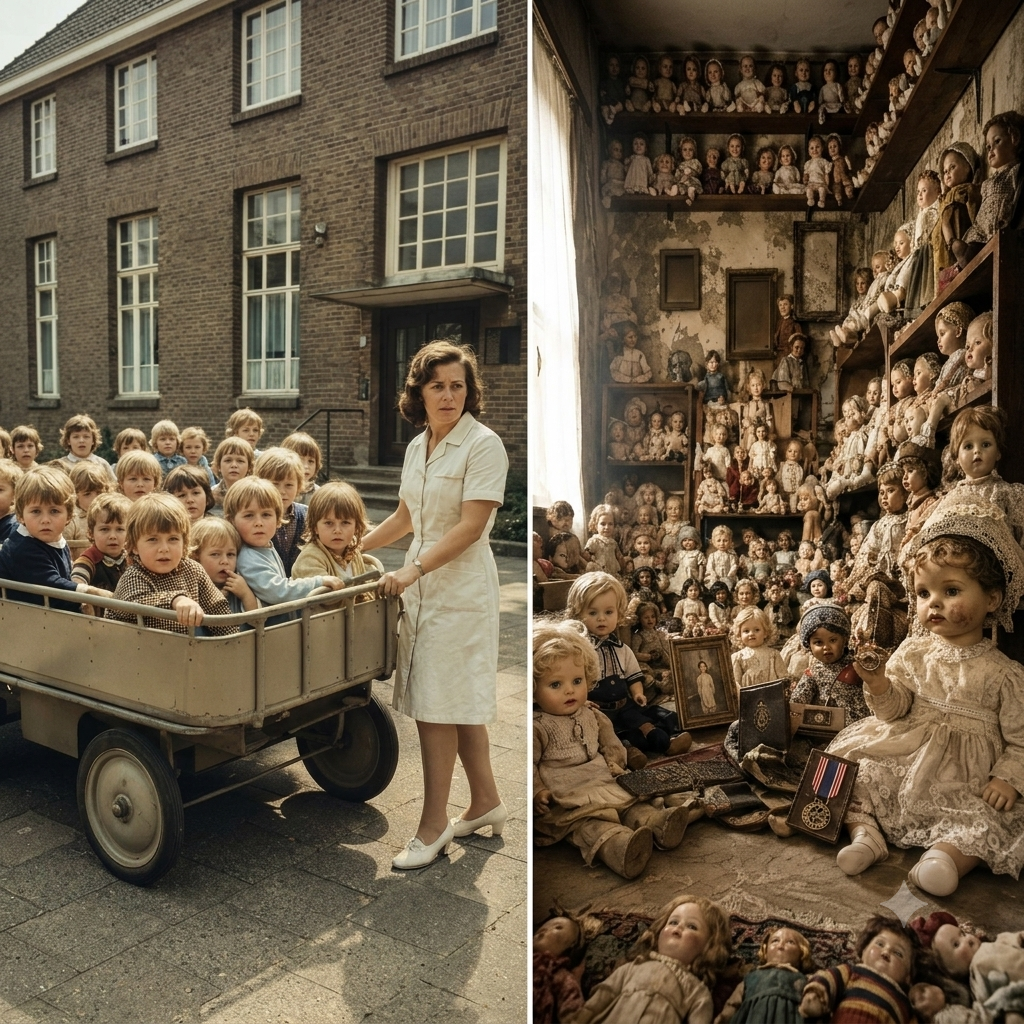
On them were dolls of various sizes and materials.
Ines counted them twice; there were 43.
The number corresponded exactly to the number of children whose trail ended in November 1972.
Each doll had a name on it.
Some names could be linked directly to the preserved occupancy lists of Falkenritz.
With this, the research for the first time established a material connection between the vanished home and individual children.
The dolls were crafted differently.
Some were made of fabric, others of wood or porcelain.
Inside their bodies were small cavities or sewn-in compartments.
Inside them were personal items, each accompanied by short written notes.
One boy had left behind a military decoration belonging to his late father.
Another child’s doll contained their mother’s slim wedding ring.
Other dolls held family photos, a single lucky coin, a prayer book, a small ear, and toys.
The material value was low, but the attached notes showed that these were things that represented a personal connection to the children’s origins.
The same explanation appeared on several slips of paper.
The children were told to leave their most important belongings in Falkenritz before being taken to so-called Christmas families for a limited time.
After Christmas, they were to return and receive their things back.
The date was the 18th. of November 1972.
With this, the claim of a completely unexpected technical evacuation was seriously damaged for the first time.
If 43 children had been induced to systematically deposit their most important keepsakes the day before , then there had been planned preparation before the alleged emergency.
Even more crucial was the message to the children themselves.
They were meant to believe that they would return.
Ines began to check the names on the dolls one by one.
Among the 43 labels, she finally found the name that had brought her to Hildesheim .
Elfriede Vogel.
The doll contained no jewelry and no mementos of parents.
Inside were two medical documents.
One confirmed Elfriede’s pregnancy.
The second was a small, badly faded scan from a prenatal examination.
The attached note identified it as Elfriede’s personal property.
The unborn child in this picture was Ines.
With this, the character of her research changed once again.
Ines had grown up her whole life assuming that her young mother had disappeared and died after the birth.
Now, before her lay an object that Elfriede had consciously kept as something precious just weeks before the birth.
The picture did not prove what had happened to Elfriede later.
But it proved that she had not dismissed her pregnancy from her life.
She had kept the image of her unborn child and only left it behind in Falkenried because she had obviously been promised she would get it back later.
Elfriede never returned.
None of the other children came back to collect their personal belongings either.
For nearly 36 years, these items lay behind a hidden wall, while the official account continued to claim a safe transfer to other facilities.
No reception log explained the disappearance.
No documented destination explained the 43 abandoned dolls.
Until this day, Falkenried had seemed like an incompletely documented administrative case from 1972.
Now there were 43 names, 43 abandoned keepsakes, and a common date.
The first reliable lead indicated that the children had not disappeared due to a technical emergency.
Someone had prepared their departure.
Behind the shelves with the 43 dolls, Ines Vogel found a second clue that linked the discovery in the hidden room to the internal administration of Falkenried for the first time.
Between a back wall and a narrow wooden panel lay a bound register whose entries reached right up to the closure of the home.
The pages contained names, dates of birth, admission dates, and brief notes about the children.
On the last written page, however, the format of the entries changed.
Under the date of November 18. November 1972 was the term “Special Placement.”
Below that, 43 names were listed.
The same number as the dolls in the hidden room.
Elfriede Vogel was at position 26, next to it a brief note about her pregnancy.
For Ines, this page was more decisive than anything she had found before, because it showed that the children’s departure had been treated internally not as a spontaneous evacuation, but as an organized placement process.
The chronological correlation was striking.
On the same day the children had left their most personal items inside the dolls, a ” special placement” had been documented in the administration.
The official explanation of a sudden heating problem could no longer be easily maintained.
At least part of the events must have been prepared before there was any talk of a technical emergency.
Ines made copies of the register pages and visited Otto Kalweit again.
During their first conversation, he had only confirmed that Rudolf Hartwig had sent him home unusually early the evening before the closure.
When Ines showed him the discovery from the side room and the term “special placement,” Kalweit recognized not only the construction behind the wall but also the room’s purpose.
He had helped build it himself in 1971.
Hartwig had explained to him back then that the home management needed a secure area for the children’s personal valuables.
Kalweit had put up the partition, installed shelves, and disguised the entrance so that it was barely noticeable from the outside.
For a home where many children did not have their own lockable cupboards, the reasoning had not seemed entirely unusual.
Only after the closure did it become clear to Kalweit that the room had apparently served a different purpose.
He had known nothing about the 43 dolls before November 19th.
November nothing known.
When he saw them later, they were already on the shelves together with the children’s items.
The connection between the hidden storage and the sudden disappearance of the residents had been apparent to him back then, but he had remained silent.
Hartwig had let him know that any investigation would also raise the question of why Kalweit himself had built an undocumented room.
This created a simple form of control.
Hartwig did not have to prove that Kalweit was guilty.
It was enough to make him feel that he would come under suspicion himself in an investigation.
Kalweit’s silence was not proof of involvement, but it showed how easily people in a closed system could be bound by partial knowledge and fear.
Through Kalweit, Ines received the name of another former employee, Hedwig Saalfeld.
She had been years old in 1972 and had worked primarily with the younger children.
Kalweit remembered that Hartwig had her procure materials for needlework and several simple doll bodies a few days before the closure.
Hedwig had made the dolls that were later found in the hidden room.
Ines looked into her subsequent life and encountered a striking continuity.
After the closure of Falkenried, Hedwig had not disappeared from Hartwig’s circle, but worked as a secretary in one of his companies after an interruption.
This connection initially seemed like loyalty.
Only older medical records revealed that there had been psychiatric treatment between the home’s closure and her later employment .
Shortly after the events of 1972, Hedwig had been treated as an inpatient for several months.
Her file noted paranoid ideation, severe symptoms of stress, and an impaired assessment of reality.
On the other other hand, almost nothing could be found regarding the specific content of her statements about Falkenried.
The timing of her institutionalization coincided directly with her attempt to report the events at the home outside of Hartwig’s sphere of influence.
This revealed a new pattern.
When someone questioned the official account, it didn’t trigger an investigation into the event, but rather a file on that person’s credibility.
Afterward, Hedwig was professionally dependent on Hartwig and remained in his circle for decades.
On paper, it looked like employment following a personal crisis.
In reality , it meant a permanent tie to the man whose decisions she had originally intended to testify against.
When Ines was finally able to speak with Hedwig, she confirmed the origin of the dolls.
Hartwig had told her the children were to be placed with selected families on a trial basis before Christmas.
The new families supposedly insisted that children arrive without old or damaged items, which is why personal keepsakes had to stay at the home.
Hedwig’s task was to make this sacrifice acceptable to the children.
The dolls were the means to that end.
Each child received their own, in which their most important personal item could be stored .
The children were to believe the items would remain safe and be returned upon their homecoming.
Especially for those clinging to memories of deceased parents or siblings, this assurance was decisive.
Hartwig hadn’t just organized a storage system.
He had created a psychological condition under which children voluntarily gave up things they otherwise likely wouldn’t have left behind.
The prospect of a Christmas family was linked to the promise that the stay would only be temporary.
The children were supposed to leave without realizing the true nature of their departure.
On November 18th, Hedwig was sent away from Falkenried.
The reason given proved to be false later on.
When she returned the next day, the home was empty, and she received no verifiable information to her questions about the children.
Shortly thereafter, she attempted to report the incident and ended up in psychiatric care herself.
For Ines, another layer of the preparations became visible.
Ottokal was not present that decisive evening.
Neither was Hedwig.
One had built the hidden room, the other had made the dolls and explained to the children why they should leave their personal things behind.
Both knew only individual parts of the process, while Rudolf Hartwig controlled the overall context.
The investigation therefore shifted from the home’s records to Hartwig’s economic development.
Before November 1972, his financial situation had been strained.
In addition to Falkenried, he operated a small transport company burdened with liabilities.
Larger investments were hardly visible.
A few weeks after the closure, this picture changed significantly.
Hartwig first acquired shares in a storage business, later land and interests in other companies.
By mid-1973, assets had been created that were difficult to reconcile with his previous financial situation.
What was especially striking was that a significant portion of these businesses was financed without any recognizable long-term loans.
The capital must have come from another source.
[She] searched through old accounting records for this origin.
Eventually, she found a directory of early donors that contained 43 individual entries.
Each consisted of a family name, a monetary amount, and a brief note about a deposit or stake.
The number of entries once again corresponded exactly to the number of children from Faltenried.
The amounts were irregular.
11,000 marks, 17,500 marks, 23,000 marks, 31,000 marks, and other sums that followed no uniform participation ratio.
For ordinary investments, a logical relation between payment and business share was missing, and no fixed fee could be derived from them either.
The differences must have had another reason.
Even more striking were the names.
Several family names from the list reappeared in later documents regarding foster care or adoption arrangements.
Not every entry could be immediately assigned.
But in several cases, there was a direct link between a payment to Hartwig and a household where, shortly thereafter, a child lived with incomplete origin documentation.
The temporal connection was close enough to make a coincidence increasingly unlikely.
Ines laid the Faltenried list and the directory of donors side by side.
On one side were 43 children listed internally under ” special placement.”
On the other side, 43 payments that appeared immediately before Hartwig’s economic rise.
There was no complete proof between the two lists yet, but the structure was clear.
The term “special placement” thus took on a second meaning.
It potentially described not just the relocation of the children, but also a process in which different sums were paid for individual persons.
The longer Ines compared the amounts, the less they seemed like investments and the more they seemed like valuations.
Why one child should have been worth 11,000 marks and another more than 30,000 marks could not yet be explained by these documents.
Age, health, origin, or specific family wishes could have played a role.
But direct proof for that was still missing.
What was decisive initially was only that Rudolf Hartwig’s new financial opportunities coincided in time with exactly 43 unusual money movements.
The hidden room had shown that the children thought their departure was temporary.
The register had proven that their transfer had been prepared under its own administrative term.
Edwig Saalfeld had explained how the children had been induced to leave their most important personal belongings behind.
Now the accounting showed that immediately thereafter, 43 payments of varying sizes appeared in Hartwig’s economic environment.
Ines could not yet prove what name Hartwig himself had given these payments, but she now knew what they likely meant.
They were not 43 investors, they were 43 prices.
Edwig Saalfeld possessed something else besides her memory that she had never shown Rudolf Hartwig.
For decades, she had recorded names, phone numbers, postmarks, and individual incidents in an unassuming notebook that had caught her attention while working at Hartwig’s company.
Each entry on its own was trivial enough not to trigger any immediate investigation.
Taken together, however, they formed a pattern that allowed Ines for the first time to link the special placement scheme to specific life paths after 1972.
Several entries concerned letters from Munich, Hamburg, Cologne, Frankfurt am Main, and Bremen.
The senders were not always the same people , but family names that Ines already recognized from the old financial records appeared repeatedly.
Additionally, Hedwig had noted calls from adult callers asking about their origins, Falkenrit, or Rudolf Hartwig.
In some cases, a second family name and a city were written next to an old name .
Hedwig had never systematically evaluated this information.
She had collected it because she feared that Hartwig would eventually destroy even the last traces.
During her work as a secretary, she occasionally received mail that did not fit into normal business routines or was confronted with calls that Hartwig handled personally.
After such contacts, documents often disappeared from the office or were moved to other files.
Particularly striking were letters from people who had first asked questions about their own childhoods in the late seventies and eighties.
They described missing birth records, unclear foster arrangements, or names they only remembered in fragments.
Some were looking for siblings, others simply wanted to know why practically no documents existed about them before a certain point in time.
Hartwig had never responded to these inquiries via normal business correspondence.
Ines began to cross-reference the names from Hedwig’s notebook with registration records, old address directories, and accessible adoption files.
Several potential connections emerged, but initially none that were complete enough.
Many families had moved, some names were too common, and other people had long since passed away.
The decisive breakthrough, therefore, did not come from Ines.
A man from Hamburg reached out to her.
Jürgen Rebein was 45 years old and had been trying to reconstruct his origins since his adoptive father’s death.
His official life history began almost entirely in November 1972.
For the time before that , he only possessed an amended birth document and a few contradictory details about an alleged earlier placement.
He did not have an original adoption decree or any traceable handover file.
Shortly before his death , his adoptive father had admitted for the first time that the child’s intake had not gone through a standard procedure.
There had been a cash payment to a man from Lower Saxony.
After that, a nine-year-old boy had joined the household without the family having to go through the usual waiting periods and checks.
The name Rudolf Hartwig was not fully spelled out in the father’s documents.
However, an old note contained the label “Hartwig, Hildesheim” and a monetary amount.
For Jürgen, this entry had initially had no meaning.
It was only Ines’s public search for former Falkenrit residents that established a connection.
Jürgen’s own memories of the time before his new family were incomplete.
He could not name any street, any address, or the exact name of the home.
A single detail, however, had remained constant.
Shortly before his departure, he had to leave an object belonging to his late father inside a doll.
It was a military decoration that, for him as a child, represented the last tangible link to his father.
Ines knew this object.
It was among the personal belongings recovered from Falkenrit.
The match changed the evidentiary value of the previous findings.
Until then, the dolls had shown that certain children were being prepared for temporary placement.
Jürgen Rebin now provided, for the first time, a living adult whose memory led directly to one of these objects and whose later family history simultaneously included an unusual payment from Hartwig’s circle.
Ines and Jürgen began to examine further cases together.
They did not focus on all names at once, but on people where several characteristics coincided.
Placement into a new household immediately after Falkenrit’s closure, retroactively altered birth records, missing original adoption documents, and no clearly verifiable origin before late 1972.
The very first matches showed that Jürgen’s case could not have been an isolated incident.
For a woman in North Rhine-Westphalia, the coherent file record also only began in late November .
A man who later lived in Bremen had a birth document whose issue date was significantly after his actual birth year.
In another case, an alleged transfer from a care facility could not be confirmed because the facility in question had no admission records for the child.
The new identities seemed formally sufficient as long as no one asked for the documents before them.
That was precisely the strength of the system.
The children did not have to be completely erased from all registers.
It was enough to cut off their past at a certain point and then begin a new, administratively usable history.
Anyone living under a different family name later could appear perfectly normal in registration records, schools, and insurance documents, even though the transition to this identity was untraceable.
Edich’s notes indirectly confirmed this mechanism.
Next to some old Falkenrit names were later surnames she had learned through letters or phone calls.
She had never known for sure if the people were actually the same children.
Now, Ines could connect several of these assumptions with later family files.
Jürgen was the first case where memory, personal object, and documents all matched up simultaneously .
For him, this realization did not mean a simple restoration of his origins.
The family in which he had grown up had provided him with education, security, and a materially stable life.
At the same time, it became increasingly likely that his entry into this family was based on a payment whose true purpose had been obscured.
Love in a later family and injustice during the handover were not mutually exclusive.
It was precisely this contradiction that gave the case its social sharpness.
An illegally placed child did not necessarily have to end up in a violent household for the original act to remain.
The deciding factor was that their origin had been disposed of without them or their relatives having any influence on it.
A good later life could not retroactively legalize the administrative breach.
While Ines and Jürgen compared more names, Hedwig revealed information she had previously withheld.
To her recollection, the complete files on the children had never been destroyed.
Rudolf Hartwig had kept a separate file for every child, apart from the official home records.
Internally, he referred to these collections as insurance files.
During her time at Hartwig’s company, Hedwig had seen several times how individual files were requested from a separate stock when letters or calls from earlier families appeared.
In her understanding, the term insurance did not refer to an insurance company.
The documents were Hartwig’s protection against the people who had been involved in the placements at the time.
They had to contain the information that Ines had previously only been able to piece together from individual traces.
Old names, new names, families, payments, and possibly the actual final destinations.
Hartwig did not keep these documents at his company.
According to Hedwig’s information, they were in a secured area of his private house in Hildesheim, in a safe inside his study.
Only later notes and individual copies had remained in the normal business archive.
He had kept the original files under his direct control.
This information made Hartwig’s behavior more understandable.
Anyone who wanted to completely hide an illegal operation would have destroyed the documents.
Hartwig had done the opposite.
He had collected and protected them.
For him, the reason lay in mutual dependency.
If families had paid for an unlawful placement, the documents could not only incriminate Hartwig, they could also compromise buyers, intermediaries, and others involved.
Possessing the files therefore meant power over anyone who had an interest in keeping the past closed.
Hedwig knew of another process that did not fit the business records.
For years, payments had been made regularly for a woman. who lived in a care facility in the Göttingen area.
No full name appeared in the accounts.
The payments went through a structure controlled by Hartwig and were internally assigned a designation.
F26 Ines did not know this number from Hedwig’s notebook.
She knew it from the sequence of the old file register.
She checked the list again.
Position 26 belonged to Elfriede Vogel.
For the first time since the beginning of her search, there was a lead that did not lead back to the year 1972, but to the present.
If the labeling truly used the same system, then Elfriede had not died after birth, nor had she disappeared shortly after the Falkenr records.
Someone was still paying for her accommodation.
Until now, Ines had tried to find out what had happened to her mother.
Now, for the first time, she had to consider another possibility .
Elfriede Vogel could still be alive.
When Rudolf Hartwig was away from Hildesheim on business for several days , Ines Vogel and Jürgen Riebein got their first real chance to find the so-called insurance files.
Hedwig Saalfeld knew the layout of the house and knew which room was used as a private study.
Over the years, she had delivered documents there several times and had seen that certain files were never kept in the regular business archives.
It was clear to him that a further search in public registries would hardly suffice if the crucial collection was actually under Hartwig’s personal control.
The study contained a secured area behind heavy wall paneling .
That was where the safe was, just as Hedwig had described.
Opening it took several attempts, but the contents immediately confirmed that Hartwig had not destroyed the past, but had systematically preserved it.
Inside were 43 thin file folders with consecutive labels from F1 to F43.
Each folder contained significantly more information than the official home records.
In addition to photographs and medical data, there were assessments of learning ability, behavior, physical health, and adaptability.
Several forms contained evaluations of how easily a child could be integrated into a new household and which traits were considered favorable or problematic for placement.
The language was objective, almost technical, yet this very coldness made the entries harder to bear.
The children had not just been managed, they had been evaluated.
For younger, healthy children, there were notes indicating a high probability of placement.
For older children, stronger reservations were noted, especially when psychological stress, school difficulties, or behavioral issues were documented.
Several files also noted which families preferred certain age groups, genders, or health characteristics.
The placement followed no recognizable pedagogical principle, but rather a system of supply and demand.
Jürgen found his own file under F18.
Inside was a photo from Faltenrit, a brief medical report, and an evaluation of his school performance .
Additionally, the family he had been sent to at the end of November 1972 was listed.
Next to the name was an amount that matched the sum that had later appeared in Hartwig’s financial records .
With that, the connection was complete for the first time.
The amount had not appeared next to a family by coincidence.
It belonged to a specific child.
Further files confirmed the pattern.
Each folder was assigned a destination, often with a family name, city, and payment.
In some cases, there were references to retrospectively created documents, new registered addresses, or instructions on which earlier information should not be carried over.
Several children were given new surnames after being placed.
Ines searched for F26.
Elfriede Vogel’s file was more extensive than many others.
Beyond the details of her pregnancy, it contained a separate assessment that described her situation as a special placement constellation.
The documents treated not only Elfriede herself, but also the unborn child as an independent factor.
Next to the designation was an amount of 31,000 marks.
The justification was brief.
Young mother, good health, pregnancy advanced, joint or separate placement possible.
The wording showed that Hartwig had not only determined Elfriede’s whereabouts.
Even before the birth, calculations had been made on how mother and child could be placed economically—separately or together.
Further pages documented the actual course of events.
After the closure of Falkenritz, Elfriede had initially been taken to a facility outside Hildesheim.
Following the birth in January 1973, the child was separated from her and placed in a household in North Rhine-Westphalia under new documents.
Elfriede herself was committed to a psychiatric ward a few weeks later.
Ines found her own new family name in the file.
This proved that her adoption had not come about by chance at a later date.
The separation had been prepared while Elfriede was still pregnant.
The documents also showed that Hartwig remained informed about both paths of life.
In Elfriede’s case, several transfers between psychiatric facilities followed.
Eventually, the designation Göttingen appeared, later only F26 with regular cost items.
The payments were processed through a structure controlled by Hartwig and continued for decades.
What Hedwig had seen in the ledgers was not anonymous charity.
It was the financing of the woman whose daughter had been sold.
However, the safe contained other files that expanded the existing picture.
Several children had not been placed with families.
They lacked new household names.
Instead, there were names of medical or therapeutic institutions, each with notes on special placement.
The criteria were striking.
Children with developmental delays, behavioral problems, or severe trauma were more frequently classified into this group.
Phrases like “limited adoptability,””medical observation,” or “long-term therapeutic placement” appeared in the files.
Some entries were also followed by payments.
Jürgen began photographing these cases separately.
After only a few files, it became clear that these could not simply be ordinary institutional placements.
Some forms contained references to research programs or medical observation assignments, without explaining exactly what was meant by them.
In several cases, the subsequent progress was only documented in brief notes.
For a five-year-old boy , the file ended with a death certificate.
For two brothers with developmental delays, similar documents were found a few months after their admission to a facility.
Another child was not yet two years old when it was taken to a medical observation center.
There, too, a death record followed later.
Up until this moment, Ines had believed the worst crime was that children had been placed into new families in exchange for money.
The new documents revealed a second layer.
For children who were harder to place, there were other takers.
Not every destination was a home.
Some were institutions where the children were treated as medical cases.
Ines and Jürgen photographed every relevant page.
They no longer focused only on names and sums, but also on internal codes, transfer dates, and institutional recipients.
The files contained enough material to later trace which agencies had been involved in the processes.
In the lower section of the safe lay another document, separate from the 43 individual files.
It was a handwritten journal by Rudolf Hartwig.
The entries were not written for administrative purposes, but for himself.
Under the date of November 18, 1972, there was a brief summary of the clearance.
Multiple vehicles had been scheduled.
The children were to be distributed in smaller groups.
The routes were organized so that no single , unified transport was created that could easily be reconstructed later.
The destinations were in different directions.
With this, Hartwig had avoided the exact problem an official evacuation would normally have left behind: a detectable movement of a large group.
Instead, Falkenrit was broken down into several smaller transports.
Each group was given its own route.
A later entry stated the total sum.
It was enough to settle existing debts and form the starting capital for Hartwig’s further business ventures.
The economic development that Ines had already reconstructed was therefore no longer just temporally suspicious.
Hartwig himself had documented the connection.
Even more damning were the marginal notes regarding individual children.
They recorded not only age and health status , but also an assessment of which destination would yield the highest or fastest profit.
Children with a good health prognosis were preferentially placed with families.
Others were passed on to institutions where admission was apparently also linked to financial benefits.
The system followed a recognizable order: selection, evaluation, and assignment.
At the end of every transaction was a payment.
Ines also came across instructions for subsequent documentation.
Previous names were not to be continued in certain cases.
Reporting channels had to be designed so that later inquiries would not automatically lead to Hildesheim.
For individual placements, birth records were to be adjusted or new family information added.
Hartwig hadn’t just distributed children; he had created new biographies for them.
For Jürgen, his own file was particularly difficult to look at.
His later life was real, his family was real, his education and his memories were as well.
But the transition into this life was based on a document where his name stood next to a price and an evaluation.
Ines experienced the same rupture in a different way.
Her birth was not documented in the file as the beginning of a family life, but as a calculable moment within a special placement.
Elfriede had not been treated as a mother whose rights needed to be verified, but as an obstacle and simultaneously as part of an economic arrangement.
The documents answered almost all questions about the mechanism.
Only one question remained open.
How many people had known about it?
The number of families, doctors, institutions, and administrative offices involved made it unlikely that Hartwig had organized every step alone.
Yet the files did not contain a complete list of those involved.
They merely showed that he had maintained an overview.
When Ines and Jürgen had secured the most important pages, time was running out.
Hartwig returned to Hildesheim unexpectedly early.
They had to leave the house before the entire contents of the safe could be evaluated .
They did not take complete file collections, but the copies were enough .
They contained F1 to F43 family names , destinations, payment amounts, medical facilities, and Hartwig’s own journal.
Above all, they contained F26.
Elfriede Vogel had not disappeared.
She had been taken to Göttingen and she was possibly still living there.
From this moment on, the search for her origin was over.
What Ines and Jürgen held in their hands was a systematically maintained body of evidence regarding the organized transfer of children, the alteration of their identities, and the exploitation of minors by medical institutions.
The Falkner case was no longer a family secret.
It was a criminal case that just hadn’t been opened yet.
The trail F26 led Ines Vogel to a care facility in the Göttingen area.
The documents from Rudolf Hartwig’s safe did not contain a complete current name, but several payment receipts, internal codes, and previous transfer dates.
Together, they formed a chain that could be traced through various psychiatric facilities to a single remaining place of residence.
For the first time since the beginning of their search, a concrete address existed where Elfriede Vogel could still be living.
The facility initially only confirmed that a resident with a corresponding biography was housed there.
Her file was extensive and went back many years.
Repeated diagnoses appeared in it, referring to anxiety, confusion, persistent memories of an allegedly deceased child, and an allegedly forced separation after birth .
These statements had not been treated for decades as possible memories of an actual event, but as a component of a psychiatric disorder.
The medical documentation was consistent in this regard.
Whenever Elfriede had insisted that her child had lived after birth, this had been described as a misperception or morbid fixation.
When she had spoken of Rudolf Hartwig, her statements appeared in the files as expressions of mistrust and delusions of persecution.
The content of her memories had thus not been verified, but diagnostically reinterpreted.
had meanwhile obtained documents that called this very medical interpretation into question.
File F26 proved that her birth had taken place, that she had been separated from Elfriede afterward, and placed in another household.
The alleged death of the child was therefore not a memory gap, but part of a false narrative.
The woman, whose statements had been dismissed as illness for decades, had told the truth on a central point.
When Ines saw Elfriede for the first time, the difference between their life stories was hard to overlook.
Ines had lived in a family under a different name, received an education, and built her own adult life.
Elfriede had ended up in a system of psychiatric care after the birth, where the original separation was never investigated as a potential crime.
Both biographies had the same starting point and were then completely separated from one another.
Ines brought the small photograph from the doll that Elfriede had left behind before her departure from Falkenr.
This picture was not spectacular evidence, but it held a significance that no later file note could replace.
Elfriede recognized the photograph and associated it with her pregnancy.
This connected to a memory that did not come from the later medical files, but from the time immediately before the home’s closure.
Gradually, her path at that time could be reconstructed more accurately.
Elfriede had come to Falkenrit as a 16-year-old pregnant girl after her family did not want to keep her following a pregnancy resulting from sexual assault.
The facility had not been an ordinary stopover for her, but the place where others decided her future.
On November 18. November she was relocated along with the other children, under the assumption that it was a temporary placement before Christmas.
After the closure of Falkenr, Elfriede went first to another facility.
File F26 showed that Hartwig continued to control her pregnancy and was already distinguishing between different placement options before the birth.
The child was to be placed separately if possible.
Elfriede herself was then considered harder to place and was increasingly treated medically rather than socially.
In January 1973, she gave birth to Ines.
Shortly thereafter, she was told that the child had died.
The available documents now showed that this information had been false.
Ines was taken to a household in North Rhine-Westphalia and received a new family designation.
Elfriede remained behind and was transferred to psychiatric treatment.
This resulted in two independent sets of documentation.
In one, a child grew up whose biological mother was supposedly dead.
In the other, a young woman lived whose child had supposedly not survived.
Both versions complemented each other so completely that a later connection became almost impossible.
The separation was not based on a single missing document.
It was based on two false life stories.
For Ines, this realization changed the meaning of her own adoption.
Until now, she could only assume that her origins were shaped by loss, illness, or an unclear decision made by her mother.
It now emerged that Elfriede had neither disappeared voluntarily nor had she demonstrably died.
Instead, she had been robbed of the child’s existence, while the child was robbed of the mother’s existence.
Elfriede’s later medical records contained the same themes over and over again.
She remembered a birth, a living child, and a separation that no one in her environment would confirm.
The longer the official version persisted, the easier it became to treat any deviation from it as a symptom.
The medical apparatus did not have to be a full part of Hartwig’s original plan for this to happen.
It was enough that the existing documents were false and no one was willing to re-examine their basis.
Hartwich’s regular payments took on a new meaning as a result.
To the outside world, they could appear to be funding necessary care.
In reality, they kept a woman in a system whose records confirmed exactly the story that Hartwig himself had created.
As long as Elfriede was considered a mentally ill patient there, any memory of her daughter remained easily attackable.
Ines and Jürgen Rebein therefore decided to no longer evaluate the secured copies only in private.
The files from Hartwich’s safe, the assignments from F1 to F4, the payment receipts, and the handwritten journal were handed over to the Hildesheim public prosecutor’s office.
The decisive question was no longer just whether individual placements had been unlawful.
The documents pointed to a systematically prepared process that spanned several locations and various recipients.
Due to the transregional connections, the investigation had to be expanded.
Children had been sent to different regions.
Families lived in several federal states, and some medical facilities were located outside of Lower Saxony.
This turned a local case into a process involving various law enforcement agencies and archives.
Edwich Saalfeld now declared herself ready to fully disclose her previous records.
She not only handed over her private notebook but also organized the events she had observed during her work for Hartwig.
This allowed several payments, subsequent letters, and internal file movements to be linked together.
Her former psychiatric treatment thus lost some of the impact that Hartwig had used for decades to undermine her credibility.
In parallel, another inventory was discovered that Hartwig had kept separate from his business records.
There, investigators found items that possessed no economic value but were important for reconstructing the children’s biographies.
Clothing, school notebooks , photographs, report cards, and personal documents were in labeled boxes, partly sorted by old names.
Even more significant were several bundles of letters.
They came from children who had already left Falkenrit.
Some wrote to former caregivers, others to friends or to people they had left behind at the home.
The letters showed that at least some of the children still believed, after their relocation, that they had a connection to their former lives.
They wrote about new families, new cities, and new rules, but also mentioned memories of people and objects from Falkenrit.
None of these letters had been forwarded to the intended recipients.
This meant the separation did not end with the physical relocation.
Hartwig had also controlled the subsequent connections.
Children who asked about their origins or tried to maintain earlier contacts received no response.
People in their old environment, in turn, received no clues as to where they were living.
For the investigators, this created a complete picture of isolation.
First, the children were separated, then their documents were altered, and finally, their communication channels were severed.
The new identity was intended to function as more than just words on paper.
It was also meant to prevent old relationships from being restored later on.
For him, this part of the discovery was particularly grave.
Her own story was not an isolated case, but part of the same mechanism.
Elfriede had believed her child was dead.
Ines had believed her mother was dead.
Other children had written and never received a reply.
The withheld letters proved that Hartwich himself had prevented the children’s later attempts to re-establish contact with their former origins.
The reunion with Elfriede could not undo this separation.
The woman Ines had before her bore the consequences of decades of treatment and a life story in which her most important memories had been constantly dismissed as illness.
Ines, in turn, could not simply replace her own past with a new truth.
The family she had grown up in remained part of her life, just as the realization that her adoption was based on a manipulated process.
This was precisely where the psychological violence of the system lay.
The truth did not simply restore order.
At the same time, it destroyed the explanations with which those affected had lived until then.
For mother and daughter, the same truth meant that both had built their lives to date on a deliberately fabricated report of death.
For the investigators, it meant that Faltenried had not disappeared with a single false evacuation report.
Behind the process was a structure that had stabilized separation, new identities, and silence over a long period.
With the opening of the criminal proceedings, this structure began to fall apart for the first time, and more names were already waiting in the newly secured files.
The investigators began to treat the 43 individual cases no longer as separate fates.
Each folder was cross-referenced with registration records, medical archives, old home rosters, and later family files.
For a portion of the children, their path into private households could now be traced.
Other cases, however, did not end with foster or adoptive families, but in institutions whose original designations were only briefly noted in the files.
It was precisely this group that became the focus of the investigation.
In Hartwich’s internal evaluations, the children in question were frequently described as difficult to place, developmentally delayed, or exhibiting behavioral problems.
Some had already passed through several institutions before Faltenried.
Others were considered unsuitable for standard placement due to health limitations.
In later documents, such children were no longer described as potential family members, but as medical cases.
Initial archival findings showed that several of them had ended up in institutions that at the time worked with psychiatric treatment, developmental diagnostics, or drug research.
The official wording was guarded.
There was talk of observation, therapeutic trials , or long-term medical care.
Only by comparing the internal records with later medical files did it become clear what lay behind these terms.
A five-year-old boy had been moved to a psychiatric facility just a few weeks after Faltenried.
There, he was included in a drug trial, even though no consent from biological relatives or identifiable legal representation was documented.
The records contained dosages, blood values, neurological reactions, and information on recurring seizures.
His name appeared only on the first few pages.
After that, he became a number.
The documentation was similar for two brothers with developmental delays.
They had been transferred together to an institution that labeled their admission as a special therapeutic placement.
A few months later, the files showed indications of various active ingredients, sleep deprivation, and observation series.
Both boys died within a short period.
Another child was not even two years old.
The original Faltenried file described a physically weak girl with increased care requirements.
After the transfer, she was listed in a medical registry that documented no family contacts whatsoever.
In this case, too, the file ended with a death certificate .
Investigators no longer had to speculate that the medical facilities had merely served as substitutes for families.
The preserved records showed an active use of the children within research and treatment programs.
Initially, it could not be determined whether the participating doctors knew how the children had arrived there.
However, the state of the documents spoke against a normal, fully vetted admission.
A crucial clue came from a now-retired doctor who had worked at one of the facilities at the time.
He had not destroyed a portion of his personal records.
The notes consisted of copies of treatment plans, handwritten additions, and observation logs that had never been fully incorporated into the official patient files.
The doctor confirmed that several children had been given drugs whose effects were still being systematically researched at the time.
To the outside world, the minors were considered patients with special therapeutic needs.
Internally, however, reactions were compared, dosages were adjusted, and side effects were documented.
The children were thus not only being treated but were being observed at the same time.
His records contained details of hallucinations, feverish states, motor disorders, seizures, and organ stress.
Some entries ended abruptly following a deterioration.
Others led directly to a death notice.
The language remained medically dispassionate, yet it was precisely this that revealed how completely the affected children had been reduced to measurable reactions.
The doctor had kept the records because he had begun to have doubts even back then.
He had been told that the children were state-housed and their participation in the programs was legally secured.
He had not verified this claim.
Only later did he realize that several of these children had practically no verifiable legal guardians and their origins in the files were unusually vague.
For the investigators, this statement was important, but not exonerating.
It showed that the system did not necessarily rely on a single, unified conspiracy.
It could also function if every involved entity simply accepted the part it wanted to see.
Hartwich did not need to disclose a child’s full background to every doctor, as long as the intake papers appeared formal enough and no one checked the prior life history.
Edwig Saalfeld was confronted with the names of the children involved.
She recognized several immediately from her time at Falkenrit.
Some had been particularly young, others had required more care than the rest of the residents.
Her memory confirmed that they had not been treated as medical research cases before their transfer.
With this, another one of Hartwich’s claims became untenable.
The children in question had not been sent to special facilities because an acute medical need had only later arisen.
Several assignments had already been prepared in his internal files.
A lack of adoptability had been enough to determine a different destination for them.
For the first time, Ines saw the complete economic logic of the system.
Children who were attractive to private households could bring in money through covert placements.
Children who were, in Hartwich’s assessment, harder to place were not excluded from the system .
For them, too, there were recipients.
The difference lay only in their utilization.
This realization deepened the psychological trauma for the survivors.
Some had to process that they had been placed in families for money, who may have believed they were going through a legitimate process.
Others learned that children from the same dormitories had not ended up in families, but in medical facilities.
The randomness of this assignment became a central component of the case.
Age, health, and adaptability had determined their future life paths.
Not law, not origin, not child welfare.
Parallel to the medical trail, investigators searched for individuals who had been directly in Falkenrit on November 18. November 1972.
Several former employees had since passed away, others were no longer fit for interrogation.
Finally, a former nurse was found who had been temporarily assigned to the children’s medical care at that time.
She had been on duty on the night of the transfer.
Her memory alone would have had limited evidentiary value after such a long time.
What was decisive was that she had kept several photographs.
The recordings were not professional, partially blurry, and lacked complete labeling.
Nevertheless, they showed groups of children being brought to vehicles one after another.
Rudolf Hartwig could be identified in several pictures.
He was holding documents in his hand and checking the groups.
In another photo, people from the local sphere of responsibility were standing in the immediate vicinity of the vehicles.
This provided visual proof for the first time that the departure was not organized solely within Faltenritz.
One recording was particularly important to them.
It showed Elfriede Vogel in an advanced stage of pregnancy.
The date of the series of photos could be assigned to the 18th based on storage notes and further documents.
November.
These photos directly contradicted the official account, which claimed the children were not moved until the following morning due to a suddenly discovered technical problem.
The chronological order was now no longer in question.
The transports had already begun the evening before.
The explanation of the heating emergency had been created later.
This also changed the significance of the official documents from that time.
What had seemed like incomplete documentation for decades now had to be examined as a possible fabricated cover story.
The question was no longer just why certain forms were missing.
The question was who had been involved in creating the false version.
The public prosecutor’s office therefore had old administrative files, technical reports , and medical notifications re-examined .
Several documents had been created only after the vehicles had already left Falkenritz.
The alleged emergency had thus been pushed to a time after the actual start of the relocation.
For the investigators, a clearer overall picture began to emerge.
Hartwig had classified children according to various criteria.
Prepared destinations and organized the departure.
Some ended up in private households, others in medical facilities.
To the outside world, the entire operation was subsequently explained by a technical emergency.
The body of evidence now no longer consisted of memory and suspicion.
There were payment records, internal assessments, medical logs, death certificates, photographs, and living persons whose later identities could be linked to the Falkenritz files .
Every new source confirmed a different section of the same system.
The cases of the deceased children were particularly distressing.
For them, no subsequent testimony could ever be obtained.
Their biographies had to be reconstructed from forms that usually treated them only as numbers or medical categories.
For some, more data existed on medication dosages than on their background.
This was precisely where the societal dimension of the case lay.
The disappearance had not only been possible because Rudolf Hartwig viewed children as economically exploitable.
It had been possible because various institutions limited their responsibility to individual sections of the files.
One home handed over, one facility took in, one doctor treated, one administration registered.
No one had to see a child’s entire journey.
Hartwig had taken advantage of this blind transition.
When the evaluation of the medical records was completed, it was clear that several children from Falkenried had entered research or treatment programs and died there.
Further cases still had to be examined.
The exact number of victims was not yet final, but the central claim of the old files was no longer tenable.
The children had not simply been safely distributed to other facilities.
Some had been sold, some had been renamed, and some had ended up in institutions from which they never emerged.
The charges against Rudolf Hartwig were no longer based on a single piece of evidence, but on several independent lines of inquiry.
Investigators had consolidated internal files, payment records, photographs, medical logs, and statements from former residents.
What was decisive was not just that the documents contained the same names and destinations.
What was decisive was that they confirmed the same sequence of events from different perspectives.
In regional court, Hartwig was not tried as the operator of a failed children’s home, but as the central organizer of a system in which minors were transferred based on economic and administrative criteria.
The prosecution argued that the so-called special placements were not covered by standard youth welfare procedures nor by transparent foster or adoption decisions.
For numerous children, complete transfer documents were missing, while concrete payments, new family assignments, and altered identities were simultaneously documented.
The first statements came from survivors whose later life paths had since been cross-referenced with the old Falkenried files.
Jürgen Rebein was one of them.
His file F18 contained the same family, the same location, and the same amount of money that was later found in his adoptive father’s records.
This meant that it was no longer just a memory against an old administrative file, but a complete link between the child, the receiving family, and the payment.
Jürgen also confirmed the origin of a personal item that had been left behind in Falkenried .
The connection between memory and material trace was thus also verifiable in court.
His later family had given him stability, but this fact did not change the reality that his transition into the household was based on a process organized outside of regular placement channels.
Other survivors followed.
One woman recognized a prayer book she had owned as a child before being separated from her biological family.
In another case, a piece of split jewelry could be linked to a sister who was identified later.
Each individual case added further proof to the record that the children had not voluntarily renounced their pasts.
The defense attempted to draw a connection between later well-being and the original injustice.
Several children had grown up in families that had provided for them, supported them, and had not mistreated them.
This was intended to create the impression that while the placements were formally flawed, they were socially acceptable in their outcome.
This argument did not hold up against the documentation.
The process had not merely abbreviated the children’s origins; it had deliberately altered them.
Former names were removed , reporting channels interrupted, and contacts prevented.
The fact that some families acted caringly later could not retrospectively legitimize the method.
Hedwich Saalfeld became one of the most important witnesses.
Her former psychiatric record, which had undermined her credibility for decades, took on a new meaning in court.
The temporal proximity between her attempt to report the events and her committal was documented.
At the same time, other evidence confirmed essential parts of what she had wanted to say back then.
She described the preparation of the dolls, Hartwig’s instructions, and how the children had been led to believe the placement was temporary.
Her task had been to create trust without knowing the actual purpose.
The children were supposed to believe their personal belongings were being kept safe for their later return.
The dolls thus became a unique piece of evidence.
They did not just prove unlawful placement, but they showed what expectations the children had when leaving Falkenrit.
The idea of a permanent separation had not been communicated to them.
Edig’s testimony also made it visible how Hartwig had controlled his environment.
Individual employees only knew partial processes at any given time.
Anyone who asked questions later could be pressured with their own complicity, professional dependency, or medical discrediting.
The system was therefore based not only on forged documents but also on the targeted distribution of knowledge.
Elfriede Vogel became the central case of the indictment because her story linked multiple levels of the system.
Her file documented the pregnancy, the subsequent separation from Ines, and the continued psychiatric placement.
The medical records, in turn, showed that her statements about a living child had repeatedly been treated as a symptom.
In court, this revealed a contradiction that had not been examined for a long time.
Elfriede had claimed that her child was alive after birth.
Hartwig’s files proved that this child had actually been taken to another household.
What had been recorded as a delusion for decades matched the reconstructed reality.
The defense tried to make her psychiatric history the focal point.
But this very strategy lost its effect because the documents did not originate from Elfriede.
They came from Hartwig’s own records.
Their content confirmed the central memory that had previously been used against her.
Even more serious were the cases of the children who had died in medical facilities.
A retired doctor presented treatment records showing that several minors had been included in programs with experimental or insufficiently tested drugs.
The defense pointed to medical standards of the time and the fact that Hartwig had not performed the treatments himself.
The prosecution therefore focused on the prior decision.
Hartwig had not brought the children in question to facilities that later conducted research by accident.
His internal files contained evaluations regarding low adoptability and special medical placement even before the transfer.
The destinations were part of his selection .
His private journal ultimately became the most difficult piece of evidence for the defense.
It did not contain neutral administrative terms, but personal notes on routes, payments, categories, and economic results.
The language differed significantly from later justifications.
The journal showed that Hartwig had differentiated children by age, health status, and placement prospects.
Next to individual names were amounts and target groups.
For children difficult to place, institutional solutions appeared, while younger and healthy children were preferentially assigned to private households.
With this, the term placement fee lost its credibility.
The amounts did not follow any uniform administrative effort.
They followed the children.
Hartwig decided, despite the documented material, to portray his own role as a socially responsible solution.
He stuck to the claim that Faltenred had taken in children for whom there were hardly any prospects elsewhere.
He presented his later measures as pragmatic accommodation in a time when the care system was already marked by overcrowding, unclear responsibilities, and limited options.
This defense contained a grain of historical reality.
That is precisely why it was dangerous.
Conditions in many institutions were problematic, and numerous children truly had few opportunities to assert their own rights.
Yet, this weakness did not justify determining origin, identity, and place of residence according to economic interests.
In the course of his testimony, Hartwig’s line of argument shifted.
Initially, he denied any economic evaluation.
Afterward, he explained the payments as varying placement costs.
Finally, he justified the entire structure with the benefit to society.
That is exactly where his controlled narrative fell apart.
His statements made it clear that he viewed children without strong family ties as a burden.
Older, sick, or behavioral-issue minors did not appear in his thinking primarily as people with a right to protection, but as administrative problems difficult to solve.
Children suitable for families could be placed; others had to be accommodated in other ways.
The internal logic of his files thus became publicly visible.
Hartwig did not see 43 individual lives in the 43 children.
He saw 43 cases, and for every case, he sought an economically and organizationally viable solution.
The prosecution placed this structure alongside the consequences: new identities, separated families, psychiatric confinement, medical experiments, and deaths were not random events following a chaotic home closure .
They emerged from decisions that had already been prepared before departure.
The court considered not only Hartwig’s immediate actions but also the documented planning, the manipulation of documents, and the supra-regional transfer.
Criminal law assessments had to be handled differently due to the long timeframe and the legal situations at the time.
Other charges remained central due to the severity of the consequences and the proven involvement .
In the end, there was a conviction that practically ruled out Hartwig’s return to a free life.
In parallel, his companies, investments, and asset movements were re-examined.
Part of the wealth later accumulated could be traced back to capital closely linked to the mediation process.
Assets were secured, and the victims ‘claims for compensation finally had an economic basis.
For Ines, the verdict did not change the past.
Her mother did not get back her lost youth.
Jürgen did not get back a childhood under his original name.
The children who had died could no longer learn that their files were finally being read as evidence rather than just medical records.
The verdict could only establish that the system had existed and that Rudolf Hartwig was responsible for it.
The decisive insight of the trial, therefore, did not lie in the severity of the sentence .
It lay in the language Hartwig used to explain his actions until the very end.
He had not believed he was destroying 43 lives.
He had believed he was solving 43 problems.
After the proceedings concluded, Falkenried was no longer a deserted place with an incomplete administrative history.
Following the final forensic investigations, the building was cleared for demolition.
Before work began, investigators once again secured every room where documents or personal items had been hidden.
The most important find remained the narrow space behind the old wood paneling where the dolls had been kept.
Every doll was once again assigned to a name.
The personal items were photographed, described, and cross-referenced with existing files.
What might have once seemed like a collection of trivial children’s objects now held the character of an evidentiary archive.
A ring, a coin, a prayer book, or a small medal could confirm that behind a later number had been a real person with their own background.
After the necessary evidence preservation was complete, the items were gradually returned to survivors or their relatives.
Jürgen Rebein received his father’s military medal back.
A woman whose identity had been reconnected to Falkenried through the investigation got back her old prayer book.
In other cases, the items could only be given to relatives because the former children had since passed away.
For several dolls, there was no one left to claim them.
Some former residents had not yet been found.
For others, it could only be determined that they had died in medical facilities.
Their belongings thus remained the last personal testimonies of a biography that otherwise consisted almost entirely of administrative and medical records.
Elfriede Vogel received the doll back, inside of which the photograph from her pregnancy had been placed.
For the investigators, it had been a piece of evidence.
For Elfriede, it was something else.
It documented that the memory of her child had already existed before others decided that this child should vanish from her life story.
Ines did not get back an ordinary family history.
The truth did not erase any of the years that mother and daughter had lived apart.
Nor did it change anything about them.
that both had understood their past under false premises.
What they regained was merely the possibility to view this past with the same facts for the first time.
The psychological consequences could not be limited by the verdict.
For Elfriede, a medical biography had built up over decades, in which real memories had been treated as symptoms.
After the original basis of this treatment had collapsed, a person remained whose life had long been defined by institutional dependency.
The realization that she had not been mistaken did not automatically heal the damage caused by the constant claim that she was.
For the other survivors, too, the clarification did not lead only to relief.
Some had led a stable life in their later families and now learned that the beginning of this life had been linked to an unlawful placement.
Others had already suffered previously from a lack of origin, uncertain memories, or contradictory documents.
For them, the truth explained much but at the same time took away the possibility of continuing to view their past as a mere void.
Uncertainty turned into certainty.
And this certainty was not in every case easier to bear.
The authorities continued the search for the identities that had not yet been fully clarified.
Old registration records were compared with later family names.
Ancestry tests helped with individual assignments, and previously separate life paths could be connected.
Some people only learned in old age that their original name had been different.
The outcomes differed greatly.
Some of the former Faltenrit children had led professionally successful and socially stable lives.
Others had been marked for decades by changing institutions, social isolation , or mental illness.
Their common origin did not explain these differences, but showed how radically a single administrative intervention could alter future life paths.
For those who had died, the reconstruction remained incomplete.
Especially the children from the medical institutions often appeared in later files only under shortened names or numbers.
Investigators were able to restore original names in individual cases, but posthumous identification changed nothing about the fact that these children had died while their background had practically lost all meaning for the treating systems.
Rudolf Hartwig’s assets were further investigated after the proceedings.
Parts of his economic development could be linked to the financial transactions of that time.
As far as legally possible, assets were secured and used to compensate those affected.
However, the payments could only capture a material value.
For a lost origin, there existed no price.
For a severed parent-child relationship, neither.
Hartwig himself remained in custody until his death.
He did not live to see the complete clarification of all cases .
His economic reputation, which had long been built on the image of a successful entrepreneur and former home operator, was replaced by the files he had kept himself.
It was precisely his meticulous documentation, originally intended to give him control, that ultimately made the scale of his system provable.
After the demolition of Falkenr, a memorial was established on the former site.
There stood 43 stones, each bearing the name of one of the children.
For some, their later life paths were fully accounted for.
For others, their ultimate fate remained unknown.
The stones were not exclusively grave markers.
Some of the people named were still alive, while others had passed away.
For many others , their subsequent fate remained a mystery.
This distinction was intentional.
The memorial was not meant to claim that all 43 children had died that night.
It was meant to record that their documented identities had been severed at that point.
What followed afterward was different for everyone.
But the shared loss lay in the fact that others had decided their names, origins, and sense of belonging.
The former personal belongings thus took on a second function.
They were no longer just memories belonging to individual families.
They contradicted the logic Hartwig had used to make his decisions.
In his files, age, health, adaptability , and economic value had been central categories.
The items, however, showed that every child had already possessed relationships, memories, and a personal history before being placed.
It was precisely this history that the system had treated as a nuisance.
For Hartwig, origin had been something that could be removed if it complicated a placement.
For some adoptive families, a child without a past was easier to integrate into their own lives.
For authorities, a formally closed file meant less work than an open case.
For medical facilities, a minor without accessible relatives was easier to reduce to just a case.
No single one of these interests explained Falkenr entirely.
Together, they made it possible.
The subsequent public review was therefore not directed at Rudolf Hartwig alone.
It led to a renewed examination of how children in care homes and other institutions were treated when they had little opportunity to complain, access records, or seek legal recourse.
Not every institutional injustice was comparable to Falkenr, but the case showed the risk that arises when administration, care, and oversight are held within the same structures and no one is obliged to track a child’s entire life path.
The decisive weakness of the system was not total lawlessness .
It was the fragmentation of responsibility.
One employee filled out a form.
Another department took in a child.
A doctor trusted the information in a file.
A family accepted an explanation regarding an origin.
A home director controlled the information between these departments.
Everyone could claim to have seen only a small part of the process.
Hartwig had understood this limitation and utilized it.
His personal attitude magnified the damage.
The investigation files did not reveal a man who believed he had crossed a line and therefore had to repress his actions.
He viewed the children as cases whose value was determined by how easily they could be integrated into existing structures.
It was precisely this conviction that made his decisions more dangerous than a single impulsive act of violence.
His pride was based on his ability to solve problems.
He saw efficiency where other people saw dependency.
He saw placement where identities were being severed.
He saw economic opportunities where children lacked effective protection.
The moral boundary did not disappear in a single moment.
It was replaced step by step by terms that sounded factual enough to make the outcome no longer appear as violence.
Special placement, housing, observation, adjustment, costs .
Ultimately, behind these terms were people whose lives could not be undone.
Ines did not keep her mother’s doll later on as a symbol of a closed case.
It remained an object from a time when Elfriede had still assumed that promises meant something.
The photo of her unborn child had survived in a locked room while mother and daughter continued living with two different lies.
Falkenrit was demolished.
The files remained, the names remained.
And with them, the simplest warning of the entire process also remained.
A person does not only disappear when no one knows where they are anymore.
They can disappear the moment a system replaces their name, declares their origin unimportant, and shifts responsibility until no one feels accountable anymore.
The crime did not begin with the final transport.
It began the moment adults decided that their own order was worth more than a child’s identity.
Thank you for taking the time today to listen to our story to the end.
Behind this case lies not only the fate of individual people, but also an important reminder of how dangerous silence, indifference, and blind obedience can become.
Where no one asks questions and responsibility is always passed on, injustice and suffering can remain hidden for many years.
The story therefore shows us how important it is to protect the dignity of every person, to take doubts seriously, and to never look away when the vulnerable have no voice of their own.
If you enjoyed this story and would like to support our channel, a small gesture is all it takes.
Click “Like,” write your thoughts and impressions in the comments below, and subscribe to our channel.
Your support helps us share more moving and thought-provoking stories with you.