A girl rides off on her bike and disappears – 9 years later her bike turns up under concrete
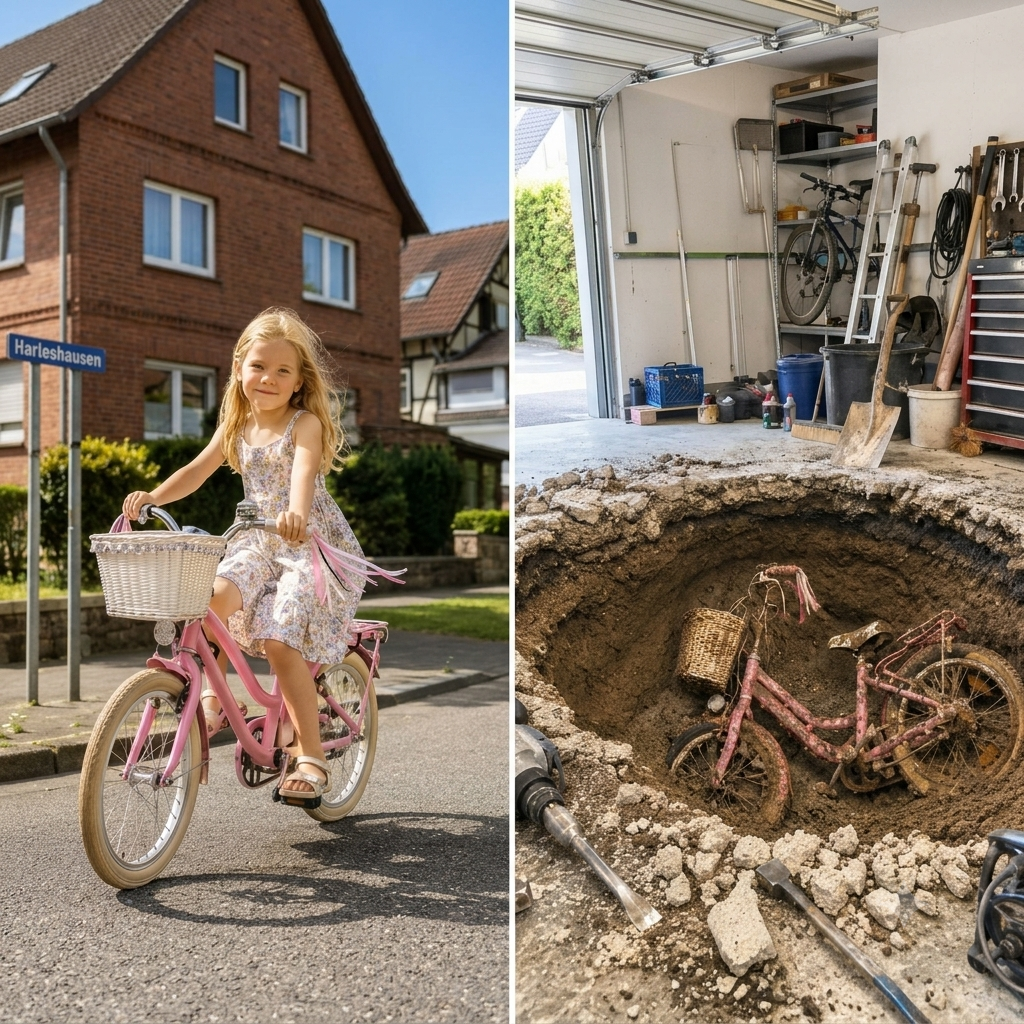
A girl rides off on her bike and disappears – 9 years later her bike turns up under concrete
On the 17th. August 2023, an object was discovered beneath the concrete floor of a garage in the Haleshausen district of Kassel that had gone unnoticed for 9 years.
Workers were busy renovating a house that had since been used for short-term rentals.
While breaking up the old floor, they first encountered metal parts between the soil and concrete remnants at a depth of nearly one meter.
A little later, it became clear that a complete object was hidden there.
It was a child’s bicycle.
The frame was heavily corroded and had originally been painted red.
Parts of the plastic basket on the front were still intact.
Remnants of colorful ribbons were still attached to the handlebars.
The condition of the bicycle suggested it had been stored in damp conditions for a long time.
But several features remained distinct enough to allow for a later identification.
The work was interrupted and the police were notified.
The location of the bicycle alone made an ordinary loss unlikely.
It had not been standing in a corner of the garage and accidentally covered with debris later.
The object was located entirely under a solid layer of concrete.
According to the workers ‘ initial assessment, the bicycle must have been there before this section of the floor was sealed.
This immediately raised the question of why someone would make a child’s bicycle disappear in this manner.
That same day, a possible connection to an unsolved missing persons case from Kassel was investigated.
The size of the bike, the color, the basket, and the remaining decorations matched an item recorded in old investigation files since the summer of 2014.
The name of the missing child was Nele Weigant.
Nele had been 8 years old when she disappeared on the 4th.
July 2014 during the summer holidays.
She had been riding her bike in the vicinity of her home.
Her mother , Corina Weigant, was preparing lunch at the time.
It was not unusual for the family that Nele played outside at times.
There was no known argument, no prior threat, and no indication that the child had planned to leave the area around her home.
Only after Corina hadn’t noticed her daughter for a long time did the search begin.
Initially, the immediate area and neighboring properties were checked.
Then, people from the neighborhood were involved.
When Nele still could not be found, Corina informed the police.
The search expanded on that very same day.
Paths, potential locations, and known family contacts were checked.
The bicycle played a major role from the beginning.
Nele had last been using it.
If the bike had been found, its location might have provided clues as to where the child had gone or whether she had encountered someone along the way.
But the bicycle also remained missing.
There was no trace of Nele.
There was no jacket left behind, no backpack, and no personal item that indicated a path.
There was no secured accident scene.
It was equally impossible to determine whether Nele had gone with someone voluntarily or had been taken against her will.
The investigation ran into a fundamental problem early on.
A starting point was missing.
Without a bicycle, a confirmed last known location, or any physical evidence, numerous possibilities had to be checked in parallel.
Tips from the public were recorded.
Possible sightings were cross-checked, and people from the family’s circle were interviewed.
But none of these leads developed into a reliable direction.
With every unsuccessful day of searching, the situation became more difficult.
The case remained open but increasingly lost any concrete points of departure.
There was no known perpetrator, no secured crime scene, and no discernible route of travel.
The question of what actually happened on July 4th……2014 could not even be narrowed down to a specific location.
For Corina Weigant, this began a state that could not be brought to a close.
A confirmed death would have created final certainty.
A return would have ended the search.
The disappearance of her daughter, however, allowed both possibilities to persist.
For years, Nele remained both missing and possibly still alive.
This uncertainty also changed the family.
Nele’s father later blamed Corina for the fact that the child had not been under constant direct supervision at the time of her disappearance.
An unsolved missing persons case evolved into a lasting question of blame within the marriage.
The missing answer as to what had happened to Nele was increasingly replaced by mutual accusations.
A few months later, the parents separated.
The divorce followed later.
Corina remained in Kassel.
She continued to work in a bakery and lived with an investigation file that was officially open but produced fewer and fewer new pieces of information.
In the first few years, new tips were still checked regularly.
Possible sightings were cross-checked.
Names were re-verified.
None of these measures led to Nele.
Over time, what remained above all was the absence of clues.
Nine years after the disappearance, the case remained unsolved.
Chief Detective Armin Jäger was one of the investigators who knew the name Nele from the earlier investigation.
What remained particularly memorable for him was that at the time, not only the child but also the bicycle had completely vanished.
An object of that size could not simply be overlooked if it had been left out in the open.
When the report arrived from Halleshausen, it was not yet proven that the found bicycle actually belonged to Nele.
The matches, however, were sufficient to reopen the old file.
Corina was informed about the discovery.
Identification was carried out based on several characteristics.
Color and size alone would not have sufficed because comparable children’s bicycles had been sold many times over.
Crucial were the preserved details on the handlebars and the front basket, which had already been described by the family in 2014.
For Corena, there was no doubt.
The bicycle under the garage floor was her daughter’s bike.
With this realization, the significance of the entire case changed.
Until that day , the police had not known whether Nele had even left Kassel.
The bicycle could have been in a body of water, in a forest area, or far outside of Hesse.
It could have been destroyed or disposed of.
Instead, it lay in Haleshausen.
Only a few kilometers away from the area where the child had disappeared 9 years earlier.
The investigators therefore initially focused entirely on the discovery site.
The workers were questioned about the construction and condition of the floor .
This revealed a decisive point.
The bicycle had not been pushed into an existing cavity at a later time.
The concrete layer above it had completely encased the object for years.
This practically ruled out a coincidence.
An eight-year-old child could not have placed her bike under a garage floor herself.
Just as little was there a plausible reason why an uninvolved finder would have painstakingly hidden a child’s bike under concrete.
The location was therefore treated as a possible component of a crime.
The garage was examined.
Special attention was paid to the area beneath the floor.
The most obvious fear had to be checked .
If someone had hidden the bicycle there, there was a possibility that human remains were also in the immediate vicinity.
None were found.
For Corena, this news was neither a relief nor certainty.
It merely meant that Nele had apparently not been left at this location together with the bike .
The question of her fate remained open.
But for the first time in 9 years , this question had a concrete connection to a property.
The difference was significant.
Until then, the case consisted almost entirely of memories, witness statements, old search efforts, and unanswered questions.
Now, a material piece of evidence existed that was directly linked to the disappearance.
Someone had had access to Nele’s bike after the 4th.
Of July 2014, someone had had access to Nele’s bike.
Someone had known of a place where this object could disappear for years, and someone must have had access to this garage.
For Jäger, the history of the house therefore became crucial.
It had to be reconstructed who had owned the property, who had worked there during the relevant time, when the garage floor had been built or altered, and which persons could enter the property.
The investigation thus had a clear geographical focal point for the first time.
For nine years, the police had had no crime scene, no perpetrator, and no material lead.
Now, the first piece of evidence lay under the floor of a house in Haleshausen.
Someone had hidden the bike there, and for the first time since Nele’s disappearance, the uncertainty had a location.
The new line of investigation led directly to the people who had regular access to the house in Halleshausen over the past few years.
Rüdiger Althaus was the initial focus.
He was responsible for short-term rentals, handing over keys to guests, and the ongoing maintenance of the property.
This placed him in the small circle of people who knew the building without having to live there themselves.
For the investigators, his role was therefore relevant from the very beginning.
In his first interview, Althaus stated that he only took over management of the house after the property had already been completed.
He claimed to know nothing about the bicycle under the garage floor.
According to his account, his work was limited to organizational tasks, repairs, and looking after rotating tenants.
The owner of the house was Henrik Klausen.
Klausen was from Germany but had been living in Zurich for a long time.
He only stayed in Kassel occasionally and largely left the practical management of the property to Althaus.
For the police, this meant that two people had to be scrutinized very closely.
The owner, who knew the history of the house, and the manager, who had regular access.
The construction documents made the situation more complicated.
The house was already standing when Nille disappeared, but the records did not clearly show whether the garage was fully completed at that time.
Therefore , they had to reconstruct what work on the garage floor was still pending and who had access to the property during that construction phase.
The investigators therefore began reconstructing previous work done on the building.
Invoices, contractor records, permits, and private agreements became relevant.
Equally important was the question of who possessed keys at those times or could move around the property without further supervision.
Althaus tried to cast a much wider net regarding potential suspects.
He pointed to changing guests and people who had used the property over longer periods.
According to him, it was entirely possible that someone from this group had access to the garage.
Klausen himself also had to be considered, as he remained the owner and had stayed in Germany occasionally.
The police took this possibility into account, without treating the tips as an exoneration for Althaus.
Every person who had used the house over the years had to be checked.
The short-term rental aspect made this work significantly more difficult.
The property had not been permanently occupied by a single family whose history could be easily reconstructed.
There had been alternating stays, varying rental periods, and people who were only temporarily connected to the property.
This increased the number of potential access points.
The investigators sifted through booking data, past agreements, and management contacts.
Special interest was paid to longer stays and periods during which work on the garage could have taken place.
At the same time, they examined which tasks Althaus had actually taken on and whether his account matched the existing records.
He was not yet a suspect, but he was among those whose movements and statements needed to be verified.
Meanwhile, for Corina, the discovery developed into a new psychological burden.
The bicycle had provided a concrete location for the first time, but offered no explanation.
Every new name meant another possibility.
Every possible access point to the house could be linked to her daughter’s disappearance.
That same day, she informed an online community that supported relatives of missing children.
Corina had used this platform for years.
There, new developments were shared, tips were discussed, and cases were followed that had long since received little public attention.
For her, this forum remained one of the few places where Nele’s name wasn’t just associated with an old file.
The discovery of the bicycle changed the focus there as well.
Corina posted the information that an item belonging to her daughter had been found under a garage floor of a property in Kassel.
She described the find briefly and made it clear that the police were investigating again.
Shortly thereafter , she received a private message from a newly created account.
The content differed fundamentally from the other reactions.
Attached was an old photo of Nele with her bicycle.
The image had been manipulated.
The child’s face had been replaced by the head of a dead pig .
The editing was crude enough to be recognizable as a montage, but precise enough to deliberately destroy the original context of the photo.
Included with it was a video.
It showed the processing of a pig’s head.
The footage was edited in such a way that it was meant to convey a specific, violent message.
It was accompanied by a message stating that Nele was dead and that Corina should finally accept this.
The significance lay not only in the cruelty.
The timing was crucial.
The account had become active shortly after the post about the found bicycle.
The sender must have either seen the post immediately or had already been waiting for the discovery to become public.
Corina forwarded the material to the police.
This created a second lead that emerged directly from the reopening of the case.
Investigators secured the message, the user account, the manipulated photo, and the video file.
Technical specialists began the evaluation.
The focus was initially not on the content itself, but on metadata, editing traces, and possible clues regarding the origin of the material.
Even the first results were striking.
Part of the video background seemed inconsistent.
The vegetation and image structure gave the impression of a recording from a Central European mountain region.
This observation was not clear enough to determine a location, but sufficient to draw attention to the possibility that the material was created outside of Germany or subsequently altered in that direction.
Henrik Klausen lived in Zurich.
This created a connection that the investigators could not ignore.
It was still unclear whether it was genuine or fabricated.
Klausen was the owner of the house under whose garage floor Nele’s bicycle had been found.
At the same time, he was located in Switzerland.
Now, immediately after the discovery, a video appeared whose background seemingly pointed to an Alpine region.
The combination was too striking to dismiss as meaningless, but it was just as striking to potentially have been created intentionally.
Jäger therefore left both possibilities open.
The Swiss authorities were to assist in contacting Klausen.
In parallel, it had to be checked whether the video could have actually originated there or if someone had deliberately laid a false geographic trail.
The investigators focused on the origin of the account.
It had no discernible older activity.
It seemed to have been created exclusively for contacting Corina.
There were no signs that the sender was part of the long-standing community of supporters.
This heightened the suspicion.
An ordinary troll could have used the public attention to send a cruel message.
Such cases were not ruled out.
People in exceptional situations were repeatedly the target of provocations, false leads, or targeted humiliations.
But here, the message fit the current state of the proceedings too well.
The bicycle had been found.
The investigation of the house began.
A short time later, Corina received a message whose central statement had only one goal.
Nele was dead, the search had to end.
For Jäger , this raised a new question.
Why would someone so urgently want Corina to stop hoping?
The police did not yet have any proof that the sender was directly involved in the disappearance.
Just as little could be determined at this time whether the owner in Zurich, a former guest, or another person was behind the account.
But the nature of the message changed the assessment.
It did not seem like a reaction to an old missing persons case.
It seemed like a reaction to a new investigative breakthrough.
While the technical specialists examined the video, the access points to the house were further reconstructed .
The history of the property, its users, and its management now formed the core of the investigation.
Althaus remained a central figure because he had had control over keys, guests, and maintenance work for a long time.
His statements were cross-checked with the records.
At the same time, Klausen was to be questioned in Switzerland.
There was still no direct evidence connecting either of the two men to Nele’s disappearance.
But the discovery of the bicycle had narrowed the circle for the first time.
The new message did not narrow it any further.
It merely increased the pressure.
Someone knew that the search had begun again.
Someone reacted to it, and someone tried to stop Corina from asking more questions precisely at the moment the police had a real lead for the first time.
The following morning, the direction of the investigation changed again.
Corina had hardly found any rest after the events of the previous day.
The discovery of the bike, the reactivation of the case file, and the manipulated message had replaced the old uncertainty with a new form of threat.
For the first time, there was not just a lead.
There was also someone who was clearly reacting to that lead.
Corina set off for work earlier than usual.
Her route led through Haleshausen again.
The house, under whose garage floor Nele’s bicycle had been discovered, lay on a route she used regularly.
Since the discovery, the property had a different meaning for her.
It was no longer just any building within a residential area.
It was the first concrete place where her daughter’s story could be traced after her disappearance.
As Corina approached the property that morning, she noticed that the lights were on in the house.
That was unusual.
The police had kept the property under control after the discovery.
The garage and the adjacent areas were considered part of an ongoing investigation.
To Corina’s knowledge, no one was supposed to be there outside of investigative measures .
Shortly after, the light went out.
Corina slowed down and noticed a white van in the immediate vicinity of the house.
It was not a police vehicle, nor was it a vehicle from the construction company that had worked there the day before.
She recognized the man who was on the property.
It was Rüdiger Althaus.
This gave his role within the investigation a new meaning.
The day before, Althaus had still declared that he had nothing to do with the bicycle found under the concrete.
He had limited his tasks to administration, rentals, and maintenance, and emphasized the possibility that former guests or the owner could have had access to the building.
Now he himself was at the location whose access had become crucial to the investigation.
Corina confronted him.
Althaus explained that Henrik Klausen had asked him from Zurich to retrieve insurance papers and other documents regarding the property from the house.
According to his account, these papers were needed by the police.
The timing, he explained, was due to the fact that Klausen was in Switzerland and had learned of the new developments early on.
At first glance, the explanation was not impossible.
Klausen was the owner.
Althaus managed the house.
Documents regarding insurance, property ownership, or previous work could indeed have been relevant to the investigators.
But something didn’t add up.
Althaus was alone at a location that had just become the focus of a newly reopened missing persons case.
He had not announced that he was going there to pick up documents.
Corinna also couldn’t understand why this had to happen at a time when no one would have expected him to be there.
Althaus left the property in the white van.
Corinna informed Jäger immediately afterward.
The investigator’s response completely changed the assessment of the situation.
Althaus had not received permission to enter the house.
Neither Jäger nor any other officer had asked him to retrieve documents from the property.
Furthermore, no authorization had been granted to remove items from the building during the ongoing investigation.
That meant his explanation was a lie.
For Jäger, this was a decisive point.
Until that morning, Althaus had primarily been investigated because his work had given him long-term access to the property.
However, there had been no direct indication that he was trying to interfere with the current investigation.
That had now changed.
Althaus had returned to a crime scene without permission and had removed something from the house.
From that moment on, Jäger no longer treated him merely as a caretaker with potential background knowledge.
He became a direct suspect in the case.
Police forces were dispatched to Harleshausen.
At the same time, Corinna shared the direction in which the white van had driven.
Jäger made it clear to her that she should not follow Althaus herself.
As long as it was unclear what he had taken from the house and why he had lied about it, his behavior could not be assessed.
For Corinna, this boundary was difficult to observe.
The past few years had turned her daily life into a long series of passive waiting.
She had waited for leads to be checked, for people to return, for a report to gain meaning, for any result to emerge.
Almost everything concerning the case had been outside of her own influence.
Now, for the first time, she had seen someone connected to the site enter the building without permission right after an important piece of evidence had surfaced.
For her, this was no longer an abstract investigative lead.
It was concrete behavior.
Corinna continued her drive, but kept her eyes on the direction Althaus had taken.
The route led north, out of the immediate city area.
After a while, she noticed the white van again.
The vehicle had stopped.
Althaus was in a remote area where few people would expect his behavior.
Corinna kept her distance.
From there, she noticed smoke rising from a metal container.
It was not ordinary garden waste.
The smoke looked dark and a chemical odor was perceptible.
It was impossible to determine from a distance what materials were being burned.
For the investigation, however, this question was immediately significant.
Only a few hours earlier, Althaus had entered the house in Halleshausen without authorization.
He had claimed he was there to pick up documents for the police.
Now, he was burning material in a metal container at a remote location.
This sequence of events could hardly be explained as a mere coincidence.
Corena contacted Jäger again and transmitted the position as accurately as possible.
The connection was unstable, but the crucial information reached him.
Althaus had stopped.
Something was being burned.
After that, the transporter started moving again.
Jäger ordered additional forces to be sent in that direction.
For him, the primary question was no longer whether Althaus needed to be investigated regarding the discovery of the bicycle.
That investigation had been necessary anyway.
The decisive question now was why he was trying to remove and possibly destroy something at this exact moment.
The timing was too tight.
The previous day, Nele’s bicycle had been discovered.
Shortly thereafter, Corena had been intimidated with a targeted message.
The following morning , Althaus had returned to the house without permission.
Shortly later, he was burning material in a place where he hardly expected to be observed.
The investigators still did not know the contents of what had been removed from the house.
Likewise, it was unknown what had been burned in the metal container.
Without this information, Jäger could not yet establish a solid link to Nele’s disappearance.
But investigations are not based solely on individual pieces of evidence.
The chronological sequence of actions could also carry significance.
The day before , Althaus had tried to make his own role seem insignificant.
He had pointed to guests, the owner, and previous access points.
Now, he himself had returned to the central site without authorization.
His behavior thus contradicted the distance he had previously established regarding the house and its past.
For Corena, another realization became more acute.
Since the discovery of the bicycle, things were happening that hadn’t happened before.
An anonymous sender was trying to make her give up.
A person with access to the house secretly returned there.
Items were removed, material was burned.
The resumption of the investigation was clearly creating pressure, and this pressure moved people who previously had no reason to reveal themselves.
Althaus continued his journey to the north.
The police tried to determine his route and position additional forces.
Corena remained in contact with Jäger and relayed the information she could still discern without getting too close to the transporter.
For the investigators, the situation had changed fundamentally within a few hours.
The bicycle under the concrete had initially only proven that someone had access to the garage.
Althaus had now proven himself that he was willing to secretly enter this place despite police surveillance.
It was not yet known what he had taken from the house.
Even less was known about what he had burned.
But after the most important piece of evidence in the old missing persons case had resurfaced , a man from the immediate vicinity of the site began making things disappear.
For Jäger, the possibility of a random coincidence was now nearly at an end.
Althaus continued his journey north.
The route eventually led into the area of Fuldatal in the Kassel district.
For the investigators, this change of location was crucial because it allowed a concrete link between his behavior and his private life to be established for the first time.
The address the white van drove to was later clearly identified as his place of residence.
Corina kept her distance.
She had already informed Jäger about the unauthorized entry into the house in Haleshausen and about the burning of material.
Now she was watching where Althaus drove after these actions.
The question was no longer whether his behavior was unusual.
What was decisive was what he would do next.
The van finally stopped in front of his home in Fuldatal.
From this point on, the situation changed again.
Althaus first returned the metal container he had previously used to burn material.
Then a red hand truck appeared.
It was a simple tool for moving heavy objects.
On its own, this cart had no particular significance.
The way Althaus used it, however, did.
He used it to move something heavy from the house to the van.
Corina could not tell from the distance what it was.
The object was not clearly visible.
Neither its shape nor its contents could be determined.
It was only clear that Althaus did not need the hand truck for small boxes or ordinary documents.
After the first trip, he returned to the house.
A second one followed shortly after, then a third.
A total of three heavy units were moved from the building into the white van.
For Corina, this created a new, immediate problem.
A few hours earlier, Althaus had removed items from a controlled investigation site without authorization.
Afterward, he had burned material.
Now he was loading several heavy objects into a vehicle at his home.
The sequence was too tight to separate them from one another.
She documented the events from the greatest possible distance with her phone.
The recordings were not suitable for determining the contents of the transported items.
However, they did show the repeated use of the red cart and the white van in front of the house .
Corina transmitted her position to Jäger.
It was clear to the investigator that an immediate police response was necessary.
He instructed her again not to approach Althaus or the property.
Multiple units were dispatched to Fuldertal.
The problem was time.
Althaus acted faster than the officers could reach the property.
After the third transport, the red car was also loaded into the van.
Everything suggested that Althaus had finished the loading process.
Shortly after, the vehicle left the property.
The police now knew his direction of travel and prepared an interception.
For Jäger, this could not happen in a place where Althaus could easily evade them or endanger others.
They had to prevent the van from leaving the area before its contents could be checked.
Corena remained in contact with the investigators.
Her own behavior had long since become part of a development she could no longer control.
Just the day before, she had only wanted to know what had been found under the concrete.
Now she was providing information on the route of a man whose actions increasingly aligned with the newly opened lead.
For her, the psychological line had long been crossed.
Althaus was no longer just the caretaker of a house where a bicycle had been found in the garage.
He was the man who had returned to the scene without permission.
The man who had removed something from there.
The man who burned materials shortly after, and now the man who brought three heavy items from his own house into a van.
No one yet knew what was actually in the vehicle.
This very uncertainty made the situation dangerous.
Police forces approached from several directions.
The van had to be stopped before Althaus had the chance to change his route again or park the vehicle in an unknown location .
A blockade was finally set up on a road leading back toward Kassel.
As Althaus reached the area, continuing was no longer possible.
The van was stopped.
Officers secured the vehicle and took Althaus into preliminary custody.
Up to this point, the suspicion against him was based on a series of suspicious actions.
The police had no knowledge yet of what he was actually transporting.
There remained the possibility that the van contained only items that looked suspicious but had no direct connection to Nele.
This uncertainty ended upon opening the rear cargo area.
There lay three black bags.
Their size and shape made it immediately clear they did not contain ordinary objects.
Inside each bag was a human body.
The first reaction of the responders therefore had to assume a potential multiple discovery.
The contents were handled with appropriate caution.
Within mere moments, what began as a search for evidence had escalated into a critical situation, as the presence of three bodies in a suspect’s vehicle could not be ruled out.
Emergency services were called in.
Then came the first discovery that changed the entire operation.
All three individuals were alive.
They were in a state of deep sedation.
They were breathing, but their reactions were severely limited.
It immediately became clear that the three people had not been in those bags voluntarily.
For Jäger, the focus of the case shifted completely within minutes.
Until this moment, the police had tried to prove a connection between Althaus and an old missing persons case .
Now, there were three living people in his vehicle.
The question was no longer whether Althaus was hiding something.
The question was who he was hiding.
The rescue teams began with medical stabilization.
One of the bags was opened.
Inside was a young woman with light hair.
Her age was initially estimated at about 17 years.
Corina was at a sufficient distance to avoid hindering police operations.
But the significance of the find reached her immediately.
She did not recognize the face as that of an eight-year-old child .
The proportions had changed.
The facial features had matured.
The person in the bag was no longer the student whose photo had appeared on missing posters and in investigation files for years.
Nevertheless, the identity was clear to Corina.
It was Nele.
With that , an assumption that had accompanied the case for a long time collapsed.
The bicycle under the concrete had initially only proven that someone had access to the child’s personal item after her disappearance.
The find had not shown whether Nele had still been alive after that day.
Now the answer lay in the cargo hold of a white van.
Nele had not died as a child in Harleshausen.
She had lived, and she had remained under Rüdiger Althaus’s control until this morning.
The other two black bags were also medically assessed.
Inside them were also young women.
Both were unconscious, both heavily sedated, both alive.
Thus, the Nele missing persons case suddenly turned into a much larger investigation .
Althaus had not just been caught with a single young woman.
He was transporting three.
Several layers immediately emerged for the investigators.
They had to clarify who the other two women were, how long they had been with Althaus, and why they were in his vehicle together.
Likewise, they had to verify whether this transport was directly related to the events in Harleshausen.
But these questions were not yet part of the initial assessment of the find.
It was initially confirmed that three people had been rescued from the van, and one of them was the child whose bicycle had recently been discovered under concrete .
For Corin, the identification did not mean a simple return to the life they had before the disappearance.
The person now receiving medical care was no longer the eight-year-old girl from her memory.
Between the last known day and this morning lay a period of time of which she knew nothing.
There was still no explanation for where Nele had been.
No explanation for how Althaus had controlled her.
No explanation for why two other young women were with her .
But one of the questions that had defined the entire case had been answered.
Nele was alive.
The discovery of the bicycle had established a location.
Through his behavior, Althaus had led the investigators to his residence.
And in the back of his van lay the first living answer to a case that had consisted only of missing clues until this morning.
The three young women were taken from the scene to a hospital under medical supervision .
For the police, a second level of investigation began in parallel.
Up to this point, the case had focused on Nele Weigant and the question of how her bicycle had ended up under the garage floor in Halleshausen.
With the discovery in the van, it now had to be determined who the other two women were and whether their presence pointed to other unsolved missing persons cases.
The first identification was carried out using existing records and by cross-referencing older missing persons data.
One of the two women was identified as Maja Riedel.
Maja had disappeared at the age of 9 in Hanover.
Her case, too, had remained open for a long time.
The investigations at the time had yielded neither a confirmed location nor any reliable trail that would have led to a specific person.
The second woman was identified as Deria Özkan.
Deria had also been 9 years old when she disappeared during a school trip in Bremen.
Her disappearance had led to extensive search efforts without a concrete perpetrator or location being determined.
It was now certain that it had not just been Nele in Rüdiger Althaus’s van.
All three young women were part of known missing persons cases.
For the investigators, the dimension of the case had changed.
It was no longer about the possible involvement of one man in the disappearance of a single child.
The connection between three cases from different locations pointed to a systematic approach.
Althaus must have been able, over a long period, to completely remove several children from their social environments and keep their whereabouts hidden.
Medical care took priority at first.
All three victims were under heavy sedation.
Their condition required monitoring.
At the same time, their rooms were secured by the police.
The investigators wanted to prevent information about their whereabouts from leaking out uncontrollably or anyone in Althaus’s circle from gaining access.
While the women were being treated in the hospital, the search of his house in Fuldertal began.
The initial findings made it immediately clear why the victims had not been discovered for such a long time.
Beneath the residential building was a bunker.
The room had originally been designed as an underground area, but was later converted into a sealed living unit.
The walls had been modified so that sounds could only penetrate to the outside to a limited extent.
The entrance was located inside the house and was not immediately recognizable from the outside.
For the police, it was now understandable for the first time how Althaus could hide three people within an ordinary residential area.
The crucial prerequisite was not complete isolation of the property.
It was the invisibility within a normal house.
Althaus was considered a recluse in his surroundings.
He rarely received visitors.
His daily routine generated little social scrutiny.
No one had any reason to regularly check what was in his basement or beneath the house.
It was precisely this inconspicuousness that had created a protected space for him over a long period.
The investigators documented the underground facility in its entirety.
They found evidence that several people had lived there permanently.
The equipment was inconsistent with short-term captivity.
The room had been designed for a longer stay.
At the same time, the enclosed structure showed that the people living there could not freely choose their whereabouts.
The apartment above the bunker had provided no clear signs to the outside world.
Beneath it, a second reality existed.
For the police, this contrast became the central feature of the case.
In an ordinary residential area, a sealed-off living space had been operated for years without neighbors or authorities having any knowledge of it.
The search yielded further evidence.
Records were found in several areas of the house.
These included diaries, photographs, and systematically filed documents regarding the three girls.
The documents spanned longer periods and contained information about their physical development, their daily life, and changes that Althaus had apparently recorded regularly.
The nature of this documentation was particularly revealing for the investigators.
Althaus did not describe the young women as prisoners.
He portrayed himself as a caregiver.
His records created a closed worldview in which he was not the one who had taken children away from their families.
He saw himself as a person who had allegedly protected them from unsuitable parents.
This self-description stood in complete contrast to the actual circumstances.
The victims had been separated from their previous lives.
Their families had no knowledge of their whereabouts for years.
Their freedom of movement had been restricted to an enclosed room .
Their contacts with the outside world had been controlled.
Nevertheless, any acknowledgment of this reality was largely missing from Althaus’s written records.
He had created a different explanation for himself.
For the investigators, this was psychologically significant because it showed the acts had not just been hidden, they had been reinterpreted within his own logic.
Althaus had apparently not described his behavior as continued unlawful imprisonment, but as a form of care.
This construct had a practical function .
It allowed him to label control as protection.
The diaries contained no indications that he perceived the girls as equal individuals.
Decisions about their daily routine, their information, and their contact with the outside world rested entirely with him.
What appeared as care in the records was in reality a system of dependency.
In parallel, his computer was examined.
The technical analysis led directly to the message Corina had received shortly after the bicycle was discovered.
Investigators found traces showing the newly created user account had been set up by Althaus.
The manipulated photo of Nele could also be traced back to his device.
This clarified that the anonymous message had not come from an unknown harasser.
It originated from the man in whose vehicle Nele was found a few hours later.
Even more significant was the analysis of the video.
Technical examination revealed that parts of the material had been altered.
The image structure, which created the impression of a recording in an Alpine region, was not authentic.
Certain elements had been digitally edited to create a geographical connection that did not actually exist.
The goal of this manipulation thus became clear.
Henrik Klausen lived in Zurich.
Althaus knew that the owner of the house in Switzerland would be investigated as soon as the bike appeared under the garage.
A video with a seemingly alpine background could strengthen the suspicion that the sender of the message was also located there.
The false trail had been deliberately constructed.
This also gave Althaus’s statements from the previous day a different weight.
He had repeatedly referred to Klausen and emphasized his role as the owner.
At the same time, he had highlighted the possibility that other people could have had access to the building.
Now it became apparent that he had been working in parallel to steer the investigation technically in the same direction.
The Swiss authorities were already involved at this point in checking questions concerning Klausen.
His statements were verified.
However, no evidence emerged that he had had knowledge of the abductions.
Likewise, there was initially no indication that he had been involved in the captivity of the three girls.
For the investigators, the construction behind the video became increasingly clear.
Klausen was not just supposed to appear as a possible suspect.
He was supposed to cost them time.
Every investigation in Switzerland, every check of his whereabouts, and every technical analysis of a video seemingly created there could divert attention away from Althaus.
The timing of the manipulation was particularly important.
It had only been actively deployed after the bicycle was discovered.
Until then, Althaus had apparently seen no immediate reason to create a false trail.
The object hidden under the concrete had remained undiscovered for years.
As long as the bike lay there, there was no direct connection between the old missing persons case and the house in Haleshausen.
The renovation had destroyed that security.
Within a short time, Althaus began to react.
He tried to strike at Corena psychologically.
He tried to shift the attention toward Klausen.
He returned to the scene without authorization.
He removed material.
He destroyed parts of it, and finally, he tried to take three sedated young women away from his house .
The investigators no longer had to view these actions as separate events.
They formed a chain reaction.
The discovery of the bike had put a system under pressure that had previously remained largely invisible.
The search in Foldertal showed how this system had worked.
Althaus had needed no remote complex, no abandoned buildings, no changing hideouts, and no obvious criminal infrastructure.
An ordinary house had sufficed, with a locked room beneath it and, above, a man who led a largely inconspicuous life.
In the files of Hanover, Bremen, and Kassel, three children had been considered missing independently of one another.
In Althaus’s house, their lives had long since been intertwined.
And while their families had searched for answers separately, the same man had recorded their development in diaries, describing himself not as a perpetrator , but as a protector.
After the effects of the sedation wore off, Nele was medically re-examined.
Her physical condition was more stable than the investigators had expected given the long captivity.
There were signs of malnutrition and several older healed injuries.
No acute, severe external injuries were found.
Likewise, the examination yielded no evidence of sexual abuse.
For the doctors, and later for the investigators as well, a different pattern emerged instead.
Control through isolation, deception, dependency, and psychological violence.
This finding did not change the assessment of the captivity.
It merely showed the manner in which Althaus had exercised his power.
Nele had aged physically, but her entire development had taken place under conditions determined by a single man.
Information , contacts, and perceptions of the outside world had been controlled.
What would have been a matter of course for other teenagers had not existed for her .
When she was capable of giving an initial statement, the investigators focused on the day of her disappearance .
Nele was able to remember the 4th.
July 2014.
The memory was not entirely without gaps, but the central events had been preserved.
She knew that she had been riding her bike near the house back then.
She also knew that Rüdiger Althaus had appeared in the area before that day.
This gave a later suspicion a basis for the first time.
Althaus had apparently been watching the family’s surroundings for some time.
He must have known that Nele played outside at times.
He also must have realized that there were moments when she was not directly accompanied by an adult.
On the day of her disappearance, he took advantage of exactly that situation.
He approached the child with a simple story.
He claimed that there was a cat nearby with newborn kittens.
The promise was deliberately chosen.
It required no complicated explanation and no long-term building of trust.
For an eight-year-old child, the prospect of seeing kittens was enough.
Nele was not initially willing to go with him right away.
However, Althaus was able to give the impression that the way was short and safe.
She was allowed to take her bike.
With that, he lowered the threshold further.
The bike was part of her familiar daily life.
As long as it stayed with her, there was no obvious break for the child between playing and leaving.
Althaus took Nele to the house in Haleshausen, which was later used for short-term rentals.
At that time, the property was not yet organized in the way it became known years later.
Exactly this circumstance was an advantage for Althaus.
The building offered him a place where he could control the child briefly without attracting immediate attention.
There, Nele was given a drink.
The taste was unusual.
Shortly afterward, she became tired.
For the investigators, this point was decisive because it explained why there were no signs of a struggle, cries for help, or a conspicuous departure.
Althaus had avoided the risk of using direct force.
He had first lured the child psychologically and then rendered her incapacitated chemically.
The combination was effective.
It reduced visible traces, it reduced resistance, and it bought him time.
When Nele was no longer able to protect herself, Althaus brought her to Folldertal.
That is where the underground room under his house was located.
For Nele, a completely different reality began then.
When she arrived there, she was not alone.
Maya Riedel was already in the locked area.
For the investigators, this statement meant that Althaus had not just started his system with Nele.
The abduction was not an isolated incident that was later accidentally repeated.
When Nele was brought into the bunker, a structure already existed that was used for the long-term captivity of a child.
Jüzkan was added later.
In the end, three girls were living in the same closed system.
Althaus now no longer had to just prevent physical escape.
He had to explain why the outside world was unreachable for the children.
For this, he developed a simple, all-encompassing lie.
He claimed there was a war raging outside the house.
The girls’ families were dead, public order had collapsed, and he alone was the person who could protect them.
For children completely cut off from news, school, friends, and family, this claim could initially work .
It explained everything: why no one came, why they couldn’t go outside, why they couldn’t reach their parents, why the confined space was supposedly necessary.
Althaus did not have to answer every single question anew.
The narrative of war created a closed model into which every restriction could be integrated.
Captivity became alleged protection.
Isolation became alleged safety.
The perpetrator became, in his portrayal, the only available adult.
The psychological structure was just as important as the physical one.
The bunker prevented access to the outside world.
The lie was intended to prevent the girls from even considering that outside world as a real possibility.
For a certain time, this system worked.
The children had no independent source of information.
Everything they knew about the world came either from their memories or through Althaus.
But as they grew older, their perception changed.
Contradictions became clearer.
A war that had supposedly destroyed all normal society did not fit with certain items Althaus brought with him.
Packaging, newspapers, and other information showed that ordered life must still exist outside the house.
The first doubts did not arise from a single spectacular clue; they arose from small mistakes.
Althaus was not able to completely remove the outside world from his own daily life.
Occasionally, newspapers remained visible.
Sometimes, information reached the underground area that did not fit his story.
For the girls, these fractures were decisive.
Little by little, they realized there was no war.
With that, Althaus’s most important lie lost its foundation.
But knowledge did not yet mean freedom.
The realization that the outside world existed made the captivity even harder in some respects.
As long as the girls believed everything outside was destroyed, the bunker could appear to be the only remaining living space.
Once they understood that normal cities, schools, and families still existed, it became clear that their own lives had been deliberately stopped.
They had not been saved.
They had been hidden.
For Nele, this realization also meant a re-evaluation of her memories of Korina .
Althaus had claimed her mother was dead.
Later, he had tried to establish a second explanation.
He portrayed the girls ‘parents as people who had neglected their children and therefore no longer had any right to them.
This claim, too, began to fall apart.
Nele remembered her home.
She remembered that her life before the abduction did not match the picture Althaus had painted of it.
He transformed the fact that her mother had been in the kitchen when she disappeared into evidence of neglect.
As she grew older, it became clear to Nele just how arbitrary this logic was.
An ordinary moment had been used by a stranger to condemn a family.
And from this self-made conviction, Althaus had derived the right to take a child.
The investigators initially recorded these statements as objective facts.
They avoided extending the questioning unnecessarily.
Nele had only recently awakened from sedation.
Her medical stability did not mean she was psychologically infinitely resilient.
Nevertheless, her information provided a crucial connection.
Halleshausen was not just the place where the bicycle had been hidden.
The house itself had been part of the abduction.
That was where Althaus had gained control over Nele.
From there, he had transported her to Fuldertal.
Thus, the discovery under the garage was directly linked to Nele’s statement for the first time.
The bicycle had not ended up on that property by accident.
Nele had been there.
Althaus had been there, and from that location, the child had been taken into the underground area of his house.
For Corena, another point was of particular importance.
During her captivity, Nele had not permanently believed that her family had given up on her.
The lies had worked, but not completely.
With every contradiction, the possibility remained that her mother was still alive, that people were searching outside, and that her disappearance had not been forgotten.
This idea hadn’t opened the bunker, but it had prevented Althaus from completely replacing the past.
At the end of the first statement, the investigators were left not only with a reconstruction of an abduction, but also the realization of how Althaus had controlled his victims.
He had not kept them solely behind a locked door.
He had tried to make the world behind that door seem unbelievable.
But that was exactly what caused his system to slowly break down.
The girls had understood that there was no war.
And eventually, they knew that somewhere outside this house, there had to be people who never stopped looking for them.
The analysis of Althaus’s diaries showed that the abductions were not born of spontaneous decisions.
His records followed the same pattern over a long period of time.
He observed families, evaluated the parents’ behavior, and derived his own idea of who should be trusted with a child.
This notion had nothing to do with legal or social standards.
It was based entirely on his personal interpretation .
His notes repeatedly expressed the conviction that parents could lose their responsibility if a child appeared unsupervised for a short time.
Althaus did not interpret such situations as ordinary parts of everyday life.
He interpreted them as proof.
A child playing alone in front of a house was considered neglected by him.
A mother who was in another room for a few minutes became, in his logic, a person unable to sufficiently protect her own child.
A family did not actually have to be unstable for this.
It was enough for Althaus to observe a single moment and interpret it accordingly.
From this assessment, he developed a second claim.
He believed he possessed the right to intervene himself.
Investigators found no discernible boundary between observation and judgment in his documents.
As soon as Althaus concluded that parents were unsuitable, he no longer viewed the child as part of that family.
In his own imagination, the child was already someone who had to be saved.
With this, he shifted the responsibility entirely.
It was not the kidnapping that appeared as a crime in his records.
The alleged negligence of the parents was declared the original injustice.
After that, Althaus portrayed himself only as a reaction to this injustice.
It was precisely this structure that made his records so significant for the investigators.
They showed that he not only concealed his own deeds, he had morally reinterpreted them over the years.
His control over the girls therefore did not have to appear as violence within his worldview .
It could be described as the necessary consequence of the supposed failure of other people.
Corinna Weigant had become a target in this system early on.
Althaus had already observed Nele before the day of her disappearance.
He had seen that the girl played outside at times while Corinna was inside the house.
From this everyday occurrence, he derived a comprehensive assessment of the family.
For him, it was not decisive how Corinna had actually raised her daughter.
What mattered was the brief snapshot he had seen himself.
From that , he made a judgment about her entire ability as a mother.
The investigators were able to reconstruct from the records that Althaus justified his later act with this.
He did not present Nele as a child he had taken from a family.
He described her as a child who had allegedly already been abandoned.
This shift was psychologically central.
It enabled him to block out the consequences of his actions.
The family’s search, the destroyed marriage , the years of uncertainty, and the complete separation of a child from their life did not appear in this logic as suffering caused by him.
To him, they were either meaningless or part of a system he considered wrong anyway.
That the same way of thinking also appeared with Maya and Deria confirmed the pattern.
The specific situations differed.
The reasoning remained similar.
Althaus looked for moments when a child was not visibly under the immediate supervision of an adult.
He then treated these moments as a kind of evidence of family failure.
He did not need objective neglect.
He only needed a reason to confirm his own notions.
This also made it understandable why he had not perceived himself as an ordinary perpetrator for such a long time.
In his system, the girls had not been kidnapped.
They had supposedly been taken over.
They were not locked up.
They were supposedly being protected.
They were not cut off from their families.
In his mind, their families had forfeited their right to them.
To the investigators, this language was no trivial expression.
It explained how Althaus could maintain control without abandoning his identity as a supposed protector.
But this system began to crumble as the girls grew older.
Children could be controlled with a limited world of information.
Adolescents asked more questions.
They compared statements, identified contradictions, and stopped automatically accepting the adult’s decisions.
This very development was recognizable in the later records.
Nele , Maya, and Deria were increasingly refusing to accept Althaus’s explanations.
The story about the war had already lost its effect.
The claim that their families were dead was no longer credible, and the idea that Althaus was protecting them increasingly contradicted the fact that they were not allowed to leave the locked area.
For Althaus, this development meant a loss of control.
The girls were no longer the children he could separate from the outside world with a few scraps of information.
They were becoming harder to deceive.
They understood the meaning of freedom better, and as they grew older, they must have realized that their captivity could not be maintained without Althaus using ever more extreme measures.
In his most recent records, the tone therefore changed.
Investigators found indications that Althaus was searching for a permanent solution.
This did not consist of setting the women free.
Instead, he had established contacts that suggested further escalation.
On his computer, there were connections to a network that communicated via areas of the darknet.
The analysis revealed that this network was linked to human trafficking.
This gave the case a new dimension.
Althaus had apparently begun to view the three young women no longer just as people he had to control himself.
He was planning to hand them over.
The investigators found evidence that the handover was being prepared.
Nele, Maya, and Deria were to be sedated again and transported out of Hesse.
The exact subsequent path was not yet fully clear at this stage.
However, the available data showed.
That Althaus maintained contacts with people operating outside his previous environment.
His own control was to be replaced by another system.
For the young women, this would have meant disappearing all over again.
This time not in a private bunker under a house, but in a structure deliberately designed to relocate people and obscure their origins.
The investigators had to compare the timing of this planning with the events in Halleshausen.
A clear picture emerged from this.
The analysis showed that the discovery of the bicycle had accelerated a transfer that was already being prepared.
Althaus now had to expect that his past connection to the house in Halleshausen would be scrutinized.
His recent actions were therefore no longer to be evaluated as isolated decisions, but as a reaction to a loss of control.
The critical mistake was that, under this time pressure, he implemented a plan that had previously been prepared in secret.
For Corena, the implications were even harsher.
If the renovation had started later, the bicycle could have remained hidden longer.
If she hadn’t noticed the unauthorized stay in Halleshausen, Althaus might have remained undisturbed.
If the police hadn’t stopped the van in time, the three young women would have vanished again from a known environment.
Then, it would no longer have been just a single man controlling their movements.
They would have ended up in a network whose sole purpose was to detach people from their existing lives.
The investigators didn’t have to speculate on how long a new search would have taken.
The available data proved that the transfer was prepared and was already underway at the time of his arrest.
The old missing persons case had thus changed forever.
It was not just the story of a man who had hidden three children under a house.
It was also the story of a system that was on the verge of making these three people disappear a second time.
This time, the trails might not have left Hesse as anything more than mere clues.
They could have dissolved completely.
The final open questions of the case could only be clarified after the building records for the house in Halleshausen were cross-referenced with Henrik Klausen’s statements and the documents seized from Althaus’s possession.
Up until then, it was known that Rüdiger Althaus had kidnapped Nele, held her for years, and wanted to take her away from Foldertal along with Maja and Derya immediately before his arrest.
However, it remained unclear how Nele’s bicycle had ended up under the garage floor and why Althaus had access to that part of the building at all.
The answer lay in a connection that began before his official tenure as property manager.
Althaus knew Henrik Klausen from a previous professional association.
Even before he later took over the management of the property, he had already been involved in the construction and completion of the house.
This gave him access to the property while parts of the garage had not yet been fully secured.
For the investigators, this point was decisive.
Althaus hadn’t just found a way to open the garage floor years later.
He had already been there before that section of concrete was fully poured.
This allowed the path of the bicycle to be reconstructed.
After Nele was brought to the property in July 2014 and incapacitated with a sedative drink, her bike was left behind at that location.
For Althaus, it posed an immediate risk.
A red child’s bike with striking decorations wasn’t an object that could have disappeared unnoticed if left out in the open.
He had to remove it from view .
The ongoing work on the building offered him exactly that opportunity.
The bike was placed in an area of the garage that was later sealed with concrete.
After that, it was no longer accessible without breaking up the floor.
A piece of visible evidence had become an object completely integrated into the building’s structure.
The method was simple, and that was precisely why it worked for so long.
Althaus didn’t need a remote hiding place.
He didn’t need to transport, burn, or dispose of the bike far outside of Kassel.
He used a place where he could assume no one would ever open it for criminal investigation reasons.
Years later, he ended up managing that very same property.
As a result, one of the case’s most important pieces of evidence was permanently under a floor to which the perpetrator himself had regular access.
It was not beyond his control.
It was in a building whose use he helped organize and whose history he knew.
The investigators therefore also had to perform a final check on Henrik Klausen .
The owner had occasionally been at the center of several questions due to his connection to Althaus and his residence in Zurich.
Then there was the manipulated video, whose background was intended to specifically evoke the impression of an Alpine setting.
However, the investigation yielded no indication that Klausen knew about the kidnappings.
No evidence was found for any involvement in the captivity of the three young women either.
His connection to Althaus explained the latter’s access to the construction project.
It did not make him an accomplice.
At the same time, it became clear how deliberately Althaus had laid the false trail toward Switzerland.
He had utilized a real circumstance.
Klausen’s place of residence in Zurich and linked it with artificially altered image information.
The deception was not supposed to seem completely fabricated.
It was intended to be just credible enough to tie up investigation time.
But in the end, this attempt could no longer stop the fundamental development.
The renovation of the garage had been started for purely structural reasons.
No one had been specifically searching there for a piece of evidence.
That was the defining irony of the case.
A routine excavation of the floor brought to light the very connection Althaus had trusted would disappear forever.
The legal proceedings began with a body of evidence that by now went far beyond the original missing person case.
The investigators had the bicycle, the construction documents, the files from the house in Fuldtal, Althaus’s records , the digital evidence from his computer, and the three rescued women.
Then there were the circumstances of his arrest.
He had been stopped in his van with three sedated individuals.
As a result, prosecutors no longer had to rely solely on reconstructing what had happened years earlier.
Part of the decisive actions had been documented just before he was apprehended.
For Nele, Maja, and Derya, however, this evidence did not mean a quick return to a normal life.
Their liberation ended their captivity.
It did not end the consequences.
All three faced a long process of medical and psychological treatment.
Years of isolation had left behind more than just memories; they had altered the development of their entire relationship with the outside world.
Time had passed differently for them than for their families.
While outside the bunker school had been finished, relationships had changed, homes had been moved, and lives had gone on, their own world had been reduced to a sealed room and one man’s rules.
Returning to society, therefore, did not mean picking up where they had left off.
That point no longer existed.
Nele was no longer the eight-year-old girl Corinna had last known.
Corinna, in turn, was no longer the same mother she had been on the day of the disappearance.
Between them lay years that could never be reclaimed.
The same applied to Maja and Derya.
Their families got their lives back, but they were not untouched by the time that had been stolen from them.
The conclusion of a missing persons case could therefore also be the start of a new burden.
Then there were the legal proceedings.
Statements had to be taken , documents analyzed, and the individual acts reconstructed separately.
For the three young women, every legal review meant another confrontation with events whose consequences they were only just beginning to understand.
The trial could establish culpability.
It could not, however, return a lost childhood.
The case also left society with an uncomfortable realization.
Rüdiger Althaus had not lived outside of every social order.
He had not led a completely hidden double life in a remote region.
He managed a property.
He handled organizational tasks.
He had contacts.
He lived in a normal residential environment.
Under the cover of this everyday life, he kept three people hidden.
It was precisely this normality that made the case so hard to accept.
Crime is often socially associated with visible deviation.
A dangerous perpetrator is expected to stand out, seem isolated, or be recognizable through clear behavior.
Althaus showed the opposite.
His crime required no conspicuous surface.
It required rooms that no one checked and an environment that could not automatically interpret his reclusiveness as a threat.
Even more unsettling was the moral construction he used to justify his actions to himself.
He had not simply ignored the boundaries of other people.
He had convinced himself that he had the right to cross those boundaries.
He turned brief moments of parental inattention into moral judgments.
From these judgments, he derived claims of ownership.
And from these claims of ownership emerged a violence that he himself called care.
That was the core of his self-aggrandizement.
Althaus placed his own assessment above the rights of parents, the freedom of children, and ultimately, any social order.
He needed no mandate and no objective basis.
His own conviction was enough for him.
That is precisely where supposed care turned into crime.
Not because care had gone too far, but because he had never accepted that other people were not subject to his control.
His later connection to a human trafficking network finally showed how completely this alleged morality had collapsed.
When the three young women grew older and harder to control, his claimed image as a protector ended where his power was threatened.
Then they were to be passed on.
The man who had portrayed himself as a savior in his records was willing to treat the same people as objects as soon as they slipped from his control.
This was not a contradictory development.
It was the logical consequence of his way of thinking.
Anyone who denies another human being the right to self-determination can also shift every other boundary.
In the end, the bicycle under the concrete remained the most precise symbol of the entire case.
It had lain there while families searched, investigation files grew thicker, and hope was slowly replaced by habit.
Above it, a house was being used.
People came and went.
The floor remained closed.
Only when it was opened by chance did a part of the past return.
Nele, Maya, and Deria survived.
But surviving was not the same as returning unscathed.
Their freedom began at a point where a large part of their childhood had already been lost.
The case therefore left no simple message about parental control.
No child can be monitored every moment, and no normal family life can be built on permanent fear.
The real warning lay elsewhere.
A perpetrator can observe a perfectly ordinary moment, judge it by his own standards, and create a justification from it for something he never had a right to.
The most dangerous boundary is not first crossed at a door or a property line.
It is crossed the moment a person believes their own moral conviction gives them the right to dispose of another’s life.
Althaus had crossed that boundary and thereafter shifted every other one.
In the end, there remained three rescued young women, destroyed years, lengthy proceedings, and families who had to learn to live with a truth they could hardly imagine while searching.
And under a garage floor in Halleshausen, it was revealed that a child had not simply disappeared.
Someone had ensured that his trail disappeared.
Thank you for taking the time to listen to today’s story until the end.
Behind this case lies not only a shocking crime, but also an important realization.
No person has the right to determine the life of another or to place their own convictions regarding freedom, family, and dignity above it.
Trust must never become control, and perceived care must never violate the boundaries of another human being.
At the same time, this story reminds us of how important attentiveness, compassion , and perseverance can be.
Even after long uncertainty, a trace can come to light and reveal a truth that remained hidden for years.
If you would like to support our channel, it is enough to simply like this video, share your thoughts and impressions in the comments below, and subscribe to our channel.
Thank you very much for your attention and your support.
M.