Her SKELETON Stood in His Halloween Yard Display for 3 Years
Her SKELETON Stood in His Halloween Yard Display for 3 Years
Friday, October 28th, 2022. 20 minutes to 10:00 at night. A kitchen table in Nelsonville, Ohio.
Bev Toliver, 67, spent 31 years in an orthopedic operating room handing surgeons screws. Tonight, she is scrolling a community group on her phone.
Someone has posted a selfie at the Boneyard, the most famous Halloween yard in Athens County. 42 skeletons around a 12-foot giant and a box for canned food for the county pantry.
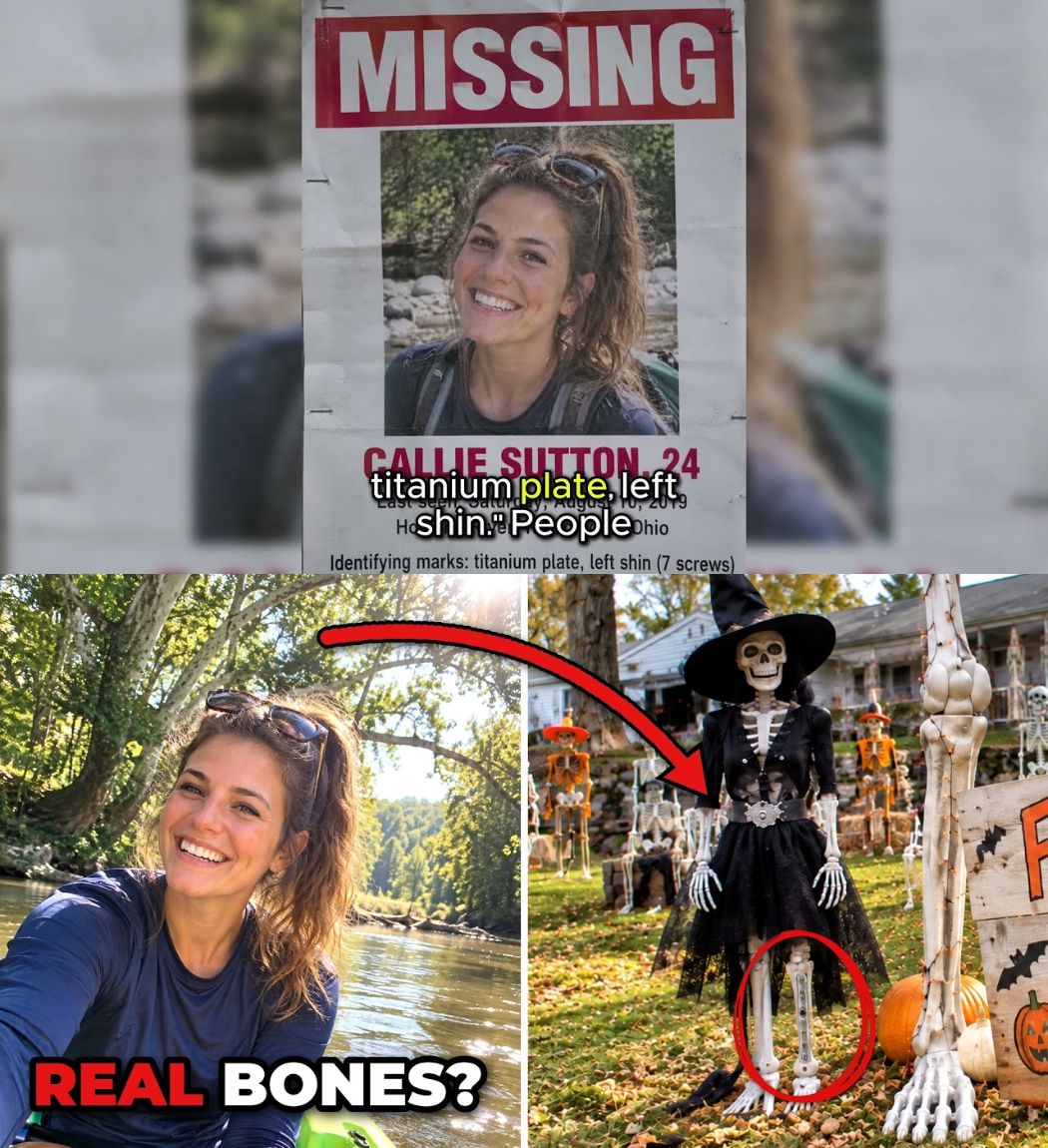
Bev spreads two fingers on the screen. A small skeleton in a witch hat. The left shin. A metal plate. Seven screws. One hole in that plate left empty.
She types one line under the picture: “Plastic skeletons don’t come with seven screws.”
Two posts below it is a flyer that a mother in Nelsonville has posted every Friday for 3 years. Kalie Sutton, 24, missing since August 10th, 2019 on a kayak trip down the Hocking River.
Identifying marks: titanium plate, left shin. Divers, a cadaver dog in a boat, 70 volunteers. The official answer was a drowning, a body caught somewhere under the log jams.
And for three Octobers, more than 20,000 cars rolled slowly past that lawn. They searched the river for 22 days. She was never in the river.
There was even a life jacket pulled out of that river with every buckle fastened. How does a woman lost on a river spend three Halloweens standing on a lawn?
Why was her life jacket empty? And who, before the town woke up the next morning, dressed the little skeleton in a pair of blue jeans?
The answer starts with the reason Kalie Sutton never got on a bicycle without a tall orange flag. She wanted every driver on the road to see her.
This is a dramatized story. The people in it are not real, but the places are. And so are the dangers. Saturday, June 7th, 2014.
A county road outside Athens, Ohio, a little after 4:00 in the afternoon. Kelli Sutton, 19, is riding home from a summer job at an animal clinic when a car comes up behind her and passes too close.
The side mirror catches her handlebar. She goes down on the gravel shoulder and her left leg goes under the bike. The driver stops. The driver is the one who calls 911.
That night, a surgeon fixes her shin bone with a titanium plate. The plate has eight holes. He puts screws in seven of them and leaves the third one empty because it sits right over the break.
When Kelli sees the x-ray, she laughs. She calls the plate her hardware and the empty hole the vacancy. Why would a 19-year-old want a copy of that picture?
Her mother asked her the same thing. Kelli had it framed and it went on the refrigerator in her mother’s kitchen in Nelsonville between a school lunch menu and a coupon for tires.
Underneath, in marker, Kelli wrote: “My best picture.”
Eight years later, a detective would take that frame off the refrigerator and hold it next to a photograph of a Halloween decoration. When the cast came off that fall, Kelli bought one thing before she got back on a bicycle.
A tall orange flag on a thin pole, the kind that stands 6 ft off the back wheel so it shows above the hood of a car. Her mother, Denise Sutton, later told investigators: “Her friends teased her about that flag. She said, ‘Make fun all you want. It’s so the trucks see me.'”
She never rode without it again, not once. Denise ran the school cafeteria in Nelsonville. Cali grew up in that town, at the edge of the Hocking Hills, where the Hocking River comes out of the woods and runs southeast toward Athens.
After the accident, she went back to the animal clinic, and by 2019, she was a veterinary technician there. The one who held the frightened dog still on the X-ray table.
Her co-workers said she talked to every animal as if it could understand her. And from 2015 on, almost every summer weekend, she was on the river.
Cali paddled alone, and she had a system for it. Paddlers call it a bike shuttle. Boat at the top, car at the bottom, bike in between.
Early in the morning, she locked her kayak to a tree at the boat ramp in Nelsonville, drove about 10 miles downstream to a second ramp near the Plains, and left the car there.
Then, she rode her bicycle back up to Nelsonville on the Hockhocking Adena Bikeway, an old railroad bed that runs beside the river almost the whole way. At the top, she moved the steel cable from the kayak to the bike, and floated down to her car.
In the evening, she drove back up for the bike. Every time she pushed off from the ramp in town, where her phone always had a signal, she sent her mother the same photo.
The bow of the kayak, the brown water, and three words: “On the water.”
Denise remembers: “Four summers. I don’t think she missed once. If that picture came, I could go about my day.”
Friday, August 9th, 2019. At a quarter past 9:00 in the evening, Cali texted her mother: “River tomorrow. Shuttle at 6:00.”
Denise wrote back one word: “Flag.”
Cali answered: “Always.”
Hold on to that photo. On the morning it did not come, its silence was the most important fact anyone had. Nobody treated it that way. Saturday, August 10th.
At 5:55 in the morning, a man walking his dog along the river in Nelsonville saw a young woman lock a green kayak to a sycamore beside the boat ramp. He noticed the bicycle on the back of her car because of the tall orange flag.
She waved. He walked on. By about 20 past 6:00, her car was parked at the ramp near the Plains. The sun came up at 6:35.
Around then, Kaylee Sutton should have been riding north beside the river, 10 miles back to her kayak. At 7:30, Renee Sutton sat in her kitchen with her coffee and her phone.
No photo came. She wasn’t worried, not yet. Maybe Kaylee had forgotten, or the phone was already sealed in its dry bag.
At 10 past 12:00, Renee wrote: “How’s the water?” The message didn’t deliver. Kaylee was supposed to come for dinner at 6:00. She didn’t.
By 7:00, Renee had called her 11 times. At a quarter past 8:00, she drove down to the ramp near the Plains, and in the last light, she saw her daughter’s car alone in the gravel lot.
The bike rack on the back was empty. At 8:40 that evening, Renee Sutton called 911. Sunday morning, August 11th.
Deputies from the Athens County Sheriff’s Office and firefighters from Nelsonville put boats in at the upper ramp. At 8:30, 2 and 1/2 miles downstream, they found Kaylee’s green kayak.
It was upside down, pinned against a log jam, and her paddle was wedged in the branches beside it. At 11:00, 300 yards farther down, a firefighter lifted a life jacket out of a slow eddy.
It was Kaylee’s. It had been floating face up and all three buckles were fastened. Everyone who looked at that river that morning saw a drowning.
Nobody asked how a woman slips out of a jacket she never unbuckled. If you’d have noticed that buckle before the search did, say so in the comments. Then, stay with Denise.
The river was about to keep everyone busy for 22 days. They started at the log jam where the kayak had been and they worked downstream.
Divers from the county went under every pile of branches deep enough to hold a person. A cadaver dog rode in the bow of a johnboat with its nose over the water.
Volunteers in waders walked the shallows in a line arms length apart. By the end of the first week, there were about 70 of them.
Between the upper ramp in Nelsonville and the bridge at the Plains, the divers checked 11 log jams, some of them twice. Not one searcher walked a single mile of the bike trail that runs beside that river the whole way.
There was no reason to. On Monday, August 12th, the deputy in charge wrote his first report and three lines in it set the direction of everything that followed.
“Subject completed bike shuttle. Launched approximately 07:45 per witness at ramp. Last cell activity 06:54. Coverage along river spotty. Bicycle not located. Likely stolen at put in.”
Every line made sense. Her car was at the bottom and her kayak was gone from the top, so she had finished the shuttle.
A man who fished under the bridge in Nelsonville told a deputy that around a quarter to 8:00 he had heard a kayak scrape down the concrete of the ramp. That became her launch time.
A phone that goes quiet on the Hocking is nothing new. And the bicycle? She would have moved her one cable from the kayak to the bike.
The kayak had no cable on it, and the bike was gone. Bikes get stolen from boat ramps. Kallie’s ex-boyfriend, Josh Kenny, was the first person detectives called.
He had worked the night shift at a warehouse in Columbus until 7:00 that morning, and a time clock and two co-workers said so. By Monday afternoon, he was off the list.
By the end of the first week, the file held exactly two things anyone could swear to. A man with a dog at 5:55. A car at a boat ramp near The Plains.
Everything after that was a guess. Even the scrape. The fisherman never looked up. He heard a kayak. He never saw who was pushing it.
On Tuesday and Wednesday, a little before 6:00 in the morning, an old sedan pulled into the gravel by the upper ramp with two boxes of donuts and a thermos of coffee the size of a fire extinguisher.
The man who got out was Merle Danner, 58, a widower from a back road a few miles downriver. The car had been his late wife’s.
Every October, he put up the boneyard, the Halloween yard with 41 skeletons that half the county drove past. He poured coffee, asked about the girl, and signed his name on the volunteer sheet.
Neighbors did that. Half of Nelsonville brought something to that ramp. Three years later, a detective would find his signature on that sheet and read it very differently.
The same week, the community group that everyone in Nelsonville reads filled up with Kallie’s face. Between the flyers, life went on.
A post about a lost beagle near Hocking College. A post from a volunteer who mows the bike trail: “Found an orange bike flag on the ground at the Glen Ebon crossing. Hung it on the kiosk.”
And a bake sale at a church on Saturday. Denise Sutton saw that post on Monday evening.
The deputies had asked the family to leave the searching to them, so she called the sheriff’s office. A deputy called her back the next day.
“The bicycle had been stolen at the put-in,” he said, “and a thief riding off on a stolen bike tears off a flag like that and throws it anywhere.”
A note went into the file. Nobody drove out to look at the crossing. The body did not come up.
The lieutenant who ran the search sat with Denise at her kitchen table under the framed x-ray and explained it as gently as he could.
The Hocking is shallow and slow in August, but it is full of log jams, and a log jam can hold a person under for months. When the winter water came up, it might bring her down.
On Sunday, September 1st, after 22 days, the search was scaled back to occasional checks. In the file, the case became five words: presumed drowning, body not recovered.
Denise did the only thing left. On the first Friday in September, at 8:00 in the evening, she posted Cali’s flyer in the community group.
The next Friday, she posted it again. Then, every Friday after that. Cali’s photo, the date, the river. And one line her mother would not let anyone take off: “Identifying marks: titanium plate, left shin.”
People started calling it flyer Friday. For 3 years, it never missed a week. Friday, October 28th, 2022.
Back to Bev Toliver’s kitchen table and to the comment she typed at 9:52. How many of those 20,000 drivers had slowed down and looked at that same leg?
At 10:31, someone answered: “Good eye, Bev. Old med school skeleton. Got it at an estate auction years ago.”
The name on the reply was Merle Danner. Bev knew that old teaching skeletons were real bone and that some still turn up at estate sales.
She had never seen one with surgical hardware in it. It was late. By her own account, she told herself it was a prop and went to bed.
In the early morning light, someone posted a new picture from the boneyard in the same group. 42 skeletons, the giant, the food box, and the little skeleton in the witch hat, standing where it had stood all month, was now wearing a pair of blue jeans.
Saturday, October 29th, 5 minutes past 10:00 in the morning. Bev Toliver called the tip line of the Athens County Sheriff’s Office. The call was recorded.
“I’m a retired surgical nurse. I’ve handed surgeons thousands of those screws. There’s a skeleton at the boneyard with a plate on its left shin. In every picture this month, it’s in a dress. This morning, it’s in jeans.”
The call went to Detective Sergeant Lori Kolb, 44. In 2019, she had worked burglaries in the north end of the county and never touched the Sutton case.
She knew the boneyard the way everybody did. She had driven her own kids past it. So, who was Merle Danner?
On paper, the most ordinary man on his road. 61 now, a widower since his wife Darlene died in 2017.
For more than 20 years, he had run a one-man business out of a shed by the river: Danner’s Skull and Bone. Hunters brought him deer heads and he gave them back clean skulls to hang on the wall.
The cleaning was done by beetles, small flesh-eating beetles in closed tanks. That shed smelled in every season and in November, at the peak of deer season, you could smell it halfway down the road.
The nearest neighbor lived a quarter mile away and had stopped noticing years ago. “That’s just the season,” people said.
He kept a ledger for the beetles. Every head that went in was written down by the number on the hunter’s tag and the animal. Buck, doe, bear. Merle was a careful man.
In 2009, Merle and Darlene put a few plastic skeletons on the lawn for Halloween. Every year, there were more.
Then came the giant, 12-ft tall with orange lights running up its ribs and a plywood box by the driveway for canned food for the county pantry. By 2019, there were 41 skeletons.
The boneyard was the nicest thing a lot of people knew about Merle Danner, and for most of them, it was the only thing. Jolene Reese, a volunteer with the food pantry, later told investigators: “Merle didn’t drive anywhere, so we picked up the cans for him. He’d hit a deer that August, fixed the truck, and swore he was done with the road. We all thought that was the grief talking.”
In the spring of 2020, Merle hurt his back. That fall, the state health department told families to skip haunted houses and decorate their homes instead, and the boneyard became a drive-thru.
Kids in costumes waving from back seats, cans tossed into the box through an open window. Merle could not lift a box that year, so for the first time, the pantry volunteers set it all up.
Jolene Reese ran the crew. In her words: “We pulled every tote out of his barn. In the back, there was one we’d never opened. It said medical skeleton, fragile. I opened it and said, ‘Merle, why have you never put this one out?’ He just looked at me for a minute. Then he said, ‘Go ahead.'”
The new skeleton was smaller than the others. “Old,” Merle said, “from a medical school.”
Jolene put a witch hat on it and stood it near the giant. When she reached for a short costume, Merle stopped her.
He gave her a long black dress that reached the ground. “A witch needs a long dress,” he said.
Jolene photographed the yard every year for the pantry’s page. Her picture from October 2019 shows 41 skeletons. Her picture from October 2020 shows 42.
2021 the same little witch, the same long dress. More cars than ever. 2022 A new sign went up next to the giant: “Final year. Thank you, Athens County.”
Merle had sold the house, and a moving truck to Florida was booked for Saturday, November 12th. After that, every toad in that barn would be almost a thousand miles away.
On the 1st of October, when the crew set up for the last time, Merle was not there. He was at a title office in Athens signing papers for the sale.
Jolene opened the little witch’s tote. Mice had gotten into it over the summer and chewed the long dress to rags.
She found a short black costume in another tote, and for the first time in three years, the little witch’s shins were out in the open. It stood that way for four weeks under the orange lights while 8,000 cars rolled past.
If Merle noticed, he said nothing to the crew. On Saturday afternoon, Lori Kolb pulled the Sutton file out of storage.
The missing person report had a line for identifying marks: titanium plate, left tibia. Clipped behind it was a copy of a radiology report from June 2014.
Denise Sutton had brought it in herself in case the river ever gave something back. Halfway down the page: eight hole plate, seven screws, hole three left open.
Kolb enlarged the left shin of the little witch on her screen and counted from the knee. One, two, the third hole was empty.
Behind the radiology report, there was one more page, a printout of the community group post from August 2019: “Found an orange bike flag on the ground at the Glen Evan Crossing.”
In the margin, in a deputy’s pen: “Thief discarded?”
Kolb pulled up a map. The Glen Evan Crossing was less than a mile from the boneyard. Here is what Lori Kolb had on Saturday night.
A woman who vanished in 2019. A plate with an empty third hole on a skeleton in the yard of a man who brought coffee to the people searching for her. Her bike flag found on the ground less than a mile from that yard.
And a pair of jeans that appeared on that skeleton the morning after a stranger asked about the screws. It was not enough for a warrant. Not yet.
Sunday, October 30th, 9:00 in the morning. Lori Kolb knocked on Denise Sutton’s door in Nelsonville.
Kolb did not mention the boneyard. She said the office was reviewing the file and needed anything medical the family still had.
Denise went into the kitchen and took the frame off the refrigerator. She held it for a moment before she handed it over: “My best picture.”
Then she brought a folder. Inside was a copy of Cali’s operative record from 2014.
Surgeons stick a small label from every implant into the patient’s chart. On that page, there were eight labels. One for the plate, seven for the screws. Each one had a lot number.
That afternoon, Kolb drove out to the boneyard in her own car and got in line with everyone else. She rolled past at walking speed and took pictures from the road, the way thousands of people had.
The little witch stood near the giant in a black top and blue jeans. From the road, all you could see was a skeleton.
The young couple from Logan sent her their original photo, taken a week earlier in full daylight. At full size, the plate filled a corner of the screen.
Kolb held Cali’s framed x-ray up next to it. The same plate. The same empty hole.
On Sunday evening, a radiologist at the county hospital laid the two images side by side. Same type of plate, same length, seven screws, the third hole left open.
In his written opinion, he was cautious: “Consistent with the same implant in the same position.”
Then, Kolb did what nobody had done in 3 years. She read the Sutton file from the first page, as if she had never heard of the river.
What if every line in it had been true and read the wrong way? The launch time came from a man who heard a kayak and never looked up.
The missing photo. Denise had told deputies in 2019 that Cali always sent it from the ramp in town.
Kolb drove to that ramp and checked her own phone. Full signal. If Cali had pushed off from there, that photo would have gone through.
The life jacket. Three buckles fastened. A person cannot slip out of a life jacket that is buckled shut. Nobody had been wearing it.
And on a volunteer sheet from August 13th, in neat block letters: Merle Danner.
One more thing bothered her, and it had nothing to do with paper. A body in a cold, deep lake can stay down for years. A body in a shallow river in August usually comes up within days.
The Hocking had been warm that summer. Nothing came up in 22 days because there had been nothing in the water to come up.
Now, there was a clock. The boneyard came down after Halloween and the moving truck was booked for November 12th.
Once those totes were on a highway to Florida, a plate with seven screws could end up anywhere. Monday, October 31st.
By the afternoon, Kolb had her affidavit. At 20 past 6:00 in the evening, a judge of the Athens County Court of Common Pleas signed a search warrant for the property of Merle Danner.
Kolb could have gone in that night. She chose not to. In Ohio, a search warrant is served in the daytime unless a judge allows otherwise.
And that night, the road to the boneyard would be one long line of cars full of children. Two deputies in an unmarked car would sit at the end of that road until morning and write down every vehicle that went in and out.
By then, it was dark and it was Halloween. The boneyard had its biggest night ever.
The line of cars went back almost to the main road. Children leaned out of windows to wave at the giant. The cans in the box by the driveway went over the top.
At 9:00, the food pantry volunteers turned off the orange lights and started taking the yard apart as they did every year. They carried the plastic skeletons to the barn and stacked them by the door.
Jolene Reese went to get the little witch. Merle stopped her. He said he would take that one himself. It was old, he said, and it was fragile.
Why would a man with a bad back insist on carrying one skeleton by himself? At 9:40, the volunteers drove home.
The deputies wrote that down, too. Nobody else went in and nobody came out. Tuesday, November 1st, 7:00 in the morning.
Deputies walked onto the lawn with the warrant. The grass was flattened in 42 places where the skeletons had stood.
41 plastic skeletons lay stacked by the barn door, still in their costumes. The little one in the blue jeans was gone.
7:22, in the loft of the barn. A gray plastic tote with one word on the lid in marker: “Lights.”
Under a pair of blue jeans and a black top, the little witch lay in pieces, packed like Christmas ornaments. Kolb found the left shinbone and turned it toward her flashlight.
The plate was there. Under a thin coat of clear varnish, the tiny numbers stamped into the metal could still be read.
She opened Denise Sutton’s folder on the hood of her car and held the first label next to the plate. Same maker, same lot number.
It was 20 to 8. For three Halloweens, Cali Sutton had been standing on that lawn.
How does that happen? How do 20,000 cars, a crew of volunteers, and a whole county look at a human skeleton for 3 years and see a decoration?
That question went to Dr. Nadia Rehn, a forensic anthropologist who works with the coroner’s office in Dayton, where Athens County sends its autopsies. She came to the barn that same morning and spent the next week with the bones in her lab.
What follows is from her report and her testimony. First, the smell. Dr. Rehn explained that bone smells of nothing once the last tissue is gone.
The beetles that clean deer skulls for hunters do the same work in natural history museums. Merle Danner had a colony of them, 20 years of practice and a shed that already smelled in every season, a quarter mile from the nearest neighbor.
In August 2019, nobody came near it. Second, the look. Real bone is not plastic white. It is cream and uneven, and it darkens with age.
So, the bones had been sealed with an ivory-colored varnish, the same tone as the cheap skeletons around them. Small holes had been drilled at the joints, and the pieces were joined with wire, the way old teaching skeletons were put together.
Then the skeleton went into a yard full of orange and purple lights, 30 ft from the road, behind a 12-ft giant that everyone was looking at instead. And there was a story ready for anyone who looked closer.
For most of the last century, real human skeletons were sold to medical schools for teaching, and some still turn up in attics and estate sales: “Old med school skeleton.”
It was the same answer Merle Danner gave Bev Toliver that Friday night. One person had felt something.
Jolene Reese told investigators she was heavier than the plastic ones, and cold, even in the sun: “I thought that’s just what the old ones are like.”
Jolene had carried that skeleton out of the barn and back again three Octobers in a row. If you drove past that lawn some October night, slowed down, maybe held up your phone for a picture for the grandkids, you saw exactly what you were meant to see.
Third, the plate. Why would anyone leave a piece of evidence with a lot number on it?
Dr. Rehn had the answer under her microscope. On the heads of all seven screws, the metal was chewed and scratched. Someone had tried to turn them with the wrong kind of screwdriver, again and again.
Surgical screws have a special head, and after 5 years, bone grows tight around them. Those screws were not coming out without breaking the leg.
Kolb’s notes from that morning have one line about it: “He knew it was there. He tried to take it off.” Then, he gave her a long dress.
And why keep her at all after Bev’s comment? He had 3 days, a road full of Halloween traffic, and a moving truck coming in two weeks that would take every tote in that barn to Florida.
A tote marked fragile had kept her hidden through three winters. On the last night, he moved her into one marked lights.
And the dogs, and the divers, and the 22 days? Cali Sutton had never been in the river, and she had never been in the ground.
A cadaver dog can find a grave. It cannot find a skeleton standing on a lawn among 41 others. Merle Danner was arrested in his kitchen that morning for tampering with evidence and gross abuse of a corpse.
He did not argue. He asked if he could put on his boots. At 3:30 that afternoon, he sat in an interview room at the Athens County Sheriff’s Office.
A camera in the corner recorded everything. Kolb read him his rights, and he said he understood them. He put both hands flat on the table.
Kolb laid two things in front of him. The X-ray from Denise Sutton’s refrigerator with “my best picture” written across the bottom in marker. And the small label from the operative record with the same lot number as the plate in his barn.
Merle Danner looked at them for almost a minute. Then he said one sentence, and it is on the recording: “I didn’t hit her on purpose. Everything after that, I did on purpose. Then, I want a lawyer.”
For almost two years after that, he did not say another word. Here is what the investigation knew a week after the raid on the barn.
Cali Sutton’s skeleton had stood in Merle Danner’s yard for three Halloweens. He had tried to remove the plate. And he had said on camera that he did not hit her on purpose.
Hit her with what? Where? When? On Tuesday, November 8th, Dr. Rehn and the Coroner’s Office in Dayton sent their findings.
The right shin bone and the bone beside it were broken at the same height, a little over 2 ft off the ground. The pelvis was broken. The skull was broken.
Dr. Rehn wrote that this pattern is what a person on a bicycle looks like after the front of a pickup truck hits her from the side. Nothing about it fit a river.
The report added one more line, and Kolb made sure Denise Sutton heard it before anyone else: “Cali would not have known what happened.”
Kolb went back to the text one more time. Friday, August 9th, a quarter past 9:00 at night: “River tomorrow, shuttle at 6:00.”
In 2019, everyone read it the same way. She did the shuttle, and then she did the river. She started that shuttle right on time. She never finished it.
From there, the morning could be rebuilt one source at a time. 5:55 by the man with the dog. Cali locks her green kayak to a sycamore at the Nelsonville ramp.
About 20 past 6:00 by the drive time. Her car is parked at the ramp near the Plains, where Denise will find it that night.
She takes the bike off the rack and starts north on the trail, the orange flag above the back wheel. 6:35, sunrise.
6:54 by the phone company’s records. Her phone touches a tower for the last time. It never touched another one.
At her usual pace, that puts her about 6 miles from where she started, at the place where the trail crosses Glen Helen Road.
Kolb drove to the Nelsonville trailhead and asked the volunteer who mows the trail about the flag he had found 3 years before. He remembered it.
He had hung it on the kiosk, and when nobody came for it, he put it in the lost and found box at the trailhead. It was still there, at the bottom, under a pile of sunglasses and a child’s glove.
A tall orange flag on a thin pole bent near the top. Now the other side of that morning.
The call log on Merle Danner’s phone led Kolb to Dwayne Pickett, 60, of Chauncey, who hosted a card game in his garage every Friday night. In August 2019, Merle was a regular.
Pickett told her: “Merle left about 20 to 7:00 in the morning. He was on his feet, barely. I offered him the couch. He said he only had to go a few miles of back road.”
Merle Danner had three drunk driving convictions: 2010, 2014, 2018. After the third, the state took his license. On that Saturday morning, he had not been allowed to drive for more than a year.
Then, the truck. In a folder of truck papers taken from Merle’s kitchen, there was a receipt from a body shop in Logan, in the next county.
Monday, August 19th, 2019. A pickup with a broken grill and a crushed right front corner. $1,860 cash. The customer said he had hit a deer.
In Ohio, nobody questions that. Deer hit thousands of cars there every fall. But the owner, Ron Gilly, had fixed hundreds of deer trucks.
His statement: “Every deer leaves hair in a grill. You pick it out for a week. That one didn’t have a single hair. And the dent was narrow, like he hit a post. A deer is wide.”
Kolb remembered the volunteer sheet. On August 13th and 14th, Merle Danner had driven to the search in his late wife’s old sedan. Now she knew why.
His pickup was sitting in the barn with its grill broken. And the river? Now that part made sense, too.
The scrape the fisherman heard at a quarter to 8:00 was real. It just wasn’t Cali. Her keys were never found, and her cable lock was gone.
Kolb’s reading of it was this. Someone with her keys had unlocked her kayak, pushed it into the current with the paddle, and thrown her life jacket in after it.
A life jacket with three buckles fastened because it had been packed in the kayak the whole time. Cali’s phone and her bicycle were never found.
By the spring of 2023, a grand jury had indicted Merle Danner on four counts. DNA from the bones tested at the state crime lab matched Denise Sutton.
The prosecutor offered a deal: plead guilty, avoid a trial, and get a sentence both sides could agree on. Merle Danner’s lawyer took more than a year to answer.
On Friday, July 12th, 2024, she told the court her client was rejecting the offer. Merle Danner wanted a jury, and he was going to take the stand himself.
Monday, September 9th, 2024. The Athens County Courthouse in the middle of Athens, Ohio. 12 jurors from the same county that had driven past the boneyard for 14 Octobers.
Four counts. Aggravated vehicular homicide. Causing a death recklessly while driving on a suspended license. Failure to stop after an accident in which a person died knowing that she had died. Tampering with evidence. And gross abuse of a corpse.
Nobody in that courtroom disputed that Merle Danner’s truck had killed Cali Sutton. The fight was over what kind of man had been driving it.
His lawyer gave the jury a simple picture: a frightened old man, not a monster. And she took the prosecution’s evidence apart one piece at a time.
Drunk? There was no blood test, no breath test, nothing. The only witness was Dwayne Pickett, who admitted he had been drinking all night himself.
Reckless? A low sun, fog off the river, a crossing he had driven through 10,000 times. The truck repair? Yes, he lied about a deer.
People lie when they are terrified. Lying is not the same as recklessness. Everything after the crash was panic, she said, and grief, and shame.
Ugly and wrong, but not murder, and not what the first count claimed. It was a strong defense.
Then the witnesses came. Bev Toliver, Ron Gilly, and Dr. Rehn told the jury what they had told investigators. Jolene Reese told them about the tote marked fragile and the long black dress.
When the prosecutor asked whether she had ever put that skeleton in blue jeans, she said no. On Tuesday, September 17th, Merle Danner took the stand.
For the first hour, his own lawyer led him through it. He said he never saw the flag until it was in front of his hood. He admitted the truck, the keys, and the kayak.
And he told the jury one thing they had never heard: “The bicycle went out with a load of scrap metal that fall.”
Twice he stopped to wipe his eyes. Then the prosecutor stood up.
On the table in front of him lay a single photograph: Jolene Reese’s picture of the boneyard from October 2019. 41 skeletons.
The courtroom video shows the time of every answer. At 12 minutes past 10, the prosecutor asked how much Merle Danner had drunk that night: “Two beers, early on. I wasn’t drunk.”
The jury had already heard Dwayne Pickett. Merle could barely stand at 20 to 7, and Pickett had offered him the couch.
At 10:15, the prosecutor asked about the plate: “I never thought about it. I didn’t even know it was there.”
The jury had already seen the scratches on all seven screws. At 10:19, the prosecutor asked who had dressed the skeleton in jeans: “The volunteers did all that. I didn’t change a thing.”
The jury had already heard Jolene Reese. The little witch was in a short black dress until the night Bev Toliver asked about the screws.
The prosecutor did not argue with any of it. He took a pair of blue jeans out of an evidence bag and laid them on the table next to the photograph.
Then he read aloud one more answer, the one Merle Danner had typed at half past 10:00 on a Friday night in October: “Good eye, Bev. Old med school skeleton. Got it at an estate auction years ago.”
“Years ago, Mr. Danner?” The prosecutor asked. “This yard stood every October since 2009. 41 skeletons. Every one of them plastic. And not one picture of her before October 2020. Which auction?”
Merle Danner said he did not remember. There was no receipt, no listing, no auction anywhere in his papers.
The 42nd skeleton appeared the second October after Callie Sutton disappeared. In the second row, Denise Sutton did not look at him once. She was looking at the jeans.
In his closing argument, the prosecutor did some arithmetic for the jury. Under Ohio law, if Merle Danner had called 911 at 7:00 that morning, a blood test would have made it the worst version of the vehicular homicide law.
With his record, at least 10 years in prison, mandatory. “He did not hide her because he panicked,” the prosecutor said. “He hid her because he could count.”
The jury deliberated for a day and a half. On Friday, September 20th, 2024, they returned their verdict. Guilty on all four counts.
Sentencing was set for November 8th. Lori Kolb had read the ledger from the beetle shed in 2022. To prepare for sentencing, she read it again line by line.
24 years of handwriting. Every head that went into those tanks had a line. The hunter’s tag number and the animal, buck or doe or bear.
In thousands of lines, two things stood out. The page for the second week of August 2019 had been torn out.
And halfway down a page from November 2011, there was a line with no tag number and no animal. Just two words and a letter: “Specimen two. F.”
When prosecutors asked about that line through his lawyer, Merle Danner did not answer. Friday, November 8th, 2024.
Merle Danner stood for his sentence in a tan county jumpsuit. He was 63. The judge gave him the maximum on every count and ran them one after another.
Under Ohio’s sentencing law for serious felonies, that came to a prison term of at least 20 years and as many as 24. Counting the two years he had already spent in jail, the earliest Merle Danner can walk out of prison, he will be about 81.
Before the sentence, he was allowed to speak. He said one sentence and it is in the transcript: “I gave that food pantry 14 Octobers.”
The prosecutor answered him in his own last words to the court: “He hid her to avoid 10 years. Today, he gets 20.”
The sale of the house had fallen through the week Merle Danner was arrested. In 2023, the property was sold to pay his lawyers.
The new owners cleared out the barn and tore down the beetle shed. Nobody has put up the boneyard since.
Some people in Athens County still drive down that road in October out of habit and turn around at the empty lawn. Jolene Reese stopped volunteering at the food pantry.
She told a reporter from a local paper that she could still feel the weight in her arms. Bev Toliver is still in the same community group.
People in Nelsonville stop her at the grocery store to shake her hand and she always says the same thing. She only counted the screws.
Lori Kolb keeps a copy of one ledger page on her desk. The line from November 2011 specimen two F has been compared against every missing woman in Ohio from that year and in the states around it. So far, there is no match.
Denise Sutton buried her daughter in Nelsonville on a Saturday in April 2023 after an expert for the defense had examined the bones. The court released her remains and kept the plate and the screws as evidence.
Volunteers from the search camp some of them had waited three and a half years to stand there. The people in this story are invented but some things in it are not and they are worth knowing.
In Ohio, a driver who hits someone must stop, help, and call for help. Driving away when a person has been killed is a felony and if the driver knew the person died, it is a more serious one.
Hiding a crash to avoid a drunk driving charge almost never makes the sentence shorter. A missing adult can be reported right away. There is no 24-hour wait and the first days matter most.
Surgical plates and screws carry the maker’s lot numbers and hospitals keep those numbers in the patient’s chart. Investigators do use them to give a name back to someone who was never found.
If you ride or paddle alone, make yourself visible at every road crossing even in daylight. A flag, a light, a bright color, and stop at crossings because a driver at dawn may not be looking for you.
Then, tell someone your plan in words that cannot be misread. Which ramp, which trail, what time you start riding, what time you start paddling.
Share your location while you are out. A plan that specific is the first thing a search team needs.
Merle Danner knew what dogs find and what rivers give back. He chose neither. Instead, he put her on a lawn where 20,000 cars slowed down to look.
Was that the perfect hiding place? Or was some part of him waiting for somebody to finally count to 42? Tell us which one you believe.
On the first Friday after the sentence, at 8:00 in the evening, the community group waited for Denise Sutton. Every Friday for more than 5 years, she had posted something about her daughter.
First, the flyer. Then, after the boneyard, a photo of Cali and the number of days left until the trial.
That Friday, there was no flyer and no number. She posted a photograph instead.
The place where the bike trail crosses Glen Eden Road in the gray light just after sunrise. At the edge of the trail, someone has set a wooden post into the ground.
On top of it, 6 ft in the air, stands a tall orange flag. The kind Cali bought the fall she learned to walk again. Every driver who comes to that crossing sees it now.