In 1994, brothers disappear in the Harz region – 14 years later, forestry workers find a buried container.
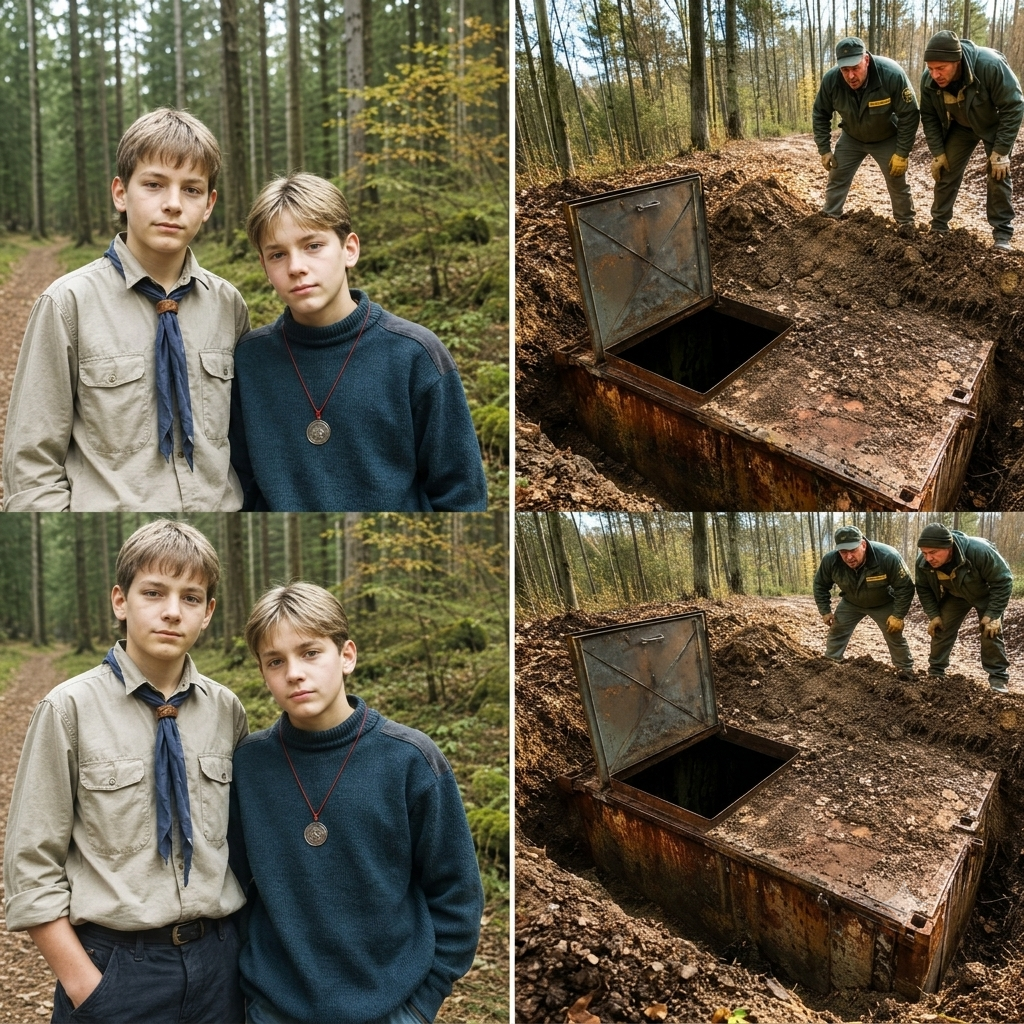
In 1994, brothers disappear in the Harz region – 14 years later, forestry workers find a buried container.
On July 16th. 1994, a missing persons case began in the Goslar district of Lower Saxony, which initially seemed like an accident but had to be reclassified as a serious crime many years later.
The brothers Tobias Kranz, 14, and Nils Kranz, 12, did not return home after a regular scout group meeting in the Harz mountains.
That same evening, a severe storm developed over the region.
For the initial investigators, this suggested an explanation that seemed reasonable, self-contained, and dangerously convincing.
Two teenagers had gone into a remote section of the forest and had been caught off guard by the weather conditions.
Within the group, Tobias was considered reliable and relatively experienced for his age.
He knew marked trails, practiced navigation, and had learned several advanced knot-tying techniques in the weeks prior.
He was particularly proud of one specific knot , as it was not commonly mastered by the younger members.
Nils was quieter and usually stayed close to his older brother.
One personal feature was precisely documented when they were later reported missing.
Nils wore a small, round metal pendant on a red cord.
At the time, it was merely an item for identification.
No one had any reason to attach greater significance to it.
The scout meeting had ended as scheduled in the afternoon.
After that, there were no more official activities for Tobias and Nils.
According to the usual routine, both should have started their way home.
When they did not appear, no foul play was initially suspected.
A delay, a detour, or a short visit with other teenagers seemed more likely.
However, these possibilities quickly faded after other families confirmed that their children had already returned and no one had seen the brothers near the group after the event ended.
The first decisive shift came from Lars Mertens, a boy from the same scout group.
His statement gave the police a concrete destination for the first time.
Before the meeting, Tobias and Nils had talked about returning to a small cave or rock opening they had previously discovered in a less frequented area of the Harz.
For the two brothers, this location was not an official destination of the group.
It was a private discovery they wanted to explore further.
Lars knew of the plan but had not joined them.
The worsening weather had been the deciding factor for him to head home.
His statement thus became the last known information regarding what Tobias and Nils voluntarily intended to do.
They had not disappeared on their normal way home.
After the event ended, they had apparently consciously returned to the forest.
This resulted in a plausible reconstruction within just the first few hours.
Two underage brothers with some scouting skills had wanted to reach a remote location.
Shortly thereafter, a severe storm set in.
There was no ransom demand, no known family conflict, no indication of a planned escape, and initially no witness who could link a suspicious adult or an unfamiliar vehicle directly to the boys.
The possibility of a crime could not be completely ruled out, but it was not supported by the available facts.
The weather simultaneously increased the pressure of time and destroyed potential clues.
Heavy rainfall altered unpaved paths.
Water collected in depressions and smaller channels swelled significantly.
A comprehensive search was only possible to a limited extent that same night.
For the investigators, this meant that during the very first hours, when footprints or other clues would have been most valuable, large parts of the terrain could not be reliably checked.
The following morning, an extensive search operation began.
Police, rescue teams, forestry personnel, and numerous volunteers were deployed.
The route between the scout event location and the area described by Lars was given top priority.
Search sectors were defined, paths and depressions were checked, and spots were inspected where two youths might have sought shelter from the storm.
The first day brought no usable findings.
There was no jacket , no backpack, and no item of equipment that could be attributed to Tobias or Nils.
Even on paved paths, there were no signs that either of the brothers had tried to return after the storm began.
The absence of personal belongings was initially not seen as a contradiction to the accident theory.
As long as it was assumed that both boys were together, they could still have been carrying their belongings with them.
With every unsuccessful search sector, the cave mentioned by Lars gained in importance.
It was the only specific place that the missing boys had demonstrably intended to visit .
Two days after they disappeared, search forces finally reached an area that matched his description.
There, off the more frequently used paths, was a rock opening.
The investigation revealed clear signs that significant amounts of water had penetrated the area during the storm.
Mud deposits and washed-up material indicated that the water level must have risen sharply at times.
On its own, this finding merely proved a flood event.
It proved neither that Tobias and Nils had been in the cave at that time, nor that they had died there.
Nevertheless, it fit perfectly with the theory that was already developing.
Then, in the immediate vicinity of the entrance, a piece of red cord was discovered.
The string was attached to an exposed root and secured with a relatively complex knot.
Only the classification by Lars Mertens revealed its special significance.
According to him, Tobias had learned this exact knot technique only a short time before and had practiced it repeatedly.
Within the group, it had been known that he was proud to be able to execute it correctly.
For the investigators, this created for the first time a seemingly direct connection between Tobias and the cave.
The location of the find matched the brothers ‘destination.
The knotting technique was consistent with Tobias.
The red cord was a material not unusual in the scouts’ environment.
A planned destination thus became a suspected last location.
Crucial, however, was what the find actually proved and what was merely inferred from it.
All that was certain was that a red cord had been fastened with a knotting technique that Tobias knew.
No one had seen him attach it there.
It could not be determined when the knot had been made.
Also, a definitive forensic link between the cord and Tobias was not possible.
In 1994, however, this distinction seemed less important than the totality of the circumstances.
The signs of the flood made the accident theory increasingly convincing.
The investigators considered it possible that Tobias and Nils had reached the cave and sought shelter there.
During the storm, water could have suddenly rushed in.
Another variation suggested that the brothers noticed the rising water level in time, left the cave, and then lost their orientation in the changed terrain.
Both explanations had the same core.
The storm was the cause of their disappearance.
The search was therefore expanded to watercourses, lower-lying areas, and possible drainage paths.
Teams checked areas where objects or bodies could have been carried by large volumes of water.
Nevertheless, nothing was found.
No clothing, no personal items, and no human remains turned up.
As the days followed, the hope of finding the brothers alive faded.
At the same time, the lack of physical evidence became increasingly conspicuous.
If Tobias and Nils had indeed been surprised by a flood in the cave, it remained unexplained why not a single clearly attributable item was found.
If they had left the cave, there was again no trace of their further path.
Further interrogations changed nothing in this regard.
Within the scout group, no serious conflicts were known.
There was no indication of a voluntary flight.
Tobias and Nils had not prepared extra clothing, money, or other things that would have fit a planned disappearance.
Nor did any concrete suspicion against a third party arise.
After several weeks, the active search was gradually reduced.
The case remained officially unsolved, but within the investigation, one assessment became increasingly dominant .
Tobias and Nils had reached the cave and had perished as a result of the storm or disappeared in the surrounding terrain.
The red knot became the most important building block of this reconstruction.
It connected the brothers ‘known plan with a specific location and that location, in turn, with the flood.
As a result, a closed chain of events seemed to have been formed, even though its decisive beginning had never been directly proven.
In the files, Tobias Kranz, 14 years old, and Nils Kranz, 12 years old , remained missing since the 16th.
July 1994.
The most likely explanation was an accident in connection with the severe storm in the Harz mountains.
That is how the case remained for years .
The investigators had a cave, signs of flooding, and a knot that Tobias knew how to tie.
What they did not have was proof that the brothers had actually been there when the storm hit.
And no one at the time asked the crucial question with enough persistence: if Tobias hadn’t tied the knot himself, who knew his technique well enough to leave exactly that trace ?
In September 2008, a forestry area in a remote section of the Harz, which had barely been used for many years, was being developed.
The area lay well outside those zones that had been intensively searched after the disappearance of Tobias and Nils Kranz.
For the workers, the old missing persons case had no significance.
Their job was to fell trees, keep access roads clear, and make the ground passable for heavy machinery.
It was during this work that an object appeared that would completely destroy the previous explanation of the case within a few days.
Jochen Feld was operating a heavy forestry machine that day.
While working on a compacted section of the ground, the machine encountered a resistance that differed significantly from a rock or a large rootstock.
The sound was metallic.
The work process was stopped because it first had to be ruled out that there was an old tank, a pipe, or some other technical obstacle there.
After removing the top layer of earth, a rusty metal surface became visible.
Initially, the group assumed it was a remnant of earlier industrial use.
In the Harz, old technical facilities, abandoned commercial areas, and traces of past human activity were not fundamentally unusual.
The find could therefore have been regarded as part of an older facility without further notice.
But beneath the earth and rotting plant material, a square steel hatch appeared.
It obviously did not belong to a small tank.
The edges led to a significantly larger structure that lay deep in the ground.
The more earth that was removed, the clearer it became that the object had been intentionally covered.
The situation could not be explained by a piece of metal accidentally buried.
The construction had been completely embedded into the underground.
Some of the workers continued to believe it was possible that it was an old storage room or a technical facility.
Any report to the authorities meant an interruption of the work and possibly a long closure of the area.
Jochen Feld assessed the situation differently.
A large steel construction in a remote patch of forest, completely hidden under earth and only accessible via a hatch, seemed unusual enough to him to involve the police.
This decision changed the nature of the crime scene.
After the officers arrived, the work area was cordoned off.
First, it had to be determined what the dimensions of the structure were and if it posed any immediate danger.
The soil around the top surface was removed in a controlled manner.
It turned out that underneath the ground was not a small bunker, but a complete shipping container about 12 meters long.
The discovery was technically striking from the start.
A container of this size could not have been placed in the ground without heavy machinery.
For this, a sufficiently deep pit had to be excavated, the structure inserted, and then completely covered again.
The effort involved argued against any spontaneous use.
Someone had prepared this location.
The police did not initially treat the find automatically as a crime scene.
Old industrial structures existed in the Harz region, and illegal storage sites were also theoretically possible.
Only opening the steel hatch led to a different assessment.
The interior was not empty.
On the floor lay two badly damaged mattresses.
Next to them were plastic bottles, beverage cans, food packaging, and other everyday items.
Some materials were barely recognizable due to moisture, while others could be roughly dated.
The amount of waste made it clear that the container had not just been entered for a short time.
People had stayed in it over a longer period.
This raised the first question that could no longer be explained by an abandoned technical facility: Who had lived in a completely buried container in the middle of the forest?
The investigators documented the interior systematically.
Among the waste, they found several older comics as well as a portable CD player.
Damaged CDs were also lying near the mattresses.
The items did not fit a common material storage, nor did they fit a space used exclusively for machines or tools.
Particularly striking was the combination of sleeping quarters, food, and entertainment material.
It pointed to a stay that had to have been organized.
Someone had ensured that the room remained usable.
At the same time, it remained completely unclear whether people had stayed there voluntarily or if the container had served another purpose.
Initially, no human remains were found.
This circumstance prevented a quick classification.
Had a corpse been discovered immediately, the site would undoubtedly have been considered a serious criminal case.
Instead, there was a hidden room, signs of a long stay , and numerous old items, but still no direct evidence of a crime.
The search was therefore continued with extra care .
Among damaged fabric and soiled objects, an investigator finally noticed a small piece of metal.
After being secured, it could be seen that it was a round pendant.
Remains of a red cord were still attached to it.
On its own, this find was also not initially conclusive.
A metal pendant could belong to anyone who had used the container at some point.
Its significance only emerged through the combination of shape, material, and cord.
The description was cross-referenced with older missing persons files.
That was when the name Nils Kranz appeared.
The original missing person description noted that the twelve-year-old had been wearing a small round metal pendant on a red cord the day he disappeared.
This detail had been included at the time because it could help with identification.
After that, it had played no further role for years.
Now, the documentation from back then was consulted again.
Existing photos of Tobias and Nils were also reviewed.
In one picture from around the time of the scout event, the pendant was visible on Nils.
The shape and design matched the object from the container.
Investigators initially avoided jumping to any hasty conclusions.
A visual comparison alone was not enough to re-evaluate the entire missing persons case.
Therefore, the object was documented more precisely and compared with the details in the old file.
The match proved clear enough to assume a direct link to the Kranz case.
With that, the significance of the container changed abruptly.
Up until that moment, there had been a possibility that the underground structure had nothing to do with the missing brothers.
With the pendant, a material connection was established for the first time between Nils and a location far outside the original search area.
The consequences were significant.
The entire early reconstruction of the missing persons case was based on the premise that Tobias and Nils had gone to the cave after the scout event and disappeared there or in its vicinity due to the storm.
The red knot had supported this assumption.
The traces of the flood had given it a plausible sequence of events .
The fact that no bodies had been found was explained by the strength of the water and the difficult topography.
The pendant in the container was difficult to reconcile with this theory .
If Nils had actually been wearing the item on the day he disappeared and it was later found in a buried container, at least one of the brothers must have reached that location.
However, the container was not located at the cave, nor in the area that had been treated as the likely drainage path of the flood at the time.
Another circumstance weighed even more heavily.
A personal item could be carried away by water.
But a pendant in a closed underground space could not easily be explained by a natural event.
There was no plausible connection between the cave, the flood, and the interior of an intentionally buried container.
The investigators therefore had to examine a possibility that had never been seriously at the center of the original proceedings.
Tobias and Nils might have either never reached the cave or left it later on.
In both cases, the previous idea of how things unfolded would have been incomplete.
The site where it was found was now treated entirely as a potential crime scene.
Every object took on a different meaning.
The two mattresses were no longer just clues to previous occupants.
The food packaging became potential traces of a more prolonged period of care.
The comics and the CD player moved into focus because they pointed to younger users.
The absence of bodies was also re-evaluated.
The container did not yet prove what had happened to Tobias and Nils.
It also did not prove how long they might have been there.
But the connection to Nils was enough to fundamentally call the accident theory into question.
For the Kranz family, this new development did not mean closure.
Instead, it meant a second phase of uncertainty.
The idea that the brothers had perished in a storm had long stood as a painful, but at least plausible, explanation.
Now, a possibility that was much harder to bear emerged.
The boys might have survived the storm and then been taken to a place whose existence no one had known about.
The container had not been hidden by accident.
It was buried deep enough to be barely noticeable from the surface.
Its location was outside the original search area.
The items inside showed that it had been used over a longer period of time.
And among these items was something that could be linked to Nils Kranz.
With that, the central assumption of the old case was no longer tenable.
The storm might have destroyed evidence, and it might have made the search difficult, but for the first time, it had to be seriously considered that it was not the cause of the brothers’ disappearance.
An old missing persons case had become a potential kidnapping case; the most important new find was not a body or a confession, but the same inconspicuous object that had merely been noted as an identifying mark for Nils on the day he disappeared.
A round metal pendant on a red cord.
With the attribution of the metal pendant to Nils Kranz, the entire assessment of the site changed.
The buried container was no longer an unknown facility with random traces of earlier use.
It now had to be treated as a possible component in the disappearance of two minors.
The investigation was expanded, and specialists from the Lower Saxony Criminal Police took over the technical and forensic examination of the structure.
It quickly became apparent that the decisive clue did not just lie in the objects inside.
The container itself was a piece of evidence.
Even the way it was placed contradicted the idea of an improvised hideout.
The structure had been completely sunk into the ground and subsequently covered so that it was barely recognizable from the outside.
For this, a pit of significant size must have been excavated beforehand.
A 12-meter-long shipping container could not be brought to such a place with simple tools, nor without preparation.
Heavy machinery had been necessary for transport, excavation, and covering.
Even more striking were the technical modifications.
The container had its own ventilation system.
Several pipes led out of the structure and continued underground.
This included industrial fans and filters designed for long-term air exchange.
The intake and exhaust points had not been installed directly above the container.
They were located much further away and arranged so that their connection to the underground facility remained difficult to discern from the surface.
For the investigators , this design was of central importance .
Whoever had prepared the container did not just want to prevent it from being discovered.
At the same time, they had to ensure that people could remain inside it for an extended period .
The entrance had also been modified.
The steel hatch had been reinforced and fitted with a locking mechanism that could not be opened from the inside in the usual way.
This made the explanation of a voluntarily used retreat even less likely.
A shelter would have required a secure exit.
With this construction, the opposite was the case.
The access was designed so that control over opening and closing lay outside the container.
This finding shifted the focus.
Until then, the pendant had only proven that Nils had a connection to the site.
The technical investigation now suggested that the site was not built for voluntary stays.
The combination of a hidden location, controlled access, sleeping quarters, and long-term air supply suggested a facility where people could be held for a long time.
The investigators nevertheless avoided jumping to conclusions about a specific type of perpetrator.
First, it had to be clarified who was even capable of building such a structure in the Harz region without attracting attention.
The effort involved was considerable.
A large pit had to be excavated, the container transported and lowered, the ventilation installed, and subsequently the entire area covered up again.
Machines of this size usually caused noise, left tracks, and required access paths.
A single operation of this kind could have stood out in a commonly used patch of forest.
Therefore, the focus turned to the previous use of the terrain.
The region around Goslar and parts of the Harz had long been characterized by mining, material extraction, and industrial operations.
For the investigators, however, the general history of the region was not decisive, but rather the specific question of who had access to the forest section in the years before the brothers disappeared.
Old documents revealed that a small company had occasionally used the area for the extraction and processing of materials.
The company possessed construction machinery, including excavators and graders.
Work with heavy equipment had therefore not been fundamentally unusual in this area.
An additional excavation or the transport of a large metal object would have likely attracted less attention within existing operations than at a completely untouched site.
This created a concrete link for the first time between the technical logistics of the container and a known company.
The examination of the old company records revealed further irregularities.
There had been indications of waste disposal violations against the business.
Former employees later reported that regulations were not always followed and that problematic materials were sometimes disposed of in a way intended to bypass official inspections.
Not every one of these claims could be fully verified in retrospect, but they were sufficient to develop a new working hypothesis.
Perhaps Tobias and Nils had not been specifically targeted for abduction.
Perhaps they had seen something.
After the scout event, the brothers had deliberately gone into a remote area.
If they had stumbled upon an illegal dump or some other unauthorized company activity, they could have become a risk to those involved.
In this model, the container would not necessarily have been built originally for the boys.
It could have already been there and subsequently used as a makeshift place of detention.
This theory initially had several advantages.
It explained why heavy machinery could be used unnoticed.
It established a connection between the site and people with access to it.
It also offered a motive that did not require long-term surveillance of the two teenagers.
An accidental discovery of illegal activities could have been enough to trigger an escalating situation.
The former manager of the operation therefore quickly became the focus.
The man had a reputation for not being reserved in resolving conflicts.
Older records and later statements provided indications of violent behavior and a willingness to pressure employees.
For the investigators, this profile initially fit the idea that two accidental witnesses might have been removed or detained to prevent a major scandal.
The search for the former operations manager did not take long.
He was now living outside the region and had worked in various areas of the construction industry.
His background check indeed revealed incriminating information about the company’s past activities.
He did not permanently deny that regulations had been violated during disposal.
With that, a part of the new theory received confirmation for the first time.
Investigations revealed that problematic materials on the former company premises had indeed not always been handled properly.
The indications of illegal dumping were therefore not just the memories of disgruntled employees.
There had been actions that, had they become known, could have had serious consequences for the company.
But it was at exactly this point that the theory began to fall apart.
The former manager denied any connection to Tobias and Nils.
His statement alone would not have cleared him.
What was decisive was that he could name a verifiable whereabouts outside the relevant area for the day of the disappearance.
The investigators checked these details extensively.
Old business records, payment receipts, and further chronological evidence were collected.
In addition, people were identified who confirmed his presence at the other location.
The individual pieces of information fit together.
The timeline left no realistic possibility that he could have been in the Harz region during the critical period and involved in the kidnapping of the brothers.
With that, the most important suspect up to that point lost his central significance.
For the investigators, this was a significant setback.
The connection between the company and the site remained in place.
It also remained confirmed that heavy machinery could be used there without attracting particular attention.
But the very man who fit the suspected motive best due to his behavior and position could not be linked to the disappearance.
Another contradiction weighed even heavier.
The theory of a short-term cover-up explained the items in the container less and less.
If Tobias and Nils had merely accidentally observed illegal activities, long-term captivity would have been unnecessary.
Two mattresses, numerous food packages, comics, and a portable CD player did not fit a situation where witnesses were to be held only temporarily.
The elaborate ventilation system could also hardly be explained by that.
The container was not equipped like a space meant to be used for a few hours or days.
Someone had ensured that people could sleep, eat, and be supplied with air there over a longer period.
Even the entertainment items took on a different meaning from this perspective .
They did not seem like randomly discarded trash, but like components of a controlled stay.
With that, the investigation once again faced a fundamental change.
The former company could explain how heavy machines had reached the forest.
It could possibly explain why extensive excavation work had not triggered immediate suspicion.
But it did not explain why an underground room had been set up so that two people could live in it for a longer time.
The investigators therefore had two separate facts at the end of this phase.
For one, someone had been able to use the existing working conditions in the forest area to hide a large construction.
For another, this construction was apparently not intended for a short-term cover-up.
Suspicion thus shifted away from a spontaneous crime and toward a much more disturbing possibility.
The container might have already been prepared before Tobias and Nils even disappeared.
And if that were true, the two brothers had not stumbled upon another crime by chance.
Then someone had intended to keep people imprisoned there for a long time.
The new question was therefore no longer whether the container had been prepared for long-term captivity.
That was by now considered likely.
What now became decisive was who possessed the technical knowledge to plan and inconspicuously operate such a facility .
The technical design also took on a different meaning from this point of view.
The ventilation system was not merely a precautionary measure against humidity or stale air.
It was elaborate enough to keep a permanently enclosed space habitable.
The hidden air ducts simultaneously reduced the risk of the facility being discovered from the outside.
Security to the outside and dependency on the inside were linked together in the same construction.
For the investigators, a disturbing picture thus emerged.
The person who prepared the container had to possess more than just technical skills.
He must have addressed the question of how humans could be kept alive underground for a long time without leaving the place themselves or outsiders discovering its existence.
This argued against an impulsive decision.
The investigation was therefore expanded to the period before the disappearance of Tobias and Nils.
If the container had already been completed beforehand, part of the preparation for the crime had to be reflected in business records, material purchases, or technical procurements.
Biological traces could hardly help with this anymore.
Moisture, rust, and long-term storage had made the interior almost useless for classic forensic investigation.
Usable fingerprints were not to be expected, and potential DNA traces could not be reliably assigned to a specific person.
That left the technology.
Special attention was paid to the components of the ventilation system.
Several parts were not assembled from ordinary hardware store materials.
These were industrial components, including powerful fans, filter systems, and robust ducts, as used in professionally installed ventilation systems.
For a technically inexperienced perpetrator, planning such a system would have been significantly more difficult.
The investigators therefore began to catalog every identifiable component.
Damaged nameplates were evaluated, serial numbers compared, and manufacturers determined.
Not every component provided a useful lead.
Some parts were too heavily corroded; others came from series that had been sold in large quantities.
Nevertheless, a technical profile emerged that was narrower than the previous person-related leads.
The builder had access to professional HVAC components.
He also understood how airflow, duct routing, and filtration had to be combined.
That was no proof of a specific profession.
But it significantly limited the potential circle of suspects.
An ordinary worker with access to an excavator could bury the container.
However, that still did not explain who had planned the system.
The investigators now deliberately separated these two skills from each other.
The former material company explained the access to heavy equipment and the possibility of disguising earthworks in the forest.
But the technical planning did not necessarily have to come from one of their regular employees.
It was just as possible that someone had worked on the periphery of the operation without being a permanent member of the staff.
Subcontractors, maintenance firms, and external technicians thus moved into focus.
In parallel, the investigators attempted to reconstruct the origin of the installed ventilation technology.
Manufacturers were contacted and old distribution channels checked.
The task was difficult because much sales data was no longer available digitally.
Some dealers no longer existed, and others had long since destroyed older records.
Nevertheless, for several particularly characteristic components, it was possible to trace which regional suppliers had sold them in the mid-90s.
At one larger industrial supplier, older sales records had been preserved.
The data sets had to be checked manually.
They were looking for orders whose combination matched the parts in the container.
Large deliveries to clinics, factories, or public institutions could be quickly ruled out .
More interesting were small individual purchases, especially those without a clear connection to a larger construction project.
Little by little, the number of relevant transactions was reduced.
Finally, a cash payment from March 1994 stood out.
Four months before the brothers disappeared, two industrial inline fans and several filters had been purchased.
The technical specifications matched the components that had been found in the container.
The scale of the order was too small for a large commercial system , but exactly enough for a limited, closed ventilation system.
The buyer had provided a name, Hartwich Sander.
This was the first time a person appeared who had not been part of the original investigations.
The background check began initially without any particular expectations.
Buying matching components could also be a coincidence if Sander worked professionally with such systems.
That, however, is exactly what turned out to be the case.
Hartwich Sander was not an employee of the former materials company, nor was he an ordinary construction worker.
He worked as a specialist in heating, ventilation, and air conditioning and ran a small business specialized in the installation and maintenance of technical systems.
His professional qualifications therefore directly matched the construction of the container.
That alone was not yet enough.
The decisive question became whether Sander had ever had any access to that forest area.
Here, too, the investigation revealed a connection.
He had occasionally taken on assignments for the materials company as an external technician.
This involved maintenance work on technical systems and machine climate control systems.
His presence on the company premises would therefore not have been unusual.
With this, Sander possessed something that the previously vetted company manager could not explain.
He combined technical expertise with legitimate access.
Further old documents showed that his professional activities were not limited to this one client.
Sander had also maintained technical systems at remote locations.
Vehicles from his business could therefore appear in areas of the Harz region without their presence automatically seeming suspicious.
Tools, pipes, or larger technical components in such a vehicle would also not have left an unusual impression.
For the first time, investigators were considering a person who could both build the system and camouflage its creation.
This changed the direction of the proceedings once again.
Until then, the image of the perpetrator had been derived from the site where it was found.
Now, for the first time, a real biography began to overlap with this image.
Sander understood professional ventilation technology.
He was able to procure special components.
He knew the area where the container had been buried, and his professional position allowed him to move about there without attracting any particular attention.
However, a motive was still missing.
The investigators did not know whether Sander had known Tobias and Nils.
There was no known personal contact between him and the Kranz family.
His name did not initially appear in the records of the scout group from that time either.
For this reason, his past was comprehensively checked.
At this point, it was important for the investigators not to repeat the same mistake that had defined the original missing persons case.
Back then, the red knot had created a convincing narrative before other possible explanations had been sufficiently examined.
Now, they were determined not to construct a perpetrator prematurely based on a technical match.
Buying the ventilators did not prove that Sander had installed them in the container.
His professional qualifications did not prove he had designed the system, and his presence in the Harz region did not prove he was linked to the boys ‘disappearance.
Yet, for the first time, these three factors were found in the same person.
The investigators did not have a perpetrator, but they had a name, and Hartwig Sander had bought the special parts needed for the container shortly before Tobias and Nils Kranz vanished.
The review of Hartwig Sander’s past began with the most obvious areas.
His employment records confirmed that he had been working in heating, ventilation, and air conditioning for years.
He worked independently, took on maintenance contracts for small businesses, and was also employed for technical work on remote facilities.
None of this was suspicious in and of itself.
Only the combination of expertise, access to the forest area, and the documented purchase of the exact components used in the container made his biography relevant to the investigators.
The question of a motive , however, remained open.
Sander was not a relative of the Kranz family, not a teacher of the boys, and, according to the documents checked so far, not a regular leader of their scout group.
If he was truly connected to the container , they had to explain why two minors, of all people, might have been held there.
The investigators therefore began checking older contacts with youth organizations.
In doing so, an incident surfaced that was not noted in any criminal record.
In the early 90s, Sander had supported a different scout group for a short time.
He was not listed there as the primary leader, but as an adult helper who assisted with technical tasks, excursions, and individual training sessions.
The role had lasted less than a year.
His departure was only briefly documented in the records from that time.
He had not been officially dismissed.
There was no complaint, no investigation, and no court decision.
However, several former leaders remembered that Sander had increasingly been perceived as problematic due to his behavior toward certain boys.
These statements had to be treated with caution.
They were a long time ago and were partly based on memories that had never been written down.
Nevertheless, a pattern emerged that the investigators could not ignore .
According to former leaders, Sander had focused conspicuously strongly on specific boys.
He offered individual children extra help, gave them more frequent personal attention, and sought opportunities to work with them without other adults present.
Some officials had perceived his behavior as inappropriate.
There were allegedly also complaints that physical proximity and personal boundaries were not always respected.
None of these observations had led to criminal proceedings at the time.
That was precisely where the special significance lay for the investigators.
The information did not prove any prior crime.
However, it showed that concerns about Sander’s behavior toward boys had existed even before Tobias and Nils disappeared.
These concerns had been serious enough to end his further involvement, but not concrete enough to trigger state investigations.
This created, for the first time, a possible connection between his technical profile and a personal motivation.
Up to this point, Sander had been in focus primarily because he could have built the container.
Now it had to be examined whether he also fit the profile of the perpetrator that emerged from the use of the space.
The container was designed for long-term control.
Whoever had built it must have been prepared to regularly bring food and other items.
The two sleeping areas and the entertainment materials indicated that the captives were not meant to be killed immediately.
The perpetrator had apparently planned a state in which two people were completely dependent on him for a longer period.
The reports from Sander’s earlier activity with the scouts gave this interpretation a new direction.
It was no longer just about technical preparation; it was about control.
The investigators reviewed all data that was already available.
Sander’s purchase of the ventilation parts took place a few months before the disappearance.
His work for the materials company explained how he could have gained access to the forest area.
His work at remote technical stations explained why a service vehicle would not automatically have been suspicious, even off the beaten path.
And his earlier contact with scout groups showed that he had moved in an environment of boys who fit the age of Tobias and Nils.
A direct link to the two brothers was still missing.
There was no proof that Sander had been a member of their own group.
No participant list contained his name.
The family’s known records also did not reveal any regular contact.
For this very reason, it was investigated whether he could have had access to information about group activities through his professional paths or earlier scout contacts.
The investigators initially found no certain proof of this.
But Sander did not have to know Tobias and Nils personally to have observed them.
The location where the container was found was in an area he knew through his work .
The boys were moving around there without adult supervision after the event.
The original case had already shown that they explored remote areas on their own initiative.
This overlap was not enough to prove the crime, but it increased the weight of the existing evidence.
The police decided against an immediate, open confrontation.
Instead, Sander’s current life was closely observed.
He was now over 50 and continued to run his small technical business.
Outwardly, he lived an inconspicuous life.
His professional routines were regular, his contacts limited.
He worked mostly alone and only dealt with customers, suppliers, and occasional clients.
There was no recognizable social standing that would have made him particularly visible.
Precisely this inconspicuousness suited a perpetrator who could have operated a facility in the forest over a long period.
The container did not require constant presence.
It required regular, plannable visits.
A self-employed technician with changing assignments could explain trips to remote areas without having to adhere to a fixed daily work schedule.
His work also offered a legitimate reason to carry tools, pipes, filters, or other technical materials.
For the investigators, an increasingly dense overall picture was emerging.
But the individual parts remained mostly circumstantial.
For the first time, technical possibility, access to the site, and a biographical hint of a potential personal motive converged in Sander’s case.
None of these facts alone proved that he had abducted Tobias and Nils.
The investigators therefore had to look for evidence that not only fit his profile but was directly linked to the container.
Before a search warrant could be requested, it was first checked whether Sander’s current workshop still contained materials or documents from the 90s.
Former business partners described him as someone who kept technical documentation for a long time .
Invoices, sketches, and installation documents were not regularly destroyed by him, but collected in folders.
This habit suddenly gained criminalistic significance.
A perpetrator who had planned a complex technical facility might have needed drawings or calculations for it.
If Sander was indeed the builder and had maintained his professional order over the years, there was a possibility that documents still existed.
At the same time, it was checked whether his acquisitions at the time went beyond the purchase of the fans.
Old delivery data was incomplete.
Some companies no longer had archives; others could only reconstruct individual invoices.
Nevertheless, indications were found that Sander had obtained an unusually large amount of material for piping and filter technology during the relevant period.
The quantities were not extraordinary enough for his trade to be incriminating on their own.
In connection with the container, however, they increased the suspicion.
The investigators finally applied for a search of his home and workshop.
The justification was not based on a single discovery, but on the combination of several independent points: the documented purchase of matching ventilation parts, his professional qualification, his access to the discovery area, and the known earlier irregularities in his behavior toward underage boys.
Until then, Sander did not know how far the investigation had progressed.
There was a significant risk for the police.
A search could dispel all previous suspicions.
If no connection was found between his property and the container, perhaps only a series of striking coincidences would remain.
The warrant was issued nonetheless.
The officers focused particularly on the workshop during their preparations.
Sander’s house might contain personal clues, but the construction of the container had been primarily a technical project.
If he was actually behind it, part of the planning must have taken place where he prepared his professional installations .
The search began without any prior notice.
The house itself initially yielded no decisive findings.
There were no items that could be clearly linked to Tobias or Nils.
No photographs, personal mementos, or other typical signs of a collection of trophies were discovered either.
These initial results seemed to weaken the suspicion instead.
Then the workshop was systematically examined.
It was highly organized.
Tools, spare parts, and business records were sorted by technical areas.
For the investigators, this order was helpful because older documents were not scattered randomly.
Several cabinets contained invoices, maintenance schedules, and drawings from past years.
One locked filing cabinet stood out in particular.
It stood among ordinary business records and did not differ outwardly from the other furniture.
After opening it, the investigators initially found technical documents as well.
Then several large-format drawings appeared.
They did not show a boiler room, a factory floor, or a conventional ventilation system.
The plans depicted a cargo container that was completely underground.
The drawings contained dimensions, air ducts, positions of fans, and the construction of a single access point.
Even before all the details were compared, one thing was obvious.
The sketches did not just generally resemble the container in the Harz mountains.
They showed exactly the type of facility whose builder the investigators had been searching for.
The drawings found in Hartwicher’s workshop fundamentally changed the status of the investigation.
Up to this point, the suspicion had arisen from a series of overlaps.
Technical knowledge , access to the forest area, the purchase of matching ventilation parts, and previous anomalies in his dealings with young boys.
The plans were something else entirely.
For the first time, they established a direct link between Sander and a construction that matched the container found in the Harz in crucial respects.
The documents were secured separately from the other business records while the search was still underway.
Subsequently, a technical comparison began with the underground facility, which had already been fully measured.
The investigators did not focus on general similarities.
A rectangular container with ventilation ducts alone would not have been sufficiently conclusive.
The deciding factors were details that could hardly be repeated by chance.
The dimensions matched perfectly.
The position of the single access point also corresponded to the actual construction.
The same applied to the layout of the ventilation ducts, the arrangement of the fans, and several points where the pipes changed direction.
Even the placement of the filter units in the drawings matched exactly how they were later found in the ground.
It became clear that the plans were not merely a theoretical technical exercise.
They were the blueprint for the very facility where Nils Kranz’s trailer had been discovered.
For investigators, this was the strongest evidence against Sander to date.
The discovery not only explained that he possessed the technical skills to build it.
It showed that he had specifically focused on planning an underground buried shipping container.
The facility had therefore not been improvised.
Its technical specifications had been calculated and determined in advance.
The search was subsequently expanded to include all records from the spring of 1994.
Among ordinary invoices, order confirmations, and maintenance logs, investigators found further documents that fit chronologically into the already known preparations.
In March of that year, Sander had not only purchased the two industrial fans and several filters.
During the same period, transactions for heavy machinery were also documented.
One contract concerned an excavator.
Another was for a bulldozer.
Both machines had been rented from a company outside the immediate Goslar area.
For a self-employed ventilation technician, such a rental required an explanation.
Sander’s regular work did not involve carrying out large-scale earthmoving.
There was no corresponding client order in his business records that would have made the use of both machines understandable .
Even more important was the chronological connection.
The equipment had been rented in the same month that Sander had bought the special components for the ventilation system.
Thus, technical planning, material procurement, and access to the necessary earthmoving machinery all fell within a tightly defined period.
Investigators checked whether the machines could have been operated by another employee or contractor.
However , the existing documents named Sander himself as the person responsible for the rental.
This did not prove where the equipment had been used.
But it showed that he personally had the means to dig a large pit and sink a container into it.
The previous theory—that someone might have just used the material company’s activities as a cover—finally took on a concrete form .
Sander did not need to own his own heavy equipment.
He only needed to know when earthworks would not seem unusual in that area and where machines could be moved without drawing extra attention.
His professional connection to the operation provided him with exactly this knowledge.
Investigators thus found almost all the technical components of the preparation in his records.
But the most important open question still concerned Tobias and Nils.
The plans proved that Sander was connected to the container.
The receipts documented his capacity for preparation.
But they did not yet explain whether the brothers had been targeted as victims from the beginning or had only become the focus later.
The further search provided a different type of evidence regarding this.
Inside a box stored alongside older documents was a collection of handwritten letters .
They had never been sent.
There were no stamps, no addressed envelopes, and no indication that a recipient had ever received them.
The texts had been written over a long period of time.
Several were marked only with the letters T and N.
This fact alone would not have been enough to link the letters to Tobias and Nils.
However, the content made any other explanation increasingly unlikely.
The texts described a self-contained life, isolated from the outside world.
The author presented himself as the central figure of a small, fully controlled social system.
He referred to provisions, daily routines, and the idea of a community that was to function only on his terms.
A certain pattern repeated itself throughout.
The author interpreted resistance not as a logical reaction to captivity, but as a problem to be overcome through time and dependency.
Provisioning was portrayed as proof of care.
In the texts, control did not appear as violence, but as a supposed order.
The fact that those affected had no choice was completely disregarded.
For the investigators, these letters offered a first glimpse into the psychological structure behind the facility.
The container was not just a physical prison; it was part of a fantasy in which an offender could exert total control over two others and simultaneously reframe that control as a relationship.
Food, water, sleeping arrangements, and entertainment were not signs of humanity in this model.
They were tools to maintain a long-term dependency.
The letters T and N were now associated with Tobias and Nils Kranz.
The chronological classification of the letters reinforced this suspicion.
Several texts had been written after the brothers had disappeared.
Individual references to two distinct personalities also matched the known relationship between them.
An older person who resisted control more strongly and a younger one who was frequently depicted in the notes as being more impressionable.
Nevertheless , the investigators avoided treating every word as an objective description of actual events.
The texts were written from the author’s perspective.
They could conflate fantasies, justifications, and actual experiences.
Their significance lay less in reconstructing an exact sequence of events than in the link between Sander, the container, and two people he had labeled T and N.
With these letters, the gap between technical preparation and potential motive was bridged for the first time.
The previously separate clues—planning, procurement, access, and the initial traces—now formed a cohesive chain of evidence against Sander.
The investigators decided to confront Sander with their findings.
At first, he denied any responsibility for the brothers’ disappearance.
He did not explain the technical documents in a way that could convincingly refute their consistency with the actual container.
Even the combination of the blueprints and the supporting documents yielded no alternative explanation that fit his normal business activities.
The questioning therefore focused on verifiable facts, not on assumptions about his personality, not on the previous allegations from the scout group, but on documents from his own possession.
The drawings were compared against the measurements of the container.
The data on the machine hours were compared with the purchase of the ventilation system.
Subsequently , the letters were included.
The closer these elements were brought together, the less room remained for coincidental alignment.
Sander initially stuck to his denial.
He denied any connection to Tobias and Nils.
The evidence, however, made this position increasingly untenable.
A man with his professional qualifications had designed an underground container, bought the necessary components, organized access to heavy machinery, and then kept texts about two people with matching initials .
Years later, a personal item belonging to Nils had been found in the corresponding container.
For the investigators, the critical threshold had been crossed.
The container could no longer be separated from Sander.
Under the weight of the evidence presented, his statement finally changed.
Complete denial turned into a step-by-step acknowledgment of individual facts.
In the end, Hartwig Sander confessed that Tobias and Nils Kranz, on the 16th of July 1994, had not been victims of the storm.
He confirmed that he had taken both boys into his custody that day.
For the first time, it was clear what the original investigation had been unable to prove.
The brothers had not disappeared by accident.
They had been abducted.
Sander also admitted that the container had been prepared before their disappearance.
The technical facility, whose construction the investigators had initially only reconstructed from plans and documents, was intended for long-term captivity.
But his confession contained another piece of information that retroactively changed the old missing persons case entirely.
The red cord at the cave entrance, which had been considered Tobias’s final sign for years, was no accidental find.
Tobias had never placed it there.
Hartwig Sander’s confession changed the case not just because it confirmed the abduction.
It explained for the first time why the original search had led in the wrong direction despite a seemingly clear clue.
The red knot in front of the cave had not been evidence of the brothers ‘ path.
It was part of the planning of the crime.
Sander stated that he had observed Tobias and Nils before their disappearance.
He knew their habit of visiting more remote areas of the Harz mountains and knew they were interested in the small cave.
This knowledge was crucial for him.
He did not have to intercept the boys at a random location .
He could wait for them to move without adults in an area where his own presence would not immediately seem suspicious.
His confession now confirmed the final open point of the preparation.
The selection of the victims was part of the plan and not the result of a chance encounter.
On July 16. 1994, Sander knew that the brothers did not intend to go home immediately after the scout event.
As the weather worsened, it created an additional opportunity for him.
The storm reduced the number of potential witnesses, hindered later search efforts, and simultaneously provided a plausible explanation for why two teenagers could vanish in the woods.
Sander approached Tobias and Nils in his work vehicle.
The presence of such a vehicle in this part of the Harz mountains would not have seemed unusual to the boys.
Sander knew the terrain from his professional activities.
His connection to technical work in the region gave him a credibility that was decisive in this situation.
As the weather deteriorated further, he could present his help as a safe way to get out of the dangerous area.
The brothers got into the vehicle.
Sander then incapacitated them and transported them to the pre-prepared container.
That ended the part of their disappearance that the original investigation could even remotely reconstruct.
From that moment on, Tobias and Nils existed outside of any known search zone.
Exactly then began the second part of the plan.
Sander knew that the police would search for the brothers.
He also knew that Lars Mertens knew about the cave.
This circumstance could have become dangerous for him, because it directed the search to a specific area where no traces of the boys were present.
A completely empty cave area might have raised doubts about the accident theory early on.
That is why Sander returned there.
He knew the significance of scout techniques for Tobias.
He knew that the older brother had practiced certain knots intensely and was associated with them within his group.
He used this knowledge to create an object that looked like a voluntarily left trail.
Sander attached the red cord to the exposed root in front of the cave.
The knot was chosen so that Lars could later associate it with Tobias.
With this, Sander did not create a complicated system of evidence .
He only needed a clue that fit the search teams’ existing expectations.
Two boys wanted to visit a cave.
A severe storm had set in.
Near the entrance, a knot appeared that the older brother was skilled at.
Inside, clear traces of floodwater were found.
Each element reinforced the other.
The decisive mistake of the investigations at the time was not that the individual observations were wrong.
The cave existed.
The flooding had occurred.
Tobias was proficient in the knot technique.
The connection made between these facts was wrong.
Sander had counted on exactly that.
The red cord never proved that Tobias had reached the cave.
It merely ensured that this assumption appeared likely.
Combined with the storm, an unverified conclusion became the basis of the entire accident theory.
The confession made clear how little manipulation was needed to steer a search effort toward a false scenario.
While police, rescue teams, and volunteers checked streams, dips, and cave areas, Tobias and Nils were in a completely different place.
The natural disaster, long blamed for their disappearance, had actually just been the cover Sander used for his crime.
Inside the container began an imprisonment that, according to Sander, was not meant to last only a few days.
He provided the brothers with food and water.
The mattresses and later recovered entertainment items were part of a system intended to enable long-term dependency.
The prisoners were entirely dependent on Sander opening the room, bringing supplies, and keeping the technical systems functional.
For Sander, judging by his letters, this dependency was no side effect.
It was the goal.
He had tried to reinterpret the relationship with the two brothers into his own vision of a community.
In his records, provision appeared as care, and control as necessary order.
That Tobias and Nils were held underground against their will was not treated as a decisive contradiction within this concept.
Tobias resisted this system from the very beginning.
Sander described the older brother as persistently defiant.
Tobias accepted neither his captor’s authority nor the idea that captivity could become a normal state.
He repeatedly tried to find ways to escape and simultaneously urged Nils not to adapt to the rules Sander had created.
As a result, a situation developed inside the container that contradicted Sander’s original plan.
Sander controlled the room, the access, and every form of supply.
What escaped his planning was Tobias’s refusal to recognize this power as legitimate.
That is exactly where the order Sander had technically prepared in every detail failed.
Tobias’s resistance thus made visible what Sander’s planning could not master: his prisoner’s will.
Several months after the kidnapping, this conflict escalated.
Tobias tried once again to change the conditions of his imprisonment.
In the process, he damaged a part of the ventilation system.
For Sander, this was not just an escape attempt.
The ventilation was at the core of his control.
It was technically necessary and, at the same time, a part of the facility he himself had designed.
In his confession, Sander admitted to killing Tobias after this incident.
The killing ended the older brother’s resistance but simultaneously destroyed the vision of a lasting community that Sander had designed himself.
Tobias was 14 years old when he disappeared.
He had only survived for a few months in the container.
Sander subsequently removed the body from the underground facility.
He transported it to another area of the Harz region and buried it separately from the container.
The location was several kilometers away from the prison .
By doing so, he ensured that even a later discovery of the facility would not automatically lead to the body.
After the confession, the investigators demanded an exact location.
Sander finally explained where he had buried Tobias.
The designated area was cordoned off and systematically searched.
The information was concrete enough to define a limited search perimeter.
Human remains were found beneath the soil.
From that moment on, the task was no longer to verify a theory.
It had to be clarified whether Sander had actually pointed to the body of Tobias Kranz, who had been missing since 1994.
The forensic examination confirmed the identity.
Tobias had been found.
For the Kranz family, this result meant a form of certainty that simultaneously ended any lingering hope .
For years, the missing body had left open the theoretical possibility that the accident assumption was wrong and the older son could be alive somewhere.
The new investigation now actually proved that the theory at the time had been wrong, but not in a way that allowed for any hope.
Tobias had not died in the flood.
He had been kidnapped, held captive for months, and subsequently killed by Hartwig Sander.
With that, a significant part of the case was clarified.
The red cord was identified as a deliberately planted false trail.
The container had been Sander’s planned prison.
The technical documents proved his preparation.
His confession explained the kidnapping and the killing of the older brother.
The remains found independently confirmed this part of his statement.
But that is exactly where the clarity ended.
Nils Kranz had still not been found.
There were no human remains in the container that could be attributed to him.
Sander had admitted to the death of Tobias in detail and provided a verifiable burial site.
However, as soon as investigators asked about the younger brother, his statement lost the clarity that had previously distinguished it.
Precisely regarding the last unexplained part of the case, Hartwig Sander began to change his narrative.
With Nils Kranz, the previous consistency of Hartwig Sander’s statement collapsed.
While he had described the kidnapping, imprisonment, and killing of Tobias in verifiable detail, his account of the younger brother became contradictory.
He claimed that after his brother’s death, Nils had increasingly refused any contact and withdrawn completely.
According to Sander’s account, in the year 1999, almost 5 years after the kidnapping, he found the container open during one of his visits.
Nils had disappeared.
According to Sander’s account, the prisoner, who was still a minor at the time, must have overcome the reinforced locking system and left the underground room without outside help.
Afterward, he supposedly fled into the surrounding forest area.
Sander claimed to have searched for him himself but found no trace.
After that, he allegedly stopped using the container regularly.
For the investigators, this version was difficult to reconcile with the known facts.
The access structure had already been technically examined.
It had been modified specifically so that a person inside could not easily open the steel hatch.
The locking system was no ordinary fastener that could be overcome with force.
It was part of the plan intended to secure Sander’s control over the prisoners.
That Nils, after years of isolation, should have suddenly overcome this exact construction on his own contradicted the prison’s function.
Added to this was the complete lack of any trace of an alleged escape.
There were no known reports from the period mentioned by Sander about a confused or neglected youth whose age and situation would have fit Nils.
No one had contacted the police, social services, or medical facilities with a story suggesting years of captivity.
Even a re-examination of older leads yielded nothing that supported his claim.
The investigators therefore considered a different explanation to be much more likely.
Nils had possibly been killed as well.
However, when this had happened and where his mortal remains were located could no longer be determined.
Sander refused to provide any statement regarding this.
He partly stuck to the escape version, while his other statements became increasingly vague.
Unlike with Tobias, he did not name a place where they could search.
Thus, the very last piece of information the family still needed remained solely in Sander’s possession.
For the Kranz family, this meant a particularly distressing form of closure.
Tobias could be identified, brought home, and laid to rest.
The decades-old false assumption of an accident was corrected, and his death had a provable perpetrator.
At the same time, the last hope that at least the older son might return home one day vanished.
For Nils, this finality was absent.
Legally, he remained a victim of a proven kidnapping.
His pendant in the container proved his connection to the place, and Sander’s own confession confirmed that he had held the boy there.
However, the decisive element for a murder conviction was missing.
There was no body, no named crime scene, and no independently verifiable account of his death.
The investigators were able to formulate a suspicion.
They could not bring him into the same evidentiary situation as with Tobias.
The claim that Nils had escaped could not be positively confirmed either.
This left a formal space between two possibilities, even though one of them was much more unlikely according to criminal assessment.
For a family, such a difference is not abstract.
As long as death is not proven, any final explanation remains incomplete.
At the same time, the absence of proof cannot create real hope when all other circumstances point in a different direction.
Sander’s criminal liability was nevertheless comprehensive.
They had the technical drawings of the container, proof of the procurement of ventilation components, and records of heavy machinery rentals against him.
Added to this were the letters, his confession to kidnapping both brothers, his statements regarding Tobias’s death , and the human remains found based on those details.
He was held criminally responsible for the provable kidnappings and the killing of Tobias.
Given the weight of the evidence, he ultimately decided not to contest the provable charges against him in a full trial.
The result was a conviction that practically ensured Hartwig Sander would never return to a life of freedom .
With that, the perpetrator was removed from society.
The damage, however, did not end there.
The criminal justice response could not give the Kranz family back their lost years.
Nor could it correct the fact that the original case had been driven by a false assumption for a long time.
The first investigation did not fail because no work had been done.
On the contrary, police, rescue teams, and volunteers had searched large parts of the area.
The problem lay deeper.
Early on, the investigation had found a narrative that fit the visible circumstances.
Two boys wanted to visit a cave.
A severe storm set in.
A knot that Tobias knew how to tie was found in front of the cave.
Inside, there were clear signs of flooding.
From these accurate individual pieces of information, a false overall explanation had emerged.
Once this explanation seemed plausible enough, later gaps were increasingly interpreted within that same model.
The fact that no clothing was found could be explained by the water, as could the fact that no bodies appeared.
The lack of further traces, in turn, fit the destructive force of the storm.
Sander had not needed to manipulate all the evidence.
He only needed a single artificial clue to lead investigators to read natural traces in the way he wanted.
The case thus revealed a weakness that went far beyond this individual missing persons case.
Investigations can fail not just because of missing evidence, but also because an early explanatory model becomes too convincing.
The better individual clues seem to fit together, the more important the question becomes of whether the link between them was actually proven or merely assumed.
The red knot in front of the cave was the clearest example of this.
For years, it had been treated as the final sign from Tobias.
In reality, it had never proven that Tobias had been there.
Its significance was created only through the interpretation of the investigators .
Sander had anticipated this interpretation.
Equally serious was the perpetrator’s social history.
Even before the kidnapping, people had become aware of his behavior toward boys.
Leaders of a former scout group had recognized boundaries that seemed problematic to them.
They had reacted by ending his participation.
But those observations back then had not led to any formal proceedings.
This fact did not mean that his later actions were already clearly foreseeable at the time .
Suspicion is no substitute for proof, and unusual behavior alone does not justify a criminal conviction.
Nevertheless, the case showed how dangerous it can be to treat problematic boundary-crossing solely as an internal organizational matter.
When adults repeatedly try to establish closeness with minors outside clear rules, create individual dependencies, or push appropriate boundaries, social responsibility does not end with a quiet dismissal.
Especially where children depend on adult judgment, conspicuous behavior must be documented , taken seriously, and, if necessary, reported.
Sander’s crime was ultimately based on a radical violation of this boundary.
He didn’t just want to possess two people.
He wanted to define the meaning of that possession himself.
In his records, he transformed captivity into alleged care, dependency into companionship, and control into order.
This was the psychological structure of his self-image.
He refused to accept that the boys involved rejected his vision.
Tobias’s resistance, in particular, was not, for him, the natural reaction of a kidnapped child, but an attack on the order he had created.
This wounded sense of entitlement to control eventually led to murder.
The case thus made visible how dangerous self-deception can become when a perpetrator morally places his own needs above the freedom of others.
Sander did not view his behavior solely as violence.
He created an interpretation in which his control allegedly had a higher purpose.
It was precisely this that allowed him to keep crossing the actual boundary further and further.
The criminal verdict ended his freedom.
It did not end the consequences of his decisions.
Tobias Kranz finally received a grave.
Nils Kranz remained missing.
His case could not be fully closed because neither a death nor an escape could be proven.
The underground container had uncovered the great lie of the original missing persons case, but it hadn’t solved the final secret.
What remained was a file with an unusual divide.
One brother found, one brother still without a confirmed outcome, a perpetrator convicted, and a crucial truth still in his possession.
That is the coldest consequence of this case.
Not every crime ends in complete resolution, even when the perpetrator is known.
Sometimes, after a verdict, the open question isn’t about who was responsible, but about what he refused to reveal until the very end.
And sometimes the most important societal warning lies not in the extraordinary cruelty of an act, but in the small boundary violations, the overlooked contradictions, and the seemingly plausible explanations that preceded it .
Hartwig Sander was only able to keep two boys missing for so long because he combined technical control with human trust and turned a storm into a believable story.
The Kranz case therefore left behind a simple but uncomfortable lesson.
Moral boundaries do not only lose their meaning when a crime begins.
They are crossed beforehand, often in small steps that others see, downplay, or deem not serious enough.
If these steps go unnoticed, the price may only become visible when there is nothing left to prevent.
Thank you very much for taking the time today to listen to our story with such attention.
There is more behind this case than just a crime.
It serves as a reminder of how dangerous it can become when warning signs are ignored, boundaries are not taken seriously, and seemingly convincing explanations are not critically questioned.
Especially where children need protection and trust, responsibility must never be treated lightly.
Even many years later, decisions, silence, and false assumptions can have consequences that cannot be undone.
If this story meant something to you and you would like to support our channel, a small gesture is enough.
Click the like button, write your thoughts and personal opinion in the comments below, and subscribe to our channel.
Every bit of feedback helps us prepare further stories for you with care, respect, and attention.
Thank you for your trust and for joining us today.