Parents Kissed Their Daughter Goodbye at the Hospital—30 Minutes Later, a Scream Rang Out from Her Room…
Parents Kissed Their Daughter Goodbye at the Hospital—30 Minutes Later, a Scream Rang Out from Her Room…
The doctors had already prepared her parents for the worst. Their little girl was on a ventilator. Her body was failing, and the family had been told more than once that she might never leave the hospital alive. Now, there was nothing more the medical team believed they could do. Lee and Francesca were facing the moment every parent fears, saying goodbye to their own child.
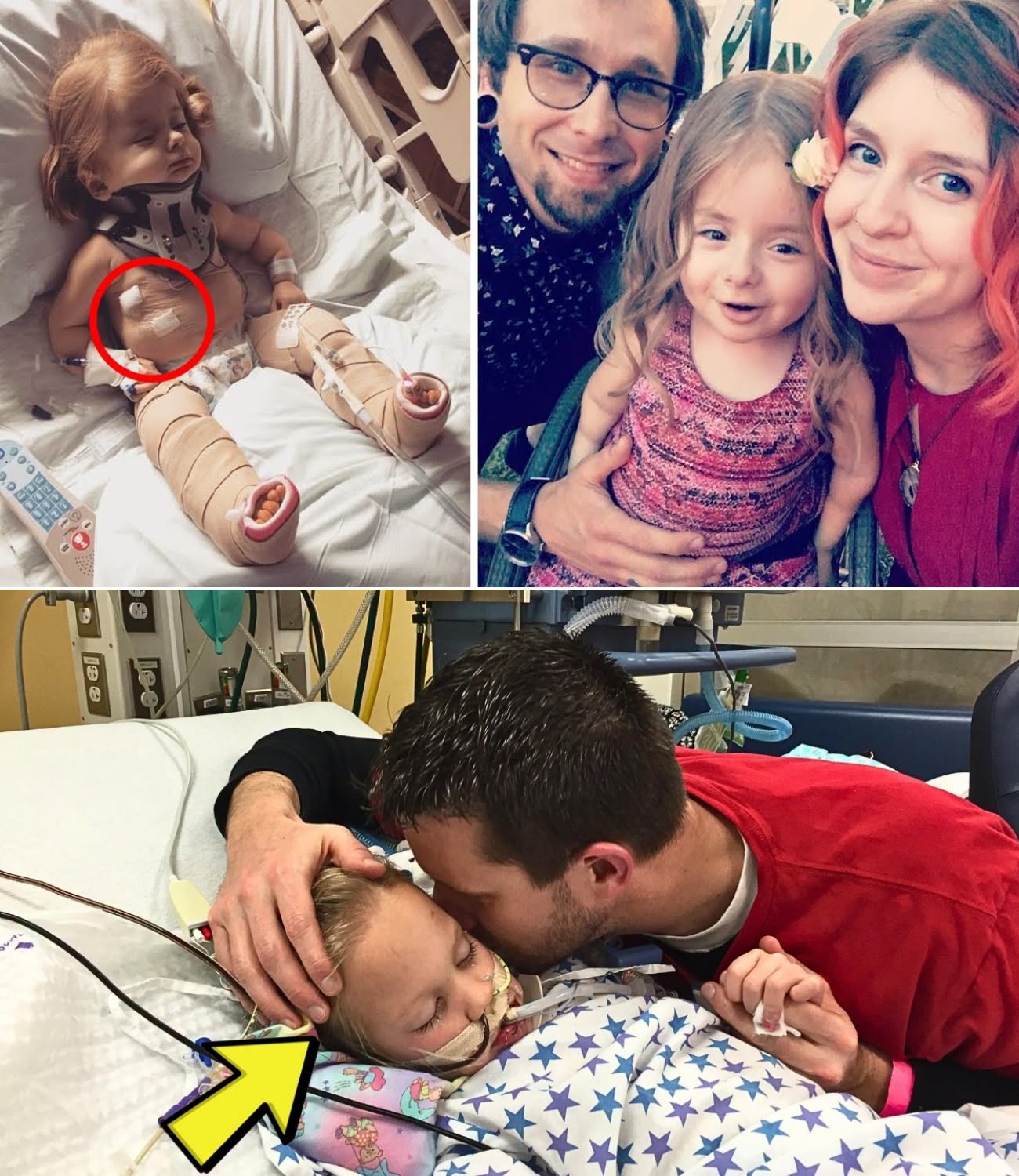
They kissed their beautiful baby girl, held her tiny hands, and tried to memorize every detail of her face. Her big brother Bobby was there, too, saying goodbye to the little sister he had only just begun to grow up with. The family took one final photograph together, a picture that was supposed to become a painful reminder of the daughter they had lost. Then the machines were switched off. Nobody in that room expected what would happen next. And when the doctors suddenly rushed back in, Lee and Francesca were about to witness something they would never forget for the rest of their lives.
But to understand how a family could go from preparing a final goodbye to facing an entirely different future, we need to go back to the beginning. Lee and Francesca lived in Clacton-on-Sea, a coastal town in Essex, England. Their life wasn’t perfect, but it was filled with the kind of happiness that makes ordinary days feel extraordinary. They had a loving relationship, a young son named Bobby, and a home where family life revolved around the usual chaos of raising a child.
Bobby was full of energy and curiosity. At 4 years old, he was the sort of little boy who wanted to understand everything happening around him. And when Francesca discovered she was expecting another baby, the family had one more reason to look forward to the future.
Then Bella arrived. For Lee and Francesca, their daughter was everything they could have hoped for. Their home suddenly felt different, fuller, and even more precious. Bobby had become a big brother, and the parents imagined all the things that were waiting ahead. Birthdays, holidays, first words, first steps, and all the ordinary memories families rarely realize they are lucky enough to have. They had no reason to suspect that their daughter’s childhood would soon become a desperate fight for survival.
Bella was only around 14 months old when her parents began noticing changes that frightened them. At first, the signs were easy to mistake for something less serious. She seemed unusually tired, and she developed a persistent cough that sounded increasingly worrying. Then, another strange symptom appeared. Her hair began falling out. Francesca started finding little clumps of hair in Bella’s crib.
Each morning brought another reminder that something wasn’t right. For a mother, watching your baby change in ways you cannot explain is terrifying. And the more the symptoms appeared, the more Lee and Francesca wanted answers. They also noticed that Bella was struggling to sit up properly. She wasn’t behaving as they expected, and the family could tell that something was affecting her strength.
Doctors initially suspected asthma. Bella was given an inhaler, and for a time, it seemed to help. The coughing became less concerning, and her parents had reason to hope that whatever was wrong might finally be under control. That summer, the family traveled to Spain. For a little while, life appeared to return to normal. There was sunshine, a holiday atmosphere, and the chance to enjoy time together away from the worries that had followed them for weeks. Lee and Francesca could concentrate on their children rather than wondering what might be happening inside Bella’s body.
Then, without warning, everything changed. Bella suffered a seizure. The family holiday suddenly became an emergency. Their little girl deteriorated rapidly, and her parents were forced to rush back to England, desperate to get her the medical attention she needed. The child who had been playing and spending time with her family was now facing a frightening medical crisis. At the hospital, the situation became increasingly serious. Doctors worked to stabilize Bella and investigate the symptoms that had troubled her parents for so long. Soon, she needed a ventilator to help her breathe.
Then came the diagnosis that changed everything. The medical team believed Bella might have mitochondrial disease, a group of rare disorders that interfere with the way cells produce the energy the body needs to function. Mitochondria are often described as the body’s tiny power stations. They help supply energy to cells, and when they do not work properly, organs with high energy demands can be severely affected.
The brain, muscles, and heart are among the systems that may suffer. Depending on the particular disorder, symptoms can include muscle weakness, seizures, breathing difficulties, and serious problems affecting multiple organs.
For Lee and Francesca, the explanation was terrifying. Their daughter was critically ill, and the condition doctors suspected could be life-threatening. They were told that Bella’s illness appeared advanced, and there was no straightforward treatment that could reverse the damage they believed had occurred. As the days passed, the situation became even more desperate. Her parents were told repeatedly that she might not survive. Each time they heard those words, they had to confront a possibility that no mother or father should ever have to imagine.
And yet, the doctors kept searching for answers. Something about Bella’s symptoms suggested that there might be another explanation. The team considered a different, extremely rare condition called biotinidase deficiency. It was a crucial possibility. Biotinidase deficiency is a genetic disorder that prevents the body from properly recycling biotin, also known as vitamin B7.
Without enough usable biotin, important processes inside the body are disrupted. The condition can cause seizures, muscle weakness, breathing problems, and other serious symptoms. The frightening part was that it could resemble other neurological or metabolic disorders. But unlike the devastating condition the doctors initially suspected, biotinidase deficiency can often be treated with regular biotin supplementation. When treatment begins early, affected children can frequently avoid the severe complications associated with the untreated disorder.
So, the medical team made a decision that could change Bella’s future. They would treat her with biotin. Her family had spent so long hearing how little hope remained that it was almost impossible to know what to expect. They wanted to believe the treatment might work, but Bella was already critically ill and nobody could promise them a happy ending. For a long time, she remained extremely unwell.
Then the doctors gave Lee and Francesca the news they had been dreading. They believed it was time to withdraw life-sustaining treatment. The date was set for July 21. The family gathered at the hospital knowing they might be spending their final hours with Bella. Relatives came to see her and say goodbye. Francesca later recalled how painful it was to watch people she had rarely seen cry break down in front of her. There was nothing anyone could say to make the moment easier. Lee and Francesca stayed beside their daughter trying to hold on to the little time they believed remained. Bobby was there with them, too. They took one final family photograph with the parents kissing Bella goodbye. Imagine the weight of that picture. It wasn’t meant to capture a milestone or a happy family occasion. It was meant to preserve a moment that Lee and Francesca could never bear to forget even though they desperately wished it had never happened.
When the time came, they couldn’t bring themselves to leave their little girl. They stayed close holding her and watching over her as the ventilator was switched off. Everyone in the room believed they were witnessing the end of Bella’s life. For several minutes, there was only waiting. Her parents had been told what was likely to happen. They had prepared themselves as best they could even though no amount of preparation could make losing a child bearable.
Then something happened that nobody in the room expected. Bella moved. Her mother had leaned down to kiss her daughter on the forehead. As she did, she felt Bella’s tiny hand relax against her own. But then, suddenly, the little girl gripped her mother’s finger hard and she began moving by herself. A cry followed. Not the sound her parents had been preparing themselves to hear in their memories of that terrible day, but the cry of a baby who was still alive.
The monitors began drawing attention. Staff heard the commotion and rushed back into the room. Lee and Francesca could hardly understand what they were seeing. The little girl they had just said goodbye to was now moving and crying. The doctors hurried to assess her condition. And then came the astonishing development that gave everyone in that room a reason to hope again. Bella’s oxygen levels were returning to normal. Only hours earlier, her parents had believed that they were about to lose her forever. Now, the medical team was urgently working to understand what was happening and what they could do next. The goodbye they thought was final had suddenly become something else.
But the biggest question remained, why had Bella’s condition been so devastating and what had changed? As doctors rushed to help Bella, Lee and Francesca were caught between disbelief and hope. They had been warned again and again that their daughter probably wouldn’t survive. They had gathered the family to say goodbye. They had watched as life support was withdrawn, believing there was no other option. And now, their baby girl was fighting to stay alive. The medical team worked urgently to stabilize her. Her parents stayed beside her, holding on to every sign that she was improving. Lee later described the desperate efforts to help his daughter, remembering how he sat next to her and held her hand. For the family, every movement mattered, every breath mattered. After everything they had endured, they were no longer thinking about the future they had imagined before Bella became ill. They were thinking about one thing, whether their little girl would get another chance.
As the doctors continued investigating, the possibility of biotinidase deficiency became increasingly important. Eventually, it became clear that the original suspicion of mitochondrial disease had been wrong. Bella’s illness was caused by biotinidase deficiency. That discovery changed the meaning of everything the family had been through. The symptoms that had seemed so mysterious, the seizures, weakness, breathing problems, and hair loss could be connected to a condition that doctors could treat with biotin. The vitamin treatment had offered a crucial clue.
Biotinidase deficiency is rare, but it is a condition in which early diagnosis can make an enormous difference. Babies diagnosed before symptoms develop can often grow up without the severe problems that may occur when the disorder goes untreated. Even children who have already developed symptoms may improve dramatically after receiving treatment, although recovery depends on the extent of the damage and the complications they have experienced.
Bella’s story also exposed a difficult reality about rare diseases. A condition can be treatable and still be dangerous if it isn’t recognized in time. Newborn screening practices vary between countries and have changed over the years. Where biotinidase deficiency is included in screening, affected babies can often receive treatment before they become seriously ill. But when a condition isn’t identified at birth, families may spend months searching for an explanation while the disease continues to affect the child.
For Lee and Francesca, those lost months had been terrifying. They had watched their daughter’s health deteriorate. They had taken her to doctors, followed the advice they were given, traveled to hospital, and listened as specialists explained why they feared she might die. Then, at the very moment they believed their story with Bella was ending, the diagnosis began opening the door to another possibility. She might live.
Her recovery did not mean the family could simply forget what had happened. Bella had been through an extraordinary medical crisis, and she would need ongoing care. Her condition required daily biotin, and continuing that treatment was essential. But there was now a future to protect. Instead of planning a funeral, Lee and Francesca could begin imagining their daughter’s life beyond the hospital. Instead of remembering only the last photograph they had taken together, they could make new memories with the little girl they had nearly lost.
And then Christmas arrived. That year, Christmas meant something entirely different to the family. For many people, the holiday is about presents, decorations, meals, and time spent together. For Lee and Francesca, it was a reminder that their family was still together at all. Bella was home. The little girl whose parents had once been told she probably would not survive was now back with her family, surrounded by the people who had spent so many painful days praying for her recovery. Bobby had his little sister back. Lee could hold his daughter at home rather than sit beside her hospital bed. Francesca could hear Bella’s voice and watch her grow. Knowing how close they had come to a completely different ending, the future was no longer something the family had to imagine without her.
Bella continued growing up with her daily medication and medical care remaining part of her life. But, the simple fact that she was there laughing, learning, and enjoying childhood meant more than words could explain. Francesca later described the joy she felt when Bella called her:
“Mom.”
After everything that had happened, even an ordinary word from her daughter carried a meaning that few people could fully understand. It was a reminder of the life they had nearly lost. And it was a reminder that the final photograph they had taken in the hospital had not become the last chapter of Bella’s story.
The family had gone into that room expecting to say goodbye forever. Instead, they were given the chance to take their daughter home and watch her grow. There is an important lesson in Bella’s experience. Though it isn’t that every impossible medical situation will end the same way. Serious illness can have many different outcomes, and not every child will recover as Bella did. Her story also shows why persistent symptoms deserve careful investigation, why rare conditions must be considered when the evidence points in that direction, and why an accurate diagnosis can be life-changing. For Bella, identifying the right condition made a difference. Biotin was not a miracle cure for every illness. It was the appropriate treatment for the specific disorder she had. She still needed it, and the family needed to make sure she continued receiving it.
But, after the fear, uncertainty, and grief of that summer, the family had something precious that once seemed impossible. More time together. A chance to celebrate birthdays. A chance to see Bobby and Bella grow up side by side. A chance to experience ordinary family days that had once seemed so far away. And Christmas became a celebration of that second chance. Lee and Francesca would never forget July 21. They would never forget the final photograph, the moment the ventilator was switched off, or the terrifying silence that followed. But, they would also never forget the moment Bella moved, gripped her mother’s finger, and began to cry. The moment the room changed, the moment the doctors rushed back in, and the moment a goodbye they believed was final became the beginning of a new chapter.
Sometimes, the most meaningful gift isn’t something wrapped beneath a tree. Sometimes, it is simply being able to sit around that tree with the people you were once afraid you would lose. That Christmas, Lee and Francesca had their daughter home. And for a family that had prepared to live without her, that was more than enough.
By Christmas, Bella was home. Her family could hardly believe it. Just months earlier, they had prepared to lose her. Now, she was back in their arms. Bobby had his little sister again. Lee and Francesca could finally breathe. Their Christmas felt different that year. The presents mattered less. The decorations mattered less. What mattered was having Bella there. She still needed biotin every day. She would need treatment for life, but she was alive, and she was growing. For Francesca, even hearing Bella call her:
“Mom”
…felt like a gift. She had nearly lost that little voice forever. Now, she could hear it every day. Bella’s story is a reminder that the right diagnosis can change everything. It also shows why doctors must keep searching when something doesn’t add up. Her family had said goodbye. Then, Bella gave them another chance, another Christmas, another birthday, another hug, another memory. And sometimes, the greatest miracle isn’t a perfect life. It’s simply getting more time with the people you love. That Christmas, Lee and Francesca didn’t need anything more. Their little girl was home.