They Opened a Toddler’s Casket Buried Beneath a Home Since the 1870s—What They Found Inside Left Everyone Stunned!
They Opened a Toddler’s Casket Buried Beneath a Home Since the 1870s—What They Found Inside Left Everyone Stunned!
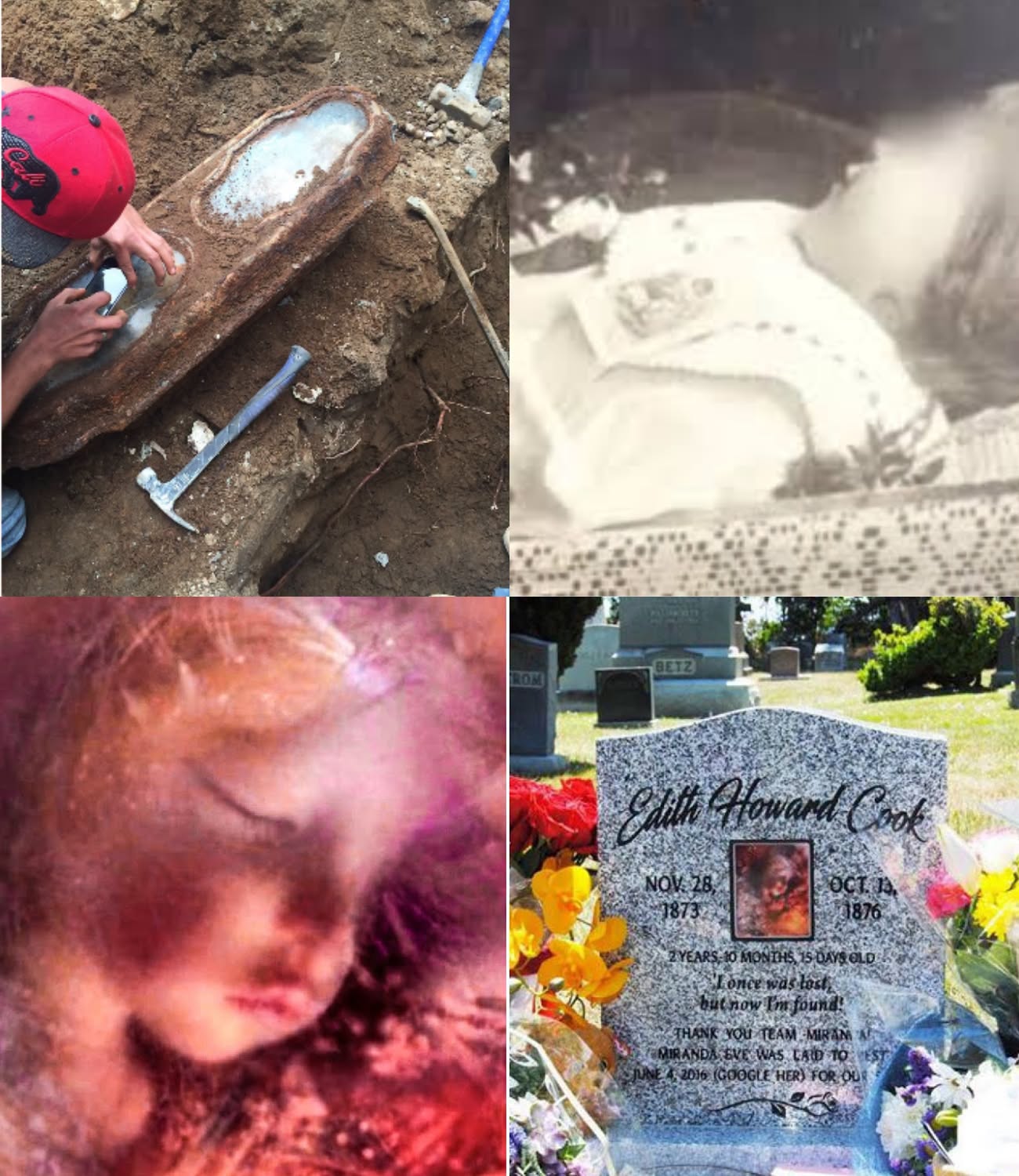
The story of a small, glass and cast-iron casket began in the 1870s at San Francisco’s Odd Fellows Cemetery. About 140 years later, last May, the story came back to life. A construction crew working at a home on Rossi Street, near the University of San Francisco, unearthed the sealed casket. Inside, they found a little girl with long blonde hair, wearing a long white lace dress. She had a cross made of flowers resting on her chest, and she was affectionately nicknamed Miranda Eve. Now, we know her real name is Edith Howard Cook.
Elissa Davey, a genealogist and founder of the Garden of Innocence project, reburied the little girl in Colma last year. Davey stated she was absolutely determined to discover the child’s true story, including the exact date of her death. Through the use of DNA, researchers successfully uncovered the girl’s identity and even tracked down a living relative.
Her name was Edith Howard Cook, the second-born child and first-born daughter of Horatio Nelson and Edith Scoofy Cook. She passed away on October 13, 1876, at the age of two years, ten months, and fifteen days. She was buried in a family plot in the Yerba Buena section of the Odd Fellows Cemetery on October 15, 1876.
Funeral home records indicated the cause of death was marasmus. Marasmus was a medical term widely used in the 1800s to describe severe undernourishment, a condition that could stem from various underlying causes that were either unknown or not fully understood back then. Given what we know today about urban living conditions in the late nineteenth century, an infectious disease is the most likely culprit behind her marasmus.
The remarkable discovery happened when a contractor doing remodeling work on the residence of John and Ericka Karner, located in the Lone Mountain neighborhood of San Francisco, uncovered the casket while excavating a section of their backyard. The medical examiner was immediately notified. After opening the casket, it was determined that the further disposition of the burial box and the young girl inside was legally the responsibility of the Karners. The casket itself was made of metal, measuring 37 inches in length, and featured two viewing windows in the lid. Because it was so tightly sealed, it perfectly preserved the body of the young girl it held.
Through the office of the public administrator, the Karners were put in touch with Elissa Davey, who arranged to take custody of the child. She quickly organized the transportation and care of the little girl in her original casket until a proper reburial could be scheduled. A new casket was specially built, into which the original one was carefully placed. The young girl, then still nicknamed Miranda Eve, was reburied at Greenlawn Memorial Park in Colma, California, on June 4, 2016, during a touching service attended by about 140 people. Another memorial was scheduled for June 10, 2017, at Greenlawn Memorial Park on El Camino Real in Colma, honoring Edith with a ceremony now that her true identity was known. The memorial service was set to begin at 11 a.m. and be open to the public.
“I actually asked my girls, I said, ‘You know, if you were to name a beautiful little girl, what would it be?’” Ericka Karner recalled.
“Miranda,” her daughter Katie answered without even questioning.
She had been buried there long before the area became a residential backyard. Of course, all the houses in that specific neighborhood were built directly on the former site of a cemetery owned and operated by the Independent Order of Odd Fellows. That cemetery had accepted burials from 1865 until about 1902. The interred were supposedly all exhumed in the early 1930s and transferred to Greenlawn Cemetery in Colma. Yet, for entirely unknown reasons, little Edith was left behind.
The research effort to identify her was incredibly complex, consisting of four general phases that frequently overlapped. A successful completion of each phase was strictly necessary to obtain a one-hundred percent positive identification. Initially, researchers sought a map or diagram of the cemetery exactly as it existed when burials ceased, but none could be found. Eventually, a scalable plan for the development of the cemetery dating back to 1865 was unearthed at the Bancroft Library at the University of California, Berkeley.
Using that historical document as a base, researchers initially identified two sections of the old cemetery that most likely corresponded to the location of the residence. Subsequently, several historical maps—including the original cemetery section drawings—were digitally layered atop one another. They were meticulously cross-referenced against old photographs to reveal a much clearer picture of which specific family plots likely intersected with the location of the backyard discovery.
Forensic examinations of the child prior to her reburial suggested she was aged two to four years old at the time of her death. DNA naturally preserved in her hair confirmed she was female, and the specific coffin style indicated a burial roughly 140 to 150 years ago. Any potential candidate had to qualify perfectly on all three counts. Surviving cemetery records and archived obituary notices were carefully utilized to research these strict criteria. In addition, the candidate would have had to be buried in a casket exactly matching the unique one discovered under the house. Confirming this final piece of information depended heavily on finding surviving funeral home records.
Researching the interments from those two overlapping cemetery sections eventually narrowed the vast search down to two highly likely candidates. Standard genealogical search methods were employed to find and thoroughly examine a massive number of records for relevant information, most of which was pulled from online genealogical databases. This was a profoundly labor-intensive effort. More than a thousand hours of intensive research was logged by three primary researchers, occasionally aided by dedicated volunteers, just to complete this phase of the project.
Living family descendants were eventually located for both candidates. Both descendants were contacted, and they agreed to provide DNA samples for comparison. One of these samples showed a remarkably good match to the DNA carefully recovered from the hair of Miranda Eve. Strands of her hair had been obtained right before her reburial specifically for this kind of advanced DNA testing, alongside an analysis of nitrogen isotopes conducted at the University of California, Davis.
“It’s likely that she was sick from some type of disease, and so she stopped eating and probably went into, you know, a coma, and then eventually passed away,” a researcher explained.
This finding is consistent with a chronic illness—unlike, for example, smallpox or an accident, where death typically occurred within weeks. With the cause of death officially listed as marasmus in the funeral home records found later for Edith Howard Cook, it all began to make sense. Whatever the specific root cause of her illness might have been—a bacterial infection seems most likely—it is absolutely certain that she died from the severe wasting characteristic of a marasmus diagnosis.
Her hair was also analyzed for traces of drugs like morphine and cocaine, which were surprisingly common components of medicinal treatments in the late 1800s, but the existence of these compounds could not be documented in her system. The analysis of nuclear DNA, which is inherited from both parents, definitively confirmed she was a girl—no Y-chromosome DNA fragments were present—and strongly suggested ancestral origins in Western Europe. Her complete mitochondrial DNA, inherited exclusively maternally, was assembled, revealing that she carried an H1a1e haplotype, a genetic signature most commonly found in the British Isles.
At the University of California, Santa Cruz, a critical analysis was performed comparing the ancient DNA extracted from the hair sample with the modern DNA obtained from the living male descendant of the prime candidate, Edith Howard Cook. They had secured a simple saliva sample from him.
“We’re confident enough to say, you know, with 99.9% certainty that a relative of this particular person… the living relative is Peter Cook,” scientists confirmed.
Edith’s grand-nephew, Peter Cook, is a direct descendant of her older brother, Milton H. Cook, and he lives in the Bay Area. The DNA was extracted from the hair samples inside the clean-room facilities at the university’s paleogenomics lab, utilizing standard ancient-DNA techniques. After careful sequencing, actionable data was successfully collected from about ten percent of the toddler’s total genome.
“From that ten percent of the sample, we were able to compare this to a candidate relative, and it turns out that the two are about 12.5 percent identical,” the research team noted.
The data showed the typical, expected patterns of old or ancient DNA. The genetic fragments were notably short, averaging only about fifty base pairs each, and they showed clear evidence of natural chemical degradation. The modern DNA sequence from Peter Cook was painstakingly compared to the historical data by examining the rate of matching at positions of rare DNA variants across the entire genome.
Excitingly, several long, contiguous sections were found where Peter Cook and the little girl matched at these rare genetic variations. They matched at a rate exactly expected for two people who share a very recent common ancestor. The historical data had no such matching segments when compared to dozens of negative controls—meaning the DNA data from entirely unrelated people. Further analysis of the matching regions definitively confirmed that these segments are bona fide “identity by descent” regions. In genetic terms, these are regions of the genome co-inherited directly from the exact same people—the parents of Edith Howard Cook.