Uncle and Niece Disappear While Camping – 5 Years Later, a BASE Jumper Discovers Their VW Amarok
Uncle and Niece Disappear While Camping – 5 Years Later, a BASE Jumper Discovers Their VW Amarok
The 49-year-old lived in Kempten and worked as a technician for a company in the Allgäu region that customized service vehicles, heavy mechanical parts, and special equipment for commercial clients. For years, Sebastian had naturally been a part of Lina’s life. He wasn’t a relative the girl only saw on holidays. He regularly went on little outings with her, stuck to agreements, and checked in if anything changed.
For Katharina, that was more important than grand promises. She knew how her brother worked and how he viewed responsibility. When Lina was with him, she didn’t have to keep checking in. Sebastian’s own life had not been easy in the years prior. Three years earlier, his marriage had ended in divorce.
The separation had weighed on him, but he had kept his job, managed his obligations, and hadn’t neglected contact with his family. By now, his life seemed more stable again. For some time, he had been seeing Nadin Falk, a 43-year-old administrative clerk from Memmingen. Katharina had the impression that her brother had found a steady routine again after a difficult phase.
The planned trip with Lina therefore fit perfectly into the image the family had of Sebastian. It was only meant to be an overnight stay. He had chosen an accessible area in the Upper Allgäu that he already knew and considered suitable for a short stay with a child. It was not a remote expedition or a spontaneous change of plans.
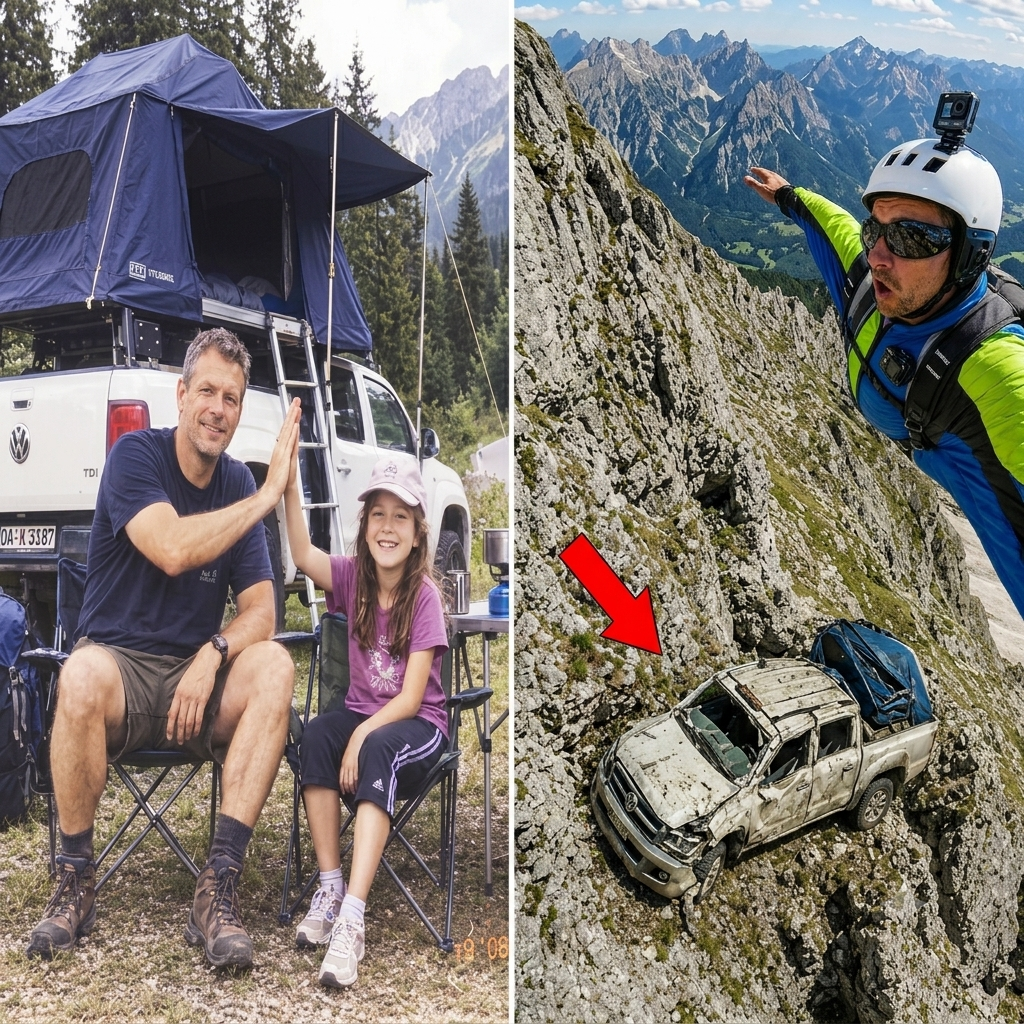
Lina was supposed to be back in Augsburg by the next morning, definitely by mid-morning. For the trip, Sebastian used his white Volkswagen Amarok. The vehicle had been modified in several ways and was suitable for short overnight stays. In the cargo bed was a dark blue tent structure that was easy to recognize.
For Sebastian, who worked professionally with vehicle conversions, such equipment was nothing out of the ordinary. To Katharina, the Amarok was simply her brother’s car. Only later would the distinctive appearance of the vehicle take on a completely different meaning. In the afternoon, Katharina and Markus drove to the intended overnight spot one more time.
It was around 3 o’clock. They wanted to make sure everything was prepared and that Lina had everything she needed. The visit was short and completely unspectacular. There was no argument, no discernible change of plan, and no indication that Sebastian intended to leave the location that same evening.
Katharina took a photo of Sebastian and Lina next to the Amarok. The white vehicle and its dark blue structure were clearly visible on it. At that moment, the image had no special value. It was an ordinary shot of an ordinary afternoon. No one thought about whether it might later have to prove when Sebastian and Lina were last seen safe.
Shortly thereafter, Katharina and Markus drove back to Augsburg. For them, the weekend had gone just like many others before it. Sebastian knew the area, Lina loved being with him, and the next day everything was to return to its normal routine. The first sign of deviation didn’t emerge until the evening.
Katharina tried to reach her brother by phone. She just wanted to briefly check if everything was okay. The call went unanswered. At first, that wasn’t unusual enough to trigger an alarm. In many parts of the Allgäu region in 2012, mobile reception was patchy. Markus considered poor reception the most likely explanation, and Katharina also knew a single missed call didn’t have to mean anything.
Later, she tried again. Again, no answer. That didn’t prove anything yet, but the situation had changed. Sebastian usually called back as soon as he had reception. Especially when Lina was with him, he kept Katharina briefly updated on any changes. He didn’t do it out of obligation, but because it was in his nature to take responsibility seriously.
Further attempts remained without result. There was no message, no callback, no notification that they had driven on earlier or changed their overnight spot. Katharina and Markus went through the obvious possibilities. Maybe the battery was dead. Maybe the phone was left in the vehicle. Maybe Sebastian had spontaneously decided to drive a bit further and was in a dead zone.
Every single explanation was possible. Taken together, however, they seemed increasingly off, because in none of these cases had Sebastian left any message. The uneasiness therefore did not stem from a single unusual detail. It arose from the combination of small deviations. One unanswered call was meaningless. Several unsuccessful attempts were more noticeable.
The fact that Sebastian didn’t call back afterwards was already less like him. The fact that there was no message about a change of plans made it harder to explain. Late in the evening, Katharina and Markus decided to drive back to the Upper Allgäu themselves. Up to that point, there was no concrete evidence of a crime.
There was no emergency call, no warning, and no message from a third party. Everything could still have had a harmless cause. That is precisely why they wanted to check for themselves first if Sebastian might have had a technical issue or was simply outside mobile coverage. When they reached the agreed-upon overnight spot, Sebastian was not there.
Lina was not there either. The white Volkswagen Amarok was also missing. With that, the situation changed once again. Sebastian could have left the spot voluntarily. That was basically possible. But the camping gear had disappeared along with the vehicle. There was no bag, no piece of clothing, and no other item to indicate that anything had ended in a rush.
At the same time, no one knew where Sebastian would have gone. Katharina tried to reach him again. No answer. Nadin hadn’t received any word of a change either. No one in the family knew of a second destination. Sebastian hadn’t announced plans to return later or take the LINER anywhere else.
The empty spot was therefore not the truly unsettling part. What mattered was that every simple explanation raised a new question. If Sebastian had driven off voluntarily, why hadn’t he informed anyone? If something had happened to the Amarok, where was the conspicuous vehicle? If he had decided spontaneously to spend the night elsewhere, why was he still unreachable?
That same night, Katharina and Markus turned to the police. The initial facts were brief. Sebastian Krüger, 49, had driven to the Upper Allgäu for a one-night stay with his eight-year-old niece, Lina Weiß. He was supposed to bring the girl back the next morning. He hadn’t been reachable since the evening.
The white Volkswagen Amarok with the dark blue camper unit was also gone. Because a child was involved, the missing persons report was immediately given high priority. Nevertheless, the case couldn’t be clearly categorized in those first few hours. Sebastian was an adult man with his own vehicle. An accident was possible, as was an unplanned departure.
Technical problems could not be ruled out either. At that point, there was no direct evidence of a crime. Just as little, however, was there a logical reason for Sebastian to voluntarily disappear with Lina. His divorce was three years in the past. He had a steady job. His family obligations were settled.
He had started a new relationship with Nadin. There was no conflict between him and Katharina that could explain why he would take her daughter anywhere without consultation. Thus, the police were initially left with only the last known situation. In the afternoon, Sebastian had been at the planned overnight spot with Lina. Katharina had taken pictures of them both.
A few hours later, Sebastian was no longer responding. When the parents returned, the two, the Amarok, and all the gear were missing. There was nothing more. That is precisely what made the matter unusual. If the Amarok had still been at the spot, the search could have started in the immediate vicinity. If pieces of equipment had been left behind, they might have indicated a hasty departure.
A damaged bag, a phone, or any personal item would have at least provided an initial direction. But there was nothing to suggest a direction. For Katharina and Markus, this meant they had no certainty about anything that night. They did not know if Sebastian was still on the road with Lina. They did not know if an accident had occurred. They did not know if someone else was involved.
They knew the agreed-upon plan had been broken and that their brother was not behaving the way he always had before. Even the photo from that afternoon suddenly took on a different meaning. Only a few hours earlier, it had been just a casual snapshot. Now, it was the last confirmed record showing Sebastian Krüger and Lina Weiß together.
The police now had a clear starting point, but no trail. A man had vanished. An eight-year-old girl had vanished. And along with them, a white Volkswagen Amarok with a dark blue canopy was missing—a vehicle that should have been distinctive enough to be spotted somewhere. On that first night, there was no perpetrator, no explanation, and no proof that a crime had even taken place.
But with every passing hour, it became harder to believe the alternative: that Sebastian Krüger had simply forgotten to check in. The next morning, the search for Sebastian Krüger and Lina Weiß began on a significantly larger scale. Because an eight-year-old child was missing and a distinctive vehicle was gone, police and rescue teams did not treat it as a standard case of a late return.
Initial measures focused on the area around the agreed-upon overnight spot and the roads Sebastian could have used from there. Mountain rescue, search dogs, and additional emergency personnel were brought in. They also searched from the air for the white Volkswagen Amarok with the dark blue canopy. The most obvious explanation remained an accident.
Sebastian knew the area, but even experienced drivers could make a mistake on narrower roads or run into trouble due to a mechanical failure. If the Amarok had gone off a road somewhere, there had to be tracks. Therefore, accessible routes, turnoffs, and less frequently used access roads were checked. Yet, that was exactly where the first major problem arose.
There was no damaged roadside, no discarded vehicle parts, and no indication that a car had veered off a drivable route. The Amarok itself was not discovered either. A large white vehicle with a dark blue canopy should have been noticeable on many open stretches. Nevertheless, no one reported a confirmed sighting.
Thus, the accident theory remained possible, but it was not confirmed. In parallel, investigators checked Sebastian’s phone. The data showed that his mobile device had still been active that afternoon. After that, all traceable usage stopped abruptly. There was no later call, no sent message, and no further contact that could explain where Sebastian had gone with Lina.
His financial trail also went cold. His bank cards were not used. There were no cash withdrawals or payments that would have pointed to a gas station, hotel, or any other place they might have stayed. For a man who intended to continue traveling with a child voluntarily, this was suspicious. A planned long-term absence would have required at least some form of preparation.
At the same time, this finding was not enough to assume a crime had been committed. A switched-off or damaged phone didn’t explain anything yet. The lack of card payments could also have had other reasons. The investigators therefore had to keep various possibilities open. This was less about police uncertainty and more about the simple fact that solid evidence was missing.
For Katharina and Markus, that was exactly what was so hard to bear. Every new piece of information seemed important at first, only to lead to the same void shortly thereafter. The car had not been found. The phone provided no leads on their direction. The bank records gave no indication. No one had reliably seen Sebastian and Lina after that afternoon.
The investigation therefore turned more toward Sebastian’s personal life. His divorce was re-examined. Officers checked whether there had been financial burdens, unresolved conflicts, or other reasons that could have driven Sebastian to disappear suddenly. But even there, no convincing picture emerged. The separation had been three years ago. He had kept his professional situation stable and continued to meet his obligations.
Nadin Falk was also questioned. Based on what was known at the time, the relationship between her and Sebastian did not appear to be an immediate trigger for a voluntary disappearance. There was no known argument, no planned separation, and no indication that Sebastian wanted to secretly abandon his life. Nadin knew as little as Katharina about where he might have gone.
Nevertheless, the investigators had to examine a possibility that was particularly distressing for the family. Sebastian had been the adult who had taken Lina with him. As long as no third party, no accident, and no crime scene could be proven, it could not be completely ruled out that he had decided on his own to vanish with his niece.
Legally and procedurally, this possibility could not simply be dismissed just because the family considered it unthinkable. For Katharina, this assumption was particularly difficult to accept. She knew her brother’s difficult years, but nothing about them fit the idea that he would intentionally keep Lina away from her parents. Above all, there was no preparation.
Sebastian had neither withdrawn money nor settled his personal affairs. He had not told anyone he was planning a fresh start. His work, his relationship, and his life as he knew it remained unchanged. Precisely because the investigation found no clear direction, initial speculations arose outside the official search. Local reports began discussing Sebastian’s divorce.
Individual theories raised the question of whether he might have been more mentally burdened than his family had assumed. Others thought it was the case that he had spontaneously driven off with Lina. None of these assumptions were based on any new evidence. For the family, this made the situation even more difficult. Katharina and Markus not only had to live with the uncertainty about Lina, but also with Sebastian’s role being publicly questioned.
They couldn’t prove anything. They could only repeat what they had experienced over the years. Sebastian had been reliable, especially when Lina was with him. The police continued working on the more practical possibilities. Roads were checked again. Tips from the public were evaluated. Reports about white SUVs were investigated, but led to no results.
Some observations referred to vehicles that clearly had different license plates or different bodywork. Others could not be reconciled with the timing of the disappearance. The more leads that were checked, the clearer a problem became. The Amarok was conspicuous enough to be searched for, but not unique enough to make every sighting automatically meaningful.
Almost three weeks after the disappearance, hope for a concrete lead emerged for the first time. In an area several kilometers from the campsite, tire tracks were discovered leading from a less-used path toward a mountain stream. The location at least allowed for the possibility that a vehicle could have gone off the track there. The area was examined more closely.
Below the water’s surface, a technical search device showed a large metallic structure. For the investigators, this was the first finding in days that could be directly verified. If it were the Amarok, the search might have found an explanation, however painful that would have been. Specialized units were brought in.
The recovery proved to be laborious. Only after closer inspection did it become clear that the metal object was not Sebastian’s vehicle. Underwater were old machines and metal parts that had apparently been illegally dumped long before. The tire tracks could also not be attributed to the Amarok with sufficient certainty. With that, the most important new lead disappeared.
For Katharina and Markus, this failure was particularly burdensome because it had briefly created something that had been missing in the previous weeks. A concrete possibility. Even a terrible certainty would have meant some direction. Instead, after the recovery, all that remained was the original question: Where were Sebastian and Lina?
The search continued, but as time went on, the possibilities changed. Large-scale search operations could not be sustained at the same level indefinitely if no new leads emerged. The emergency teams had checked the accessible areas multiple times. The known roads and paths had been investigated. Technical data provided no new movement.
With the colder months, the large-scale measures were eventually reduced. The case remained open. That did not mean that the police considered the disappearance solved or would stop responding to leads. But the constant search with numerous personnel could not continue without a new approach. An acute missing persons case was slowly beginning to turn into an unsolved long-term case.
For Katharina and Markus, there was no such transition. For the authorities, responsibilities, deployment levels, and priorities changed. For her parents, Lina remained the same missing eight-year-old every morning and every evening. They had no message, no goodbye, and no evidence that allowed them to form a final idea of her fate.
Sebastian also remained missing. The initial questions about his possible responsibility did not disappear entirely, but they were also not supported by evidence. There was still nothing that showed he had prepared for an escape. Just as little was there a find that proved something had happened to him and Lina. This uncertainty defined the following months more strongly than any single theory.
Katharina and Markus decided against holding a funeral service for Lina. For them, there was no death that they could confirm. As long as there was no evidence, their daughter remained missing. That was not hope in the simple sense. It was the refusal to accept a final answer that no one could provide. At the end of the first winter, the investigators were therefore faced with an unusually empty case.
They had a last known location. They had a photo of Sebastian and Lina. They had the data from a phone that had suddenly gone silent. They had a white Volkswagen Amarok that had not been found anywhere. What they did not have was a trail explaining how two people and a large vehicle could completely vanish from their known lives within a few hours.
And the longer this trail was missing, the harder it became to accept an idea that had been self-evident at the beginning: that a simple explanation was waiting to be discovered somewhere nearby. For almost 5 years, nothing changed regarding the decisive question. Sebastian Krüger and Lina Weiß remained missing, as did the white Volkswagen Amarok with the dark blue roof tent. Leads continued to be registered and checked, but none led to a result.
For the investigating authorities, the case was no longer an acute search operation but an unsolved missing persons case that could only be set in motion again by a new, concrete lead. For Katharina and Markus, this administrative change had little meaning. Lina was still their daughter who one day had not returned. In the summer of 2017, this new lead came from a direction that no one had associated with the case.
Felix Hartmann was 34 years old and had spent years involved in technical mountain climbing and sports filming. He knew challenging routes and regularly used a small camera during his trips to evaluate individual sections later. He didn’t use the footage to search for missing persons. Like many in Bavaria, he’d heard of Sebastian and Lena, but the case wasn’t part of his trip.
One day in July, Felix was on a rarely used route in a Bavarian mountain area. The area was well outside the zones that had been the focus of the search five years earlier. For that very reason, there was no initial cause to link it to the old missing persons case. It was only when reviewing his camera footage later that Felix noticed something.
In a short section of the material, a shape was visible below his route that didn’t fit the natural surroundings. The clip lasted only a few seconds, and the object was far from any normal access path. At first glance, it was hard to tell what it actually was. Felix reviewed the segment again. The shape seemed too regular for a boulder or deadwood.
Furthermore, two colors were visible that seemed unusual in that spot. A light area and, right next to it, a darker blue. He zoomed in on individual frames. After that, it was clear that a vehicle was lying there. It was heavily damaged and only partially visible from the original perspective. Still, parts of a white bodywork could be distinguished.
On one part of the wreck, there was also dark blue material whose original function couldn’t be determined for sure. For Felix, only one thing was obvious at first. A vehicle didn’t belong in that location. The discovery site was striking because it wasn’t right next to a normal road. A car couldn’t have just been parked there.
If it really was a vehicle wreck, it had to be determined how it got there and if the accident was already known. Felix therefore passed the information to the authorities and provided the video footage and location data. What initially seemed like the report of an old, perhaps long-registered accident quickly took on a different meaning. During the first check, the officers noticed the combination of a white vehicle and dark blue material.
In the files on unsolved vehicle discoveries and missing persons cases, there was an entry matching these exact details. Sebastian Krüger’s white Volkswagen Amarok with the dark blue tent attachment. After five years, this combination was still unusual enough to justify a close examination. Investigators compared available images with older photos of the Amarok. Due to the heavy damage, a positive identification could not be made from the video alone.
However, the shape and proportions of the vehicle were consistent with the missing car. The dark blue material was also in a spot where parts of the old camping setup could have been. Just like that, a random observation had turned into a possible lead. The difficulty now lay in reaching the vehicle. The location was in a spot inaccessible to ordinary vehicles.
Direct investigation by a regular police patrol was also ruled out. Therefore, a technically specialized mountain rescue unit was brought in. Together with the police, they were to secure the area and enable an initial investigation. For the officers, only one question was initially crucial. Was it actually Sebastian’s Amarok?
After preparing access, the first responders were able to examine the wreck more closely. The condition of the vehicle showed that it had been lying there for a long time. Many exterior features were altered by damage and years of exposure to the elements. Nevertheless, the investigators found an area of the vehicle where the identification number was still readable.
The number was cross-referenced with data from the missing persons case. The result left no room for doubt. The car belonged to Sebastian Krüger. After almost 5 years, this was the first significant item found from the original case. The very vehicle whose disappearance had posed one of the investigators ‘biggest mysteries since 2012 was located far outside the original core search area.
For Katharina and Markus, this news initially brought no answer, but a new form of uncertainty. The discovery confirmed that Sebastian’s journey had eventually led far away from the agreed-upon overnight stop. But it did not yet explain why. Even less did it answer the question of what had happened to Sebastian and Lina. Therefore, the next examination focused on the interior of the Amarok.
After a crash or serious vehicle accident, one would have expected at least some clues about the occupants to be found there. Even after 5 years, human remains, personal items, or other traces could have provided information as to whether Sebastian and Lina were in the vehicle during the crash. But the car contained no human remains. Neither Sebastian nor Lina were found.
Closer investigation of the area around the vehicle also yielded no findings indicating that two people had been thrown from the car during the crash. There was no definitive trace of clothing or personal items that could be attributed to Sebastian or Lina. This finding fundamentally changed the case. Up to this point, the idea of an undiscovered accident had always been one of the plausible possibilities.
The Amarok could have veered off the road on a remote stretch and remained overlooked for years due to its difficult location. The discovery of the vehicle even seemed to confirm this theory at first. But a deeper look raised a different question. If Sebastian and Lina were not in the Amarok when it reached its final resting place, it had to be explained why their vehicle was there.
The investigators therefore examined not only the wreck but also the higher area from which it could have fallen. In doing so, an old technical access road was identified. It was originally used for maintenance work and played practically no role in normal road traffic. It had not been among the primary routes checked during the 2012 search either. The location of this access road matched the position of the truck.
Reconstructions showed that the Amarok could have reached the lower-lying area from there. The vehicle therefore did not have to travel over any of the roads where search teams had looked for accident traces five years earlier. There was a route far enough outside the search area at the time to remain undiscovered. This explained for the first time why neither road checks nor search flights in 2012 had found the car.
But this explanation simultaneously intensified the actual mystery. Sebastian had no known reason to drive there with Lina. The technical access road did not lead to the agreed-upon overnight stop or the route back to Augsburg. There was also no known plan to visit this remote area. The experts therefore examined the vehicle’s position and the possible course of its descent more closely.
According to their preliminary assessment, it was highly unlikely that the Amarok had accidentally left a normal road at that exact spot during a routine drive. The vehicle must have first reached the upper section of the old access road. How it subsequently went over the edge could not yet be definitively answered at that time. The investigators therefore avoided jumping to any hasty conclusions.
There was still no proof as to who had brought the Amarok there. Just as little could it yet be proven whether Sebastian had driven the vehicle himself or if another person had been involved. The find allowed for a new hypothesis, but not yet a final conclusion. However, one fact could hardly be overlooked anymore. The accident, which had been searched for for weeks in 2012, could no longer simply explain the case.
Had Sebastian crashed in this Amarok with Lina, the investigators would have expected at least traces of both of them. Instead, they found a vehicle in a hard-to-reach place far outside the original search area and no indication that its two missing occupants had been inside during the crash. Thus, the most important piece of evidence in the case simultaneously transformed into its biggest new problem.
For 5 years, the police had searched for the missing Amarok because they hoped its discovery would explain what had happened to Sebastian and Lina. Now the car was found, and instead of providing an answer, it clearly showed for the first time that the disappearance had likely been more complicated than investigators assumed in 2012. The investigation was not finished with that.
In a certain way, it was starting all over again. For the first time in years, there was again an actual location, a real vehicle, and traces that could be examined. For Katharina and Markus, that still did not mean certainty about Lina. But after almost five years without a single reliable lead, there was finally something again that could be verified.
The white Amarok was no longer missing. Sebastian and Lina still were. And that exact difference suddenly turned an old missing persons case back into an active investigation. The examination of the found Volkswagen Amarok took on new significance after the vehicle’s identity was confirmed. As long as the car was considered a potential accident vehicle, the main question was whether Sebastian Krüger and Lina Weiß had been inside during the crash.
After no evidence was found for this, the investigators’ task changed. Now it had to be clarified how the Amarok got to this location in the first place and whether the damage to the vehicle could have been caused solely by the crash. Even before larger parts of the wreck were recovered, the experts documented the damage as completely as possible.
After nearly five years, much had been altered by corrosion, material fatigue, and the consequences of the impact. For this very reason, a distinction had to be made between later damage and traces that might have already been present before the crash. That was difficult, but not impossible. The rear bumper zone was particularly noticeable.
There were several deep, nearly horizontal damages whose course did not fully match the assumed movement of the vehicle during the crash. Some scratch and pressure marks were located in areas that, according to the experts ‘ assessment, could not easily be explained by contact with the ground. Individual areas were severely deformed by the impact, but older traces were still recognizable beneath this later destruction.
For the first time, this raised the possibility that the Amarok had already been damaged before the crash. The investigators initially avoided any further interpretation. Contact with another vehicle was only one of several conceivable explanations. The Amarok could have struck a technical structure while maneuvering. It could have been damaged previously at another location.
It was also conceivable that the position of the wreck made the traces appear more complicated than they originally were. But laboratory testing yielded a finding that made this restraint more difficult. Residues of a gray coating material were found in several deep scratch marks on the rear part of the vehicle. The composition differed significantly from the Amarok’s standard factory paint.
In addition, very small metallic particles were secured whose material properties did not belong to the affected vehicle parts. That alone did not prove where the residues came from. However, chemical analysis showed that the gray coating was a durable epoxy resin paint, such as is used for heavily stressed industrial components. Such coatings were suitable for machinery, heavy support structures, technical protection systems, and special vehicle attachments.
This material was untypical for ordinary car paint. The metal particles also matched durable steel alloys, such as those used in reinforced technical components. This made the original accident assumption even more problematic. The experts reconstructed the position of the Amarok once again, along with the potential direction of the fall and the location of the old service road above the discovery site.
If the vehicle had plunged from there under its own momentum, its movement would have been expected to result in specific damage patterns. However, the deep horizontal marks on the rear could not be adequately explained by this. Another possibility fit better. The Amarok could have been parked at the end of the access road while a second, heavier vehicle exerted pressure on it from behind.
An ordinary bumper would not have been suitable for this. What would have been necessary was a reinforced front construction, such as a heavy brush guard or a pushing device designed for industrial use. This explanation connected several previously separate elements for the first time. The position of the wreckage argued against a normal traffic accident.
The absence of Sebastian and Lina in the vehicle also argued against a shared crash. The damage to the rear now indicated contact that had possibly occurred before the fall. And the foreign material apparently originated from a technical field with which Sebastian had been professionally familiar. With that, his workplace was brought directly into the investigation for the first time.
Sebastian had worked at a company that customized service vehicles and technical vehicles for commercial clients. Their offerings also included reinforced bumpers, mounts, protective structures, and individual solutions for vehicles used in harsh conditions. Some of these components were treated with resistant industrial coatings. Investigators compared material data from the laboratory with the company’s records.
The epoxy resin paint used was known there. This did not mean that the residues found on the Amarok undoubtedly came from this specific company. Such coatings were also used by other firms. But the match was close enough to re-examine the workflows and vehicle modifications from 2012. This gave the case a direction that no one had seriously pursued five years earlier.
During the initial missing persons search, Sebastian’s workplace had been checked, but primarily with a focus on his personal background. Colleagues had described him as reliable. No serious disputes had become known. No one had mentioned a concrete professional conflict that could have fit his disappearance. Because there was no indication of a specially modified second vehicle at the time, it had not been systematically investigated who could have built or used such constructions at the company.
Now the question posed itself differently. Who possessed the technical knowledge to construct or adapt a heavy front structure? Who had access to the necessary materials for that? And who might have given Sebastian a reason to feel threatened outside of work? The renewed interviews with former and current colleagues did not initially reveal a clear motive.
Sebastian had been professionally respected and had no known dispute that could suddenly emerge as a possible explanation five years later. Many statements largely matched what investigators had already heard back in 2012. Therefore, Nadin Falk was questioned again. Five years earlier, her relationship with Sebastian had provided no obvious leads.
She had reported no serious conflict and had not named anyone she considered dangerous. Now, however, it was no longer just about Sebastian’s own behavior. Investigators wanted to know if anyone in his professional environment had reacted unusually strongly to his relationship with Nadin. In this context, she remembered Tobias Rem.
Tobias was now 44 years old and had also worked at the company back then. He was considered technically highly capable and was especially familiar with custom metal structures, vehicle frames, and reinforced attachments. Complex solutions that could not be taken from a standard catalog were precisely his area of expertise. That alone did not make him a suspect.
A different piece of information was decisive. Nadin reported that, during her relationship with Sebastian, Tobias had shown an interest in her that she found uncomfortable in retrospect. There had been no relationship between her and Tobias. Nevertheless, he had repeatedly taken an interest in her and asked conspicuously often how Sebastian was doing privately.
At the time of the disappearance, this had not been understood as a possible context for the crime. Sebastian himself had apparently not derived any serious danger from it. To him, Tobias had been a difficult, reserved colleague whose behavior seemed annoying rather than threatening. There had been no documented dispute and no incident in which Sebastian had involved the police or his employer.
But after the discovery of the Amarok, the same information looked different. The investigators spoke to several former colleagues again. Individual memories aligned with Nadin’s account. Tobias had inquired about the relationship between Sebastian and Nadin. He had wanted to know if they spent weekends together and where Sebastian went in his spare time.
Some employees also recalled that Tobias had commented on Sebastian’s increasingly stable private life with noticeable irritability. Even that was not yet proof of a crime. Envy, rejection, or a one-sided fixation did not automatically make someone a perpetrator. Investigators therefore had to carefully distinguish between a possible motive and an actual connection to the disappearance.
But suddenly, Tobias fit into several areas that had previously been separate. He knew Sebastian. He knew his professional skills and vehicles. He himself possessed the knowledge to manufacture reinforced bumper or protection systems for heavy vehicles. He worked in a facility that used a coating compatible with the residues on the Amarok. And he had apparently developed a personal interest in Nadin while she was with Sebastian.
For the first time since the vehicle was recovered, there was a name that could be linked to both the technical trail and a possible personal motive. Nevertheless, a crucial gap remained. There was no witness testimony placing Tobias near the overnight spot on the evening of the disappearance. No one could confirm that he had met with Sebastian at that time.
Likewise, any proof was missing. That Tobias knew the old service base or had been there. The five years that had passed since the disappearance made these questions even harder to answer. Memories had become more unreliable. Work documents had been partially archived or were long out of daily use. Vehicles had been sold, converted, or replaced.
Even a potential technical construction could have vanished in the meantime. The police therefore did not yet have a solid case against Tobias Rem. They only had a new lead. However, this lead was significantly more concrete than anything that had been available since 2012. The traces on the Amarok now linked a possible technical sequence of events to Seb’s professional environment for the first time.
And within that environment, there was Tobias—a man in whom technical expertise and a possible personal motive intersected. For Katharina and Markus, this brought no relief. For 5 years, they had lived with the possibility that an accident had left no traces. Now, for the first time, the suspicion seriously arose that the disappearance was not the result of a mistake or coincidence.
If the Amarok had indeed been intentionally placed where it was found, someone must have made decisions after the last photo that were designed from the start to cover their tracks. But even this realization did not answer the most important question. There was still no certain indication of what had happened to Sebastian and Lina. And Tobias Rem was also, at this point, just a man whose name was suddenly appearing in too many places to ignore.
What the investigators were still missing was the one piece of evidence that could turn a suspicion into a verifiable link —proof that Tobias had actually been where Sebastian and Lina disappeared that night. The investigators now had a name, a possible motive, and a technical connection. But that was not enough. Tobias Rem could fit the traces on the Amarok perfectly, but as long as no one could prove he was actually near Sebastian Krüger and Lina Weiß on the evening of the disappearance, the suspicion remained just that—a suspicion.
Therefore, the investigation focused once again on the company where Sebastian and Tobias had worked together in 2012. This time, it wasn’t just about employees, tools, or materials. The investigators wanted to know which vehicles had been used back then, how their missions were documented, and whether any technical records still existed that no one had considered significant 5 years prior. In doing so, they stumbled upon an area that had barely played a role in the original missing persons case in 2012.
The company maintained several heavy service vehicles for field operations. They were used for repairs, transporting materials, and working on commercial facilities. For internal management purposes, some of these vehicles had already been equipped with GPS systems back then. The company primarily used the data to track operating times and distances driven. Because there had been no concrete evidence of a company vehicle’s involvement during the initial investigations, these records had never been systematically cross-referenced with Sebastian’s disappearance.
The crucial question now was whether the old data even still existed. Part of the original systems had long since been replaced. Vehicles had been exchanged, software updated, and internal processes changed. But the company had archived older datasets as part of their technical documentation. Not everything was complete, but enough had been preserved to still track individual vehicles from 2012.
For the investigators, this was the first lead that connected Tobias not just to a motive or a professional skill, but potentially to a specific location. They focused on the service vehicle that had been regularly assigned to Tobias at the time. It was a heavy company vehicle used for technical field operations that could be equipped with a reinforced front end. That alone was not yet suspicious.
Several of the company’s vehicles had similar capabilities. The decisive question was where this vehicle had been driven in the weeks before Sebastian’s disappearance. The evaluation began with the data from before the camping weekend. At first, the movements seemed unremarkable. Tobias drove to clients, workshops, and technical job sites. Many routes could be explained by work orders.
But between these regular trips, individual positions appeared that did not fit the documented assignments. Furthermore, the service vehicle assigned to him had been in areas that Sebastian regularly visited in his free time. A single visit could have been a coincidence. A second one as well. But the repeated proximity to places associated with Sebastian’s private habits could no longer be explained so easily.
The times fell outside of clearly documented work shifts. For some of these trips, there was no corresponding work order. This gave Nadine’s earlier statement a new meaning. She had reported that Tobias had repeatedly asked about Sebastian’s weekends and private activities. Previously, this had been viewed as unpleasant personal interest. The GPS data now suggested that he might not have just been asking.
He might have been trying to actually track Sebastian’s routines. The investigators still had to remain cautious. It still could not be proven that Tobias had deliberately followed Sebastian. A company vehicle could have been driven by several people. Technical inaccuracies in older GPS data also had to be taken into account. Therefore, duty rosters, shift logs, and internal vehicle assignments were compared with one another.
The more documents that were brought together, the tighter the connection became. On several of the days in question, Tobias was indeed registered for this exact vehicle. This left the possibility of a coincidence, but it became increasingly difficult to explain. Then the investigators analyzed the data from the day of the disappearance. On the afternoon of the day in August 2012, the service vehicle was initially in an area consistent with regular operations.
Later, the route changed. The vehicle moved in the direction of the Oberallgäu, not just generally toward that region. The stored positions led to the vicinity of the area where Sebastian and Lina had planned to spend the night. For the first time, there was a technical dataset connecting Tobias to the area surrounding the last known location. But the records continued.
Later that same night, the company vehicle moved deeper into the area. The route did not correspond to a normal drive back to a client or to the company. Instead, it led toward that old service access road that investigators had only identified after finding the Amarok. Exactly there, above the spot where the wreck was discovered nearly 5 years later, the GPS registered the vehicle again.
Then it stayed there. For about three-quarters of an hour, the position did not change significantly. After that, the vehicle started moving again. These data changed the case more than any testimony from previous years. Until then, investigators had suspected that a heavy vehicle might have been involved with the Amarok. Now there was a company car from Sebastian’s own work environment that had been registered both near the campsite that night and later at the access road above the scene.
And this car was assigned to Tobias REM. The investigators checked the data multiple times. They compared the stored coordinates with the system’s technical maps, verified the accuracy at the time, and had it confirmed that no tampering with the archived records was detectable. The old data were not perfect, but sufficient for the decisive location details.
Coincidence thus became increasingly unlikely. Tobias had no documented professional reason. to be at the old service access road that night. No company assignment was recorded there either. Even more weight was given to the fact that the company car’s position matched exactly the point from which experts estimated the Amarok must have gone over the edge. The technical trace on the rear of the Amarok and the digital trace of the service vehicle began to form a consistent story for the first time.
But the investigators kept looking for a second confirmation. They checked the service vehicle’s maintenance records from that time. There, too, they found an entry that had previously received no attention. A few days after the disappearance of Sebastian and Lina, the front bumper or protective assembly of the vehicle assigned to Tobias had been replaced. The reason given was damage during a work assignment.
On its own, this was not unusual either. Vehicles used for heavy technical work suffered damage on a regular basis. But in light of the other findings, the repair took on a different meaning. The investigators wanted to examine the parts that had been removed. That was no longer possible. The damaged structure had been disposed of according to the operational procedures of the time.
Five years later, it no longer existed. A direct comparison between the material of the old front end and the residue on Sebastian’s Amarok was therefore ruled out. It was a painful gap. Had the connection been recognized in 2012, the parts might have been secured. Now, only the repair documentation, the GPS data, and the traces on the Amarok remained.
But taken together, these points were significant. Tobias possessed the technical knowledge for reinforced vehicle structures. He worked with materials that matched the residue that was found. His service vehicle had been registered repeatedly near Sebastian’s recreation spots in the weeks before the disappearance. On the evening of the disappearance, his route led first near the overnight spot and then exactly to the service ramp from which the Amarok presumably plunged.
Shortly thereafter, the vehicle’s front construction had been replaced. For the first time, the investigators had more than just a possible motive. They had a logical connection between Tobias and the crucial locations. Nevertheless, part of the case remained completely open. The data did not explain what had happened at the overnight spot. They also did not explain where Sebastian and Lina had been before the Amarok was brought to the service ramp.
The car had been found empty. This confirmed that the site where the Amarok was found was likely not where the pair’s fate had been sealed. For Katharina and Markus, this development was difficult to process. For years, there had been practically nothing. Now, within a short time, a connection emerged that pointed increasingly clearly toward someone in Sebastian’s professional circle.
The old idea that Sebastian might have disappeared with Lina voluntarily thus lost significant plausibility. But this relief brought no comfort. If Tobias was actually behind the disappearance, another question became all the more urgent. Why hadn’t Lina been in the Amarok? From everything the investigators reconstructed about Tobias’s interest in Nadin, Sebastian seemed to be the obvious focus of his potential motive.
Lina had nothing to do with this relationship. She had been 8 years old and was simply with her uncle when he disappeared. That opened up two possibilities, neither of which was reassuring. Either Lina had also been killed and her trace was at an unknown location, or she had survived the initial crime. In 2018, Lina would have been about 13 years old.
This possibility could no longer be treated merely as the parents’ hope. The new evidence turned it into a serious investigative question. Tobias Rem was no longer just a colleague with peculiar behavior. His assigned vehicle was technically linked to the crucial locations. The GPS data had recorded a portion of that night about which almost nothing had been known for five years.
However, what they didn’t show was the most important thing. They didn’t show where Sebastian had ended up. And they didn’t show where Tobias might have taken Lina, in case she was still alive after that night. The GPS data had linked Tobias to the key locations, but the fate of Sebastian and Lina remained unexplained. Therefore, the investigators now turned their focus to Tobias’s current life.
Tobias continued to live alone. In his immediate surroundings, there was no sign of a child. No school had Lina registered under a different name. No health insurance company reported a corresponding minor in his household, and the resident registration office yielded no person fitting her age and history. The investigators also checked whether Tobias had made regular purchases, contracts, or other expenses in recent years that suggested he was caring for a child.
No clear picture emerged. However, that did not mean that Lina had to be dead. Tobias had worked for years in areas where he was often on the road alone. His professional profile was therefore re-evaluated in detail. He had not just been a vehicle technician. His duties also included the maintenance and repair of pump systems, technical substations, older industrial buildings, and other facilities that were not constantly occupied.
Some of these facilities were far outside regular residential areas. For the investigators, this made a possibility relevant that had never been seriously considered during the first search. If Tobias had hidden a child for years, it did not have to be in his apartment. The investigation therefore shifted to locations to which he had independent access. Work documents, old order lists, lease agreements, and technical usage rights were compared with one another.
Many entries led to nothing. Over the years, Tobias had serviced numerous facilities. Some no longer existed; others had long been modernized or handed over to new operators. The number of possible locations was initially too large to check each one with the same intensity. Then a contract appeared that differed from the other documents.
A few months after the disappearance of Sebastian and Lina, Tobias had leased a decommissioned water treatment plant in a remote part of Bavaria for a long term. The stated purpose was the storage of technical equipment and private work on machinery. The justification fit his profession. Tobias possessed the relevant skills, and for someone working with larger components, extra space was not fundamentally unusual.
That was precisely why the contract had alarmed no one at the time. Now it was being evaluated differently. The facility had several technical rooms, older utility systems, and areas that could be used independently of one another. Tobias had been the regular user for years. There were no signs of public access and no second person who controlled the site in the same way.
Nevertheless, the investigators did not want to turn the remote site into a crime scene based solely on its existence. They checked whether Tobias had actually worked there continuously. Invoices, maintenance receipts, and material orders showed that he had visited the facility time and again. Some of these activities could be explained by his stated use. Others consisted merely of regular trips for which no precise work purpose could be reconstructed.
This made the location relevant, but not yet conclusive evidence. While part of the investigative team prepared the legal and tactical requirements for a later search, another team re-examined the old GPS records from the night of the disappearance. Previously, they had focused mainly on two points: the area near the overnight stay and the old service road above the Amarok found later. But the stored data did not end there.
After the stop at the service road, the company vehicle assigned to Tobias started moving again. The route led back into a lower-lying region. Then the car came to a stop near a narrow forest track and service road. It remained there for a long period of time. This stop had been visible during the initial evaluation, but had initially received less attention than the position directly above the Amarok.
Now it took on a different meaning. If Tobias had indeed disposed of Sebastian’s vehicle at the service road, it had to be explained why he spent several more hours in another remote area afterward. There was no documented work assignment. The time also did not fit a normal operational activity. The investigators determined the position as precisely as the old GPS data allowed and compared it with the maps from that time.
The area was off the normal route and offered no discernible reason for a long stay. This gave rise to a new suspicion. Perhaps the Amarok was not the only thing Tobias had made disappear that night. A specialized search team was assembled. Because the potential search for human remains was now involved, dogs trained for this purpose were also deployed.
The investigators knew that more than five years had passed and that even a precise GPS point did not guarantee that anything would still be found. Nevertheless, the technical lead did not lead to a dead end this time. The search dogs reacted in a limited area near a large boulder. Following this, the ground was professionally examined.
The work proceeded slowly because every find had to be not only recovered but also forensically documented. Finally, human remains were discovered. Even the initial assessment pointed to an adult male. For Katharina, the news wasn’t an immediate confirmation. After five years of false hope and dead ends, investigators also avoided making hasty statements.
Only the forensic examination and a comparison with existing records would provide clarity. The identification was made through dental records and additional genetic testing. The remains belonged to Sebastian Krüger. With that, part of the case was finally resolved after nearly six years. Sebastian had not left his family.
He had not taken Lina voluntarily. He had not crashed the Amarok. He had been killed and then hidden. The forensic examination revealed a severe head injury consistent with a violent death. Investigators concluded that Sebastian must have already been dead before his vehicle was driven to the old service road. The GPS data now revealed a logical sequence, though not every single moment could be reconstructed.
Tobias’s company vehicle was first registered near the overnight area. Later, it was located at the old service road, from which Sebastian’s Amarok had been driven off the edge. After that, the route led to the spot where Sebastian’s remains were now found. This finally linked the previously separate clues into a coherent picture. Tobias had been watching Sebastian for a long time.
He knew his habits and knew where he spent his weekends. On the day of the disappearance, his company vehicle was near the overnight location. Sebastian was killed. His body was hidden in a different location. The Amarok was later taken to a remote service road and disposed of so it wouldn’t be found for as long as possible.
What still couldn’t be clarified was the exact order of events between Sebastian’s death and the disposal of the vehicle. There was also still no confirmed reconstruction of exactly what happened at the overnight site. But for the investigators, the decisive factor was that the most important technical and forensic clues pointed in the same direction. Only Lina was still missing.
At the site where Sebastian was found, there was no indication that a child had also been hidden there. A search of the immediate surroundings also yielded no trace of Lina. This finding was just as significant as it was disturbing for the investigators. If Tobias had killed Sebastian, Lina had been an unexpected part of his plan that night.
She was eight years old and could testify to who had been with her uncle. For a perpetrator who subsequently made a vehicle disappear down a remote road and hid a body elsewhere, she would have been a significant risk. Nevertheless, she was not with Sebastian. This gave the possibility, which Katharina and Markus had refused to give up for years, a concrete basis for the first time.
Lina could have survived the night. The investigators immediately linked this thought to the second new finding: the decommissioned water treatment plant, which Tobias had rented months after the disappearance and used alone for years. The location had previously only been considered suspicious. After the discovery of Sebastian, it became urgent.
If Tobias had been prepared to kill his colleague and deliberately dispose of his vehicle, no one could assume that Lina was safe in a potential hideout. At the same time, a rushed operation could not be allowed to endanger her further. Therefore, preparations for the raid were accelerated. The investigators had to review the building’s technical plans, identify access points, and consider that Tobias knew the facility very well from his years of use.
His professional experience also meant he could alter technical systems without it being immediately apparent from the outside. For Katharina and Markus, the discovery of Sebastian was a truth they had never hoped for, yet it brought something to an end. For years, rumors had been circulating. That their brother could have been responsible for Lina’s disappearance himself. Now it was clear that this assumption had been wrong.
Sebastian was a victim. But that very certainty made Lina’s situation even more difficult. Because if Tobias was indeed the man behind the disappearance, then he hadn’t just known how to cover his tracks. He had managed to continue his normal life for years, even though Sebastian was dead and Lina remained missing. The investigation had finally clarified what had happened to Sebastian.
But instead of closing the case, this discovery only intensified the final open question. Lina was not with her uncle, and now the investigators had to find out if the decommissioned plant, which Tobias had controlled for years, was the place where the answer had remained hidden. Preparations for the raid on the decommissioned water treatment plant were accelerated after the discovery of Sebastian’s remains.
For the investigators, the situation had changed. They were no longer just looking for evidence against Tobias Rem. There was now a concrete possibility that Lina Weiß was still alive after more than 5 years and was in a place that Tobias alone controlled. That is precisely why the operation could not be treated like an ordinary search. The facility had been used and technically modified by Tobias for years.
Old plans showed the original layout, but no one could say for sure which areas had been rebuilt in the meantime. His professional skills made the situation additionally difficult. Tobias knew electrical controls, mechanical locks, and industrial security systems. He knew how technical facilities could be isolated from one another or operated independently. Therefore, the police in Bavaria brought in specialized task forces and technical experts alongside the investigating officers.
The goal was clearly defined: Tobias was to be apprehended, but the search for Lina had priority. No one knew if she was actually in the facility. It also could not be ruled out that an unprepared interruption of technical systems might be dangerous for her. The investigators had by then gathered enough intelligence that further hesitation was not justified.
On the planned day, the facility was secured and the search began. Even in the first areas, it became clear that the available documentation was only of limited reliability. Some technical doors no longer corresponded to their original state. Certain conduits had been altered. Several controls were running independently of the original main system.
Tobias had not simply used the facility as storage space. He had spent years adapting parts of it to suit his own needs. At first, he was not found. The emergency teams checked one area after another. At the same time, they had to avoid shutting down central systems without verification. The possibility that Lina was dependent on power, ventilation, or another supply somewhere was now too serious to make technical decisions based solely on tactical considerations.
Then, individual systems began to change unexpectedly. Several internal doors locked themselves. Technical access points that had previously been open could suddenly no longer be operated normally. Individual controls were activated, even though they should have had no function for the normal operation of the decommissioned facility. It was now clear that Tobias knew the police were in the building.
He was not just using his knowledge of the building’s layout. He was making use of systems he had modified himself to make access to certain areas more difficult. For the response teams, this meant the original approach had to be adapted. Technicians isolated individual control circuits and verified every shutdown before it was carried out. Some doors had to be opened independently of the existing control system.
Other areas could only be entered after it was ruled out that changing the power supply would affect unknown rooms. The delay increased the pressure. With every passing minute, the question of whether Lina was actually being held somewhere inside the facility became more urgent. Yet, the search could not be so hurried that it caused an area to be overlooked or a system she might depend on to be damaged.
Tobias remained outside the controlled sections at first. His knowledge of the technical structure gave him an advantage, but it could only delay the search. Gradually, more and more control options were put out of operation. The areas where he could still hide became smaller. Finally, Tobias was located in a former operating area of the facility.
He was arrested. This ended the immediate danger posed by his interference with the technical systems. But the most important question remained unanswered. Tobias provided no useful information about where Lina was. Even after his arrest, there was no indication that he intended to make the search any easier for the investigators. The search therefore continued without interruption.
Now, the technical modifications of recent years were examined even more closely. The investigators compared lines, circuits, and access points with the original plans. It was noticed that part of the utility supply led to an area that showed no corresponding use in the old documents. At first, it was just a discrepancy. But in a case where Tobias had already converted a complete technical system for his own purposes, such a discrepancy could not be ignored.
The experts traced the retrofitted connections. They led to a section that, according to the original blueprints, should not have contained an independent room. Behind a technical panel, however, was an additional access structure. The door was heavy, electrically secured, and not listed in the original documents. With that, the significance of the search changed once again.
Until then, the police had been checking a large facility where Lina could potentially be hidden anywhere. Now, for the first time, there was a specific room that Tobias had obviously deliberately created or shielded. The utilities for this area were checked before the access was opened. There was a separate power supply, its own ventilation, and an independent water supply.
The construction was not improvised. It was designed to keep a closed-off area habitable for a long time. After opening it, the officers found Lina alive. She was alive. The eight-year-old girl who had disappeared in the summer of 2012 was now about 13 years old. With that, the most important uncertainty for her family ended after almost 6 years.
But the initial observations already made it clear that a physical rescue did not mean that Lina could simply return to her former life. The room had been set up for long-term habitation. There were groceries, everyday items, books, learning materials, and things intended to keep a child occupied. At the same time, everything that would have allowed independent contact with the outside world was missing.
There was no accessible internet connection, no telephone, and no way to connect with other people without Tobias. Particularly important was the nature of the information available. The books and materials had not been put together by chance. Tobias had controlled what Lina could read, learn, and know about the world outside the room. For years, he had been the one who decided which information she received and which she did not.
For the investigators, it became clear that the captivity had not just been physical. Lina had been separated from her previous life as an eight-year-old child. At an age when children still strongly develop their concepts of safety, family, and social rules through adults, Tobias had cut off access to all other caregivers. In doing so, he had created a situation where his version of reality was almost impossible to verify.
While Lina had received basic care, that was precisely what made the structure of her captivity so difficult to grasp. Tobias hadn’t simply left her behind in an empty room. He had established a controlled living environment where nearly every piece of information went through him. For a child, after years, this meant more than just the loss of freedom.
It meant the loss of normal points of comparison. Lina could not check for herself what had happened to her parents. She could not search for Sebastian. She could not find out what news had been spread about her own disappearance. She had no normal school life and no regular contact with peers. Everything that existed outside of this closed system was dependent on Tobias.
The initial medical and psychological assessments were therefore carried out with great restraint. No one expected Lina to give a full statement about the past years. The investigators first wanted to ensure that the rescue itself did not become another source of overwhelm. Even simple questions could be problematic. After more than five years of controlled information, it was unclear which memories Lina could accurately place, which perceptions Tobias had influenced over the years, and how she now viewed people from her past.
The police therefore did not treat her primarily as a witness. She was initially viewed as a minor who had suffered long-term unlawful detention, whose protection took priority. Specialized medical and psychological professionals took over her ongoing care. Lina was to be taken to a facility that had experience with severe and long-lasting trauma in children and adolescents.
The youth welfare office was also involved in the next steps because an immediate return to daily family life, despite their biological parenthood, could not automatically be considered the best solution. For Katharina and Markus, only one piece of news got through at first. Lina had been found. She was alive after years without a single reliable lead.
After the discovery of the Amarok and finally the identification of Sebastian’s remains, this was the answer they had held onto despite everything. But the investigators also had to convey to them that the situation was more complicated than a standard return of a missing child. Lina was no longer eight years old. Almost six years of her life had passed while her contacts, information, and decisions had been controlled by a single person.
The family could not simply skip over this time. For the investigation, too, the discovery of Lina was not yet a complete conclusion. Tobias was now in custody. The technical facility could be secured and systematically examined. The materials found there would later play an important role in reconstructing the conditions of Lina’s captivity.
But at this moment, something else was the focus. Since 2012, Katharina and Markus had not known whether their daughter was still alive. All previous developments had only generated new questions. The silent phone, the missing Amarok, the false lead in the water, years without results, and finally the vehicle in that remote location and Sebastian’s grave—every new discovery had simultaneously altered and burdened their hope.
Now the scale of these questions had been answered. Lina had survived, but the police had not found her as the eight-year-old girl that Katharina had left with Sebastian on the afternoon of her disappearance. They found a 13-year-old whose entire development over the years had taken place under conditions far removed from any normal childhood. The door behind which Tobias had hidden her was opened.
What she still knew of her former life, who she trusted, and how much of the world outside that room she could even comprehend, nobody could answer that day. Her captivity had ended. The path back to a self-determined life had only just begun. The first weeks after Lina’s liberation made it clear that her return had not started the moment the police opened the locked door.
For Katharina and Markus, their daughter had been found again after almost six years. For Lina herself, however, there was no easy way back to the life that had been interrupted in 2012. She was initially cared for in a specialized facility that had experience with long-term trauma in children and adolescents. Medical examinations were only the beginning.
At least as important was the question of how Lina reacted to people she knew from her early childhood and what ideas she had developed about her family over the past years. It very quickly became apparent that remembering and recognizing were not the same thing. Lina knew individual names. Some information about Augsburg, her parents, and Sebastian was still there.
But many of these memories seemed disconnected from one another. She could recount certain facts without that automatically creating the former emotional closeness. For Katharina and Markus, this was harder to accept than any scenario they had imagined during those years of waiting. They had pictured countless times what it would be like to see Lina again.
In these visions, the same eight-year-old had always returned, the one who had stayed with Sebastian on that afternoon of the disappearance. Reality did not allow for this possibility. Standing before them now was a teenager. Almost six years of her development had taken place without her parents. The attending professionals therefore explained early on that the family must not force anything.
Lina was not to return immediately to her former home just because her identity had been clarified. Nor was she to be obligated to immediately perceive Katharina and Markus in the roles that had remained a matter of course for both of them. The youth welfare office was involved in these decisions. For Katharina, this was unusual at first.
She had never voluntarily relinquished responsibility for her daughter, yet she had to accept that experts were now helping decide what contacts, visit times, and next steps were reasonable for Lina. But that was exactly the crucial difference compared to the years under Tobias. No one was to dictate terms to Lina anymore just because they thought they knew what was right for her. Decisions were to be based on what she herself could handle, step by step.
In the first few discussions, it became clear how completely Tobias had controlled her perception. He hadn’t just prevented contact; for years, he had chosen exactly what information Lena received about her past. As a result, certain memories had become intertwined with his explanations. Others she could barely process further because there was no one with whom she could talk about them.
Quickly correcting those years was impossible. Katharina and Markus had to learn that even well-meaning questions could be a burden. Why Lina couldn’t remember something was often something she herself couldn’t explain. Why she knew some names but felt no sense of familiarity with them couldn’t be solved by telling stories more often. The family therefore did not start by trying to reclaim the lost years.
They started with what was still possible. Brief contacts were slowly expanded. Information about the family was offered not as an expectation, but as an invitation. Lina was to decide for herself when she wanted to learn more and when it was enough. Sebastian occupied a difficult place in this. Lina knew that he had been with her that weekend.
Individual memories of him existed, but the years that followed had overshadowed much of them. When investigators finally confirmed his death, the family was advised not to immediately confront Lina with all the details of the crime. Sebastian’s remains had since been returned to the family. With the identification of his remains, the years of doubt regarding Sebastian had also finally come to an end.
He had become the victim of a premeditated crime. The family held a private funeral for him. For Katharina, this did not mean complete closure. So many years had passed between his disappearance and this certainty. The criminal proceedings against Tobias Remen were also underway. The body of evidence was extensive.
Old GPS data linked his company vehicle to the overnight area, the service route, and where Sebastian was later found. The traces on the Amarok matched materials and technical structures from his professional environment. Maintenance records documented the replacement of the front structure shortly after the crime. Added to this was the water treatment plant and the rooms set up there.
Lina had been found there. This meant there was no longer just a technical connection. The long-term deprivation of liberty could be directly proven. The public prosecutor filed charges for the killing of Sebastian, the kidnapping and false imprisonment of Lina, and other related crimes. During the trial, it became clear that Tobias had acted deliberately over a long period.
Watching Sebastian before the disappearance, using the company vehicle, disposing of the Amarok, and later controlling Lina were not the result of spontaneous decisions. It was a system. Tobias was ultimately sentenced to life imprisonment. Due to the particular gravity of the guilt, any future release was made significantly more difficult.
For Katharina and Markus, the verdict was important, but it didn’t immediately change Lina’s daily life. No court ruling could give back the years between her 8th. and 13th. year of life. No verdict could make her the girl from 2012 again the following morning. For this very reason, the focus of the story shifted increasingly away from Tobias.
Lina began a customized learning program. The years without regular schooling had left gaps, but she wasn’t just put into a class and subjected to academic pressure. Specialists helped her develop a pace that accounted for both her academic needs and her mental resilience. Later, her first contacts with peers were added. These weren’t treated as a test either.
Lina didn’t have to prove that she was functioning normally again. She was allowed to learn to decide for herself whom she trusted and how much closeness she wanted to allow. For Katharina and Markus, something fundamental changed in the process. During the years of the disappearance, they had made almost every decision out of a single desire: to get Lina back.
After her liberation, they had to learn that love could not mean demanding the old Lina back. Their daughter had changed. Not all of that was just a result of the violence Tobias had inflicted. She had also grown older in the meantime. She had developed her own interests, her own boundaries, and a way of processing information that her parents had to learn about first.
Katharina and Markus sought counseling for themselves. This helped them understand that their own image of Lina had also remained frozen during the years of waiting. For them, her bedroom was a final snapshot, and the planned Sunday after the camping trip had been part of a past that had never truly continued. Lina, on the other hand, had lived on under conditions no one would have chosen for her, but she had lived on nonetheless.
In the following months, there was no talk of a complete recovery. No one promised it. There were steps forward and steps backward. Some memories came back, while others remained blurred. Lina initially did not want to know certain details from the criminal proceedings. On other questions, she insisted on deciding for herself when she received answers.
These very decisions were an important sign for the specialists. For the first time in years, Lina could determine for herself what information she received, whom she met, and which academic goals she wanted to pursue. What seemed small from the outside meant something fundamental after years of complete control. Step by step, she reclaimed her self-determination.
Katharina and Markus gradually understood that their task was not to fix Lina’s past. They could only influence how much safety and freedom her future life would regain. What they could do was simpler and yet more difficult. They could stay without demanding anything in return. They could support their daughter without deciding for her.
They could accept that trust didn’t return simply because a family belonged together biologically, but because it had to be rebuilt daily. The case of Sebastian Krüger and Lena Weiß was now legally closed. The police now knew why the Amarok had disappeared. Sebastian had regained his place in the family history, free from the suspicion of being responsible for Lina’s disappearance.
Tobias was in prison, but for the family, the real ending wasn’t a court date. It consisted of much more subtle things. Of a girl who was allowed to choose again. Of parents who had learned that being found was not the same as being restored. And of the realization that a lost childhood is not healed by pretending it never happened.
The years between 2012 and 2018 remained part of Lina’s life. No one could remove them, but they didn’t have to define who Lina would be for the rest of her life. Perhaps that was the most important truth Katharina and Markus took from it all. Some losses cannot be undone. Some wounds do not disappear just because the injustice has ended.
Hope then does not mean returning to a former life. Hope means, despite everything, gaining the freedom to choose the next chapter yourself. Thank you for taking the time today to listen to this story to the very end. It reminds us how fragile safety can be and how important trust, patience, and humanity are in difficult times. Some lost years cannot be reclaimed, but they do not have to dictate the rest of one’s life.
What matters is giving a person the freedom to find their own path again and letting new hope emerge. If this story meant something to you and you would like to support our channel, a small gesture is enough. Please hit the “Like” button, share your thoughts or feelings in the comments below, and subscribe to our channel. Your support helps us a great deal in continuing to share moving and thought-provoking stories with you. Thank you for your attention, your trust, and for staying with us today.