15 Children Vanished on a Field Trip in 1986 — 39 Years Later, the School Bus Is Found Buried
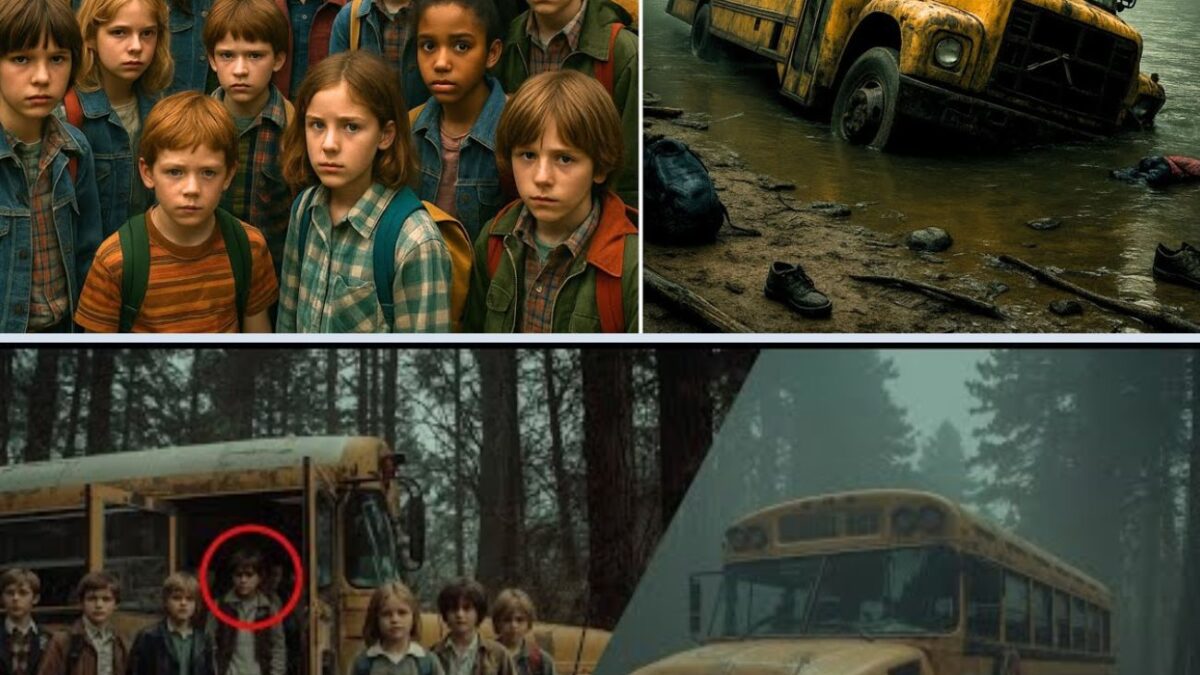
In 1986, 15 children boarded a school bus for a field trip and were never seen again. There was no crash, no wreckage, and no trace left behind. Nearly four decades later, when a forgotten bus was found buried deep in the woods of Morning Lake, a survivor was discovered with it. What she remembered would unravel a truth far more terrifying than anyone had ever imagined.
The fog had settled thick over Hallstead County like a lid no one dared lift. It clung to the pines, curled under porch lights, and silenced the sound of tyres on asphalt. You could drive a whole mile and not realise you had passed your own childhood. That was how memories vanished around here, quietly and without protest.
It was just past 7 a.m. when the call came through the radio. Deputy Sheriff Lana Whitaker had just poured her first coffee when the dispatch crackled. There was a possible discovery out by Morning Lake Pines where a construction team digging for a septic tank had unearthed what they believed was a school bus. The registration plates matched a long-closed case.
Lana stood frozen in the silence of her kitchen while the mug warmed her palm. Her other hand reached automatically for the notepad she always kept near the toaster, but she did not need to write it down. She knew the case by heart. Fifteen children and one bus driver had vanished into thin air back in 1986.
They were students from Hallstead Ridge Elementary, her very own school, grade, and classmates. She had been homesick that day with chickenpox. For nearly forty years, she had carried that small, strange guilt like a splinter beneath her skin.
She slid the untouched coffee into the sink, grabbed her keys, and left the house without locking the door. The drive to Morning Lake was quiet and slow, with the fog dulling sound and stretching time. Pines rose on either side of the narrow two-lane road like patient sentinels.
Lana passed the old ranger station, now abandoned, and turned onto the overgrown service road that had once led to the summer nature camp the kids were headed for. She remembered how excited they had all been on that morning. It was the last field trip before summer break, promising a lake, a fire pit, and new cabins built by volunteers.
She remembered the photos in the yearbook showing smiling faces pressed against the bus windows. There were kids with Walkmans, cartoon backpacks, and disposable cameras. She remembered every single one of them.
When she arrived, the construction crew had already cleared a perimeter around the site. The yellow paint of the bus was visible in patches beneath the mud, dull, cracked, and half crushed under the weight of the years. A backhoe stood motionless beside it like a guilty beast that had just unearthed a grave.
“Ma’am,” the site foreman greeted her, removing his hard hat. “We didn’t touch anything once we saw what it was. You’ll want to see this.”
Lana nodded, her throat too tight to speak. They had cleared one side of the vehicle enough to open the emergency exit door. A sour, earthy smell hung in the air, revealing dust, mould, and the brittle decay of time inside.
The seats were still in place and some of the seat belts were still latched. A pink lunchbox sat on the floor beneath the third row. A child’s shoe lay on the back step covered in dried moss, but there were no bodies.
The bus was empty, which made it worse somehow. It was a hollow monument, a question mark buried deep in dirt. Lana stepped inside, her boots creaking on the warped floorboards while the air felt stale and heavy.
As she reached the front, she saw it taped to the dashboard, barely faded by time. It was a class list written in the looping, cheerful handwriting of Miss Delaney, the homeroom teacher who had vanished with them. There were fifteen names listed, all children aged nine to 11.
At the bottom, someone had scrolled a message in a different hand that was darker, sloppier, and written in red marker right over the top.
“We never made it to Morning Lake.”
Lana stepped back out of the bus as the air grew colder around her. Somewhere behind her, a bird called out, but it sounded more like a warning than a greeting. She turned to the site foreman with a flat voice.
“Seal off the area. No one touches anything else until the state team gets here.”
“Yes, ma’am.”
She looked back at the bus framed by tall pines and heavy silence. They were supposed to be gone for just two days, but instead, they never came back. Now, after nearly four decades, the bus had returned without them, yet someone had clearly been here long enough to leave behind that chilling message.
The old Hallstead County Records building smelled of mildew and lemon cleaner. Its ceiling fans spun lazily like they were waiting for the rest of the county to catch up. Lana stood at the counter tapping her fingers on the wood as the clerk retrieved a case box from the archives.
It had been twenty minutes since she left the bus site, but her hands still felt dirty with its dust.
“Here we are,” the clerk said, sliding the file forward with both hands as if it might fall apart if mishandled. “Field trip 6B, Hallstead Ridge Elementary, May 19th, 1986. Sealed after five years with no updates.”
Lana nodded and carried the heavy box to one of the side desks. She opened the lid slowly as if afraid something might leap out at her. Inside were photos of the children, xeroxed class rosters, a list of personal items packed for the trip, and at the very bottom, a report stamped in bright red.
Missing persons, presumed lost, with no evidence of foul play. That stamp had haunted the town for decades. There was no evidence, no foul play, and no children.
Yet Lana had always suspected there was much more to the story. Everyone in town had. The bus driver’s name was Carl Davis, a part-time employee who was recently hired and barely vetted. He had no wife or children, and reportedly skipped town shortly after the disappearance, never to be found either.
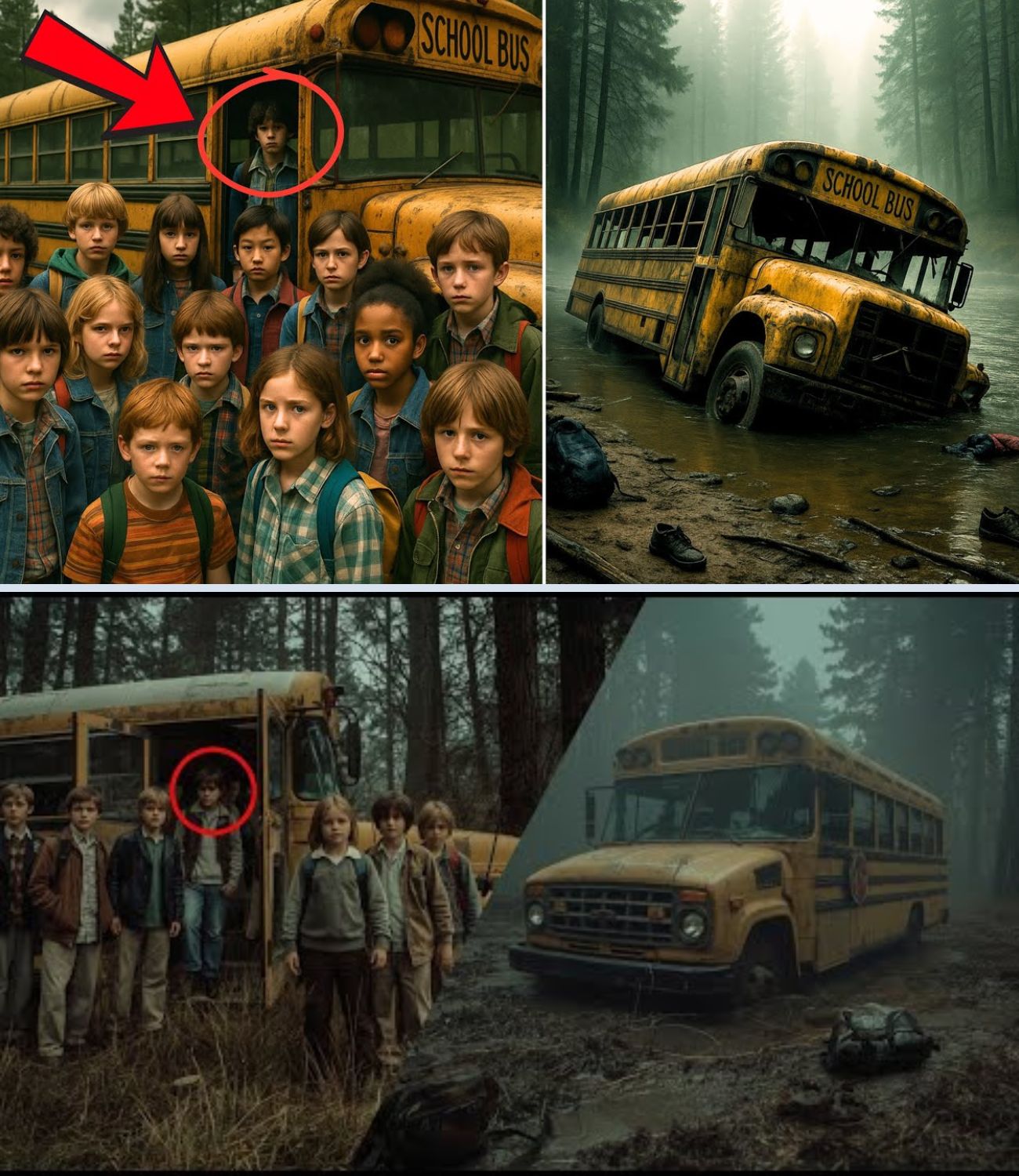
Then there was the substitute teacher. Miss Delaney was sick that week, and in her place was an M. Atwell, a woman no one remembered hiring. The records listed her address as an overgrown lot on the edge of town, and she had never been seen again either.
Lana leaned back in her chair staring at the photocopied class photo. She still remembered their names, their laughter echoing in the halls, and their little backpacks swinging as they raced towards the yellow bus in the car park. She traced a finger over one face in particular, Nora Kelly, who had wide green eyes, a missing tooth, and a pink ribbon tied in her hair.
Nora had lived two houses down from Lana back then, and they had shared ice lollies on the curb every single summer. The photo made Lana’s chest ache until a sharp knock snapped her back into the present moment.
Deputy Harris stood in the doorway with wide eyes.
“Sheriff, you need to see this.”
They were at the hospital fifteen minutes later. A woman had been found by a fishing couple half a mile from the dig site. She was barefoot, dressed in tattered clothes that did not match any local brands, dehydrated, malnourished, and barely conscious, but she was alive.
The nurse stopped Lana outside the exam room. “She’s stable, has no ID, and appears to be in her mid-30s, but she keeps saying she’s 12 years old. We thought it was trauma until she gave us her name.”
The nurse handed Lana a clipboard with a name scrolled across the top in trembling handwriting.
“Nora Kelly.”
Lana’s knees nearly buckled beneath her.
“She says she was on a school field trip,” the nurse added gently, “and that she’s been trying to get home ever since.”
The woman inside the room sat up slowly when Lana entered. Her hair was long and tangled, and her face was drawn and pale, but her eyes were unmistakable with their wide, green gaze. Lana stopped at the foot of the bed.
“Nora?”
The woman blinked as her eyes welled up with tears. “You got old,” she whispered, a single tear sliding down her cheek.
Lana felt her throat close up tightly. “You… you remember me?”
Nora nodded slowly. “You had chickenpox. You were supposed to come too.”
Tears burned in Lana’s eyes as she walked slowly to the chair beside the bed and sat down, too stunned to speak.
“They told me no one would remember?” Nora whispered. “That no one would come.”
“Who told you that?” Lana asked gently.
Nora looked past her out the window before turning back with a trembling voice. “We never made it to Morning Lake.”
The sun had dipped behind the trees by the time Lana drove back to the sheriff’s office. The golden hour light filtered through the blinds casting long stripes across her desk. She did not sit down immediately, choosing instead to stand staring at the whiteboard she had cleared that morning.
It now held fifteen names tacked up in two neat columns. Above them in red marker was written Morning Lake field trip, May 19, 86. Below that was a brand-new heading.
Nora Kelly, survived, returned. She circled Nora’s name before adding notes about her being found near the Morning Lake site, appearing to have aged normally while believing she was 12 years old with no memory of events after the bus left school. She also noted Nora’s repeated phrase, “We never made it to Morning Lake.”
Lana exhaled slowly because something still did not make sense. If Nora had been alive all this time, where on earth had she been, and what about the rest of the children? By 9:00 p.m. she was back at the hospital where the doctors had run basic evaluations showing no signs of injury beyond sun exposure, dehydration, and psychological trauma.
Her DNA was currently being processed, but Lana did not even need the test to know the truth. It was her, and Lana was entirely certain of it. Nora had been moved to a quieter wing, and when Lana entered, she found her curled beneath a blanket staring at a small paper cup of water on the tray.
“Hi again,” Lana said softly.
Nora looked up. Her face still held the gaunt fragility of someone who had spent too long away from the world, but her voice was much clearer. “You believe me, don’t you?”
“I do,” Lana said.
Nora gave a sad smile. “Most don’t.”
Lana took a seat. “Can I ask you something?”
Nora nodded. “Do you remember the bus ride?”
Nora looked down at her hands. “Only the beginning. The driver didn’t talk much and he wasn’t our usual guy. And there was someone else, a man waiting by the fork in the road.”
Lana leaned forward intently. “Do you remember what he looked like?”
“Not really. I think he had a beard. I just remember what he said.”
“What was that?”
Nora’s voice dropped to a terrified whisper. “He said the lake wasn’t ready for us yet. That we’d have to wait.”
Lana felt a cold shiver crawl up her arms. “He got on the bus?”
Nora nodded. “And then I don’t know. I woke up in a barn, but it wasn’t a barn anymore. It was like a home, but the windows were covered and the clocks were all wrong.”
“What do you mean?”
“They always said it was Tuesday, even when it wasn’t. They wouldn’t let us talk about before. We had to use new names.”
Lana tried to keep her face entirely neutral. “Who are they?”
Nora swallowed hard. “There were two of them at first. A woman and the man. She called him Mr Avery. I don’t know if it was his real name. She disappeared after a few months, and I think she got sick.”
“Do you know where the barn was?”
Nora shook her head. “They moved us around, sometimes in vans. We weren’t allowed to look outside. They said people had forgotten about us and that it was better this way.”
Lana sat in a stunned silence. “Some of the others… they forgot about school, about home,” Nora said. “But I didn’t. I never did.”
Lana reached into her coat pocket and slid something onto the tray. It was a faded yearbook photo.
Nora picked it up and stared at it with wide eyes. “That’s me,” she whispered. “And that’s Caleb and Marcy. And…” She stopped as her eyes filled with tears. “You kept this?”
Lana nodded. “I never stopped.”
Nora clutched the photo tightly to her chest. Later that night, Lana sat alone in her truck parked outside the old Hallstead barn on County Line Road. She had remembered something from Nora’s description about the clocks and the way the windows were boarded up.
This barn had once belonged to a man named Frank Avery who died in 2003, but he had a son named Martin Avery whose last known address was unknown. Lana stepped out of the truck and stared at the dark silhouette of the barn in the moonlight.
The wind rustled the tall grass while a loose door creaked softly in the breeze. She moved cautiously towards the side of the building with her flashlight casting long shadows across the dry wood. Something glinted near the base of the barn wall, catching her eye. It was metal.
She crouched down and found a small plastic bracelet tangled in the weeds. She picked it up to see it was faded purple and etched with a child’s name in blocky handwriting reading K-I-M-I.
Lana’s breath caught in her throat. Kim Leong was one of the 15 missing children, a quiet, artistic girl who loved dinosaurs and wrote her name on everything. Lana stood up slowly with her heart pounding against her ribs.
The past was no longer just whispering to her anymore. It was screaming. The bracelet was still gripped tightly in Lana’s hand when she returned to the station just after midnight. She did not turn on the overhead lights, opting only for the small lamp on her desk that cast a pool of amber across the surface.
The rest of the office remained quiet and still. She placed the bracelet right beside the class photo, lining it up with the smiling face of Kim Leong.
Kimmy had been 10 years old, wore glasses, and loved dinosaurs, and now here was her bracelet found beside a barn linked to a man with no current address. Lana picked up the landline and dialled the Texas missing and unsolved cold case unit. She left a detailed message requesting a full report on Martin Avery and his last known associates, knowing she would not get an answer until morning.
Yet something monumental was happening right now, and she could not sleep with ghosts pressing in at all the windows. By sunrise, the Morning Lake dig site was buzzing with quiet urgency. More of the earth around the buried bus had been cleared away, and a second team from the state’s historical preservation unit had arrived to document the excavation. They were there less because of its history and much more because of what the site now represented.
Lana stood beside the emergency exit with her arms folded, watching the forensic technicians catalogue every single inch of the hollowed metal shell. She had barely slept because her mind was far too loud with memory and unease.
“Sheriff,” one of the investigators called out, lifting a sealed evidence sleeve. “You’re going to want to see this.”
She walked over immediately. The technician, a man in his late 40s with square glasses and a quiet voice, held the plastic pouch very carefully. Inside was a photograph with colours slightly curled at the edges, but not aged nearly as much as it should have been.
Lana frowned. “Where was it?”
“Wedged behind the metal paneling above the back left window. Looked recently placed, honestly.”
She took the photograph and studied it closely. It showed a group of children, maybe eight or nine of them, standing in front of what looked like a low wooden building resembling a barn or a lodge. It was difficult to tell because the siding was weathered and the windows were boarded up.
The children’s expressions were strange, being completely blank—neither frightened nor smiling, simply absent. A few of the faces were unmistakable: Marcy, Kimmy, Caleb, and right there in the centre, Nora with her green eyes wide and vacant. However, Lana’s stomach dropped sharply as she noticed something else in the image.
Behind the children, barely visible in the shadows of the doorway, stood a tall, bearded man whose face was mostly obscured by a wide-brimmed hat. She flipped the photograph over to find handwriting on the back. It simply said, “The chosen, year two,” with no date or location provided.
Back at the station, Lana laid the photograph beside her ghost notebook and her growing collection of names and fragments. Year two meant they had been held for much longer than she had ever dared to imagine. She opened a county map and began cross-referencing all properties owned by the Avery family, including abandoned buildings and old religious sites in the area.
One particular location caught her eye: Riverview Camp. It was an old summer retreat for children purchased in 1984 by a private family trust. The land records had been scrubbed clean, and the property had remained off-grid since the early 1990s, sitting right at the edge of the national forest thirty miles away from the bus site.
Lana circled it in bright red ink. That afternoon, she brought the photograph to Nora at the hospital. The moment the image touched her hands, Nora gasped and her fingers began to tremble.
“This was after the first winter,” she said softly. “We were made to pose once a season to show progress.” She looked up with tears forming in her eyes. “That building? It’s where they kept us the longest.”
“Do you know where it is?”
Nora shook her head slowly. “We weren’t allowed outside without blindfolds, but I remember sounds. A river, a whistle at sunset, and the air. It always smelled like burning pine.”
Lana’s mind clicked into gear. Riverview Camp was named for its proximity to a river bend, and there had once been a logging train passing through that region whose whistle used to echo for miles at dusk.
“Do you recognize this man?” Lana asked, pointing to the shadowed figure in the photograph.
Nora hesitated before whispering, “That’s not Mr Avery. That’s someone worse.”
“Worse?”
“They called him Father Elijah, but he wasn’t a priest. He just liked the sound of it.”
Lana felt a chill work its way up her spine. “What happened to him?”
Nora stared hard at the photograph. “I don’t know. He just stopped coming one day after year three. Then we were moved again to a different place with different rules. Some didn’t make it. Some…” She broke off with a cracking voice. “Some forgot their own names.”
Lana placed a gentle hand on Nora’s arm. “You didn’t forget. You came back.”
Nora gave a fragile nod. “But they’re still out there. Some of them. I feel it. The others…” She looked Lana directly in the eyes. “They don’t want to be found.”
That night, Lana drove north towards Riverview Camp. The road narrowed down to gravel while the trees thickened around her like towering walls. Low fog gathered on the ground, curling between roots and old fence posts, until her headlights caught a faded wooden sign half-swallowed by vines reading Riverview Youth Retreat: Private Land.
She parked right at the edge of the old property line and stepped out into the absolute silence. There were no birds and no rustling wind, just the low hiss of distant water sounding like a river. Lana took her flashlight and followed the overgrown path.
Halfway down the trail, she saw it: the exact building from the photograph. Its roof sagged heavily and the porch was rotted through, but the wooden siding was the same, blackened at the corners with windows boarded up from the inside. She approached slowly.
Just before stepping onto the porch, she froze in her tracks. In the dirt were fresh footprints, small ones belonging to a child. Lana reached for her gun, using a low and cautious voice.
“Hello, is anyone here?”
There was absolute silence. Then, from somewhere inside, came the soft creak of floorboards followed by a child’s whisper just audible in the dark.
“You’re not supposed to be here.”
Lana’s hand gripped her flashlight tighter as she stepped slowly onto the warped porch while the wood groaned beneath her weight. Another whisper echoed from inside, sounding low and almost playful.
“She came anyway.”
The front door was cracked open by just a sliver. There were no recent signs of forced entry, no new locks, and no chains. Yet the smell of earth and metal drifted out like the air inside had not moved in years. Lana nudged the door with her foot, and it opened with a long, slow creak.
Her beam swept across the bare room with its dust-choked air and the skeletal remains of long-abandoned furniture. What caught her eye first, however, were the words carved into the far wall. There were children’s names, some scratched shallow as if rushed, while others were carved deep and angrily over and over again as though someone was trying desperately not to forget.
Kimmy, Marcy, and Elijah had been crossed out, followed by Caleb and Sam with a question mark beside them, and then initials like J.N. and Nora repeated three times, one below the other. Lana swallowed hard because this was not just a hiding place; it had been a prison. She stepped forward with her boots stirring up the dust while the wood beneath her creaked but held firm.
She passed what had once been a table, now splintered and tipped against a wall, noticing something beneath it. She crouched down to find a metal box rusted at the edges but still entirely intact. She pried it open slowly.
Inside were papers that were yellowed and damp, but resting right on top was a thin stack of Polaroids bound together by a rubber band. She lifted them out carefully. They showed children again, but this time they were not posed. These were candid shots taken from unsettling angles, showing some sleeping, some eating, and one crying in the corner of a narrow, windowless room.
Each photo had a name written on the back, but none were their real names. Instead, they bore labels like Dove, Glory, Silence, and Obedience. The final photograph was different, showing a child standing alone by a tree with her face turned away.
Her left arm was visible, and Lana saw what she was meant to see: a purple plastic bracelet identical to the one she had found near the barn. It was Kimmy. She flipped the photo over to read the single word written there: “Disobeyed.”
Suddenly, a soft creak sounded behind her. Lana stood up quickly, darting her flashlight across the room.
“Hello,” she called out. “I’m not here to hurt anyone. I’m here to help.”
There was silence, and then a soft voice drifted down from the second floor above. “You’re not like them.”
Lana turned towards the old, brittle staircase that miraculously still held its shape. She climbed each step slowly with shallow breath and her hand hovering near her sidearm. At the top landing, she paused.
One of the doors at the end of the hall was slightly ajar, with a faint flicker of candlelight visible through the gap. She moved towards it cautiously. Inside, the air was noticeably warmer, indicating someone had been here recently.
The walls were covered in children’s drawings made with charcoal and pencil—crude but very deliberate. She scanned them with her heart thumping against her ribs. One drawing showed a line of children walking through the woods, another featured a faceless man with arms stretched wide like wings, and a third displayed a school bus in flames with a row of small, identical headstones on the ground below it.
Lana stepped back feeling dizzy while her light shook in her hand. Then she heard that voice again, quiet and close by.
“They told us not to draw, but we did anyway.”
She turned to see a boy no older than 10 standing barefoot in the doorway with dark, shaggy hair, pale skin, and dirt smudged across his thin cheek.
“Who are you?” Lana asked gently, lowering her flashlight.
The boy did not answer right away. “They called me Jonah, but that wasn’t my name.”
Lana crouched down keeping her voice steady. “Do you remember your real name?”
He hesitated before shaking his head. “They took it.”
She nodded slowly. “It’s okay. You don’t have to remember it right now.”
“Are you here to take me away?”
“I’m here to help,” Lana said softly. “Are you alone?”
Jonah looked down at the floor. “No.” He pointed behind her towards the wall behind the old metal bunk beds.
Lana stood up and followed his gaze. There, etched faintly into the floorboards and nearly covered by dust, were more names. However, these had not been carved by hand; they had been burned directly into the wood using heat or time in a way she could not quite explain, leaving the surrounding wood scorched.
Beneath them in black ink were the words, “Names we must not forget.” There were 12 names listed, with three circled and the rest crossed out.
Lana sat with Jonah in the back of her SUV while the boy was wrapped in a heavy blanket, remaining completely silent except for the soft rustle of the emergency thermal foil crinkling with every movement. His gray, distant eyes looked far older than any 10-year-old’s as he stared out the window as if waiting for something to leap from the trees. They had not spoken much on the drive back, and he had not asked where they were going or why she had come, because only one thing seemed to matter to him.
“Are the others coming back too?”
Lana had not answered because she simply did not know. Back at the station, she gently ushered him into a quiet back office she rarely used and pulled the blinds shut while a local social worker was on her way. Lana had insisted on being the one to talk to him first, bringing him a juice box, an old wool hoodie, and a set of laminated photos she had printed from the original yearbook, faded by time.
Jonah sat with the photos in his lap, tracing a small finger over each face. “I remember her,” he whispered. “That’s Marcy.” Then he tapped another. “And him. Sam. He always got in trouble because he wasn’t good at staying quiet.”
He pointed to one more photo showing Lana’s own childhood face. “You were supposed to come.”
The local sheriff smiled faintly. “I was, but I got sick.”
Jonah tilted his head thoughtfully. “That’s lucky.”
Meanwhile, across town, the forensics team called in a major discovery. They had found another photograph buried deep beneath the rear floor panel of the bus, and this one was partially burned at the edges. It showed four children seated around a campfire, with one of them facing the camera directly, possessing dark skin and short hair.
In the bottom corner, written in marker, were the words, “He stayed. He chose to stay.”
Lana stared hard at the photograph as something tugged at the edge of her memory. She pulled up the old roster again, mentally reviewing each name until she paused at one particular individual. Aaron Develin had been 11 years old at the time of the trip—quiet, bright, a gifted chess player, and someone who always read books far beyond his grade level.
She checked the county database to find an A. Develin listed in the town’s electrical department at age 49, with no high school record on file prior to 1990 and having moved into Hallstead in 2004 to live alone in a trailer outside of town with no listed next of kin. Lana stood up slowly.
She no longer believed in mere coincidences. The trailer was perched precariously at the edge of a gravel lot, half-buried by pine needles with a door rusting at its hinges. A single bulb above the porch flickered faintly as Lana pulled up.
She knocked once and received no answer. She knocked a second time, and this time a calm, low voice answered from within.
“I knew someone would come eventually.”
The door swung open. The man standing there looked considerably older than his years, featuring gray streaks at his temples and sharp, unreadable eyes. He wore a simple shirt, a flannel jacket, and work jeans, yet there was something about the way he stood so still, like a man waiting for judgment.
“Aaron Develin?” Lana asked.
He did not respond right away before nodding once. “I remember you. You used to wear braids and a jean jacket with patches.”
Lana blinked in astonishment. “You remember me?”
“We were in the same class. You had a green backpack with a silver zipper that always got stuck.”
Her heart skipped a beat. “Why didn’t you come forward?”
Aaron stepped aside to let her in. “Because not everyone wanted to leave.”
Inside, the trailer was meticulously clean and remarkably sparse. A chessboard sat on a small coffee table while bookshelves lined the walls, entirely filled with volumes on psychology, memory, and group behaviour.
“I left the sanctuary in 1991,” Aaron said, sitting carefully on the edge of the couch. “I was 16. They let me go.”
“Let you?”
“I was the one who stayed when others tried to escape, the one who helped them keep order. I believed in it for a long time and thought it was safe there.”
Lana sat across from him listening intently. “But then things changed,” he continued. “After year four, the group splintered. Elijah disappeared and the others began to rebel. Marcy ran away, and Caleb tried to fight back.”
He paused before adding, “I stayed. Not because I agreed, but because I was terrified of the outside world.”
Lana’s voice remained steady. “You could have helped find them.”
“I was told the world had forgotten us, that our families had moved on.” His voice broke slightly. “When I finally left, I didn’t know how to be anything other than quiet.” He looked directly at her. “But if you’re here now, someone else must have come back.”
Lana nodded. “Nora.”
Aaron’s eyes flickered with emotion. “She remembered,” he whispered. “After all this time, she never forgot.”
Aaron looked away towards the window where dusk was just beginning to touch the treetops. “I know where the others might be,” he said. “At least where they were sent after the fires.”
“Fires?”
Aaron’s hands clenched tightly. “There was an uprising. Some of the kids were older by then and they set part of the sanctuary ablaze. The group scattered while the younger ones were moved, split up, and hidden under new names.”
He stood up. “They buried the truth deep in the woods, but I can take you there.”
That night, Lana met Nora in her hospital room and showed her the photograph of the boy at the fire. Nora’s breath caught in her throat as she stared at it like she was seeing a ghost.
“He stayed behind,” she whispered. “We thought he was gone, but he stayed and they listened to him.” She looked up anxiously. “Do you think he remembers us?”
Lana nodded slowly. “He remembers everything.”
The forest felt different now, no longer wild or free, but watchful as though it remembered every deed done here. The leaves rustled softly, yet the air remained still. Each step Lana took on the narrow trail behind Aaron Develin stirred the silence like fine dust.
He had not said a single word in the last mile, walking only with a quiet urgency, hands buried in his jacket pockets and eyes never straying from the path. Nora had not come because her body was too weak and her memories were far too raw, but Lana had promised to go see what was left and try to find those who had never made it out.
They reached a small clearing just after midday. Surrounded by towering pines, a half-collapsed structure leaned heavily against the hillside with its roof caved in. Vines twisted up through the wooden frame as if nature itself was trying to reclaim what man had hidden away.
“This was the original sanctuary,” Aaron said quietly. “The first site, the place we were taken after the bus was diverted. It used to be much bigger with four cabins, a lodge, and two underground cells.”
Lana paused. “Cells?”
He nodded slowly. “They called them reflection rooms, but they were just pits. There was no light and no noise, just the sound of your own thoughts until they stopped making sense.”
Lana’s stomach turned. “They put kids in there?”
“Marcy, Kimmy, and Nora once for simply saying the word ‘school’.” His voice cracked. “I let it happen. I didn’t stop it because I believed it was the only way we would survive.”
Lana took a deep breath and stepped into the ruins. Inside, the smell of mildew and ash lingered faintly alongside scorched floorboards and broken furniture. Yet in one corner, shielded beneath a collapsed beam, something remained entirely intact: a set of three small metal lockers that were rusted but still upright.
Aaron joined her. “These were ours. They made us keep only what they gave us—blank books, uniforms, and a single spoon. But some of us hid pieces of who we used to be.”
Lana pulled open the first locker to find it completely empty. The second, holding barely ajar, contained only a torn shoe and a melted crayon. However, in the third locker, something was tucked away inside a bundle wrapped in cloth.
She carefully lifted it out and opened the fabric. Inside lay a cracked cassette player, a child’s bracelet, and a drawing carefully preserved in plastic showing a girl standing on a hill beneath a full moon wearing a red ribbon and holding a sign with three handwritten words: “We are still here.”
Lana knelt down with the drawing resting in her lap. It was not just a plea; it was a declaration.
Aaron crouched beside her. “Nora drew that. I remember the day before she ran.”
“You said they scattered the others,” Lana whispered. “Where?”
He pointed towards the ridge behind the old sanctuary. “There’s a second trail hidden away. That’s where they moved the younger ones when the fire came. They didn’t call it sanctuary anymore.”
“What did they call it?”
Aaron’s eyes darkened. “Haven.”
Two hours later, Lana stood at the crest of the ridge. The sun was beginning to dip low, sending long beams of amber light filtering through the trees. Ahead of them, partially camouflaged by thick moss and age, stood a concrete structure built directly into the hillside.
There were no signs, no markings, and no paths, save for a heavy steel door rusted firmly at its hinges. Aaron approached it slowly.
“This was where they took the ones who were too young to question, or the ones too broken to resist. It was quieter here and much colder. They didn’t teach anymore; they just observed, calling it watching the fruit ripen. I didn’t understand what they meant at the time, but it was all about control and waiting.”
“Waiting for what?” Lana asked.
Aaron looked away. “For obedience, for full forgetting.” He placed his palm flat against the cold metal door. “There’s a room inside that was sealed the last time I saw it. They called it the garden. There were no lights, just voices. They made some of us stay in there until we stopped asking to leave.”
Lana shivered. “And what happened to the ones who didn’t stop asking?”
He did not answer. They pried open the door using an emergency jack from Lana’s truck. The air inside was damp and utterly still.
Her flashlight beam swept across cement floors, water-stained walls, and broken pieces of furniture. Scratches lined the walls—names, symbols, and short messages etched with fingernails, keys, or worse. Yet what stopped Lana cold was a small door off to the right featuring a plaque hanging crookedly above it with a single word inscribed upon it: “Garden.”
She turned to Aaron, who nodded slowly. “Some of them are still alive, Sheriff,” he said quietly. “I don’t know where, but I know it in my bones.” He stepped back with his voice dropping to a whisper. “Because I hear them in my dreams, calling each other by the names they weren’t supposed to say.”
Back at the hospital, Nora awoke just after midnight with her heart pounding and her breath coming shallow. The fluorescent lights flickered gently overhead until a nurse entered, startled by her sudden expression.
“Are you okay, sweetie?”
Nora stared blankly at her. “I had a dream,” she whispered. “But it wasn’t mine.”
The nurse leaned in closer. “What was it?”
“There was a room,” Nora continued. “No light, cold walls, and someone whispering.” She swallowed hard. “They were saying my name.”
The garden was not a room; it was a void. Lana stood just inside the threshold with her flashlight beam trembling as it pierced the heavy darkness. The walls were close, the ceiling was low, and the thick, unmoving air felt as though it had not been breathed in decades.
There was no furniture and no windows, just cold concrete. Yet the smell—that same faint mix of damp earth, old metal, and something fainter and almost sickeningly sweet—made Lana pause. Behind her, Aaron remained outside the doorway, refusing to step foot inside.
He had explained that the children were not just kept here; they were retrained here, forced to sit in silence for hours, told to whisper prayers that were not prayers, and taught to forget the sound of their own names. Lana scanned the room with her light.
The walls were covered in marks, not just names this time, but tallies numbering in the hundreds, perhaps thousands. Each one was scratched in precise sequence to count something—time, days, or punishments. In the far corner, her beam caught the edge of something buried beneath dust and broken plaster.
She knelt down carefully and brushed away the debris to find a small recorder of the kind used by journalists or investigators. It was battered, and the magnetic tape inside was nearly disintegrated. She flipped it over to find words etched into the plastic with a pin or nail: “For the ones who remember.”
She slipped it into an evidence bag while her hand grew suddenly unsteady. This was not some relic left behind out of idle curiosity; it was a deliberate message, meaning someone had desperately wanted to be heard. At the station, Lana called in the tech team to carefully restore the fragile cassette.
It took hours, but by early evening the tape was finally ready to be played just once, as it was far too delicate for repeated runs. She asked to be left entirely alone when they played it back. The office lights were low while the rain began tapping softly against the station window panes.
She pressed play. There was loud static, and then a voice emerged—small and weak.
“This is Nora. I think. I don’t know anymore. It’s dark and I can’t tell how long I’ve been here, but I think I remember school. I think I had a brother.”
Lana sat forward intently.
“They don’t let us say real names. They say that’s how the world finds you. But I write them anyway, even if it’s just in my head.”
There was a long pause on the tape. “If anyone finds this, don’t believe them when they say we ran away. We didn’t. We were taken. We were made into something else.”
Another pause followed before the voice continued. “But I’m not gone. Not yet.”
The tape clicked off. Lana sat in the heavy silence with her pulse racing. The tape was old, but the voice had not belonged to Nora; it was younger and more hesitant, yet unmistakably that of Kimmy Leong.
That same night, she brought the recorder to Nora at the hospital. When she played the tape, Nora covered her mouth in shock.
“I remember this,” she whispered. “She used to practice her voice like she wanted someone to hear it the right way someday.”
“She was trying to hold on,” Lana said gently.
Nora nodded. “She never gave up, even when the others started to fade.” She reached for the tape before stopping herself. “She’s alive,” she said quietly. “I don’t know how I know that, but I just do.”
Lana did not argue because the voice had not sounded like someone at the end of their rope; it had sounded like someone waiting. The next day, Aaron handed Lana a map he had hand-drawn entirely from memory. He pointed to a spot near the far end of the woods just beyond the second ridge.
“The records mentioned a second tunnel,” Lana said. “One that was never found.”
Aaron nodded. “The older kids spoke of it like a myth, a secret way out. But I don’t think it was an escape route.”
Lana looked at him sharply. “Then what was it?”
“A hiding place.”
“For what?”
Aaron turned to her with a grim expression. “For the ones they never wanted the world to know existed.”
Back at the hospital, Kimmy woke in the early morning light to find Nora had fallen asleep in the chair beside her with her hand resting on the bed’s edge. Kimmy turned her face towards the window where morning was breaking, realizing she had not seen a sunrise in almost thirty years. When her voice finally came, it was barely a breath.
“It’s not over yet.”
The final tunnel was not marked on any official map, but Kimmy’s journal held the key. Buried within coded margins and scattered through false verses, Lana pieced together the hidden meaning: three stone trees, a stream that split but never rejoined, and a red cross drawn over a hollow curve at the bend of the river. Aaron had told her once that the forest north of Morning Lake was riddled with sinkholes, some entirely natural while others were man-made.
Lana followed the map at dawn. The riverbed was low from the dry season, revealing dark limestone and twisted roots beneath the surface. Birds chirped overhead, but the woods felt hushed as if holding their breath.
Lana crossed over slippery rocks until she found them—three large petrified trees clustered together on a ridge. She stood between them and looked down to see that the river split right here, once flowing wide, but now diverted into two narrow forks with one veering off into the stone. And there, exactly as drawn in the journal, was a depression in the ground, almost circular in shape and covered in moss and branches.
She cleared them away gently to reveal a steel hatch fused with age but still intact. A faint engraving at the edge was worn nearly smooth, reading T.S.2 for Transfer Station Two. Her fingers traced the cold metal while her voice remained low and steady.
“For the ones they never wanted the world to find.”
With backup arriving just a few minutes behind her, Lana forced the hatch open. A rush of cold air poured out, dry and bitter, tinged with mildew and something faintly metallic. The shaft was narrow, reinforced with concrete, and sloped downward for nearly twenty feet before flattening into a narrow corridor.
Her boots echoed as she stepped into the past, feeling how still the air truly was. What she found inside was not a prison, or at least not strictly one; it was a preservation site containing ten rooms, each no larger than a walk-in closet. Some contained beds, others only mats, and a few featured drawings on the walls—crude stick figures holding hands, suns with sharp rays, and the outline of a bus disappearing over a hill.
Yet there were no children here, only remnants. She entered a larger central room with a domed ceiling where fifteen small desks were arranged in a tight circle, all facing inwards. Each desk had a nameplate, some of which Lana recognised while others she did not.
At the very centre of the circle beneath the dusty glass dome stood a locked case containing a book. Lana broke the glass gently and retrieved it. The cover was plain, made of worn black leather, but when she opened it, her breath caught in her throat.
It was titled “The Final Curriculum,” containing typed lessons, handwritten notes, and margins filled with erratic scribbles. Words were repeated over and over again: “Obedience is safety. Memory is danger. The past is the infection. The future is correction.”
Each page grew progressively more unstable, featuring notes scrolled by different hands—some childlike, others firm. A specific name was repeated on page after page: Cassia, followed by being crossed out, and then written again. On the very final page, it read, “Cassia did not forget. Cassia ran. Cassia saw what they did in room six.”
Lana spoke into her radio. “Requesting search team. Possible hidden chamber off main structure. Look for room six.”
There was static before a voice replied, “Copy that.”
They found room six behind a false wall with its door bricked over and sealed in thick concrete. It took hours, but when they finally breached it, the air hit them like a wave of time gone wrong. Inside there were no beds and no windows, just hundreds of photographs pinned to the walls depicting children in uniforms, children kneeling, and children standing in rows with blank, empty faces.
Then, right in the centre of the far wall, was a mural painted entirely by hand. It showed a girl running through trees with her arms outstretched and her face turned upwards towards the light, accompanied by painted words below: “Cassia remembered. She left the light on for us.”
Back at the hospital, Kimmy sat upright as Lana laid the photograph from room six before her, causing tears to well up in her eyes.
“That was her,” she whispered. “Cassia. She was older than us, and very quiet. She never joined the chants.”
“They said she disappeared during year three,” Lana noted. “Did she escape?”
Kimmy shook her head slowly. “She wasn’t trying to escape.” She looked up. “She was trying to leave a door open.”
That night, Lana stood at the edge of Morning Lake where the stars shimmered across the water’s surface. Fifteen children had been taken, and three had returned, but now there was irrefutable evidence that others had survived, if only for a while. The final journal entries, the mural, and the tape all pointed to one unthinkable truth: some of the missing children had never died, but had simply disappeared into a place the world was never meant to see, with at least one of them—Cassia—having fought hard to be remembered.
The mural haunted Lana deeply. The face of the girl Cassia, painted in swirling shades of blue and gold with her arms outstretched as if trying to fly, suggested someone older than the others in the photos—maybe 14 or 15 years old. Her presence in that sealed room suggested something entirely different about her, implying Cassia had not merely been a victim, but a witness or perhaps even a whistleblower.
Lana returned to the station to reopen a forgotten file on state ward transfers from 1991 to 1993, containing dozens of unnamed children relocated after the collapse of two unlicensed group homes in Northern California. All of them had scrubbed medical records and redacted intake forms, but one entry stood out. It was a girl whose age was estimated between 13 and 15, brought in with no memory of her name, placed in temporary care, and described as emotionally disconnected yet physically healthy, having refused to speak during her entire first year.
Her given name upon intake was Jane Doe number 19, later renamed Maya Ellison and adopted in 1994 by a couple right here in Morning Lake. Lana leaned back in her chair with her heart racing. Cassia had not disappeared; Cassia had become Maya.
Maya Ellison ran the local bookstore in town as a quiet, kind woman in her early 40s known for her soft voice and obsessive memory, capable of recalling customers’ reading preferences from years prior. Lana had spoken to her dozens of times, borrowed books, and asked about local history, yet not once had she ever suspected a single thing.
She drove straight to the shop. Maya stood behind the counter shelving a stack of second-hand paperbacks with her hair pinned in a loose bun and glasses perched on her nose. When she looked up and saw Lana, she smiled politely.
“Sheriff, the mystery section’s has been busy this week.”
Lana stepped closer with a soft voice. “Maya, do you know who Cassia is?”
The woman froze completely. Slowly, her eyes met Lana’s, and for a brief flicker, there was absolute recognition. Then she said, “No. Should I?”
Lana placed the photograph of the mural and the running girl right on the counter. Maya’s hands began to tremble violently.
Lana waited patiently. “I… I used to dream about her,” Maya said quietly. “I thought she was made up, just a story I told myself. She would say things I didn’t understand about names, about tunnels, and about forgetting.” Her voice broke. “I thought it was trauma from someone else’s life. I never believed it was mine.”
Lana laid her hand gently over Maya’s. “It was yours. You didn’t just survive. You tried to leave a light on.”
Maya pressed her fingers to her lips while tears filled her eyes. “I was so afraid,” she whispered. “They told us if we left, no one would believe us, and that the world didn’t want us.”
“They were wrong,” Lana said. “You were found.”
Later that night, Lana brought Maya to meet Kimmy. The moment the door opened, Kimmy stood upright, and the two women stared at each other—one frozen in the past, the other having built a life entirely outside of it. Then Kimmy whispered, “Cassia.”
Maya whispered back, “Kimmy.”
They embraced slowly at first before holding each other fiercely. Tears fell freely, but neither woman needed to say much else because the silence between them was not empty; it was undeniable proof that they had endured.
Aaron visited the hospital the following morning, standing awkwardly at the edge of the room and feeling unsure if he was welcome. Kimmy nodded to him warmly. “You’re the reason they weren’t all forgotten,” she said. “You stayed.”
“I was too afraid to leave,” he replied honestly.
Maya looked at him carefully. “Maybe so, but fear kept us alive.” She reached into her bag and pulled out a photograph that investigators had recovered from room six without knowing how to identify it. It showed a group of older children standing near the base of a tree, with one boy in particular standing slightly apart from the rest with his eyes down and shoulders stiff.
Aaron stared at it. “I thought they burned that,” he whispered.
“You remembered your name,” Maya said. “That’s more than most.”
By the end of the week, Lana had gathered everything: the journals, the photographs, the mural replica, the taped confessions, and the recovered belongings. She filed an official report titled “The Morning Lake 15: A Case Reopened.” It would take months, perhaps even years, for the full truth to come out, and the state would investigate what had been missed.
Families would eventually come forward, some seeking lawsuits and others mourning, but others like Nora, Kimmy, and Maya had a completely different goal. They wanted to start a foundation dedicated to lost children, the unheard, and those who had their names stripped away before finding them once more.
On a warm spring morning, Lana returned to the lake where the sun sparkled brightly across the water’s surface and ducks passed silently across the ripples. A small wooden sign now stood proudly at the edge of the dock, reading: “In memory of the missing. To those who waited in silence, your names are remembered.”
She knelt down and placed a Polaroid beneath the sign—the very one from the old mural depicting the girl running toward the light. Then she stood up because she knew there were others still out there, and maybe, just maybe, some of them were still waiting.
Three months later, the town of Morning Lake was quiet again. Tourists came and went, the local school reopened, and the missing children’s case made national headlines, allowing the town to slowly begin breathing behind all the noise. Yet for those who had lived through the nightmare, the wounds had not fully healed—not yet, anyway.
Nora was the first to leave, moving to Seattle to take classes and begin painting again for the first time since she was a girl, with her very first canvas being a recreation of the mural Cassia had painted in room six. “It’s not just about surviving,” she told Lana before departing. “It’s about creating something no one can ever take away.”
Kimmy chose to stay, living in a small cottage near the edge of the woods where the townspeople were kind, with some even remembering her mother and her name from old prayer lists. She visited the lake every single week to leave a flower at the wooden sign, never bringing her journal but always bringing her voice to speak names aloud to the trees—real ones.
Maya returned to her bookstore, but she no longer held just stories within its walls, choosing instead to host free workshops for youth and quiet spaces for those who lacked safe homes or safe memories. Every Friday, she set out tea and read aloud from books chosen by the children themselves, and while no one ever asked about her past, she would sometimes trace the outline of a certain mural in the back room with her fingers during breaks.
As for Aaron, he left Morning Lake quietly without a goodbye or a forwarding address, leaving Lana to later find a note slipped beneath her office door. “There’s more out there,” it read. “I’ve heard whispers of other towns and other kids. I wasn’t brave enough then, but maybe I can be now.” Taped to the letter was a photograph of an old, rusted, but familiar bus with a single word written on the back: “Arcadia.”
Lana kept the letter safely tucked inside her desk drawer without opening a new case—not yet, at least. But sometimes at night, when the wind rustled the trees outside her bedroom window, she would think of that name, of the ones they had found, and of the ones they had yet to find. She would look up at the stars glittering over Morning Lake and wonder how many names the world had truly forgotten, and how many were still waiting for someone like Kimmy, Cassia, or Lana to remember them.
You Might Also Enjoy

Mom Installed a Camera To Discover Why Babysitters Keep Quitting But What She Broke Her Heart


She Gave a Hungry Little Girl a Free Birthday Cake — The Next Morning, a Black Rolls-Royce Arrived