5 Sheriffs Rushed Toward an Injured 8-Year-Old Girl — Then the Rookie Nurse Said, “Don’t Move Her!”
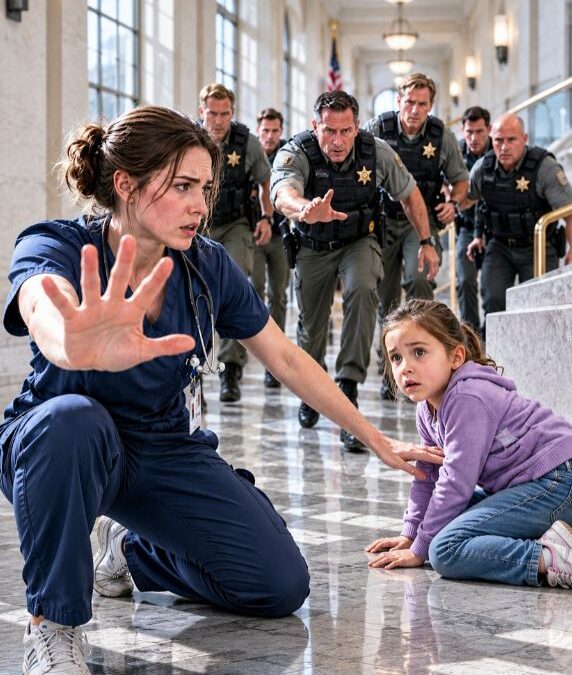
Five constables ran towards an eight-year-old girl lying at the foot of a staircase, convinced that they were going to save her. None of them suspected that the newest nurse at the Valencia Courthouse was about to cross their path, nor that a single sentence from her would freeze five men trained to act without hesitation. It all started at 11:10 on a Tuesday in October, when a metallic voice ordered the immediate evacuation of the building over the loudspeakers. An anonymous caller had reported a device on the upper floors.
Lawyers, officials, and families rushed down the marble stairs. Inés Moreno had only been in the court’s medical service for three weeks. She was 28 years old, wore a lab coat that still smelled new, and had a reputation among veterans for being quiet, punctual, and too serious for her age. Nobody knew where he came from.
Inés was running against the current of people, with her emergency backpack on her shoulder, when she saw a pink shoe lying next to the last section of the main staircase. Its owner was just a few metres away. A girl with braids and a cartoon t-shirt lay twisted on the cold floor. She was crying, but she was awake.
Her name was Lucía Ferrer and she had gone to the courthouse with her mother, who was testifying that morning as a witness. The crowd had trampled her and no one had seen how she fell. Five constables arrived almost at the same time. At the front was Officer Raúl Cordero, 20 years of service, a commanding voice and no patience for the unexpected.
Their mission was simple: get everyone out of the building before something worse happened. Cordero bent down to pick up the girl in his arms. Then Inés intervened.
“Don’t move her,” she said.
He didn’t scream. He said it with such firm calm that Cordero was left with his hands suspended a hand’s breadth from the girl. He looked her up and down, at the white coat, the rookie badge, and gave a half-smile full of impatience.
“There’s a bomb threat, nurse. This floor is not clear. We’ll take her now.”
Inés didn’t move.
“Look at your hands,” she replied.
Cordero lowered his gaze. The girl’s right hand was clutching her t-shirt, her knuckles white. The left hand lay open on the ground, completely motionless. Inés knelt down and spoke with a sweetness very different from the one she had used with him.
“Lucía, look at me. Can you move the fingers of this hand?”
The girl looked at her own hand as if it belonged to someone else. She tried with all her might. Nothing happened. One of the constables muttered something under his breath. Cordero clenched his jaw.
“It could be the fright,” he said.
“Maybe,” Inés admitted. “And it could be something much worse. If we do it wrong, and that’s what I fear, there’s no going back. Give me a minute. Just one.”
Cordero’s radio crackled. All units to the south exit, the building must be empty in four minutes. His men looked at him, waiting for an order. Cordero was caught between two duties. Behind them, hundreds of people continued to flee.
In front of her, a terrified little girl and a three-week-old nurse who asked her to risk her career based on a hunch.
“And by what authority do you ask this of me?” he asked in a low voice. “Who are you to stop five officers?”
Inés held his gaze. For a second he seemed about to answer truthfully. Something ancient crossed her eyes, something that did not belong to a novice nurse. He placed his palms on either side of Lucía’s head, without squeezing, without moving her, with a precision that seemed strangely familiar to the constables.
The oldest, a grey-haired man named Matías Ortega, stared at her. He had seen that posture only once in his life, 15 years ago, on a mission in Lebanon, and he had never forgotten it. It was exactly how military medics worked under enemy fire. He approached Cordero and whispered something in his ear. Cordero paled. Lucía burst into tears even louder.
“I’m scared,” she said. “Are they going to pick me up?”
Inés stroked her forehead with two fingers.
“Nobody will touch you without my warning, I promise.”
Then the radio crackled to life again, and this time the voice was tense, almost broken. They’ve found a suspicious package on this same floor, 30 metres from the stairs. There are three minutes left. Cordero looked at the girl, looked at the clock, and looked at Inés. His voice came out hoarse.
“Tell me the truth, nurse, what were you before you put on that gown?”
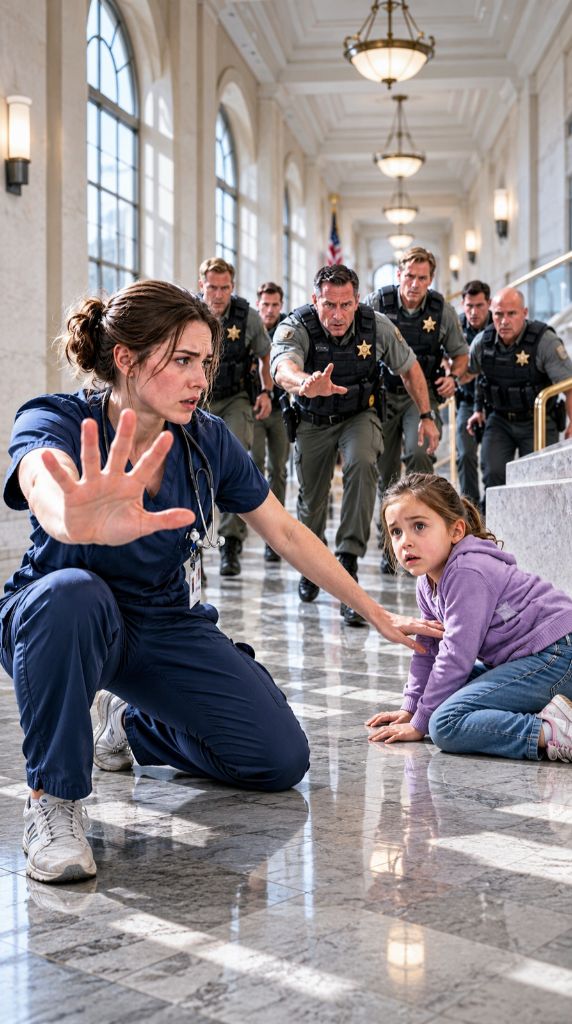
Inés closed her eyes for a second. When she opened them, she no longer looked like a novice. And what she answered left the five constables breathless. Inés opened her eyes and said a single sentence that changed everything.
“I was a medic sergeant in the paratrooper brigade, and once I let them move a wounded man without waiting, and that mistake still haunts me.”
After that, no one said another word for a long second. Cordero remained motionless, as if his lungs had been emptied. The other three constables looked at each other, but it was Matías Ortega who stepped forward, his eyes wide and his voice trembling for the first time in 20 years of service.
“Moreno?” he repeated slowly. “Sergeant Moreno, the one from the ambush at María Yum?”
Inés didn’t answer, and that silence was enough. Ortega put a hand to his mouth.
“My son Hugo was in that convoy,” he said. “His spine was broken, and the firing wouldn’t stop. He told me that a nurse held his head in her hands for four hours, that she didn’t allow anyone to lift him until the helicopter arrived, and that when he asked her name she just told him to stay still. Hugo walks today thanks to that woman. We’ve been looking for her for years to thank her, and she didn’t exist in any records. He had left the army without saying goodbye to anyone.”
The other marshals lowered their gaze to the three-week-old nurse they had treated like a nuisance just a minute before. Cordero swallowed. The half-smile on his patient face was gone.
“Sergeant,” he said respectfully, and for the first time, his embarrassment was evident. “What do you need?”
Inés didn’t pause to savour the moment. For her, this wasn’t a victory; it was a ticking clock.
“I need a spinal board,” she said. “It’s in the infirmary downstairs by the service entrance, and I need someone to get it now.”
A young marshal named Beltrán darted down the corridor. The others formed a circle around Lucía, barely touching her, almost holding their breath. The little girl looked at them one by one, her eyes filled with tears. Inés spoke softly to her.
“Look, sweetheart, these gentlemen are going to take care of you. See how serious they’ve become? It’s because they work for me now.”
Lucía let out a shaky laugh that turned into a moan. Inés took the opportunity to check her pulse, her breathing, the colour of her lips. Everything about her was still the sergeant she had been, except now her hands trembled a little more. The radio crackled again. It was the voice of the bomb squad leader, dry and unadorned.
“Suspicious package identified in the east corridor of the ward. Security perimeter extended to 50 metres. I repeat, 50 metres. No one enters or leaves that area.”
Cordero paled again. The staircase where Lucía lay was right on the edge of the new perimeter. They had two minutes left, maybe less, and that word, perimeter, had just made everything much more difficult. Then hurried footsteps were heard. Beltrán returned empty-handed and with a distraught expression.
“I can’t get through,” he said, panting. “The bomb squad has closed the infirmary corridor. The board is on the other side, right behind the package.”
Nobody said anything. Ortega clenched his fists. Cordero closed his eyes for a moment. Lucía looked at them all and her voice, barely a thread, broke the silence.
“Are you going to leave me here?”
Inés took her good hand and answered without hesitation.
“No. I promise you.”
But deep down, Inés knew she had just made an almost impossible promise. No backboard, no stretcher, no equipment, a bomb 30 metres away, and five men depending on her to avoid making the biggest mistake of their lives. She remembered another floor, another wounded man, another clock. She remembered the exact reason she had hung up her uniform and sworn never again to command anyone’s life.
She took a deep breath. She looked at the circle of marshals awaiting her order, and what she said next chilled them to the bone.
“I need one of you to lie down on the floor right now, and I need it to be the one least afraid of staying still, because he’s going to spend the next few minutes in a place no one would want to be.”
No one moved until Matías Ortega stepped forward and knelt on the marble without asking for explanations.
“Me,” he said. “I’ve spent 20 years learning to stay still when everything explodes.”
Inés looked at him for a second longer, like someone recognizing an old trench comrade, and she nodded. What she was about to ask had nothing to do with a bomb. It had to do with a little girl they couldn’t afford to mess up even once.
“Lie on your side next to Lucía and don’t breathe until I say so,” she ordered. “I’m going to show you how to roll her as a unit, head, shoulders, and hips as one. We’ll practice it with you now, because with her, there won’t be a second chance.”
The other officers understood instantly. The nurse they had treated as a nuisance had become the only person in the entire building who knew how to save her. Inés put each man in his place with a short sentence. Cordero would hold the head because he was the calmest under pressure. Beltrán, the shoulders. A fourth officer, the hips. The fifth, the legs.
They practiced the roll over Ortega once, then again, then a third time until they moved as one body, breathing in unison. They still needed something to support her on, and the board was still behind the suspicious package. It was Beltrán who looked up toward the side corridor. There it was. The door to courtroom number two, a solid oak leaf, two metres long, wide and straight like a coffin.
Cordero understood what Inés was thinking before she said it. They removed the hinges with one of their multi-tools and laid it on the floor next to the girl. Three minutes earlier they would have sworn this was madness. Now it seemed like the only hope. Inés leaned over Lucía and spoke into her ear.
“Sweetheart, I’m going to ask you something very difficult. You’re going to stay as still as a statue while these men turn you around. If anything hurts, don’t say anything. Just blink twice. Deal?”
Lucía blinked once, slowly. Then she lowered her voice until it was barely audible.
“Inés, I have to tell you something first. I didn’t fall by myself.”
The whole circle froze. Inés felt a chill she hadn’t even felt with María Yum.
“What did you say, darling?”
The girl swallowed.
“I was going downstairs with Mummy and suddenly someone pushed me hard through the back. It wasn’t the people. It was a hand. I turned around as I fell and saw a man. He had a very large black bag pressed against his chest and wasn’t looking down. He was looking up, toward the judges’ floor.”
Cordero felt the ground move beneath his boots. A black bag. A man pushing a little girl down the stairs as everyone fled. This wasn’t an accident, or panic, or a coincidence. Someone had taken advantage of the chaos, and perhaps even caused it. The bomb threat was no longer the most dangerous thing about the building. Ortega, still lying on the floor, slowly turned his head.
“What did that man look like, little one?”
Lucía closed her eyes to remember.
“He was tall and wore a dark blue jacket. He had a card hanging around his neck, like yours.”
One of the bailiffs let out a sharp breath. A card hanging around his neck. That meant court personnel, someone with access to all the floors, someone who had passed through security without being asked for anything. Inés didn’t let panic take over. She breathed deep down, thinking about the only thing she could control.
“First the girl,” she said in a steely voice. “Then that man. If we let this distract us and turn Lucía around wrong, he’ll have won twice. On my count.”
The five men took their positions over the girl’s body, their hands trembling. Inés raised a hand.
“One. Two.”
Then Cordero’s radio crackled with a voice none of them expected to hear. It was the building’s head of security, and she was broken with fear.
“Cordero, I repeat. Where exactly are you? We just reviewed the cameras on the main staircase. There’s a man on camera pushing a minor. And he’s wearing your sheriff’s uniform.”
Cordero slowly lowered his gaze to the four men around him. One of them had just taken a step back and his hands were no longer on Lucía. Gaspar Villalba took another step back, his right hand slowly sliding down to his belt. No one breathed. Inés, palms on either side of Lucía’s head, didn’t look up.
“No one lets go of the little one, no matter what.”
Cordero turned to his partner and suddenly remembered things that hadn’t caught his attention before. Villalba had been the first to offer to hold her legs, the only one who hadn’t asked about the bomb, and the one who had checked his watch every ten seconds.
“Gaspar,” he said with forced calm, “tell me this is a mistake.”
Villalba smiled, and that smile confessed everything.
“It didn’t have to end like this. The girl shouldn’t have seen my face.”
Lucía let out a moan and Inés gently squeezed her forehead.
“Just look at me, darling.”
Ortega, lying on the ground, began to move his hand towards Villalba’s ankle without anyone noticing. Villalba spoke quickly, like someone who had been rehearsing a speech for weeks.
“The bomb doesn’t exist. The package in this hallway is a cardboard box with an alarm clock. I put it there. I just needed them to evacuate the building for 20 minutes. On the judges’ floor, there’s an evidence room with the files of the construction company Arisa, three years of bribes paid to officials across Valencia. Tomorrow they were going to be opened in front of the court. This morning they were going to be burned. They paid me very well for it.”
Cordero felt nauseous. Twenty years in uniform and the man who shared shifts with him on weekends had emptied an entire courthouse to burn a mountain of papers.
“And the girl?” Inés asked without looking at him.
Villalba shrugged with a coldness that froze the four of them.
“I was leaving the room with my bag when she crossed paths with me. She stared at me. Children remember faces.”
It was a split second, a push, and everyone would have thought she’d been trampled by the crowd. Ortega closed his fingers around Villalba’s ankle and pulled with all his might. The traitor fell flat on his face with a thud. Beltrán lunged at him, but Villalba, with an agility that no one expected, drove his elbow into his ribs, broke free and ran towards the column in the lobby, right where the black bag was hidden.
Cordero took a half step to pursue him. Inés spoke without raising her voice, and her command pinned him to the ground.
“Cordero, you hold the head. If you let her go now, Lucía could be paralyzed forever. Let him run away.”
Cordero clenched his teeth until his tongue bled. Every fibre of his body wanted to run after him. He placed his hands back next to the girl’s head and remained motionless. Villalba picked up the bag, looked one last time at the kneeling constables and smiled. Then he ran towards the service stairs.
Beltrán got up limping to follow him, but Inés stopped him with a sharp shout.
“The shoulders are yours, Beltrán. If you leave, there’s no turnaround.”
Beltrán stood frozen, his eyes filled with rage and tears. It was the bitterest decision of Cordero’s life, and also the most correct one. A criminal escaped with evidence from half the city and they let him go because of an eight-year-old girl. But Inés had understood that long ago, on a dusty ground on the other side of the world.
You can pursue the one who flees afterwards. What’s broken can’t be returned. Inés raised a hand.
“On my count. One. Two. Three.”
The four men turned Lucía around as a unit, head, shoulders and hips as one piece, and left her on the oak door without any of the girl’s muscles twisting even a millimetre. Lucía released the breath she had held for minutes. Inés stroked her cheek.
“You did it perfectly. That’s it.”
But Lucía did not smile. She grabbed Inés’s sleeve with her good hand and looked at her with wild eyes.
Inés whispered.
“That man said something to me while he was pushing me. He told me that my mother wasn’t going to leave here either.”
At that same moment, Cordero’s radio crackled and a trembling voice announced that no one had seen Elena Ferrer at the south exit. Elena Ferrer was not at the south exit because she had never reached it. Inés knew it before anyone said it, when she saw Cordero go silent with the radio glued to his ear.
Lucía began to tremble on the oak door and Inés held her face with both hands.
“Listen to me, my love. I’m going to find your mother, but first I’m getting you out of here.”
It was the second impossible promise of that morning, and this time she wasn’t sure she could keep it. Then the head of security, Marta Quintana, returned to the radio with a trembling voice. The cameras showed a woman banging on a door from the inside on the judges’ floor.
It was the testing room, and smoke was starting to come out from under that door. Villalba had not only lied about the bomb. He had locked Elena in with the files before setting them on fire, because a witness who was to testify the next day should not leave an empty building alive. Ortega had already stood up.
“I’ll go,” he said. “Salinas, with me.”
Inés nodded only once.
“Go up the north staircase, and before opening the door, touch the metal. If it’s hot, you wait.”
The two men disappeared upstairs and Inés knew that the weight of that decision was also hers. She placed her hands on either side of Lucía’s head. Cordero took the shoulders, Beltrán the hips, and the young Nicolás the legs.
Four men, an oak door, and a count to three. They lifted the girl without her moving an inch and started walking through the lobby with the smoke already floating under the ceiling. Every step was an act of faith, and Inés guided every turn with such a serene voice that no one remembered being afraid.
On the service staircase they heard a sharp bang and a scream. Beltrán tensed up, but Inés stopped him with a single word.
“There’s no running here.”
Through the opening appeared Gaspar Villalba, handcuffed and with a bleeding nose, pushed by a Civil Guard officer wearing a tactical vest. The black bag was hanging from the agent’s hand. He looked up, stopped, and stared at Inés as if he were seeing a ghost. He had a slight limp in one leg.
Inés recognized him before he recognized her, because she had held that head for four hours under fire.
“Sergeant,” Hugo Ortega whispered, his voice breaking. “My father told me he had found her, but I didn’t believe it until now.”
Inés did not let go of Lucía’s head.
“I can’t hug you, Hugo. Now I can’t let go.”
He smiled through tears.
“Calm down, sergeant. This time it’s our turn to take care of you.”
And he escorted the oak door to the street with his chest open. Outside, the October air smelled of rain. The SAMU paramedics were waiting with the empty stretcher and the transfer was so smooth that Inés barely felt herself let go.
Then the building door burst open and Ortega came out carrying a woman in his arms, his face black with smoke and coughing nonstop. She was alive. She had been banging on the door for 10 minutes and the room had only started to burn when they opened it.
Elena Ferrer saw her daughter on the stretcher and let out a scream that made half the street cry. When she was able to speak, she looked around for Inés.
“Thank you,” she said.
Inés shook her head and pointed at the five men surrounding her.
“Give them to them. I just taught them when not to play.”
That afternoon, the camera footage and Villalba’s confessions brought down the construction company Arisa, but Inés didn’t see any of it. She was in a hospital corridor when the doctor came out with a tired smile. Lucía had a small spinal cord injury due to inflammation, without a fracture and without needing surgery.
At dawn she moved the fingers of his left hand, one after the other. Cordero was waiting for her at the door with the helmet under his arm.
“Officer Moreno,” he said with a crooked smile, “the head of security wants you to teach her protocol to the entire force.”
Inés took a while to respond. She had sworn never to command anyone’s life again, and now she understood. She was never in charge. It was about knowing when to stop the world and when to let it go.
From her bed, Lucía raised her good hand.
“Inés,” she said very seriously, “when I grow up I want to be like you. I want to tell everyone not to move it.”
Inés took her fingers and for the first time in years allowed herself to smile without guilt.
You Might Also Enjoy

Mom Installed a Camera To Discover Why Babysitters Keep Quitting But What She Broke Her Heart

She Gave a Hungry Little Girl a Free Birthday Cake — The Next Morning, a Black Rolls-Royce Arrived