6 Doctors Discharged the Screaming Little Girl — Until a Rookie Nurse Stopped Her from Leaving

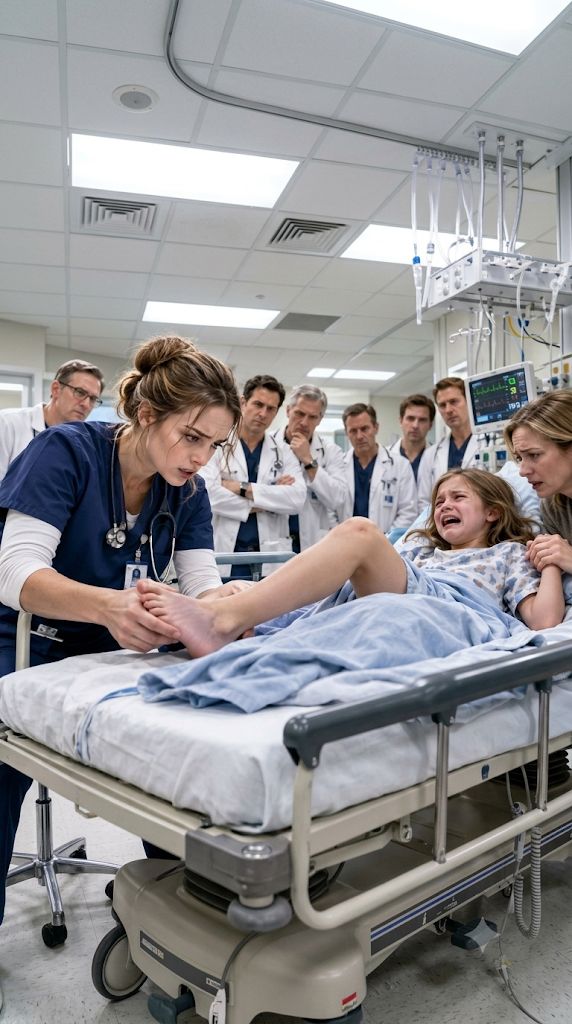
Little Sofia Reyes had been screaming for over an hour, and none of the six doctors who examined her that night seemed to know why. She was eleven years old, with a swollen right knee from a bad fall during a soccer game at a school on the outskirts of Madrid. Her mother, Marta, no longer knew whether to hug her or beg her to calm down. The X-rays showed no fractures, and the blood tests were completely clean. On the hospital bed, folded and ready, lay the discharge papers.
No one noticed the nurse who walked into the room at that moment. She had been working on the pediatric ward at La Paz University Hospital for only five days, and her name meant nothing to anyone in that hallway. Dr. Álvaro Iváñez, the doctor on call, already had his hand on the privacy curtain when she spoke up.
“Don’t remove the leads just yet,” Lucía said in a low but firm voice.
Álvaro turned around, raising an eyebrow in surprise. “She’s been discharged.”
“Six doctors have seen her tonight,” Lucía noted.
“The knee is stable, there’s no fracture, and we desperately need this bed.”
“I just want to check one thing,” Lucía replied without moving her hand from the monitor cable.
Marta, completely exhausted, stepped forward and pleaded. “Please, don’t touch her again. Every time someone stretches her leg, she screams like she’s being killed.”
Lucía looked directly at the girl, whose fists were tightly clenched around the sheet. She knelt down by the bedside and spoke to her with a calmness that didn’t match her five days of official experience at that hospital.
“I’m going to move your leg a little. You tell me when to stop, and I will stop, no exceptions.”
Sofia swallowed hard and nodded. Lucía held her heel and lowered the knee slowly, just a few centimeters. Sofia screamed out in pain. Lucía stopped immediately, and within seconds, the girl’s breathing returned to normal.
Álvaro crossed his arms, looking impatient. “We’ve already checked that. The pain is thoroughly documented.”
“I’寧 not checking for pain,” Lucía said. “I’m checking something else.”
She repeated the movement at the exact same angle. Once again, the scream came at the precise moment. Lucía touched Sofia’s left foot, then the right one, and paused to compare them. Something didn’t add up, and she knew it before she even had the evidence to explain it.
Álvaro’s pager buzzed loudly. “We have three kids waiting for a bed,” he said, staring at the discharge papers as if they were the only truth that mattered.
Lucía understood perfectly what was at stake here. She was the newest nurse on the shift, halting a discharge signed by six doctors based purely on a hunch she couldn’t even name yet. If she was wrong, she would delay an already evaluated patient and call her own judgment into question during her very first week. If she was right, the next person to notice the change could be Marta in the car on the way home.
Sofia moved slightly, and her knee slid into extension. Her face tensed up before the sound arrived. Lucía held the leg again and brushed the right foot. It felt colder; she checked the left one, which remained warmer. Álvaro noticed it too and asked what was wrong.
“I don’t feel comfortable signing this discharge,” Lucía said, “basing it on exactly the same position, the same pain response, and now the fact that the right foot is colder.”
“That doesn’t automatically mean it’s dangerous,” he replied defensively.
“No,” Lucía said, holding his gaze steady. “But it has changed.”
Marta stopped packing her daughter’s things. Álvaro lowered his voice. “You are holding a bed against a discharge that is already completed.”
Lucía looked at the empty wheelchair next to the bed. She knew exactly what it would cost to be wrong and exactly what it would cost to say nothing. “Put my name on the hold,” she said.
Finally, Álvaro studied her for a long second, as if trying to understand where that confidence came from in someone with so little official experience. “Twenty minutes,” he said at last. “After that, I need a real reason.” Then he left the bay.
What no one in that hospital knew yet—not Álvaro, not Marta, not Sofia herself—was that the rookie nurse they had just left alone by the bed was not exactly who her personnel file claimed. Over the next twenty minutes, that secret was about to come to light with the life of an eleven-year-old girl hanging by a thread that only Lucía Fernández seemed capable of seeing.
Nineteen minutes. That was the time Lucía Fernández had left to turn a hunch into something Álvaro Iváñez could not ignore. She pulled the blanket away from Sofia’s feet and compared the pulses. The left was strong and effortless; the right was present, but noticeably weak. Marta watched every gesture of her face as if her daughter’s sentence were written there.
“Is it bad?” Marta asked with a broken, trembling voice.
“I don’t know yet,” Lucía replied without taking her eyes off the clock.
She could easily document the difference, notify Álvaro, and let him decide if it mattered. That would have been the safest version of her job, the one that compromised nothing and risked nothing. But then Sofia moved again, and her knee slid into extension. The girl’s face tensed before the scream came. Lucía placed two fingers on the right pulse, feeling it weaken under her touch the exact instant the leg straightened.
“Bend your knee,” Lucía instructed.
Sofia obeyed, pulling her leg toward her chest. The pulse strengthened again instantly. Lucía repeated the check over and over: weak on extension, strong on flexion, following the exact same pattern repeatedly, as if the girl’s body were trying to say something no one else had wanted to hear.
That was when someone appeared at the cubicle door—someone who shouldn’t have been there at that hour. It was Dr. Rubén Castro, head of trauma, a man whose presence in pediatrics at one in the morning had no logical explanation. He stopped dead in his tracks when he saw Lucía leaning over the bed with two fingers on the girl’s ankle.
“Fernández,” he said with a voice that made Marta turn around in surprise. “I didn’t know you were on shift tonight.”
Lucía tensed up, just for a second, but it was enough for anyone with a clinical eye to notice. “Dr. Castro, I didn’t expect to see you here.”
Rubén entered slowly, his gaze fixed on the position of Lucía’s hands rather than the patient’s face. “What do you have?”
“A change in distal perfusion with knee extension,” she said without any of the hesitation typical of someone who had only been in a hospital for five days. “Weaker pulse on extension, improvement on flexion, and asymmetrical temperature in the foot.”
Rubén walked over and repeated the check himself with the practiced hands of someone who had been doing exactly that for twenty years. Extension yielded a weak pulse; flexion yielded a strong one. He looked up at Lucía with an expression Marta couldn’t interpret—half surprise, half something akin to deep respect.
“This is exactly what we would look for in popliteal vascular entrapment,” Rubén murmured, almost to himself. “How did you see it so quickly?”
Before Lucía could answer, Álvaro entered the cubicle with his pager still vibrating at his waist. He stopped cold when he saw his department head standing next to the bed he himself had discharged barely half an hour ago.
“Doctor Castro,” Álvaro said, bewildered. “I had already closed this case.”
Rubén didn’t take his eyes off Lucía. “Well, you’re going to have to reopen it, and you’re going to have to listen to this nurse, because she just found something that six doctors—myself included, had I been on call—would likely have overlooked.”
Marta looked at Lucía with a mix of hope and confusion. Álvaro, for his part, felt the ground beneath his professional certainties beginning to shift. Who was this new nurse, who had arrived on the floor just five days ago, really? And why did the head of trauma treat her as if he already knew her, as if he knew something about her that the rest of the hospital was completely unaware of?
Rubén turned to Álvaro. “Order an urgent Doppler ultrasound and alert vascular.”
Now Álvaro bolted out of the cubicle, and for the first time that night, no one mentioned the twenty-minute deadline. Marta kept watching Lucía, who had returned to focusing on the girl as if the previous conversation hadn’t even happened, but something in the room had shifted profoundly. The rookie nurse whom no one took seriously ten minutes ago had just sent the head of the entire trauma department into a controlled panic at one in the morning.
As Sofía closed her eyes, exhausted by the relentless pain, Marta couldn’t help but wonder who Lucía Fernández really was. And why, when Dr. Castro had said her last name, he had done so like someone recognizing a person from a past he would prefer not to explain in front of a scared mother in the middle of the night.
The Doppler ultrasound arrived in less than ten minutes—something that on any other night would have been impossible in that overcrowded hospital. But no one questioned the speed because the name that had requested the test belonged to the head of trauma himself. Walking right behind him was a five-day nurse who, for reasons Marta still didn’t understand, seemed to know exactly what they were about to find.
The technician slid the probe behind Sofia’s knee while Lucía held the girl’s foot in the exact position she had documented minutes earlier.
“Flexed, protected, without forcing the extension,” Lucía directed.
“I need a slight change in position to compare the signal,” the technician said.
“No,” Sofia said immediately, clutching the bed sheet tightly.
Lucía leaned toward her gently. “You decide how much, and you say when to stop. No one is going to move you more than you allow.”
Sofia looked at Lucía for a long second, as if in those five days the nurse had earned something that neither six doctors nor her own mother had fully achieved: absolute trust. “Okay,” she said finally, “but stop as soon as I say so.”
The technician lowered the knee just a few degrees. The Doppler signal changed immediately, producing a harsh sound that even Marta, with zero medical training, understood was far from normal.
“That’s it,” said Lucía. “That’s enough, you can stop now.”
The technician looked up in sheer surprise. “How did you know exactly the point where the signal would change?”
Lucía did not answer. She remained silent in the exact same way she had when Rubén Castro spoke her last name with that strange tone—like someone recognizing a detail they preferred not to explain in front of strangers.
It was then that the exam room door swung open again, and this time someone entered who made Rubén Castro himself stand at attention almost without realizing it. It was Dr. Elena Vázquez, head of the hospital’s entire vascular surgery department, a woman whose presence at that hour could never be explained by a simple routine shift.
Two more doctors entered right behind her, and following them, unexpected by anyone, was a man wearing a uniform that did not belong to the hospital staff. Marta felt her heart rise straight to her throat.
“Who is that?” she whispered, looking frantically at Lucía, but Lucía kept her eyes fixed firmly on the monitor screen.
The man in the uniform—a Civil Guard colonel named Ignacio Solís—stopped at the door and fixed his gaze directly on Lucía Fernández, the new nurse who had barely been on the floor for five days.
“Lieutenant Fernández,” said the colonel with a voice that brought the entire room to absolute silence.
Álvaro, who had just squeezed in behind everyone else, froze dead in his tracks. “Lieutenant?” he repeated, completely lost. “Excuse me, Colonel, but she is a civilian nurse. She has been on this floor for five days.”
Colonel Solís took two firm steps forward. “This woman served eight years as a combat nurse in medical evacuation units on missions where she made decisions that most doctors in this hospital would never have to make in their entire careers. She saved lives in conditions where there were no ultrasounds, no second opinions, and no twenty-minute margins—only her bare hands and her own judgment.”
Marta looked at Lucía with her mouth slightly open, utterly unable to process what she was hearing. The nurse who had insisted on delaying her daughter’s discharge—the one everyone had treated as the newest member of the shift—turned out to be a decorated veteran who had deliberately hidden her past.
“Why didn’t you say anything?” asked Elena Vázquez, looking at Lucía with a striking mix of astonishment and professional bewilderment.
Lucía finally looked up, and for the first time that night, her voice trembled slightly. “Because I didn’t come here to be recognized. I came to start over as a civilian nurse, learning a completely different system. What I did tonight, I didn’t do as a lieutenant; I did it as the nurse who was in this room when no one else wanted to look twice.”
Colonel Solís observed her in silence for several long seconds and then did something no one in that room expected. He turned toward Rubén Castro and Elena Vázquez to say more, but before he could finish his sentence, Sofia’s monitor began to wail with a shrill, piercing alarm.
All eyes turned instantly toward the bed, where the pulse in the girl’s right foot had just completely vanished. The alarm filled the room with a sharp beep that made Marta cover her mouth with both hands in horror. On the screen, the wave that seconds earlier showed the pulse in Sofia’s right foot had flattened out completely into a dead line.
Colonel Solís cut his sentence off midway, and everyone rushed toward the bed at the exact same instant. Lucía didn’t waste time shouting orders or asking for permission. She moved before anyone else could react, placing her fingers on Sofia’s ankle with the exact same calm she had maintained all night.
Elena Vázquez moved forward too, but stopped mid-step upon seeing that the nurse already had the situation completely under control with a precision that not even she, the head of vascular surgery, could have executed faster.
“Doppler, now,” Lucía commanded without raising her voice, and the technician immediately placed the probe back on the exact spot Lucía pointed to.
Silence descended. Not a single sound came from the speaker. Marta let out a choked, desperate sob. Sofia, half-asleep from sheer exhaustion, opened her eyes, startled by the sudden terror in the room.
“Vessel one hundred percent compressed,” Elena announced, staring intently at the screen. “If we don’t release the pressure in the next few minutes, the tissue will start to die.”
Colonel Solís, who seconds earlier was speaking of medals and combat missions, now watched the scene with a completely different expression—that of a man recognizing in real-time why that woman had been a lieutenant in a combat evacuation unit.
Lucía Fernández did not hesitate for a fraction of a second. She flexed Sofia’s knee with an exact, controlled movement while speaking to the girl in a voice that completely contradicted the intense urgency of her hands.
“Sofia, listen to me. I’m going to bend your leg slowly. It’s going to hurt, but it’s what will bring the pulse back. Trust me just a little longer.”
Sofia, tears streaming down her face, gave a faint nod. Lucía completed the movement, and everyone in the room held their breath, staring at the Doppler screen. For three agonizing seconds that felt like an eternity to Marta, there was nothing at all; then, a weak, irregular pulse flickered back onto the monitor.
“There it is,” the technician gasped, his voice trembling with overwhelming relief.
Rubén Castro ran a shaky hand over his face. “We need an operating room right now. This cannot wait for another round of conservative compressions.”
Elena Vázquez was already on her phone, activating the emergency on-call surgical team. Meanwhile, Álvaro—still processing everything he had just discovered about the nurse he had underestimated barely an hour before—stared at Lucía with a mix of profound shame and admiration he didn’t quite know how to express out loud.
Colonel Solís approached Lucía as the medical team prepared to move Sofia. “This is exactly what you did out in the field,” he said in a low voice meant only for her ears, “seeing what nobody else notices and acting before it’s too late.”
Lucía didn’t take her eyes off Sofia for a second. “Out there, I didn’t have time to doubt myself. I shouldn’t have had time here, either.”
Marta approached with her hands still shaking uncontrollably. “You saved her twice in a single night.”
“She’s still not out of danger,” Lucía replied, carefully adjusting the position of Sofia’s leg as the transport team wheeled the stretcher in, “but now the right people are listening to her.”
As they rushed Sofia toward the operating room with Rubén, Elena, and two additional surgeons trailing closely behind the stretcher at a rapid pace, Colonel Solís lingered in the hallway a moment longer. He watched Lucía Fernández walk away beside the girl before turning to Álvaro, who still hadn’t managed to utter a single word since discovering the truth about the rookie nurse.
“Do you know why she left the army?” Álvaro asked, almost without thinking.
The colonel looked at him with an expression that left zero room for further questions that night. “That, Doctor, is something she will have to tell you if she ever decides to. But I assure you that what you just saw here is not even half of what that woman is capable of when a life is truly at stake.”
As the heavy operating room doors swung shut behind Sofia’s stretcher, no one in that hallway—neither Marta, nor Álvaro, nor the colonel himself—knew yet that what was about to happen inside those walls would test not only the young girl’s life, but the deepest secret Lucía Fernández had sworn never to reveal.
The operating room filled with a focused, professional silence where every single second mattered immensely. Elena Vázquez positioned herself directly in front of the monitor while Rubén Castro prepped the surgical field. Through the glass observation window, Marta watched from outside, pressing her hands against her chest as she struggled to look away from her daughter’s tiny figure beneath the blazing lights.
Lucía did not go inside. Her clinical task within that room was finished, and she knew it well. Yet she didn’t budge from the glass, standing right beside Marta and watching in absolute silence with the heavy, contained tension of someone who had lived through moments like this before—in places where there were no clean windows or digital monitors, only bare hands and split-second decisions.
Inside, Elena located the exact point of vascular compression precisely as Lucía had described minutes prior. “Right where she said,” Elena murmured as she worked with millimeter-level precision.
Rubén, keeping his eyes locked on the surgical field, replied in a low tone. “If we had waited twenty minutes longer to listen to her, this would have ended very differently.”
Outside, Colonel Solís walked over to stand beside Lucía in front of the glass partition. “When you leave here,” he said without looking directly at her, “the hospital administration is going to want to know who you really are, and this time you won’t be able to avoid it.”
Lucía closed her eyes for a brief fraction of a second. “I know.”
“Why did you leave the uniform behind?” he asked, unable to hold back a curiosity he had harbored ever since recognizing her in the trauma bay.
“Because I spent eight years saving lives during the worst possible moments for people losing them around me,” Lucía replied, her voice steady yet heavy with a weariness no one in that hallway had seen in her until now. “And eventually, there came a point where I needed to help save them before that worst moment ever arrived. Working here in a civilian hospital, I can still do that.”
The colonel nodded slowly, as if her answer finally slotted into place alongside a puzzle piece he had been searching for all night. Marta, who had absorbed every single word in silence, reached out and gently took Lucía’s hand.
“I don’t care what uniform you wore in your past,” Marta said, her eyes brimming with tears. “I only care that tonight, when no one else wanted to bother looking at what was happening to my child, you did.”
Nearly two hours later, the heavy operating room doors slid open. Elena emerged first, pulling off her surgical gloves with an expression that mixed profound exhaustion with deep relief.
“Everything went well,” she announced, addressing Marta directly. “We released the vascular compression just in time. The circulation is completely restored, and your daughter is going to walk normally.”
Marta collapsed into a silent, shaking embrace, her tears finally born of pure relief rather than terror. Rubén stepped out right behind Elena and walked straight up to Lucía, ignoring everyone else for a moment.
“If it had been any other nurse with five days of experience on duty tonight,” Rubén said sincerely, “Sofia likely would have left this hospital holding a discharge signed by six doctors and carrying a leg that would never have functioned the same way again. Thank you.”
Four days later, Sofia walked down the pediatric ward hallway wearing a light knee brace and sporting a bright smile that had nothing in common with the terrified girl screaming in agony on the night of her admission. She stopped right in front of the nurses’ station, where Lucía was busy finishing up a chart report.
“Nurse Fernández,” Sofia said with a playful, feigned seriousness that instantly gave her away. “Or should I say… Lieutenant?”
Lucía smiled—a rare expression that very few people on that ward had witnessed before that week. “Here, I’m just a nurse, Sofia. That is the only thing I ever need to be.”
Marta approached from behind, holding the final discharge papers, which this time had been signed without a single hesitation or doubt. “We will never, ever forget what you did for us,” she said warmly.
Lucía watched the young girl walk down the hall without the slightest trace of a limp, feeling a deep sense of peace she hadn’t experienced in a very long time—the quiet certainty of being exactly where she was supposed to be.
“It wasn’t just what I did,” Lucía said softly, looking back at them. “It was the fact that someone, at some crucial point in this story, finally decided to stop and listen before signing their name. That is truly the only thing any patient ever needs.”
As Sofia and Marta disappeared down the corridor toward the hospital exit, Lucía Fernández returned to her shift. She wore no military uniform and displayed no medals, only her standard white coat, fully aware that the next time someone doubted her for being the newest face on the ward, they would already know precisely what she was truly capable of.
You Might Also Enjoy

Mom Installed a Camera To Discover Why Babysitters Keep Quitting But What She Broke Her Heart


She Gave a Hungry Little Girl a Free Birthday Cake — The Next Morning, a Black Rolls-Royce Arrived