63-Year-Old Man Has No Idea DNA Evidence From His Cadillac Will Expose Him 35 Years Later
“So, you’re saying I don’t have any idea if I gave her a ride or I don’t know if I gave her a ride. I could have gave her a ride. I don’t I don’t I didn’t give her a ride. Okay.”
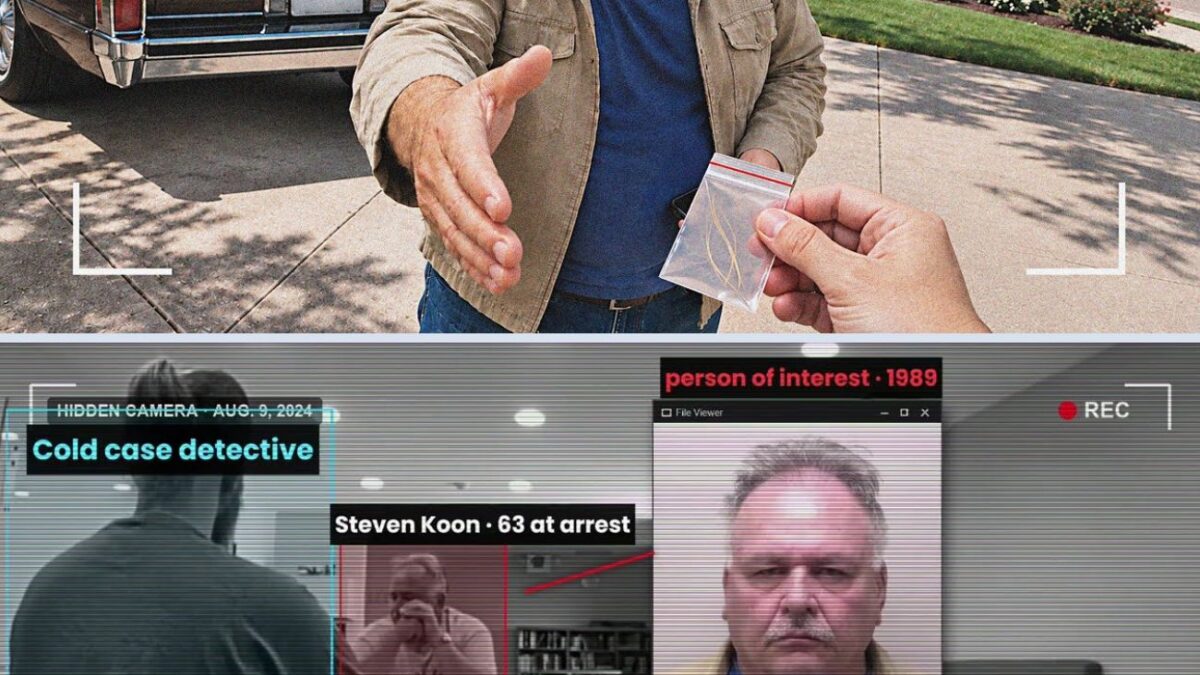
This is Steven Coon. The two men across the table are cold case detectives and a hidden camera is rolling. He has no idea DNA evidence from his Cadillac is already on its way back to a lab.
“The big brown Cadillac, right?”
“I think so.”
Thirty-five years ago, a mother of five vanished after a night out. Coon says he never knew her, leaving behind only two hairs on the floor of the front passenger seat. In 1989, the science couldn’t say whose they were, but now it can try.
“They did process your car, right?”
“Well, Steve, there is this in the car or something like that. I’m not trying to play tricky with you, but it’s just technology is now changing. You can resubmit old evidence and that’s what we’re in the process of doing.”
Judgment: guilt of interest to second-degree murder. April 19th, 1989, Traverse City, Michigan. Linda Matir is 41. She has five children.
She loves flamingos and old country music, and she dances whenever it comes on. Her plants thrive even when she forgets to water them. At the time of the murder, Linda was a mother of five children, a sister, and a daughter.
That night, she goes out with her friend Sally Horton and a few others. They end up at a bar hoping to catch a line dancing class. It’s already over.
“They were hoping to get at the one at the bar they finally ended at to do some line dancing, line dancing classes, but that had already ended. So, they weren’t able to do that, so they just sat and socialized at that bar.”
Sometime after midnight, Linda is seen at a bar near Chum’s Corners. Then she’s gone. A week later, on Thursday, April 27th, a mushroom hunter finds her body in Hooser Valley in the woods south of town.
In the late afternoon of Thursday, April 27th, 1989, the body of an unidentified female homicide victim was discovered in Hooser Valley. Her ribs are broken on both sides. So is her jaw.
“It would take significant force to break ribs as well as a mandible. Significant force.”
Steven Coon was identified as a person of interest in 1989. Investigators find the 1976 Cadillac Coon has been driving, parked at his father’s property. Officers would later testify the inside had been wiped of fingerprints and one side scrubbed.
“There were magenta fibers found in Steve Coon’s car. One was on the driver’s floorboard and one was in the rear seat behind the driver on the floor. Those were sent to the FBI in ’89.”
From the front passenger side, they collect hairs. In 1989, that’s about as far as the science goes. The hairs and fibers go into evidence bags.
The bags go into a box. The case goes cold. Coon stays in Northern Michigan. The evidence waits.
In 2023, Grand Traverse County detectives reopen the file with help from a cold case program at Western Michigan University. August 9th, 2024. Two detectives sit down with Coon. They tell him they have a few questions about something else.
“Yeah, that’s all that stuff, too. Um, so I had a couple other questions about something else. Can you just give me an opportunity to talk to you? Listen. All right, this is something that came up here this spring. Was an old complaint with your name and we just kind of started going back into a bunch of stuff over the years and and I don’t know none of this cuz it’s it’s a real old complaint. You have a lot of questions got asked a long long time ago with a lot of different people and we just kind of started reopening it and going back to it again. Everybody has a boss always saying I have one kind of thing. So, it’s kind of a dual thing that we started doing with with the old mature homicide. And here was one of the days we kept going back through and checking with a lot of some people.”
Notice what the detectives do not do. They don’t mention the car. They don’t mention the hairs. They start with something else and they let Coon talk.
“I think initially do you remember what you told law enforcement or didn’t? Not trying to you said you didn’t remember doing anything but you also had drinking that night. I remember that back in the day you said…”
“I drank a little bit. I drank a little bit. So that second go-round or something you said, ‘Hey, you know, I think I might remember, but get back with me.’ That’s all the report reads. That’s all the report reads. It doesn’t say that anybody ever ever tried even talking to you again.”
“You know, I don’t recall ever saying that.”
What Coon doesn’t know is that the hairs and fibers from that Cadillac are already being sent back out for testing. He assumes the old trail is completely dead. But science moves faster than memory.
“I mean, because there’s I think three or four people said we left the fire that night, but we don’t have anything more than that. That doesn’t mean anything, right? All right. Right. It’s just trying to figure out why or or or not or if there’s some other reason that I don’t know. Help me understand what that reason would be. You know what I mean?”
“Do you recall doing that?”
“No.”
“Or leaving that with her?”
“No.”
“Or was there some kind of And I mean, I’ll be honest with you. Is there some kind of fear that if I say you know I gave her a ride home then I’m not see here or or what’s…”
“I got to tell you I have no idea. I have no idea what you know. Okay. So you’re saying I don’t have any idea if I gave her a ride or I don’t know if I gave her a ride. I could have gave her a ride. I don’t I don’t I didn’t give her a ride.”
This is the sentence to remember. Not “I don’t remember.” Not “Maybe I didn’t give her a ride.” A clean answer is easy to test.
Two hairs from the front passenger seat floor told a different story. And that car had been thoroughly wiped down.
“And that was in what kind of car? You had the big brown Cadillac, right?”
“I think so.”
“Yeah, Big Brown Cadillac. I didn’t even tell you what year it was.”
“No, I think it was registered to somebody else or something like that. And he ended up parking at dad’s. Well, we kept our everybody all of us kept our vehicles down there and my motorcycle was down there.”
That Cadillac had been wiped down. And a woman who knew Coon back then says he told her he’d left the car at his father’s place, hoping investigators wouldn’t find anything in it.
“A regular at the bar would later testify he saw the two of them together in 1988 and ’89, hands on each other’s shoulders.”
“I said for me, you know, one of the big things when I look at that real quick and like I said, I did call the tailor and talk to them and go over it. They’re like, ‘You know, could it be somebody else?’ They’re like, ‘No, it was Steve. It was Steve because he was leaving our house. He was moving our house and him and his dad were doing it and he finished up the job. It was Steve that left with her. There was no one else around cuz we would try to kind of get her get her out of the water cuz she was drunk and causing problem, fell down, hit her face or something like that. And like I say, that doesn’t mean anything. But what what for us is it makes us draw is that but I know in the original you make a comment to those guys that you doing and I don’t recall any tailor.”
“Okay.”
“And me and my dad never did any roofing on peninsula.”
“Mh-hmm. But anything you told the guys you ended up at the same bar you told guys originally you ended up there lights bar spikes you ended up there you were there but you never got back to them like no one ever talked to you again about that and you never cuz I don’t see anything that anybody ever talked to you again about that at all right um so that’s kind of the things I’m trying to understand you know what I mean or understand why cuz you Well, they did process your car, right? And and I don’t want to say that if it’s not in the car, we should never find anything in that car. That’s correct. So, if I go back to that, then I then I want to come back to that say, well, Steve, there is this in the car or something like that. I’m not trying to be tricky with you, but it’s just technology is now changing. We can resubmit old evidence and that’s that’s what we’re in the process of doing.”
Listen to how the questions have changed. First, something else. Then that night at the bar. Then did you give her a ride? Now there is this in the car.
The detectives have moved from Coon’s memory to Coon’s car. The evidence is already at the lab. He doesn’t know that yet.
“Is there some fear that if I say I get a ride home here, I some fear that or…”
“Or is it just something he’s saying? I don’t know. I don’t want to talk about that. I give her a ride.”
“Okay. No, you’re not giving me a ride.”
“You got to go with my sisters. Okay. At the conclusion of that last one, you said, ‘Get back with me. I want to for whatever reason, I basically said a minute, but I might have a female ride home.’ It’s in there.”
“I don’t know why I would have said that, though.”
18 minutes earlier, Coon said, “I didn’t give her a ride.” Now, his own words from 1989 are read back to him, and the answer becomes, “I don’t know why I would have said that.”
“I mean, you knew back then that she’s she didn’t know her.”
“No, no, no, no. I’m saying you knew back then those guys who talked to you that Linda was dead.”
“Well, some of them told me I don’t know. I could tell you I talked to…”
“Okay. Did those guys ever tell you that she was dead or where she was found or anything like that?”
Seven seconds of silence alone proves nothing, as people go quiet for many reasons. What matters is what can be checked. And the car could definitely be checked.
The interview ends. No handcuffs. That’s the version of this story where Coon walks away and the case stays cold. It’s not what happens.
This marked a major turning point after decades of waiting. On February 18th, 2025, Coon was finally arrested at the age of 63.
“On today’s date, the Grand Traverse County Sheriff’s Office arrested a 63-year-old Leelanau County man for open murder related to the 1989 death of Linda Matir. We believe that the relationship between the two was a casual encounter.”
June 2026, Coon goes on trial for open murder. The case comes down to what was found in that car.
First, the fibers. An expert compares 10 from the car with 10 from the scene.
“We were able to find differences using the techniques we’ve described between the fibers recovered from the scene and the fibers recovered from the suspect’s vehicle.”
“Is there any way to tell us exactly where these fibers came from? Both the car fibers and the scene fibers.”
“That’s my…”
Then the hairs. Their mitochondrial DNA can’t prove they’re Linda’s but it can’t exclude her either.
“We get a population frequency of 0.21%. And what that means that in North America 99.79% of the North American population could be excluded. Approximately 1 in every 477 individual maternal lineages would also have that same sequence.”
The defense points to more. A hair found on the only sock Linda was wearing. It’s not hers and it’s not Coons. And a box of old files that turns up weeks before trial with a 74-page interview transcript that runs just 32 pages.
Then a woman who knew Coon back in 1989 takes the stand to share what she remembered.
“Can you tell the jury what he what he said?”
“I think I killed someone.”
“Do you recall telling law enforcement officers that Mr. Coon is a pathological liar?”
“Yeah.”
“That you don’t believe anything?”
“I never believed anything.”
“And I’m going to ask you now, as I said I would at the beginning of this case to come back with the only reasonable verdict given the evidence. I’m going to ask you to find the defendant guilty for the death of Lyn Tier.”
“Really look at is that your reasonable doubts don’t need to be the same. Some of you may find a reasonable doubt from one slide. Some may find a reasonable doubt from another slide. That’s okay. You can have different reasonable doubts.”
After 12 jurors spent about 16 hours in deliberation, a final decision was reached.
“Why is your verdict as to count one murder?”
“Guilty.”
“My mother got justice today. Today was her day. I used to spend most of my summers sitting at my mom’s grave site and I will continue to do that. I just feel a special bond at that place. Most people don’t like cemeteries. That’s my spot to go to so I can talk to my mom.”
“37 years, one month and some odd days since this happened. I had my doubts through the years that when it became a cold case that it might not ever come to fruition and come to court.”
On August 24th, 2026, Coon was officially sentenced to at least 30 years behind bars.
“He didn’t just commit a crime, he destroyed my family. He changed the course of my childhood life forever. My mother deserved to live.”
Asked if he wants to speak, Coon declines. He still says he’s innocent.
A bar, a ride he swore he never gave, and a Cadillac wiped clean defined the mystery. Two hairs rested on the passenger side floor for 35 years in a box.
What convicted Steven Coon wasn’t how he looked, how quiet he went, or how long he paused. It was what could be checked.
It all came down to a ride he said he never gave, a woman he claimed he never knew, and a car that kept what was left on its floor.
So if a story ever doesn’t sit right with you, don’t judge the person. Check the details. Don’t forget.
“I’m going to rest easy tonight and there will be less and less and less tears.”
Linda Matir was 41 on an ordinary Wednesday night in April. She went out with a friend, hoping to learn to line dance. The class was already over.
So, what convicted Steven Coon? Two hairs and a few fibers on the floor of a Cadillac or a story that kept changing in a single afternoon?
Tell us where you would have drawn the line.
You Might Also Enjoy

Mom Installed a Camera To Discover Why Babysitters Keep Quitting But What She Broke Her Heart

She Gave a Hungry Little Girl a Free Birthday Cake — The Next Morning, a Black Rolls-Royce Arrived