A Navy SEAL Laughed at the SAS Veteran’s Warning. Ten Minutes Later, Nobody Was Smiling
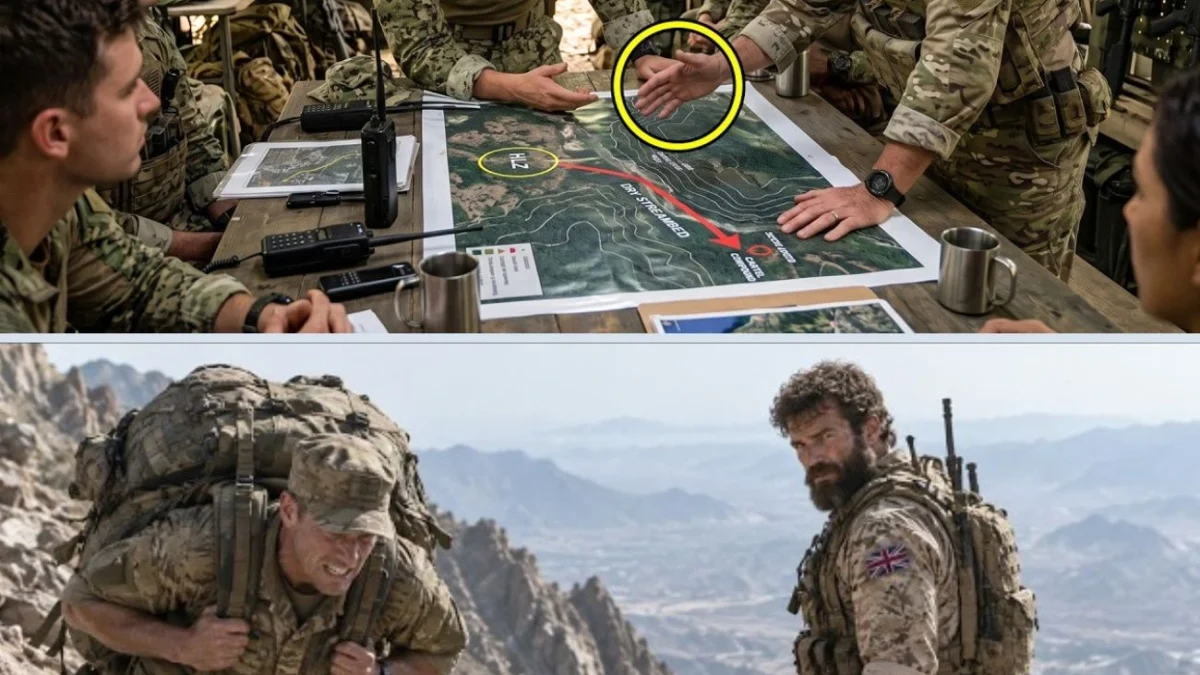
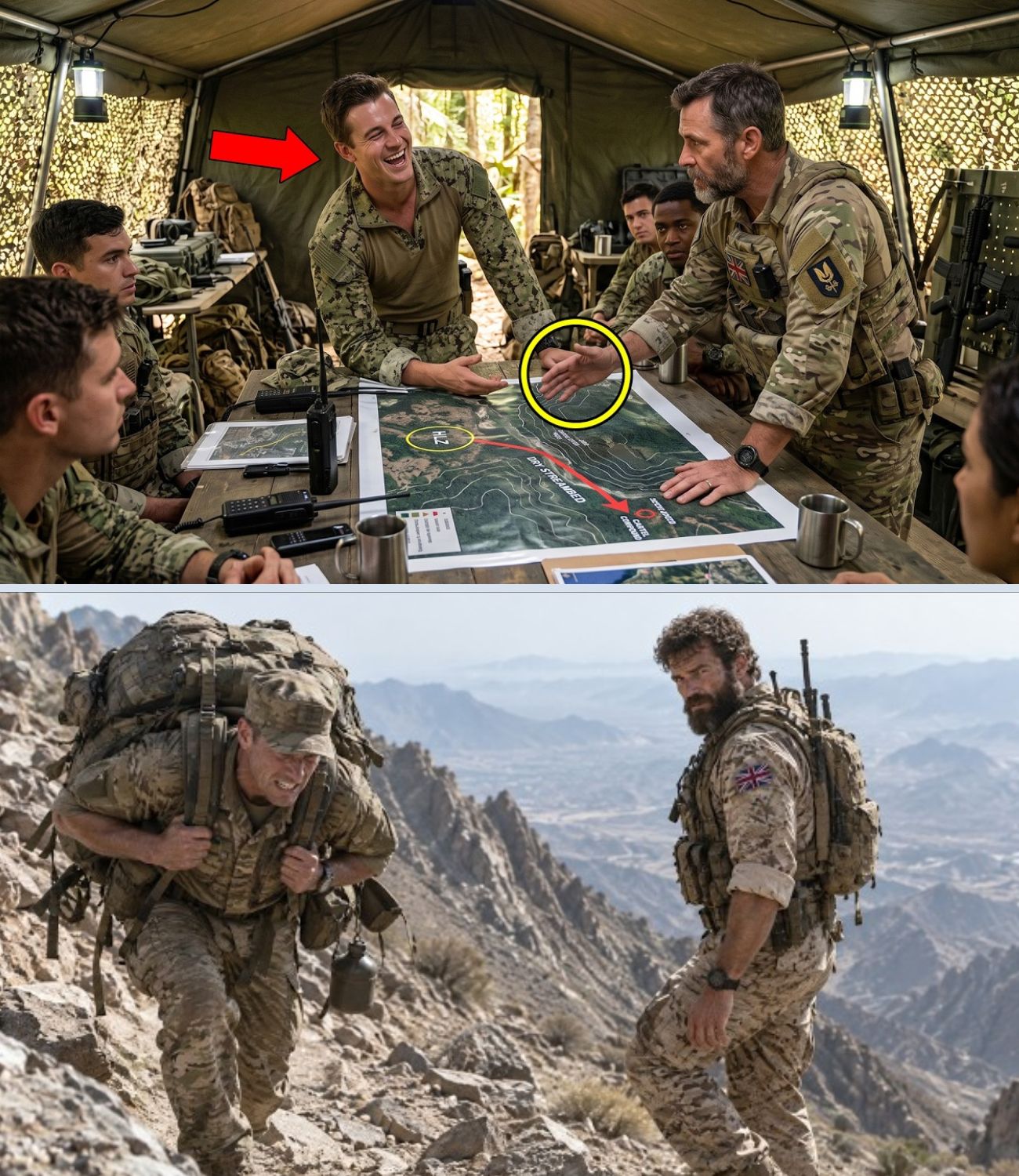
Heavy with the stench of stale sweat and hot electronics, the air inside the tactical tent felt suffocating. When the young American let out a short, sharp bark of dismissive laughter, Davies didn’t even blink. He merely tightened the frayed strap on his webbing, knowing the grim truth. While the confident American saw a textbook raid, Davies saw a graveyard forward operating base.
Restrepo was a miserable stretch of concertina wire and Hesco bastions bleeding into the damp edge of the Colombian jungle. It was a place where the air hung heavy and wet, sticking to the lungs like wet cotton. Inside the briefing tent, a single oscillating fan pushed hot air back and forth over a plywood table littered with satellite imagery.
Callum Davies stood in the corner. He was a small man by special forces standards. Lean, unassuming, with a face that looked like it had been left out in the rain for 40 years. He wore a faded olive drab t-shirt, his issued boots scuffed down to the suede, a roll of sniper tape hanging from a carabiner on his belt.
If you saw him in a pub in Hereford, you’d think he was a tired carpenter. You wouldn’t guess he had 22 years in the Special Air Service. Across the table stood Lieutenant Brody Hutchinson, known as Hutch. He was everything Davies wasn’t. Built like a college linebacker, Hutch was a golden boy of naval special warfare. His gear was immaculate.
The AOR1 camouflage pattern on his plate carrier was crisp. His high-cut ballistic helmet bristled with strobes, cameras, and panoramic night vision goggles. He looked like the future of war. Davies looked like a ghost from its past. They were looking at a compound nestled deep in a ravine surrounded by triple canopy jungle.
The target was a cartel enforcer who had started playing politics funding a local insurgency. He had to go.
“It’s a standard smash and grab,” Hutch said, tapping a stylus against the laminated map. “We insert via Black Hawk here, three clicks south, fast rope into this clearing.”
“We push straight up this dried riverbed. It’s a straight shot. Minimal resistance on the approach. We hit the compound, breach, clear, and extract before they even get their boots laced.”
Hutch looked around the room. His squad of SEALs nodded. They were young, fit, and hungry. They thrived on speed, surprise, and violence of action, utilizing overwhelming firepower, shock, and awe.
Davies leaned forward, his elbows resting on the plywood. He didn’t look at the compound. He looked at the contour lines surrounding it.
“The riverbed,” Davies said. His voice was quiet, a low gravelly rasp that forced the room to settle down to hear it. “It’s a natural funnel.”
“It’s a highway,” Hutch corrected, smiling thinly. “It cuts our approach time in half. We stay off of the ridges. We avoid the heavy brush. We move fast.”
“Fast makes noise, Lieutenant,” Davies said. He traced a finger along the steep elevation lines flanking the dried river. “You’ve got 70° inclines on both sides of this draw. It’s a canyon. If they have spotters on the high ground, you won’t see them through the canopy. But they will see you.”
Hutch crossed his arms. The synthetic fabric of his combat shirt rustled.
“With all due respect, Sergeant Major, this isn’t the Falklands. We have ISR overhead. The drone feeds show zero thermal signatures on those ridges. They’re empty.”
“They’re empty now,” Davies replied. “Because it’s 2:00 in the afternoon. When the sun drops and the heat leaves the canopy, the thermals change. Mud and soil blankets block infrared. The locals know this. They’ve been fighting in this bush since before you were born.”
Hutch sighed, an exaggerated puff of air. He looked at his second-in-command, a heavily tattooed operator named Cooper, and rolled his eyes. The tension in the tent was palpable. It was a clash of doctrines. The American way: leverage technology, push hard, dominate the battle space. The British way: trust nothing, assume a trap, bleed into the environment.
“Look, Davies,” Hutch said, his tone bordering on patronizing. “I appreciate the caution, but if we take the ridgeline like you’re suggesting, we’re hacking through dense foliage for six hours. We’ll be exhausted by the time we hit the objective. The HVT will be long gone. We take the riverbed, we hit them hard. Speed is security.”
Davies looked up from the map. He met Hutch’s eyes.
“Speed is security when you’re in a car, son. In the jungle, speed is a coffin.”
That was when Hutch laughed. It wasn’t a malicious laugh, but it was worse. It was dismissive. A short, sharp bark of genuine amusement. He shook his head, looking down at the older man.
“I’ll tell you what, Davies,” Hutch said, grinning. “You and your three guys take the scenic route. Play in the mud on the ridge. My team will take the riverbed. We’ll save you a cold beer for when you finally show up to the exfil.”
The SEALs chuckled. Davies’ men, Trent, Hayes, and a medic named Bishop, didn’t move a muscle. They just looked at Davies. Davies didn’t raise his voice. He didn’t posture. He just reached down, picked up his rifle, and checked the chamber.
“The riverbed is a kill zone,” Davies said softly. “Don’t go down there.”
“See you at the rally point, old man,” Hutch said, turning his back to prep his gear.
Davies watched him for a second. Then he stepped out of the tent into the blinding, humid sunlight. Trent fell in step beside him.
“Reckon he’ll listen?” Trent asked, lighting a cigarette.
“No,” Davies said, staring at the distant, dark green smear of the tree line. “Check your medical kits. We’re going to need them.”
The insertion was chaotic, loud, and brutally fast. The Black Hawks flared over the clearing, rotor wash flattening the elephant grass in concentric waves. Ropes kicked out the doors. Hutch and his men went first. They descended with flawless, practiced precision, heavy boots hitting the soft earth, weapons up, fanning out into a perimeter. They moved like a machine.
Davies and his team followed. They didn’t look like a machine. They moved like water, slipping off the ropes and instantly disappearing into the shadows at the edge of the clearing. By the time the helicopters banked hard and disappeared back into the hazy sky, the SAS operators were already gone, swallowed by the brush.
The jungle immediately closed in around them. It was a sensory overload. The heat was a physical weight pressing against their chests. The smell was a thick mixture of rotting fruit, damp earth, and sweat. Cicadas screamed in a deafening metallic chorus.
They reached the divergence point within 20 minutes. Before them lay the dried riverbed. It was exactly as the map had promised: a wide, flat scar of baked mud and smooth stones winding its way deep into the valley. Above it, the jungle rose in steep, imposing walls of green on either side.
Hutch stood at the mouth of the draw. He held up a fist, halting his column. He looked back at Davies, who was standing a few yards away in the thick ferns, preparing to begin the grueling climb up the ridgeline. Hutch tapped his helmet comms, grinning beneath his camouflage paint.
“Last chance to take the express lane, Brits.”
Davies didn’t use his radio. He just gave a slight shake of his head. Hutch flashed a thumbs-up, turned, and signaled his men forward.
The SEALs pushed into the riverbed. They moved beautifully, a staggered column covering all angles, boots crunching on dried mud, rifles panning smoothly. They were fast.
“Fools,” Hayes whispered over the internal squad net. “Let’s move.”
Davies clicked back. “We take the high ground. Stay parallel to them. Keep your eyes in the canopy.”
The climb was agony. The incline was brutal, the mud slick with moss. Every step required hands and feet, pulling themselves up by exposed roots and vines that tore at their gloves. They didn’t hack through the brush; they wove through it, parting leaves gently and letting them fall back into place so as not to leave a trail. They moved in total silence—a slow, agonizing crawl through the green hell.
Down below, through gaps in the foliage, Davies could occasionally catch glimpses of the SEAL team. They were making incredible time. The riverbed was clear of obstacles, and they were eating up the distance, marching straight into the throat of the ravine.
Ten minutes passed. The heat grew more oppressive. The sweat stung Davies’ eyes, pooling in the deep lines of his face. He paused, pressing himself against the trunk of a massive ceiba tree. He raised a closed fist. Behind him, Trent, Hayes, and Bishop froze instantly. Davies breathed through his nose. He listened. Something was wrong.
The baseline of the jungle had changed. When you spend enough time in the wild, you stop listening for what’s there, and you start listening for what isn’t. The deafening roar of the cicadas had abruptly died down in the valley ahead. The macaws weren’t calling. The jungle was holding its breath.
Davies slowly brought his rifle up, peering through the Trijicon ACOG scope down into the valley. He scanned the opposite ridgeline. Nothing but green. But it was the wrong kind of green. He saw a cluster of ferns near the lip of the ravine. The underside of a fern leaf is a lighter, paler green than the top. The cluster he was looking at was a dull, pale shade. Someone had cut branches and stuck them in the mud to create a blind, but they had planted them upside down. A tiny detail, a fatal mistake.
Davies shifted his scope down. The SEALs were directly below that blind, moving fast, totally exposed in the center of the riverbed. Hutch was on point.
“Hutch, this is Davies,” he whispered into his boom mic.
Static hissed in his ear. The steep walls of the ravine were scrambling the line-of-sight comms.
“Hutch, break. Halt your column. You are walking into an L-shaped ambush. High ground, both sides. Acknowledge.”
More static. Davies looked down. Hutch hadn’t stopped. He was checking a GPS device strapped to his wrist, waving his men forward. They were 50 yards from the choke point.
“Trent,” Davies hissed over the short-range squad net. “Set up the GPMG. Suppressing fire on the opposite ridge. Bishop, Hayes, fix bayonets. This is going to get ugly in about three seconds.”
Down in the valley, a single sharp crack echoed. It wasn’t a rifle shot. It was the sound of a dry branch snapping under weight. Hutch stopped. The SEALs froze, weapons snapping up. For a fraction of a second, the riverbed was perfectly still. Hutch looked up at the dense, impenetrable wall of green above him. The laughter was long gone from his face. The realization hit him, visible even from the ridge—the cold, creeping dread that the old man had been right. They were in the fatal funnel. There was no cover, nowhere to hide.
From the opposite ridge, a heavy machine gun opened up, the muzzle flash tearing a brilliant yellow hole in the shadows. The jungle exploded. The first burst of PKM fire didn’t sound like a movie. It sounded like thick canvas being ripped violently in half right next to their ears. Down in the riverbed, the mud around Hutch’s boots erupted in a violent sequence of geysers. The sheer volume of fire was staggering. It wasn’t just one machine gun; it was three, positioned in a synchronized crossfire that turned the narrow draw into a blender of copper, lead, and splintered rock.
“Contact right! Contact front!” Cooper screamed, his voice cracking over the chaotic din.
Training kicked in. The SEALs didn’t freeze. They hit the deck, rolling for whatever meager depressions they could find in the baked earth, bringing their M4s up and returning fire. Tracers punched blindly up into the dense green canopy. They were shooting at smoke and noise. The cartel fighters were dug into spider holes and camouflaged blinds, firing down with total impunity.
Hutch slammed his back against a boulder no larger than a microwave. It was the only cover within 50 yards. A heavy-caliber round smacked the stone inches from his helmet, showering his neck with sharp, hot fragments.
“Push up!” Hutch yelled into his radio, grabbing a fragmentation grenade. “We have to break out of the X. Move!”
But there was nowhere to move. The walls of the ravine were too steep, the mud too slick, the incoming fire too concentrated. Ten yards away, a young SEAL named Jackson stood up to bound forward. He made it exactly one step. A round caught him square in the chest plate, spinning him violently. Before he hit the ground, a second round tore through his thigh. He collapsed into the dry dirt, screaming and clutching his leg as blood immediately began to pool, turning the pale dust into dark, sticky mud.
“Man down!” Cooper bellowed, dropping his rifle and lunging toward Jackson.
Cooper never made it. A burst of fire walked across his path, catching him in the shoulder and pitching him face-first into the dirt.
Hutch watched his invincible team disintegrate in less than 30 seconds. The panoramic night vision goggles, the satellite uplinks, the drone feeds—none of it mattered down here in the dirt. He had led them straight into an abattoir. He squeezed his eyes shut, his chest heaving, the metallic taste of adrenaline and sheer panic flooding his mouth.
Then, the sky tore open. From the ridge above and behind the cartel’s left flank, a different sound cut through the chaos. It was a slower, heavier, far more deliberate rhythm: thump, thump, thump, thump.
Trent had set up the L7A2 general-purpose machine gun on a heavy root system. He didn’t fire in panicked, continuous bursts. He fired in controlled, punishing five-round intervals. The British 7.62 mm rounds ripped downward at an angle the cartel fighters hadn’t prepared for.
Davies knelt beside Trent, looking through his ACOG scope, calling targets.
“200 meters. Adjust left. Base of the large mahogany. You see the muzzle flash?” Davies said, his voice flat and conversational.
“Target acquired,” Trent grunted.
“Put them down.”
Trent squeezed the trigger. The heavy rounds chewed through the foliage, splintering the mahogany trunk and instantly silencing the cartel machine gun nest hiding behind it. A body tumbled out of the brush, crashing heavily down the steep incline and landing in a crumpled heap near the edge of the riverbed.
“Shift right,” Davies said, not missing a beat. “Elevation plus 10. Spider hole.”
Down in the kill zone, Hutch opened his eyes. The incoming fire from his left had suddenly evaporated, replaced by the terrifying, deafening crack of rounds passing directly over his head from the ridge. He looked up. Through the swirling dust and cordite smoke, he couldn’t see the British operators. They were entirely invisible against the jungle. But he heard them.
“Bishop, Hayes,” Davies’ voice crackled over the emergency squad net, calm and devoid of inflection. “Pop smoke. We are bounding down. We have to drag them out.”
“Copy that, boss,” Hayes replied.
Three yellow smoke grenades tumbled down the 70° slope, bouncing off roots and hissing violently as they hit the floor of the ravine. Thick, acrid smoke began to fill the choke point, blinding the remaining cartel gunners on the opposite ridge.
“Hutch, listen to me,” Davies’ voice came over the radio again. It wasn’t a request. It was an absolute command. “Do not move. We are coming to you.”
Hutch couldn’t answer. He was staring at Cooper, who was lying unnervingly still in the dirt.
Figures materialized out of the yellow smoke. They didn’t run with the frantic, adrenaline-fueled sprint of panicked men. They moved with a terrifying, calculated efficiency. Hayes slid down the last 20 feet of the embankment, landing on his boots. He didn’t even look at Hutch. He immediately posted up behind the dead cartel fighter, bringing his rifle to bear and firing double-taps up at the opposing ridge, providing covering fire.
Bishop, the SAS medic, moved straight to Jackson. He didn’t ask how the kid was doing. He dropped to his knees, drew a pair of trauma shears, and cut Jackson’s pant leg open in one fluid motion. Blood was pumping in bright red, rhythmic spurts—a femoral artery hit. Jackson was thrashing, his eyes wide with shock.
“I’m dying, man. I’m dying.”
Bishop drove his knee hard into Jackson’s groin, pinning the artery against the bone with his body weight. Jackson screamed in agony.
“Shut up,” Bishop said mildly. He reached into his kit, pulling out a tourniquet. “You’re not dying today, mate. It’s a Tuesday. Bad luck to die on a Tuesday.”
Davies was the last one down. He didn’t slide. He descended the treacherous slope with a quiet, sure-footed grace, his rifle constantly scanning. He reached the floor of the ravine and walked straight through the incoming fire, the air snapping and popping around him. He reached Hutch’s boulder.
Hutch looked up at him. The young SEAL’s pristine gear was covered in gray mud and blood. His eyes were wide, the arrogant shine completely gone, replaced by the hollow, dilated stare of a man who had just looked his own hubris in the face. Davies crouched down next to him. He didn’t smile. He didn’t say, “I told you so.”
“Where are you hit?” Davies asked.
Hutch blinked, looking down at himself. He hadn’t even realized it. A dark stain was spreading across his left oblique just beneath the edge of his body armor. A ricochet had caught him under the ribs.
“I… I don’t know,” Hutch stammered.
Davies reached out, pressing a gloved hand hard against the wound. Hutch winced.
“Through and through. It missed the lung,” Davies said, his voice completely detached. “You can walk. Grab your second-in-command. We are leaving.”
“Cooper,” Hutch said, pointing a shaking finger at his teammate. “He’s down.”
“Then pick him up,” Davies said. He stood up, turning his back to Hutch and raising his rifle to fire at a muzzle flash high on the ridge. “Trent is going to lay down a continuous belt. When he does, you carry your man back the way you came. Do you understand me, Lieutenant?”
Hutch swallowed hard. He nodded. “Yes.”
“Good. Move.”
The retreat was a grueling, agonizing slog. Trent opened up with the GPMG, holding down the trigger and walking a solid wall of lead across the opposite ridge. The jungle shredded under the onslaught. Leaves rained down like green snow. Under the deafening roar of the covering fire, Hutch and another SEAL grabbed Cooper by the drag handles on his plate carrier. They pulled him back through the mud, the ground sucking at their boots. Cooper groaned, a wet, rattling sound. Bishop dragged Jackson, one hand gripping the young man’s vest while the other kept his own sidearm raised.
Davies and Hayes formed the rear guard. They backed out of the kill zone slowly, stepping over roots and rocks without looking down. Every time a cartel gunner peeked over the ridge to take a shot, Davies or Hayes put a round inches from their face, forcing them back down. They didn’t waste ammunition on suppression; they shot to kill, and they shot with terrifyingly precise effect.
It took them 45 minutes to crawl 300 yards back down the riverbed to the insertion clearing. By the time they reached the tree line, the heavy canopy gave way to the blinding afternoon sun. Trent came last, his GPMG smoking, the barrel radiating heat waves. He jogged backward, perfectly balanced, until he crossed into the tall grass of the clearing.
“Break contact,” Davies ordered over the net.
The SAS operators melted back into the perimeter. Silence fell over the clearing, save for the ragged, desperate panting of the SEALs and the static of the radio as Hutch called in a medevac.
The extraction Black Hawks arrived 20 minutes later. The wait felt like a decade. Nobody spoke. The cartel didn’t pursue them; the sheer, brutal efficiency of the SAS rear guard had broken their assault. They had lost too many men to Trent’s machine gun to risk pushing into the open clearing.
Bishop had stabilized Jackson and Cooper. Both would live. But their war was over. They lay on stretchers in the tall grass, hooked up to IV bags, their faces pale and drawn.
Hutch sat on a Pelican case near the edge of the landing zone. His uniform was soaked in sweat and his own blood. A medic had slapped a chest seal and a tight bandage over his flank. He sat bent forward, his elbows resting on his knees, staring at his boots—the boots that were supposed to march straight down the riverbed to glory.
He watched Davies. The older man was sitting on a fallen log a few yards away. He had taken his helmet off, and his sparse, graying hair was matted with sweat. He was stripping down his rifle, methodically wiping the mud and carbon from the bolt carrier group with a rag. He wasn’t shaking. He wasn’t breathing hard. He looked exactly the same as he had in the briefing tent.
Hutch stood up. His side burned with a hot, stabbing pain, but he ignored it. He walked over to the log. Trent and Hayes watched him approach, their eyes cold and flat. They didn’t shift their weapons, but their posture tightened. Davies didn’t look up from his rifle.
Hutch stopped in front of the SAS veteran. He opened his mouth to speak, but the words caught in his throat. He wanted to apologize. He wanted to explain that the drone feeds were clear, that doctrine supported his decision, that he had never lost men like this before. He looked at Davies’ hands. They were scarred, rough, and stained with gun oil—the hands of a man who had buried more friends than Hutch had ever made. Hutch realized in that moment that apologies meant nothing out here. Excuses meant less. The jungle didn’t care about satellite imagery or naval combat doctrine. The jungle only cared about who respected it and who didn’t.
Davies finally looked up. He slid the bolt carrier back into the upper receiver and snapped the rifle shut with a sharp, metallic clack. He met Hutch’s eyes. There was no anger in Davies’ expression. There was no vindication. There was only a bone-deep weariness.
“You lost the element of surprise, Lieutenant,” Davies said quietly.
Hutch swallowed the lump in his throat. “I lost more than that.”
Davies nodded slowly. He reached into his webbing and pulled out a battered aluminum canteen. He unscrewed the cap and held it out.
“Drink,” Davies said. “You’re in shock.”
Hutch took the canteen. His hands were shaking so badly the aluminum clattered against his teeth. The water was lukewarm and tasted like iodine. But it was the best thing he had ever swallowed. He handed it back.
“Why didn’t you stop me?” Hutch asked, his voice a hoarse whisper. “In the tent. You knew. You knew exactly what was going to happen.”
“I gave you my assessment,” Davies replied, screwing the cap back on. “You gave me your orders. I am not your commanding officer, Hutchinson. I cannot save you from your own ego. I can only pull you out of the fire when it burns you.”
The rhythmic thumping of rotor blades echoed in the distance. The Black Hawks were inbound.
“They’re going to court-martial me,” Hutch said, looking back at his wounded men. “I walked them right into a slaughter.”
Davies stood up. He slung his rifle over his shoulder. He looked at the young officer, stripping away the rank, the gear, and the bravado, seeing only a frightened kid who had just learned the hardest lesson in the world.
“They won’t court-martial you,” Davies said. “You took contact, you returned fire, and you extracted your casualties. The paperwork will say it was a fierce, unforeseen engagement. The brass doesn’t punish aggression. They’ll probably give you a medal.”
Hutch looked sick. “I don’t want a medal.”
“Good,” Davies said, turning toward the LZ as the Black Hawks flared over the tree line, the rotor wash hitting them like a physical blow. “Because the medal isn’t for you. It’s to make the people back home feel better about sending kids into the dark.”
Davies walked past him, leaning into the wind and moving toward the waiting helicopters. He stopped and looked back over his shoulder.
“Next time you look at a map, Lieutenant,” Davies yelled over the roar of the engines. “Remember that the contour lines don’t bleed. Men do. Now get your people on the bird.”
Hutch watched the small, unassuming Brit climb into the back of the Black Hawk. The laughter from the briefing tent felt like it had happened a lifetime ago. There was no humor left in him. There was only the ringing in his ears, the smell of copper, and the terrifying realization that in this world, experience wasn’t a badge you wore—it was a scar you carried. Hutch turned, grabbed the handles of Jackson’s stretcher, and carried his bleeding man toward the sky.
You Might Also Enjoy


Mom Installed a Camera To Discover Why Babysitters Keep Quitting But What She Broke Her Heart


She Gave a Hungry Little Girl a Free Birthday Cake — The Next Morning, a Black Rolls-Royce Arrived




