“BOSS, YOUR MOTHER IS ALIVE! I SAW HER IN THE MENTAL ASYLUM!” — THE MAID SCREAMED WHEN SHE SAW THE PORTRAIT IN THE MANSION.
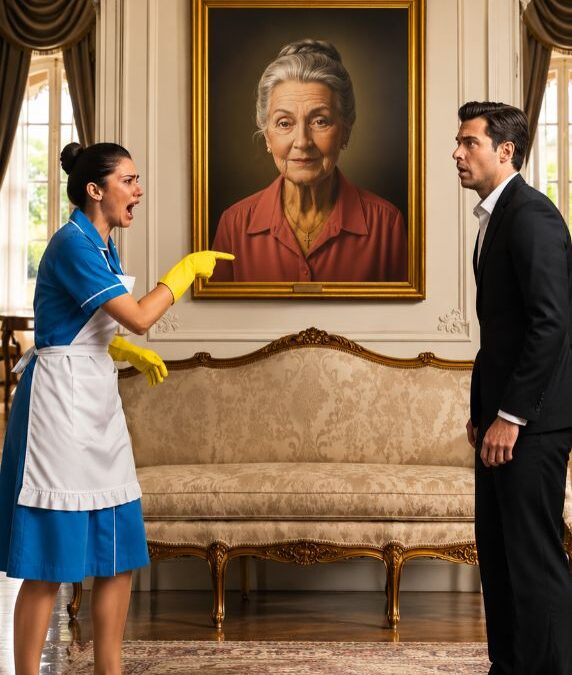
Sir, your mother is alive. “I saw her in the asylum,” Dolores cried, her voice trembling and her eyes brimming with tears. The echo of her words bounced off the high walls of the Montiel mansion, where even the air seemed to stand still. Héctor Montiel, seated beside the grand piano, froze.
The document he held in his hands fell to the floor without him noticing. He turned slowly, his heart pounding in his chest, trying to understand if what he had just heard was real or madness. “What did you say?” he asked, his voice barely audible.
Dolores swallowed hard, fear and emotion mingling in her throat. “I swear on my mother’s grave, sir, that woman in the portrait is Doña Josefa Montiel.” I worked at that clinic, sir, at the San Miguel Arcángel clinic.
She cleaned his room every day, brought him water, and changed his sheets. I heard her praying his name every night. He said, “My son Hector plays the piano and one day he will come for me.”
The silence that followed was heavy, as if the whole house were holding its breath. Soft footsteps could be heard from the main staircase. Jimena López de Montiel, Hector’s wife, appeared slowly descending, dressed in white, elegant, with an expensive perfume that filled the air, but in her eyes there was something more than curiosity. There was alarm.
“What’s going on here?” she asked in a sweet, measured voice, as if she were afraid of losing control. Hector did not respond. He kept looking at Dolores, trying to find meaning in her gaze. The employee held the rag in her hands, nervous but determined.
“I didn’t want to cause any trouble, sir, but I couldn’t stay silent any longer,” she finally said, her voice breaking. He pointed to the portrait hanging above the piano. The painting depicted a woman with gray hair and a serene smile. Doña Josefa, wearing the same gold necklace that Hector remembered giving her on their last birthday together.
His heart skipped a beat. That necklace was impossible to mistake. “How can you guarantee something like that?” he muttered more to himself than to her. “Because I took care of her, sir,” Dolores replied, taking a step forward.
I saw her, I heard her, I spoke to her. She was alive, lucid, sad, but alive. The words pierced his soul. For a moment, Hector felt the ground crumble beneath his feet.
Jimena, who had already reached the last step, approached slowly and placed her hand on her husband’s shoulder. “Love,” she said in a rehearsed tone, “please don’t let a stranger tell you things like that. That woman must be confused. There are thousands of old women in those places who say nonsense.”
Dolores shook her head, indignant, but without losing her humility. “I’m not confused, ma’am. I would never forget her face or her eyes. She wasn’t talking like a madwoman, she was talking like a mother waiting.”
Héctor looked at his wife. “Jimena, why would she say something like that?” She shrugged, pretending it was because she was tired, Héctor. “Humble people live on stories, on fantasies. Don’t pay any attention to her.”
But Dolores’s voice broke the air again. “It’s not my imagination, sir. She had the same necklace, the same one that appears in that portrait. And every time she mentioned his name, her eyes filled with hope.”
Héctor felt a blow to his chest. Memories came like flashes of lightning. The hurried burial, the coffin, the doctor Jimena had brought, the rush to be over with it all. “Six years,” he whispered.
Jimena rushed to touch his arm. “Love, please, don’t start with that. You were there. Your mother died. I was with you the whole time.” But he didn’t answer. His gaze was fixed on the portrait, the same sparkle in his eyes, the same peace in his smile, the same sense of life.
“I’m not lying, sir,” Dolores insisted. “I saw her by the window, looking up at the sky, repeating her name.” She said that the day you played the piano, she would know that love still awaited her.
Héctor swallowed. His whole body trembled. Jimena took a step back. The remote control slipped through her fingers.
“Enough,” Héctor said hoarsely. “Both of you leave.” Dolores lowered her head, tears streaming down her cheeks, but relieved to have spoken. Jimena stood motionless for a second, surprised, and then obeyed. The echo of their footsteps faded down the hallway.
Héctor was left alone. He approached the portrait, his eyes fixed on his mother’s painted face. The gilded frame reflected the dim light from the stained glass. He ran his fingers over the paint as if he could touch real skin.
An old phrase, stored in his memory, returned to him. True love never dies, son. It only waits. Héctor felt a lump in his throat. The air felt heavy, his heart pounding.
“And if it were true,” he whispered, unaware that this doubt would change his life forever. Years before that scream that would change everything, the Montiel mansion was a place filled with light, laughter, and the aroma of freshly brewed coffee.
Doña Josefa Montiel walked the halls with her wooden cane, her gaze unwavering, her voice that of someone who still felt in control of the world she had built. She had been a widow for over a decade, but she retained the same mettle with which she and her husband had built the Montiel Inversiones group, the business now run by their son.
Héctor had inherited not only the surname but also the responsibility. He was meticulous, polite, a man of his word, but there was an invisible crack in his character. He craved approval, he needed to feel loved and respected. And Jimena López, his wife, knew it perfectly well.
Jimena had arrived in the family like a whirlwind. The daughter of a once-promising businessman, she adapted gracefully to the new social circle. She quickly learned to navigate cocktail parties, to pronounce the exact words, to smile without revealing her true colors. In everyone’s eyes, she was the perfect wife. In Doña Josefa’s eyes, she was a storm disguised as calm.
“Hector, darling,” Jimena would say every morning as she served him coffee, “you should let your mother rest. She’s tired, she’s always forgetting things.” “Don’t exaggerate, Jimena,” he would reply without looking up from his newspaper. “Mom has a good memory, she just repeats some stories.”
Jimena smiled subtly, letting the doubt float in the air like a perfume. “Sure, but yesterday she asked me twice what day it was, and recently she left the stove on. Imagine if Sofia had been around.” The phrase was a perfect trap.
Sofia, her daughter, was barely 3 years old. She was the only one who could bring genuine smiles to Doña Josefa’s face. The old woman adored her, filling her with stories and songs from her childhood in Puebla. But Jimena always found a way to turn that love into a threat.
“Mom, it’s not a danger,” Hector said, somewhat annoyed. “I didn’t say that,” she replied, stroking his shoulder. “I just think she needs help, maybe a medical check-up, some rest, you know, quiet places where older people feel safe.”
Doña Josefa often heard those conversations from the corridor, and every word Jimena said sounded to her like a drop falling on a stone. She knew that the woman couldn’t stand her presence, that she saw her as a shadow that had to disappear. One afternoon the tension exploded.
Doña Josefa was in the garden taking care of the bougainvillea when she heard laughter behind the window. Jimena was talking to a man in a suit whom she didn’t know. When he entered the room, the silence was immediate.
“Sorry, I didn’t know we had visitors,” she said with a polite smile. “Mother,” Hector interjected uncomfortably. “He is Dr. Ernesto Villalobos, a mental health specialist. He came just to chat a little, on Jimena’s recommendation.”
Doña Josefa looked at him calmly, but something inside her contracted. The doctor was smiling too much. “It was a pleasure to meet you, Doña Josefa. Your daughter-in-law spoke wonders of you,” she said, taking notes in a small notebook. That afternoon was the beginning of the farce.
From then on, Villalobos began to visit the house frequently. Sometimes I would talk to Hector in the studio, other times to Jimena in the garden. And on each visit, Jimena added a new story about the supposed deterioration of the old woman, who forgot to close the doors, who confused names, who had accused the employee of hiding medicines from her. All lies, but said with a sweetness that disarmed any suspicion.
Dolores, the then young employee, noticed the change in the atmosphere. The air grew heavy every time Jimena entered a room. “She doesn’t like you being near the girl, Doña Josefa,” she whispered to him one day while serving tea.
“I know, daughter,” the old woman replied with a sad smile, “but the truth always comes out, even the finest lies crumble with time.” Doña Josefa began writing letters she never sent. In them, she described how she felt watched, judged, and ostracized, but she never imagined those same words would be used against her.
A month later, Villalobos presented Héctor with a clinical report, complete with letterhead and seal. It stated that his mother was showing early symptoms of senile dementia and episodic confusion. The son read it several times, unable to believe it.
“Are you sure, doctor?” “Unfortunately, yes. It’s mild, but it could worsen,” Villalobos replied as Jimena lowered her gaze, her expression sorrowful. Doña Josefa entered at that very moment.
“Huh? What is it that you’re reading so secretly?” Hector nervously hid the paper. “Nothing, Mom, just a routine report.” But she wasn’t stupid, she saw it in his face. The doubt had already taken root.
That night, as silence enveloped the mansion, Jimena watched from the window of the master bedroom as her mother-in-law prayed in front of the piano. “What are you asking for, you stubborn old woman?” he whispered.
Doña Josefa opened her eyes and, unaware that she was being watched, said to the air, “May God enlighten you, girl, before your ambition condemns you.” That was the last peaceful night in the Montiel house. Winter arrived with a strange air in the mansion.
The days were colder, and not only because of the weather. Héctor avoided long conversations with his mother, and Jimena seemed to enjoy it. She had achieved what she so desired: to sow doubt. And once doubt germinates, it only needs a little fear to bloom.
Every morning, Héctor received discreet reports from Dr. Villalobos. The psychiatrist spoke in a serious, professional tone, but behind his words hid the same self-interest that had brought him there. “Money. I don’t want to alarm you,” he said at each meeting. “But the symptoms are clear. Doña Josefa is beginning to lose track of time.”
Héctor nodded, his heart heavy. Jimena, beside him, feigned surprise and concern, though inwardly she smiled. One afternoon, after a brief misunderstanding with Sofia’s medication in hand, Jimena took the opportunity to take the next step.
“Hector, please, we can’t go on like this anymore,” she said between fake sobs. “Your mother needs professional help. It’s not fair to her or to us.” Hector, tired and overwhelmed, relented. “Fine. If the doctor thinks it’s necessary, I’ll take her for a few days for an evaluation.”
Jimena counted. A smile. Those few days would be enough to turn the evaluation into confinement. When Doña Josefa received the news, she reacted with dignity, although her hands trembled.
“A clinic? Why?” “Just so you can rest, Mom,” Hector replied, trying not to look her in the eyes. “You’ve been very tired lately.” She sighed with a calmness that hurt. “Tired or uncomfortable for your wife?”
Hector frowned. “Don’t say that. Jimena just wants to help you.” “Sure,” Doña Josefa said with a sad smile. “All traitors say the same thing before closing the door.”
She then appeared dressed in a beige coat, her expression impeccable. “Doña Josefa, the ambulance will arrive at 10. It will only be a checkup, I promise.” The old woman didn’t respond, only stared at her with that gaze that pierces through masks.
“Héctor,” she said before going up to her room, “If you ever doubt what you’re doing, remember this. Lies don’t heal, they only rot.” At 10 o’clock sharp, the ambulance parked in front of the gate. Two nurses in white uniforms got out and greeted us politely.
Doña Josefa said goodbye to Sofía with a kiss on her forehead. The little girl, not understanding, asked, “Grandma, where are you going?” “To a place where people learn to listen to my love,” she replied, tenderly hiding her sadness.
The journey to the San Miguel Arcángel clinic was silent. The gray landscape of the city blended with the old woman’s thoughts. When the vehicle stopped, a metal gate slowly opened. The place didn’t look like what they had been promised.
There were no gardens or music, just cold corridors and the smell of disinfectant. She was greeted by a nun with a rigid smile. “Welcome, daughter. Here you will be under our care.” Doña Josefa nodded without saying a word.
I knew perfectly well that care and prison sometimes wear the same uniform. The following days were a string of empty routines. They would wake her up at 6, force her to take medication that made her drowsy, and barely let her walk around the yard.
At first he tried to call Hector, but they always told him that there was no authorization for visits or calls. When he asked about Jimena, the response was a dry smile. “Her daughter-in-law contacted her. He said you need complete rest.”
One night, while the other inmates were sleeping, she heard footsteps in the hallway. It was Dolores, a young woman in a white uniform with a kind face. She had recently been hired as a cleaning staff member.
“Hello, ma’am,” he whispered. “Yes, daughter.” “Only here the silence is heavy,” replied Doña Josefa, smiling with her eyes, her voice heavy with sorrow. “I know you’re not crazy.” The old woman looked at her in surprise. “How do you know?”
“Because madmen don’t cry in silence, nor do they pray with their full name.” And that night a bond was born between them that not even confinement could break. Meanwhile, at the mansion, Jimena was busy erasing every trace.
He ordered Doña Josefa’s clothes to be packed, her portraits to be put away, and even the lock on her room to be changed. He told everyone that the lady had moved to a nursing home and that, due to her condition, she preferred not to receive visitors.
Hector, his soul shattered, convinced himself that it was for the best. “It will only be for a short time.” He repeated this every night while looking at his mother’s portrait. But the months passed and the letters from the clinic kept arriving with the same message.
“The patient is stable, but should not receive external stimuli.” Jimena served him the wine and smiled. “Relax, love, everything is under control.” And Hector, without knowing it, was toasting with the same hand that had signed his mother’s death warrant.
In the clinic, Doña Josefa wrote her last letter before losing the strength to hold the pen. “If anyone finds this, tell my son that I’m still alive, that I’m still waiting. There is no worse punishment than being forgotten, and he will not forget me.”
That letter never left the place. Dr. Villalobos read it, tore it to pieces, and ordered an increase in the dose of sedatives. But Doña Josefa’s soul did not go to sleep. Inside, a voice repeated like a mantra: “Love always finds a way, even if the path is a cage.”
The San Miguel Arcángel clinic was not the place of rest they had promised her. It was a house of silence. The windows were sealed, the walls smelled of dampness and chlorine, and the nights were an echo of murmurs and muffled cries.
Inside, time wasn’t measured in hours, but in doses. Doña Josefa Montiel lost track of the days. There were no mirrors, no clocks, no familiar voices, only the routine of medications and the voice of a nurse who repeated her name every morning as if it were a number.
“Montiel, get up.” She obeyed without answering. She knew that talking too much could bring her another pill or a suspicious look. Sometimes, upon waking, she heard shouts in the hallway. Other times, the cries of a patient begging to go home. Then she prayed silently, clutching the rosary she hid under her pillow.
“God, don’t let my son think I’m dead inside.” One afternoon, while sweeping her small room with an old brush, she heard a young voice behind the door. “May I come in, ma’am?” It was Dolores, the new cleaning lady, carrying a metal bucket and wearing a nervous smile.
“Of course, dear,” Josefa replied, sitting on the edge of the bed. “My name is Dolores Ramírez.” “If you need anything, I can help you,” she said, lowering her voice. “I don’t like how they treat you here.”
Doña Josefa looked at her tenderly. “Don’t get into trouble for me, child. Here, even good deeds come at a high price.” Dolores smiled and, unable to stop herself, confessed, “My mother was also interned in a place like this. She wasn’t sick, she was just in the way.” Josefa nodded slowly. “So, you know how she feels?”
From that day on, Dolores began cleaning her room every day, but she really went to listen to her talk. Secretly, she brought her bits of bread, letters without an addressee, and news from the outside world. Josefa told her stories of her childhood in Puebla, of how she met her husband, and of the first time Héctor played the piano.
Dolores, who had grown up without a father, began to see her as a grandmother. A silent trust grew between them, woven with small gestures, a smile, a prayer, a shared tear. But the others began to notice their closeness. A nurse pointed it out.
“Ramírez, don’t talk so much to patient Montiel. She’s delusional.” Dolores pretended to understand, though inside she burned. She knew that woman wasn’t delusional; she spoke lucidly. She remembered dates, names, and even the colors of her daughter-in-law’s wedding dress. It was impossible not to believe her.
One night, while mopping the hallway, she overheard the doctors talking. “How long will they keep her here?” one of them asked. “Until the family decides otherwise,” Dr. Villalobos replied. “And believe me, with the money Mrs. Jimena pays, that won’t be soon.”
Dolores felt a chill and put her hand to her chest. That sentence was enough for her to understand that there was no illness, only a well-paid punishment. From then on, whenever she could, she wrote down what she saw in a small notebook.
“Doña Josefa is lucid, speaks coherently, asks to see her son.” It was her way of resisting, of leaving proof of the truth. She knew that one day she would get out of there, and if the world continued as it was… Right, she would tell what was happening.
One afternoon, while changing the sheets, Doña Josefa took her hand. “Daughter, if you ever get fired or leave, promise me something.” “Anything, ma’am.” “Look for my son. Tell him I’m not dead.” Dolores swallowed, holding back tears. “I promise.”
Months turned into years. Josefa’s health was failing. Not from madness, but from sadness. Her steps were slow, her voice soft as a whisper. Dolores cared for her like her own mother, combing her hair, telling her gossip about the nurses, stealing smiles from her.
But one day everything changed. Dr. Villalobos arrived accompanied by two men. “Patient Montiel will be transferred,” he announced. “Where to?” Dolores asked. “To a special ward. That’s none of your business.” That was the last time she saw her.
The next day, the room was empty, the bed made, and the rosary on the pillow. Dolores looked for answers, but found only silence. A nurse whispered to her, “They say she died last night.” She didn’t believe it. She knew it in her soul.
Doña Josefa wasn’t dead. And although they dismissed her shortly after, she swore that one day she would find a way to tell the truth. Outside, the world kept turning. Jimena dressed in black, feigning mourning.
Héctor signed papers without looking, and in a coffin, without a body inside, the cruelest lie of their lives was sealed. Meanwhile, in some forgotten corner of the clinic, a woman continued praying her son’s name.
Her voice, barely a whisper, said through tears, “Love doesn’t die, it’s just locked away where no one can hear it.” The dawn that announced the death of Doña Josefa Montiel was so gray that not even the birds sang. At 7 a.m., the phone rang at the mansion.
Hector, half asleep, answered without imagining that this call would mark the beginning of the end. “Mr. Montiel,” said a professional voice without emotion. “This is the administration of the San Miguel Arcángel Clinic. We regret to inform you that your mother passed away this morning due to cardiac arrest.”
Héctor’s silence was so profound that even the clock in the hallway seemed to stop. “My mother,” he whispered. “Are you sure?” “Yes, sir. She died in her sleep. She didn’t suffer.” Jimena, who had been watching from the doorway, rushed toward him, feigning surprise.
“What’s wrong, love?” Héctor hung up the phone, his hands trembling. “It’s Mom,” he said breathlessly. “She died this morning.” Jimena covered her mouth, and for a second, something resembling a smile crossed her face.
“My God, no,” she murmured. But in her eyes there was relief, the kind of relief only those who believe they have won feel. The funeral was arranged with suspicious speed. Dr. Villalobos sent the documents, the clinic delivered a sealed coffin, and Jimena took care of every detail.
“It’s not advisable to open the coffin,” she told her husband softly. “The clinic recommended not to do it for health reasons.” Héctor, devastated, nodded, unaware that the biggest infection was already inside his own home.
The coffin arrived covered in white flowers and a gold ribbon that read, “Rest in peace, Doña Josefa Montiel.” No one noticed that the weight wasn’t that of a body, but that of a lie. During the ceremony, Héctor barely spoke.
The sound of the piano he himself had requested to accompany the wake broke his heart. Each note reminded him of his mother’s hands playing that same melody, the one she taught him when he was a child. “When you play without love, you’ll only make noise,” she used to tell him.
Jimena, dressed impeccably in black, stayed by his side the whole time, her tears perfectly measured for the photograph. No one suspected anything. No one, except one person. In a small room at the clinic, Dolores silently gathered her things.
She had been dismissed without any explanation. “Mrs. Montiel has passed away,” a nurse told her. “There’s nothing more to be done here.” But Dolores knew something wasn’t right. She had heard rumors, comments as she passed by, and that feeling in her chest that wouldn’t let her breathe.
Before leaving, she went into Doña Josefa’s empty room. The rosary was still on the pillow, untouched, and that was enough for her to understand. A woman who prays every night doesn’t die without saying goodbye to her faith.
She took the rosary, hidden in her hands, and left with a broken heart. She didn’t know how or when, but she would keep her promise. In the mansion, the mourning lasted less time than it takes for a flower to wilt.
The following week, Jimena had her mother-in-law’s room closed, packed the portraits into boxes, had the clothes donated, and ordered the piano replaced with a modern sculpture. “It’s time to look ahead,” she said, pouring a glass of wine.
Héctor looked at her, speechless. His life had become a silent routine. His love for his mother was mixed with the guilt of not having visited her, of not having asked more, of having believed without seeing.
Every night he sat in the study, looking at the photo of her smiling next to the piano, and in his mind, only a phrase echoed: “Lies don’t heal, they only rot.” Meanwhile, in a forgotten room of the San Miguel Arcángel clinic, a nurse placed a tray of food without looking.
The plate grew cold in front of a thin woman with a serene gaze and trembling hands. It was Doña Josefa, alive, breathing slowly, but aware of everything. She knew the world believed her to be dead, she knew her name had been erased.
And yet, every night she prayed for her son. “May love awaken him, Lord. May the truth find the door.” The hallways of the place were silent witnesses to her resilience. Her body aged, but her mind remained clear. She waited, she only waited.
Years later, the piano played again in the mansion, this time under the small hands of Sofía, the granddaughter she never knew. Each note was an echo of a love buried alive. It was a rainy afternoon when little Sofía Montiel, barely 9 years old, decided to explore the mansion’s attic.
She was looking for a doll. The house was old, but she found something that shouldn’t be there: a dusty portrait of a woman with a gentle smile. “And who is this lady?” she asked, lowering the painting with difficulty.
Jimena, who was in the living room, turned when she heard the frame fall. For a moment, the color drained from her face. She ran to the attic and snatched the portrait from the girl’s hands. “Don’t touch that!” she shouted with a rage that frightened Sofía.
The girl stepped back, confused. “But she looks like Daddy,” she said innocently. Jimena took a deep breath, forcing a smile. “She was a distant relative. It doesn’t matter anymore. Yes, go on, come down for dinner.”
She put the portrait in a box and hid it in a closet in the study, as if she could bury the past once more, but lies have a way of finding their way out through some crack. That same week, Héctor hired a new maid to help around the house.
She was a middle-aged woman with a serene gaze and steady hands. Her name was Dolores Ramírez. She arrived recommended by an old family friend, and although she seemed like just another worker, inside she carried a burning story.
As soon as she crossed the mansion’s gate, she felt a chill. Everything was familiar. The smell of the garden, the paintings, the echo of footsteps on the marble. It was the same place her former patient, Doña Josefa, dreamed of returning to.
For the first few weeks, Dolores remained silent. She cleaned, cooked, observed. But one afternoon, while tidying the study, she saw a dusty box. The name Montiel was engraved on the corner.
She opened it carefully, and there was the portrait, the same face she had seen every day at the San Miguel Arcángel clinic. The face of the woman she tenderly cleaned, the one who asked her to look for her son. Dolores’s heart began to pound.
She stood motionless, holding the painting with trembling hands. Tears escaped her without permission. “My God,” she whispered, “It’s her.” At that moment, Hector entered the room. “What are you doing with that portrait?” he asked, surprised.
Dolores didn’t know what to say at first. She looked him in the eyes and for a second saw the same gleam she had seen in Doña Josefa’s. “I’m sorry, sir,” she stammered. “I was just cleaning.” Hector took the painting and examined it closely.
It was his mother, younger, with her hair up and that smile he had never forgotten. He felt a lump in his throat. “Where did you find it?” “It was in this box, sir. I don’t remember putting it here,” she said softly.
Dolores wanted to speak, but something inside her stopped her. It wasn’t the right time. Even so, the words began to push against his chest from within. That night Dolores couldn’t sleep. He felt Doña Josefa’s voice echoing in his head.
“If I ever get fired or you leave, promise me you’ll tell my son I’m not dead.” He got up. He walked to the window and saw the city lights in the distance. He knew that if he told the truth he would face powerful people, but if he remained silent he would bear the burden of a death that never happened.
The next day he mustered up his courage. He waited until Jimena went shopping and asked to speak with Hector. He was in the study reviewing some documents. “Mr. Montiel,” he said in a trembling voice, “I don’t know if you’ll believe me, but I worked for a while at the San Miguel Arcángel clinic.”
Hector looked up, intrigued. “Seriously? What does that have to do with me?” Dolores took a deep breath. “I was attending to a woman’s room, a patient named Josefa Montiel.” The silence fell like a stone. Hector went pale.
“That’s my mother’s name,” she whispered, almost voiceless. Dolores nodded, holding back tears. “Sir, your mother was alive when I left that clinic. She did not die. I saw her, I took care of her, I heard her pray for you.”
He stood up suddenly as if the ground had disappeared beneath his feet. “What are you saying? That can’t be true.” “It is, sir,” she said, taking a worn rosary out of her purse. “She gave this to me. She asked me to give it to you if they ever found her.”
Hector took the rosary with trembling hands; he recognized it instantly. It was his mother’s, the same one she had given him when he was a child, when he swore to protect her no matter what. Dolores looked him in the eyes.
“Your mother did not die, Mr. Hector. They locked her up. And I think I know who did it.” The silence that followed was unbearable. Only the ticking of the clock filled the room.
Outside it started to rain again, and every drop that fell against the windows seemed to say the same thing. The truth always finds a way. Hector stood in the middle of the studio with his mother’s rosary in his hands.
Dolores was still there looking at him with compassion, knowing that the truth pierced him like a knife. “Are you sure about what you’re saying?” he asked, his voice breaking. “As sure as I am of my name, sir,” she replied firmly. “I saw her. I spoke with her. Mrs. Josefa Montiel was not sick, she was lucid, sad, but alive.”
The silence stretched until it hurt. Hector sat down slowly, unable to process it. His whole body was trembling. “But the clinic sent me a death certificate.” “I know,” Dolores said. “Dr. Villalobos signed it, but he did not review it. He never checked it.”
Hector clenched his fists. Each word was a dagger piercing years of guilt. He remembered the day of the funeral, the closed box, the suspicious weight. He remembered Jimena’s perfect tears, the rush to bury her. Everything fit together.
“Where is my mother now?” he asked, almost pleading. Dolores lowered her gaze. “I don’t know, sir. When I was fired, they said she had been transferred, but no one could say where.” Hector stood up suddenly.
“I can’t just sit here,” he said with barely contained fury. “I’m going to find her. And if I find out that someone hurt her…” Dolores gently interrupted him. “Don’t act in anger, sir. Her mother always said that the truth doesn’t need to shout, it just needs to be heard.”
That night the mansion did not sleep. Hector reviewed documents, calls, and old emails. He found the receipts for the payments Jimena made to the clinic, all with her signature. And in one of them, the name of Dr. Villalobos appeared repeatedly as a guarantor.
Rage consumed him. With each step, the echo of the piano in his head grew louder, as if his mother were playing from some hidden place, pleading for justice. When Jimena arrived, she found Hector in the office staring at the papers.
“What are you doing up at this hour?” she asked, placing her bag on the table. “Looking for answers,” he said without looking up. “Answers? What are you talking about?” Hector took a deep breath and placed the rosary on the desk.
Jimena looked at him, not understanding. “What’s that?” “My mother’s rosary.” And he watched her with a calmness that hurt. “An employee of the clinic came today. He says my mother never died, that you paid to keep her locked up as if she were crazy.”
Jimena’s face twitched. For a moment, the air became heavy. She tried to laugh, but her voice trembled. “What are you talking about, Hector? Do you think I’m capable of something like that?” He slammed his fist on the table.
“Capable of that and more. Since you married me, you’ve tried to erase everything that connected me to her. You couldn’t stand that I loved her more than you.” Jimena approached slowly with glassy eyes.
“She hated me,” she screamed. “She never accepted me. She said she wasn’t worthy of her son. Do you know what it feels like to live with someone who looks at you as if you were an intruder, Hector?” He clenched his teeth.
“That didn’t give you the right to steal his life.” Jimena lowered her voice, whispering as if she were talking to herself. “I just wanted peace. I just wanted him to stop interfering. The doctor said he could help. It only lasted a while, and then everything spiraled out of control.”
Tears began to run down her face, but it was too late. The damage was done. Hector looked at her with a mixture of horror and compassion. “Peace is not built on lies, Jimena. It was built with love, and you killed the love that was in this house.”
That same night, Hector left without saying where he was going. Dolores accompanied him. I had a contact, a nurse who worked with her, Olivia Torres. She might know the whereabouts of Doña Josefa.
When they arrived at Olivia’s small apartment, the woman greeted them nervously. “I thought they’d never come,” she said. “I’ve kept this for years.” From a metal box he took out a yellowish envelope with the logo of the San Miguel Arcángel clinic.
Inside there was an incomplete file and a sheet of paper with a recent stamp. In it, a single line changed everything. Patient transferred to Santa Lucía residence. Record Number 217. Hector pressed the paper to his chest.
“Saint Lucy,” he repeated. “Where is that?” “On the outskirts of Toluca,” Olivia replied. “But be careful, Mr. Montiel. Not everyone wants that truth to come to light.” Outside, the rain was falling again with fury.
Dolores looked at him firmly. “Are you ready for what you might find?” Hector nodded. “My only fear is not arriving on time.” They got into the car. The lights disappeared into the fog towards the place where love had been buried alive.
And as the engine drove away, a voice inside him whispered, “Don’t seek revenge. Seek redemption.” That voice was his mother’s. And for the first time in years, Héctor believed he could still hear her.
Dawn over Toluca was pale and damp. The car moved slowly along a dirt road that led to an isolated building, almost hidden among eucalyptus trees. The sign at the entrance read, “Santa Lucía Residence, Special Care.”
Héctor got out of the car, his heart pounding in his chest. Dolores was with him, holding a folder with the papers Olivia had given her. The building’s facade was cold and silent, with gray walls and closed windows. There were no flowers, no laughter, no sign of life.
A nurse came out to greet them. “Can I help you?” “I’m looking for a patient,” Héctor said, showing her the file. “Josefa Montiel.” The woman frowned. “We don’t have a public registry, only authorized visits.”
Héctor handed her a wad of bills. “She’s here now.” The nurse hesitated, but fear and money weigh differently. He checked a folder and murmured, “Room 217, second floor, at the end of the hall.”
“Thank you,” Hector said without waiting. The hallway smelled of disinfectant and memories. The doors had rusty numbers, and the air felt thick, as if time moved more slowly there. Each footstep echoed with guilt.
Dolores walked behind him, praying silently. When they reached room 217, Hector stopped. His hand trembled on the handle. For years he had imagined this moment, and yet the fear of not finding her was almost unbearable.
Dolores patted him lightly on the shoulder. “Come in, sir. She’s waiting for you. Even if she doesn’t know it.” The door opened slowly. Inside, a gray-haired woman sat by the window watching the rain.
She wore a wool shawl over her shoulders and a rosary between her fingers. Her profile, though thinner, was still the same. “Mama,” Hector whispered, barely a word. She turned slowly. Her tired eyes blinked in disbelief.
The rosary fell to the floor. “Hector,” she said, trembling. Her voice broke in a mixture of astonishment and tenderness. He took one step, then another, until he knelt before her.
“Forgive me,” he whispered. “Forgive me for believing you were gone, for not searching, for not protecting you.” Doña Josefa caressed his face with trembling hands. “No, son, you don’t have to ask for my forgiveness. Forgiveness is for those who forget, and I never forgot you.”
They embraced tightly, weeping silently. For a moment, time seemed to breathe with them. Dolores watched from the doorway, holding back her tears. She had dreamed of this moment for years.
And now, seeing them like this was like witnessing a miracle the world no longer expected. Héctor stayed with his mother for hours. He told her everything: the lies, the deception, Jimena’s betrayal. She listened without anger, only with sadness.
“Son,” she said finally, “don’t let hatred steal what little remains of you. Justice will come, but not at the cost of your soul.” That night, Héctor requested her release from the hospital so he could take her home.
The administration resisted, but when he showed them the documents and the name of the detective, Ricardo Salgado, there were no objections. He had hired Ricardo that same week, and the man already had enough evidence to take the case to the authorities.
When they left the building, the wind was cold, but the sky was beginning to clear. Doña Josefa took a deep breath, closing her eyes. She had forgotten the smell of fresh air, she said, smiling.
And Héctor, his voice still breaking, replied, “You’ll never forget it, Mom.” Back at the mansion, silence greeted them like an old ghost. Jimena wasn’t there. She had left that very morning, leaving only a note.
“Forgive me, Héctor, I didn’t know how to love without fear.” He crumpled the paper and left it on the table. There were no more words to say. His mother, on the other hand, looked around serenely. “This house needs love, not revenge.”
Weeks passed, slowly rebuilding what pain had destroyed. Héctor called his daughter Sofía and introduced her to her grandmother. The innocent girl approached with a yellow flower. “Grandma, Daddy says you were asleep.”
Doña Josefa smiled and replied, “Yes, my child, but now I’m awake.” The sound of the piano filled the house again, this time with three generations sharing the same space. Doña Josefa played slowly, guiding Sofía’s fingers while Héctor watched them from the armchair.
The notes rose like prayers to the high ceiling, mingling with the afternoon light. Dolores watched from the doorway with a smile. She knew her promise had been kept and silently gave thanks for having had the courage to speak when everyone else was silent.
As night fell, Héctor approached his mother and kissed her forehead. “Tomorrow we’ll sign the papers, Mom.” “What papers?” she asked. “The ones for the Doña Josefa Montiel Foundation.”
“We will help other elderly women who were forgotten or unjustly locked up. It will be your legacy and my way of asking for your forgiveness.” Doña Josefa smiled with her eyes full of tears. “You already have forgiveness, son. Now give yours to yourself.”
Outside the rain had stopped. The sky opened, letting through a ray of light. And for the first time in many years, the echo of the piano did not sound like guilt, but like peace. A few months have passed since that reunion that changed the history of the Montiel family forever.
The mansion, once cold and full of shadows, had regained its warmth. The curtains were no longer closed. The piano played every morning and the garden bloomed again. In the center of the courtyard, a white marble plaque bore the name, Fundación Doña Josefa Montiel, for the dignity of those who were forgotten.
Around her, older women arrived every week seeking support, companionship, and a place where they could feel seen again. Dolores was in charge of greeting them with a smile. And although she was still the same simple woman, now her voice had strength.
She knew she had changed the fate of one family and perhaps many others. Héctor Montiel, for his part, became a different man. He was no longer the distracted businessman chasing after money, but a son reconciled with his history.
Every afternoon she visited the foundation and sat by the piano with her mother and daughter. It was her new routine, a way of healing with music what life had broken with silence. One day, during an interview, a journalist asked him, “Why create a foundation in your mother’s name?”
Hector thought for a moment before answering, “Because there are truths that save, but also truths that hurt. My mother taught me that love doesn’t die, it’s just hidden, and I don’t want anyone else to have to look for it behind closed walls.”
The journalist lowered his gaze, moved, and that phrase, which later became the foundation’s motto, lingered in the air. Love is not locked away, it is set free. Doña Josefa, although more frail, was still the soul of the place.
She liked to walk through the corridors, talk to the women who arrived, and listen to their stories. Whenever someone asked her how she had endured so much, she answered calmly, because she was not alone. God and my son always listened to me, even if it took them a while to find each other.
Dolores always smiled when she heard it. She knew those words were the purest truth she had ever known. One afternoon, as the sun set over the garden, Sofia ran to her grandmother with a sheet of paper. “Grandma, I made a drawing for you.”
It was a portrait of the three of us, the girl, her father, and Doña Josefa, playing the piano. She watched it with tenderness. “And why did you give me wings, my love?” she asked playfully. “Because Dad says you’re our angel.”
Doña Josefa laughed sweetly and hugged her. “So, promise me something, Sofia.” “What is it, Grandma?” “When you grow up, never let anyone silence you. Not even if the whole world tells you you’re wrong. Follow your heart because it’s the only one that doesn’t lie.”
Sofia nodded very seriously, as if she understood more than she could say. That night, as the piano played in the distance, Hector watched from the terrace as the rain fell softly again, without a storm, and for the first time he did not feel it as a punishment, but as a blessing.
It was as if the sky itself washed away the remains of the lie that had darkened their days. He closed his eyes and listened. She could hear her daughter’s laughter, her mother’s voice, the peaceful sigh of that house. Everything that had been broken was finally whole.
Doña Josefa, looking at the sky, murmured a final prayer. “Thank you, Lord, for letting me live long enough to see that love does have a memory.” And at that moment, a ray of light crossed the window and illuminated her face.
It was not a miracle, but something simpler: the reflection of dawn on a heart that, after so much, was finally at rest. If life ever makes you doubt the truth, remember this. Lies can bury someone, but love always brings them back.
You Might Also Enjoy


Mom Installed a Camera To Discover Why Babysitters Keep Quitting But What She Broke Her Heart


She Gave a Hungry Little Girl a Free Birthday Cake — The Next Morning, a Black Rolls-Royce Arrived




