“Can I Tell My Dad You’re Just Like Him?” — The SEAL’s Son Recognized the Tattoo of Her Elite Unit.
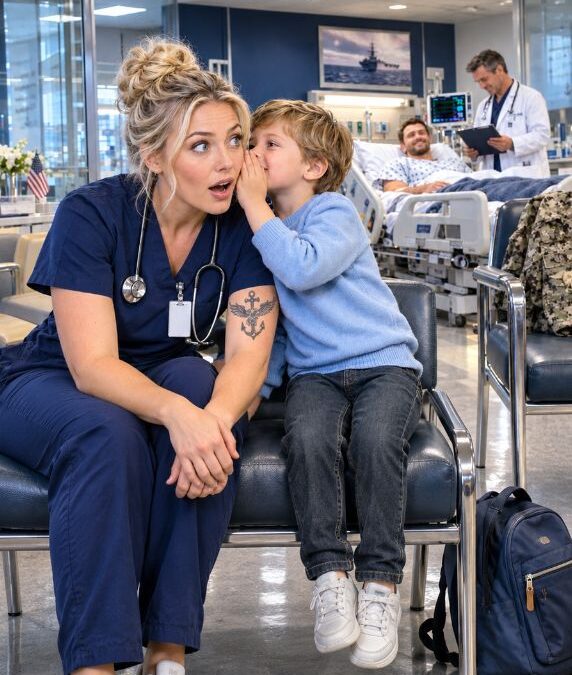
Dana Whitfield is the quiet new nurse at Cascade Bay Medical Center in Portland, the one the doctors laugh at and the one nobody ever really sees. Then a wounded Navy SEAL is admitted to her unit and his 5-year-old son notices the small tattoo she hides under her sleeve. One whispered question changes everything and a sudden cardiac arrest forces her to choose between staying invisible and saving a life. Along the way, you will learn exactly how hands-only CPR works step-by-step.
Dana Whitfield kept her eyes on the floor because the floor never laughed at her. It was 6:45 in the morning on the fourth floor of Cascade Bay Medical Center in Portland, Oregon and morning rounds had already turned into a show. Dr. Spencer Langley stood in the middle of the cardiac step-down unit with his white coat pressed and his chin high. Four residents surrounded him like an audience.
Dana stood at the edge with a clipboard she was holding too tightly. “Nurse Whitfield,” Dr. Langley said, loud enough for every bed to hear. “Bed 12 asked for a blanket 20 minutes ago. Did you get lost or are you simply too small to find the supply closet?” The residents laughed. A patient near the door looked away, embarrassed for her.
Heat crawled up Dana’s neck. Her blue scrubs hung loose on her 5’4″ frame and the long sleeves covered her arms all the way to the wrist, exactly as she wanted. Her hands began to tremble the way they always did when people stared.
“I will bring it, Doctor,” she said softly.
“Please do. And Whitfield, try to be useful. In this building you are furniture, quiet, easy to move, and easy to replace.”
Dana nodded and walked away with her shoulders curled inward. Nobody saw what her eyes did on the way. They counted the exits. Two stairwells, one service elevator, one fire door propped open with a mop bucket. Old habits never asked permission. Nurse Manager Gloria Pratt had made her opinion clear on the very first day, 3 months ago.
Keep your head down, Whitfield. The doctors here have egos, and I have a budget. Bed 14 was the only place on that floor where Dana felt like a person. Chief Petty Officer Ethan Cross, a Navy SEAL known to his team as Tex, had been admitted 2 days earlier after a brutal training accident left him with a damaged chest and a fragile heart rhythm. He was big, tired, and kind, and he thanked her every single time she touched his IV pole.
His son was the reason she smiled. Liam Cross was 5 years old with messy hair, a blue sweater two sizes too big, and eyes that noticed everything. He had been sitting in the visitor chair since sunrise, holding a folded piece of paper like it was made of gold. That morning, Dana crouched beside the chair to straighten his father’s blanket, and her sleeve slid up. Just an inch. Just enough.
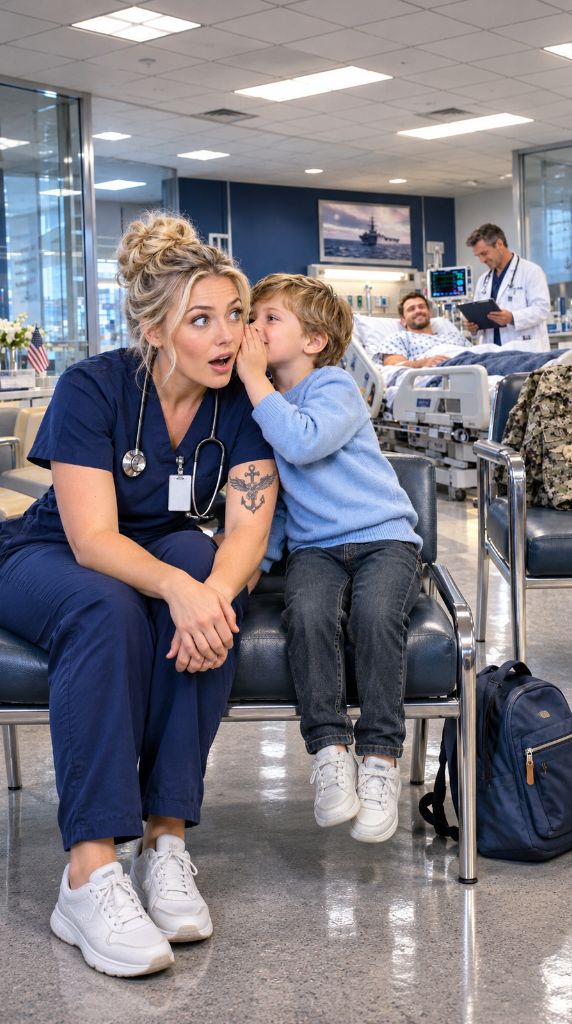
Liam stared at the dark ink on her forearm, an anchor with open wings. Slowly, he unfolded the paper with small, careful fingers. It was a crayon drawing of the very same anchor and the very same wings.
Liam leaned close and cupped his hand around her ear. His whisper was warm and shaky. “Can I tell my dad you are just like him?”
Dana stopped breathing. In 3 months, nobody at this hospital had asked her one real question. Now, a 5-year-old had looked straight through the disguise she had spent years building.
“Where did you get that drawing, Liam?” she whispered back.
“My dad made it. He says an angel with this tattoo saved his life, and he never got to say thank you.”
Her heart pounded. Across the room, Ethan was asleep, his chest rising slowly under the monitor wires. Dana pulled her sleeve down with a trembling hand.
“Please give me a little time, buddy. Can you keep a secret?”
Liam nodded very seriously, the way only a child can. Then a sound cut through the ward, a heavy thud and the clatter of a metal tray. Dana spun around. In bed 12, the same bed that had asked for a blanket, 70-year-old Arthur Nolan had slid sideways against the rails. His face was gray. His eyes were open but empty. The monitor above him screamed one long flat note.
Dr. Langley looked up from his tablet and for the first time that morning said nothing at all. Dana no longer heard the alarm. She heard only her own breathing, slow and steady, and an old voice in her head that had never really left. Mr. Nolan was not breathing. His heart had stopped. She had maybe 4 minutes before his brain began to die.
Here is what was happening inside Mr. Nolan, and what Dana knew to do. This was a sudden cardiac arrest. His heart had stopped pumping blood, so his brain and every organ were starving for oxygen. Every minute without help lowers the chance of survival, which makes waiting the most dangerous choice of all. The technique is called hands-only CPR, and anyone can learn it. First, check whether the person responds and is breathing normally. If not, shout for help, call 911, and send someone to bring an automated external defibrillator, also called an AED.
Kneel beside the person on a firm surface. Place the heel of one hand on the center of the chest. Put your other hand on top and lock your elbows. Push straight down hard and fast, about 2 inches deep, at a pace of 100 to 120 pushes each minute. The beat of the song Stayin’ Alive is a great guide. Let the chest rise fully between pushes. Do not stop until help takes over and switch with someone every 2 minutes if you can. When the AED arrives, turn it on and follow its voice.
Dana dropped the head of the bed flat and pulled the hardboard from under the mattress. She slid it beneath Mr. Nolan, tilted his chin, and watched his chest. Nothing. No rise, no fall. She placed the heel of her right hand on the center of his chest, locked her elbows, and pushed. Her hands were no longer trembling. They were steady as stone.
Dana shouted without looking up, “You in the green scrubs, call a code blue, fourth floor, bed 12. You by the door, bring the crash cart and the defibrillator. Move.”
The residents jumped as if a general had spoken. One ran, another grabbed the phone. “Doctor, he—”
Langley stood frozen with his tablet against his chest, his mouth open and his face pale. “Nurse Whitfield, you are not authorized,” he stammered. “We should wait for the code team.”
“He has no pulse,” Dana said, pushing in a perfect rhythm. “Every minute you wait takes away his brain. Help me or step aside.”
Langley stepped aside. Thirty pushes, sixty. Sweat ran down her temples. Her count was low and calm, the cadence of someone who had done this on moving trucks and in the dark. Liam watched from the chair with both hands over his mouth, holding the drawing against his chest.
The elevator doors opened. Chief Petty Officer Knox, Ethan’s team leader, stepped out with a teammate, both in plain clothes and both carrying paper cups of coffee. They stopped at the same moment. Knox was a broad man with a gray beard and a stare that had read a thousand battlefields. He did not look at the patient. He looked at her hands, locked elbows, shoulders stacked above the wrists. Depth exactly right. No wasted motion, no panic, not a single missed beat.
He set down his coffee very slowly and spoke to his teammate in a low voice. “Those are not a nurse’s hands. That is naval special warfare training.”
Two minutes passed. Dana’s arms were burning, and she did not slow down. Then the crash cart rattled in. Dana tore open the hospital gown, placed the pads, and stepped back with both palms raised.
“Everybody clear.”
The machine analyzed, announced that a shock was advised, and delivered it. Mr. Nolan’s body jerked once. Dana went straight back to compressions without wasting a second. Thirty more pushes. Then a faint blip on the monitor. Another, then a steady, beautiful rhythm. Mr. Nolan coughed, gasped, and opened his eyes.
The ward erupted in relief. Somebody cried. An old woman in bed 10 clapped her hands. Dana sat back on her heels, shaking from the inside out, and for one moment she let herself breathe.
Then Dr. Langley found his voice. “Well,” he said, straightening his coat, “I suppose that went acceptably. I was just about to give the order.”
Nobody laughed. Knox looked at him the way a man looks at a stain on a clean floor.
“Whitfield.” The voice came from the doorway. Nurse manager Gloria Pratt stood there with her arms crossed. “My office.”
The office smelled like burnt coffee and old paper. Dana stood in front of the desk. Dr. Langley stood beside it, calm and polished, as though he had been waiting for this moment all morning.
“She ignored the chain of command,” Langley told Pratt. “She started compressions without a physician order. She shouted commands at my residents, and she placed pads on my patient. If anything had gone wrong, this hospital would have faced a lawsuit.”
“His heart had stopped,” Dana said quietly.
“That is exactly what a doctor is for,” he answered.
Pratt rubbed her forehead. “Dana, I cannot have a probationary nurse acting like the unit commander. You are suspended with pay until the review board meets. Leave your badge.”
Dana unclipped the badge from her scrubs. It felt lighter than it should have. Everything inside her wanted to argue. Instead, she placed it on the desk and bowed her head, the old disguise sliding back into place, though she could feel it cracking.
Out in the corridor, Knox was leaning against the wall with his arms folded. “Where did you train, Nurse Whitfield?”
“A community college in Ohio,” she said.
“Funny. Community colleges do not teach that rhythm.” He studied her face for a long moment, then let it go. “Chief Cross is awake. He has been asking for you since the code.”
In bed 14, Ethan lay pale against the pillow with Liam curled beside him. “I did not tell him,” Liam said at once. “I promised.”
“You did not have to, little man,” Ethan said gently. “I heard everything through the curtain.” His eyes moved to Dana. “Please roll up your sleeve.”
She hesitated, then slowly pushed the fabric to her elbow. The anchor, the open wings. Ethan covered his mouth with a big scarred hand, and his eyes filled.
“Seven years ago, I was in the back of a helicopter bleeding out in the dark,” he said. “I could not see anyone’s face. I could only feel a hand holding mine, and I could see this ink on a wrist in the red light. A voice kept saying, ‘Stay with me, Tex. I have you.'”
Dana closed her eyes. “‘I have you, Tex,'” she whispered.
Seven years earlier, she had been Hospital Corpsman First Class Dana Whitfield, call sign Sparrow, the only medic on a night mission that went wrong in a valley no map would name. She had worked on Tex for 90 minutes in a helicopter with no lights, her hands slick and shaking until his heart finally held. Two weeks later, she left the Navy and told no one why, because she had also lost two others that night, and she had carried their names ever since.
Ethan wept without shame. Liam looked up at his father. “So, she is an angel?”
“She is the reason you exist, buddy,” Ethan said.
Dana pulled her sleeve back down. “Please keep this between us. If they know, they will ask questions I am not ready to answer.”
Ethan held her hand and did not let go. “Then it stays yours.”
By evening, the sky over Portland had turned the color of an old bruise. Wind hurled rain against the windows and the weather alert said the worst storm in 10 years was rolling in off the Pacific. Dana sat in the break room with her coat on, a suspended nurse with nowhere to be, staring at her empty hands. She told herself she was only waiting to see Mr. Nolan stay stable. She did not believe it.
At 8:04 that night, the lights went out. First came a groan from the building, then total darkness. Then the emergency generator coughed once and died. Monitors went black. Alarms wailed. Down the hall, a ventilator switched to its battery and began to beep a warning. Somebody screamed.
There were 31 patients on the fourth floor, 11 on monitors, and three on ventilators. Dana ran toward the noise before she decided to move. At the nurses’ station, Gloria Pratt held a flashlight with both hands, whispering, “Call facilities. Call someone. Why will nobody answer?”
Dr. Langley stood beside her, his face lit from below by the glow of his phone. “We wait for maintenance,” he said. “Nobody leaves the unit.” His voice cracked. “The system will restart.”
“The system will not restart,” Dana said. Every head turned. “The generator failed. The battery on the third ventilator has about 40 minutes. The elevators are dead. I smell smoke, which means a transformer is burning somewhere below us. We have to move the ventilator patients first, then the monitored ones, before that smoke reaches this floor.”
Langley scoffed. “You are suspended. You have no authority here.”
Dana’s shoulders rose, her chin lifted. Her gaze changed from a soft gray fog to hard blue steel. When she spoke again, it was not the voice anyone had heard in 3 months. It was low, flat, and absolutely certain.
“Doctor, in about 10 minutes a man who cannot breathe on his own will stop breathing. You can argue with me until then. Or you can take a bag and squeeze it. Your choice.”
Silence. Then Gloria Pratt lowered the flashlight and said in a small voice, “Tell us what to do.”
Dana pointed. “Triage by color. Red tape on ventilators and cardiac patients. Yellow on anyone who needs help to walk. Green on anyone who can walk alone. Residents, you carry the yellow patients down the east stairwell. Nurses, you bag the ventilator patients by hand. One nurse for each, no exceptions. Gloria, you hold the stairwell door and count heads.”
Two shadows appeared in the hallway. Knox and his teammate had come running at the sound of the screaming.
“Chief,” Dana said, and Knox stopped short because no civilian had ever addressed him that way. “I need six strong backs and a clear path down the east stairs. Take the heaviest patients first. Use bed sheets as carry slings. Go.”
Knox did not ask a single question. He nodded and moved. Down the hall Liam stood in the dark trembling with the drawing in his fist. Dana knelt in front of him.
“Sailor, I have a very important job for you. Hold this flashlight and keep the light on my hands. Can you do that?”
Liam wiped his nose and nodded. “Yes, I can.”
They moved ventilator by ventilator, bed by bed. Dana bagged a patient herself, squeezing in time with her own breathing while calling turns and counts over her shoulder. A bed jammed against the door frame. She freed it with one clean shove. Smoke began to creep along the ceiling.
“Low and slow,” she called. “Keep the patients below the smoke.”
She kicked the mop bucket out from the fire door that had been propped open all day and the heavy door slammed shut, sealing the corridor. The east stairwell glowed with a thin green emergency light. By the time the last red-tagged patient reached the landing, the hallway behind them was thick and gray.
Doctor Langley knelt beside a ventilator patient, squeezing the bag with both hands, tears running down his face. “I am sorry,” he whispered to nobody. “I do not know how to do this.”
“You are doing it,” Dana said. “Keep squeezing. Do not stop.”
On the stairs, Knox carried Ethan down himself, one arm under his knees and one behind his back. Behind them, Dana came last, counting heads, her voice steady through the dark.
A young nurse looked back and whispered, “Who is she?”
Ethan answered into the dark, loud enough for the whole stairwell to hear. “That is Sparrow.”
Knox stopped dead on the step. “Sparrow? The corpsman who kept you alive for 90 minutes?”
“The same.”
Knox turned and looked up at her for a long quiet moment. Then he squared his shoulders and in front of 40 frightened people he said, “Petty Officer Whitfield, it is an honor to serve under you tonight.”
Nobody on that stairwell said a word. Dana swallowed hard, nodded once and kept moving. “Thank you, Chief. Eyes forward. We are not done.”
They were not done for another 3 hours. Dana did not sit down once. At 4:00 in the morning, she counted the last name and found that every single patient from the fourth floor was safe and breathing. Not one was lost.
The sun rose over Portland, pale and clean. In the lobby, hospital president Margaret Ellis stood before the review board, still in yesterday’s suit, hearing the same story from three different mouths. Knox spoke last and he spoke calmly.
“31 patients, zero losses, led by a nurse you suspended yesterday. Her name is Hospital Corpsman First Class Dana Whitfield, call sign Sparrow, decorated for saving more SEALs than I can count. You were lucky she stayed.”
Ellis turned slowly. “Dr. Langley.”
Langley stood with his coat wrinkled and his hands hanging empty. “I have no excuse,” he said. “I told her she was furniture. I was wrong.”
“You will be removed from all teaching rounds,” Ellis said, “and you will complete emergency response retraining sitting in the front row beside the nurses you humiliated. The board will hear every complaint from every person on that unit.”
Langley nodded, then walked over to Dana with his head low. “Nurse Whitfield, I owe you a thousand apologies.”
“You owe bed 12 a blanket,” Dana said.
For the first time in 3 months, someone in that building laughed with her instead of at her. Gloria Pratt came next holding the badge in both hands.
“I was wrong, too, Dana. The hospital would like to offer you the position of head nurse for the entire unit.”
Dana looked at the badge for a long time, then she clipped it back on. “Thank you, but I do not need a title. I need nurses who can speak without being afraid and doctors who look up from their tablets. If you give me that, I will stay exactly where I am.”
Then she did something she had not done in 7 years. She rolled up her sleeve to the elbow and she left it there.
Ethan was discharged 2 weeks later. Before he left, Liam taped the crayon drawing inside Dana’s locker door, right beside a small photograph of two names she had finally decided to stop carrying alone. On a quiet Monday at 6:45 in the morning, rounds began on the fourth floor. Dr. Langley stood at the edge of the room this time, not the center. He looked every nurse in the eyes, and at bed 12 a very warm blanket was already waiting.
Everyone finally understood what Dana Whitfield had been all along. She never hid her weakness. She hid her command.
You Might Also Enjoy


Mom Installed a Camera To Discover Why Babysitters Keep Quitting But What She Broke Her Heart


She Gave a Hungry Little Girl a Free Birthday Cake — The Next Morning, a Black Rolls-Royce Arrived




