He Beat His Stepdaughter Every Day… But He Never Imagined What the Horse Would Do
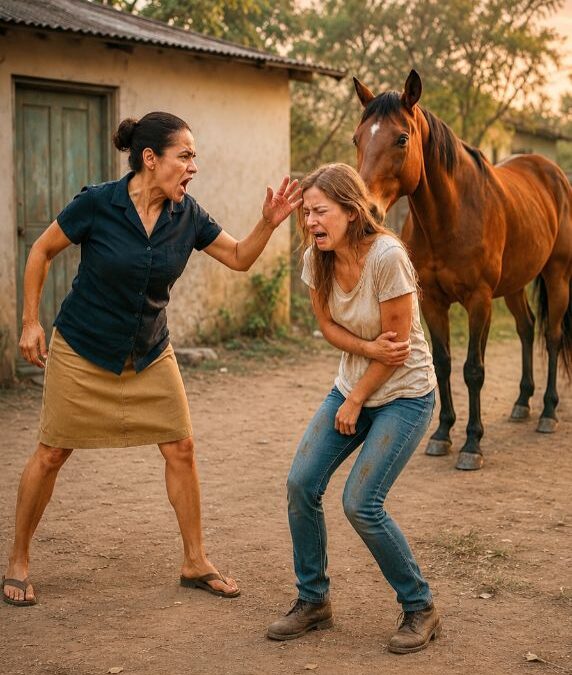
What happens in this story will shock you, because no one imagines that a simple horse can do what many humans didn’t dare to do. For months, a young woman’s pain was ignored by everyone. But when the silence seemed eternal, God used an animal to make it unthinkable. This story will not only break your heart, but it will also make you question who is truly listening to the suffering of others. Stay because what you are about to see may change the way you look at life forever.
It was a hot afternoon in Valle del Rosario, that little town where time seemed to walk more slowly, where dogs slept in the shade of mesquite trees and children ran barefoot through the dirt streets. The clear sky had that blue hue that only appears after the rains, when the sun beats down and the earth begins to release its aroma. In the small garden of house number 17 on Las Palomas street, Isabel Fernández was watering the few flowers that were still alive. Her hands trembled slightly as she held the hose, not from the heat, but from the pain that had been running through her body since the night before. Every movement reminded him of the blows. On her right cheek, a purple bruise was beginning to appear, and on her left forearm, the skin was broken, covered by an improvised bandage that tried to hide the evidence. Isabel was 25 years old, but her eyes seemed to carry the weight of many decades. Her large, crystalline green eyes no longer shone. They seemed to be silently crying out for help. Her light brown hair fell straight to her shoulders, sometimes partially covering the marks on her face. Her once smooth, white skin now showed recent scars, as if life had decided to leave her with tattoos of pain. The birdsong barely managed to soften the atmosphere. Butterflies flew around the dried flowers, as if they didn’t know that this place hid a hell behind those beige walls, worn by the sun and the lack of paint.
Inside the house the air was thick, the curtains remained closed almost all day. The windows had rusty bars and the silence was mixed with the constant hum of the old fan in the room. There was Don Ernesto, Isabel’s father, a 55-year-old man, tall, robust, with broad shoulders, completely gray hair and a perfectly trimmed mustache. His face, though stern, showed neither anger nor sadness, it showed emptiness. He was sitting in his usual armchair, in front of the television, watching a baseball game, as if absolutely nothing existed outside the television. That’s how it was every day. That’s how she had learned to ignore her own daughter’s silent scream. But the one who did exist and was more than enough was Marta Salinas, Isabel’s stepmother. Marta was 42 years old, with light brown skin, black hair always tied up in a tight bun that stretched her face, dark eyes, cold as marble, and a constant expression of disdain. When he wasn’t shouting, his voice sounded like a sharp knife sliding across wood. While Isabel tried to stay on her feet, watering the plants as if that routine could protect her from what was happening inside, Marta watched her from the doorway with her arms crossed and a grimace of contempt.
“Don’t forget to clean the kitchen when you’re done,” she ordered without raising her voice, but with the same sharpness as always.
Isabel didn’t answer, she just nodded slightly and continued watering the flowers, as if the drops could also extinguish the fire burning inside. The heat made his forehead sweat, and the sweat mixed with a small wound on his left eyebrow, causing a constant burning sensation. But she was used to those pains. What he still couldn’t get used to was the loneliness of suffering it all in silence. Suddenly, a different sound pulled her out of her trance. A soft whinny, almost like a whisper, came from the neighboring property; he looked up and there he saw it for the first time so close. It was Alma, the neighbor’s mare, a beautiful specimen with shiny brown fur, long, silky manes moved by the breeze, and strong, firm legs like young tree trunks. But the most impressive thing about Alma was her eyes, two large spheres, prof. that seemed full of compassion, eyes that looked at her in a way that was different from how any other human being looked at her.
Alma got as close as she could to the old wooden fence that separated the two properties. He moved his ears forward as if trying to catch even the slightest sigh from Isabel. She sniffed the air restlessly, as if she could smell fear. Isabel felt a shiver run down her spine. But not from fear, but from something more difficult to explain. It was as if for the first time in a long time someone really saw her, not as Ernesto’s useless daughter, not as Marta’s punching bag, but as a person, as a being who deserved care. At that moment, Doña Remedios, Alma’s owner, appeared. She was a woman of about 60 years old, short in stature, with completely white hair gathered in a thick braid that fell over her right shoulder, small, very lively eyes, skin tanned by the sun, and wrinkles marked by years of work under the open sky.
“Good afternoon, little one.” She greeted from her porch in a sweet voice that contrasted sharply with Marta’s harshness. “It’s so hot, isn’t it?”
Isabel forced a smile, as she had learned to do whenever someone spoke to her.
“Yes, ma’am, Remedios, it’s very hot.” I brought you some mangoes from the tree, they’re sweet. “If you’d like, come by this afternoon to pick them up,” the woman offered, searching for any excuse to get the young woman through her gate.
“Thank you very much, ma’am. I appreciate it,” Isabel replied subduedly.
From the doorway, Marta watched the scene. Her eyes flashed with suspicion, and before the conversation could continue, she let out a sharp cry.
“Isabel, hurry up. I don’t have all day to wait for you.”
Isabel’s smile vanished in an instant, and lowering her head, she replied, “I’coming.”
She waved goodbye to Doña Remedios and walked back to her prison. Alma, from the fence, whinnied once more, but this time with a higher-pitched sound. Her eyes followed Isabel until she disappeared inside the house. She seemed restless, as if her instincts were screaming that something was very wrong. Inside, hell awaited her once more. Marta stood in the middle of the kitchen. On the table were dirty dishes, the wet mop on the floor, and an old rag. Her shadow, cast by the The yellow light from the lamp stretched out like a monster.
“What were you talking about with that old woman?” he asked in a venomous tone.
“Nothing important, she just offered me some mangoes,” Isabel replied, trembling slightly.
“Oh, yes, well, she can give them to you when you finish cleaning all this.” He threw the rag at her face.
Isabel caught it in midair, her eyes glazed, taking deep breaths to keep from collapsing. Meanwhile, outside, Alma pawed the ground softly, restless. Her ears twitched like antennae. Her eyes remained fixed on that closed door where the real pain was just beginning. It was early morning, one of those times when the air still holds a bit of freshness before the sun begins to punish the earth. The streets of Valle del Rosario were just beginning to awaken. The roosters crowed loudly. Stray dogs wandered, searching for shade, and the church bells rang softly as if they wanted to greet the new day without making too much noise. In house number 17, the silence was thick. Inside those Isabel was already awake. Although, to be honest, she had barely slept. The previous night had been another hell. Marta, as usual, had lost control over something trivial. A poorly washed cup, a disheveled rag—any excuse was enough, and her hands knew no bounds. The blows echoed through the hallways, while Don Ernesto kept his eyes glued to the television, as if the loud volume could drown out his own daughter’s screams.
Now, in front of the cracked mirror in her small bathroom, Isabel tried to cover the bruises with cheap makeup, but inflamed skin doesn’t cooperate when you’re trying to hide the pain. The dark circles under her eyes, her swollen lip, the bruised mark on her cheekbone—all of it told a story her lips didn’t yet dare to speak. She took a deep breath, arranged her light brown hair to partially cover her face, and went out to the backyard, that one place where she could breathe, even if only for a few minutes. The garden was small, surrounded by a worn wooden fence. Some Flowers struggled to survive under the relentless sun: a few bougainvilleas, mallows, and twisted sunflowers. The sound of birds gave her a false sense of normalcy, and right then, she heard that same soft whinny that had startled her days before. She looked up and once again met those eyes.
Alma was there. The brown mare, imposing and serene, had approached the fence. Her enormous dark eyes seemed to study every detail of Isabel. And it wasn’t mere animal curiosity. There was something more, something almost human in that gaze, as if she could see beyond the bandages, beyond the layers of makeup, straight to the pain hidden in her soul. Isabel couldn’t help but walk slowly toward her, as if afraid of startling her, though the truth was, it was she who was trembling.
“Hello, beautiful,” she whispered softly.
Alm flicked his ears forward, recognizing the young woman’s sweet tone. His snout stretched over the fence, seeking contact. Isabel, with utmost care, raised her right hand, the same one that Marta had twisted the night before, and touched the warm fur of the mare. It was a magical moment. The soft touch of the animal, the warmth of its breath, the delicate touch of its mane moving with the breeze. For the first time in a long time, Isabel felt something akin to peace. It was as if the universe was telling her, “You are not alone.” Tears began to flow from her eyes. But these were not the usual desperate tears, but different ones, tears that are born when the soul finds, even if only for seconds, a refuge. Alma let out a sigh as if she wanted to comfort her and lowered her head so that Isabel could stroke it better. The sun began to filter through the branches of the mesquite tree, creating a golden glow around them both, as if God himself were witnessing this small miracle.

From the porch next door, Doña Remedios silently observed the scene. Her small, attentive eyes missed nothing. It wasn’t the first time he’d seen the bruises on Isabel’s face, but this time his instinct screamed at him more strongly. Something very bad was happening behind those walls. He decided to approach with the same gentleness as someone who doesn’t want to frighten a wounded bird.
“Good morning, my girl.” She greeted him gently with her always warm voice.
Isabel turned around, discreetly wiping her tears with the sleeve of her sweater.
“Good morning, Mrs. Remedios.”
The woman stopped a couple of meters away, respecting the space.
“I see that Alma has already grown fond of you, and she’s not one to get attached easily, huh?” she commented with a calm smile.
“She’s very pretty,” Isabel replied, barely letting out a soft sigh.
“Yes, it is, but what about you?” she asked with a subtle change in her tone. “Are you okay, Guij?”
Isabel swallowed. Her eyes moved quickly, searching for some corner where she could hide her anguish. Her fingers nervously played with the hem of her sweater.
“Yes, yes, I’m fine, ma’am. Thank you.”
Doña Remedios looked at her for a few more seconds, as if she wanted to delve into the unspoken words. He didn’t insist, but he didn’t stop watching her either.
“Well, anything you need, I’m here. You don’t have to tell me anything, just knock on the gate.”
“Yes.” Isabel nodded silently.
That simple gesture of kindness caused another lump in his throat. Meanwhile, Alma remained glued to the fence, as if she didn’t want Isabel to leave. Her large eyes seemed to understand everything that no human words could explain. On the other side of the house, from one of the windows, Marta watched the scene. His narrow, cold eyes exuded distrust. She pressed her lips together and turned sharply, disappearing into the shadows inside. The town clock struck 9 a.m. when the same old nightmare came knocking again.
“Isabel,” Marta’s sharp voice was heard from inside. “Stop wasting time and go inside and clean.”
The dry, authoritarian tone pierced his chest like invisible needles.
“I’m coming,” Isabel replied in a barely audible whisper.
He stroked Alma’s face one last time. “Thank you,” she whispered almost in secret.
The mare let out a small snort as if saying goodbye for the moment, but her eyes remained fixed on the young woman as she returned to her enclosure. Doña Remedios sighed from a distance, watching Isabel disappear behind the iron gate. Suspicion burned in her chest, but an idea was also beginning to take shape. That girl couldn’t remain alone in that hell. Alma, restless, stamped her foot once more. Her senses knew what humans couldn’t yet see. Something very dark dwelled in that house. And she, in a way no one yet understood, was preparing to be much more than a mere spectator.
The midday heat beat down like lead on the small town of Valle del Rosario. The cicadas sang incessantly, filling the air with that constant buzzing that, for those who suffered in silence, seemed to mock their misfortunes. The dirt streets stirred up dust with every breeze, and the air was thick with the scent of hot earth. It mingled with the aroma of freshly made tortillas wafting from some humble homes. But in house number 17 on Las Palomas Street, there was no smell of food, no laughter, no soft voices. There was only a thick, dangerous silence, the kind that precedes storms. Inside the house, the atmosphere was heavy. Marta paced back and forth like a caged animal, her eyes filled with suppressed rage. Isabel, as always, tried to be invisible. Her movements were precise, careful, like someone crossing a minefield, knowing that any misstep could unleash disaster.
That morning, while washing the dishes in the kitchen, a small accident occurred. One of the glasses slipped from her hands, hit the edge of the sink, and shattered on the floor. The sound of the breaking glass echoed throughout the house like a gunshot. Isabel froze for a moment. Her breathing quickened. She knew what was coming. From the living room, Marta slowly turned her head. Her eyes, black Like bottomless pits, they dug into Isabel’s hunched back. She gritted her teeth and walked toward the kitchen, letting the echo of her footsteps herald the storm.
“What was that?” she asked with a false calm that was more frightening than a scream.
“It slipped. I’m sorry,” Isabel stammered, not daring to turn around.
Marta reached her, standing only inches from her back. The woman’s breath hit Isabel’s neck like knives of hot air.
“Always the same, Isabel, always the same. You’re not even good enough to wash a glass,” she whispered, venom dripping from her voice.
Suddenly, the first blow came swiftly, sharply. The back of her right hand struck the side of Isabel’s head, making her stagger. Then came the tug of hair, the violent pull that forced her to spin and fall to her knees on the broken glass.
“Look at me when I’m talking to you!” Marta shouted, her eyes wide.
Isabel, tears already welling up, lifted her face Barely. A thin trickle of blood ran from her cheek, cut by a shard of glass. At that moment, Ernesto appeared in the kitchen doorway. Tall. His imposing figure was silhouetted against the light from the hallway. But he did nothing. He said nothing, he just looked at them. His gray, empty eyes showed no fury, no pain, no empathy. Only that indifference Isabel already knew. Marta also glanced at him briefly.
“She dropped a glass,” she said mockingly, as if it were all a simple household accident.
Ernesto sighed, lowered his gaze, and turned away, disappearing once more into his silent world in front of the television. That was his refuge. It always had been. Isabel, still on her knees, gritted her teeth to keep from screaming. She struggled to her feet, trying not to show the burning pain in her injured knee. Marta pushed her against the wall before leaving the kitchen, leaving the threat hanging in the air.
“Clean this up and don’t let it happen again. Understood?”
The young woman nodded as tears blurred her vision. From her vantage point, in the neighboring stable, Alma pawed the ground with her front hooves. She didn’t need to see that house to know her friend was suffering. The sound of the cries, though muffled by the walls, traveled through the warm air to her sensitive ears. The mare snorted, raised her head, and paced restlessly. Her enormous eyes shone with a mixture of anguish and frustration, as if she wanted to break through the fence and enter the house to protect it. Doña Remedios, from her window, had also heard the cries. She closed her eyes and clenched her fists. It wasn’t just suspicion anymore. Something terrible was happening inside. But the town was small and gossips were loose. No one wanted to meddle in other people’s business, but she couldn’t keep looking the other way.
As night fell, silence returned to the house, but not rest. Isabel lay down on her narrow bed, her body aching, her mind in turmoil, and her heart broken. Every part of her skin seemed to bear a fresh memory of the blows. She stroked Gently, she reached for her own arm, seeking comfort where there was none. In the dimness of her room, the only sounds that accompanied her were the whisper of the wind slipping through the crack in the window and Alma’s distant whinny. That sound, for some reason, gave her strength.
“Thank you, Alma,” she whispered softly. “You’re all I have left.”
She closed her eyes, trying to sleep, but the fear that tomorrow could be the same or worse kept her awake. Meanwhile, in the stable, Alma paced restlessly in the dim moonlight. Her breathing was ragged. Her hooves pounded the ground, as if something inside her were warning her that her role in this story had not yet begun. The mare seemed connected in some invisible way to the pain of the young woman who suffered night after night in the neighboring house. The crickets continued to chitter outside, as if unaware that behind those walls a silent battle was being waged between life, fear, and pain. No one in the village seemed willing to… They tried to act, but fate, and perhaps something greater, was already preparing the moment when things would begin to change.
Very soon, dawn fell like a sigh over Valle del Rosario. The first rays of sunlight painted the tin roofs, adobe walls, and branches of the old mesquite tree that stood in the center of the plaza with gold. Everything seemed calm, as if the town were slowly waking after a long, heavy sleep. But not everyone rested equally. In house number 17, the air remained thick, dense, heavy like the smoke that never quite dissipates after a fire. Isabel got up with difficulty. Her muscles screamed with every movement. Her side still ached from the shoves of the previous night, and her knee still bore the marks of the glass that had pierced it when she fell. In front of the bathroom mirror, she observed her reflection with resignation. The bruises under her eyes, the purplish line that crossed her right cheekbone, and the cut on her left eyebrow looked like tattoos of her private hell. She washed her face with water Cold, as if trying to extinguish the fire burning beneath her skin. Her light brown hair, naturally straight and silky, was arranged as always, falling forward, concealing the worst marks. She knew very well how to hide her story behind a simple hairstyle.
It was barely 6:00 a.m. when she went out to the backyard. At that hour, she could still find a little silence, a respite before Marta woke up and began the next chapter of her daily torture. The sky was tinged with pinks and oranges, while the birds began their symphony welcoming the new day. The air smelled of earth damp with dew, mingled with the scent of the bougainvillea that heroically survived in her small garden. And there, as if waiting for her, was Alma. The brown mare had approached the old wooden fence again. Her eyes, enormous, dark, and deep, gazed at her with that mixture of tenderness and wisdom that moved Isabel so deeply. She wasn’t just an animal, Alma was much more. She was presence. It was comfort, it was company. Isabel walked slowly toward her, as if afraid that any noise would shatter that fragile moment of peace.
“Hello, beautiful,” she whispered, barely letting her voice cross her lips.
Alma pricked up her ears and craned her neck, reaching for the young woman’s hand. Isabel, with the same care as someone caressing a crystal object, raised her arm and placed her hand on the mare’s warm, soft muzzle. As soon as she felt the animal’s warmth beneath her palm, something inside her broke. Tears sprang to her eyes as if they had been held back for days. It wasn’t the desperate weeping she usually did in the early hours alone in her room. This weeping was different; it was a release, a deep sigh from a wounded soul.
“I don’t know why you’re doing this, but thank you,” she said, barely audible.
Alma let out a small snort as if she understood every word. Her large eyes gazed at her intently, and for a moment Isabel felt that the mare absorbed some of her pain, as if that A creature sent by God had the capacity to bear a fraction of her suffering so that she could endure another day. The first rays of sunlight illuminated them both. The golden light outlined Alma’s brown coat, giving it an almost sacred glow. The scene, if someone had seen it from the outside, seemed like something out of a divine painting. The young woman, broken but still standing, was being emotionally supported by an animal that seemed to understand what no human had wanted to see.
As she stroked the mare’s firm back, Isabel closed her eyes for a few seconds. For the first time in a long time, her breathing calmed. Her shoulders, always tense, slowly lowered. It was as if that simple physical contact helped her release, even if only for a few minutes, the weight she carried day after day, but the moment did not go unnoticed by anyone else. From the porch of the neighboring house, Doña Remedios observed everything in silence. The woman, around 60 years old, petite, with tanned skin and completely white hair, delicately braided, had a fixed gaze and Worried. Isabel’s gestures, her stifled sobs, the bruises she could barely see when the young woman’s hair moved—everything screamed one thing. That girl was crying out for help without speaking. Doña Remedios pressed her lips together and lowered her gaze for a few seconds. She knew that if she tried to pressure her, Isabel would shut down. People who live in fear become experts at protecting their tormentors, even if it costs them their lives. But she also knew she couldn’t stand idly by. She walked slowly to the fence with soft steps that barely stirred a bit of dust.
“Good morning, my child,” she greeted with her usual warmth.
Isabel turned her face slightly, trying to quickly wipe the tears from her cheeks.
“Good morning, Doña Remedios,” she replied, forcing a smile.
“I see that Alma has already adopted you,” she commented tenderly. “And let me tell you something, girl. When Alma becomes attached to someone, it’s because she feels that person needs her.”
Isabel lowered her gaze, unable to bear the weight of those words.
“She’s a very special animal,” the young woman added, barely whispering.
Doña Remedios observed her for a few more seconds, reading her body language: the dull eyes behind her attempts to smile, the posture hunched with physical and emotional pain.
“If you ever need to talk, even about something trivial, I’m here, okay?” she offered, making it clear that her house would always be an open refuge.
Isabel nodded silently, swallowing the lump forming in her throat. While the two women exchanged those few but significant words inside the house, Marta watched them through the half-open window. His eyes, sharp as knives, dripped with distrust and jealousy. She clenched her teeth and crossed her arms over her chest. Marta hated that Isabel was talking to the neighbor. She hated that someone could notice what she had managed to hide for so long. For Marta, any outside glance represented a Danger, a threat to her absolute control over that house.
“Damn nosy old woman,” she muttered under her breath as the town clock struck 7.
The momentary calm ended. As every day, Marta’s voice broke the brief respite of peace.
“Isabel, stop wasting time and go inside and make breakfast.”
The dry, authoritarian tone pierced the air, pushing Isabel back into her daily prison.
“I’m coming,” she replied, stroking Alma’s back one last time.
Alma, as if understanding the sadness of the moment, let out a long, deep sigh, lowering her head as the young woman slowly walked away toward the house. Doña Remedios didn’t stop watching until the iron gate closed behind her. Then she pressed her lips together tightly, took a deep breath, and for the first time in a long time, began to formulate a plan in her mind. Something told her that this animal wasn’t in Isabel’s life by chance. Alma stood alone by the fence, the sun already rising in the sky. Her ears twitched attentively, her Her eyes remained fixed on that house. It was as if the mare could smell the fear, anguish, and pain that hung within those walls. The bond that had formed between her and Isabel was no ordinary one; it was an invisible tie, woven from suffering but strengthened by the pure empathy of a being who, though wordless, understood what many humans refused to see. And though Isabel didn’t yet know it, that bond would soon change her destiny forever.
The midday heat beat down like burning lead on the small valley of Rosario. Cicadas sang incessantly, and dust rose with every gust of wind, swirling through the narrow streets of the village. Life there followed its usual routine. Men sat on the sidewalks, women chatted as they swept in front of their houses, children ran barefoot. Everything seemed calm on the surface, but sometimes what is unseen is what screams the loudest. In house number 17, behind those worn walls and curtains always drawn, the routine had a different hue. A dark, dirty, dreary color. Isabel, as she did every day, tried to walk the tightrope of household chores, maintaining her balance so as not to awaken Marta’s fury. That day the atmosphere felt especially tense. Marta was more irritable than usual, and when she entered that state, any insignificant detail could be the spark that ignited hell. In the dining room, Ernesto remained in his usual chair, in front of the television, watching a baseball game at high volume. He had perfected the art of disappearing without moving from his place, of pretending not to hear, not to see, not to know.
While washing the dishes in the kitchen, Isabel noticed her hands trembling slightly. It wasn’t the cold; it was anticipatory fear. Marta prowled the house like a shark smelling blood, looking for the slightest mistake to unleash her rage.
“You don’t have enough soap on that rag!” she suddenly shouted from the hallway.
“Sorry, I’ll wash it again,” Isabel replied in a low voice, almost a whisper.
Marta approached her… From behind, without warning as always, she struck her a sharp blow on the back of the neck with the back of her hand, not hard enough to knock her unconscious, but enough to humiliate her, to remind her who was in charge.
“Always the same with you, you useless little girl.” She spat contemptuously. “Let’s see if you learn one day.”
Isabel lowered her head, biting her lip to hold back her tears. If she cried, it would only make things worse. Meanwhile, in the neighboring house, Doña Remedios watched everything from her window. Her eyesight, though aged, was still sharp enough to detect what others preferred to ignore. She had seen the bruises, the expressions of terror, Isabel’s nervous movements every time Marta appeared, and above all, she had seen that strange and beautiful connection between the young woman and Alma. For several days now, something had been bothering her. Her maternal instinct, the one that never fades even with the passing years, screamed at her that this girl was trapped in a nightmare, and what worried her most was how often she heard the blows and the Screams, especially at night when the town seemed asleep, but the walls echoed with the suffering.
“Something very serious is happening here, Alma,” she whispered to her mare as she fed her.
The mare looked at her with those large, dark eyes, as if she too understood what was happening. It was no coincidence that Alma reacted every time the screams came from the neighboring house. She pawed the ground, circled, and snorted restlessly. Her sensitivity seemed to surpass that of many humans. One afternoon, as the sun began to set and the shadows lengthened the outlines of the trees, Doña Remedios decided to approach the fence, where, as usual, Isabel was petting Alma. It was almost like a daily ritual, that brief moment of peace before returning to the enclosure. The woman approached slowly, not wanting to frighten her.
“Good afternoon, daughter,” she greeted in her warm voice.
“Good afternoon, Mrs. Remedios,” Isabel replied with a fragile smile.
The wind gently moved both of their hair, and for a moment, only Alma’s soft snort could be heard. Doña Remedios observed her closely. The bruises on her arms were more visible that day. Her makeup no longer covered everything. There were fresh scratches on her left wrist, and a slight hematoma was beginning to appear under her right eye.
“Just look how much this mare loves you,” she said with a smile, trying to bring up the subject without frightening her. “Alma is very special. She feels things, things that many of us don’t want to see.”
Isabel lowered her gaze. She bit her lip to keep from bursting into tears.
“Yes.” “She’s very good,” she barely whispered.
There was a heavy silence between them. Doña Remedios felt it was the perfect moment to take another step.
“My dear child, forgive me for intruding,” she paused briefly to find the right words. I’ve noticed you’ve been getting a lot of tapping lately. ” Everything’s fine at home.”
Isabel froze. Her heart began to race. She knew that question would come someday, but she wasn’t ready yet.
“No, it’s nothing,” she stammered. “I’m clumsy. I fell the other day while doing laundry, and then I tripped in the kitchen. You know, things happen.”
Doña Remedios listened in silence. She didn’t contradict her, didn’t pressure her, but she didn’t believe her either. She had heard those excuses before, many times, from other women in the village who had lived through similar ordeals. She knew that denial was a form of protection.
“Well,” she said gently at last, “if you ever need anything, anything at all, even just to have a coffee and a chat, you know where I am. You don’t need to give me explanations. Just touch the gate.”
So Isabel nodded and for the first time in days allowed a solitary tear to roll down her cheek. Alma, as if relieved of the tension, whinnied softly, bringing her muzzle close to the young woman’s face, as if trying to comfort her. From her kitchen window, Marta watched the whole scene. His eyes sparked with a mixture of fury and distrust. She clenched her teeth tightly, muttering under her breath, “Messy old woman, she’d better mind her own business.” She knew perfectly well that Doña Remedios was beginning to suspect something, and that made her more irritable every day.
Night fell and with it, a thick silence returned to the interior of the house. From her bed, Isabel mentally reviewed every word she had exchanged with Doña Remedios. A mixture of fear and hope overwhelmed her. On the one hand, he was afraid that Marta would discover that someone suspected something. On the other hand, he desperately wanted to have the courage to accept the help that woman was offering him. In the darkness, the only sound that broke the silence was the distant neighing of Alma. That sound, once again, gave him the strength to endure another night. But the coming days would bring storms that no one imagined. And an unexpected act by that mare would be the beginning of everything.
It was night in Valle del Rosario, that kind of heavy night where the wind doesn’t move. And the air is trapped between the alleyways, as if the town itself knew that something was about to happen. The stars, though twinkling in the clear sky, seemed distant, almost indifferent to the suffering that those silent streets breathed. In house number 17, hell was preparing its stage. Isabel had spent the entire day walking on tiptoe, carefully choosing her words. every movement, every glance. I knew that Marta was more irritable than usual, and when that happened, any tiny mistake could be the trigger. Don Ernesto, as always, remained absent, sheltered in the false comfort of his armchair in front of the television, pretending that he did not hear, that he did not see, that he did not exist. The dinner had been tense. Marta kept looking for flaws. Whether the soup was cold, the meat was tough, or the napkin wasn’t folded properly. Everything served as a pretext to launch poisonous darts with his sharp voice. But what ignited the spark was a simple accident.
Isabel, while clearing the plates, accidentally dropped one of the cutlery pieces. The fork fell to the floor with a small metallic sound, almost insignificant, but in that house such a sound was enough to unleash fury. Marta jumped up from the table, her eyes bloodshot with rage.
“Again, Isabel, you’re useless. “You’re not even good for clearing the table!” she yelled, her voice echoing throughout the dining room.
Isabel lowered her head, quickly picking up her fork, her hands trembling.
“I’m sorry, I didn’t mean to,” she whispered.
“It’s always the same with you,” Marta roared, advancing toward her like a raging bull. “I’m fed up with you!”
Without warning, she shoved her violently against the wall. The blow to her back elicited a muffled groan from Isabel. The plates in her hand fell and shattered on the floor, scattering shards of ceramic across the floor. Don Ernesto barely looked up. His gray eyes flashed for a second with discomfort, but as always, he said nothing. He turned his attention back to the television screen, as if the game he was watching was more important than the horrific scene unfolding just a few feet away. Seeing her husband’s passivity, Marta felt even more emboldened. She grabbed Isabel by the hair, yanked her hard, and dragged her several steps to the kitchen.
“You’re going to clean this up right now,” she yelled, shaking her. “And you’d better make sure there isn’t a single piece left on the floor.“
Isabel, almost crying, knelt among the broken glass. Her bare knees began to bleed as they came into contact with the ceramic fragments. The physical pain barely competed with the weight of the humiliation. Her hands, also injured, trembled as she tried to pick up the pieces while tears streamed down her face uncontrollably.
“Hurry up!” Marta continued shouting from behind her.
Each scream was like a knife tearing at his soul. Meanwhile, on the other side of the fence, in the stable, Alma was not at ease. His ears twitched restlessly, picking up every sound that floated in the heavy night air. Marta’s screams, Isabel’s muffled moans, the dry sound of the blows, all reached her senses directly. The mare began to walk in circles inside the corral, stamping her front hooves on the ground, panting loudly, as if she wanted to tear it away out of sheer rage. Doña Remedios, who was already in bed, heard the commotion from her room. She got up quickly, put on her nightgown, and went out into the yard with a flashlight in hand.
“What’s wrong, my girl?” he asked the mare as he approached, but Alma didn’t stop.
His whole body trembled with anxiety. Her large eyes seemed to be pleading for action. Doña Remedios, looking towards the neighboring house, felt a chill run down her spine. Although I couldn’t see what was happening inside, there was no longer any room for doubt. Something very serious was happening there.
“My God,” she whispered, clutching the rosary around her neck.
Inside the house, hell still raged. When Isabel finished cleaning, Marta shoved her again, this time against the cupboard door. The impact knocked the wind out of her.
“This is what you get for being stupid!” she yelled, her face contorted with rage.
Isabel’s fear was absolute, but something inside her began to break in a different way. That night, her wounded body couldn’t take any more, but her soul was starting to scream from within.
“Enough!”
Seeing Isabel slowly get up without protest, Marta lost even more control. She raised her hand, intending to strike her face again, but this time something stopped her. A sharp, deafening thud echoed from outside. Thump. Then another. Thump, thump. Both women froze, turning toward the front door. It was as if someone were trying to kick it down. Then, desperate, soul-dead whinnies shook the night. Hint, thump, thump.
The mare She had broken through the fence and was ramming her front hooves against the front door of the house, as if she knew exactly where to be. Her whinnies were sharp, powerful, filled with desperation and a holy fury, as if heaven itself had entrusted her with the mission of intervening. Neighbors began to emerge from their homes, awakened by the commotion. Lights flickered on, doors opened, and murmurs grew louder.
“What’s going on? It’s Remedios’s mare. She’s ramming into Ernesto’s house.”
Doña Remedios, her heart racing, ran after Alma, crossing her own gate without a second thought. Some neighbors followed, alarmed by the unusual commotion.
“Alma, calm down, my child!” she cried desperately, but the mare wouldn’t stop.
Thump! Thump! Each blow shook the old iron gate as if it were about to collapse. Inside the house, Marta trembled with anger and fear. She had never imagined that an animal could be shattering its facade of perfection before the eyes of the town.
“What the hell?” she muttered, clenching her fists.
Isabel, for her part, couldn’t believe what she was seeing. The whinnies of her soul pierced her chest, not with fear, but with hope. For the first time in years, someone, even if it was just a mare, was fighting for her, for her freedom, for her life. Hell had erupted, and there was no stopping what was coming. The scandal continued to shake the heart of Valle del Rosario. The shadows of the night no longer concealed the hell that had hidden for months behind the walls of house number 17. This time something, or rather someone, had decided to intervene, and it wasn’t a human being; it was a pure soul, it was soul itself. The brown mare, with enormous, bright eyes, kept rapping on the old iron gate with her front hooves. Each impact resounded like a cannon shot in the middle of the night. Her whinnies cut through the silence like sharp knives. R. Bang, bang, bang.
Inside the house, Marta had begun to completely lose control. Her wild eyes darted from the door to Isabel, from Isabel to the window, as if searching for an impossible escape. The woman’s hardened face, normally calculating, was now contorted with fury and panic.
“Damn crazy mare,” she spat through gritted teeth.
Isabel, still kneeling beside the shattered kitchen glass, stared at the door, her heart pounding in her ears. Her green eyes, usually held back tears, now shone with a mixture of disbelief and hope. For the first time, someone, even if it was an animal, was crying out for her. For the first time, her stifled cries echoed in the outside world. Meanwhile, outside, the spectacle drew more and more neighbors. Lights came on one after another, wooden doors opened, and people emerged barefoot in bathrobes, rubbing their eyes, trying to comprehend the chaos unfolding before them. It was happening before them. It was Alma, Remedios’s mare, she was like she was possessed. Look how she was banging on the door.
The murmurs grew. The neighbors exchanged bewildered glances. They had never seen anything like it before. Doña Remedios, her face pale with fright, but determined, went to the entrance of Isabel’s house. Tears burned in her eyes as she clutched her rosary between her fingers.
“Alma, please, my child, calm down, calm down.” She begged in a low voice, but the mare didn’t respond.
She remained firm, implacable, as if sent from heaven. Bang, bang, bang. Each bang resonated like a desperate cry, as if the very gates of heaven were knocking on the doors of that cursed house. The neighborhood dogs began to bark. The night birds took flight from the nearby trees, as if the entire universe were moving in sync with the young woman’s contained anguish.
Inside the house, the situation was escalating rapidly. Marta, sweating Cold, he staggered like a cornered animal. His dilated pupils revealed something Isabel had never seen in him before. Real fear.
“Make them leave. Do something, you stupid woman!” she yelled, shoving Isabel against the wall.
Isabel, breathing heavily, looked her straight in the eyes. She was no longer completely submissive as before. Something inside her had changed. That silent strength Alma transmitted to her from the other side of the door was beginning to blossom in her chest.
“I can’t,” she whispered, trembling. “I can’t anymore.”
Marta, on the verge of losing all control, raised her hand once more, but before she could strike her, a louder crash shook the house.
Crack! One of the door hinges gave way. The iron frame vibrated dangerously. The neighbors began to shout.
“She’s going to knock the door down! Call the police! This isn’t normal anymore.”
In the distance, sirens began to wail. The patrol car from the small San Miguel del Valle detachment was speeding towards them, alerted by the desperate cries of the neighbors. The headlights of the vehicles illuminated the facade of the house as Alma continued to pound relentlessly. Doña Remedios, seeing the red and blue lights approaching, let out a long sigh of relief.
“Thank God,” she whispered, clutching her rosary tightly.
Inside the house, Marta took a step back at the sound of the sirens. “[ __ ]!” she muttered, her voice cracking.
She glared at Isabel with pure hatred, as if she were to blame for everything.
“This is your fault, you [ __ ],” she spat.
But Isabel didn’t look away. For the first time in a long time, she held eye contact, and inside she felt something very close to courage. The fear hadn’t disappeared, but it no longer controlled her. It was as if, in that instant, she heard Alma’s message transform into a whisper of faith. No more.
The officers arrived in seconds. Four police officers got out of the patrol car, armed, alert, not quite understanding what they were facing, only knowing that the situation was serious.
“Everyone back off!” one of them shouted as the neighbors retreated.
The commander, a tall man with a serious face named Officer Morales, quickly approached the door while Alma followed. pushing.
“Calm down, calm down!” she tried to shout as she assessed the scene.
Doña Remedios ran towards the officers. “Please, my mare isn’t crazy, something horrible is happening in there. They’re hurting her.”
Agent Morales turned to her, read the terror in her eyes, and didn’t hesitate.
“Break down the door,” he ordered firmly.
The blows from the officers were added to those of the soul. Boom, boom, boom. Until finally the old door gave way with a clang of twisted metal. Crash. The sight that appeared before everyone’s eyes left the entire neighborhood breathless. There was Isabel on her knees, her face swollen, her lip split, her arms covered in bruises and cuts. Marta stood beside her, holding her arm tightly. The stepmother’s face was a mask of fury. anger and lack of control. For a second everything was silent until Alma, from the broken entrance, let out one last whinny, a different one, one full of relief. He had accomplished his mission.
The officers entered quickly.
“Let her go!” shouted one of the police officers, pointing at Marta.
Marta finally let go of Isabel’s arm, but she was still screaming like a madwoman.
“They don’t understand anything. This brat made it all up. She’s a liar.”
But the images spoke for themselves. The officers didn’t need any more proof than the state they found Isabel in. They handcuffed her in seconds. Marta was screaming and kicking, but there was no way out. The neighbors watched in shock from the street.
“My God, poor girl, that’s why the mare was screaming so much.”
Isabel, still trembling, was helped by Doña Remedios, who, with tears in her eyes, held her tightly to her chest.
“It’s over now, my child, it’s over now. Here I am. You’re safe here.” He whispered to her again and again.
Isabel’s tear-filled eyes sought Alma’s, who was now watching her from the broken doorway. His breathing was ragged, but calm. His enormous eyes seemed to say, “Speechless, I protected you, you’re not alone.” And although no one could explain it that night, everyone in Valle del Rosario understood that that woman hadn’t acted by chance. She had been an instrument of something much bigger.
The echo of Marta’s screams still lingered in the air, but now they were just that, echoes. Echoes of power. The sound of the handcuffs clicking shut on her wrists was almost a song of liberation for everyone witnessing the scene in front of house number 17 in Valle del Rosario. Agent Morales, still breathing heavily, held Marta firmly as she continued to struggle.
“Let me go, this is all a misunderstanding. That brat planned it.” She screamed like a cornered animal, but no one believed her anymore.
The marks on her face and body of Isabel was the living proof she could never hide. And that mare, that noble creature who had broken down the wall of silence, had been the voice she could never raise. Isabel, on the other hand, remained standing, held up by Doña Remedios’s firm embrace. Tears continued to roll down her cheeks, but this time they weren’t tears of pain, but of such great relief that her body still didn’t know how to process it. She was free at last.
The neighbors couldn’t look away. They had gathered in the street as if they were witnesses to a miracle they never imagined seeing.
“Poor thing. No wonder we always saw her sad. Look how that witch had her.” “And we thought she was such a good woman, so well-mannered.” “I never imagined hell was so close to us.”
Voices whispered incessantly, as if everyone were waking from a long sleep of indifference. While the police dragged Marta toward the patrol car, she continued screaming, kicking, hurling insults at the wind.
“You betrayed me, Isabel. You are ungrateful. Everything I did was for your own good.”
No one was fooled. The words of aggressors always sound the same when they lose control. They blame the victim for their own wrongdoing. Officer Morales slammed the patrol car door shut.
“Take her away,” he ordered.
The patrol car sped off, leaving behind a cloud of dust that rose in the warm early morning air. Meanwhile, the town doctor, old Dr. Santa María, had arrived, alerted by the commotion. A man with a kind face, white hair, a well-groomed beard, and gray eyes that had seen everything in that town for decades. He quickly approached Isabel.
“My child, may I examine you?” he asked in a gentle, almost paternal tone.
Isabel nodded, unable to speak. The doctor carefully examined each wound, each bruise, each cut.
“She has several contusions, recent and old lacerations,” Morales informed the people in a low voice. “This didn’t happen overnight, Commander. This has been going on for months, maybe years.”
The officer nodded. “Hardened. We suspected it. But seeing him like this hurts,” he replied, swallowing hard.
“We’re going to take her to the health center for a full checkup,” the doctor added. “She needs urgent attention, but above all she needs rest, peace and lots of love.”
Doña Remedios, who did not leave Isabel’s side for a second, spoke firmly.
“I’ll take care of her, doctor. She won’t be alone for a single day longer.”
Upon hearing those words, Isabel burst into tears in the woman’s arms.
“Thank you,” she managed to say between sobs. “Thank you for not letting go of me.”
Doña Remedios tenderly stroked her hair.
“You don’t have to thank me, my girl. God was the one who put Alma in your path and she knew what to do when no one else did. Here begins your new life, my little girl, I promise you.”
While the officers were finishing securing the scene, one of them approached the Morales people.
“Commander, Don Ernesto is inside, but he hasn’t said a single word.”
The commander frowned. “Bring it in minutes.”
Don Ernesto appeared escorted by the police. His face was pale. Her gray, sunken eyes avoided looking at her daughter. He looked like a man defeated by his own cowardice. Agent Morales confronted him without raising his voice.
“Did you allow all of this, Mr. Ernesto?”
The man lowered his head, unable to respond. Her lips barely moved, as if trying to form an excuse, but only a trembling whisper came out.
“I didn’t know how to stop her.”
The commander stared at him, making no attempt to hide his contempt.
“You always knew it,” he told her in a firm tone. “He simply chose to look the other way.”
Ernesto did not respond. I knew I had no defense. He had failed as a father, as a man, as a human being. The neighbors silently watched him as he was escorted to testify before the prosecutor. They knew that although the law might be more lenient with him because he had not directly participated in the violence, his moral punishment would be eternal. The weight of shame in a small town is not easily erased. While all that was happening, Alma was still standing in front of the house, now much calmer. Her ears twitched attentively, but her eyes were at peace, as if she knew that the mission heaven had entrusted to her had come to an end. Isabel, still in pain, slowly approached the mare led by Doña Remedios. When he was face to face with Alma, he rested his forehead against the mare’s warm muzzle.
“Thank you, Alma,” he whispered through tears. “If it weren’t for you, I don’t know where I’d be now.”
Alma let out a soft snort, as if responding with love. The night breeze blew gently, swaying the mare’s glossy mane in the dim moonlight. That night, Valle del Rosario was never the same again. For the first time in a long time, the entire town had witnessed what happens when the silence is broken, when someone, even a horse, dares to cry out for those who cannot. And in the midst of all that darkness, the truth had finally come to light.
The first light of dawn was beginning to peek out from behind the mountains surrounding Valle del Rosario. The entire town still seemed silent, as if no one had truly slept after the previous night. The images still lingered in everyone’s minds: Alma’s desperate whinny, the muffled knocks on the door, the shouts, the sirens, the truth bursting like thunder in the darkness. But now the dawn brought something. Different, it brought justice and a new beginning. In the small court of San Miguel del Valle, the courtroom was packed. It wasn’t common for a trial to attract so much attention in that small town. The wooden benches creaked under the weight of the neighbors, who one after another had come to witness what they all already knew: the horrific story that had unfolded for months just a few meters from their own homes.
At the front, Judge Robles, a man of about 60, with a serious expression, a gray beard, and deeply weary eyes, took his seat on the bench. He had seen many cases in his career, but none as heartbreaking as this one.
“We are now beginning the hearing in the case against Marta Salinas,” he announced in a firm voice. “Accused of domestic violence, repeated physical assault, deprivation of liberty and attempted homicide.”
Marta, wearing the beige prison uniform and handcuffed, remained standing. Her face looked different; there was no more pride, no more air of absolute control that once enveloped her. Now there was emptiness. His eyes, once cold and calculating, now showed a mixture of fear, suppressed rage, and a dark resentment towards everyone present, but especially towards Isabel. Don Ernesto, for his part, was sitting further back, alone, downcast, dressed in a dark suit, his shoulders hunched as if he were carrying the weight of a mountain. She did not face the same charges as Marta. But he would also have to answer for his omission. When Isabel was called to the podium, there was absolute silence. She walked slowly, with a firm step, but still with a certain fragility. Her physical wounds were beginning to heal, but the emotional ones still hurt. Even so, there was something different about her gaze. It was no longer the look of a broken victim. Now it was the look of someone who had decided to break their chains. The prosecutor invited her to take a seat. The judge looked at her kindly.
“Miss Isabel Fernández, can you tell this court in your own words what you experienced in that house?”
Isabel took a deep breath. Her hands trembled for just a few seconds, but then she raised her face and began.
“For months,” her voice trembled at first, but it soon grew stronger. “For months I lived trapped in a hell. Every day was a new punishment, a new insult, a new blow. No matter what he did, he always found an excuse to hurt me.”
Murmurs began to be heard on the benches. Some neighbors lowered their heads in shame. Others covered their mouths with their hands in horror.
“My father,” Isabel continued, barely turning her head toward Ernesto. “He always knew. Every scream, every blow, he heard them from his armchair. He never defended me, never intervened, he just stayed silent.”
Ernesto’s eyes welled up with tears. He pressed his lips together, battling his own shame.
“I,” she continued, swallowing hard. “I didn’t know how to get out. I was afraid. Afraid to speak, afraid no one would believe me, afraid that if I tried, things would only get worse.”
She paused briefly, taking a deep breath.
“And that’s when something happened that I’ll never be able to explain, when even I didn’t have the strength to ask for help. Alma did.”
Some of those present nodded silently, remembering that night, Mrs. Remedios’s mare. Isabel continued, her voice now breaking with emotion.
“She heard my screams, my cries, and it was Alma who did what no one else had done. It was she who alerted the town. It was she who saved my life.”
Judge Robles nodded gravely as he took notes Every word.
“Thanks to that miracle, I am alive and I was finally able to speak.”
Tears were already rolling down her cheeks, but now they weren’t tears of fear, they were tears of relief. Doña Remedios, sitting in the front rows, couldn’t hold back her tears. She held her rosary in her hands, whispering prayers as she looked proudly at the young woman she now considered a daughter. After finishing her statement, Isabel slowly stepped down from the stand. The prosecutor presented the physical evidence, the medical reports, the photographs of the old and recent bruises. Everything was conclusive. Marta’s defense attorney tried to minimize the charges by alleging stress, emotional problems, and family misunderstandings. But Judge Robles didn’t need to hear any more. After several hours of deliberation, he returned with his verdict.
“This court finds Marta Salinas guilty on all counts,” he announced firmly. “She is sentenced to serve an effective prison term and receive mandatory psychological treatment.”
Murmurs of relief filled the courtroom. Then he turned to Ernesto.
“As for Mr. Ernesto Fernández, this court acknowledges his omission and negligence as aggravating factors. He doesn’t face criminal charges of violence, but his inaction will cost him custody of his daughter, and he will be placed under judicial supervision. He will be required to undergo mandatory therapy to address his permissive behavior and his inability to protect a vulnerable being in his care.”
Ernesto, slumped in his seat, didn’t protest. He knew this was the truth that would haunt him for the rest of his days. When the hearing concluded, the officers escorted Marta out of the courtroom. This time she wasn’t screaming, she wasn’t struggling, she was simply walking like someone walking toward a destination from which they can never escape. As they left the courthouse, the midday sun beat down fiercely. Isabel, accompanied by Doña Remedios, walked slowly across the plaza. A few meters away, under a large tree, Alma was waiting for her, serene as always. Isabel approached and, as if repeating the ritual of that night, rested her forehead against the mare’s muzzle.
“It’s all over,” my child whispered, “thank you for not abandoning me.”
Alma’s eyes shone in the sun, as if she understood every word. Doña Remedios, standing beside them, gently placed her hand on Isabel’s shoulder.
“Now the fun begins, my dear,” she said. “Now the life you deserve begins.”
The wind blew softly, swaying the leaves of the tree, as if God himself were blessing this new beginning. A month had passed since that day in court. The town of Valle del Rosario was no longer the same. Conversations in the bakery, in the market, and in the doorways of houses continued to revolve around what had happened. But now the words were no longer gossip or blind judgment as before. They were moments of wonder, reflection, shame, and hope. Many wondered how they could have lived so long ignoring Isabel’s muffled cries. Others silently expressed their gratitude that justice, although late, had finally arrived. But for Isabel, the days now had a different flavor. The light came in differently through the window of Doña Remedios’s house, where she had temporarily settled. The air seemed cleaner, the sunrises warmer, the small details of life more precious. Even the silences were different. They no longer hurt, now they rested. Every morning, after breakfast, she walked slowly towards the stable where Alma was waiting for her. The mare was always standing there, slightly moving her tail, twitching her ears, as if greeting her as soon as she saw her appear.
On that particular day, the sun shone golden over the fields. The wildflowers that grew around the corral swayed in the gentle breeze, while the blue sky seemed as clear as her soul at that moment. Isabel slowly entered the stable, caressing the old wood of the doors as she approached.
“Hello to my little girl,” he said in that soft voice he reserved only for her.
Alma stretched her neck and rubbed her cheek against Isabel’s, as if they shared their own language made of caresses, glances, and shared silences. Know?
“Sometimes I still wake up at night with my heart racing,” she confessed softly, as if it could all happen again, as if the fear were trying to return, but then I remember you and I breathe.
The mare let out a long, warm snort and gently rested her head on the young woman’s shoulder. Isabel closed her eyes and let the tears flow, but this time without pain. It was a pure cry of gratitude, of life.
“I don’t understand how you knew, how you heard what no one else could hear,” she continued. “But I will always believe that it was God who sent you. When I no longer had the strength to scream, you screamed for me.”
The wind drifted in through the open door, caressing Isabel’s chestnut hair and the mane that shone with soul. The scene was simple and profound at the same time. No more words were needed. A few feet away from the porch, Doña Remedios watched them with shining eyes. She held in her fingers the same rosary she hadn’t let go of that night when everything changed. Her lips They moved in silent prayer.
“Thank you, Lord,” she murmured. “Thank you for showing us that sometimes miracles come in the form of firm hooves and big eyes. Thank you for putting Alma in her path.”
As the days passed, the bond between Isabel and Doña Remedios grew even stronger. She was no longer just the neighbor who had lent her a hand; she was the mother that life had denied her in its early stages. And together they began to give new meaning to their days. Alma also seemed transformed. Since that night, there was an even greater sweetness in her behavior, as if her soul had understood that her mission on this earth was to protect, love, and sustain. The town, for its part, never forgot what that animal had done. Many began to grow closer to their own animals, to look at them with different eyes, understanding that sometimes the purest hearts are not those that speak, but those that feel. Even the children of the community came to visit Alma, to bring her carrots and apples. The mare, always patient, received them with her serene gaze and Noble, as if she knew that her story was now also an example for them.
One Sunday morning after Mass, Father Julián approached Isabel in the plaza.
“My child,” he said with a peaceful smile, “this story will remain in everyone’s hearts for a long time. God worked in a mysterious, yet perfect way. And you, even though you don’t see it yet, have been a testament of faith for this entire town.”
Isabel lowered her head humbly.
“I only survived, Father,” she replied softly.
But the priest slowly shook his head.
“No, Isabel, surviving is what you did for years. Now you are living, and that—that is the true miracle.”
She smiled as that new light shone in her eyes, the light that only comes after passing through the darkest tunnel. As evening fell, Isabel returned to the stable. The sky was painted in shades of orange, pink, and violet. The air smelled of fresh earth and hope. She stopped in front of Alma and hugged her tightly, closing her eyes.
“Thank you for being my wings when I could no longer fly.”
Alma snorted once more as if If I answered, I would always be here. The wind continued dancing through the branches. The sun slowly hid behind the mountains, and the small valley of Rosario was enveloped in that serene silence that only places that have witnessed a miracle can know.
You Might Also Enjoy


Mom Installed a Camera To Discover Why Babysitters Keep Quitting But What She Broke Her Heart


She Gave a Hungry Little Girl a Free Birthday Cake — The Next Morning, a Black Rolls-Royce Arrived




