He Paid a Shoeshiner $500 for a $5 Shine… Until She Finally Asked Why
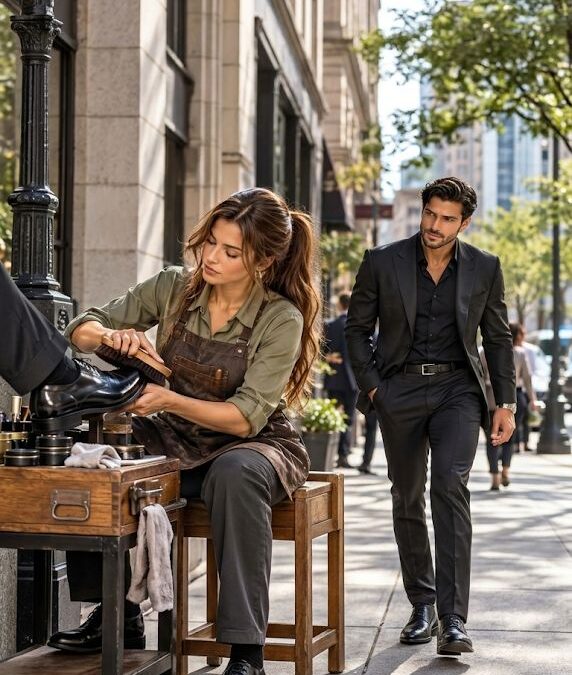
Sir, sir, wait. You forgot your change.
I didn’t forget it.
You walk very fast for a man in expensive shoes.
I didn’t know anyone was behind me.
It’s $495.
Then you’ve earned a good day.
A good day is $5 and a thank you.
Then consider this the thank you.
I shined your shoes for 5 minutes. I don’t take what I haven’t earned.
Nobody has ever chased me to give money back.
Then you’ve been meeting the wrong people.
Then nobody has ever been honest with you.
That’s exactly what he used to say.
Who? Sir, who used to say that?
It doesn’t matter.
It matters. It matters to your face.
Please, just take the money.
I can’t. If I keep it, I can’t look at this corner tomorrow.
Same corner tomorrow?
Sir, I just told you I’m not taking…
$5. Exactly five. I promise.
You’re early.
The shoes were dirty.
Sir, they were clean when you left.
Then they got dirty walking back here.
You walked a whole mile to get dirty shoes?
Three blocks, actually.
Sit down.
You do that slowly.
Good work isn’t fast.
Somebody else used to say that, too. Do you know whose stool that is?
Mine?
Not always.
What do you mean, not always?
Finish the shine, please.
Daniel Reed was 38 years old, and he owned one of the most famous watch companies in the world. His watches sat on the wrists of presidents, singers, and kings. They sold for more than most people earn in 10 years. He lived on the top floor of a glass tower, where the whole city looked like toys below him.
Every morning, his driver opened the car door. Every evening, a chef set one plate on a long table built for 12. Daniel had everything, except someone to say, “How was your day?” People thought he was cold. The truth was simpler. He had learned long ago that if you never ask for anything, nothing can be taken away.
It began when he was eight. His mother died and his father, Robert, a quiet man with strong hands, became his whole world. Robert shined shoes on a busy street corner from sunrise until the last customer. He never earned much, but he never missed a single school fee.
Every evening, Robert came home with tired hands and a smile for his son. “A good shine isn’t fast, Daniel,” he used to say. “And an honest day’s work is never small.” Daniel promised himself that his father would never work again. He studied hard, worked harder, and built a watch company from nothing.
But Robert never got to enjoy it. He passed away just as the company’s first great success arrived before Daniel could buy him the house he had promised. Daniel never went back to that corner. He couldn’t. It was easier to sell time than to remember how much of it he had wasted. Until one morning, 10 years later, something made him walk there.
Naomi was 29 years old and her whole business fit inside a wooden box. Brushes, polish, cloth, a few tins of dye, and a small hammer for loose heels. Every morning at 6:00, she carried that box to the same busy street corner and sat down on the same old stool. She wasn’t rich. Most days, she earned just enough.
Her little brother, Samuel, was in his last year of school, and every coin she made had a purpose. Fees, books, a pair of shoes for him that never had a single scratch. But Naomi never complained. She said that a pair of shoes carries a person through their whole day, and the least she could do was send them off feeling proud.
She charged $5 for a shine and almost nothing for repairs. The nurse who walked to the hospital every morning, the school teacher with the cracked sole, the old man who always paid in coins and apologies. Naomi never made anyone feel small about it. She had learned the trade as a young girl from an old shoe shiner who worked this very corner.
He was a quiet man with strong hands, and he taught her everything. How to hold a brush, how to listen to the leather, and why a good shine is never rushed. When he grew too weak to work, he gave her his stool. “Keep it honest,” he told her. “That’s all it needs.” He used to speak about a son he hadn’t seen in years, always with pride and never with blame.
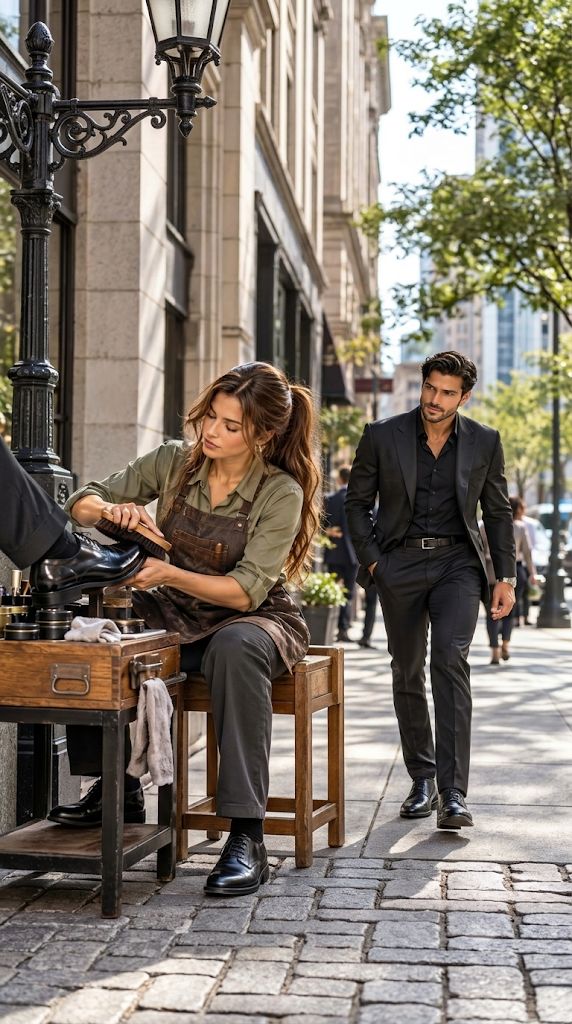
Naomi never learned where that son had gone. Her dream was small. One day, a tiny shop with a door, a bell, and her own name on the glass. But dreams cost money, and Naomi had learned to keep hers quiet. So, she sat on the old stool, polished the shoes of strangers, and told herself that kind work would be enough. Until one morning, a man in a very expensive suit sat down in front of her and said nothing at all.
Daniel hadn’t planned to come here. That morning was the 10th anniversary of his father’s death. He woke before sunrise, dressed in the dark, and told his driver he wanted to walk. He didn’t say where. His feet seemed to know. 10 years had changed the street. New buildings, new shops, new faces. But the corner was exactly the same, and so was the sound of a brush moving over leather.
He stopped when he saw the stool. Old, dark wood, worn smooth by years of sitting. A young woman was seated on it, humming softly as she worked. She looked up and smiled. “Shine, sir?” Daniel opened his mouth to say no. Instead, he sat down. The chair across from her was low, and he felt out of place in his tailored suit.
He placed his foot on the rest and stared straight ahead. He didn’t trust his voice. Naomi didn’t ask questions. She never did with silent customers. She just got to work, slowly and carefully, the way she had been taught. The brush moved, the cloth moved. Little by little, the leather began to glow.
Daniel watched her hands. Strong hands. Steady hands. Hands that reminded him of someone he had spent 10 years trying not to think about. Something tightened in his chest. “Done, sir,” Naomi said at last. “$5.” Daniel reached into his pocket. He didn’t look at the bills. He just placed a thick fold of money in her palm, stood up, and walked away without a word.
Naomi glanced down. Then she looked again. Her eyes went wide. “$500?” She stared at the money, then at the man disappearing into the crowd. Every bone in her body said the same thing. This was a mistake, and mistakes should be fixed. She grabbed the box, counted out the change, and ran.
Naomi caught him two blocks away, out of breath, holding $495. Daniel refused to take it back. She refused to keep it. In the end, they agreed on exactly $5, and he promised to return. She thought that was the end of it. The next morning, he was already waiting.
“You’re early,” Naomi said.
“My shoes got dirty.”
“Sir, they were clean when you left.”
“Then they got dirty walking back here.”
She fought a smile and failed. “Sit down.”
That was how it began. Every morning, Daniel Reed appeared at the corner with a different excuse. A puddle he had walked through on purpose. A little dust. A scuff he swore he had gotten from a revolving door. Naomi pretended not to notice. She shined his shoes, took exactly $5, and sent him off.
Then, she learned who he was. A customer pointed at a watch billboard above the street and laughed. “That’s him, Daniel Reed, richest man in the city.” Naomi looked at the quiet man in the low chair and said nothing. She just charged him $5 the next day, like always.
Slowly, he started to talk. At first, it was only small things. The weather, the traffic, a meeting that went too long. But Naomi listened the way she listened to leather, patiently and without hurry, and the small things became bigger ones. He told her he hadn’t taken a day off in 9 years. He told her his dinner table sat 12 people and had never held more than one plate.
He told her, once, almost by accident, that silence was the loudest sound in his home. Naomi never gave advice. She just kept brushing and sometimes said, “That sounds lonely.” And Daniel, who had been called ruthless, brilliant, and untouchable, would say quietly, “Yes, it is.”
One afternoon, she noticed his hand tremble as he reached for his phone. “Did you eat today?” she asked.
“I’ve been busy.”
“That’s not what I asked.”
Daniel looked away. “I don’t usually have lunch.”
Naomi didn’t say a word. She opened her little lunch cloth, broke her sandwich in half, and held out the bigger piece. “I can’t take your lunch,” he said.
“It isn’t a gift. It’s half a sandwich.” She shrugged. “Eat.”
He stared at it for a long moment. Then he took it and ate slowly, like a man who had forgotten what it felt like to be looked after. From that day, there were two halves. Neither of them said anything about it, but every afternoon at 1:00, Naomi unwrapped her cloth and Daniel’s chair was already waiting.
One Thursday, the sky turned gray before noon. By the time Daniel arrived, the first drops were already falling. Naomi was packing up quickly, covering her box with a thin plastic sheet. She looked up when she saw him. “Sir, you should go home. It’s going to pour.”
“Then why are you still here?”
“People still need to get to work,” she said. “Some of them need their shoes to look right when they get there.”
Daniel almost laughed. Then the rain came all at once. Naomi grabbed the only umbrella she owned, an old black one with a bent rib, and without a second thought, she held it over his shoes.
“What are you doing?” Daniel said. “You’re getting soaked.”
“The leather will stain, sir. These cost more than my rent.”
“Naomi, it’s just shoes.”
“Not to the person who made them.”
The water ran down her hair, her shoulders, her hands. Her little cloth and her tins of polish sat uncovered at her feet. She didn’t care. She kept holding the umbrella steady until the worst of the storm passed. Daniel couldn’t speak. In his whole life, he had been protected by drivers, assistants, and security guards. But he had never once watched someone stand in the rain for something he owned.
Later that same week, a young man hurried up to the corner, pale and shaking. His shirt was ironed, but his shoes were cracked and gray with dust. “I have an interview in 20 minutes,” he said. “I don’t have much…” He reached into his pocket and pulled out two crumpled bills. It wasn’t enough. They both knew it.
Naomi didn’t hesitate. She pointed to the chair. “Sit.”
Daniel watched from the side, silent. She worked fast this time, faster than she ever worked for him. She brushed, buffed, patched a tiny split in the heel with a dab of glue. When she finished, the shoes looked like new.
“How much?” the young man asked, voice shaking.
“Nothing,” she said. “Go get that job.”
His eyes filled. “Why would you do this?”
“Because somebody once did it for me.”
The young man ran off, nearly tripping over his own feet. Naomi watched him go, smiling softly as if she’d been paid in full. Daniel stayed where he was, and his hands wouldn’t stay still.
“Do you do that often?” he asked.
“When I can.”
“Nobody pays you for it.”
“That’s not why you do it,” Naomi said, like it was the simplest thing in the world.
Daniel looked at her for a long moment. Then his eyes drifted to the old stool beneath her, to its dark, worn wood. And for the first time since he’d come back, he noticed a faint scratch on its underside that looked a lot like letters. His heart began to pound.
The next afternoon, Daniel arrived early. He didn’t bring an excuse this time. He sat in the low chair, and for a long time he said nothing. Naomi began to work, but she could feel something was different. His eyes weren’t on his shoes, they were on the stool.
“Do you know whose stool that is?” he asked.
Naomi smiled. “Mine.”
“Not always.”
The brush stopped. “What do you mean, not always?”
“Finish the shine, please,” Daniel said quietly.
She finished. Her hands moved slower than usual, and the whole time she felt his eyes on the old, dark wood beneath her. When she was done, she stood, tipped the stool on its side, and looked at its underside. She had sat on it for 6 years. She had never once turned it over.
There were letters there, small and uneven, carved long ago with the tip of a knife. Naomi ran her thumb over them and read slowly: Robert Reed.
She looked up. Daniel’s eyes were wet. “Why does it have a name on it?” she whispered.
“Because it was his.” His voice cracked on the last word. “Robert Reed was my father.”
Naomi didn’t move. The street noise seemed to fade, and the only sound left was the cloth slipping from her fingers onto the pavement. “This was his corner,” Daniel said. “He shined shoes here for 22 years. He carved his name under that stool so no one would ever take it. I used to sit right where you’re sitting and do my homework while he worked.”
Naomi pressed her hand to her mouth. “The old man, the one who taught me… He never told me his name. He only said to keep it honest.”
“That sounds like him.”
“He spoke about a son,” she said softly. “He said his boy was building something big somewhere in the city. He never said where.”
Daniel looked down. “I never came back. After he died, I couldn’t. I told myself I was too busy, that the company needed me. The truth is, I didn’t want to see this corner without him.”
“Daniel.”
“I came here that first morning on the anniversary of his death. I just wanted to look at it. Then I saw you sitting on his stool doing his work, the way he did it, slowly, honestly.” He let out a shaky breath. “I couldn’t walk away.”
Naomi stared at him, and for the first time since he’d come, she understood the $500 bills, the dirty shoe excuses, the half sandwich at 1:00. Every day, he hadn’t been paying for a shine. He had been paying for a seat on his father’s corner.
She set the stool upright, very gently, as if it might break. Then, she pressed her hand to the wood and said the only thing she could think of. “He never blamed you, you know.”
Daniel looked up. “Not once,” she said, “not ever.”
Naomi didn’t say anything for a while. She just knelt beside her wooden box and opened the bottom drawer, the one she never used. “I need to show you something,” she said.
She took out a small bundle wrapped in an old gray cloth, folded carefully, the way someone folds a thing they care about. Inside was a shoe shine brush with a handle worn pale from years of use and a polishing cloth, soft and thin with a tiny thread stitched R in the corner.
“He gave me these the day he gave me the stool,” Naomi said. “I never used them. They never felt like mine.”
Daniel stared at the brush. His hands were shaking before he even touched it. When he finally lifted it, the handle fit his palm perfectly. It was the same brush he used to watch move across leather when he was a boy. The same brush that had smelled of polish and warm afternoons.
“I used to hold this when he was tired,” Daniel whispered. “He’d let me finish the last pair of the day. He said I had good hands.”
Naomi smiled through the tears gathering in her eyes. “He told me the same thing about his son.”
Daniel looked up sharply. “One evening, near the end, he was too weak to work,” she said. “I sat with him and he talked about you. About how you used to do your homework right here on the pavement. He said you were going to build something great.”
“Did he say…” Daniel’s voice broke. “Did he ever ask why I didn’t come?”
Naomi shook her head. “He said you were busy being the man he knew you’d become. And then he said something I never forgot.”
Daniel waited, barely breathing. “He said, ‘He’ll come back when he’s ready. Keep the corner warm for him.'”
For a moment, nothing in the world moved. Then Daniel pressed the brush to his chest and bent forward. And the sound that came out of him wasn’t the voice of a billionaire. It was the voice of an 8-year-old boy who had waited 10 years to say goodbye.
Naomi didn’t speak. She simply sat beside him on the pavement in the middle of a busy street and let him cry. People walked around them. A bus passed. The city carried on. But on that small corner, a son had finally come home.
When he could breathe again, Daniel looked at the brush in his hands and then at her. “I can’t take this,” he said hoarsely. “It’s yours.”
“It was never mine,” Naomi said gently. “I was only keeping it safe.”
Daniel closed his fingers around the handle. For the first time in 10 years, the weight in his chest felt like something he could carry.
For 2 days after that, nothing was the same. Daniel kept coming at 1:00 and Naomi kept sharing her sandwich. But something new sat between them, quiet and warm, and neither of them knew what to call it.
On the third day, Daniel arrived with a folder in his hand. “I want to show you something,” he said.
Naomi wiped her hands and opened it. Inside were photographs of a small building on a quiet street. A glass front door, a little brass bell, a narrow counter, and a window with plenty of light.
“What is this?”
“It’s a shop,” Daniel said, and his voice was careful. “I bought it yesterday. It’s yours. The papers are signed. Your name is already on the glass.”
Naomi stared at the photograph. Her dream, the one she had kept quiet for years, was lying right there in her hands. For 1 second, her eyes lit up. Then, she closed the folder. “I can’t accept this.”
Daniel blinked. “Naomi, you deserve it. You kept my father’s corner alive when I couldn’t. Please, let me do this one thing.”
“I didn’t do it for a reward.”
“I know that. That’s why you deserve it.”
“No.” Her voice shook, though she kept it steady. “If I take this, then every shine, every sandwich, everything we shared becomes a payment. I don’t want to be the girl who got a shop from the billionaire. I want to earn my own door. It’s not charity.”
“It feels like charity, Daniel.” She pushed the folder gently back into his hands. “And your father would never have taken it, either.”
Those words landed harder than she meant them to. Daniel’s face went still, and the light in his eyes dimmed. “I see,” he said quietly.
He stood up, tucked the folder under his arm, and for the first time in weeks, he didn’t say, “Same time tomorrow?” He just walked away.
The next day, the low chair stayed empty. Naomi told herself he was busy. The day after, she told herself the same thing. By the third day, she stopped pretending. At 1:00, she unwrapped her cloth, broke her sandwich in half, and set the bigger piece on the empty chair. An hour later, it was still there.
Her brother Samuel noticed that evening. “You haven’t smiled in 3 days.”
“I’m fine.”
“Naomi.” He sat beside her. “Where’s the man with the shoes?”
She looked down at her hands, at the tiny scars from brushes and blades. “I think I hurt him.”
“Did he hurt you?”
“No.” Her voice was barely a whisper. “He just wanted to give me something, and I didn’t know how to take it.”
Samuel was quiet. Then he said, “Maybe he doesn’t know how to give except with money.”
Naomi looked up. “Maybe,” he said, “nobody ever taught him another way.”
That night, she sat on the old stool long after the street had emptied, and ran her thumb over the carved letters beneath it. She didn’t want a shop from him, but she had finally figured out what she did want. She wanted him to come back.
On the fourth morning, Naomi arrived at the corner earlier than usual. She told herself it was for the early commuters. She set down her box, sat on the old stool, and did not look at the empty chair for a full 10 minutes.
Then, she heard footsteps. Slow ones. Careful ones. The kind of footsteps of a man who had practiced what to say all night and still wasn’t sure.
Daniel stopped in front of her. No driver behind him. No folder in his hands. He wore a plain jacket instead of his usual suit. “Good morning,” he said.
“You’re early,” Naomi said softly, and her voice almost broke on the word.
“I wasn’t sure you’d want me here.”
“Daniel, please…”
“Let me say this first.” He took a breath. “You were right. I tried to give you a shop because it was the only way I knew how to say thank you. All my life I thought love was something you paid for. I never learned any other way.”
Naomi’s eyes were already shining.
“My father never gave me things,” Daniel said. “He gave me time. He gave me his evenings and his tired hands and his stories. And I forgot that. I’m sorry I forgot it.”
“You don’t have to apologize.”
“I do. And I don’t have anything to give you today.” He opened his hand. In his palm sat the old brush, the one with the pale handle and the thread-stitched cloth. “Accept this.”
Naomi looked at it, then at him. “What are you doing?”
“Something I’ve never done.” He knelt on the pavement, right there in the middle of the street. “May I?”
She glanced down at her shoes. They were old, cracked at the sides, and scuffed gray with years of dust. For six years she had polished the shoes of every stranger who sat across from her. She had never once polished her own. “Daniel, you don’t have to…”
“Please.”
She nodded and slowly lifted her foot onto the rest. Daniel dipped the brush into the polish. His hands trembled at first, but then something came back to them. The rhythm. The patience. The same slow circles he had watched from the pavement as a boy.
He worked quietly, never rushed. A good shine isn’t fast. Naomi watched the man who owned a thousand watches kneel before her with his father’s brush, and she felt her breath catch. People passed by and stared. Neither of them noticed.
When he finished, the leather glowed like new. Daniel sat back on his heels, and for the first time in weeks, he smiled. “How much do I owe you?” Naomi asked, her voice shaking with a laugh.
“Five dollars,” he said. “Exactly five.”
She burst out laughing, and tears slid down her cheeks at the same time. Daniel laughed, too. A real laugh, loud and unguarded, the kind that hadn’t left him since he was 8 years old.
Then he looked up at her, still kneeling, and said the words he’d been afraid to say for days. “Naomi, can I come back tomorrow?”
She wiped her eyes and held out her hand to help him up. “Sit down, Daniel. You’re early.”
The next morning, Daniel was early again. This time, he wasn’t empty-handed. He carried a small wooden sign under one arm, hand-painted, the letters a little uneven. He hadn’t ordered it from a designer. He had made it himself at his kitchen table the night before with a borrowed brush and three failed attempts.
“What is that?” Naomi asked.
“Not a gift,” Daniel said quickly. “Just a sign. If you don’t like it, I’ll take it home.”
She read it, and her breath caught: Robert’s Corner. Honest work since 1989.
“He never had a sign,” Daniel said softly. “He always said the work would speak for itself. But I thought, maybe the corner should have his name on it where people can see.”
Naomi pressed her lips together and nodded. They hung it together on the lamp post above the stool.
Word spread slowly after that. A nurse told her sister. A school teacher told her whole staff room. A man who got a job after a free shine told everyone he met. Before long, there was a short line at the corner every morning, and Naomi’s little cash tin grew heavier by the month.
Daniel never bought her a shop. He never brought another folder. He just came at 1:00 every day, paid exactly $5, and shared half a sandwich. Some things he did change. He started leaving the office at noon. He hired a second assistant so he could take Sundays off. He began to eat dinner with the lights on, and once, shyly, he invited Samuel to the long table built for 12. Samuel brought two friends and a deck of cards, and the table was never silent again.
And one spring morning, almost a year later, Naomi unlocked a small door on a quiet street. She had saved every coin for it, and she had signed the lease with her own name. A little brass bell hung over the entrance. Her name was painted on the glass in careful gold letters.
Daniel arrived at exactly 1:00 in his plain jacket and stood on the pavement for a long moment before stepping inside. “It’s beautiful,” he said.
“I earned it,” Naomi said, and smiled so wide her eyes crinkled.
“You did.”
He sat in the first chair, and she knelt to work. “Five dollars,” she said when she finished.
“Exactly five.”
Behind the counter, on a small shelf, sat an old brush with a pale handle and a folded gray cloth stitched with a single R. And outside, on the corner a few streets away, the old wooden stool still stood beside a newer one under a sign with a father’s name on it, waiting for anyone who needed a seat.
Naomi looked at Daniel and Daniel looked at her. “Same time tomorrow?” he asked.
She tilted her head, smiling. “Sit down, Daniel. You’re early.”
You Might Also Enjoy


Mom Installed a Camera To Discover Why Babysitters Keep Quitting But What She Broke Her Heart


She Gave a Hungry Little Girl a Free Birthday Cake — The Next Morning, a Black Rolls-Royce Arrived




