Heartless Son Abandons His Mother — But God Sends Her a Loyal Heart: A Horse.
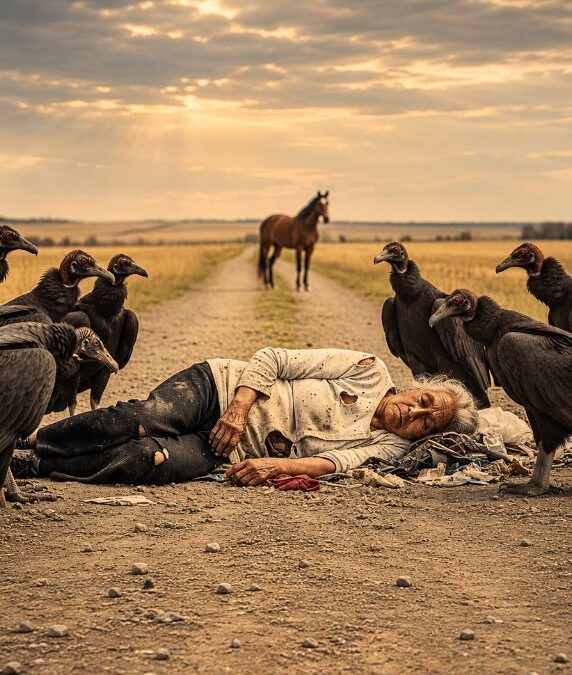
Have you ever felt completely abandoned? Have you ever looked up at the sky in the midst of unbearable pain and wondered where God is? If your heart has been broken by the betrayal of someone you love, if you have ever felt humiliated, mistreated, or felt that your suffering has no end, then this message is a direct divine call to your soul.
Today I’m not going to tell you a simple story. I am going to reveal to you the living proof of how God acts in the darkest moments, through the shocking and true story of a son who abandons his own mother to be eaten alive by vultures. Just like you heard. And what happened in that desolate place, in that ravine of death, will shock you.
But more importantly, it will show you the secret to transforming the greatest of tragedies into the greatest of miracles. What’s at stake here is your ability to access God’s power when all seems lost.
Look closely, my friend, at how darkness can nest in the most unexpected places, not in gloomy castles or enchanted forests, but under the scorching sun that punishes the land of a humble ranch. There, on that cracked piece of land clinging to life on the edge of a dry ravine where a mighty river once flowed, lived an old woman named Consuelo. His name was a bitter irony, a whisper of fate mocking his existence.
She was a mother who had dedicated her years, her strength, and her dreams to raising her only son, Damian. But the child she once cradled in her arms had transformed into a man whose heart was a wasteland more barren than the desert that stretched on the horizon. The violence in that house wasn’t always screams and loud noises; often it was a heavy silence, an atmosphere charged with a hatred so dense that you could cut it with the knife Consuelo used to cut the stale bread.
Damian didn’t need to hit his mother every day to mistreat her. His contempt was a poison he administered to her daily, a constant way of humiliating her spirit, reminding her of her old age, her fragility, her supposed uselessness in a world that, according to him, belonged to the strong and not to those who, like her, clung to a God who seemed deaf to their prayers. It was the silent cruelty of the peasant who hates the land that fed him, ingratitude made man.
The house that was once the nest of a loving husband and the laughter of grandchildren who no longer came, had become a prison. Each wooden beam seemed to have absorbed Damian’s cruelty. He, who was neither rich nor a millionaire, but who coveted the misery they possessed as if it were a treasure, saw his mother as the last obstacle to selling the ranch and escaping from that life of poverty that he so detested.
The old woman sometimes felt like a rejected animal, an old mare no longer useful for work and destined only for abandonment. Damian used to punch the walls when frustration consumed him, and although his fists didn’t always find his mother’s skin, the thud was a promise, a warning. The way he looked at her, with those cold, calculating eyes, was worse than any blow.
It was psychological torture that sought to break her, to humiliate her until she became an echo of herself. He called her an invalid, lame in her ideas, blind to the reality he preached. And she, in her corner, next to the unlit stove, could only hug her knees and pray silently, asking God for a miracle, a sign, something to remind her that she was not completely alone in her ordeal. Meanwhile, the family’s old horse, in the corral, seemed to observe the scene with an almost human sadness, a silent witness to the violence that hung in the air.
The breaking point, that moment when a crack becomes an abyss, came on a dusty afternoon. Damian had received an offer for the ranch, a pittance offered by a speculator from the nearby town. But for him it was a passport to a new life, far from the responsibility of caring for a mother he considered a burden.
“Let’s sell, mother,” he said. His voice, without inflection, was like that of a judge delivering an irrevocable sentence.
Consuelo, with the dignity that only years and suffering can forge, refused. “Here lies your father,” he whispered. “And here I will be buried. This land holds the memories of your baby, the laughter of your daughter before you took her away. You cannot burn what we are.”
That resistance, that spark of defiance in the old woman’s eyes, was what unleashed the wild and untamed beast that lay dormant in Damian’s soul. The argument escalated, the words became daggers. He didn’t just want to expel her from his home, he wanted to erase her from his life, to chain her memory to oblivion. The monstrous and vile idea began to form in his mind, not as a sudden impulse, but as a logical and definitive solution to his problem.
It was then that the true extent of his cruelty was revealed. He wouldn’t kill her with his own hands, no. That would be too direct, too dirty. His plan was more twisted, a way of mistreating his existence until his last breath. He would take her to the most desolate place he knew, the ravine of the souls, a deep canyon where the sun beat down and only vultures dared to fly.
He was going to abandon her to her fate, leave her alive for nature to do the dirty work. He imagined his mother, the old woman who gave him life, crying out for an indifferent God as the sky darkened and the birds of prey began to descend. It was a supreme act of violence, not only against his body, but against his faith, against his very essence. He wanted to humiliate her before creation, to show her that her prayers were useless, that her son was her true and ultimate God, a God of hatred who had the power to decide her fate.
This was not the act of a desperate farmer, but the masterpiece of a monster dressed as a peasant. The next morning, under a gray sky that seemed to foreshadow tragedy, Damian tied the old horse to the cart. He told his mother he would take her to the village hospital for a check-up, a lie as thin as the veil of decency he still pretended to maintain. Consuelo, although her heart was shrunken with fear, decided to face her destiny. She saw the truth in the coldness of her son’s eyes, but she no longer had the strength to fight.
During the journey, every clatter of the wheels on the dirt road was a hammer blow to the coffin of their hopes. He gazed at the familiar landscape, the sparse forest, the dry hills, bidding farewell to a world he no longer felt was his own. There were no words between them; silence was a shroud. He, focused on his goal, on the final act of expelling his mother from existence. She, clutching a worn rosary, whispering the name of her son, not of the man who was taking her to her death, but of the child she once loved, asking God not for a miracle to save her life, but a miracle to save Damian’s soul.
And so, the cart ventured down the road that led to the ravine, to the threshold of hell on earth. There it was, my dear friend, the final act of human cruelty in its purest and most naked form. Damian stopped the cart at the edge of the ravine. The silence of the place magnified the terrified heartbeat in his mother’s chest. There was no final goodbye, not a word of remorse. With the same coldness with which a farmer pulls up weeds, he took the old woman by the arm and placed her on the burning ground, a few meters from the abyss.
Consuelo did not fight. His body, fragile as a dry leaf, no longer belonged to him. All he had left was the dignity to face his destiny. He saw his son get into the cart, take the reins, and leave without looking back. The sound of the wheels moving away was the sound of their entire world collapsing. The act of abandoning was complete. She was left alone. A tiny, insignificant figure under an immense, coppery sky, feeling his son’s hatred like a physical burn on his skin.
A final act to humiliate not only her life, but also her unwavering faith in a God who at that moment seemed to have completely forgotten her in the vastness of the desert. And it is precisely at that point, in the darkest hour of the soul, when hope is only a cold ash, that the universe sometimes bends down to whisper. Consuelo closed her eyes, preparing for the end. He could hear the whistling of the wind in the canyon, which sounded like a lament, and he sensed more than he saw the shadows of the vultures that were beginning to trace circles in the sky, the harbingers of death.

His heart, exhausted from so much mistreatment, gave up. “Thy will be done,” he murmured, not to Damian, but to his God.
And then the miracle happened. It was not a choir of angels nor a blinding light, it was a familiar and earthly sound, the soft snorting and the brush of a warm body against his shoulder. She opened her eyes and the sight took her breath away. It was Centinela, the family’s old horse, the animal that Damian had left tied to a post while throwing his mother out. He had broken his tether and instead of fleeing to the safety of the ranch or getting lost in the woods, he had walked up to her.
He stood there beside the old woman, a silent and unlikely guardian. The son had abandoned her, but the beast, in an act of pure loyalty, refused to do so. “Pay close attention to this lesson, my disciple, for it is profound. Divine intervention does not always descend in a chariot of fire, like Elijah. Sometimes, the hand of God manifests itself through creatures we consider inferior, those whose instinct is purer than the corrupted reason of man. The horse Sentinel became the personification of this miracle.”
During the cruellest hours of the day, the animal positioned itself so that its body cast a shadow over Consuelo’s fragile figure, protecting her from the relentless sun that threatened to scorch her skin and her life. When a coyote, lured by the promise of easy prey, stealthily approached, the docile horse transformed into a wild and untamed beast. It pawed the ground, whinnied with a fury Consuelo had never known, and placed itself between her and the danger.
“Does this not remind you of the story of Balaam’s donkey in the book of Numbers, chapter 22, which saw the angel of the Lord when man was blind to the truth?” God didn’t need to give Sentinel a voice. His action was a complete sermon, a declaration of divine justice that shamed the son’s violence and betrayal. Meanwhile, miles away, Damian felt a strange euphoria. He felt free, light, as if he had shed a chain that had bound him his entire life.
He imagined a different future, far from poverty, perhaps even as a rich man, a millionaire who had managed to change his destiny with a bold decision. He had succeeded in expelling the last anchor of his past, but upon arriving at the ranch, a small thorn of unease pierced his celebration. The wagon was there, but the corral was empty. Sentinel wasn’t there. At first, he didn’t think much of it. The old nag must have stretched, he thought.
But the image of the horse, always so submissive, breaking its rope and disappearing didn’t fit. It was a loose piece in the perfect puzzle of his plan. He tried to ignore it, to convince himself that everything had gone according to plan, but the animal’s absence was a silent echo of her deed. A witness who had refused to be complicit, and whose disappearance was beginning to sow the first seed of doubt in her soul, hardened by hatred.
Back in the ravine, night fell, bringing with it a bone-chilling cold. The miracle of the horse’s protection had allowed Consuelo to survive the day. A gift of time and breath, but the miracle was not a complete rescue. It was a tool, an opportunity. Divine intervention had saved her from certain and immediate death, but now she faced a different test: endurance, survival in a hostile environment, her elderly body at the limit of its strength.
She was safe from death’s grasp for the moment, but still trapped between heaven and the abyss. The miracle was not the end of the test, but the beginning of a new stage in her spiritual journey. Now, more than ever, her connection with God would be her only sustenance, prayer her only water in the desert. Faith had been rewarded with a sign. But now that same faith demanded to be lived in every breath, in every moment of uncertainty.
Dawn broke in the ravine, and with the first light of the sun, the night’s chill gave way to the harsh reality of survival. Consuelo’s body, an old woman unaccustomed to such harshness, cried out in pain. Thirst was a fire in her throat, and hunger a knot in her gut. For anyone else, this would be the beginning of the end, the moment when despair devours the last vestiges of hope, but for Consuelo, it was the start of a different kind of journey.
Look closely, my friend, for here a great secret is revealed. The prayer of one who has witnessed a miracle is no longer the same, no longer the plea of a beggar, but an intimate conversation with a father. Feeling the first ray of sunlight, Consuelo did not curse her fate. Instead, she turned her head with effort and stroked the neck of Dicion Mosetin, the sentinel horse.
“Thank you, my God,” she whispered, cracked. “Thank you for the night and for this guardian you sent me. Thank you for life.“
Her prayer wasn’t to change her situation, but to sanctify it, to find the divine presence not despite her suffering, but in the midst of it. She had no prayer book or rosary other than the one her memory held, but the scriptures were woven into the lining of her soul, and so, in the vast and terrifying solitude of the desert, her voice rose, weak but firm, reciting the words that had been her anchor throughout her life.
“Do you realize the power in this?” she would say to her faithful horse. “The Lord is my shepherd; I shall not want. He makes me lie down in green pastures.”
And as she said it, she would close her eyes and imagine not the dry, reddish earth, but the green fields of her youth. “He leads me beside still waters. He restores my soul.”
And she felt an inner coolness she could not quench. “Even though I walk through the valley of the shadow of death, I will fear no evil, for you are with me.”
Her voice would break with emotion. The ravine was her valley of shadow. Her son’s hatred was the evil that haunted her. And the warm, living presence of the horse at her side was God’s rod and staff, a tangible and real comfort. Her faith was not a denial of her pain. It was the transfiguration of that pain into a testimony.
Think, my good friend, of the great figures of faith who were tested in the aridity of the land. Think of Hagar, the Egyptian servant, cast out by Sarah and abandoned with her son Ishmael in the desert of Beersheba. The Bible tells us, there in Genesis 21, that she sat at a distance so as not to see the child die. Her mother’s heart was broken. But God heard the boy’s voice, and an angel spoke to Hagar, opening her eyes so that she saw a well of water.
Comfort was Hagar, a rejected mother, abandoned to certain death by the cruelty of her own people. Her ravine was the desert of Beersheba, but the miracle had already happened to her. Her well of water wasn’t something to be drunk with the mouth, but with the soul. It was the inexhaustible spring of faith, the constant prayer that kept her spiritually hydrated. An act of resistance against the drought that her son Damian’s violence had tried to impose on her spirit.
And while Consuelo drank from this spiritual well, her son Damian tried to drown his own soul in alcohol. He had gone to the town’s cantina, a noisy place full of men who boasted of their strength. Damian felt like one of them. He announced to anyone who would listen that he would soon sell the ranch, that he would become a rich man, that his destiny was in his own hands. He lied easily when asked about his mother, saying that he had left her well cared for in the hospital.
But his joy was fragile, an empty shell. An old farmer remarked in passing, “Your horse is strange, Damian. The other day I saw him near your land, more stubborn than a mule. He looked like a sentinel.”
The animal’s name, mentioned at random, was like a stone in Damian’s stomach. The image of the missing horse, the vanished guardian, returned to his mind. A silent reminder that there are witnesses in this world who cannot be bought or intimidated. Justice, sometimes, begins as a small, uncomfortable itch on the conscience of the guilty.
As evening fell on the second day, Consuelo’s body was at its limits. She was a frail old woman, and the physical toll of the ordeal was immense, but something extraordinary was happening. As her body weakened, her spirit grew clearer, stronger, brighter. Hunger and thirst had stripped her of everything superfluous, leaving her with the only thing that mattered: her direct connection to God.
Her prayer changed once more. It was no longer just one of gratitude or a plea for strength; it became a prayer of intercession. In the stillness of twilight, with Sentinel’s head resting near her lap, Consuelo began to pray for Damian’s soul. She asked God not to punish him, but to have mercy. She asked Him to allow her to see the darkness in which she lived. This is the threshold of transformation, the moment when the victim begins to weave the mantle of forgiveness, an act that would prepare her for the next and perhaps more difficult chapter of her odyssey.
As dawn broke on the third day, a profound transformation had taken place in Consuelo’s soul. Her body, it was true, was reaching the limit of its endurance. She was an old woman shipwrecked in an ocean of dust and rocks, but her spirit, curiously, had found a calm she hadn’t known for years. The memory of her son Damian’s cruelty was no longer an open wound oozing hatred and pain.
In the silence of her meditation, nourished by prayer and the nearness of her faithful horse, she had begun to see Damian in a different light. He was no longer the monster who had wanted to burn her alive and bury her in oblivion, but a being worthy of pity. He was like a lost child, a spiritually deformed and crippled soul, trapped in a cage of bitterness he himself had built. He realized that the one truly chained was not her, abandoned in a ravine, but him, a prisoner in the freedom of his own resentment. That compassion, born in the heart of his own suffering, was the first step in his miraculous metamorphosis.
Then, in an act as solemn as if she were in the greatest cathedral in the world, Consuelo performed the most sacred of rituals. She gazed at the vast sky, felt the presence of God, not as a judge, but as a loving witness, and uttered the words that would change everything.
“Lord,” she whispered, a sound carried away by the wind, “I forgive him.”
What a powerful thing forgiveness is, my friend. Look closely, forgiveness is not an act of amnesia, it is not pretending the offense never happened, it is a conscious decision to change the fate of the wound. It is taking the resentment the offender has thrown at you and instead of letting it burn you up inside, use it to light a fire.
By forgiving her son, Consuelo wasn’t condemning his act of abusing and abandoning her; she was breaking the spiritual chain that bound her to him. She was declaring that Damian’s hatred would no longer have power over her. It was an act of supreme justice—not the justice of men that seeks punishment, but divine justice that seeks the restoration and freedom of the soul.
This act of grace elevated her to holy company. Doesn’t it remind you of the words of Jesus himself on the cross? While men had subjected him to the ultimate violence and humiliation, he looked beyond the act, into the broken and blind hearts of his executioners. There in the Gospel of Luke, chapter 23, verse 34, we find his incredible plea, “Father, forgive them, for they do not know what they are doing.”
That is the pinnacle of spiritual empathy. Consuelo in her humble ravine reached that same peak. She understood that her son was a spiritual invalid, a man who believed he was taking control of his life, but who was actually acting from a deep and unfathomable weakness. The cruelty with which he treated her was not a sign of his strength, but irrefutable proof of his inner misery.
This understanding is the master key that unlocks the heavy door of true forgiveness. A forgiveness that expects nothing in return. Meanwhile, at the ranch, Damian’s freedom had become torture. The silence of the house was a deafening scream. Every object that had belonged to his mother seemed to accuse him. Her empty chair by the hearth, the shawl she had left half-knitted, the scent of herbs that still lingered in her room. Every detail was a hammer blow against the wall of his pride.
The lie he had told in town about the hospital now felt bitter and stupid. But his main obsession, the fixed idea that kept him awake at night, was the absence of the horse. Why had Centinela, the most predictable and loyal animal in the world, disappeared? The beast’s incomprehensible loyalty was a mirror reflecting back to him the image of his own monstrous betrayal. The figure of the horse became the anchor of his guilt, a symbol of the innocence he had tried to destroy and which, somehow, had revealed itself.
Finally, unable to bear the tyranny of his own thoughts any longer, Damian made a decision. He couldn’t admit, not even to himself, that he was worried about his mother. His pride wouldn’t allow it. Instead, he clung to the only excuse his mind could tolerate.
“I have to find that horse,” he said aloud, as if to convince himself. “I can’t lose the animal too. I’ll go to the ravine and see where that damned nag went.”
He was lying to himself. It wasn’t the horse that was calling him; it was a much deeper, invisible force. It was the power of a mother’s prayer, the energy of forgiveness already released into the universe, a spiritual thread drawing him back to the scene of his crime, not as the wild, untamed man he had left, but as a tormented soul unknowingly walking toward his own destiny.
Damian returned to the ravine, his soul a knot of pride and panic. The journey back was agonizing. Every rock on the path seemed to whisper of his crime. He had convinced himself that his sole mission was to find the horse, to tie up the last loose end of his perfect plan. He peered over the canyon’s edge, his heart pounding with anticipation of a macabre confirmation: his mother’s remains, proof that his cruelty had triumphed and his new fate was certain.
But what his eyes beheld shattered his world into a thousand pieces. Down there, at the bottom of the abyss, she was. Alive. She wasn’t crying or lamenting. She sat with her back straight against a rock, her figure silhouetted against the afternoon sun. Beside her, like a royal guard, stood the sentinel horse. Calm and vigilant. The image was so unreal, so powerful, that for a moment Damian thought he was seeing a mirage, an apparition. The old woman he had discarded as useless junk, the woman he considered invalid and weak, now possessed a terrifying majesty.
Look, it comes down to this truth, my friend, because it is one of the greatest. True power does not reside in the fist that can strike or the voice that can humiliate. Supreme power, indomitable strength, resides in the spirit that refuses to be conquered by hatred. In that instant, Damian saw his mother for the first time, not as the burden that anchored him to a life of poverty, but as a force of nature.
Her survival wasn’t a mere fact; it was a miracle that acted as a mirror, reflecting his monstrosity and the futility of his violence. Every breath she took was a verdict of divine justice against him. The serenity of her face, marked by suffering but imbued with an incomprehensible peace, was a fortress that no aggression could break. He had tried to destroy her with his masculine power, his brute force, but she had become untouchable, protected by an invisible shield forged in faith and resilience.
Trembling, not understanding the force that drove him, Damian began to descend the perilous path that led to the bottom of the ravine. The horse raised its head and followed him with its eyes, never leaving its charge’s side. Every step Damian took was a step toward his own surrender. When he finally reached the canyon floor, the air seemed to grow heavy. He saw his mother’s face up close: her sunburnt skin, her chapped lips, her emaciated body. It was the physical proof of the hell he had put her through.
He opened his mouth to utter an excuse, an accusation, anything that might give her back control, but before he could utter a sound, she looked at him, and in her eyes there was neither fear nor resentment. Her voice, though weak, resonated in the canyon with the authority of a matriarch.
“You’re back, my son.”
Those three words, spoken without a trace of anger, stripped him of all his defenses. It wasn’t the question of a victim, but the acknowledgment of a mother who already knew how the story ended. In that moment, before the eyes of her crumbling son, Consuelo transcended her own identity. She was the embodiment of a lineage of female power that Damián, in his blindness, had never recognized.
She was the strength of his own mother, Damián’s grandmother, who had built a ranch from nothing; she was the resilience of all mothers who protect their cubs, who face scarcity and pain with a strength that cannot be measured in muscles. It was the silent wisdom of the old woman who had seen generations born and die and understood the cycles of life and the folly of men. Damian had based his identity on a twisted idea of masculinity, one that confuses violence with strength. But now he was on his knees, figuratively, before true power: the capacity to endure, to forgive, to love in the face of hatred, the strength to create and sustain life instead of trying to extinguish it, a power blessed by God, infinitely superior to his own.
Damian’s fall was total. He collapsed to his knees. The sound of his body hitting the dusty ground was the only sound in the canyon. He couldn’t speak. The man who had wanted to defy the world, who had felt like a millionaire in his freedom, was now a helpless child before the woman he had tried to bury. The reversal of power was absolute. She, the rejected one, the abandoned one, was now the moral center of gravity of both their universes. He, the perpetrator, the judge and executioner, was now a supplicant who didn’t even know what to beg for.
Consuelo’s empowerment was complete, not because she had won a battle, but because she had refused to fight with her enemy’s weapons. She had survived, and in doing so, she had forced her son to confront the one thing he could not defeat: the truth of his own spiritual misery. The silence at the bottom of the ravine was so dense it seemed to have weight. Damian, kneeling on the earth that was to be his mother’s grave, finally looked up. His eyes, which had always burned with the arrogance of one who believes himself master of destiny, were now empty, extinguished.
And in that emptiness, the truth found space to enter. It began as a murmur, a guttural groan that escaped from the depths of his being.
“I… I brought you here to…” The words choked in his throat, ashamed of their own existence.
But Consuelo’s serene gaze, a gaze that did not judge, simply waited, forcing him to continue. And then, the dam broke. In a torrential, disjointed confession, he vomited up all the rot that had festered in his heart. He confessed his plan to abandon her, his desire to burn away every vestige of his impoverished life, his resentment at feeling like a peasant tied to an old woman he blamed for his misery. He admitted the hatred that had consumed him, the cruelty with which he had planned every detail to humiliate and mistreat her to the very end. It was the first time she had heard her own evil aloud, and the sound was monstrous, unrecognizable, the voice of a strange savage.
Consuelo listened to the torrent of poison without flinching. There wasn’t a trace of triumph on her face, not the faintest hint of “I told you so.” Her patience was like that of a mountain enduring a storm, knowing it will pass. When Damian finally collapsed, exhausted and trembling like a frightened child, she reached out her bony hand and rested it on his bowed head. The touch was like an anchor amidst his shipwreck.
“I already knew, my son,” she said in a soft but firm voice. “I didn’t need your words to know the truth of your heart.”
In that moment, Damian understood the depth of his mother’s innocence. It wasn’t the naive innocence of one who doesn’t see evil, but the pure innocence of one who, seeing it, chooses not to be tainted by it. Her innocence wasn’t a weakness he could exploit, but an impenetrable shield, a truth as fundamental as the river flowing to the sea. He had tried to tarnish it, but it was like trying to soil the sun by throwing handfuls of mud at it. Her truth remained intact, luminous, and now illuminated the darkness of his own.
“But how?” Damian stammered, his logical mind unable to process the scene. “How did you survive? This place, the sun, the animals.”
His gaze fell upon the horse, still motionless, a silent witness to a drama that transcended human reason. It was then that Consuelo told him of the miracle. She recounted how Centinela, the animal he had scorned, had become his shadow, his protector, his solace. She described how his faith, far from wavering, had become his sustenance, how his prayers were not desperate pleas, but conversations with a God who had never abandoned her.
“You sought to chain my body and bury my name,” she explained with astonishing calm, “but you never had power over my soul. My spirit was in a place your violence couldn’t reach.”
For Damian, it was as if a veil had been torn away. The world he knew, a world ruled by force and cunning, crumbled. He realized he had been fighting an invisible power, a truth that could not be defeated by schemes or cruelty. That realization was the final blow to his pride. The image he had of himself, that of a strong man taking control of his life, shattered. He looked into the mirror of truth, and the image reflected back was that of a pathetic being, a spiritually blind man, invalid in his judgment, a moral failure who had stumbled over his own wickedness.
He saw himself as poor in spirit, a millionaire in arrogance, but a beggar in love and decency. The true outcast was him, expelled from the realm of compassion by his own actions. His mother’s innocence was no longer an affront, but a beacon revealing the misery of his own shore. The son who had wanted to be a god to his mother realized he wasn’t even a whole man. The truth, once acknowledged, brought him not peace, but the sharp, purifying pain of a wound finally healing.
The bottom of the ravine became the stage for a death and a birth. The arrogant, hate-filled Damian died, and in his place remained a broken man, an empty shell without direction or purpose. He looked up at his mother, the woman who had survived his personal hell, and her eyes were those of a shipwrecked man pleading for land. He didn’t know what to say, what to do. Forgiveness seemed like an unattainable galaxy. Redemption, a meaningless word.
Consuelo, reading the helplessness on his face, knew that acknowledging the truth wasn’t enough. It had to be the first step on a long road. With the authority her ordeal had given her, she gave him her first command in this new life: “Help me get up, son.”
It wasn’t a request, it was a command. The first act of penance. The journey out of that canyon would be the first test to see if the recognition of innocence and truth could begin to translate into action. Following his mother’s command, a command that was his first act of penance, Damian approached and helped her to her feet. The contact with her frail body was an electric shock to his soul. He felt in his hands the life he had tried to extinguish. The fragility he had scorned and which, paradoxically, had revealed itself as an invincible force.
The ascent out of the ravine began. It was an ordeal in reverse. Each step upward was a deeper descent into the abyss of his own shame. The old woman’s body weighed little, but the weight of his guilt was crushing. An invisible burden that made him stumble and gasp. The son who had thrown his mother into the abyss now struggled to pull her out, and in every effort, in every tense muscle, he felt the echo of his own cruelty. This was not merely a physical effort; it was the first and most painful exercise in the gymnasium of redemption, a path back to humanity that had to be traversed step by step, rock by rock.
It was in this struggle that the sentinel horse went from being a passive protector to an active participant in the redemption. Seeing Damian’s difficulty, who at one point slipped on the loose gravel and almost fell with his precious load, the animal intervened with an intelligence that chilled Damian’s blood. The horse positioned itself strategically, using its strong body as a buttress, allowing Damian to regain his balance. Then, with incredible gentleness, it approached Consuelo and lowered its head slightly, inviting her to rest on its back. In this way, the noble animal began to bear some of the weight, easing Damian’s burden and literally becoming a bridge of flesh and blood between mother and child.
It was a choreography of silent compassion, an act of pure instinctive grace that went beyond any training or logical explanation. The horse wasn’t simply helping, he was teaching a lesson about bearing one another’s burdens, a lesson Damien was only beginning to grasp. And here, my good friend, we must pause to honor the profound significance of this beast in this human story stained by the son’s betrayal and the violence of a hardened heart. It is the animal who stands as a beacon of loyalty and virtue. Isn’t this a lesson in humility given to us by God Himself? Creation in its purest state often reflects divinity more clearly than our convoluted hearts.
Sentinel, whose name means guardian, proved to be the embodiment of his name. He was not a wild, irrational beast; he was an indomitable spirit in his devotion, a living instrument of miracle and justice. While man used his reason to plot how to mistreat and abandon, the horse used his instinct to protect and serve. He is a walking sermon, a reminder that faithfulness, compassion, and sacrifice are not human inventions, but echoes of our Creator’s character present in the most unexpected creatures.
When finally they reached the edge of the ravine, bathed in sunlight and the sweat of their exertion, something inside Damian had broken forever. He looked at Sentinel, not as his property, not as a beast of burden, but with a reverence he had never felt for anything or anyone. He saw wisdom in its dark, liquid eyes, an ancient, wordless wisdom. Trembling, he reached out, not to take the reins with command, but in a gesture of supplication, of gratitude. He stroked the horse’s muzzle, and in that simple touch, in the soft texture of its skin, he felt a surge of emotion that overwhelmed him.
Tears sprang to his eyes, hot tears of shame and of a gratitude so profound it hurt. He finally understood the verdict the horse had delivered with its loyalty. The animal, in its simplicity, had proven to be more human, nobler, and more just than he, the son of man. The journey back to the ranch began in a completely new light. The unholy trinity that had traveled toward the ravine, the executioner, the victim, and the silent witness, had been transformed into a sacred trinity: the penitent, the resurrected matriarch, and the holy guardian.
With a gentleness he had never possessed before, Damian helped his mother mount Sentinel. It was the perfect reversal of his crime. The woman he had dragged to her death was now enthroned upon the agent of her miracle. And he, the man who had arrogantly driven the wagon, now walked ahead, leading the horse by the reins like a humble servant. He was no longer its master. He was his mother’s servant and indebted to the animal that had taught him the meaning of loyalty.
The way back would be long, but each step was a word in his prayer of repentance, the rhythm of the horse’s hooves marking the beat of his new and fragile chance at life. The return to the ranch was not a homecoming, but a return to the scene of a spiritual crime. Every meter of the dirt road that Damian traveled, leading the horse that carried his mother, was a station on his own Via Crucis. And upon arriving, the house that had once seemed a prison of poverty now appeared to him as a palace of mercy he didn’t deserve to inhabit.
The consequences of his pride weren’t a divine punishment rained down from the sky; they were far more intimate and devastating. It was his mother’s silence as he helped her down from the horse, a silence not of resentment, but of a pain so profound that words couldn’t reach it. It was the way the sun fell on the empty corral, a reminder that his plan to be rich and free had left him poorer and more chained than ever. He realized that cruelty is a boomerang; you throw it hard to strike another, but it always returns with multiplied speed to shatter the thrower.
His pride, that tower from which he looked down on the world with disdain, had crumbled, and he was buried beneath its rubble, a man who would have to face each day the ghost of the person he had been. The news, like water seeping through cracks, found its way to the town. The speculator who wanted to buy the land, impatient to close the deal, showed up at the ranch a few days later. He found Damian repairing a fence with the clumsiness of a man whose soul wasn’t in his work. And Consuelo, the old woman who was supposedly in a distant hospital, sitting on the porch gazing at the horizon.
The lie crumbled with shameful ease. The man, understanding the situation, or at least part of it, left with a grimace, and the story began to snowball through the town’s streets. Damian, who had wanted to be a respected millionaire, became the monster of the ravine, the son who had tried to let the vultures devour his own mother. The pride that had made him feel superior now made him an outcast, a reject. The humiliation he had engineered for his mother became his own robe of shame, one he would have to wear every time he dared to show his face.
Human justice, often clumsy, sometimes finds a way to reflect the divine. But the external consequences were a mere scratch compared to the internal gangrene. Damian discovered that true hell wasn’t a fiery place God sends you to, but a state of the soul you create yourself. He couldn’t sleep. Every time he closed his eyes, he saw the ravine, heard his mother’s silence as she was abandoned. He looked at his reflection in the watering trough and saw the face of a stranger, a being deformed by hatred.
He understood that his plan hadn’t just been to expel his mother, but to burn his own past, to bury his peasant identity, but in doing so, he had almost incinerated his own soul. He felt like a spiritual invalid, a blind man who had walked straight into a precipice. The wild, untamed man he thought he was was actually a frightened child, terrified by the darkness that he himself had unleashed. The violence he had inflicted hadn’t made him stronger; it had left him hollow, broken, an echo of a man.
And for some consolation, the consequences were of a different nature, perhaps heavier. She had survived the miracle of the ravine, but now she faced a different trial: rebuilding. Her elderly body was healing slowly, but her greatest task was to shepherd the soul of her wayward son. The son who had wanted her dead now followed her with his eyes like a lost dog, searching for guidance he didn’t know how to ask for.
Their relationship had been irrevocably transformed. They were no longer simply mother and son; they were survivor and penitent. She had to find in her heart not only the forgiveness she had already granted him, but also the strength to teach him to forgive himself—a monumental task. She had to guide him out of the desert of his guilt, a labor as arduous as the one the sentinel horse had done for her. Her role had changed, from victim of cruelty to architect of a possible repair. Redemption, a burden only a mother with unwavering faith could bear.
Ultimately, the most tangible consequence was the land itself, the ranch, the object of Damian’s scorn and the reason for his crime, now his only anchor. The sale had vanished, and with it, his feverish dream of a life of wealth. They were still poor, but the word had taken on a new meaning. Damian realized that true wealth lay not in money, but in the land his father had worked, in the loyalty of a horse, in the mercy of a mother.
Pride had led him to despise his roots, but now those same roots were the only thing that could prevent his soul from completely disintegrating. The land became the stage for his penance, the place where he would have to work not to earn money, but to regain his humanity. The consequence of his pride was the destruction of his ambitions, but within that destruction lay the single, fragile seed of possible salvation, one that would require not only his effort, but a change of heart of all those around him.
At first, the ranch became an island of silence in the sea of the community. The town, once indifferent to their existence, now watched them with a mixture of horror and morbid fascination. Damian was the monster, the unnatural son, and Consuelo the almost spectral victim. When Damian went to town for supplies, mothers pulled their children away, men glared at him with hatred, and women whispered as he passed, hurling words like stones.
He accepted every insult, every contemptuous look, as part of his just penance. He didn’t defend himself, didn’t raise his eyes; he simply carried his shame as he had carried his mother out of the ravine. His world shrank to the confines of his land, to an endless cycle of physical labor that was his only form of prayer, his only attempt to change the landscape of his soul. His only company was his mother’s silence and the calm, non-judgmental presence of the sentinel horse, the holy trinity of his redemption.
But such a powerful story cannot remain contained. The legend of the old woman who was abandoned to be devoured by vultures and who survived thanks to the loyalty of her horse and her unwavering faith began to grow. It transcended gossip to become a local myth. Consuelo, without seeking or wanting it, transformed into a figure of reverence. People called her the saint of the ravine. What was most incomprehensible to them was not the miracle of her survival, but the miracle of her forgiveness.
That she had not expelled her son, that she allowed him to live under her roof, that she cared for him in his spiritual misery. That defied all human logic. Her example became an uncomfortable question at the heart of the community. What kind of force, what kind of God allows such radical love? Her silent empowerment, the force of her grace, began to exert a strange gravity, an influence that went beyond words and that slowly began to erode the hard rock of communal judgment.
The turning point came through the old town priest, a man who had seen enough sin and suffering to know that truth is rarely simple, decided to visit the ranch, intrigued by the stories. He didn’t find the monster people described, but a broken man working the land with feverish devotion. And he didn’t find a trembling victim, but a matriarch, a spiritual grandmother whose peace was as deep as the river in the rainy season.
He sat with Consuelo, and she told him the story, not as a complaint, but as a testimony. The priest, a man of faith, recognized the authentic hand of God in every detail, in the cruelty and the miracle, in the fall and the forgiveness. The following Sunday, his sermon wasn’t about the fires of hell, but about the scandalous and undeserved grace of forgiveness. He spoke of the parable of the prodigal son and told his congregation, “We have a living version of that story among us, and it teaches us that our duty is not to judge the one who returns, but to celebrate the mercy that brought him back.”
The heart of the community, nurtured by the priest’s words and watered by Consuelo’s persistent example, began to soften. The change wasn’t sudden, but gradual, like the dawn. One day, a woman struggling with her teenage son left a basket of bread and cheese at the ranch gate. Damián found the gift and wept silently. An old farmer who had once looked down on him simply nodded one day when their paths crossed. They were small gestures, but they were bridges being built across the chasm of ostracism.
People began to see the story differently. Damián was no longer just the monster, but also a reminder of the darkness that can lurk in any human heart, and Consuelo was proof that faith and forgiveness were real forces capable of working out the impossible. The horse Centinela became a local celebrity, and the neighbors’ grandchildren sometimes left carrots on the fence for the miracle horse.
And so life on the ranch found a new rhythm, a new normal. It wasn’t a story with a fairy-tale ending. They didn’t become rich, and the memory of the ravine would never be completely erased, but hatred had been replaced by hard work and quiet purpose. Violence had given way to a routine of mutual care.
One afternoon, as the sun set and painted the sky orange, Consuelo and Damián sat on the porch in silence. Centinela grazed nearby, his presence a constant blessing. The ranch, once the scene of tragedy, was now a beacon of quiet hope.
And here lies the final lesson, my dear friend. The greatest miracle wasn’t the survival of an old woman or the loyalty of a horse. The truest and deepest miracle was the resurrection of a soul, the transformation of a heart of stone into one of flesh. And that kind of miracle, the miracle of grace, has the power not only to change a man’s destiny but to heal the wounds of a family and redeem the soul of an entire community.
You Might Also Enjoy


Mom Installed a Camera To Discover Why Babysitters Keep Quitting But What She Broke Her Heart


She Gave a Hungry Little Girl a Free Birthday Cake — The Next Morning, a Black Rolls-Royce Arrived




