How the SBS Proved the CIA Wrong About the Falklands Before the War Even Started
In April 1982, the CIA sent a classified assessment to the White House. It said Britain faced major difficulties retaking the Falkland Islands. The distances were too great. The Argentine defences too established. The odds too long. America’s top intelligence analysts looked at the situation and concluded that what Britain was attempting was at best unlikely.
What the CIA did not know, what nobody outside a very small circle of British commanders knew, was that while that assessment was being written, a group of SBS operators were already on the islands. Not approaching. Not preparing to. Already there. Living in shallow scrapes in the freezing peat, wrapped in cam nets, watching Argentine soldiers patrol within earshot, eating cold rations in the dark, and transmitting intelligence back to a task force still 800 miles away.
Three weeks before the first British soldier officially set foot on the Falklands, the SBS had already mapped the beaches, counted the enemy positions, and found the landing site that would win the war. The CIA said Britain faced major difficulties. The SBS were already solving them before the assessment had finished being written. This is how that happened, and this is what it proved about a kind of warfare that the most powerful intelligence agency in the world had not thought to account for.
Argentina invaded the Falkland Islands. It was not supposed to be a war. The Argentine military junta, led by General Leopoldo Galtieri, had calculated carefully and concluded that Britain would not respond with military force. And the islands sat 8,000 miles from the United Kingdom, on the far side of the South Atlantic, in some of the most hostile ocean in the world.
Britain had been quietly signalling for years that its interest in maintaining a permanent military presence in those waters was declining. In 1981, the British government announced plans to withdraw HMS Endurance, the only Royal Navy vessel permanently stationed in the South Atlantic. Buenos Aires read that as confirmation. Britain would protest. Britain would negotiate. Britain would not fight.
The junta was not alone in that conclusion. In Washington, senior figures in the Reagan administration looked at the situation and reached similar judgements, though for different reasons. US Secretary of the Navy John Lehman later described watching classified satellite photographs of the Argentine military making what he characterised as half-hearted attempts to fortify the islands against what Buenos Aires believed to be the unlikely possibility of Great Britain attempting to take them back.
The CIA sent its assessments to the White House describing the major difficulties any British assault would face. Some inside the administration privately called it an anachronistic Gilbert and Sullivan battle, a phrase that captured precisely how seriously the world’s most powerful military establishment was taking Britain’s chances in the South Atlantic.
The scepticism was not irrational. Argentina had deployed nearly 10,000 troops to the islands. They had established defensive positions around Stanley and Goose Green. They were fortifying airstrips and installing anti-aircraft positions. Their helicopter force gave them mobility across the islands that ground forces without air support could not match.
Britain’s task force would have to sail 8,000 miles with no land base, no permanent air cover from shore, no satellite imagery, and almost no ground intelligence about what was waiting on the islands. The approaching South Atlantic winter would reduce the operational window by the day. Every hour that passed, Argentine defences became more established.
The question that mattered, and that neither Washington nor Buenos Aires could fully answer, was whether Britain had a way to get inside that defensive picture before the window closed. The answer was already in the peat.
On the 5th of April, 3 days after the invasion, the task force sailed from Portsmouth. The scenes at the dockside were extraordinary. Crowds lining the waterfront in the spring sunshine. HMS Hermes and HMS Invincible moving through the harbour mouth. Sailors on deck, families on the quayside. It was one of those moments a nation watches and cannot quite process.
Britain had not fought a war of this kind, a unilateral expeditionary operation to retake sovereign territory, alone, 8,000 miles from home, since Suez in 1956. That had been a catastrophe. The question everywhere was whether this would be different.
The task force was built around the two carriers, supported by destroyers, frigates, submarines, and a fleet of requisitioned civilian vessels. RMS Queen Elizabeth would eventually carry a full brigade. The container ship Atlantic Conveyor was converted to carry aircraft. The ocean liner SS Canberra became a troop ship. 28,000 men, equipment and supplies for a prolonged campaign in one of the most hostile maritime environments on Earth.
By any conventional measure, it was a serious force. But conventional measures were not the only ones that mattered. Argentine air power was a genuine threat. The Exocet armed Super Étendard attack aircraft was a weapon the Royal Navy had no reliable counter to, as HMS Sheffield would prove within weeks.
And British commanders could not plan a landing without knowing where the Argentine defences were strongest and critically where they were weakest. Without that intelligence, the task force was a fleet sailing south with enormous capability and almost no specific information about where to use it. Someone had to go in first and find out.
On the other side of the intelligence picture, inside the Argentine headquarters on the Falklands, Brigadier General Mario Menendez was planning a defence he had every reason to believe was solid. Menendez had nearly 10,000 troops. He had positioned his strongest formations around Stanley and Goose Green and was keeping his helicopter mobile reserve ready to respond rapidly to any landing.
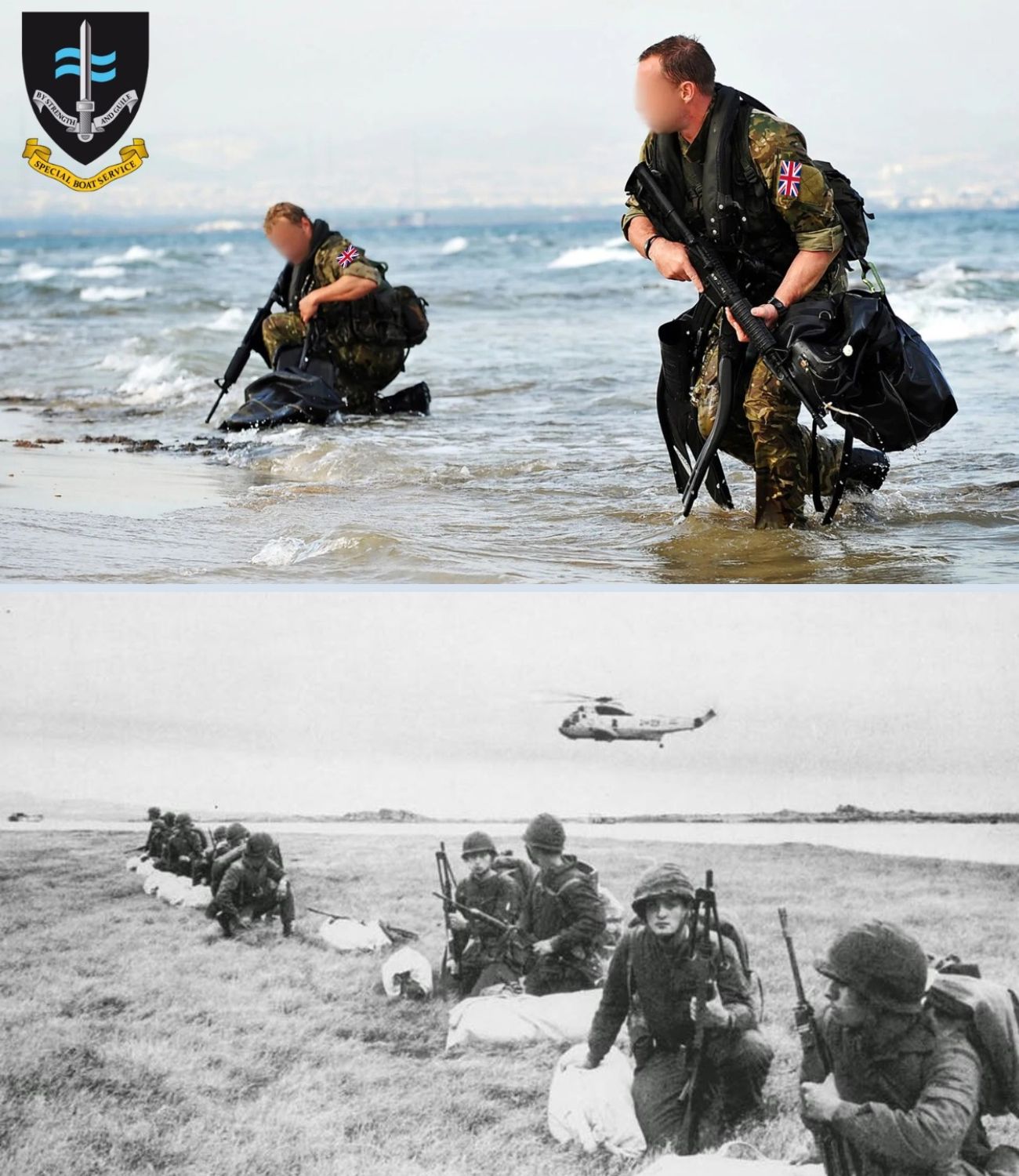
The centrepiece of his planning was a specific assumption about where the British would come. They would come the way a modern military power came to a contested amphibious objective, directly towards Stanley if the beaches could support it or as close as possible if they could not. American doctrine had shaped British military thinking for decades. Menendez had read the same assessments. He positioned his forces to meet exactly that assault.
His intelligence staff confirmed the thinking. Argentine analysis expected the British amphibious landing to come in the eastern part of the islands near the capital. The defensive preparations had been built for that assault. The helicopter reserve was positioned to respond to that assault. When the British came, they would be met where they landed, challenged on the beach before they could establish themselves and driven back into the sea.
It was a reasonable plan built on reasonable intelligence. The problem was that the intelligence was being overtaken by events Menendez had no awareness of. While his staff were building their assessments, many small groups of British soldiers were lying within earshot of his patrols in the western part of the islands, watching everything and reporting it back in encrypted transmissions to a task force Menendez thought was hundreds of miles away.
His defences were being mapped from the inside. His strongest positions were being noted and reported. His weakest positions, the ones he had left unguarded because his assessment said the British would not go there, were being identified with the patience of men who had nothing to do for weeks except watch and wait.
The Special Boat Squadron was the Royal Navy’s specialist amphibious reconnaissance unit. They had been doing this kind of work in one form or another since the Second World War, as when their predecessors had surveyed the beaches ahead of the Normandy landings and the operations in the Mediterranean that shaped those campaigns.
The capability that evolved over four decades of Cold War preparation was exactly what the Falklands required. The ability to survey a potential landing beach from the water and from the ground. The ability to assess an anchorage for the specific technical details that planners needed and that aerial photography could not provide. The physical and psychological capacity to operate on occupied enemy ground for extended periods with no margin for error and no route back until the mission was complete.
Together with G Squadron of the 22nd SAS, the SBS received their tasking as the task force moved south through warmer waters. Insert onto the Falkland Islands and locate Argentine defensive positions. Survey the potential landing beaches. Find where Britain could come ashore. Transmit everything back. Do not be seen.
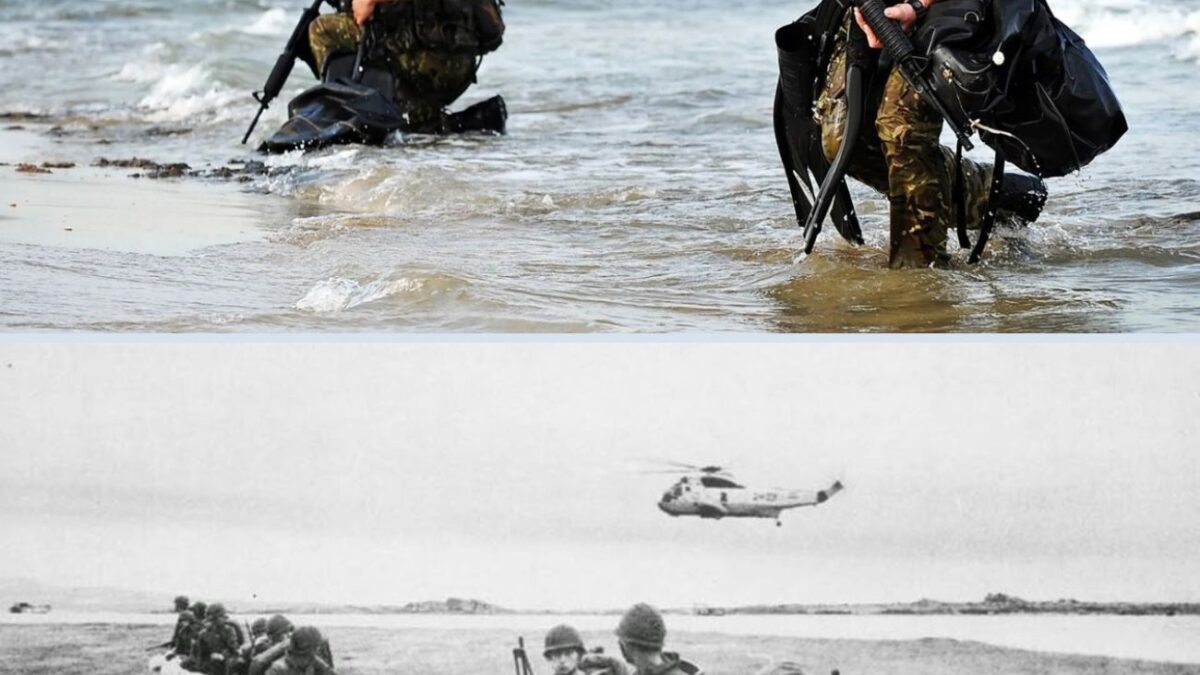
On the 1st of May, as the task force reached the outer edge of helicopter range from the islands, the insertions began. Sea King helicopters lifted off from the carriers in darkness, flying nap of the earth over the South Atlantic to stay below Argentine radar coverage and deposited small groups of men on enemy-occupied ground, four-man patrols heavily laden with everything they would need for an indefinite period in the field because there would be no resupply, no relief rotation, no way back until a helicopter could be sent for them without risking the mission.
The conditions were exactly as harsh as the terrain suggests. Military accounts describe the Falklands as defined by weather characterised by blowing snow, constant drizzle, squalls of freezing rain, and gusting wind that never completely stopped. The ground was peat bog, deep and waterlogged, the kind of surface that swallows boots and drains energy from a man’s legs with every step, making controlled silent movement through darkness an act of sustained will.
There were no trees, no walls, no structures of any kind offering concealment between one ridgeline and the next. The only cover was the lie of the land and the sparse tussock grass of a sub-Antarctic island that would hide a man lying completely flat but offered nothing to a man who needed to move. The patrols moved only at night.
Before first light, they found hides, shallow scrapes dug into the peat and recovered with cam nets and natural material, invisible unless someone walked directly onto the position. They lay in those hides through every hour of daylight. Argentine soldiers walked patrol routes within a few hundred metres of those positions, sometimes closer.
The patrols watched them pass, counted the men, noted their weapons, their patrol intervals, the directions they walked. Every observation was coded and transmitted to HMS Hermes in encrypted signals crossing 800 miles of open ocean. It was a question of watching and waiting in freezing rain in a hole on an occupied island for weeks.
The SBS had a specific mission on East Falkland where the main Argentine garrison was based and where any British landing would ultimately need to be established. The task force planners had identified several potential landing sites needing verification from the ground. San Carlos Water on the western side of East Falkland, Port San Carlos further north, Ajax Bay on the southern shore of the inlet.
Each had to be assessed against the same criteria. Could the beaches physically receive a landing force? Were the water depths workable for the ships? What Argentine presence existed in the area? The difference between a successful landing and a catastrophe could come down to a sand bar or a current or a defensive position on a ridgeline that aerial photography had not resolved clearly enough to act on.
The SBS surveyed each site. They entered the water at night in sub-zero temperatures to take hydrographic readings measuring depths and assessing gradients at the critical points where landing craft would need to run in. They climbed to observation positions before first light and lay through full days watching the approaches, counting any Argentine presence, assessing what a landing force would actually face.
What they found at San Carlos stopped the planning in its tracks. The SBS and SAS reconnaissance teams reported back that San Carlos was, in the exact words of the intelligence assessment, unbelievably, except for visiting patrols, to be devoid of enemy. The beaches were suitable. The anchorage was workable.
The terrain behind the beach gave troops room to establish and hold a beachhead. And the Argentine military which had concentrated its strength near Stanley and deployed its reserves to respond to the expected direct assault on the capital had left the approaches to San Carlos almost entirely undefended.
The reason was exactly what the ground reconnaissance had confirmed. Argentine defensive planning had catered to the expectation that the British would land in what one assessment described as the American way, straight at Stanley or as close to it as the beaches would support. The defences were in the east.
San Carlos on the western side was where Menendez had left the gap that the SBS had found. There was one exception. At the northern entrance to San Carlos water, a ridge called Fanning Head overlooked the entire approach route the landing force would need to use. The Argentine position there was the Eagle Detachment, call sign EC Hermes, approximately 60 soldiers armed with heavy weapons including an 88 mm anti-tank gun and machine guns covering the water below.
If those men were in position on the morning of the 21st of May, the landing craft running in below them would face fire from above in enclosed water. The damage would be catastrophic. Fanning Head had to be cleared the night before. The mission went to 3 SBS.
On the evening of the 20th of May, 25 operators were lifted by helicopter to an insertion point approximately 6 and a half kilometres from the ridge. They were supported offshore by HMS Antrim, whose Wessex helicopter carried a thermal imaging device that swept Fanning Head in the darkness. The sweep found the Argentine position precisely. The SBS observer described what he saw in his report.
“Bright glow worms in pairs, clusters of body heat at defensive posts. Several groups along the northern approach and a group at the very top of the feature.”
The heavy weapons company was there, exactly where the reconnaissance had predicted. The SBS moved towards the ridge in the darkness. They brought a Royal Navy naval gunfire forward observer to direct HMS Antrim’s guns from the ground and Marine Captain Roderick Bell, who spoke fluent Spanish with a loud speaker. The plan was to offer the Argentine garrison the opportunity to surrender before the assault went in.
The Argentines refused. HMS Antrim opened fire on Fanning Head. The fall of shot corrected in real time by the observer crouched on the hillside below, shifting with the precision that only a man on the ground can provide. The SBS assault went in simultaneously, 25 operators crossing ground they had been watching long enough to know better than the men defending it.
When it was over, 11 Argentine soldiers were dead, six were prisoners, and the rest had withdrawn into the darkness. The approach to San Carlos was clear. 60 km to the south at the same hour, 60 SAS soldiers were conducting a diversionary raid on Argentine positions at Darwin. They put down such a sustained volume of fire from small arms, machine guns, rocket launchers, and mortars that Argentine commanders at Darwin radioed the headquarters to report they were under assault from a full infantry battalion.
60 men had created the battlefield signature of 600. Every Argentine soldier oriented towards Darwin that night was not looking towards San Carlos. Hour was 2:30 local time on the 21st of May, 1982. In the darkness before dawn, the British task force moved through the Falkland Sound and positioned outside San Carlos Water.
Landing craft were lowered from the ships. Troops began the crossing from ship to shore on beaches that the SBS had surveyed weeks earlier, had verified, had reported accurately as suitable and clear. 2,400 soldiers came ashore. Men of 40 Commando, 42 Commando, 45 Commando, the second and third battalions of the Parachute Regiment, Royal Artillery, Royal Engineers.
They came ashore on ground that had been mapped and cleared before they arrived. The Argentine defences were exactly where the intelligence had placed them. The beaches were exactly as clear as the reconnaissance had reported.
On the West Falklands simultaneously, three SBS reconnaissance teams that had spent weeks locating, tracking, and harassing an Argentine force of over a thousand troops prevented any movement to reinforce the garrison facing the landing in the critical first hours. Menendez’s airmobile plan could not be executed against beaches his intelligence told him the British would never use.
The landings were not bloodless. Argentine aircraft attacked the ships in the sound with genuine courage and real effect in the days that followed. HMS Ardent was hit by nine bombs and sank. HMS Antelope followed.
The campaign that unfolded across the following weeks was hard and costly. The 255 British service personnel who died in the Falklands War deserve to be remembered alongside everything the reconnaissance made possible. But the landing itself, the moment that could have ended the campaign before it truly began, had worked. The beaches were exactly what the SBS had reported.
The intelligence had held. Britain won the Falklands War on the 14th of June, 1982, when Argentine forces at Stanley surrendered. The campaign had lasted 74 days. The islands returned to British sovereignty.
In Washington, the assessment shifted. Secretary Lehman revised his understanding of British capability in practice. The CIA acknowledged in its post-war analysis that British victory had been achieved against the difficulties that pre-war assessments had correctly identified. What those assessments had not accounted for was what small groups of trained operators could do to the intelligence picture, and therefore to the outcome, before the major operations began.
No satellite image could have found San Carlos devoid of enemy. No signals intelligence could have confirmed the gradient of those beaches at low tide, or identified the exact positions of the Eagle Detachment on Fanning Head. The intelligence that made the landing possible was human intelligence, gathered by men lying in the peat in the dark, and it was the most consequential intelligence of the entire campaign.
The SBS teams that inserted on the 1st of May went onto those islands with no certainty about when they would come back. They lay in freezing peat in shallow scrapes, listened to Argentine soldiers pass within earshot, and transmitted their findings in the knowledge that if they were discovered, there was no quick reaction force coming. They did it for weeks, without air support, without reinforcement, in conditions that no training exercise accurately replicates.
They found San Carlos devoid of enemy. They cleared Fanning Head the night before the landings. They kept a thousand Argentine troops pinned on the wrong island while 2,400 British soldiers came ashore on the right one, and they proved, in the most direct way possible, that the CIA had been wrong about Britain’s prospects in the South Atlantic.
The history of the Falklands War is usually told from the 21st of May, when the ships arrived at San Carlos and the commandos and paratroopers went ashore in the dark. That account is true, and it is extraordinary, but it starts too late. The real beginning was 3 weeks earlier, when Sea Kings came in low over the South Atlantic and put a handful of men onto occupied ground with one instruction:
“Find where we can land. Do not be seen.”
They found it. They cleared the way, and they proved that the most important intelligence in a war is not always gathered from orbit or from signals intercepts. Sometimes it is gathered from a hole in the ground 200 m from the enemy by someone who has been lying there long enough to know the pattern of every patrol.
The CIA said Britain faced major difficulties. The SBS were already inside those difficulties, dismantling them, before Washington had finished writing the sentence.
You Might Also Enjoy


Mom Installed a Camera To Discover Why Babysitters Keep Quitting But What She Broke Her Heart


She Gave a Hungry Little Girl a Free Birthday Cake — The Next Morning, a Black Rolls-Royce Arrived