MILLIONAIRE’S MOTHER WAS LOSING WEIGHT EVERY DAY — UNTIL HER SON CAME HOME AND SAW WHAT HIS WIFE WAS DOING
“Some deaths don’t come all at once; they come in small doses.“
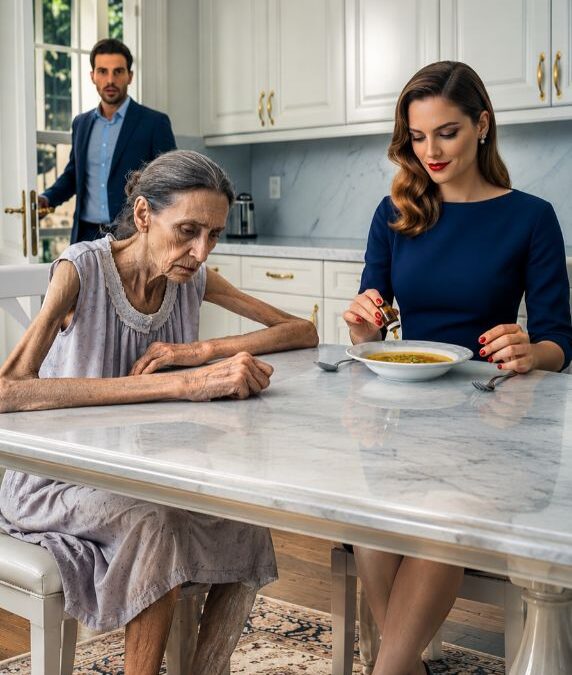
This is how the days felt for Doña Teresa Arriaga, mother of Mauricio, the beloved businessman from Coyoacán, in Mexico City. Every morning, standing in front of the old mirror in the hallway, she saw a little less of herself.
The dresses that used to fit her snugly now danced loosely on her body. Her skin, which used to have the glow of Sundays with mass and sweet bread, had turned pale, like the marble in the kitchen where she spent most of her time alone.
Mauricio said that his mother was tired, things of old age, and Jimena, his wife, confirmed it with that tone that calmed and pricked at the same time. “She’s fragile, love. I make sure he eats well.”
“You’ll take care of it,” Mauricio repeated, relieved, without noticing the poison hidden in the word.
What Jimena called caring was actually controlling. In that old house with high walls, wooden beams, and a cold floor, time seemed to run slower.
The kitchen clock, hanging above a tile painted with flowers, ticked away the hours with exaggerated patience. The sound of the spoon hitting the plate sounded like a lament.
Doña Teresa sat down at the table, her trembling hands resting on her cane. Lupita, the long-time employee, watched her with caring and praying eyes. She had learned to look without speaking.
Jimena served the dish with a discreet smile, so discreet it was frightening. “Go on, Doña Teresa, it’s the same old thing, your light soup.”
“I’m not very hungry, my daughter.”
“The doctor said so,” Jimena replied. “It needs to be fed.”
No doctor had indicated anything, but Mauricio, blinded by love and haste, believed every word, and every spoonful from his mother was a bitter victory for Jimena.
The days became all the same. The house smelled of medicine, watery soup, and expensive perfume.
Lupita saw everything: the cups returning almost intact, Doña Teresa’s voice getting lower and lower, Jimena’s hairstyle still perfect, her smile still frozen.
The elderly woman hardly spoke anymore. Before, she used to talk to the plants in the yard, and she would laugh softly while listening to the radio with old bowling pins. Now silence had taken its place.
Silence and a confusion that made her dizzy. Sometimes Doña Teresa would ask, “Lupita, what day is it today?”
“Monday, ma’am, no more Mondays,” Lupita would reply, trying to keep her voice from breaking, because she had noticed things: juices with a strange taste, pills in switched boxes, details that would escape anyone, except someone who sees the same person disappear little by little every day.
When Mauricio arrived late from meetings, he would look at his mother dozing in the armchair and he found it endearing. “She’s resting, love. It’s so nice that you always take care of her,” Jimena said, pouring wine and glowing from within.
The love of a son and the wickedness of a wife coexisted under the same roof, like light and shadow on the same wall. In Doña Teresa’s room, a sepia portrait of her late husband, Don Agustín, stared directly at the bed.
She whispered to him, “I’m trying, old man. I’m trying to hold on.” But the body no longer obeyed.
Her steps felt short, her skin thin, her voice trembling, and her eyes began to lose their shine as if they were fading from within. Jimena, on the other hand, shone.
She organized dinners, greeted the neighbors of Coyoacán, and repeatedly said that she cared for her mother-in-law like a mother. Who would doubt a woman so elegant, so polite, so perfect in the kitchen?
The same one where years ago Doña Teresa prepared coffee and pancakes for neighbors. Now all that remained was a scent of loneliness. Between the clinking of the spoon and the distant murmur of Miguel Ángel de Quevedo Avenue, the question was born that the public did not yet know it needed to hear: What is a woman capable of doing to get what she wants when no one is watching?
The days went by as if nothing had changed, but Lupita could see. Discreet, with her apron always clean, she kept in her eyes a memory that no one could erase.
She saw her employer becoming more and more hunched over, her face thinner, her plate with less food, and Jimena, just as impeccable, just as sweet, too sweet.
“Lupita, don’t put so much salt in the soup. The doctor said it was dangerous at her age,” Jimena ordered.
“Yes, ma’am, and less meat. She has a sensitive liver.”
Lupita lowered her head. I knew that wasn’t care, it was control. And little by little that control became a prison.
Doña Teresa, who used to walk the house with a firm step, now barely moved forward with the help of a cane. The metal striking the mosaic made a sad echo, a reminder of what was being lost: strength, autonomy, voice.
Sometimes he would stand at the window overlooking the inner courtyard. The jacaranda tree, which always bloomed purple with the spring, was now dry.
And Doña Teresa whispered, “Are you tired too, my friend?”
Jimena entered, interrupting his thoughts. “Did you take your medicine, Doña Teresa?”
“Yes.”
“From which box?”
“The one that was on the table.”
“Oh no, not that one. I arranged them. Better leave it to me. I organize everything.”
With one gesture he took the glass and the pills. She smiled and disappeared down the hallway. Lupita watched from the doorway, unable to do anything.
I saw Doña Teresa confused, lost in thought, forgetting the hours, the names. Who would believe her? Who would dare question the boss’s wife?
The days continued the same, as if time had stopped in the Arriaga house. The dining room clock ticked each minute with a heavy tick, as if counting the spoonfuls of a slow agony.
Doña Teresa no longer went out to the patio. His walking stick was his only companion, and each step echoed in the mosaic with a sound that blended with the distant song of the birds.
Jimena said she shouldn’t get tired, that the midday sun could be bad for her, but Lupita knew that being cooped up hurt more than any ray of sunshine.
“Ma’am, why don’t we go out to the patio for a little while?” he suggested one morning, opening the curtains.
“Oh, Lupita, I’m afraid I’ll fall.”
“I’ll just give her a little air.”
“No, my daughter, if Jimena Centera gets angry.”

That phrase was new. If Jimena finds out. Before, Doña Teresa was in charge of everything; now she had to ask permission even to breathe.
Lupita pretended to obey, but her gaze grew increasingly distrustful. I had noticed that Jimena controlled every bottle, every pill, every meal.
Even the doctors, the one we’d had for ages, Dr. Ruiz, no longer showed up at the house. Jimena said he charged too much, that she had found a better one, but nobody knew him.
That night, Lupita went upstairs to leave the tray with the chamomile tea. The door was ajar.
Doña Teresa murmured in her sleep, “I don’t want to sleep, I don’t want to sleep.”
Lupita approached slowly. On the desk there were two glasses, one with clear water, the other with a whitish tint.
Lupita’s stomach tightened. He picked up the glass, smelled it, didn’t know what it was, but something about the smell sent a shiver down his spine.
He put it back in its place just as he heard footsteps in the hallway. Jimena appeared in her wine-colored silk robe holding a book.
“What are you doing here, Lupita?”
“I brought the tea, ma’am.”
“Leave it there. I’ll take care of it.”
The voice was soft, but full of the kind of authority that isn’t shouted. It is necessary. Lupita went downstairs in silence, her heart pounding in her chest.
The next morning, Doña Teresa could barely get up. His eyes were sunken and his hands were cold.
Jimena served breakfast while humming a song. “How did my mother-in-law sleep this morning?” she asked with practiced sweetness, feeling a little dizzy. “It must be the pressure. I’ll give him his pill.”
From the kitchen, Lupita saw her open the medicine drawer and take out a small, unlabeled bottle. Jimena took a glass of juice and, with her body covering her eyes, poured two drops.
Then he stirred with the silver spoon, all in silence. “Here you go, ma’am, slowly.”
Doña Teresa took a sip and wrinkled her face. “It’s bitter.”
“It’s because of the pill, love,” Jimena smiled. “The doctor said it helps with rest.”
Lupita clutched the rag in her hands. Every fiber of her body wanted to scream, but fear weighed more.
Hours later, Mauricio arrived home from work. She carried a bouquet of flowers and had a noble weariness in her eyes.
“How is my queen?” he asked, kissing his mother’s forehead.
“Well, son, just tired.”
“You look thin, huh?”
Jimena intervened before she could answer, “It’s just that she doesn’t eat well, but I take care of her, don’t worry.”
Mauricio smiled confidently and hugged his wife. Lupita watched them from the doorway with barely contained anger. Love can also be a blindfold.
That night the silence was longer. Lupita couldn’t sleep.
From his room he could hear the ticking of the clock mixed with a faint sound, the scraping of a spoon against a glass. He got up, opened the door just a few centimeters, and saw Jimena walk down the hall, barefoot with a bottle in her hand.
The glow from the refrigerator light illuminated her face. Calm, precision, coldness. Lupita held her breath.
Jimena placed the glass on Doña Teresa’s tray and left the room without looking back. When the silence returned, Lupita entered.
The old woman was sleeping, breathing with difficulty. The glass was still warm on the table.
Two drops floated on the surface forming a strange pattern, like a small whirlpool. Lupita remained motionless, looking at what he could not understand, but which he already sensed.
Someone was killing Doña Teresa little by little. At dawn, the whole house smelled of coffee brewed in a pot and lies.
Jimena, impeccable as always, greeted her husband with a kiss. “Have a good day, love.”
“Thanks, my darling. I’m leaving my mom in your care.”
“I always take care of her,” he answered, glancing sideways at Lupita.
And as the gate closed, the maid silently vowed that she would not allow the old woman to go out without a fight. She didn’t know how or when, but something inside her had just awakened.
The weeks passed with a deceptive calm. From the outside, the Arriaga house looked like a perfect home.
White facade, bougainvillea on the railing, a wooden gate always clean, but inside the air had become heavy, so heavy that even the curtains seemed tired of moving.
Doña Teresa ate less and less. Sometimes he would take two spoonfuls of soup and leave the plate full. Others didn’t even sit down.
“I’m not hungry, Lupita,” he whispered. “Everything tastes weird to me, weird like an old lady, like metal.”
Lupita swallowed. She had also noticed the sour smell coming from the glasses, the cloudy color of the water, but she had no proof, only intuitions, and the fear of losing her job was growing louder.
One afternoon, while sweeping the hallway, she heard Jimena’s voice talking on the phone. “Yes, yes, the will remains the same, but if she gets worse, everything will pass to Mauricio’s name and you know that’s also in my best interest.”
Silence, laughter. “Oh, don’t exaggerate. Nobody suspects anything.”
Lupita stood still, her heart pounding. I knew I shouldn’t listen, but it was too late. That phrase stuck in his head like a thorn.
Nobody suspects anything. That night she went down to the kitchen to get a glass of water. The clock was almost 12.
From the window he saw Jimena in the courtyard under the yellowish light of the lamppost. He had a bottle in his hand.
He uncorked it, poured some into a glass, and stirred it. Slowly, Lupita hid behind the curtain, watching breathlessly.
Jimena climbed the stairs with soft steps, leaving behind a silence that smelled of death. The next morning, Doña Teresa did not get up.
“Her blood pressure went up,” Jimena explained. “I already called the doctor.”
But no doctor arrived, just a messenger with a bag of new medications prescribed by the specialist, without a prescription, without a signature. Lupita discreetly took them when Jimena left.
He read the labels. They were calming, strong, not suitable for elderly people. His blood ran cold.
When Mauricio returned, she tried to say something to him. “Mr. Mauricio, may I speak with you?”
“Sure, Lupita, is something wrong?”
“It’s about his mom.”
“What’s wrong with it?”
“I believe those remedies…”
Jimena walked in right then with an icy smile. “What remedies, Lupita?”
“Nothing, ma’am.”
“I’m just worried, love,” Jimena interrupted, stroking her husband’s arm. “But I already explained to the doctor that sometimes she mixes up the doses.”
Mauricio smiled confidently and changed the subject. Lupita lowered her head, but something was boiling inside her.
That night, Doña Teresa woke with a start. “Lupita here,” she called in a faint voice. “Everything hurts, and I feel like I’m floating.”
“Do you want me to call the doctor?”
“No,” she murmured, her eyes half-open. “Just don’t leave me alone.”
Lupita hugged her, feeling her body light, almost weightless, and in that moment she understood. It wasn’t illness; it was poison.
The next morning, the tension was palpable. Jimena was making coffee, whistling as if nothing were amiss.
“The lady isn’t coming down today, is she?” Lupita asked.
“No, she’s weak.”
“Can I bring you breakfast?”
“No need.”
“I’ll do it.”
Lupita pretended to feel something, but she waited. When Jimena brought up the tray, she followed slowly, barefoot, without making a sound.
From the half-open door, she saw what she needed to see. Jimena uncapped the bottle, poured three drops into the juice, and stirred it with the silver spoon.
Then she straightened the tablecloth and smiled at her reflection in the mirror like someone getting ready for a performance. Lupita backed away, stifling a scream.
She ran downstairs to the kitchen and collapsed into a chair. Her heart pounded in her chest like a drum.
She needed proof. If she said anything without showing it, no one would believe her. If she remained silent, Doña Teresa would die.
That afternoon, when Jimena left for the beauty salon, Lupita went up to the mistress’s room. On the table, the clear bottle was still warm.
It had a sweet, artificial scent. Lupita found the old cell phone she kept in her apron and took a picture. Just that.
A blurry image, but enough to begin with. Then she straightened the blankets and gave Doña Teresa some water.
Clean up. Hang in there, old lady. I’m going to do something.
The old woman looked at her with glassy eyes. “Don’t get into trouble, my child.”
“If I don’t get involved, she’ll die,” Lupita replied with a lump in her throat.
That night, for the first time, she didn’t pray to sleep, she prayed to wake up alive the next day. The following week began with a thunderstorm over Coyoacán.
The gray sky was reflected in the old windows and the sound of the rain seemed to mark the pulse of the house. Doña Teresa was still weak, but something in her gaze had changed.
Now she looked at Jimena with fear and with a kind of lucidity that was frightening. “I don’t want that soup,” she said one night, pushing the plate away.
“Oh, old lady, why, if I made it myself?”
“I don’t trust you.”
Jimena let out a soft laugh. “She’s delirious. Age makes her say nasty things.”
But Lupita heard from the kitchen and her skin prickled. She knew that Doña Teresa had already understood everything.
The next day, Mauricio rushed downstairs with the phone in her hand. “Love, the engineer changed the meeting. I’ll be back late.”
“Don’t worry,” Jimena replied, kissing him. “I’ll take care of your mother.”
“Thank you, my love. I don’t know what I’d do without you.”
And it was precisely that phrase, so often repeated, that made Lupita shudder. “I don’t know what I’d do without you, because if he only knew what I did when I wasn’t there.”
During the afternoon, the rain stopped. The smell of wet earth drifted in through the open windows.
Lupita was washing the dishes when she heard a sharp knock upstairs. She ran upstairs, her heart in her throat.
Doña Teresa’s bedroom door was locked from the outside. Doñita knocked. Silence.
“Doña Teresa, can you hear me?”
A weak moan answered. “Lupita, I’m thirsty.”
Lupita pushed on the door. It wouldn’t budge. She looked for the spare key, but the drawer where it was always kept was empty.
Then she understood. Jimena had taken it. Desperate, she pounded on the wood. “Doña Teresa, please don’t fall asleep.”
The voice on the other side was barely a whisper. “The water… Bitter.”
Lupita ran to the kitchen, grabbed a knife, and went back upstairs. She jammed the tip between the frame and the lock and pushed with all her might.
With a creak, the door clicked shut. Inside, Doña Teresa lay on the floor, pale, her glass overturned.
Lupita knelt down and held her in her arms. “It’s okay, ma’am, it’s over now.”
She replaced the glass and whispered, “Shh, don’t talk, I’m going to take care of you.”
When Jimena returned, the scene hit her like a slap in the face. “What happened here?” she asked, feigning surprise.
“The lady fell,” Lupita replied defiantly.
“Oh my God, poor thing, did you give her her medicine?”
“No, ma’am, I didn’t give her anything.”
Their eyes met, and although neither said anything, there was no going back. That night, Doña Teresa slept with a slow heartbeat.
Lupita stayed by her side, watching over her as if she were watching over her own mother. She clutched her cell phone in her hands.
The photo of the bottle was still there, but she needed more. She needed to see her in action.
The next day dawned sunny, but the atmosphere in the house remained just as gloomy. Mauricio left early, and Jimena calmly began tidying the kitchen as usual.
Lupita pretended to clean the living room, but left her cell phone on the shelf, discreetly pointed toward the table. Her heart was pounding so hard she could hear it.
At 11:30, Jimena came in, opened the drawer, took out the bottle, poured two drops into a glass, and mixed it with a small spoon. All recorded, all clear.
Lupita held her breath until the woman left the room, then rushed to review the video. There it was, the evidence, the exact moment Jimena poisoned the water.
She didn’t know whether to laugh or cry. Fear mingled with euphoria. Finally, she had proof.
That afternoon, she waited for Mauricio to arrive. When she saw him come in with his briefcase over his shoulder, she approached him nervously.
“Mr. Mauricio, I need you to see something.”
“What’s wrong, Lupita?”
“Please, look at it first.” Then he asks me if I’m crazy.
She showed him her cell phone. For the first few seconds, he frowned, confused. Then, when he saw his wife pouring the liquid into the glass, his expression vanished.
“No, it can’t be.”
“I saw him many times, sir, but I was only able to record him now.”
“What is that? What are you giving my mother?”
“I don’t know, but it’s killing her little by little.”
Mauricio was speechless. He gripped the cell phone tightly, his eyes shining with a mixture of anger and guilt.
“No one must know yet,” he finally said. “Let me handle it my way.”
“But, sir, please…”
“Lupita, I beg you.”
She nodded. As she watched him go upstairs, she understood that something big was about to happen. That night the house was never the same.
For the first time, the truth was breathing inside. That night, Mauricio ate dinner in silence.
The storm had passed, but the noise inside his head was louder than any thunder. Jimena served the soup, just like always, and asked in her honeyed tone, “Is everything okay?”
“Good, love?”
“Yes,” he answered without looking at her.
“And your mother is resting.”
“That’s good, poor thing. She’s suffered so much.”
Her words sounded gentle, but each one was a pinprick to his conscience. Mauricio could no longer see her the same way.
Every gesture, every smile seemed like a mask. While she spoke of love, he could only remember the video, the glint of the bottle, the two drops falling slowly, the movement of the spoon, the image of the cruelest deception.
Lupita, from the kitchen, kept looking at the clock. Every passing minute was an eternity.
She knew Mauricio had seen the video, but she didn’t know what he would do about it. She feared that doubt would paralyze him.
Because love, she thought, when it is blind, can also be complicit. The next morning, the sun streamed through the curtains of Doña Teresa’s room.
She opened her eyes with effort. For the first time in a long time, she didn’t feel dizzy.
Mauricio was sitting beside her with a cup of coffee in his hand. “Son, didn’t you go to work?”
“No. Today, Mom, I want to take care of you.”
Taking care of me. How strange. You used to say I exaggerated.
“Not anymore, Mom. Now I know you were right.”
Doña Teresa looked at him, confused, and then smiled, a glimmer of relief in her eyes. It was as if her soul were slowly returning to her body.
Downstairs, Jimena was on the phone, oblivious to everything. “Yes, everything was under control. No, Mauricio didn’t suspect a thing.”
Until she heard footsteps coming down the stairs, she hung up immediately, forcing a smile. “Honey, I made you breakfast.”
“I’m not hungry,” he said firmly.
His tone disconcerted her. He never spoke to her like that. She tried to approach him, but he took a step back.
The silence that followed was more eloquent than any shout. Jimena watched him nervously. “Is something wrong?”
“No, are you sure?”
“Very safe.”
She turned around and left the kitchen. Jimena was paralyzed. For the first time, I was not in control.
The tension was unbearable all day long. Lupita cleaned without making a sound, but with her ears open.
Doña Teresa slept peacefully, without her usual tremors. Mauricio remained in his second-floor office, looking at his cell phone over and over again, doubting whether he should act or wait for the exact moment.
He knew that an accusation without additional evidence could backfire on him. She also knew that every minute of waiting could be her mother’s last.
At nightfall, he went down determined. Jimena was waiting for him in the living room, wearing an elegant dress and holding a glass of wine.
“Are you going to stay silent all day?” she asked in a sweet voice, but with tense eyes.
“I’m thinking,” he said.
“In what?”
“In everything I didn’t see.”
She frowned. “Don’t start with your drama, Mauricio. It’s not a big deal.”
“Jimena, it’s true.”
There was silence. The clock struck 8. Jimena took a deep breath. “I don’t know what you’re talking about.”
“I do.”
“About what?”
“From my mother.”
She feigned surprise. “What’s wrong with your mother?”
“You know it.”
Jimena smiled. A second later, that smile turned into a laugh. “You’re going to repeat the maid’s nonsense again.”
Mauricio didn’t answer, he took his cell phone out of his pocket and put it on the table. The video started playing on its own.
The sound of the falling liquid broke the silence. Two drops, a spoon, Jimena’s face clear, unmistakable.
She paled. “That doesn’t prove anything,” she said nervously.
“Try everything,” he replied.
“It’s manipulation. That woman hates me.”
“Is he afraid of you?”
“No, Jimena.”
“Fear?”
“Yes, you.”
The air became thick. Lupita listened from the hallway, clutching the rag in her hands. I knew that was the beginning of the end.
Mauricio took a breath. “I don’t believe you anymore.”
“Mauricio, please.”
“No, this time you’re going to listen to me.”
The woman took a step back. He held the empty jar he had found on the counter and placed it in front of her. “What did you give him? Was it medicine?”
“Medicine for whom?”
“To put her to sleep or to kill her?”
“Don’t talk nonsense,” he shouted, but his voice no longer sounded confident.
At that moment, Doña Teresa slowly descended the stairs. Her body was still weak, but her eyes were firm.
“Don’t argue for me,” she said, her voice trembling.
Jimena turned around. “Doña Teresa, you shouldn’t get up.”
“I shouldn’t have, but I did.”
Mauricio ran to help her, but she raised a hand. “I’m tired of being silent.”
Jimena clenched her fists. Doña Teresa looked directly at her. “You thought that poison only kills the body, but it also kills the soul.”
“He’s delirious!” Jimena shouted.
“No, I’m remembering.”
The silence was absolute. Only the distant noise of the street broke the tension.
Before we continue, I want to ask you something important. Have you ever experienced something similar? Have you ever felt that someone close to you was manipulating you or making you doubt what you saw?
Or do you know someone who went through something like that? Tell me below, I read all the comments, and also tell me where you’re listening from. I love knowing how far our stories reach.
Take this opportunity to subscribe to the channel, leave a like, and share this video. That helps my work a lot and allows more people to see stories like this. I thank you from the bottom of my heart. Now let’s continue.
Doña Teresa slowly advanced to the table. The trembling of her hands was visible, but her gaze was firm and determined.
Mauricio helped her sit down. Jimena watched the scene with her lips pressed tightly together, as if she still believed she could control the situation.
“You don’t know what you’re saying,” he insisted in a strained voice. “You’re confused, Teresa, confused.”
“I’ve been here a long time,” the old woman replied without looking away. “Ever since you came into this house.”
Jimena’s face changed color. She tried to laugh, but the laughter broke. “Please, stop.”
“No,” said Doña Teresa, “enough with the lies. I know what you’re doing. I felt it every time you gave me that soup that tasted like metal, every time my hands wouldn’t obey me and my head spun for no reason.”
Mauricio closed his eyes, hurt, as if each word were stabbing him with a knife. Jimena desperately sought his gaze.
“Don’t believe her, she’s sick, she doesn’t know what she’s saying.”
But he wasn’t looking at her, only at the jar on the table, the same jar she had sworn she didn’t know. “There’s nothing more to explain,” he said in a low but firm voice.
Jimena took a deep breath. “If you do this, Mauricio, you’re going to destroy your life.”
“You already destroyed mine.”
The silence was long. You could hear dogs barking in the distance, the noise of a passing car, the wind moving the curtains, nothing else. Only the weight of fear.
Suddenly, Jimena took a step forward. Her eyes, which had previously feigned sweetness, now shone with fury.
“Is this how you repay me for everything I did for you?”
“For me?” he repeated incredulously. “You did it for the money.”
“That’s a lie, I loved you.”
“No, you loved power.”
She clenched her teeth. “You don’t know what it’s like to live with nothing. I learned to survive, and if marrying you was the only way to have a decent life, I did it. At my mother’s expense; she was already old. Sooner or later, she was going to die.”
“लेकिन हमारी वजह से नहीं?” Mauricio’s shout echoed off the walls.
Doña Teresa trembled, but didn’t move. Jimena looked at him, surprised by the rage she had never seen in him before.
“Do you know what the worst part is?” Mauricio continued. “That I was fooled too. I thought love could change you, but love doesn’t cure the poison.”
Jimena smiled sarcastically. “The poison is in everyone; some just hide it better.”
Lupita, in the hallway, felt her heart racing. She knew something was going to happen. She felt the urge to do something, but fear paralyzed her.
Jimena looked at the bottle and took it with a trembling hand. “Do you want to know what it feels like?” she said, bringing it to her lips. “That’s what you’ll show you.”
Mauricio reacted immediately. “Don’t…”
“What are you doing?”
He snatched the bottle from him with a swift movement, throwing it to the floor. The glass shattered into a thousand pieces.
The liquid trickled onto the tiles. The bitter smell filled the air. Doña Teresa closed her eyes and murmured a prayer.
Lupita ran to the kitchen, trembling. Jimena fell to her knees, sobbing.
“I just wanted you to see me,” she said through tears.
“I saw you too late,” he replied.
The woman looked up. In her eyes, there was something that was no longer love or fear, but pure hatred.
“I’m not going to lose everything,” Jimena whispered. “No.”
She took a step forward, but her foot slipped on the spilled liquid on the floor. The knife fell from her hand, and she fell with it.
A thud, a scream. Silence. Lupita ran inside.
Mauricio knelt, trying to catch her. The blade hadn’t cut her, but the fall had knocked her unconscious.
The ambulance arrived minutes later. The paramedics carried her out on a stretcher, their eyes vacant.
Doña Teresa watched from the doorway, wordless. “Is she alive?” Lupita asked.
“Yes,” Mauricio replied emotionlessly, “but her soul has been dead for a long time.”
Doña Teresa placed a hand on her son’s shoulder. “Son, evil never wins, it just takes time to fall.”
He hugged her tightly, fighting back tears. For the first time this time he didn’t feel guilt, he felt relief.
The sound of the ambulance faded away, leaving behind a different silence, a silence of rest, not of fear. That night the house felt empty.
The echo of the paramedics’ footsteps still lingered in the air, mixed with the smell of disinfectant and the fear that would take time to dissipate.
Mauricio stood by the door, watching the ambulance lights disappear down the cobblestone street. The sound of the siren grew fainter and fainter until silence once again filled everything.
Lupita closed the door carefully and lowered her head. “Thank God they took her away.”
Doña Teresa, sitting in the armchair, nodded slowly. “Sometimes, daughter, God takes his time, but He always arrives.”
Her words were gentle, but they carried the weight of someone who had survived hell. Mauricio couldn’t stop trembling.
“I loved her, Mom.”
“No, son,” she replied firmly. “You loved the idea of someone loving you.”
“But what if I had helped her? What if I had seen it sooner?”
“You can’t heal what doesn’t want to be healed.”
The young man lowered her head. Lupita approached and placed a hand on his shoulder.
“You did what you had to do, sir.”
“But what if it all ends badly?” he asked, his voice breaking.
“Sometimes, for something to be reborn, it first has to break.”
Doña Teresa closed her eyes. Finally, her soul felt a kind of calm.
It wasn’t happiness yet, it was relief. The kind of relief you feel when you go outside after a very long lockdown.
The next day, the sun came in through the windows, warm and calm. The air smelled of freshly baked bread.
Lupita had baked early, just like before. Doña Teresa descended slowly without the flare.
“And that courage?” Lupita asked, smiling.
“If I survived her, I can survive the stairs,” the lady replied with a mischievous glint in her eyes.
Mauricio appeared shortly afterwards with a tired face. “I went to the hospital and asked, Doña Teresa. Jimena is under observation. Doctors say he is not in danger.”
“The body heals easily, son. The soul, no.”
“I know.”
Silence returned. But it didn’t weigh anything anymore. It was a necessary silence, like the one that precedes a prayer.
During the following weeks, the house changed its atmosphere. The windows remained open. The smell of bitter soups had disappeared.
Lupita would put on old music while she cleaned, and Doña Teresa would accompany her by humming along. In the afternoons, Mauricio would sit on the terrace with a blank notebook trying to write something, anything to get out what he felt.
One afternoon the doorbell rang. It was Inspector Ramirez.
“Good afternoon, Mr. Larios. Official pass. I am here to inform you that the case is still under investigation. Your wife, well, Mrs. Jimena, will be transferred to a psychiatric center while the judge determines whether she can be tried.”
Mauricio nodded. “He said something, just one sentence.”
“Which?”
“I didn’t want to kill her, I just wanted her to see me.”
The silence that followed was long. Doña Teresa pressed her lips together like someone praying in silence.
“The devil always starts by asking for love,” he whispered, “and ends up taking everything away from you.”
The inspector looked down uncomfortably. “I’m so sorry, ma’am. You should be grateful the truth came out before it was too late.”
The man nodded and withdrew, leaving behind the scent of paper and justice. That night Mauricio couldn’t sleep.
He got up, went down to the kitchen and turned on the light. The clock read 3 a.m.
The empty space where the jar used to be was still on the table. He stared at it for a long time, imagining what might have happened if Lupita hadn’t recorded that video. He felt a chill.
Doña Teresa appeared at the door. “Another night without sleep.”
“Can’t.”
“Insomnia is what remains when consciousness awakens,” she said, smiling. “लेकिन यह गुजर जाता है, बेटा, सब कुछ गुजर जाता है।”
Mauricio sat down next to her. “And how do you forgive something like that, Mom?”
“With time and with truth.”
“I don’t know if I can.”
“You don’t have to do it all at once. Just don’t let hate accompany you to sleep.”
He nodded, taking a deep breath. Doña Teresa stroked his face. “Do you know what I think sometimes?” she asked.
“What?”
“That God doesn’t punish with fire or stone, He punishes with a mirror.”
Mauricio frowned. “A mirror?”
“Yes. Sooner or later, we all end up seeing what we are. And she had already seen herself that night.”
They both stayed awake a while longer in silence. The wind moved the curtains, and for the first time in months, it wasn’t frightening.
It was just wind. Wind that came and went like life itself. At dawn, Mauricio opened the windows.
The sky was clear. The jacaranda trees were beginning to bloom.
The air smelled clean, and although the pain was still there, something inside him had changed. It wasn’t the end yet, but it was no longer darkness.
The days began to pass with a calm that almost seemed unreal. After so many weeks of tension, fear, and silence, the house finally breathed.
Doña Teresa walked through the hallways unhurriedly, as if she wanted to relearn every corner of her own home. Lupita, always discreet, opened the windows early to let in the sun.
The air smelled of bread, flowers, and coffee. And amidst all that, something very simple, yet very powerful, was being reborn: peace.
Mauricio spent his mornings with his mother on the terrace. She knitted while he read the newspaper or simply watched her.
Sometimes they didn’t speak; there was no need. The silence, now, no longer hurt, it healed.
One afternoon, Doña Teresa set her knitting aside and looked at him. “You know, son,” she said, “sometimes I think the soul ages because of sadness, not because of years.”
Mauricio smiled. “So you’ve grown younger.”
“No, son,” he replied, “I just learned to breathe again.”
Lupita appeared in the doorway, her hands still damp from the soap. “I left you some freshly brewed coffee if you’d like some.”
“Thank you, daughter,” Doña Teresa said.
“Thank you, Lupita,” Mauricio added. “I don’t know what would have become of us without you.”
The woman lowered her head shyly. “I only did what I felt I had to do.”
“And that,” Doña Teresa replied, “is what separates the brave from the cowardly.”
There was a brief but meaningful silence. Outside, the sky was beginning to cloud over.
A light breeze stirred the curtains, and the aroma of coffee filled the room. Doña Teresa gazed at the mountains and sighed.
“The weather changes, but the heart takes longer.”
That night, while everyone slept, Mauricio went to his father’s study. The place was just as it always was: the desk lamp, the books arranged by color, the family portrait hanging on the wall.
He turned on the dim light and sat down at the desk. He took a blank sheet of paper and wrote slowly, “Dear Dad, now I understand what you wanted to teach me.”
The words began to flow on their own. It was a letter without a postal address, but with a purpose.
He wasn’t looking for a reply; he was looking for forgiveness. When he finished, he carefully folded the paper and put it in the drawer.
As he closed it, he noticed something he had never seen before: a small, rusty key, taped to the bottom of the drawer. He picked it up curiously and looked around.
He soon discovered the matching lock. A small box. The wooden cabinet was stored on the highest shelf.
He carefully took it down and opened it. Inside were old photographs, a rosary, and a letter addressed to his mother, written by his father shortly before he died.
He read it slowly, feeling each word like an echo of the past. “Teresa, if one day the house goes dark, seek faith. It is the only light that depends on no one.”
Mauricio clutched the letter in his hands and for the first time understood that his father had never truly left. Doña Teresa, without knowing it, had kept that faith alive with every breath, with every silent prayer before the window.
The son smiled. He had found his own answer. The next day, the sky dawned clear.
The smell of damp earth filled the air. Doña Teresa was in the kitchen, humming an old song as she baked bread.
Mauricio watched her from the doorway without saying a word. It was a simple moment, but it contained everything: love, loss, reunion.
“What are you looking at, son?” she asked, laughing.
“At you, Mom.”
“And what do you see?”
“The strongest woman I know.”
“Don’t exaggerate, Mauricio.”
“I’m not exaggerating. I saw you fall and I saw you get up. Not just anyone can do that.”
Doña Teresa smiled, tears welling in her eyes. “I wasn’t strong, son. I was guided.”
“By whom?”
“By faith and by the love I still have left.”
Lupita came in with a tray of cups. “Can I join you?”
“Of course, daughter,” Doña Teresa replied.
The three of them sat down. The sun shone through the window, casting soft shadows on the table. For a moment, time seemed to stand still.
Doña Teresa raised her cup and said, looking at both of them, “Let’s make a toast, even if it’s with coffee.”
“Why are we toasting?” Mauricio asked.
“For the truth,” she replied, “because sooner or later it always comes out.”
The cups clinked together and the sound of the glass mingled with a genuine laugh, the first in a long time. A laugh that somehow sealed the end of fear and the beginning of a new life.
That afternoon, as the sun began to set, Mauricio went out into the garden. The bougainvillea, which had been dry before, now had flowers.
He touched them with his fingertips, surprised. “Even the plants breathe differently,” he murmured.
Doña Teresa appeared behind him, leaning against the door frame. “Everything that lives responds to the light, son. Even us.”
He smiled without turning around. “So, I guess it was time to open the windows.”
“Yes,” she said, “it was about time.”
Night fell softly over the San Ángel neighborhood. The warm lights of the neighboring houses were reflected in the windows and the distant sound of a street guitar arrived like a sigh through the trees.
Inside the Larios house, everything was calm. The smell of freshly baked bread still floated in the air, mixed with the faint fragrance of the jasmine that Doña Teresa had placed in a vase on the table.
Mauricio entered the room and found his mother sitting on the sofa, wrapped in a blanket. Lupita sewed silently near the window.
The scene was simple, but it contained a new beauty, that of the everyday when it no longer hurts. “Do you know what I think sometimes, son?” said Doña Teresa without lifting her gaze from the embroidery she held in her hands.
“What, Mom?”
“That some deaths don’t come all at once. They arrive little by little, like spoonfuls of sadness.”
Mauricio remained silent. She raised her eyes and added with a serene smile, “Pero también hay vidas que regresan de la misma manera, poco a poco, con fe y con amor.”
He approached and took her hand. “You came back, Mom.”
“No, son, I never left, I just disappeared for a while.”
Mauricio smiled, holding back tears. “Know? I learned more from this pain than in my entire life.”
“Pain teaches what comfort hides,” she replied, looking at him tenderly.
Lupita stopped sewing and joined the conversation. “Doña Teresa, do you believe that bad people change?”
“I don’t know, daughter, but I know that God doesn’t forget anyone. Nor from those who do harm, especially from them, because the one who does harm also lives in darkness and darkness always seeks a spark.”
There was a brief, almost sacred silence. Doña Teresa sighed like someone handing something to the air.
“Human justice punishes, but divine justice transforms.”
Mauricio lowered his head. “So, you forgave her?”
She thought about it for a moment. “Not yet, but I don’t hate her anymore. And that’s not the same thing.”
“No, son. Forgiving is not forgetting, it’s letting go of what doesn’t belong to you.”
Lupita smiled. “That’s beautiful, Doña Teresa.”
“It’s not mine, it belongs to life.”
The woman slowly got up and walked to the window. The garden was illuminated by the moon. The flowers, once withered, seemed to shine.
Doña Teresa closed her eyes for a moment and murmured a prayer. “Thank you, Lord, because in the end the light always comes.”
Mauricio watched her without saying anything. For the first time, he saw no fragility in her. He saw strength.
That silent strength that only women who survive pain without losing their tenderness possess. Minutes later the three of them sat down to dinner.
Bread, coffee, and a little fresh cheese, nothing more. But at that moment everything was enough.
Doña Teresa raised her cup. “Let’s toast again.”
“Why now, Mom?” Mauricio asked, laughing.
“For us, for those who stayed behind, and for those who learned to see with their souls.”
The cups clinked. The sound was faint, but it seemed to fill the entire house.
That night, Mauricio went up to his room and looked out the window. The wind moved the branches of the trees and the moon was reflected on the roof.
He took the letter he had written to his father out of his pocket, read it once more, and put it away in a drawer. I knew that somehow the cycle was closed.
He went back downstairs to the living room. Doña Teresa was sleeping on the sofa with her head resting on Lupita’s shoulder.
Mauricio covered them with the blanket and stood for a moment observing them. At that moment he understood that true wealth was not in big houses, nor in titles, nor in inheritances.
It was in the simple moments, the ones that cost nothing and heal everything. He turned off the lights and went out into the garden.
The air was fresh. He looked up at the sky and said softly, “Thank you, Dad. Thank you, Mom. I understand now.”
A gentle breeze stirred the leaves of the tree as if in response, and in that invisible gesture the soul of the house seemed to smile.
You Might Also Enjoy

Mom Installed a Camera To Discover Why Babysitters Keep Quitting But What She Broke Her Heart

She Gave a Hungry Little Girl a Free Birthday Cake — The Next Morning, a Black Rolls-Royce Arrived