“Step Back, This Is the President’s Detail” — The Agent Who Ordered the SAS Off the Perimeter
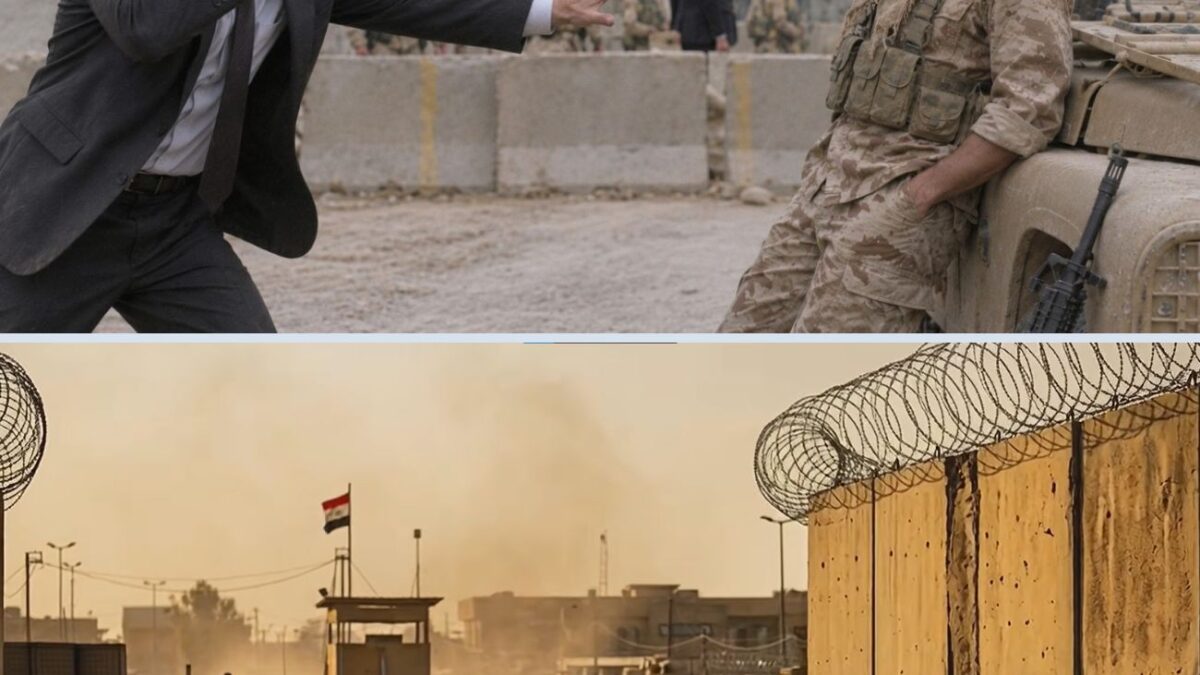
You are standing in dust up to your ankles. Your hand is up, your palm is out, and you are shouting at a man you should not be shouting at. Step back. This is the president’s detail.
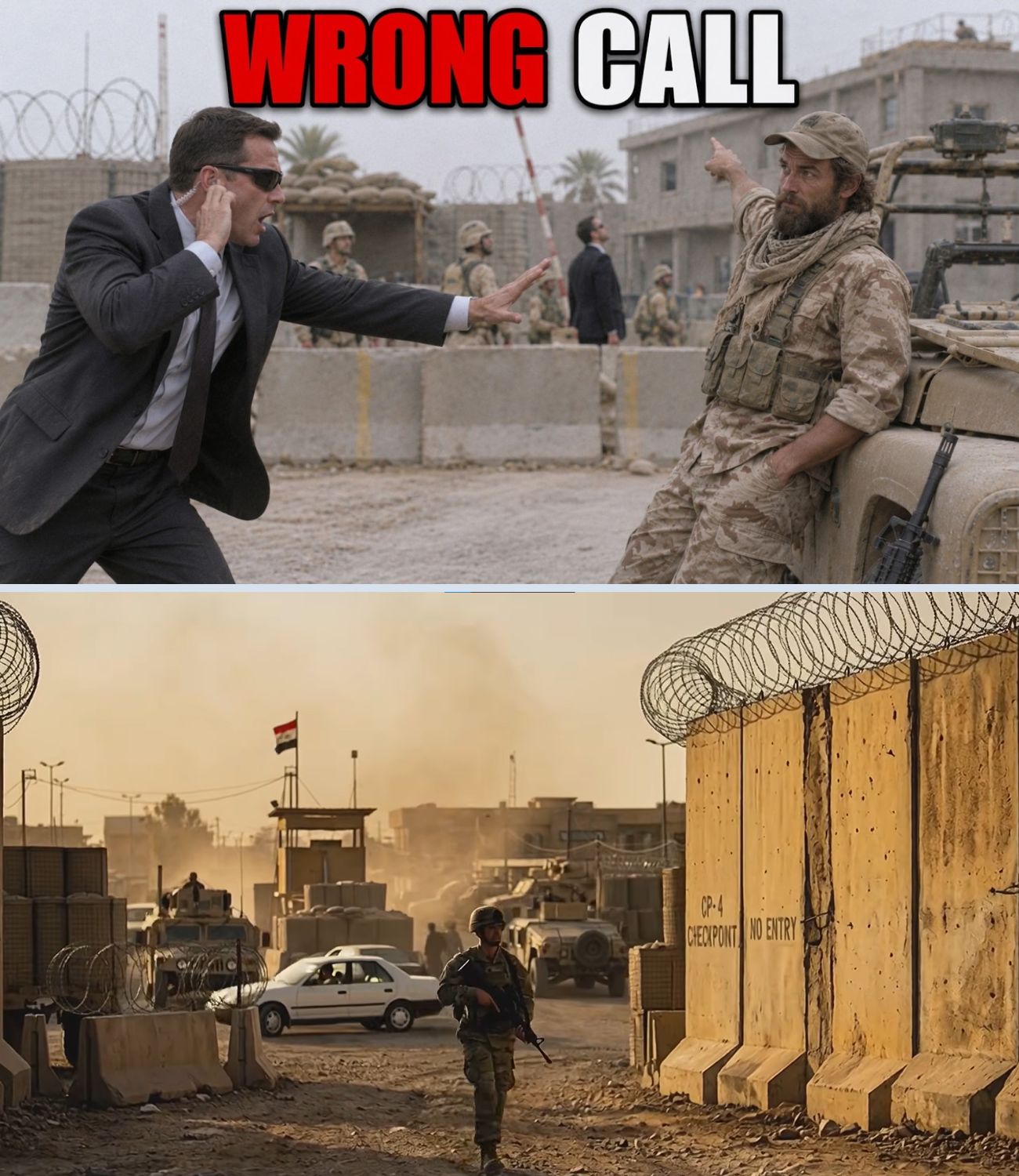
The ochre of a T wall stands to your left. Barbed wire stretched tight enough to hum in the afternoon wind. A tan Land Rover with its door still open and a carbine propped muzzle down against the wheel arch.
And the man in front of you in a desert smock and a tan cap, bearded, unhurried, pointing past your shoulder at a ridgeline 2 km out. The smell is diesel and heated canvas. The taste is grit on the tongue. The pressure behind your right ear is the coiled earpiece, hot where it touches skin.
Your raised hand is not a threat. It is the trained Secret Service hold, fingers together, palm flat, thumb tucked. The gesture you have drilled a thousand times in corridors in Washington and hotel lobbies in Paris and on an airstrip in Nairobi.
The British sergeant in front of you is not looking at the hand. He is looking at the ridge. The problem is that he is right and you are about to learn why. And the problem before that is that you have already given the order.
Who owns a perimeter when the man with the badge arrived 3 hours ago and the man with the rifle has been there a week. This is the afternoon Daniel Roark, 8 years on the service, 3 on the president’s own detail, will remember for the rest of his career.
Three weeks earlier, a gray Virginia morning at the James J. Rowley Training Center in Beltsville. The running track was still wet from overnight rain. Roark was 41 years old.
He was finishing a 6-mile run with a counter-assault team rotation and he was coming in third, which annoyed him. At 38, he had been first in. He knew the difference now was not his legs.
It was that the men ahead of him were eight years younger, and he was a man who measured himself in seconds and did not forgive the difference. His credentials were the kind of credentials you earned, not the kind you were given. Eight years on the service, before that the 75th Ranger Regiment, two tours in Iraq, one in Afghanistan.
Out as a staff sergeant in 2003 because his wife’s second pregnancy had been difficult, and he had wanted a job where the tours were 2 weeks in Luxembourg rather than 12 months in Mosul. He had come up through the uniformed division first, then plainclothes, then the hard practical gateway of counter-assault selection.
Weeks of live-fire motorcade drills, nights in the shoot houses at Beltsville running counter-sniper problems against each other on the model city until the muscles in his neck locked. He had cross-trained with the Hostage Rescue Team at Quantico, spent 4 weeks on an exchange with the French at Satory, and stood on the inner bubble for two sitting presidents.
He had a metric he was proud of. In 3 years on the Presidential Protective Division, he had never, by his own count, lost eyes on the protectee for longer than 4 seconds during a push. Four, he counted. He was the kind of man who counted.
He had worked, at one point or another, with every Tier 1 unit the United States had. Rangers, Delta on a courtesy tour, DEVGRU on a facility visit, Force Recon in Lejeune, the quieter elements that lived in and around the Air Force.
He had an opinion about foreign special forces that he was tactful enough never to say out loud, and the opinion was that they were very good at their jobs, and their jobs was not his job. His job was proximity. Their job was projection.
A man who hunted in a wadi for 6 days was a magnificent instrument, but he was not standing 6 feet from the most protected human being on Earth with a radio in his ear and a one-second decision window. That, in Ruark’s private grading, was a different trade, a harder one.
He carried in his own chest a quiet thesis about the work. The inner bubble was a discipline of authority. You owned the ground by stating that you owned it, and anyone who did not step back had already failed the test.
He had moved generals back. He had moved an ambassador’s security chief back. He had, once in a hallway in Prague, moved a man he later found out was the head of the host nation’s protective service back, and the man had nodded because the rule is the rule.
Over coffee in a glass-walled room at service headquarters on H Street, he was told he was on the advance for a presidential drop-in to a forward operating base in Al Anbar, 3 hours on the ground, troop handshake, photograph, back on the aircraft.
Outer cordon by coalition forces, specifically by a British Special Air Service patrol that had held the ground for the preceding week. He wrote the words outer cordon in his notebook and underlined them once, neatly, and did not think about it again until the aircraft landed.
The journey in was a C-17 drop into Al Asad and then a V-22 Osprey onwards to the smaller forward operating base on the western edge of Al Anbar province. Squat concrete walls painted the same color as the ground they sat on. Two tiers of wire-filled barriers.
A single Cold War era airstrip. A chow hall built out of a shipping container. A dust that got into the seals of a hard case within 20 minutes of being opened.
The afternoons were long and punctuated by the thump of distant mortars, the way the light at 4:00 went the color of weak tea. Inside the tactical operations center, a plywood room with a map stapled to the wall, Ruark took the advance brief from a US Army Lieutenant Colonel running the base.
The visit was not a classified secret in the room, but it was not yet on paper outside it. Three hours on the ground, 1200 local, a speech to the assembled task force in the hangar, a photograph with the senior non-commissioned officers, back out, standard.
The inner bubble was Roark’s. 12 agents pre-deployed, the counter-assault element on standby in a suburban convoy. The middle ring was the military police company already on base.
The outer ring, and this was where the Colonel paused and drank from his coffee cup before continuing. The outer ring was a British Special Air Service patrol running an observation post on a wadi rim 2 km northwest of the wire.
They had been there for 7 days because 3 weeks earlier the signals intelligence had picked up a specific man with a specific rifle moving in and out of three specific villages in a pattern the analysts did not like. The patrol was a mobility troop call sign operating out of a stripped and up-armored Land Rover Defender. The call sign was zero alpha.
The patrol commander was a staff sergeant named Pritchard. The Colonel said the name carefully because it was a name he had had to learn how to say. Roark listened. He asked the questions a professional asked, the handover line. Communications, rules of engagement for the outer ring. Who deconflicted if something happened on the wadi rim while the protectee was on the apron?
He got good answers. He wrote them in his notebook. And at the end of the brief, when the Colonel asked if he wanted to go out to the observation post and introduce himself, he said yes because that was the discipline. Eyes on every element.
He said it to the agent beside him, Viv Kowalski, in the suburban on the way out to the gate. She was 29, the only woman on the inner bubble, and she had worked a visit to a British carrier 2 years earlier. She knew every frequency on the base by heart within an hour of her boots touching the apron.
Roark was looking through the windscreen at the gray-brown wall of the wadi and the thin line of dust where a vehicle had recently moved along it. And he said flatly,
“I don’t care what tab they wear. This is a presidential perimeter. They step back or I move them back.”
Kowalski did not say what she was thinking. What she was thinking was that she had watched British special forces hand a problem over before. And the way they did it was specific, and Roark had not seen it yet. She said instead,
“Copy, boss.”
She keyed her radio. The Suburban slowed at the wire. A man in a tan cap and a desert smock stepped out from behind the lead Land Rover, raised one hand in the easy, unhurried wave of a man who had been watching them approach since they left the operations center.
And Roark, for the first time in his career, found himself opening a door onto ground that was not his. The heat hit him as a solid thing, not the Virginia heat he knew, but a dry mineral heat that sat on the skin without breaking it.
He was in a charcoal suit, a light blue shirt, a dark tie, and black Oxfords he had already regretted by the time his second foot was on the dirt. The earpiece coiled behind his right ear with the clear plastic tube running down into his collar.
He carried a SIG Sauer P229 in a strong side holster under his jacket and a laminated index card in his breast pocket with his daughter’s school timetable printed on it. He touched the card without thinking. He always did before every push.
The man in the tan cap was leaning against the near wing of the Land Rover with the patience of someone who had leaned against that wing for a week. Late 30s, muscular rather than lean, a dark brown beard neatly kept, a tan scarf wound loosely around his neck.
His plate carrier was tan, the pouches arranged in a pattern Roark’s eye, read as practical rather than parade. His carbine, an L119 in the standard patrol configuration out of the Diemaco line, suppressor attached, was propped muzzle down against the arch of the front wheel within easy reach. A Glock 17 rode in a drop holster on his right thigh.
He was not wearing a helmet. None of them were. That was the first thing Roark noted, and it was the first quiet wrong footing of the afternoon.
The military police at the gate were helmeted. The agents in the suburban were in soft caps and ballistic vests under their jackets. The patrol in front of him, four men visible, two more somewhere he could not see, were in tan ball caps and desert smocks, and were drinking tea from enamel mugs.
Pritchard, because this was Pritchard, straightened off the Land Rover without hurry and off put his hand.
“Ewan,” he said, not his rank, not his unit, not his full name, just the first name in a voice pitched low enough that Roark had to lean a half inch forward to catch it. “You’ll be Roark.”
“Special Agent Roark.” Roark said, because the full form was the discipline. “Secret Service. I’m running the inner bubble for the visit.”
“Right.” said Pritchard.
He fished a tin out of a pouch on his smock, opened it, and rolled a cigarette one-handed on the wing of the Land Rover. Thumb and forefinger working the paper, tongue to the edge, a flick of a cheap lighter, two long draws, and then he ground the lit end out against the metal, and tucked the half-smoked rest behind his ear. Roark watched this and filed it as a tick. Later he would understand it was a man keeping his scent profile low.
“Niles up top. Reese is on the set. We’ve got two more on the far side of the wadi.”
The man called Nial was Sergeant Holbrook, though Roark did not yet have the name. He was a thin figure on a rolled-out mat on top of the Land Rover’s roof, a pack as a bench rest, a long rifle on a bipod, a paper bag book with the cover torn off lying face down beside his left elbow. He did not look up when he was named. He lifted one gloved hand, two fingers, and lowered it.
Roark ran through his checklist. Handover line, communications, rules of engagement. Pritchard answered each in the same quiet voice, in sentences shorter than Roark’s questions.
On the handover line, Pritchard pointed, not with his whole arm, but with the knuckle of his right index finger, two short jabs at a line of white stones Roark had not noticed arranged across the dirt track, 30 m ahead of them.
“That,” Pritchard said, “your side, my side. If someone crosses it from your side, I know who they are. If someone crosses it from my side, I shot them before they got there.”
It was said without swagger. It was said the way a man tells you the time. Roark felt for the first time that he was not interviewing this man so much as being interviewed by him. He did not like the feeling. He pushed against it. He said flatly, because this was the moment he had been building towards since the operation center,
“I’ll need your patrol pulled back 100 m for the duration of the visit.”
Pritchard looked at him. He did not look at the ridgeline. He looked at Roark, and the first crack in Roark’s assumption began there, in the simple fact that the man in front of him did not react. Pritchard did not argue. He did something more disarming. He said,
“Walk the line with me first, then tell me where you want us.”
Roark almost refused. His checklist did not have a line item for walk the line, but the ask was reasonable, and refusing it in front of Kowalski, whose face at his shoulder was very carefully neutral, would have been the kind of thing he would have marked another agent down for. So, he said,
“15 minutes.”
Pritchard nodded. He picked up his carbine without appearing to pick it up. The motion was so economical that Roark, who had watched the Delta instructors at Beltsville do the same drill, registered it as a quality rather than a movement.
They walked out past the white stones onto Pritchard’s ground. The wadi was not what Roark had been picturing. The cinema wadi was a dry riverbed. This one was a broken spine of rock and compacted sand that curved away to the northwest in a shallow arc with a low ridge on its far side and a scatter of goat tracks running down into it from villages Roark could not see.
Pritchard moved at a pace Roark found himself having to work to match, not fast, but placed every footfall on rock rather than dust. No raised cloud behind him. Roark’s Oxfords left a clean line of prints. He became aware of this within 30 seconds and did not know what to do about it.
Pritchard showed him things. He showed him a cairn of three stones at the foot of a thorn bush.
“Ours,” he said, “marker. If the cairn is three stones, it’s safe to pass. If the top stone is moved, it isn’t. The patrol at the far end shifted the top stone yesterday morning. We went another route for 40 minutes.”
He showed Roark a smear of something dark on the underside of a rock lip at waist height.
“Boot polish.”
“Reese’s. We mark the line of sight from here to the ridge because the light changes at 4:00 and you lose the shadow without it.”
He showed him a shallow scrape in the lee of a boulder, oval-shaped, with a frayed scrap of green netting weighted at one corner by a stone the color of the ground.
“That’s where Nile was for 6 hours yesterday. He saw the man he’s been looking for in this village.”
And Pritchard pointed with the same short knuckle jab at a cluster of flat roofs a kilometer and a half out. Walk out to the well, drink, walk back in. He’s there now, in the house with the blue door, second from the left.
Roark looked. From where he was standing, he could not see any of this. He could see roofs. He could see a goat. He could not see a blue door. Pritchard produced from a pouch on his smock a compact spotting scope the size of a soft drink can. He handed it over without a word. Roark lifted it.
The world through the glass resolved into a single blue rectangle in a mud plastered wall with a man in a gray robe squatting in its shade and a long dark shape leaning against the wall beside him that Roark’s eye, trained by years of range work, recognized before his brain named it. It was a Dragunov, or close enough to a Dragunov that the distinction did not matter. Roark lowered the scope. The afternoon rearranged itself around him.
“You’ve been watching him for a week,” he said.
“Six days this morning,” Pritchard said. “Headshed want him left where he is until the visit’s done. He knows where somewhere. He doesn’t know where. The moment we move, he moves. If we pull back a hundred meters,”
Pritchard did not finish the sentence. He did not need to. Roark, who had just given exactly that order, felt the heat of it on the back of his neck in a way that had nothing to do with the sun. He asked the right question. This was one of the things that would later save him. He asked,
“Why didn’t you say that at the Land Rover?”
Pritchard almost smiled. The almost smile was a thing that happened at the corner of his beard and nowhere else on his face.
“Because you’d have taken it as me telling you how to do your job. Thought it was better if you came and looked.”
They walked back. On the way, Roark watched the sergeant on the roof of the Land Rover more carefully than he had before. Holbrook had not moved. His cheek was welded to the stock of his rifle. The paperback had shifted by 2 in to accommodate a slight change in the angle of his left elbow.
His breathing, as they came up level with the vehicle, was the slow, low breathing of a man in the fifth hour of what was going to be an 8-hour hold. He did not acknowledge them. He acknowledges, instead, a single twitch of his left hand against the stock, which Pritchard read without looking.
“He’s still there,” Pritchard said. “Niles got him.”
Back at the Whitestones, Roark stopped. He was aware of Kowalski’s presence at his shoulder and of the Suburban’s engine still idling behind them and of the 3 hours he had until the aircraft carrying the protectee began its descent profile over the Euphrates. He was aware, most sharply, that he had arrived at this wire with a certainty in his chest and that the certainty had developed a crack running the full length of it.
He did not withdraw the order, not yet. The ego defended itself. It said, in the voice he would later be embarrassed to remember, that proximity was still the discipline, that outer cordon or not, the man standing 6 ft from the protectee was the man who had to make the 1-second decision and that nothing he had just seen changed the geometry of that fact.
But he said to Pritchard, as they reached the Suburban,
“Hold your current position. We’ll revisit the 100-m question after the second brief.”
Pritchard nodded once. He did not say thank you. He did not say good, Paul. He said,
“There’s tea in the Rover if your lads want any before you drive back.”
The Suburban pulled out. In the wing mirror, Roark watched Pritchard lean back against the wheel arch of the Land Rover, take the half cigarette from behind his ear, consider it, and tuck it away again without lighting it. The first assumption had not fallen. It had bent. He would spend the drive back to the operation center trying to pretend it had not.
Back inside, Roark took 10 minutes alone. He was not a man who took 10 minutes alone during an advance. He took them anyway. He stood at the plywood map wall and looked at the grease pencil arc that marked the outer cordon and the small inked cross that marked the house with the blue door.
And he did the thing he always did when he was unsettled, which was argue himself back onto his own ground. Proximity, he told himself, was still the job. Six days of patient observation was magnificent work, but it was not the work of standing between a human being and a bullet at a range of 11 feet. He had done that. He had done it three times.
He had drawn his weapon in the course of duty exactly once, a 2005 rope line incident in Ohio, a man with a hunting knife. Resolved by three agents moving together in the drill they had rehearsed 400 times. That was the discipline. That was the job. He told himself this and he almost believed it.
Major Alec Fenwick found him there. Fenwick was the squadron officer commanding, a spare, gray-haired officer in his early 40s in a uniform that fitted him too well to be new with the quiet voice the regiment’s officer class seemed to grow into. The voice that forced the listener to lean in by half an inch.
He had come across from the officers’ side of the operation center make Roark assume some kind of diplomatic contact. Instead, he stood next to Roark at the map wall and looked at it with him.
“Pritchard says you walked the line,” Fenwick said.
“I did.”
“Good. He wouldn’t have taken you if he thought you wouldn’t.”
Roark turned his head. Fenwick was still looking at the map.
“Your lads will be in the hangar for the speech,” Fenwick said. “Mine won’t. Mine will be where they are now and 2 km the other way. We don’t do the inner bubble. You do the inner bubble.”
“If I may.”
And here Fenwick paused, and the pause was so neatly placed that Roark registered it as a technique. It’s worth you spending 20 minutes in the killing house with Pritchard’s number two before the protectee lands. Not because you need the practice, because they need to know how you move, and you need to know how they move in case the afternoon decides to be interesting.
The killing house, the close-quarter battle facility on the base, a rough plywood and tire replica, nothing like the real house at Credenhill, but serviceable. Roark knew the invitation was also a test. He did not mistake it for a courtesy. He agreed.
He was not sure, as he agreed, whether he was doing it because the professional in him knew it was right, or because the man in him was still looking for the floor on which he could stand and feel tall. He suspected both. He was honest enough with himself in the privacy of this 10 minutes to know it was both. Fenwick nodded and went.
The 10 minutes were up. Roark walked out to find Kowalski and to arrange the lift to the killing house. On the way he touched the card in his breast pocket.
The killing house on the base was a joke compared to the real thing, and everyone in the building knew it. Four rooms, plywood partitions, a bullet trap backing, strip lights, a central corridor with a jog in it. Roark had seen better in abandoned car dealerships.
He had also seen the real house at Harvey Point and the hostage rescue team shoot house at Quantico, so the comparison was not kind. He did not say any of this. Pritchard did not pretend otherwise.
“It’s what we’ve got,” he said, and that ended the conversation.
Roark was in a borrowed tan plate carrier over his shirt with his sidearm in a borrowed drop holster and a US M4 variant on a sling across his chest. Not an L119, a base armory weapon signed out for him. He had not asked to run the drill. Pritchard had not asked him to.
The arrangement, worked out in six unhurried sentences on the walkover, was that Ruark would stand in the corridor, jog, and watch Pritchard, a corporal named Caddick, and a trooper called Finn run a four-room clear, and then they would swap and do it again with Ruark in the stack as second man. That was all, no scoring, no clock, no audience.
Caddick was introduced in the five seconds it took to walk from the vehicle into the building. He was the patrol’s signaler and medic, mid-20s, pale even under the Iraqi tan, with a small patch of dark hair sticking out from under his cap at the back, and an easiness in the way he carried his kit that Ruark’s eye marked as the easiness of a man who had run a lot of miles with that kit on.
In his smock pocket, Ruark saw the top of what looked absurdly like a child’s plastic compass, the kind with a bubble and a cheap rotating bezel. He assumed it was a joke. Later, he would learn it was not. It was a gift from a nephew, and Caddick used it.
They set up. Pritchard gave the brief in two sentences. Clear left, support right, meet in the fourth room. If it’s blue, it’s a shoot. If it’s green, it’s a hold. If it’s red, it’s a question. Go.
Ruark watched the first run from the jog. Three men went through four rooms in 11 seconds. Ruark counted. He had run this drill with the hostage rescue team, with counter assault, with the Marines at Lejeune, and 11 seconds for four rooms was not impossible, was not even remarkable at that tier.
But what was remarkable was that at no point during the 11 seconds did any of the three operators say a word. There was no clear, no moving, no contact right. There were only the sounds of boots on plywood.
The double tap of Pritchard’s suppressed carbine on the second blue target in the first room. The scrape of Caddick sliding past the door frame of the third. And a short low whistle from the far side of the corridor that Roark, two seconds later, understood as the signal that all three men were in position at the fourth room’s entry.
They did not kick the door. The door was already open. They flowed through it in a wedge that collapsed into a line as the room narrowed. The engagement, one blue target, head and chest at 6 ft was already finished by the time Roark’s eye had tracked to it.
Pritchard walked back down the corridor, lowering his carbine, and said,
“Your turn.”
Roark staggered second behind Pritchard. Caddick slotted third, Finn fourth. The weight of the plate carrier was unfamiliar in the shoulders. The balance of the M4 felt neutral, well-loved, not the tuned machine he carried at Beltsville, but acceptable. His heart was doing a thing he had not asked it to do.
They went. The first room went correctly. Roark cleared right as Pritchard cleared left. Two blue targets, two double taps, and the sound of his own weapon in the small space was enormous. The patrol’s carbines were suppressed. His M4 was not.
The second room was the problem. The second room had a red target. Roark saw it. Red meant question. He had 3/10 of a second to decide what question. In that 3/10 of a second, his brain tried to run a service checklist.
Was it the protectee? Was it a known friendly? Was it a bystander? Was it a controlled civilian? The checklist was run for the room because the room was not a rope line in a hotel.
The checklist was written for the inner bubble, and this was not the inner bubble. His barrel was up, and his finger was on the trigger, and he did not shoot, and he did not lower the weapon, either. And in that half second of suspension, Pritchard’s hand appeared flat across the top of Roark’s forearm, not pushing it down, just resting on it. And Pritchard said, at a conversational volume,
“Leave him. Move on.”
And they moved on. The third room was clean. The fourth room was a single blue, and Caddick took it from the doorway without breaking stride. They walked out. Pritchard racked his carbine onto safe and set it against the wall. He did not say anything about the second room. He did not need to. The absence of his saying anything was louder than anything he could have said.
Outside, in the dust, Roarke pulled off the plate carrier and felt the sweat on his shirt go cold almost immediately in the dry air. Caddick was beside him, un-clipping his own. And he caught Roark’s eye and said kindly,
“The red ones are the hard ones. Took me a year to stop freezing on them.”
Roark looked at him. Caddick was 24, 25 at the outside. Roark, who had been on the service for 8 years and shot at a very high standard for all of them, understood in that moment a specific thing about his own training.
His training had been for a closed geometry, a motorcade, a corridor, a rope line. The categories of threat were narrow, and the decision was overwhelmingly binary. The geometry he had just stood inside was open. The categories were wider.
The decision was three-way, not two-way, and the economy of movement he had mistaken that morning at the Land Rover for aloofness was in fact the discipline required by that open geometry, built over hundreds of hours in rooms like this one and worse. It was not better than his training.
It was pointed at a different question, a harder one in its own way, and the fact that it was harder in its own way did not make his work smaller. It made his work narrower, and he had for the first time a precise sense of how narrow. He had, for the second time in 4 hours, arrived at ground that was not his.
Kowalski, who had been watching through the open doorway and who had heard none of the conversation, keyed her radio and said,
“Boss, we’ve got 90 minutes to wheels down.”
Roark said,
“Copy.”
He put the plate carrier down on the bonnet of the vehicle. He touched the card in his breast pocket. He got in.
50 minutes to wheels down. Roark is at the plywood map wall again. He is not alone this time. The room is busy. The colonel is on the radio with the base sergeant major. Kowalski is running a communications check with the inner bubble element.
The convoy vehicles are being checked over out in the dust. The smell of too much coffee and the warm plastic of radios in the sun has filled the room up to the roof beams. He is standing at the map and he is doing nothing. He is standing and looking at it and doing nothing.
In his head, the two things from the morning are folding into a third thing and he does not yet have language for the third thing. The first thing is the knuckle jabbing at the blue door a kilometer and a half away and the figure in gray with the long dark shape leaning against the wall beside him and the simple terrifying competence of a man who has looked at that door for six days and not been seen.
The second thing is the red target in the second room of the plywood house and his own barrel up and his finger on the trigger and his training arguing with itself inside the 3/10 of a second his training had always assured him was enough.
The third thing, the thing he does not yet have language for, is this. The man he ordered off the perimeter this morning is the reason the inner bubble will survive this afternoon. He does not want this thought. He stands at the map and lets the thought arrive anyway and then he lets it stay because he is a professional and a professional does not pretend that what has happened has not happened just because what has happened is uncomfortable.
He thinks without wanting to about his father who was a city police officer in Baltimore for 26 years and who once told him over a very bad beer in a very good bar on Fells Point that the hardest thing in police work was the thing no one told you at the academy.
There would come a day when you realized the other man in the room knew more than you did and the measure of you was not that you were wrong but that you noticed it in time. Roark had been 22 when his father said that. He had nodded and had not in any real sense understood it. He understands it now.
45 minutes to wheels down. He takes out his notebook. He opens it to the page where he wrote three weeks ago in service headquarters on H Street those two underlined words. He looks at the underlining. He does not know what he expected the two words to mean. He knows now what they mean. He does not add a line. He closes the notebook.
Kowalski across the room is watching him. She has worked with him for 18 months and she can read his face from three operations away. She says nothing. She simply holds his eye for two seconds the way a good second in command does and then goes back to her communications check because the job has not stopped and will not stop until the aircraft is wheels up and clear of Iraqi airspace.
He finds Pritchard on the radio 10 minutes later. Not the long-range net, a side frequency the operation center has agreed for cordon coordination. He keys it. He says,
“Zero alpha, this is Roark. Hold your position. Original orders. Disregard the 100-meter revision.”
There is a pause of about two seconds. He imagines very precisely Pritchard leaning against the wing of the Land Rover with the half cigarette tucked behind his ear and Holbrook on the roof with his cheek welded to the stock. And he imagines the small movement of Pritchard’s hand to the pressel switch on his chest.
Pritchard’s voice comes back at the same conversational volume he has been listening to all morning.
“Zero alpha copies. Holding.”
That is all. Roark sets the handset down. He goes out to the vehicles. The afternoon has 33 minutes left before the aircraft lands.
Supervisory Special Agent Marcus Delaney stepped off the second Osprey 8 minutes ahead of the protectee’s bird. Delaney was the detail lead for the visit. Roark senior on the ground. 19 years on the service. Former Marine. The only man on the detail who saluted the colors from memory rather than habit.
He was a large calm man in a charcoal suit identical to Roark’s except for the quality of its tailoring, which was better. He found Roark at the edge of the apron. He did not shake hands. He said,
“Walk me.”
They walked. Roark gave him the inner bubble in 14 sentences. The corridor from the apron to the hangar. The hold point at the second concrete wall. The fall back to the operations center. The egress plan if the apron went hot. Delaney listened. He did not interrupt. At the end he said,
“The outer?”
Roark said,
“British Special Air Service patrol. Staff Sergeant named Pritchard. Six operators. One up-armored Land Rover. An observation post on the wadi rim at 2 km.”
He paused. He said,
“They’ve been tracking a confirmed shooter for 6 days. He’s in a village a kilometer and a half from the observation post. Pritchard’s got him.”
Delaney looked at him. Delaney’s eyes were the pale gray of a man who had been looking at problems for 19 years and who had stopped expecting most of them to be new. He said,
“And your assessment of them?”
Roark took a breath. There was in the breath a small moment of surrender that the professional in him recognized and that the man in him found, surprisingly, a kind of relief. He said,
“They are exactly where they need to be. I’d like them to stay there.”
Delaney nodded once. He said,
“Good.”
He said,
“I heard you had them on the move this morning.”
Roark said,
“I did. I was wrong.”
Delaney looked at him for another second and then nodded again and said,
“Then we’re fine.”
He did not add anything to it. He did not need to. He went to find the colonel.
Roark stood at the edge of the apron. The wind had picked up. The dust was moving across the strip in low fast banners. The aircraft carrying the protectee was visible as a dot on the horizon and the dot was growing. He keyed his radio.
“Side frequency, zero alpha Roark. Status?”
Pritchard, same voice,
“Zero alpha.”
“He’s moved. He’s at the well. He’s carrying the rifle this time. Nile has him.”
Roark’s hand tightened on the pressel switch. He said,
“Rules of engagement?”
Pritchard said,
“Headshed’s call. We’re asking Nile’s on him.”
Roark said,
“Copy. Inner bubble is live in 12.”
He lowered the handset. He looked at the dust. He looked at the apron. He looked past the apron at the gray brown wall of the wadi 2 km out and at the thin line where he knew now the Land Rover was parked and at the ridge line above it where he knew a man was lying on a rolled out mat with a paperback within easy reach of his left elbow. The afternoon was about to decide whether it would be interesting.
Roark touched the card in his breast pocket. He did not slowly. He walked out onto the apron to meet the aircraft. Wheels down. The aircraft is on the strip. The ramp is coming down. The rotors are still turning. The dust is a wall.
Roark is at the base of the ramp. Delaney is at his shoulder. Kowalski is at the far end of the wall corridor with her hand on her radio and her other hand low at her side with the index finger extended, which is the counter-assault hand signal for ready.
The protectee comes off the ramp with the exact gate Roark has watched for 3 years, the measured unhurried knowing the camera gate of a man whose life is a series of corridors. The corridor is 38 m long. The corridor is Roark’s. They move.
12 seconds into the push Pritchard comes up on the side frequency.
“Zero alpha. He’s up. He’s moving. He’s out of the house. He’s walking east behind the compound wall. Nile has him.”
Roark’s left hand is a finger’s breadth from the protectee’s elbow. His right hand is clear. His weapon is holstered. His eyes are on the second wall, which is 9 m away.
“Copy zero alpha. Call it.”
“Zero alpha. He’s at the rim. He’s prone. He’s gone to glass.”
The protectee is at the hangar threshold, 6 m. Roark’s hand is on his elbow now. The hand is steady.
“Zero alpha. He has line of sight on the apron. Nile has solution. 4 m. Rules of engagement?”
The pause is 2 seconds long. The pause is the longest thing that has ever happened to Daniel Roark. The colonel’s voice comes onto the net.
“Zero alpha. You are weapons free.”
Roark does not hear the shot. Nobody on the apron hears the shot. The suppressed carbine in Nile Holbrook’s hands, firing at 2 km 300 m across a hot afternoon with a 7 mph crosswind, makes a sound that is not audible from the strip.
What Roark hears instead, two full seconds after the shot has been fired and the solution has resolved itself, is Pritchard’s voice on the side frequency at the same conversational volume he has been using since the morning.
“Zero alpha, threat down, clean, no secondaries, patrol holding.”
The protectee is in the hangar. The hangar roars, not for Pritchard, not for Holbrook, not for anything anyone in the hangar knows has happened. The hangar roars because a president has arrived.
Roark’s hand slips off the protectee’s elbow. The inner bubble closes around the stage. The speech begins. Roark steps back to the edge of the hangar wall. He keys the side frequency once.
“Zero alpha, confirm.”
“Confirmed. Male, approximately 35, scoped rifle, bipod, one round, center mass. He didn’t finish his range card. We’ve got the rifle. We’ve got the card. Reese is on the body. Hassan’s up with him.”
Roark says,
“Copy zero alpha. Thank you.”
He says it before he knows he is saying it. It is the first thank you of the operation. Pritchard does not say you’re welcome. Pritchard says,
“Hold your bubble, we’ll clear the ground, your side’s done.”
Roark lowers the handset. Delaney is watching him. The protectee is 12 m away at the podium, saying the first of the three jokes his speech writers have put in the opening paragraph, and the hangar is laughing.
Roark is not laughing. Delaney is not laughing. They are both, in the small, private, professional way they do these things, breathing.
The speech ran 31 minutes. The handshake line ran 18. The photograph with the senior non-commissioned officers took four.
The protectee was back on the ramp of the aircraft at 15:51 local. The rotors spun up. The dust rose. The aircraft lifted, rotated, and was gone.
Roark stood on the apron with his jacket open and his hand not touching the card in his breast pocket because his hand was shaking slightly. And he knew if he touched the card, he would feel the shake in his fingers, and he did not want to feel it yet. Delaney beside him said,
“You want the drive out to the wadi.”
Roark said,
“Yes.”
They took a Humvee. Delaney drove. The patrol had not moved. The Land Rover was where it had been. Pritchard was leaning against the wing. Holbrook was still on the roof, though he was sitting now, legs crossed, rifle across his lap, the paperback open on his thigh.
Caddick was standing a little way off with the interpreter, a thin bespectacled man in his 40s called Hassan al-Bakri, who had been a chemistry teacher in Mosul before the war and who still corrected people’s grammar in three languages.
The two of them were looking at a small leather-bound notebook they had taken off the dead man, and Hassan was translating a line of Arabic for Caddick in a low voice. Caddick was nodding slowly. The plastic compass was in his hand.
Roark got out of the Humvee. Pritchard saw him. Pritchard pushed himself off the wing of the Land Rover and walked out across his own ground to the line of white stones. He stopped on his side of them. He waited.
Roark walked up to the line. He stopped on his side of them. He put out his hand. Pritchard looked at it. He stepped across the white stones. He took the hand. He did not say anything about the morning. He said,
“Tea’s still on if you want it.”
Roark, who had not tea with anything that was not a lemon slice and a congressional staffer in 4 years, said,
“Yes, please.”
They walked back to the Land Rover together. The testimony was not given on the apron. The testimony was given 4 years later in a conference room in Glynco, Georgia at the Federal Law Enforcement Training Center where Rourke, now a supervisory special agent with a slight gray in his hair that had not been there in Alabama, was addressing a class of 26 new agents in a session that was not on the published syllabus.
The session was unofficial. It was the one he asked to teach whenever a new class came through. The topic, written on the whiteboard behind him in blue marker, was the handover line.
He stood at the front of the room with his jacket off and his sleeves rolled to the elbow and he told the class the story. He told it in the flat, undecorated voice of a man who had told it to himself more times than he had told it to anyone else.
He told them about the Land Rover and the white stones and the knuckle jabbing at the blue door. He told them about the plywood house and the red target and the hand that had rested on his forearm without pushing. He did not tell them about the shake in his fingers on the apron because some things were not for a classroom.
He told them about the order he had given and then he told them, in his own words, exactly what he thought about it now. He said it slowly so that the young agents in the room could write it down if they wanted to and so that the ones who would not understand it yet would remember it later when they did.
“I told that staff sergeant to step back from the perimeter. I told him it was the President’s detail. I told him he’d move or I’d move him. I was 8 years in. I was counter assault qualified. I had worked two Presidents and I was wrong. I was not wrong because he was better than me. He was not better than me. I was not wrong because the regiment is some kind of myth. They are not a myth. They are a regiment of men who go to work and come home and eat dinner with their wives like anyone else. I was wrong because I did not understand until that afternoon what a perimeter actually is. A perimeter is not a line you draw on a map in a room in Washington. A perimeter is a conversation between the man who has been on the ground for a week and the man who arrives on the ground for an hour. The man who has been there for a week knows things the man who arrives for an hour cannot know. And the discipline of the man who arrives for an hour is not to pretend he knows them, but to ask. The inner bubble owns the last 6 ft. It does not own the 2 km. I ordered Staff Sergeant Pritchard off his position because I thought the badge in my pocket made the ground mine. The ground was not mine. The ground was his. He had earned it by being on it in the dark for six nights and by watching a man walk out of a house with a rifle for six days. And he had held the handover line not because I let him, but because he would not have moved regardless of what I said. And that is the only reason the protectee walked out of that hanger on his feet. I have thought about it more than I have thought about anything else in this job. I have thought about what would have happened if he had been the kind of man who moved when he was told to move. And the answer, the answer I have had to live with is that we would have come home that afternoon with a story a lot of people would be telling for a lot of years. So, when you go out there, and you will go out there, and you will stand in a dusty place next to someone in a uniform that isn’t yours, and he will be quieter than you expect and more patient than you are comfortable with, and you will feel in the back of your throat the urge to tell him whose ground it is. I want you to remember this. The ground belongs to the man who has held it. Your job on the inner bubble is to deserve what he has held.”
He stopped. The class was very quiet. He picked up his water bottle. He took a drink. He said,
“Right, let’s break for 10.”
And they filed out. That was the line. That was the verdict. That was what the Secret Service agent who had ordered the Special Air Service off the perimeter said when, years later, he was finally asked.
Roark stayed on the service another 11 years. He made supervisory special agent two years after the base visit, assistant special agent in charge four years after that. He worked two more administrations.
He never again, by his own count, ordered a foreign element off a perimeter without first walking the line with them. Twice during visits to allied countries, he found himself on the receiving end of a version of the same conversation he had had at the Whitestones in Al Anbar.
And both times he recognized what was happening and walked the ground and said the thing he had learned to say, which was,
“Show me.”
Pritchard left the regiment four years after the visit. At 22 years service, and went to work in the private sector doing close protection in places where quiet competence is paid for in cash.
He does not talk about Iraq. He does not talk about the afternoon on the base. In the single interview he has ever given to a defense journalist, when the journalist asked him about working with the United States Secret Service, he said,
“By all accounts, they’re good lads. They turn up. They listen if you give them a reason to.”
That was the whole answer. The journalist moved on to the next question.
Holbrook is still in. He is a warrant officer now. He still reads paperbacks with the covers torn off so that no one in the sergeants mess can see what he is reading.
Caddick was commissioned from the ranks three years after the visit. He still carries the plastic compass. His nephew is 19 now and considering the army himself. And the family has strong feelings about that in three directions.
The two services, the regiment and the service, exchange small professional visits twice a year. They have done so for a long time. The visits are unremarkable.
The professionals on both sides meet in rooms where there are no cameras, and they walk each other’s lines, and they ask each other the questions it is useful to ask.
Reacher in his last three years on the service ran the service end of the exchange. He insisted on walking the line in person every time. He said to any junior who would listen that it was the only part of his job he refused to delegate.
The afternoon on the base, the Land Rover, the white stones, the hand raised in the dust, the half cigarette tucked behind the ear, is not in any official record Reacher is prepared to acknowledge. It exists as a story a man tells in a conference room in Georgia to new agents he is trying to prevent from being the man he was.
If you ask him now, and some have, what he remembers most about the morning, he does not describe the shot. He does not describe the ridgeline.
He describes a man in a tan cap rolling a cigarette one-handed on the wing of a Land Rover and tucking it half smoked behind his ear. And the slow certain way the man did not look at him when he gave the order.
And the way the handover line was in the end held not by the order, but by the discipline of the man on the other side of it. The inner bubble is a discipline of authority. The outer cordon is a discipline of patience.
The men who hold the ground do not need to be told whose ground it is. That is what he said. That is what he learned. That is the line.
You Might Also Enjoy


Mom Installed a Camera To Discover Why Babysitters Keep Quitting But What She Broke Her Heart


She Gave a Hungry Little Girl a Free Birthday Cake — The Next Morning, a Black Rolls-Royce Arrived




