The Admiral Was Paralyzed for 20 Years—Until an ER Nurse Did What No Doctor Could
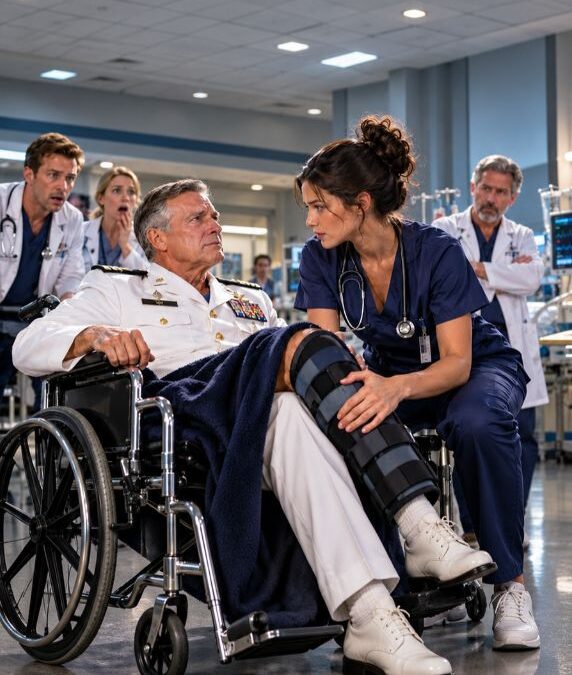
The emergency room of St. Brendan’s Memorial never truly slept, but at 2:47 on a rainy Tuesday morning, it went completely silent. The automatic doors slid open and a wheelchair rolled through, pushed by two stone-faced aides. In it sat a man nearly every person in that building recognized, even those who had never met him. Admiral Richard Hale, 38 years of service, three wars, and a chest of ribbons that told a story most people could only imagine.
His white dress uniform was immaculate, his posture rigid, his jaw set like a sealed vault. And for 20 years, he had not taken a single step. Nurses froze at their stations. Doctor Mark Callahan, the hospital’s chief of orthopedics, straightened his white coat and hurried forward with a young resident, Emily Brooks, close behind. Everyone knew the legend.
Two decades earlier, during a violent storm in the North Atlantic, a failed hoist on the deck of his flagship had thrown Hale 30 feet onto steel. He survived, but his spine did not. Specialists in Washington, Baltimore, Zurich, and Houston had examined him, and every verdict was the same: complete spinal cord injury, permanent paralysis from the waist down. No treatment, no hope, eventually no more questions.
Tonight’s emergency was, on paper, small. Hale had been transferring from his car to his chair outside a Veterans Dinner when the chair rolled away and he slid to the pavement, twisting his right knee. A swollen, bruised knee on a man who couldn’t feel it. The paramedics had locked it in a hinged brace, wrapped him in a navy blanket, and brought him in. Doctor Callahan glanced at the knee, ordered an X-ray, and prepared to move on.
To him, this was routine. An old man, an old injury, an old story. Nothing here could surprise him. He was about to be proven wrong. Standing at the edge of the commotion was Maya Reyes, a night shift nurse with 6 years of experience and a hair bun that never survived a full shift. She had no famous name and no title beyond RN, but she had something the hospital’s best minds had quietly stopped using, curiosity.
Her father had been a Navy machinist’s mate and she had grown up on his sea stories. When the charge nurse asked who could take the Admiral’s vitals, Maya raised her hand before anyone else could. “I’ve got him,” she said. Hale studied her with the cold, measuring gaze that had once commanded fleets.
“Young lady, you needn’t fuss over me. I’ve been a patient longer than you’ve been a nurse.” Maya wrapped the blood pressure cuff around his arm without blinking. “Probably true, sir, but tonight you’re in my ER, so you’re stuck with me.” For the first time in a long while, the corner of his mouth almost moved.
As she worked, she asked about the fall and about the pain. “I feel nothing below my belt, nurse,” he said, his voice flat and polished smooth by years of repetition. “That is rather the point of being paralyzed.” Protocol required her to check circulation and sensation in the injured leg, so Maya knelt beside the wheelchair and gently pressed around the swollen knee, then slid her fingers lower along the shin.
That was when something happened. Something tiny. Something almost invisible. The Admiral’s big toe curled. Just a flicker, like a candle flame disturbed by a breath of air.
Maya stopped breathing. She pressed again, a little lower, and the toe flexed again. She glanced up at his face and at his hands gripping the armrests. He hadn’t noticed. Nobody had.
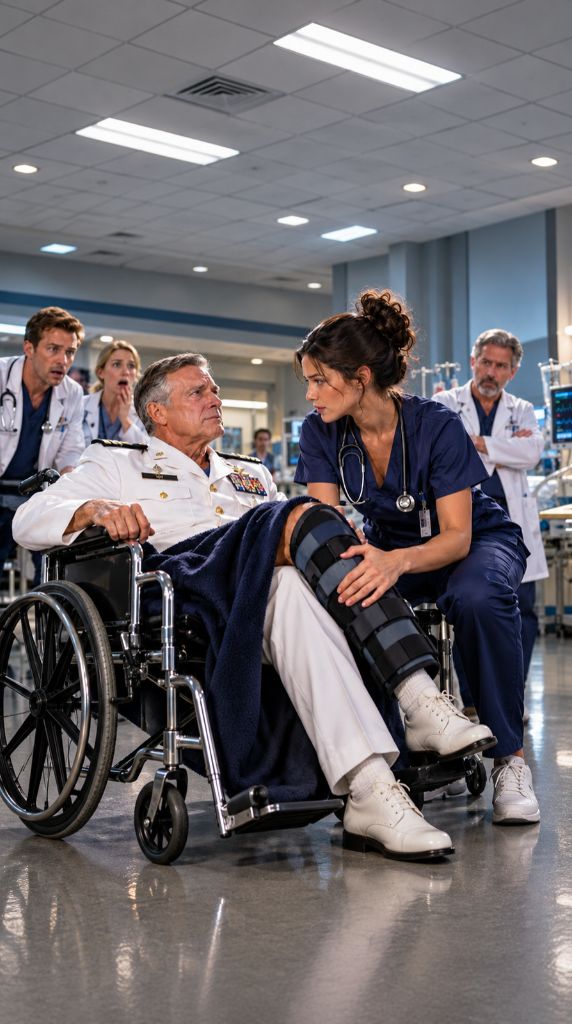
She stood and moved quietly to Dr. Callahan’s side. “Doctor, I think he has voluntary movement in his right foot.” Callahan didn’t even look up from his tablet. “Spasms, nurse. Reflex activity. It happens in spinal injuries all the time and it’s documented in his file.”
“It’s not random. It responds to exactly where I touch.” She finally met her eyes, tired, kind, and final. Maya, 20 years, 11 specialists. Let it go. Behind him, Walter Green, the veteran head of neurology, folded his arms and gave her the slightest shake of his head.
The resident looked at the floor. The message was clear. Stay in your lane. But Maya had spent six years learning that the lane was often where the mistakes hid. She returned to the admiral’s side and crouched to eye level.
“Sir, I need to ask you something, and I need honesty. Has anyone ever tested your reflexes while you weren’t expecting it?” He frowned. “They’ve tested everything.” “Humor me.”
She pulled a small reflex hammer from her pocket and tapped just below his left kneecap. The leg jerked, sharp and visible. A murmur rippled through the staff. Callahan’s pen stopped moving. “Hyperreflexia,” he said slowly. “Expected in upper motor neuron lesions.”
“Then explain why his toe moves when I touch it.” She turned back to Hale. “Admiral, I want you to try to wiggle your right toes. Just try.” “Nurse, this is cruel,” Hale said quietly, and for a moment the warrior’s armor cracked, and she saw 20 years of disappointment behind it. “I’ve tried 10,000 times.”
Maya held his gaze. “Then try 10,001, sir. Right now. I’m right here.” The entire emergency department had gathered in a silent half circle. Doctors, nurses, even a janitor leaning on his mop.
Hale closed his eyes. His jaw tightened. A bead of sweat slid down his temple. 10 seconds passed, 20, nothing. Then, beneath the edge of the blanket, inside the sock, the toe lifted. Small, trembling, real.
Someone gasped. “Doctor,” Callahan’s face drained of color. The admiral opened his eyes and stared down at his own foot as though it belonged to a stranger. “That’s not possible,” he whispered.
The hand that had once steadied a battleship’s course was shaking. For 20 years he had been told it was over, and in one quiet moment, a nurse everyone had overlooked had cracked open a door that 11 experts had sealed shut. But Maya knew the hardest part had not even begun. Proving he could move was one thing. Convincing a hospital full of brilliant, proud, exhausted professionals that they had missed something for two decades was another. And she had to do it before the admiral’s fragile hope collapsed again.
“Sir,” she said softly, “I need you to trust me. What I’m about to ask for is going to make some very powerful people very uncomfortable.” “I want a full spinal MRI,” Maya said, loud enough for the whole room to hear. “Tonight, with metal artifact reduction.” Dr. Callahan exhaled sharply. “He’s had MRIs, nurse. Dozens of them.”
“Not with the right sequences. His original surgery left titanium hardware in his spine. Those old scans were blurred around the exact spot we need to see.” A hush fell. It was a specific, technical, and uncomfortably intelligent point. Dr. Green, the neurologist who had shaken his head only minutes earlier, uncrossed his arms.
“Say that again,” he said quietly. Maya repeated it. She told them about a case study from her nursing program, a patient whose paralysis had been labeled complete for years until updated imaging revealed bone fragments hiding in a metal shadow. She wasn’t claiming to be a doctor. She was asking them to look once more.
Green studied her for a long moment, then turned to the wheelchair. The admiral had not said a word. Now his voice cut across the room like a command from the bridge. “Gentlemen, the nurse has made a request. I suggest you carry it out.”
Nobody argued with that tone. Within minutes, Hale was being wheeled toward radiology and Maya walked beside him. In the cold hum of the waiting area, the Admiral finally spoke and he didn’t sound like a legend. “Do you know why I stopped trying, Nurse Reyes? The accident killed a young sailor, 19 years old. The same hoist that threw me crushed him. I decided that if I could not walk, it was a fitting penance. Hope felt like betraying him.”
Maya sat down beside him. “My father was a machinist’s mate,” she said. “He died in a hospital where no one listened when he said something was wrong. I promised myself that when I became a nurse, I would always listen.” The Admiral turned to her and in his eyes was something that hadn’t been there before, the first faint light of possibility.
The scan took 90 minutes. At 5:15 a.m., Dr. Green walked into the consultation room carrying a tablet and his hands weren’t quite steady. Dr. Callahan was there, along with a neurosurgeon, Dr. Priya Raman, who had been called in from home. Green turned the screen toward them. “Look at the thoracic spine. Here, behind the old hardware, there’s a small bone fragment pressing into the cord surrounded by dense scar tissue. The cord is compressed, not severed. His injury has never been complete. It was labeled complete during a chaotic emergency at sea and every specialist after that inherited the label instead of questioning it.”
The room was silent. Callahan sank into a chair and covered his mouth. 20 years, 11 experts, one assumption that nobody dared challenge. Dr. Raman leaned in. “It’s operable,” she said carefully. “But I won’t lie to you, Admiral. The fragment sits very close to the cord, and the surgery is risky. There’s a real chance of making things worse. There’s also a chance, and I can’t promise how large, that you could regain function.”
The Admiral looked at the scan, then at Maya. “What would you do, Nurse?” She didn’t hesitate. “I’d rather risk the fall than spend another 20 years wondering if I could have flown, sir.”
He nodded slowly, a decision made in the space of one breath. “Schedule it.” The surgery lasted 9 hours. Maya’s shift had ended long before, but she never left the building. She sat in the family waiting room, still in her Navy scrubs, her stethoscope draped around her neck, staring at the clock.
Staff members drifted past and quietly set down coffee, a sandwich, a blanket. Nobody said anything. They didn’t need to. Even Dr. Callahan came by, sat across from her, and finally managed three words. “I was wrong.”
At 6:40 that evening, Dr. Raman stepped through the doors, mask pulled down, exhaustion written across her face. Then she smiled. “The fragment is out. The cord is decompressed, and it looks healthy. Now we wait.”
The recovery was neither quick nor easy. For weeks there was only numbness. Then came tingling, then a muscle twitch in the thigh. Then, in the third month, a knee that bent on command.
Maya visited every day she could, sitting beside the physical therapy mats and cheering like she was watching a championship game. Some days the Admiral wept with frustration. Some days he laughed. Every single day, he tried.
Eight months after that rainy night, the doors of Saint Brendan’s emergency room slid open once more. The staff had been told to expect a visitor, and they lined the corridor in silence. Into the light stepped Admiral Richard Hale in his white dress uniform, leaning on a polished cane, walking on his own two feet. Each step was slow and deliberate, and each one echoed like thunder.
Nurses cried openly. Dr. Callahan stood at attention, his eyes shining. At the end of the hall stood Maya Reyes in her navy scrubs, her hands pressed over her mouth. Hale stopped in front of her.
Then, with a straightened spine and a steady hand, he raised a crisp salute. “Nurse Reyes,” he said, his voice thick with emotion. “Every doctor told me what was impossible. You were the only one who asked what was possible.” Maya, tears streaming, saluted back.
In the following months, the admiral funded a new program at the hospital called the listening initiative, which requires every complex case to be re-examined by fresh eyes, no matter how old the diagnosis. Its first plaque bears Maya’s name, along with her father’s. The lesson of this story is simple, and it’s one the world forgets far too often. Titles don’t discover the truth. Attention does.
Sometimes the person who changes everything isn’t the one with the most degrees. It’s the one who refuses to look away when something doesn’t add up.
You Might Also Enjoy


Mom Installed a Camera To Discover Why Babysitters Keep Quitting But What She Broke Her Heart


She Gave a Hungry Little Girl a Free Birthday Cake — The Next Morning, a Black Rolls-Royce Arrived




