The General’s Daughter Was Declared Dead—Until the Floor Nurse Whispered 4 Words and the Room Wen…
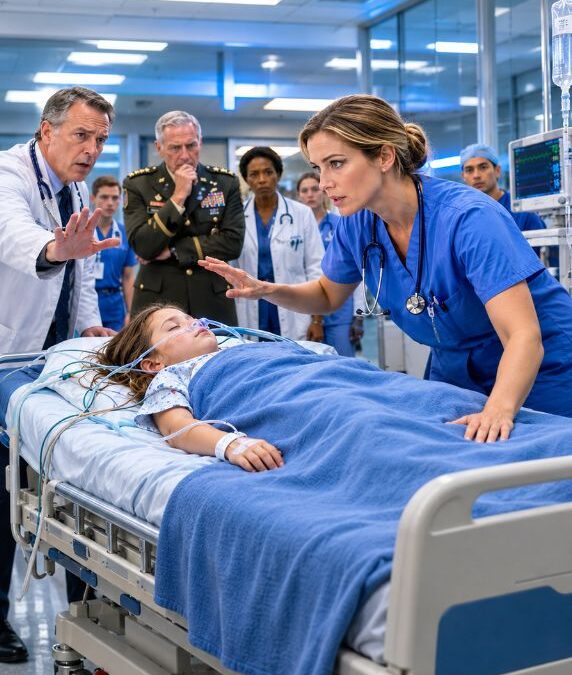
“She’s already gone,” Dr. Crandall said without turning around. “Get her prepped for paperwork.” Lena Holt had been standing 3 ft behind him, the way she always stood, close enough to be useful, far enough to be forgotten. She looked at the child on the gurney, 8 years old maybe, lips the color of old chalk, hair plastered flat against a face that had already started to look like a photograph of a face rather than a face itself. Lena set down the IV kit she’d been carrying and walked to the bedside.
Nobody told her not to. Nobody noticed she had moved until she was already there. The trauma bay at Fort Belvoir Community Hospital had a particular smell after midnight, antiseptic and recycled air, and underneath both, something metallic and permanent that no amount of bleach ever fully reached. Lena had worked this floor for 3 years.
She knew its rhythms the way she knew her own breathing. The particular beeping pattern that meant critical but stable, the silence that meant something else entirely. This silence was the second kind. “Holt,” Dr. Crandall’s voice came from the direction of the nurses’ station, where he was already reaching for a clipboard. “Warm up the family room. I need to have a conversation before the general gets here.” “Yes, doctor.”
She said it the way she always said things to him, small, level, the verbal equivalent of furniture. Her full name was Lena Morrow Holt, though she’d gone by her maiden name since the transfer, and nobody here had thought to ask why. She was 37, though she could have been anywhere from 30 to 45 depending on the light. Her hair was brown and pinned flat.
Her scrubs were the standard issue blue that made everyone who wore them look equally unremarkable. She had a small, pale scar on her right forearm, just above the wrist, that she’d told three different colleagues was from a kitchen accident. None of them had pressed further. Nobody pressed Lena on anything.
She had a way of answering questions that left you feeling like you’d received more information than you had. She looked at the child on the gurney. The monitor beside the bed showed a flat line with the board certainty of a machine that had already made up its mind. 78.1 Shapiro and feet.
Lena’s hands went very still. She had seen that number before, not in a trauma bay, in a different context entirely, in a different life, in weather that had no business existing on a planet hospitable to human beings. The paramedic near the door was filling out a form on a clipboard, moving with a particular efficiency of a person putting paperwork between themselves and what they just failed to do.
“How long was she in the water?” Lena asked. He looked up. Nobody usually asked the paramedics questions directly. That was the physician’s territory. “Approximately 38 minutes. Creek behind her family’s property. It’s been sitting at 31° with the snow melt. We started CPR on scene, maintained it the whole ride. Any warm water exposure at any point?”
“Ma’am?” “Before she went in, after she came out.” “Any contact with warm fluid that would complicate the core temperature reading?” He stared at her. “No. She went straight from the water to us.”
Lena nodded once and turned back to the monitor. 78.1 and dropping. Behind her, Dr. Crandall was still talking to someone near the station. She heard her own name followed by “Just a floor nurse. She won’t interfere.”
She had heard variations of that sentence for 3 years. At some point, she had stopped waiting to hear it and started simply planning around it. The door from the ambulance bay opened again, and this time what came through wasn’t a paramedic. It was a man in army service dress, stars on both shoulders, moving the way a person moves when they’ve been running and are trying to make it look like walking.
His face was the particular color of a man who’d driven here at speeds that should have cost him his license and was only now allowing himself to understand why. His name, according to the intake sheet visible on the counter, was Whitmore, General A. H. Whitmore. That his daughter on the gurney. Lena didn’t need the paperwork to tell her. She could see it in the way his eyes went to the small still face before they went anywhere else.
“Stop.” The word came out of her before she decided to say it. Dr. Crandall was already walking toward the general, already composing the expression he wore when delivering bad news to important people. Grave, practiced, not quite apologetic. He stopped.
The clipboard stopped. The entire room seemed to pause in the uncertain way of people who couldn’t quite identify where the voice had come from or whether it had really meant to speak to them. “She’s hypothermic,” Lena said. She didn’t raise her voice. She didn’t need to. The room had already gone quiet enough that a normal speaking voice carried to every corner of it.
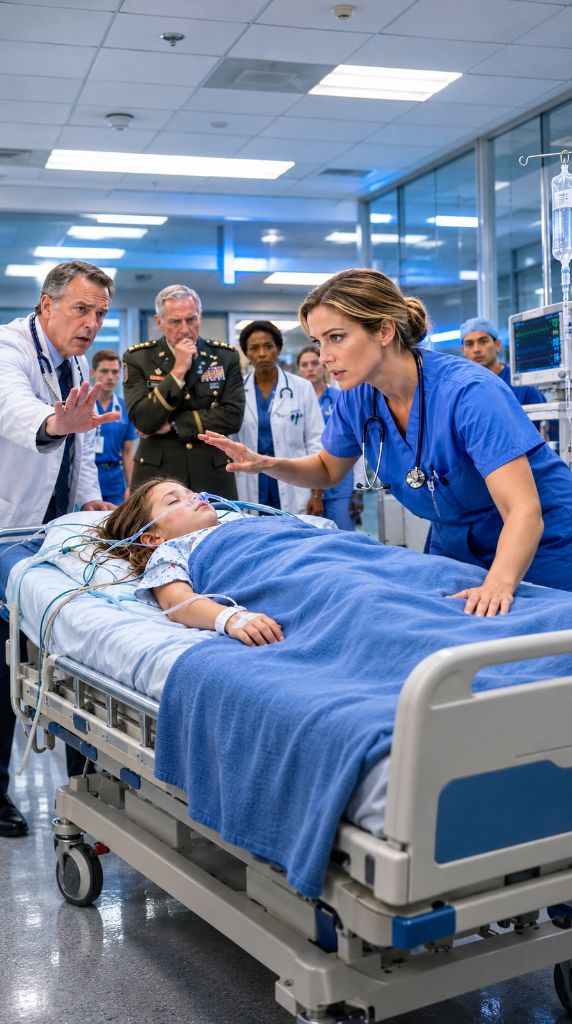
“Core temperature 78.1. Cold water, 31° for 38 minutes. That is not a dead patient. That is a cold patient. And you cannot call those two things the same until she’s been rewarmed.”
Dr. Crandall turned slowly. He had a particular way of turning toward subordinates who had surprised him. Deliberate, the way a large animal turns when it hears something behind it and is deciding whether the thing behind it is worth its attention. “Nurse Holt.” “Doctor.” “I’ve been a physician for 26 years.”
“Yes.” She was already pulling the warming blanket from the rack beside the bed. “The protocol I’m describing is standard search and rescue medicine. Cold water immersion at these temperatures and this duration produces signs that are clinically indistinguishable from death. Fixed pupils, absent pulse, no respiration. None of those findings are reliable below a core temp of 86°. The rule is not dead until warm and dead. She isn’t warm yet.”
The paramedic near the door had gone very still, pen hovering above his clipboard. “This is not your call to make,” Crandall said. His voice had dropped into the register he used for residents who needed correcting. “You are a floor nurse in my unit. The patient has no shockable rhythm, no respiration, no—”
“She has 38 minutes of cold water immersion and a core temperature that makes every one of those findings meaningless.” Lena’s hands were moving while she talked, not fast, not hurried, with the particular economy of motion of someone who had done the same tasks and conditions that did not permit excess movement. “I need the active external rewarming kit from the cabinet on the north wall. I need warm IV saline at 42° two large bore IVs run wide open. I need someone on compressions and I need it maintained continuously and I need respiratory standing by with a warmed humidified oxygen circuit. I need all of that in the next 90 seconds.”
Nobody moved. They were all watching Crandall waiting for him to shut this down. The general hadn’t moved from the doorway. He was watching Lena with the flat evaluating attention of a man who had spent decades assessing people under conditions that didn’t allow for second guesses. “She knows what she’s talking about,” he said quietly.
The room shifted. Not much, just enough. A young resident near the wall straightened almost imperceptibly. The way residents straighten when they’ve been waiting for permission to do what they already know needs doing. He crossed to the cabinet on the north wall and opened it without waiting to be asked.
Crandall’s jaw tightened. “This is outside your scope of—” “Then stand next to me and supervise,” Lena said. “Or tell me I’m wrong. But if you can’t tell me I’m wrong based on the temperature on that monitor, then we keep working until she either comes back or reaches a temperature where her findings actually mean what you think they mean.”
The silence after that was the kind that makes time feel strange. Crandall didn’t move. The resident brought the rewarming kit. Lena started. Compressions first.
She positioned her hands herself demonstrating the rate before handing off to the paramedic who’d set down his clipboard and crossed the room without being asked, the way field personnel move when they’ve been waiting for someone to give them something real to do. “Core rewarming only,” she said, positioning the warming pads at the torso, the groin, the axillae, not the limbs. “If cold acidic blood from the periphery reaches the heart before the core is stable, it can trigger an arrhythmia we won’t be able to manage at this temperature. Core first, always core first.”
A nurse who’d been hovering near the foot of the bed started to reach for the girl’s feet with a blanket. The instinct was kindness. It was also exactly wrong. Lena caught her eye and shook her head. The nurse stepped back.
“She’s cold,” the nurse said almost to herself. “I just—” “I know.” Lena’s voice didn’t change. “It’s the right instinct for almost every other situation, not this one.” The warm saline went in, both arms, wide open. The IV lines ran the fluid that was at that moment warmer than the blood it was entering, which was an impossible-sounding sentence and also exactly the point.
Crandall hadn’t left. He was standing near the wall, arms crossed, watching with an expression Lena couldn’t read and wasn’t looking at anyway. The monitor showed nothing. It had shown nothing since the girl came in. A flatline was a flatline was a flatline, and for everyone in that room except Lena, that was what a flatline meant.
Lena watched the temperature display instead. 78.1… 78.4… It climbed slowly, the way temperature climbs when the source of heat is the body’s own reawakening rather than something applied from the outside. She leaned down close to the girl’s ear. She did it without thinking about it, the way she’d done it once on a helicopter deck in weather that wanted to kill both of them.
“I’m not walking away from you,” she said, quiet enough that only the girl could hear. If any part of her was still in there, still registering input, still somewhere on the long road back, Lena wanted her to hear that sentence. She had needed to hear it once from someone else in a different kind of cold. “You don’t have to do anything. Just don’t let go.”
Behind her, the general made a sound she didn’t turn to look at. 79.1. Somewhere around the fourth minute, a new voice entered the room. Measured, precise, belonging to a woman who introduced herself to no one and simply moved to the foot of the gurney and read the monitor display with the attention of someone who ran numbers for a living.
Dr. Christina Barra, chief of emergency services, had the kind of institutional authority that didn’t need to announce itself. She’d been paged by someone. Lena didn’t know who and wouldn’t have cared, and she stood now in the quiet way of a person deciding what kind of room they’ve walked into before they say a single word. “Talk me through what you’re doing,” she said to Lena. Not who authorized this, not what’s your justification, just talk me through it.
Lena talked her through it. Numbers, sequence, rationale, expected timeline. No drama in the delivery, no appeal to anyone’s feelings. Just the protocol stated the way it needed to be stated, which was the way she’d been trained to state things in situations that didn’t have room for ornamentation.
Barra listened with her full attention. Then she looked at Crandall. “Have you documented any objection to this protocol?” Crandall’s jaw worked briefly. “Not yet.” “Then don’t start now.” She pulled a pen from her coat and uncapped it. “Nurse Holt, keep going. I’ll supervise personally. Dr. Crandall, I’ll need a word with you in the hallway when this is finished.” Crandall left the room. Nobody watched him go.
80.6. The monitor trembled. It was almost nothing. A flutter at the edge of the display, the kind of flicker that could have been artifact, could have been interference from another piece of equipment, could have been exactly what it looked like, which was a heart trying to remember it had a job.
“There,” Lena said. The paramedic doing compressions glanced up. “Keep going,” she said. “It’s too fragile to hold at this temperature. Don’t stop for the flicker. Keep going until I tell you otherwise.” He kept going.
82.3. The flutter became something more persistent, still chaotic, still not a rhythm anyone would call usable, but present. “VF?” the resident asked. “Ventricular fibrillation, yes. At this temperature, that’s actually progress.” Lena’s voice had taken on a different quality than it had held all night.
Not warmer, exactly, but more focused, the way a signal becomes clearer when you’re finally close enough to the source to receive it without static. “We shock at 85, not before. Below that temperature, a shock won’t hold and you’ll waste the attempt.” The resident opened his mouth, closed it, and wrote something on his notepad instead. 84.1… 84.7…
“Charge,” Lena said. The resident looked at Barra. “You heard her,” Barra said. He charged the paddles. “Clear.”
The body rose once beneath the pads. The line on the monitor scattered, became noise, and then, in the particular way that never got less extraordinary, no matter how many times you witnessed it, steadied. Weak, irregular, a rhythm that would need watching every second of the next several hours before anyone could call it reliable. But hers.
“Sinus rhythm,” a nurse said, and her voice cracked on ascent in a way she didn’t try to hide. Lena exhaled once and straightened her posture, and watched the monitor with the particular attention of someone who has learned not to celebrate until the numbers have held for at least 30 seconds. The general was at the doorway. She hadn’t heard him move.
He stood with one hand against the frame the way people stand when they need something to hold on to. “She has a heartbeat,” Lena said. She said it to the general first before she said anything else, because the most important information in this room was currently for that man, and she wasn’t going to make him figure that out from medical shorthand.
“It’s unstable, and she has a long way to go, and I’m going to need everyone in this room to keep working. But, she has a heartbeat.” The general put his face in his hands for a moment, then he lifted it again, and whatever was behind his eyes when he looked at Lena was not a thing she had a name for, but she recognized it. She had seen it before.
It was what you looked like when someone had reached into the place you’d already accepted as empty, and pulled something back out. “Core first,” she said again, redirecting her attention to the monitor. “Keep the warming going. I want her at 90 before we even say the word stable out loud.”
The room reorganized itself around her without anyone announcing that it was doing so. Nurses moved. The resident wrote orders. Barra made calls. And Lena stood at the center of it with her hands and her eyes, and the part of her that had never fully come home from the mountains and the cold, the part she’d been quietly dismantling for 3 years, the part that had apparently not dismantled as completely as she’d believed.
86.4… 88.1. At some point, someone brought her a cup of coffee. She didn’t drink. She noted it on the counter and left it there, too busy watching the numbers to bother with anything as ordinary as warmth for herself.
It was the resident who asked. He’d been working steadily beside her for the better part of 40 minutes, and at some point, professionals who have worked beside each other through something like this stop being strangers in the ordinary sense. He asked the way young doctors ask things when they’ve run out of clinical questions and moved into the human ones without fully realizing it.
“Where did you learn this? The sequence, the temperature thresholds, the core first warming, all of it. I’ve been through 3 years of residency, and I’ve never seen it laid out that clean.” Lena adjusted the warming pad angle half a centimeter without looking at him. “Mountain search and rescue medicine, high altitude, cold exposure environments.” “You were in SAR?”
She didn’t answer right away. She had a collection of non-answers she rotated through, depending on who was asking and how much it mattered. This one was going to matter. She could already feel it, the way you feel a shift in atmospheric pressure before the weather changes. “I was a flight medic,” she said finally, before nursing. “For who?”
She watched the monitor, 89.3, climbing. “Army,” she said. “Medevac, then SEER, survival, evasion, resistance, and escape. We train soldiers to survive cold exposure, hostile environment medicine.” “And then you became a floor nurse.” It wasn’t quite a question. “And then I became a floor nurse,” she confirmed, and her tone made it clear that the sentence was complete, and she wasn’t attaching anything else to the end of it.
He was quiet for a moment. “You should be teaching this protocol. We don’t have anything like this in the hospital training library.” “I know,” she said without bitterness, because there wasn’t any. She had known it for 3 years. She had also, for 3 years, been actively choosing not to do anything about it, which was different from not knowing.
90.1. The small hand on the sheet moved. It curled, just slightly. Fingers pulling in toward a palm, the reflex of a body remembering what bodies do. Someone in the room made a sound. More than one someone. Lena didn’t look away from the monitor to find out who. She heard the general’s breathing change behind her.
Not a word, just a change. Just the sound of a man’s chest finally allowing itself to open after a long time of keeping shut. “She’s starting to come up,” Lena said. “Slow your movements, gentle handling only. Her cardiac irritability is still high, and physical stimulation can trigger arrhythmia. Move her like she’s made of something valuable, because she is.”
The quiet that followed was a different kind than the quiet from before. Less the absence of sound, and more the presence of attention. Barra had come back from the hallway and stood near the wall watching. She had a small notebook out. She was writing something in it that was not, Lena suspected, an incident report.
Dr. Crandall came back in at 94. He came in without his clipboard, which was the first unusual thing. He came in and stood near the door and didn’t say anything, which was the second. He looked at the monitor and then at the girl and then at Lena and something moved across his face that would have been difficult to categorize but was not difficult to understand.
He crossed the room and stopped at the foot of the gurney. “What do you need?” he said. It was possibly the most remarkable sentence he had spoken in the three years Lena had worked under him. “Another core temp in 4 minutes,” she said, “and respiratory to check the warmed circuit settings. The rate looks a degree high to me.”
He went to check it himself. 91.7… 93.2. At 94°, the girl’s eyes moved beneath the lids. At 95°, her lips parted around a sound that was only breath at first and then very slowly became something more deliberate than breath. “Dad,” she said.
It was barely a sound, more the shape of a word than the word itself, but it was unmistakable. The general was across the room before anyone could have told him to move and Lena stepped back. The way you step back when the work is done and the people it was done for need to reach each other.
She stepped back and watched the general’s hand find his daughter’s hand and watch the girl’s fingers tighten around his and something in her chest did what it had not done in longer than she could accurately measure. It loosened just slightly, just enough to notice. She turned toward the door.
Barra fell into step beside her, not quite blocking her path, not quite letting her pass. “SAR medicine,” Barra said. “Yes.” “That’s classified curriculum in most of its applications.” “It’s not a secret that cold water is cold,” Lena said.
“Or that the body doesn’t function the same way in extreme hypothermia as it does at normal temperature. The principles aren’t classified. They’re just not taught in civilian medicine the way they should be.” Barra looked at her for a long moment. “We have a training deficiency in this department that just became very visible tonight. And a person standing in front of me who is currently teaching a floor nursing curriculum that is frankly beneath her.”
Lena said nothing. “I’d like to have a conversation about that,” Barra said. “Tomorrow in my office. Not as a reprimand, I want to be clear about that. As a department director asking a staff member what it would take to bring her full capability into this building on purpose.” “I’ll be there,” Lena said.
She found Dr. Crandall in the hallway near the supply closet, which was where she’d been heading in the first place. He was leaning against the wall with his arms at his sides, not crossed, which she noticed because his arms were always crossed. He looked at her. She waited.
“I was wrong,” he said, “about her prognosis, obviously. But also about—” He stopped, started again with the particular discomfort of a person not accustomed to saying things they mean without a rehearsal. “I’ve spent 3 years treating you like a useful piece of furniture. I don’t have an excuse for that. I’d like to stop doing it.”
“That’s a reasonable goal,” Lena said. “I’d like to know what else I don’t know. Specifically, what this hospital is capable of that it currently doesn’t know it’s capable of.” She considered him for a moment. Not with warmth, exactly, but with the measured recalibration of someone updating a long-held assessment based on new data. “That’s also a reasonable goal,” she said.
The general found her an hour later while she was at the nurses’ station completing the documentation she’d been deferring all night. He walked to the counter and stood there until she looked up. “My daughter is asking for her dog,” he said, “by name, with a complaint about how long she’s been asleep.”
Lena set down her pen. “That is an excellent sign,” she said. He was quiet for a moment. He had the posture of a general, which was a posture that almost never allowed uncertainty to show through it. But uncertainty was exactly what showed through it now, and she got the impression that for him, that was a significant concession.
“She was going to be declared dead,” he said. “In the next 30 seconds, I understand that.” “Yes.” “And you were the only person in that building who didn’t let it happen.” “I had help by the end.” “You didn’t have help at the beginning.” He looked at her. “I want to know who you are, not the personnel file. Who you are.”
Lena thought about how to answer that. She had been thinking about versions of that answer for 3 years, which was approximately how long she’d spent in this building being someone much simpler than she actually was. “I’m a nurse,” she said. “Who used to be someone who went into very bad situations and brought people out of them. I stopped doing that for reasons that don’t change the skills, only the address on my badge.”
“Why did you stop?” She held the question in the air between them for a moment before answering. He’d earned the question. She wasn’t sure he’d earned the full answer yet, but he’d earned the shape of it. “I lost someone,” she said, “after a mission that went right for the patient and wrong for someone I was responsible for. I needed to be somewhere that the wrong kind of outcome didn’t follow me off the clock.”
She paused. “It turns out you don’t leave the training when you leave the job. You just stop using it on purpose. And then something like tonight happens, and you understand that you’ve been waiting for a reason to use it again that was bigger than the reason you stopped.” The general said nothing for a long time.
When he finally spoke, he said it quietly, without the rank or the posture, just a man at a counter talking to a woman who had done the impossible thing when it needed doing. “I have a family because of you.” Lena picked up her pen. “You have a daughter because she’s stubborn,” she said. “I just refused to agree that she wasn’t until we could prove it.”
She went back to her documentation. He stood at the counter for a moment longer and then he did the thing that men like him almost never do in clinical settings, which was say thank you without a modifier, without a qualification, without a plan attached to the end of it. She wrote it down in her chart notes the only way she knew how, in the temperature readings, the timeline, the sequence of interventions, the outcome documented with the same plain economy as everything else she did.
A child presented, a child survived, the protocol was as follows. She finished the last line, signed it with her full name, Lena Morrow Holt, RN, and set down the pen. Down the hall, a little girl was describing her dog to a night shift nurse who would, in about 4 minutes, produce a photograph from her own phone screen and receive in return a sleepy but genuine critique of whether the pictured animal bore any resemblance to the described one.
Lena heard the sound of it, not the words, just the shape of a child’s voice doing the ordinary and extraordinary work of being alive. And she sat with it for a moment the way you sit with something you had almost talked yourself out of believing was still possible. Then she filed the chart, collected her things, and walked toward the elevator with the particular steadiness of a person who has carried something heavy for a long time and has only just set it down and is still figuring out what it means to walk without it.
You Might Also Enjoy


Mom Installed a Camera To Discover Why Babysitters Keep Quitting But What She Broke Her Heart


She Gave a Hungry Little Girl a Free Birthday Cake — The Next Morning, a Black Rolls-Royce Arrived




