The Mafia Boss Found the Maid’s Little Girl at His Computer — “Your Cameras Are Lying!”
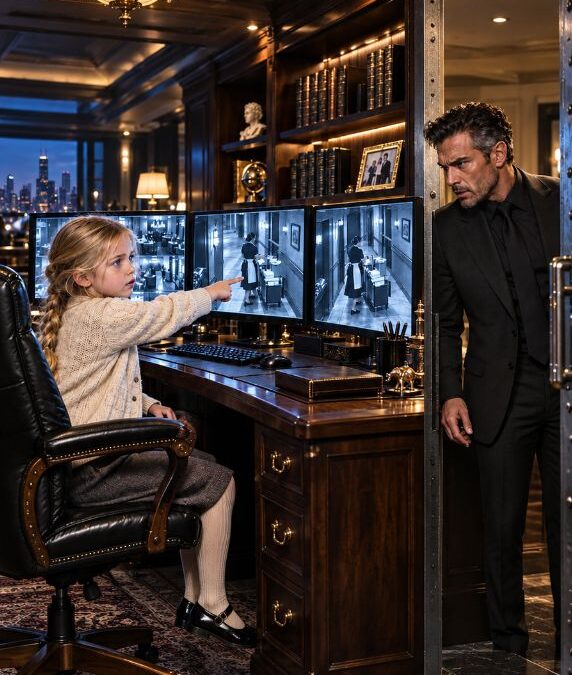
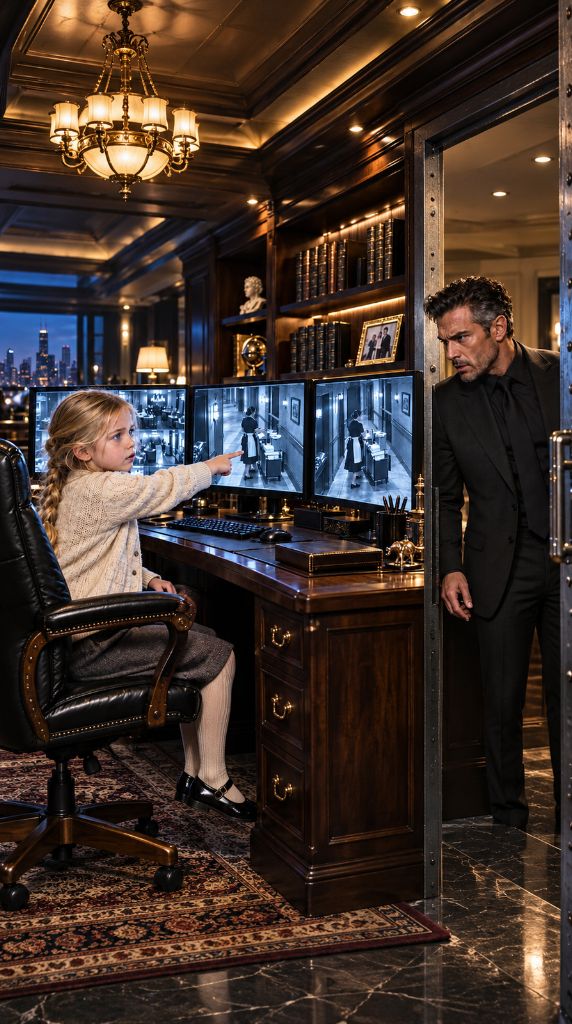
“Who let you in here?” Dante Moretti had faced men with guns without raising his voice. Yet, at 4:15 in the morning, the sight of a little girl sitting at his private computer stopped him in the doorway. Her feet hung above the floor.
A faded cream sweater covered her narrow shoulders. Three security monitors washed her pale braid in cold blue light. The room lay one level below the laundry wing of Moretti estate, beyond a service stairwell and a steel door that answered to a coded lock. It was where Dante watched the businesses he owned, the men he trusted, and sometimes the men he did not.
Children had no reason to know it existed. The girl did not look at him. She pointed at the middle screen with a shaking finger. “Please, sir, don’t turn it off. That lady went past twice.”
Dante followed her gaze. The screen showed a service corridor at Moretti family restaurant, 6 miles away. A cleaner pushed a cart across the picture, lifted her right elbow to avoid a narrow doorway, and disappeared.
A few seconds later, she came through again. Same lifted elbow, same loose wheel wobbling on the cart. Even the little turn of her head was identical. In the corner, the clock hesitated, repeated a number, then jumped ahead.
“You saw that?” Dante asked. The girl’s hands closed around a brass pocket watch. Its glass was cracked from rim to rim. “Daddy used to say clocks aren’t supposed to make the same mistake twice.”
The unscheduled maintenance alert still glowed on Dante’s phone at 4:08 a.m. He had acknowledged it from the upper hall a few minutes earlier and come down himself. At 4:15, someone barely tall enough to reach his chair’s edge was sitting in the room the alert had named. He called Marcus Reed, his head of security.
“Bring the access records, and don’t touch the restaurant feed.” While they waited, Dante saw the door had not latched. Lily said a maintenance cabinet beside the laundry room had clicked in a strange pattern.
The night supervisor had stepped away to fetch clean linens, and Lily had gone looking for her when she saw the service stairwell open and light coming from the room below. The steel door was ajar, the viewer already running. Lily had typed nothing, opened nothing, and watched long enough to see a woman pass twice.
Marcus arrived with a tablet. The lock had entered maintenance mode at 4:08. A technician had left at 4:11 without securing the spring latch. The temporary permission would expire at 4:17.
No alarm had sounded because the access appeared valid, but the system had preserved the activity log. “Who authorized it?” Dante asked. “An old facilities account,” Marcus said.
“The work ticket says an emergency remote system test, but there was no approval from my office. I’m tracing who still controls that account.” The girl finally turned toward Dante. Her eyes were frightened, but she was holding herself very still.
“Am I in trouble?” she asked. Dante looked from her face to the repeating corridor. Someone had walked into his safest room before she had.
Someone had left a pre-recorded corridor sequence running on his screen, and a 7-year-old child had been the first person willing to say what she saw. A minute later, a woman hurried in wearing a gray cleaning uniform. A white cloth was still gripped in one hand, and her eyes went straight to the child.
“Lilly.” The girl slipped from the chair. “Mama, I didn’t touch the buttons.”
Elena Hayes dropped to her knees and pulled her daughter into her arms. Then she looked up at Dante, her face drained of color. “Mr. Moretti, please. She wasn’t supposed to leave the staff lounge. It’s my responsibility.”
Dante recognized Elena from occasional overnight shifts with the cleaning contractor. Her babysitter had canceled and the house manager had allowed Lilly to wait in the staff lounge under the night supervisor’s care. Elena could lose her assignment for what had happened.
None of those arrangements explained why a maintenance worker had left the most sensitive door in the estate unsecured. “I told her to stay where she was,” Elena said. “If the contractor hears about this, they could take me off the roster. I can’t lose these shifts.”
“I’m not deciding anything about your work,” Dante replied. “I need to know what happened.” Marcus showed Dante the corridor footage again.
The cleaner appeared twice, each movement impossibly exact. Lily clung to her mother’s hip and stared at the floor. “Why were you watching the screen?” Dante asked her more gently.
“I wanted to see why it skipped.” She held up her watch. “Daddy fixed clocks.” “He showed me how to listen when one little part wasn’t taking its turn.”
“Where is your father?” Elena’s arm tightened around her child. “My husband died 11 months ago.”
Dante lowered his eyes to the watch, suddenly aware of how carefully the girl was protecting it. Its chain had been repaired with ordinary thread where a proper link was missing. “He worked on security cameras,” Elena continued. “At your family’s restaurant. His name was Daniel Hayes.”
Marcus stopped scrolling. The sound was so small Dante might have missed it. A sharp breath drawn through the nose. “You knew him?” Elena asked. Marcus looked at her.
“I reviewed part of an incident report after he died.” Dante remembered the report now. A late-night breach, missing maintenance records, an allegation of unauthorized access.
He had seen the name on a stack of files and signed a recommendation prepared by senior staff. He could not recall the man’s face. Marcus opened Daniel’s personnel summary.
His badge photograph showed a tired man in a work jacket. Beneath it, the company accused him of a security breach. The finding had been entered after his death.
It was not a dismissal, but a judgment imposed when Daniel could no longer defend himself. Lily recognized the picture immediately. “Daddy,” she whispered.
A brief smile crossed her face. Then she read the larger word beneath his name, sounding out the letters as if working through homework. “Suspect.”
She turned to her mother. “Mama, why does his picture say he was a bad man?” Elena closed her eyes.
She had practiced a hundred answers to that question, none of them good enough. “Because somebody made a mistake about your daddy.” “Did he steal something?” Lily asked.
“No.” Elena’s answer came so quickly it startled even her. “He didn’t.” Dante glanced again at the file.
There were signatures, dates, an executive summary, all the trappings of certainty, nothing from the man whose life it had condemned. “Who wrote the original findings?” Dante asked. “Finance and facilities put the packet together,” Marcus answered.
“I raised a discrepancy in the camera logs, but the review was closed before I could get the underlying footage.” “And you let it close.” Marcus said nothing.
The silence was an answer. Elena lifted Lily into her arms. “Mr. Moretti, we don’t want trouble. We only want to go home.”
He could have let them leave, closed the screen, and ordered someone else to handle the embarrassment. Eleven months earlier, that was almost exactly what he had done. Instead, he asked Marcus whether the restaurant footage from Daniel’s final work days could still be checked.
“A limited security archive was placed under retention when the reported breach triggered a claim,” Marcus said. “The outside vendor holds sealed copies, not just the version our office kept. It may take time to retrieve them.” “Request them,” Dante said.
“Through counsel, I want the original retention records, too.” Dante turned to Lily. “Your father worked on clocks and cameras. Mostly cameras.”
“He said cameras have to tell the truth about when things happen.” “And did he ever say someone was making them lie?” She looked up at her mother first.
Elena’s lips trembled. “Near the end,” Elena said softly. “He was trying to tell somebody exactly that.”
Eleven months earlier, Daniel Hayes had worked nights because the restaurant was quieter after the last customer left. He wore a brown maintenance jacket and kept a pencil behind one ear. Sometimes, on the way home, he brought Lily a paper bag with a warm roll from the kitchen.
He never told her how much of his work consisted of checking machines that nobody noticed until they failed. One Tuesday, a cleaning cart crossed a camera in the private wine corridor at 1:12 in the morning. Daniel was testing a replacement monitor when the same cart appeared again.
Its bent wheel lifted at exactly the same point. The woman pushing it turned her head at the same angle. When the picture returned to normal, the clock jumped forward.
Daniel checked the cables before he checked the equipment inventory. Three new recorders had been billed and approved, yet the serial numbers inside the cabinets belonged to the old units. A receiving clerk could find the invoices, but not evidence that the replacements had arrived.
At home, Elena had found him one night at their kitchen table with his old pocket watch open on a cloth. “Is it broken again?” she’d asked. “No, I’m making sure it isn’t.”
He had wound it, let it tick, and held it near Lily’s ear. Their daughter was six then, still young enough to think every puzzle had a simple answer. “Hear that?”
“Each little click comes when it should. If you hear the same wrong beat over and over, you don’t just blame the clock.” “Who do you blame?” Lily had asked. “You ask who’s been touching it.”
Daniel closed the watch, then opened it again for her. “And if it misses a second, you can’t put that second back, sweetheart. You can only set it right and help it keep going.”
Elena remembered the look Daniel gave her after Lily went to bed. It was not the expression of a man who had found a broken camera. It was the expression of a man who wished he had not found what he had found.
In the Moretti security room, Elena described Daniel’s final weeks, the night shifts, the fear in his eyes, and his insistence on seeing Dante himself. She had begged him to stop. They had a child and overdue rent.
She knew that telling the truth did not always protect the man whose employer held the paycheck. “He told me there were two sets of records,” she said. “What the camera really caught, and what somebody wanted people to see.”
Marcus requested the old footage from an outside security vendor. An insurance claim after Daniel’s death had placed the disputed recordings and access logs under preservation hold. Those sealed copies were outside Victor’s control, though retrieval would take time.
The next afternoon, the vendor confirmed that the wine corridor footage repeated while the genuine feed was missing. Then the on-screen clock jumped forward 3 seconds. Someone had substituted recorded images.
“That’s how someone walked through that corridor without appearing on the picture,” Marcus said. “Do you know who?” Dante asked. “Not yet. And the camera alone won’t tell us.”
Elena brought the official traffic report she had kept beneath her bed. Daniel had died in a collision with a delivery truck at a rain-soaked intersection. Investigators found no basis for the rumor that he was drunk, nor proof that anyone staged the crash.
Elena claimed no more than the report supported. What she could not forgive was the lie told about him afterward. “People at the restaurant told me they couldn’t help us because he was a thief,” she said.
“Some said he drank. His own daughter heard that from another child.” Marcus found the company’s accusation in a summary prepared after the crash. It stated that Daniel had been drunk and had stolen files, though the accident report supported neither claim.
The name of the person who supplied those allegations was obscured by internal approvals. Victor Blackwood, Dante’s senior financial advisor, called from downtown. For nearly 20 years he had managed the Moretti family’s contracts and vendors, the financial machinery Dante rarely examined.
In Chicago, the family name carried threats Victor never needed to put in writing. “I hear there’s confusion about an old employee case,” Victor said. “You should be careful not to make that widow relive everything for nothing.”
“I haven’t reached a conclusion,” Dante replied. “Then let the people who handled it finish their work. You have an audit next week and enough on your plate.”
When the call ended, Dante’s long-time driver was waiting by the office door. He had been with the family long enough to understand what a silence meant. “Someone’s playing games with your security,” the driver said.
“I could bring that technician in. Let him explain it face to face.” Dante knew what that offer meant. Years ago, he would have accepted before breakfast.
The man would have been frightened into a story and Dante would have decided which parts to believe. He looked instead at the report with Daniel Hayes’ name on it. “No,” he said. “You don’t touch him.”
“Marcus finds the records. The lawyer asks the questions.” The driver studied him. “Since when do we wait for a lawyer?”
“Since I learned what happened when I didn’t.” On the second evening, an independent warehouse clerk responded to Marcus’ request. A recorder had been billed as installed just after Daniel died, but the unit bearing that exact serial number was still sealed on a warehouse shelf.
The invoice said the restaurant had received it. The warehouse said it had never left. Both records could not be true. Elena ran a finger over the printed number.
“Daniel wrote that one down.” That evening, Elena’s cleaning supervisor reported an unfamiliar man asking about her shifts and Daniel’s old tools. He claimed to be checking contractor inventory.
Elena thought of Daniel’s toolbox beneath her kitchen sink and realized someone was searching for more than company equipment. Dante offered her and Lily the garden guest cottage until they understood the threat. It had a private entrance and windows that opened onto a narrow courtyard.
Elena looked at the guards near the gate and did not move inside. “Are we guests?” she asked. “Or prisoners?”
“You can leave whenever you choose. You keep your phone. I’m asking you not to go back to your apartment alone.” “Then don’t tell your people to speak to Lily without me.” “They won’t.”
Elena made him repeat the promise before agreeing. Protection meant nothing if it required giving up control over her daughter. The next morning, the apartment manager called.
Two men wearing maintenance badges had entered the building claiming Elena had requested an inspection. Her door was damaged. Police documented the break-in and the building manager preserved a lobby recording for them.
Afterward, Elena insisted on returning with an officer and Marcus. Lily stayed safely at the cottage with a caregiver Elena approved. The dish drawer had been emptied, blankets pulled from the beds, Daniel’s toolbox opened, and Lily’s pencils scattered across the kitchen.
Their apartment had been small but theirs. Now everything looked touched by strangers. Dante stopped beside a jar of coins and overdue bills.
At his estate, furniture was replaced without discussing the price. Here, a cupboard hinge had been fixed with mismatched screws. Elena followed his gaze.
“Those are for her school lunches,” she said, pointing to the coins. “Before you ask, we manage.” “I wasn’t going to ask.” “People who have enough money always say that.”
The intruders had taken a camera manual and some wiring. Daniel’s repair sketches were missing from his toolbox. Then Elena remembered something he had told Lily when the girl hid cookies beneath their kitchen table.
“Grown-ups look high,” Daniel had told her. “Kids look low.” Elena went still. Daniel had spent weeks repairing the shaky kitchen table before he died.
Lily used to crawl beneath it and watch him. Elena ran her hand along the underside. One edge of the wooden apron had been loosened and fixed again, but she could not feel anything behind it.
She called the cottage. Lily answered sleepily. “Sweetheart, remember when Daddy fixed the kitchen table? Did he show you a hiding place?”
“He said the red lunchbox had to stay where the chairs couldn’t kick it.” “Where, baby?” “Under the little board near my seat. You have to push the board up first.”
Elena found the catch and lifted it. A tin box came free from beneath a strip of black tape. It was small, scratched, and decorated with the faded face of a cartoon rabbit.
She sat back on the floor holding it in both hands. Daniel had packed Lily’s sandwiches in that lunchbox when she was younger. After it broke, he had insisted he could find a new use for it.
Inside lay a miniature cassette, a small key with a stamped number, copied equipment receipts, and a folded letter. Elena recognized Daniel’s hurried handwriting immediately. “If anything happens, compare the copies. Don’t let the clock tell the whole story. Tell Lily I was trying to do the right thing.”
Elena read the final sentence three times. Then she bent forward, the letter against her chest, and wept without trying to hide it. For 11 months, people had asked her to accept that her husband was not the man she thought he was.
Here, beneath a table he had repaired for his daughter, was proof that he had been thinking of their safety until the end. An independent attorney photographed and documented the lunchbox contents with Elena’s consent. Elena kept Daniel’s letter.
The original cassette and receipts were placed in sealed evidence sleeves after copies were made and checked. The small numbered key belonged to an older parts cabinet at Moretti family restaurant. It opened no secret vault, only a drawer Daniel had once used at work.
The cassette was played from a copy. Daniel’s voice emerged beneath distant restaurant music. “The corridor wasn’t empty. I checked the actual devices. Someone is replacing the footage.”
A man’s lower voice answered, distorted by the noise of an ice machine. “Then you’re asking questions you shouldn’t be asking.” The recording ended after a scrape of chairs.
There was no confession and no threat to kill Daniel, but a frightened technician had confronted someone powerful enough to make him afraid. When Elena spoke with Lily that evening, her daughter asked whether the men had found Daddy’s things.
Elena looked at the little red box on the table. “Not the part he wanted us to find,” she said. Lily was quiet.
“If Daddy wasn’t bad, why did everyone stop saying his name?” Dante heard the question from the cottage sitting room. He had no answer fit for a child.
He knew only how readily people had accepted his company’s verdict without asking who had written it. A closed file could keep hurting a family long after the office lights went out. The following morning, Elena went to Moretti family restaurant with Dante, Marcus, and the attorney.
Lily remained safely at the cottage by Elena’s decision. Whatever they found in the wine corridor belonged to the adults now. The 40-year-old restaurant still displayed family photos beside the wine shelves.
Beyond them stood a neglected technical cabinet. Daniel’s key opened his old parts drawer, a place Victor’s people had overlooked while searching modern servers. Its paper inventory matched Elena’s lunch box receipts, but not the equipment for which the company had paid.
“This equipment wasn’t replaced,” Marcus said. “It was billed as replaced.” The attorney was photographing the drawer when Marcus received a message from headquarters.
An old access extract pulled from the company system identified him as the person who had entered the corridor on the night Daniel collected his evidence. Dante read it twice. “Your badge?”
“That’s what it says.” “Were you there?” “No. I was working the estate that night.”
“You told me you noticed gaps in the footage 11 months ago.” “I did. I also believed the investigators when they told me the original recordings were unavailable. I should have kept asking.”
It was not enough to clear him. Dante had trusted Marcus with his life for years. Now his name appeared in the very records Marcus had promised to check.
The attorney urged caution. An entry on a computer was an allegation to verify, not a verdict. Victor arrived before the discussion ended, immaculate in a navy suit.
A junior manager had told him Dante was reopening the case. Victor called it a disturbance he had come to manage. “Marcus, I suggest you step away from the equipment,” he said after reading the access extract. “For everyone’s protection.”
He turned to Elena. “And you should know that your contractor has concerns about your assignment. This has gone well beyond the agreed work.” “You spoke to my contractor?” Elena asked.
“I speak to people when a business is at risk.” “These are numbers my husband wrote down before he died,” Elena said, lifting one of the receipts. “You can check everyone. That’s all I’m asking you to do.”
Victor smiled without warmth. “Grief can make ordinary documents look like messages.” Victor moved a little closer, lowering his voice so the restaurant staff would not hear.
“There are agencies all over this city that need dependable cleaners, Elena. A note from a major client can make a woman look unreliable. School hours, rent, the little emergencies that never stop. Think about what Lily needs before you turn your husband’s old papers into a war.”
Elena’s throat tightened. He knew the details of her life. He had bothered to learn them, but not to help. “Lily needs the truth about her father,” she said. “You can call every cleaning company in Chicago. You won’t teach my daughter to be ashamed of him.”
Victor’s smile held. “You mistake concern for a threat.” “Then stop threatening my work every time I ask a question.”
Elena placed the receipt between them. “If Daniel was wrong, those numbers will show it. So check them.” Dante had heard the exchange from the doorway.
“Your office won’t contact her employer again,” he told Victor. “If there is a genuine work issue, her contractor can put it in writing to counsel.” Victor met his eyes, then looked away first.
Dante temporarily removed Marcus’s access to the central system while the attorney arranged a neutral review. Victor approved with an almost imperceptible nod. To everyone watching, he seemed to be the responsible man in the room.
Elena’s supervisor called minutes later to say her next shifts had already been suspended following a complaint from the client. By evening, the case against Marcus was falling apart. The vendor’s preserved incident packet included the restaurant access snapshot and estate control room footage, retained because the estate console could access the restaurant system.
The original snapshot contained no restaurant entry for Marcus, while the control room recording showed him at the security desk before, during, and after 1:14 a.m. The precise minute the altered restaurant record placed him 6 miles away. The incriminating line existed only in the company’s later copy.
Someone had added it after the preservation date. Marcus was cleared of that access, though he did not pretend the finding erased his failure to pursue Daniel’s complaint 11 months earlier. “I told myself I couldn’t prove anything,” he admitted.
“It was easier than admitting I didn’t want to fight the men above me.” The attorney traced the estate’s old maintenance account to a vendor migration overseen by Victor’s finance and facilities office. That did not yet prove he ordered the morning intrusion.
It established a link between the old restaurant security system and the new attempt to access its records. The attorney turned to a different source. As part of the company’s annual outside accounting review, an independent firm had retained read-only copies of payment decisions, supporting attachments, and their approval history.
Its finance archive, not the security vendor’s camera storage, contained a folder titled Hayes Family Relief File. The first page carried Dante’s digital signature. He had spent 3 days demanding to know who had buried Daniel Hayes’s warning.
The answer was not contained in one name. Part of it was written in his own. An independent accountant’s read-only record confirmed Dante had approved the hold himself.
The Moretti family had promised Elena and Lily funeral aid, housing assistance, and an education fund. Daniel’s earned wages were handled separately. The promised support, however, never arrived.
A preliminary note attached to the original claim described an unexplained equipment discrepancy. It did not accuse Daniel of theft or drinking. Under Victor’s recommendation, the entire package had been frozen because the dead technician was supposedly connected to an unresolved breach.
Dante had signed the hold. He remembered it now as one of many neat, abbreviated forms placed before him on a crowded morning. Elena stood over the page without speaking.
She remembered calling that office from the hallway outside Lily’s school. She remembered a polite voice telling her the matter was under review. She remembered standing in the pharmacy one evening with a feverish child in her arms calculating whether she could afford medicine and the next week’s rent.
She had found a way. Mothers often did. That did not make the choice fair. “You signed it?” she asked.
Dante kept his eyes on the document. “Yes.” “Did you read what you were taking away?”
“I read the summary.” “Did you ever speak to me?” “No.”
“Did you look at the report that said my husband stole from you?” “I relied on the people who prepared it.” Elena gave a quiet laugh that held no humor.
“My husband died, and a man who never met him decided what kind of person he was. Then you put your name beneath it. Everybody told me the decision was final because you signed it.”
Dante looked up. “I didn’t know what your life was like.” “Then you should have looked.”
No one defended Dante. Marcus lowered his gaze. The attorney closed the file so Elena would not have to stare at the signature.
Victor had misled him, but Dante’s own hand had approved the harm. It had taken a child at his computer for him to understand the difference between authority and responsibility. “I failed your family,” he said.
Elena took a step back. “Don’t make this a speech. If you want to do something, leave the evidence where people outside your house can see it. Even the part with your name on it.”
“I will.” “Then we’ll talk about what comes after.” She left him there, not because she was satisfied, and not because she wanted to wound him.
She needed to collect herself before she faced Lily, who was waiting for a story about her father that did not keep changing with the needs of powerful men. On the fifth morning, Evelyn Brooks arrived at the attorney’s workroom. Silver-haired and 61, she had spent 30 years repairing flawed recordings for Chicago jazz clubs.
Daniel had once helped her with a failing sound system. Elena asked her to listen. Evelyn checked the original cassette against its preserved copy.
The restaurant music and ice machine hum continued beneath both voices without an obvious break. That could not guarantee authenticity, but it argued against a crude splice. Just before the second man spoke, a distinctive two-note fault chime sounded in the background.
The vendor’s preserved security recording captured that same rare fault alarm during Daniel’s last shift. Its service log recorded the malfunction. Evelyn could corroborate the recording setting and approximate time, not identify either man.
Beneath the dialogue, two separate ticking patterns were also audible. “There might be two watches close to that microphone,” she said. “But I cannot tell you whose watch made which sound. Audio like this isn’t a fingerprint.”
With Dante’s written corporate authorization and the attorney’s supervision, the team obtained retained mail routing records from the company’s independent email provider. A message had been sent from Daniel’s work account to Dante on the morning of the accident. It never reached his inbox.
A rule maintained through the executive finance office had sent it instead to a restricted archive. The recovered subject line was simple, “Mr. Moretti, your cameras are lying.” Dante read the email alone first, then asked that Elena be allowed to see it.
Daniel had written that the cameras were showing repeated pictures, invoices were being approved for hardware that had not arrived, and he needed an independent meeting before the evidence disappeared. He had attached the two serial numbers Elena had found in the lunch box. “I don’t know who else to trust with this,” the message ended.
“Please let me show you what I found before someone decides I’m the problem.” By late afternoon, the attorney had preserved the email, vendor exports, financial documents, and recording outside Moretti’s network. She requested the approval history behind the accusation against Daniel.
Only then did she consider Marcus’s plan to catch anyone removing more records. Elena found Dante near the cottage entrance that evening. “What should I tell Lily?” she said.
“Tell her that what we’ve found says her father was trying to protect people. Tell her we’re still checking the rest.” “She wants a promise.” “I know.”
“Then don’t give her one you can’t keep.” On the fifth evening, Marcus placed a decoy transfer file in a monitored company directory. Its figures were fictitious and its identifier traceable.
The genuine evidence collected so far was already preserved elsewhere. Elena and Lily were not part of the operation. Dante had reservations.
“If Victor is innocent, we’ve spent five days treating suspicion like proof.” “Which is why the decoy contains no real financial information,” the attorney said. “If someone takes it, that tells us about the taking. It doesn’t establish what happened to Daniel 11 months ago.”
Dante looked at the relief document bearing his name. “Then we follow what the evidence says. Even where it leads back to me.” The team monitored only company systems and storage they had authority to supervise.
Marcus put an independent camera in the technical corridor, disconnected from the compromised time controls. Every movement would have a verifiable timestamp. Shortly after dusk, a maintenance contractor approached the wine corridor with a current service badge.
He opened the cabinet, connected a company-issued work tablet to the monitored service network, and used it to send the planted folder to an outside supplier account. Then he tried to take an older recorder out of its rack. A silent alert reached Marcus.
The independent camera showed the man’s face and hands without a missing frame. Dante could have sent men to frighten the contractor. Instead, a manager and security guards stopped the unauthorized work as the attorney preserved video and network records.
The contractor left the recorder untouched and surrendered his badge. Investigation, not intimidation, would follow. The monitored gateway recorded the decoy’s identifier, transfer time, and destination.
Independent treasury records tied the receiving account to a supplier paid for replacement camera modules. Warehouse records proved many units had never shipped. The decoy proved only an unauthorized transfer.
The separate payment and delivery records exposed the wider fraud. The contractor’s work ticket came from Victor’s office, as the service firm independently confirmed. The attorney also matched identifiable badge numbers in the apartment lobby recording to that firm’s dispatch book.
No tenant or building manager had ordered the inspection. Victor’s office had requested the equipment recovery visit. Police received the footage and dispatch records to determine responsibility for the break-in.
A separate message showed Victor had recognized Elena on the cleaning firm’s roster months earlier and asked that she be assigned to the estate. Elena had applied to the cleaning firm herself. Victor had simply used his influence as a client to keep her within reach, apparently hoping to learn whether she still possessed Daniel’s evidence.
Marcus also obtained the original 4:08 maintenance test order from the facilities contractor with its authorization trail. With an audit approaching, Victor had directed the estate technician to test the restaurant’s camera replay from the secure maintenance console before a recorder was removed. The same replay method could show an empty corridor while someone entered it.
The technician left a pre-recorded cleaner looping on the screen when he abandoned the room. The technician’s own service call logs applied the remaining minutes. Dante had acknowledged the access alert shortly after 4:08, but the technician did not receive the warning from his dispatcher until 4:11.
He rushed away without checking the faulty spring latch. Remote maintenance had made the relay beside the laundry room click. Lily followed that sound, found the door open, and noticed the repeated footage.
What looked like an impossible break-in had been Victor’s unfinished attempt to hide another visit to the restaurant. The independent accountant supplied the approval history requested earlier that day. Victor had received a warehouse notice showing that the camera modules supposedly stolen by Daniel were never delivered.
Two days later, he approved the internal finding blaming Daniel for their disappearance. The packet also alleged drinking, although the official crash investigation found no such evidence. It did not link Victor to Daniel’s death, but it showed Victor endorsed accusations contrary to documents he already held.
Dante studied the evidence. Lily had not hacked his computer. She had not been chosen by anyone. She had noticed what adults trained to obey his orders had stopped questioning.
The room was supposedly secure. The people with its keys were not. That evening, Victor entered the restaurant’s private dining room with the same calm expression he had worn for two decades.
Only Dante, Marcus, the attorney, and one independent financial examiner were present. Elena had given her evidence and was at the guest cottage with Lily. Dante had promised neither would be used as an instrument of intimidation.
Victor sat down. “I take it you want an explanation for this ridiculous audit exercise.” “I want you to look at the receipts,” Dante said.
He laid out the duplicated serial numbers, the unpaid relief fund, the preserved email, the original access snapshots, the contractor orders, and the transfers to the outside supplier account. He placed the older warehouse warning beside Victor’s approval of the accusation against Daniel. He made no claim that Daniel’s traffic accident had been arranged by Victor.
He did not need to invent another crime. “These are mistakes made across departments,” Victor said. “You can’t place 20 years of accounting on one man’s desk.”
“No,” Dante agreed. “But you were told those camera units were never delivered. Two days later, you approved a finding that Daniel stole them.”
“Your office diverted his warning email and contractors into his family’s home under a false pretext, and authorized both maintenance visits. Those records came from separate places you couldn’t erase.” Victor’s gaze settled on the older warehouse warning.
For the first time, he left a silence where an easy explanation should have been. Then he touched the relief hold with one manicured finger. “And this, you signed it. Do you know what investigators will ask about the businesses you never bothered to examine? You know what people whisper when they hear the Moretti name.”
Dante remembered his driver at the office door offering to bring a technician in for questioning. There had been a time when his answer to Victor would have been delivered by men who frightened people into silence. Those methods had never taught him what was true.
“If you hand over those records,” Victor continued, “you may be handing them the beginning of your own downfall. Your family won’t thank you for choosing a dead repairman’s name over their future.” “Then show them everything, Victor, including what I signed. You’d ruin yourself for a man who can’t even hear you.”
“Daniel Hayes tried to warn me,” Dante said. “I left him unheard. You turned that silence into a weapon against his widow and child. I’m not letting you use mine anymore.”
Victor leaned forward. “I kept these businesses running while you played the man everyone feared. Do you think those people outside will care about the difference between your orders and my paperwork?”
“They may not,” Dante said. “They have a right to ask. So let them see all of it.” Victor opened his mouth, but the familiar speech did not come.
He had built his defense on Dante’s fear of exposure. The fear was real. It simply no longer made the decision. The attorney confirmed that the preserved materials, including Dante’s approvals, were being submitted for independent financial review and referral to the appropriate authorities.
Dante removed Victor from his company roles and revoked his access under the corporate procedures. There was no dramatic arrest that night. No one declared a verdict before an investigation had finished.
Victor rose. “You don’t know what you’re giving away.” “I know what I kept,” Dante said, “and who paid for it.”
When the advisor left, Marcus remained in the doorway. “Daniel tried to tell us,” he said. Dante looked at the empty chair.
“He tried to tell me.” Six weeks later, Moretti family restaurant opened early for its staff. Autumn light reached the white tablecloths.
Cooks, servers, and office employees gathered near the wine corridor. Some had known Daniel. Others had believed the report that condemned him.
An independent review had cleared Daniel of the company’s accusations. Corrections went into his record and to recipients of the original report. The promised family relief was restored without asking Elena to waive other rights.
The investigation of Victor’s finances continued. No court had resolved every charge, but the lie about Daniel no longer stood as the company’s truth. Elena entered with Lily holding her hand.
She wore a simple blue dress instead of her cleaning uniform. She had taken a position with a small school maintenance office where the hours suited Lily’s routine. It was her decision, not a job Dante had arranged to keep her grateful.
Their apartment had been repaired. The red lunch box sat on a shelf at home, no longer needed as a hiding place. Dante stood near a newly mounted brass plaque on the wall beside the wine corridor.
For once, he had not written a speech for someone else to polish. He looked toward the people assembled before him. “Daniel Hayes worked here,” he said.
“He found a problem we should have taken seriously. He tried to warn me. Instead of listening, I allowed a report to turn his honesty into an accusation.”
“I approved a decision that hurt his family. I was wrong. From now on,” he continued, “an accusation against an employee will not become a final judgment because someone important signs a summary.”
“There will be independent review, preserved evidence, and a chance to answer. Daniel should have had those things. Every person here should.” Dante stepped aside.
The plaque bore Daniel’s name and a simple line beneath it. He chose to tell the truth when silence would have been easier. Lily approached slowly.
She had brought her father’s pocket watch in both hands. A watchmaker Elena chose had cleaned the movement and replaced a worn spring, but Lily had refused a new glass face. The long crack remained.
It was how she knew she was holding the same watch Daniel had carried home in his jacket. She opened it. The little ticking filled the quiet around her.
“That’s Daddy’s name,” she whispered. “Yes,” Elena said. “Will people stop saying he was bad?”
“They’re going to know what he really did,” her mother answered. “He tried to help even when he was scared.” Lily looked at Dante.
“Did you listen this time?” Dante lowered himself to one knee so he did not tower over her. “Yes. I should have listened sooner.”
The girl considered that answer with a seriousness that made him feel very old. Then she turned back to the plaque and traced her father’s first name without touching the metal. Elena stood beside Dante for a moment after Lily walked back toward the sunlight.
“Thank you for correcting the record,” she said. “It matters.” “I know the apology isn’t enough.” “No,” Elena replied. “It isn’t, but it’s a beginning.”
He nodded. He did not ask her for more. Outside Lily held the watch close to her ear.
She remembered her father letting her listen to it at the kitchen table telling her that a missed second could not be put back. A good clock could only be set right and allowed to keep moving. Now she understood a little more of what he had meant.
The crack was still there. So was the loss. Nothing in Chicago, not money or power or a room full of apologies, could bring her father back.
But the hands were moving again and the name on the wall belonged to the man she remembered. Daniel Hayes. Not a thief. Not a shameful secret. Her daddy.
You Might Also Enjoy


Mom Installed a Camera To Discover Why Babysitters Keep Quitting But What She Broke Her Heart


She Gave a Hungry Little Girl a Free Birthday Cake — The Next Morning, a Black Rolls-Royce Arrived




