The Oldest Cold Case Solved by a Single Drop of DNA
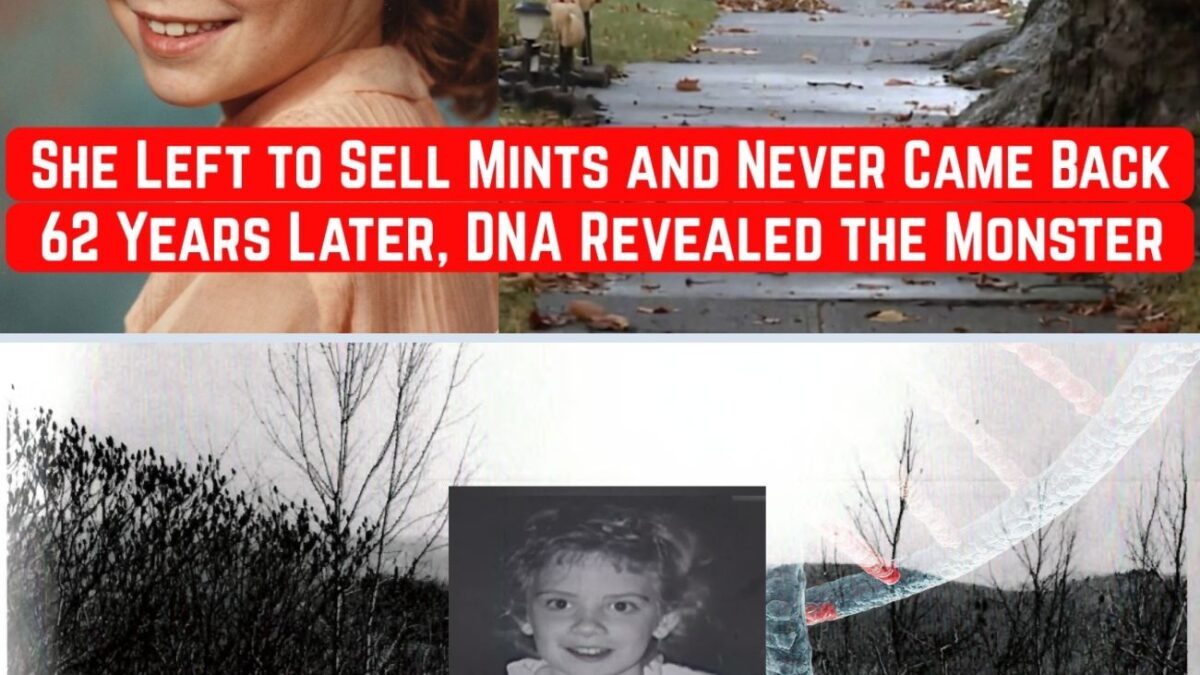
She was 9 years old and weighed 60 lb. On the afternoon of 6th March 1959, she walked out of her front door carrying seven small boxes of mints and never came home. This is not a story about a child who simply wandered off. It is a story about a predator who chose the smallest, most harmless target on the street.
It would take 62 years, three generations of detectives, and a glass jar sitting untouched in an evidence locker to finally expose him. But before we get to any of that, we have to go back to that Friday afternoon. To understand what was lost, you first have to understand who Candy Rogers was. Spokane, Washington in 1959, was the kind of place where kids walked to school alone and neighbours left their doors unlocked.
West Central Spokane was a working neighbourhood, filled with modest homes and familiar faces where everyone knew your name. Nobody watched the clock when children went outside because there was simply no reason to. Candy lived in an apartment above a neighbourhood grocery store on the 2000 block of West Mission Avenue. Her mother, Elaine, worked as a high school history and PE teacher, while her grandparents lived right next door.
She even had a dog named Shep who was always by her side. Candy was small for her age, standing 4 ft 4 in tall, weighing 60 lb, and naturally shy. Yet she was a Bluebird, the junior level of the Camp Fire Girls of America, which mattered deeply to her. It gave her something meaningful to work towards and goals to achieve.
The 6th of March 1959 marked the very first day of the Camp Fire mint selling season. Candy got out of school at 3:15 pm and was at her troop leader’s house by 3:30 pm to pick up her boxes. She had a clear plan to sell enough mints to earn a sales badge and win a free week of summer camp. However, she could only carry seven boxes at a time because she was far too small for more.
They came home and waited patiently for 4:00 pm, which was the official start time. During that half hour, she sat with her grandmother, ate an oatmeal cookie, and played happily with Shep. She chatted about which neighbours she was going to visit and who would definitely buy her mints. She was not nervous at all; instead, she was filled with excitement.
At exactly 4:00 pm, Candy Rogers stepped out into the cold March air and started knocking on doors. In the Pacific Northwest in early March, darkness falls remarkably fast. By 5:40 pm, the street lamps were already coming on across the neighbourhood. Candy knew the golden rule of being home before the lights came on.
Therefore, when 5:30 pm passed with no sign of her, her grandfather went outside to look. He checked with the neighbours and walked the entire block, but nobody had seen her recently. Her mother, Elaine, had been at a hair appointment and arrived home to find her daughter missing. Within the hour, family members were searching the icy streets frantically.
By nightfall, the police had been officially called in to assist. There were plenty of other Camp Fire Girls out selling mints that crisp evening. Dozens of little girls wore the exact same uniforms and carried identical boxes. This coincidence made it nearly impossible to retrace Candy’s exact path.
Witnesses thought they saw her, but they could never be entirely sure which child was Candy. Then, at around 9:00 pm, searchers found something that changed everything forever. On Pettit Drive, a winding road climbing a hill locally known as Doomsday Hill, boxes of Camp Fire mints were discovered scattered across the ground. They were not dropped carefully; they were strewn about haphazardly.
Some boxes looked as though they had been hurled from a moving car window as someone sped away. This chilling trail of boxes led south across the Fort George Wright Bridge, completely away from Candy’s familiar neighbourhood. One recovered box bore a partial fingerprint that was carefully lifted, preserved, and sent straight to the FBI, though tragically it was never identified.
By 9:00 pm on 6th March 1959, Spokane understood one terrifying truth with absolute clarity. Candy Rogers had not wandered off or simply gotten lost in the dark. Someone had deliberately abducted her from the streets.
The burning question was who could have done this, and why target this little girl? Out of all the children out that evening carrying boxes of mints on a cold Friday afternoon, why her? The answer was hiding in plain sight the entire time, but it would take 62 grueling years to uncover. By the morning of 7th March, every single person in Spokane knew Candy Rogers was missing.
More than 1,200 local residents showed up spontaneously to help find her. Twelve hundred people mobilized for one little girl, including Marines, Boy Scouts, utility workers, mail carriers, and horseback riders. All of them descended upon West Central Spokane well before sunrise to search every inch of terrain. A command post was swiftly established at the intersection of Pettit Drive and the TJ Meenach Bridge right where her mint boxes were found, while the US Air Force dispatched helicopters for aerial coverage.
They possessed no mobile phones, no GPS tracking devices, and no advanced digital cameras. Their only clues were scattered mint boxes, one unidentified fingerprint, and a trail that abruptly ended at the edge of a bridge. On 7th March, just one day after Candy vanished, a US Air Force helicopter flying low over the search area struck high-tension power lines. It crashed violently into the Spokane River below, plunging the rescue effort into deeper tragedy.
Three brave crew members were killed in the crash: Airman Marlis D. Ray, Staff Sergeant William A. McDonal, and Lieutenant Kenneth G. Fautek. Two other crew members miraculously survived the disaster. Three men had died while searching for a single missing child. The city of Spokane was now grieving in two devastating directions at once, and poor Candy had still not been found.
The days that followed were suffocatingly silent in the worst possible way imaginable. Tips flooded in from across the entire country, starting as hundreds and quickly mounting into thousands. Detectives followed every single lead diligently and contacted anyone with a relevant criminal history. In 1959, however, there was no official sex offender registry to consult.
Several suspects were eventually developed through police work, but none could be tied definitively to Candy’s disappearance through physical evidence. Sixteen long days slipped away without a breakthrough. Then, on 21st March, two airmen from Fairchild Air Force Base were hunting in the dense woods off Old Trails Road. This location was about 7 miles away from Candy’s home in a remote area.
Moving through the trees near an abandoned rock quarry, they noticed something unusual resting near a tree trunk. It was a pair of small girls’ shoes placed neatly there, not dropped in a rush, but deliberately left behind. They immediately returned to their base and reported the chilling discovery to authorities. The next morning, a large search party arrived at the site just as daybreak cracked.
Within minutes, one of the searchers brushed aside a dense pile of brush and pine needles to reveal a horrifying sight. Candy Rogers lay buried beneath dead branches and tree boughs, roughly 50 yards off the rural road. Retired Spokane Police Captain Richard Oberdin was one of the brave officers who found her that grim morning. He would carry that haunting image etched into his mind for the rest of his life.
Remarkably, he would still be alive 62 years later when the monster who put her there was finally unmasked. The official cause of death was determined to be manual strangulation. The murder weapon was a narrow strip of cloth torn directly from Candy’s own slip, the undergarment she had worn when leaving home. Her tiny feet were bound tightly with another matching strip of that same garment.
Furthermore, a distinct mark encircled her waist, strongly suggesting she might have been restrained with a rope at some point. However, no rope was ever recovered from the crime scene. Medical examiners also discovered evidence of a much darker physical violation that added an unspeakable layer of horror to the crime. Every single piece of evidence was meticulously catalogued and preserved by investigators.
The investigators in 1959 had no inkling of what future technology would eventually extract from biological material decades later. Yet, thankfully, they preserved everything with extraordinary care anyway. The tragic discovery of Candy’s body altered the fabric of Spokane society in ways that persisted for generations. Parents who had previously never thought twice about letting children walk alone now watched anxiously from windows.
They established strict new rules and curfews for their families. The horrifying case became woven into how Spokane parents raised their children for decades, serving as a solemn warning passed down through generations. Police possessed vital physical evidence, including a DNA sample they did not yet possess the technology to analyse. They desperately hoped science would one day hand them an answer.
However, before that scientific breakthrough could occur, a notorious serial killer was about to muscle into the investigation. He would send everyone chasing false leads down the wrong path for the next 40 years. The detectives remained utterly unaware of this looming deception.
For decades, Spokane detectives firmly believed they knew precisely who killed Candy Rogers. They had a compelling name, a dark criminal history, and a piece of evidence pointing straight at one man. For 40 long years, that working theory felt rock solid and unquestionable. Tragically, it turned out to be completely and utterly wrong.
Here is what makes the reality so much more harrowing. The true killer had never appeared in a single tip, witness statement, or police report throughout 62 years of investigation. While detectives relentlessly chased the wrong man, the real perpetrator lived quietly right in the same city. He raised a family, went about his daily life, and ultimately died before anyone ever cast a suspicious glance his way.
His name was Hugh Beyond Morse. He was an active member of the Spokane Motorcycle Club, fitting the profile of a man who blended into the community without raising alarms. When Candy first vanished, he even showed up to help with the community search efforts. He walked those very streets alongside grieving neighbours and determined officers.
He was searching for a little girl he almost certainly already knew was dead. Morse lived just a couple of blocks away from Candy’s home. Four years prior to her murder in California, he had been apprehended for attempting to molest two Girl Scouts selling cookies door-to-door. This was a chilling mirror image of the exact predatory behaviour that befell Candy.
Less than a year after Candy’s body was discovered, Morse raped and murdered two women in Spokane. Following those atrocities, he crossed the country and committed at least seven more violent crimes before finally being caught in Minnesota in 1961. His capture occurred after a sharp-eyed neighbour recognised him from an FBI wanted poster. He eventually died inside a Minnesota prison in April 2003 while serving two consecutive life sentences.
His dark profile matched Candy’s case almost to perfection. He specialized in preying on young girls selling merchandise door-to-door, and he was physically present in the area at the time. Then there was the peculiar detail involving chewing gum. Hugh Morse possessed a bizarre signature habit at nearly every crime scene investigators discovered.
They consistently found grape-flavoured gum left behind across multiple locations, making it a hallmark of his offending. During Candy’s autopsy back in 1959, an observant detective noted a purple-coloured stain on her clothing. When examined closely under scrutiny, the stain emitted a distinct grape scent. That single subjective observation took on a monstrous life of its own within the investigation.
As Morse’s terrifying profile as a serial predator became clearer over the decades, that purple stain became the unshakeable centerpiece of the case against him. It was never scientifically tested or officially proven at the time. Instead, it was an unverified assumption that hardened into near absolute certainty over time. This fatal flaw misdirected every subsequent investigative effort down a blind alley for forty years.
Then came the turning point in the year 2001. Detective Mindy Connolly courageously submitted Candy’s preserved clothing to an advanced forensic laboratory. Scientists successfully isolated a clean semen sample from the evidence and constructed a full DNA profile. This marked the very first time in 42 years that investigators possessed something tangible beyond mere circumstantial suspicion.
They eagerly tested this genetic profile against Hugh Morse. To everyone’s shock and dismay, it did not match him at all. The grape-flavoured stain, the parallel crimes, and the damning geography suddenly meant nothing in the face of science. The DNA profile unequivocally said no.
The profile was subsequently uploaded into CODIS, the national DNA database, but it returned zero hits and complete silence. The real killer had apparently never been arrested for any offence that required submitting a DNA sample to the database. He had never surfaced as a person of interest to law enforcement. In 62 long years, his name had never appeared once in a tip or report.
He had been hiding in plain sight right there the entire time, and not a single soul had ever looked at him. There is one reason and one reason alone that this historic cold case was finally solved. It was not the brilliance of modern detectives, nor fancy technology, nor even the specialized lab in Texas. While all those factors mattered deeply, none of them could have succeeded without a single pivotal decision made back in 1959.
Long before DNA testing was even a glimmer of a concept, an anonymous investigator placed Candy’s underwear inside a glass mason jar and sealed it tightly shut. That simple glass container became the invisible thread connecting a murdered 9-year-old girl in 1959 to a definitive DNA match in 2021. Glass does not degrade over time, nor does it absorb ambient moisture.
Crucially, it does not chemically interact with whatever organic material is stored inside its confines. That airtight seal, crafted in an era with zero awareness of genetic science, created a near-perfect preservation environment. When forensic specialists finally cracked open that glass jar in the early 2000s, the trapped DNA was remarkably intact and robust. It was robust enough to build a complete and flawless genetic profile.
The investigators of 1959 could not possibly have known what future miracles they were safeguarding, but they saved it anyway. Brittany Wright grew up right there in Spokane, hearing tales of Candy Rogers not as a sensational news story, but as a cautionary parental warning. Her parents always told her to watch where she went and remember what happened to that little girl.
The tragic case was deeply woven into the local culture of how Spokane parents raised their children decades after the crime occurred. Wright eventually grew up to become a professional forensic scientist with the Washington State Patrol Crime Laboratory Division. In 2018, when the Spokane Police Department began a comprehensive reassessment of its cold case files, Candy’s folder landed directly on her desk.
The timing was far from random coincidence. Back in 2018, California investigators made global headlines by employing a revolutionary technique known as forensic genetic genealogy. This method successfully unmasked the Golden State Killer, a notorious serial predator who had evaded capture for four decades. The technique worked by uploading crime scene DNA profiles into consumer ancestry databases to uncover distant genetic relatives of the unknown suspect.
Skilled genealogists then meticulously built family trees until they successfully narrowed the vast search down to a single individual name. The moment that historic arrest flashed across international news networks, police agencies everywhere pulled out their oldest cold cases with renewed hope. Law enforcement across the nation asked themselves whether this cutting-edge method could work for their own unsolved mysteries. Spokane immediately asked that exact question regarding Candy Rogers.
However, a serious obstacle instantly stood in their way. Although the DNA sample was exceptionally well preserved compared to typical old evidence, it had still degraded over 60 years. Furthermore, it was heavily encumbered with stubborn non-human environmental contamination. In 2020, Wright submitted the challenging sample to a private genealogy laboratory for analysis.
They sent the results back, declaring the sample far too degraded to work with, and flatly declined the case. That crushing rejection felt like the absolute end of the road. CODIS had yielded zero results, and every traditional investigative avenue had been thoroughly exhausted. If genetic genealogy proved impossible with what remained of the evidence, the case was effectively finished for good.
Then, fortunately, Wright heard about an innovative laboratory based in Texas called Othram. Othram specialized precisely in tackling the most difficult biological cases that other mainstream laboratories routinely turned away. They had developed a proprietary process known as forensic-grade genome sequencing, engineered specifically for highly degraded, contaminated, or near-depleted samples. In February 2021, Wright detailed the difficult sample to the experts at Othram.
Without hesitation, they agreed to try their specialized methods. She carefully packaged up what remained of the precious evidence. At that critical juncture, she later described the sample as being reduced to the very last microscopic drops before shipping it to Texas. Eventually, Othram completed their complex sequencing work.
They had successfully built a comprehensive genealogical profile and run it through a commercial ancestry database. The promising results narrowed the suspect field down to three brothers: John Ray Hoff, James Andrew Hoff, and Terry Allen Hoff. Crucially, standard genealogy cannot distinguish between brothers because their DNA looks nearly identical within a family tree structure.
To identify definitively which of the three brothers had left his DNA on Candy’s clothing, investigators desperately needed a living relative’s cooperation. As it turned out, only one of the three brothers had children, leaving a single path forward. Detective Storment picked up the phone and dialled a woman who had spent her entire life believing her father died because he suffered from severe depression. She had absolutely no idea what monumental shock was heading her way.
In 62 years of intense investigation, John Ray Hoff’s name had never appeared in a single police report, neither as a suspect, a witness, nor even a passing mention. Detective Storment stated it plainly during the subsequent press conference, noting that Hoff was entirely off their radar until 6th September 2021. That was the momentous day everything changed forever. When Storment called Kathy Hoff, he introduced himself as a cold case investigator who urgently required her assistance.
Within 45 minutes of that unexpected phone call, she arrived in person at Spokane Police Headquarters. However, she was not walking in blind; she already knew something was terribly amiss. She had not waited passively after hearing from a mysterious detective; instead, she had immediately turned to the internet. Somewhere during those frantic 45 minutes, she had uncovered the haunting story of a 9-year-old girl murdered in Spokane back in 1959 while selling Camp Fire mints.
She walked straight into that police station carrying the immense, crushing weight of what she already suspected in her heart. Kathy volunteered her own DNA swab without a moment’s hesitation. The genetic results rushed back on 8th September 2021 with staggering certainty. The DNA recovered from Candy’s clothing was a staggering 2.9 million times more likely to be related to Kathy than to any random person sampled from the general population.
Her own father was the monster who left that incriminating DNA behind. Yet, investigators knew their arduous work was still not finished. Since John Hoff was long deceased, there would be no dramatic courtroom trial, no intense cross-examination, and no legal defence mounted. This reality meant the heavy burden of absolute certainty rested squarely on the shoulders of the investigators themselves.
They needed to be as ironclad-sure as modern science could possibly make them. They officially obtained a legal warrant and exhumed John Ray Hoff’s body on 23rd September 2021. The definitive results returned on 1st October with astronomical precision. The mathematical probability that the DNA from Candy’s clothing belonged to Hoff rather than an unrelated individual was 25 quintillion to one—that is the number 25 followed by 18 zeros.
That staggering figure left zero room for doubt, and the case was finally solved. John Ray Hoff was born on 11th August 1938 right there in his home city of Spokane and grew up comfortably on the 2500 block of West College Avenue. He was never an outsider or a drifter; he was thoroughly local, well-known, and entirely familiar to the community.
His early life, however, displayed glaring warning signs that formed a recognizable pattern in hindsight. In 1955 at the age of 16, he escaped from a state juvenile reform facility near Olympia and was eventually recaptured near Yakima. That minor brush with the law pushed him toward a military path. He enlisted in the US Army at 17 and was assigned to the sensitive Nike missile sites protecting Fairchild Air Force Base right outside his native Spokane.
On 6th March 1959, he lived at 221 West Broadway Avenue. Meanwhile, Candy’s family home was situated on the 2200 block of West Mission Avenue, exactly one mile apart. In 1961, a mere two years after Candy’s brutal murder, Hoff was arrested again in West Spokane. The serious charge levelled against him was second-degree assault.
The horrifying details of his crime revealed that he had grabbed a woman, forcibly removed her clothing, bound her tightly using her own garments, and strangled her nearly to death before fleeing. Miraculously, that victim survived her ordeal. Read those chilling details very carefully. He used his victim’s own clothing to bind her and strangled her with her own garments.
This modus operandi was an exact, chilling match to what was inflicted upon little Candy Rogers. The ligature found deeply embedded around Candy’s neck had been torn directly from her own slip, and her ankles were bound with another strip of that very same garment. The 1961 victim survived solely because an unexpected interruption startled him away. Poor Candy had received no such mercy.
Hoff served a paltry six months in prison for that horrific assault. As a direct consequence of that felony conviction, the Army declared him a deserter and issued a dishonourable discharge. He drifted aimlessly between various menial jobs, selling cutlery door-to-door, working at a lumber yard, and logging hours at a meatpacking plant where he suffered a severe chemical burn across his face. He was a troubled man incapable of building a stable life.
Then there is the most agonizing detail about Hoff that cuts far deeper than all the others combined. He had a young stepsister who was 10 years old in 1959 and also an active Camp Fire Girl. She was assigned as Candy Rogers’ official big sister in the youth programme, acting as the older mentor whose duty was to guide the younger Bluebird. She genuinely knew Candy and cared deeply about her.
When Candy mysteriously disappeared and the entire city fell apart searching desperately for her, this young girl was utterly devastated. She sat right beside her own brother, John Hoff, crying uncontrollably. She poured her heart out to him, telling him how much she missed her little Camp Fire sister and how horrific the tragedy felt. He sat right there beside her and said absolutely nothing in response.
John Ray Hoff ultimately died in 1970 long before anyone could ever hold him legally accountable. He took his own life by shooting himself in the head. Eerily, the exact date he chose for his suicide was his own daughter’s birthday—the day she turned 9 years old, which was precisely the same age as Candy Rogers when he raped and murdered her. Whether that grim timing stemmed from crushing guilt, bizarre coincidence, or something much darker, he took that secret with him to the grave.
When investigators finally set out to locate where he had been buried, they uncovered a startling fact that left the entire room dead silent. For 51 long years, John Ray Hoff was buried in the exact same cemetery as Candy Rogers—the little girl he had abducted and the child he had strangled with her own clothing. She was laid to rest in that cemetery, and remarkably, so was he, resting just yards away from her for over five decades.
While her grieving family visited her graveside year after year wondering who could have committed such an atrocity, her ruthless killer lay in the exact same ground, enfolded in the exact same silence, right in their home city. Not a single person had ever known. His name had never once entered the sprawling police investigation files. When Detective Storment broke the news to Hoff’s surviving family members about what the DNA had irrefutably confirmed, he captured the profound tragedy at the press conference.
He stated: “I took those people’s lives and their childhood and dumped it on its head.” He was not exaggerating or being overly dramatic for effect. Poor Kathy had spent her entire existence believing her father died prematurely because he suffered from debilitating depression. That was the comforting family narrative they relied upon to make sense of losing him.
In one shattering conversation with the detective, that false story was instantly replaced by a nightmare no one could have ever prepared for. The crushing grief did not simply evaporate; instead, it transmuted into something infinitely more complicated and painful. When the family learned he was buried in the very same cemetery as Candy, they made an honourable decision without needing to be asked. They promptly arranged to have his mortal remains exhumed and moved to a completely different cemetery so that Candy, as Storment eloquently put it, could finally enjoy some peace.
When Candy’s surviving family heard about this gesture, her cousin Joanne was completely overcome with emotion. That compassionate gesture extended from the killer’s family to the victim’s family was certainly not legal justice, but it was the only meaningful thing they possessed the power to give. There remained the lingering, heartbreaking matter of Hoff’s stepsister, who was now well into her 70s. Once the case was officially solved, Storment tracked her down personally to explain what her brother had done.
She was, in the detective’s own words, absolutely and utterly heartbroken. She recalled the agonizing memory of sitting right next to John Hoff all those decades ago, weeping over Candy’s disappearance and pouring out her grief. She told him how devastated she felt and how desperately she missed her little Camp Fire sister. He had simply sat there, listened attentively to her weeping, and offered not a single word.
She had spent her entire life carrying that crushing burden of grief as an innocent bystander, never once suspecting that the person responsible was sitting right beside her, absorbing her authentic tears without a single flinch. Kathy Hoff courageously delivered a videotaped statement that was broadcast during the 19th November press conference. She refused to hide from the truth or attempt to deflect the horror by stating directly:
“I’m very, very sorry for what my dad did, that he took her life horribly. I hope that it gives her peace knowing that even though it’s not really justice because he doesn’t get any punishment, his name has this on it now. And they can know it’s solved.”
That poignant statement is well worth sitting with in contemplative silence. There would never be a formal courtroom trial, no sentencing hearing, and no dramatic moment where the legal system looked John Hoff in the eye to condemn him publicly. He had successfully cheated earthly justice by taking his own life decades prior. However, Kathy was offering the only fragment of restitution that remained: unvarnished public acknowledgement.
His name was now permanently chained to the monstrous acts he committed, the official record corrected, and the naked truth recorded on paper forever. It certainly did not constitute true justice, but it was far from nothing. Sitting quietly in the audience during that historic press conference was retired Captain Richard Oldenburg. He was one of the dedicated police officers who had originally discovered Candy’s lifeless body back on 22nd March 1959.
He had personally brushed aside that grim pile of brush and pine needles to witness what John Hoff had left behind. He had carried that haunting, unbearable image in his heart for 62 harrowing years. Miraculously, he had lived long enough to finally hear the definitive answer and express his profound gratitude by stating:
“I thank God that I lived long enough to see the end of this case.”
Detective Storment, who appeared visibly moved and emotional throughout the entire conference, was asked how many cumulative hours had been poured into the Candy Rogers investigation over six decades. He declined to offer a numeric total. Instead, he remarked:
“This isn’t measured in hours. This is measured in careers.”
Three distinct generations of devoted detectives had worked tirelessly on this single cold case. Three successive generations had handed the investigative torch forward with the exact same silent, desperate plea: never give up on her. Thankfully, that final generation of investigators refused to let her down. Candy’s cousin Joanne wiped fresh tears from her face and offered a simple, heartbreaking reflection:
“I feel like Candy’s loss was just a horrible loss. She was so cute and she didn’t have much time. She didn’t have much time.”
Candy Rogers was only 9 years old when her bright life was extinguished. She had simply wanted to earn a sales badge, play with her beloved dog Shep, and enjoy oatmeal cookies baked by her loving grandmother. She looked forward to visiting a neighbourhood full of friendly neighbours on a crisp spring afternoon. A future that belonged to her by natural right was ruthlessly stolen on a cold Friday in March 1959.
The perpetrator was a 20-year-old soldier living just one mile away who was never once placed under official suspicion. While the world will never know the magnificent person she would have grown up to become, certain enduring truths remain clear. She mattered deeply enough that 1,200 compassionate citizens dropped everything to search the wilderness for her. She mattered enough that three generations of police officers refused to let her file gather permanent dust.
She mattered enough that a dedicated forensic scientist who grew up hearing her whispered name packaged one final, fragile sample to ship to a distant laboratory. She refused to accept that the truth was lost to history forever. Furthermore, she mattered enough that the daughter of her murderer looked squarely into a camera lens to ensure the world knew his true name and his heinous deeds. Sixty-two years, eight months, and thirteen days had finally elapsed.
That is the agonizing duration Candy Rogers had to wait for the truth to come to light. The long, agonizing clock has finally stopped ticking. Yet, a haunting question lingers in the air. How many other forgotten cold cases from the 1950s and 1960s still harbour biological evidence locked inside evidence cabinets?
They are waiting quietly for modern technology—technology that already exists today—to finally grant them definitive answers. John Hoff committed a nearly identical, vicious assault in 1961 yet served a mere six months behind bars. If that lenient judicial sentence had accurately reflected the profound danger he posed to society, would Candy Rogers’ case have ever needed to wait six decades for resolution? What does true justice truly mean when the only punishment a monster faces is having his despicable name permanently branded to his crimes long after he is gone?
You Might Also Enjoy


Mom Installed a Camera To Discover Why Babysitters Keep Quitting But What She Broke Her Heart


She Gave a Hungry Little Girl a Free Birthday Cake — The Next Morning, a Black Rolls-Royce Arrived




