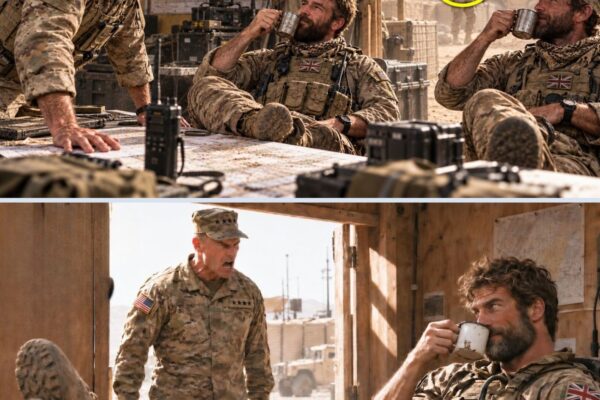
“We Hand Him Over When I Say So” — The SAS Major Who Defied Baghdad Command Over One Prisoner
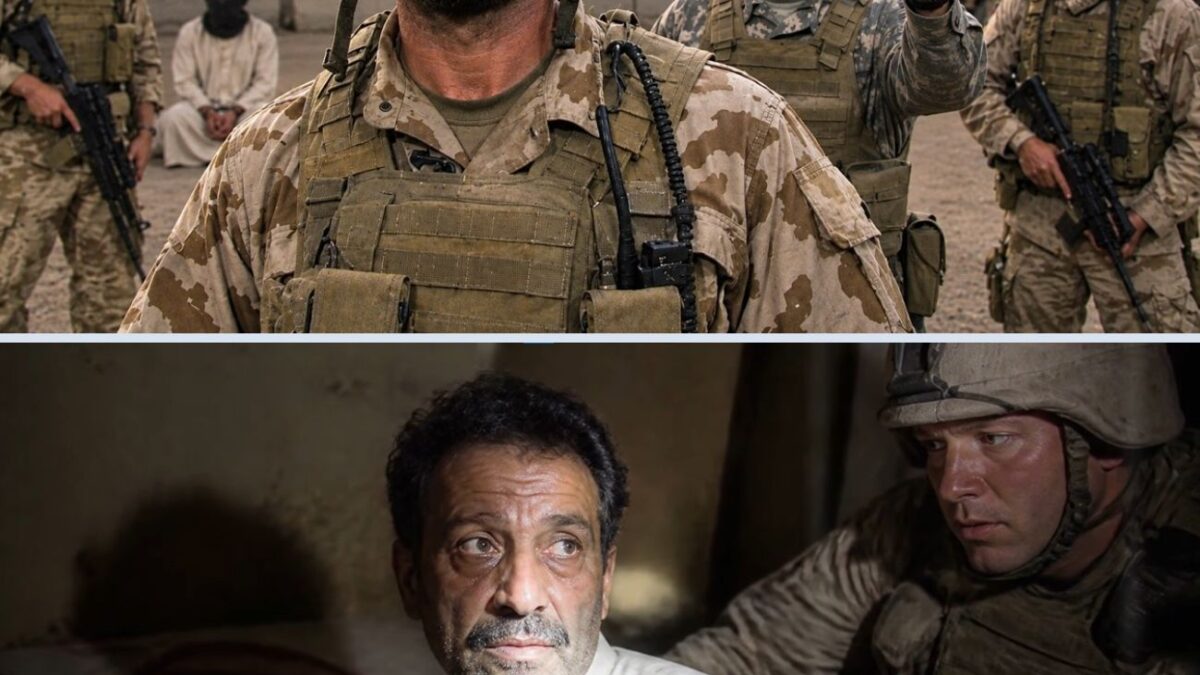
There is a plywood walled operations room on the edge of Baghdad International at 4:00 in the morning. A colonel of the United States Army is standing in the middle of it with his hand raised. He is telling a special air service major to his face that the man cuffed in the back of a super cat outside is to be driven across the wire and handed to an American holding cell within the hour.
The major is still in his assault kit with gray courtyard dust on the stock of his rifle. He has been awake for 22 of the last 24 hours. He is looking at the colonel the way a man looks at weather he intends to walk through.
The colonel’s name is Dwight Harland, and he is 61 years old. He has a silver star from Mogadishu that half the room has heard about and nobody has heard from him. He says it loud enough that the signalers two partitions away stop typing.
“You people take 4 hours to arrest a man. My kids could arrest in 4 minutes. You are not operators. You are lawyers with rifles. Hand him over.”
He lets the hand hang in the air because he wants an answer in front of witnesses, and he gets one. The major does not raise his voice.
“We hand him over when I say so.”
There are 11 Americans and six British on that floor, and every single one of them has just understood that something is about to happen that will be written down and remembered. The colonel has said a thing in front of his own people that he cannot unsay, and he will be made to. He has in one sentence bet 26 years of career on the idea that the Hereford man in front of him is a bureaucrat in dusty trousers.
He has bet it in a room with a clock on the wall and a map behind him and a general on his way. The clock reads 02:11, and the next 4 hours are the subject of this account. You should know before anything else happens two facts the colonel does not.
The man in the back of the supercat is not the brother the Americans have been hunting for seven months. The major with the dust on his rifle already suspects it because of something he saw on a jawline by the light of a weapon torch 40 minutes ago in a courtyard with a lemon tree in it.
The colonel wants the prisoner in four minutes, but he will wait four hours and watch. Dwight Harland is not a fool, which is the first and most important thing to understand about him. The whole point of what is about to happen to him is that it is happening to a competent man.
He went into the United States Army in 1981 out of a small town in western Pennsylvania where his father and grandfather had been steel workers and the recruiting sergeant had been patient. He made Ranger and selection for a unit it is still polite not to name directly. On a street in Mogadishu in October 1993, he carried a wounded sergeant 400 m under fire and came out of it with a silver star and a limp that took 18 months to walk off.
He did two tours in Iraq after the 2003 invasion, the second of them running a task force out of Mosul that put real named facilitators into the ground. He is a man who has done the thing. By 2007, he is a full colonel on the coalition joint operations center floor in Baghdad.
He is tired in the particular way that senior American officers get tired in that war. He is tired of what he sees as slow, tired of what he sees as cautious, and tired of watching men he believes to be the enemy walk home because the paperwork was not neat enough. In his own mind, he is the adult in a room of pedants, though he is wrong about the pedants and right about the war being slow.
The joint operations center is a long rectangular hanger divided into pens by eight foot sheets of unfinished plywood and hung with cables the way an old barn is hung with cobwebs. There are 17 screens along the back wall and a map of Baghdad four meters wide along the front. There is a coffee pot that has not been washed since March and a smell that is one part diesel, one part dust, and one part the sour tang of men who sleep in their uniforms.
The air conditioning fights the desert and loses. On any given night, there are American intelligence officers, American signalers, a small British liaison cell behind its own partition with its own kettle, and at least one general either present or dialing in from somewhere cooler. On this night, the general is Pfeiffer, who is 40 minutes away, giving Colonel Harland 40 minutes to settle the matter.
The matter, as Harland sees it, is this. For seven months, American intelligence has been chasing a mid-tier Al Qaeda in Iraq facilitator named Omar Al Dulaimi, a man who moves money, moves weapons, and twice now has moved the kind of bomb that puts American boys into aluminum boxes. At 22:30 that night, British Signals Intelligence produced a target address in Adhamiyah.
At 23:10, the British squadron on the ground confirmed the house, and at 23:50 they went in. At 01:20, they came out with one detainee, hooded, cuffed, compliant, and loaded into the back of a Super Cat. Four hours, door to door, to the colonel standing in front of a map with a red grease pencil circle around Adhamiyah is four hours too many.
To the colonel, the men who have just done this should have kicked the door at midnight, shot anything that moved, dragged the target into the vehicle, and been back inside the wire by one. To the colonel, what has actually happened—the slow quiet entry, patient questioning in the courtyard, biometric swab, and second biometric swab—is a parade of lawyers in helmets. He is not entirely wrong that it was slow, but he is entirely wrong about why.
He is standing by the map wall with one hand on a mug of coffee he is not drinking, talking loudly enough for the signalers to hear because he wants them to hear. Chief Warrant Officer Wendell Kruper, who has a delta pedigree older than most of the men in the room and the good sense of a man who has survived three bad bosses, is standing behind him with his arms folded and his face arranged.
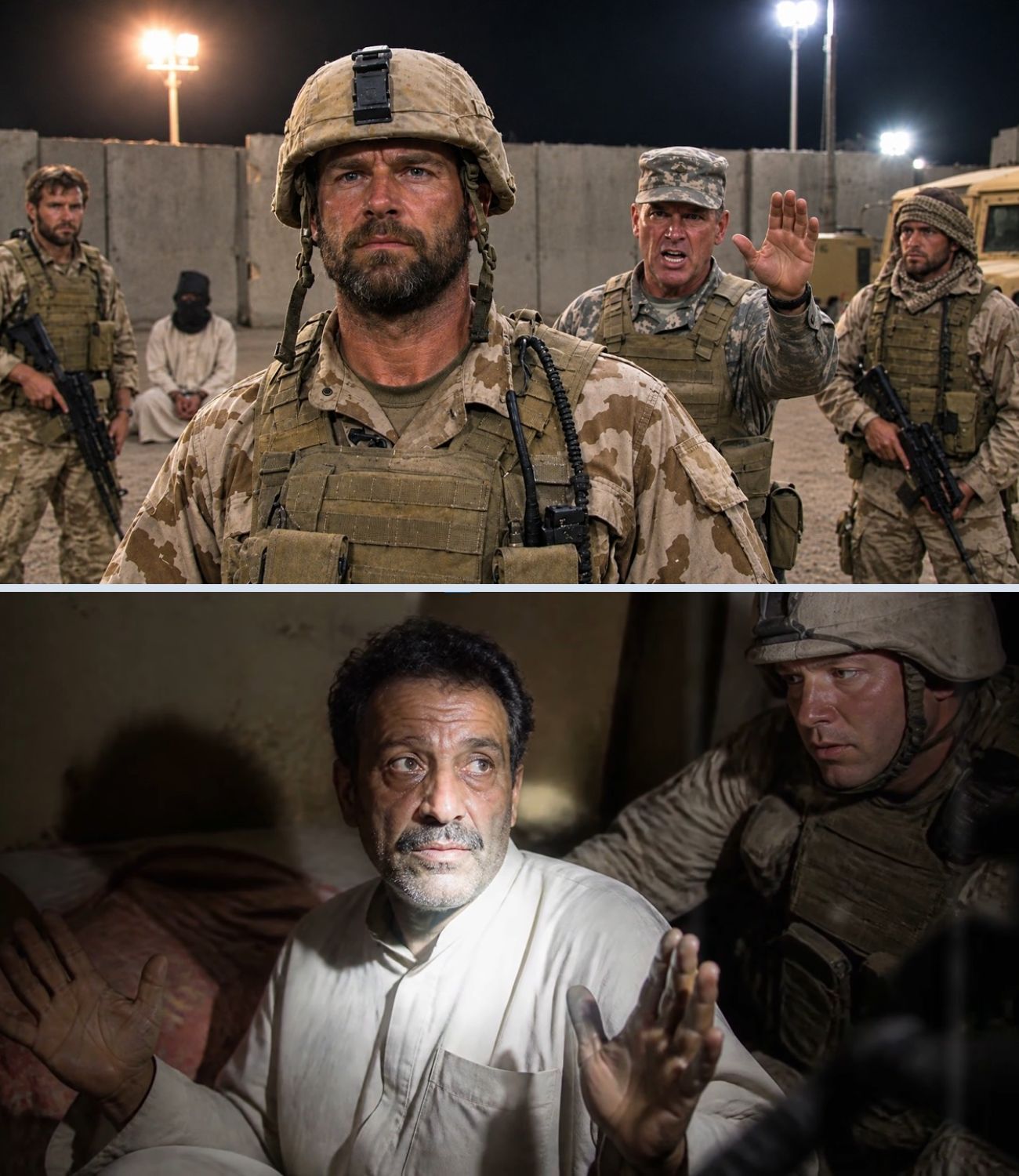
Across from them, the British Major A N Brecken, OC of the Saber Squadron element, 38 years old, 15 years in the regiment, two in Bosnia, two in Afghanistan, and two prior in Iraq, has walked onto the JOC floor still in his belt kit and with a radio on his shoulder. He has come to brief, though he has not yet opened his mouth. Harland does not wait.
“You people,” he says, and he says the next words looking directly at Brecken and loud enough for the map wall to hear them. “Take four hours to arrest a man my kids could arrest in four minutes. You are not operators. You are lawyers with rifles. Hand him over.”
A British staff sergeant two steps behind Brecken—Rodery Price, Welsh, carrying a scuffed brass compass in his thigh pocket that belonged to his father who did Oman a decade in—does not move his face. He has heard worse said by better men. The young American captain at the intelligence console, Ellis Vaughn, 29 years old and two months into his first deployment, looks very carefully at the screen in front of him.
Kruper behind Harland does the thing he has done in rooms before, breathing out slowly through his nose without laughing. Brecken takes one step forward and answers short.
Four hours earlier, in a different part of the city, the Saber Squadron element has been moving. Adhamiyah, in the autumn of 2007, is a Sunni district on the east bank of the Tigris, a grid of low breeze block houses and narrow streets where the power goes off at unpredictable hours and the dogs do not. It is a place where a loud entry costs more than a quiet one because loud entries bring neighbors onto rooftops, and rooftops bring the kind of gunfight that puts holes in the wrong people.
The squadron knows this, having learned it specifically in the past year in three separate streets not far from this one. The target address is a single-story house with an inner courtyard and a wall at the back that gives on to an alley. Signals and human intelligence have put the target inside.
A second independent signals cut, routed through the British cell and not shared with the colonel’s floor until confirmed, has put the target inside as of 22:40. The assault team is 12 men. They drop 200 m out on foot in the dark and walk in.
There is a particular silence that a trained 12-man element can carry through a residential street at midnight, and Trooper Micah Oluwole, youngest on the team, has been taught it for three years and still finds it surprising when it works. He is 23 and carrying an L119 with a suppressor, while the ballistic sunglasses he bought with his own money because he hated the issued ones are pushed up onto the front of his helmet above the night vision mount. He is moving in the second of three pairs along the south wall of the compound, speaking not a word as nobody speaks.
Price, three men ahead, puts a hand flat against the gate and then takes it away, checking the hinges without using the torch yet. The compass in his trouser pocket does not come out because he is not thinking about the compass, but about the hinges, which are new. They do not kick the door; they lift the latch, and the latch lifts.
Inside the courtyard there is an old lemon tree with wire looped through its lower branches to hold up a washing line that is no longer there. There is a plastic chair on its side and a kettle on a cold gas ring in a sort of outdoor kitchen built against the back wall. There is water in the kettle that is still warm when Sergeant Theo Ashdown, the team medic and third man through the door, puts his gloved hand against the side of it.
Ashdown is the man on the team who in a bar in Hereford 18 months earlier won a round of drinks by reciting the detainee handling standard operating procedure in full from memory, in the order the paragraphs appear, including the footnotes. He is not reciting anything now; he is logging. The warm kettle means somebody has been in the kitchen in the last 20 minutes, meaning somebody is still in the house. The house has three rooms, and the team clears them in 41 seconds.
In the second room, on a low mattress, there is one man who is awake, sitting up, in his forties, thin in a long white tunic and bare feet, holding his hands away from his body with the palms out before anyone has told him to. He is not armed and has not run. He looks, Oluwole thinks later, more tired than afraid.
Major Brecken is the fifth man through the door. He takes one look at the face in the beam of Ashdown’s weapon torch, and something in his expression changes by a degree. Price, who has been working with Brecken for two years, notices the degree and does not comment on it.
The reason is on the man’s jawline, where there is a scar along the left mandible—thin, about four centimeters long, old, the kind of scar a child gets falling off something concrete. Brecken has seen three photographs of Omar Al Doulaimi in the last six weeks, and in all three the scar is on the right. He does not say it yet, but files it.
They cuff the man without hooding him yet. Brecken has a particular preference, which he does not advertise and does not need to, that a man whose face you still need to see should not yet have a bag on his head. Ashdown reads the English side of a bilingual card, the squadron’s attached interpreter reads the Arabic, and the man on the mattress gives a name.
“Yusef Al Doulaimi.” He gives it twice. He says in Arabic that he is a teacher, teaching geography at a secondary school eight streets away. He says his brother Omar does not live in this house and has not lived in this house for two years.
Price, listening, writes nothing down because that is Corporal Daniel Weir’s job, and Weir, three paces back, is already writing it down in very small left-handed block capitals on a waterproof pad in the thigh pocket of his own trousers. Brecken says quietly to Ashdown, “Prints and a swab, both. Now.”
Ashdown takes the detainee’s right hand. He takes prints on a card and a buccal swab on a sealed cotton stick. He bags the card and the stick, labels them, and hands them to Weir, who logs the time—00:37—and the chain of custody.
None of this takes very long, and none of it is dramatic. It is also, in this district and in this war, the difference between the right man in a cell by morning and the wrong man in a cell by morning. It is the thing the colonel on the JOC floor, who has never been in this courtyard and never will be, is about to call lawyering.
Brecken has in the left thigh pocket of his trousers a folded, laminated page with the relevant lines of the Geneva conventions printed on it in nine point, with worn pale corners. He does not need to read it because he knows what it says. They carry out a search of the house and find school books, including a geography textbook in Arabic open and face down on a small table beside the mattress with pencil marks in the margins.
They find no weapons and no money beyond a few hundred dinars in a tin. They find in a drawer a photograph of the detainee with a class of 12-year-olds on a step in front of a school building. They load the detainee into the back of the Super Cat at 01:11 and are back inside the wire at 01:58.
Brecken, walking across the gravel from the vehicle to the JOC door, is already composing in his head the sentence he intends to say first. He does not get to say it first because the colonel speaks first. You have already heard what he said.
Return now to the floor at 02:11 and the sentence that is already in the air. Harland has told Brecken to hand the prisoner over, and Brecken has told Harland that he will not. There is a beat in which the whole floor is listening even though most of the floor is pretending not to be.
Harland, who has not met Brecken before this week, makes an assumption. The assumption is that the man in front of him is being territorial, that this is a unit pride problem, a flag problem, a who gets the credit problem. He has seen it before in junior officers, handled it before, and now prepares to handle it again.
“Major,” he says, and his voice has come back down to the measured, slightly patient tone of a man who is about to explain something simple. “You are going to put that prisoner in a vehicle. He is a high value target. He goes to the facility. Those are your orders.”
Brecken takes the radio off his shoulder and sets it on the shelf of the nearest partition, taking his gloves off and putting them beside the radio. These are not theatrical movements, but the movements of a man who intends to be in this room for a while and wants his hands free.
“Sir,” he says, using the word which some of his men notice. “The man in the back of that vehicle is not Omar al-Duleimi. I believe he is Omar’s elder brother. I will know in approximately 40 minutes. Until I know, he stays under my guard in my cell on this side of the wire. When I know, you will have whatever I know in writing and the chain of custody will be clean.”
Harland laughs, not meaning it unkindly in his own head, thinking he is laughing at a junior man’s overcaution.
“40 minutes,” he says. “Major, in 40 minutes my kids could arrest him four times.” He says it to the room, but the room does not laugh with him.
Captain Ellis Vaughn at the intelligence console has been listening with a particular stillness. Vaughn is 29, on his first deployment, and has been chasing Omar al-Duleimi on three screens for six weeks. He knows the face, having in front of him the photograph the Americans have been working from—a grainy Iraqi police mugshot from 2004—and beside it on a second screen a single frame grabbed by the squadron’s helmet camera in the courtyard 40 minutes ago and already uploaded through the British cell.
The grabbed frame is of the detainee’s face in the courtyard lit sideways by Ashdown’s weapon torch. Vaughn looks at the mugshot, looks at it again, and his mouth opens very slightly. He does not say anything yet because he is a captain, the colonel is talking, and he is new.
Kruper, standing behind Harland with his arms still folded, has been watching Vaughn’s face, having worked with captains like Vaughn in rooms like this before. Kruper shifts his weight and clears his throat once, quietly. Harland, mid-sentence about the facility and the timeline, does not hear him.
Brecken, who has been waiting for exactly this, takes one step to the side so that he is within arm’s reach of Vaughn’s console. He does not touch the mouse or reach over the captain’s shoulder, but points from a polite distance at the mugshot.
“Captain, the scar on that face, which side?”
Vaughn, who has been staring at exactly this for 90 seconds, does not have to look again. “Right, sir.”
Brecken points at the grabbed frame. “And that one?”
“Left.”
The whole room has heard it, including Harland, who is a man in enough rooms to know when a room has just heard something. His face changes by one small degree, which is all it is going to do in front of his own captain, but it is enough. He covers it by moving.
“Scars switch sides in mirrors,” he says. “Photographs mirror. You know that, major.”
“Not this one. The source file metadata was checked. It is not mirrored. Captain Vaughn’s own cell confirmed it in August.”
“That’s correct, sir,” Vaughn says, directing it to his screen rather than Harland. But he says it loud enough that Kruper, Price, and two signalers behind the next partition hear it. One of them, who has worked with Vaughn since the summer, looks over the top of the plywood for the first time in four minutes.
Harland does not reply immediately, taking a drink from the coffee he is not drinking. He sets the mug down slightly harder than intended, and a thin brown ring jumps onto the shelf. In his 26th year in the United States Army, in a room full of his own people, he has just been told by one of his own captains that the British major is right about a face and he is wrong.
He recovers because he is good at this. “A scar is a scar. The biometric will settle it. Get the biometric, major, and we will see where we stand.”
This is, as Brecken thinks but does not say, exactly what he intends to do, exactly what he has been doing since 00:37, and exactly what the colonel just spent 4 minutes calling lawyering. Vaughn at his screen does not raise his head, Kruper shifts his weight back to level, and Price in the corridor outside is already moving to escort Ashdown, the print card, and the swab stick to the British cell’s own biometric terminal. The squadron set it up on their own side the previous summer rather than wait on the American queue.
That was only the first time that night the colonel would be wrong. You should remember the words the colonel said in front of the map wall at 02:11 because they are not going to be taken back and because the man who said them is now going to spend the next 90 minutes trying three separate ways to make the prisoner leave the British side of the wire before the fingerprint match comes back. Each of those three ways will fail in front of the room.
This is the first of them. He goes up the chain, doing what 26 years has taught him to do when a junior officer is in his view obstructive. He picks up a telephone on the plywood shelf beside the map wall and uses it standing up.
He calls the American side of the task force command cell two buildings over and asks for a lieutenant colonel he has known since Kosovo. He is not loud, knowing this is a different kind of fight now. He says in effect that the British on the ground have a detainee held up on procedural grounds, and that he would appreciate a word from the task force principal to the British CO to break the logjam.
He uses the words logjam and bureaucratic drag, but avoids lawyers with rifles because he knows by now he should not have said that out loud and is unwilling to repeat it on a logged line. Brecken, standing 6 ft away, hears half of the call because the colonel has not lowered his voice, but does not interrupt, understanding that there is a correct moment to let a thing run its course.
The call makes it within 7 minutes to Lieutenant Colonel James Carro, commanding officer of the deployed British element, who is in a smaller, quieter room on the British side of the camp and has already been briefed by Brecken on a sat phone at 02:04. Carro is a man with a reputation for one particular sentence: “My decision, my name on it,” which he said at Sandhurst in 1988 and approximately once a fortnight ever since.
He takes the call, listening to the polite, tired American task force principal who is not himself terribly keen on Colonel Harland. Carro says without raising his voice that the prisoner is being held under British evidential procedure, that a biometric match is in progress, and that the hold should resolve within the hour to establish identity on paper before handover questions become academic or urgent.
He closes with, “My decision, my name on it. I will be at the JOC in 12 minutes.” Carro arrives at the floor at 02:31 in clean fatigues, looking rested despite not sleeping. He walks past the map wall, nods to Krupa and Vaughn, stops in front of Harland, and remains standing.
“Colonel, I understand you have a concern about one of my men.”
“I have a concern about a prisoner.”
“The prisoner is in Major Brecken’s custody under my authority. Major Brecken has my full confidence. The biometric terminal in our cell is working on the sample now, and we will know who we have inside the hour. At that point you will have the result in writing and we will proceed accordingly.”
He pauses and adds as a precise man, “If the result is Omar Al-Duleimi, you will have the detainee within the hour by vehicle convoy to your facility with my signature on the transfer. If the result is not Omar Al-Duleimi, we will discuss what happens next.”
Harland has options at this point. He could escalate by calling two-star General Pfeiffer, who is now 30 minutes out instead of 40, or insist on his order as a direct order and make Brecken formally refuse on record. He does none of these because he is not stupid and because a lieutenant colonel has just said in front of the same room that heard lawyers with rifles that his major has full confidence and biometrics will settle it within the hour.
To escalate further is to bet in front of a arriving two-star that biometrics will come back his way, a bet he is unwilling to make while Vaughn’s scar answer lingers in the room. “Within the hour then.”
“Thank you, Colonel.” Carro moves one step to the side to speak quietly to Brecken, leaving the prisoner unmoved.
“Ian, are you right about this?” Carro asks in a voice that does not reach the map wall.
“Sir, I think I am. The jaw is wrong. The age is wrong by six or seven years. He answered to Yusef without prompting. He said his brother has not lived in the house for two years. The house is a teacher’s house.”
“Fingerprint?”
“Running.”
“Hood off?”
“Hood off. In my cell, water, he has been shown courtesy.”
Carro nods once for Brecken alone and walks out of the room at 02:39. Harland watches him go, having almost called them school girls before catching himself too late about the lawyers.
At 02:46, Harland does the second thing, deciding to see the prisoner himself. Under the interservice arrangement, he has the right to view the detainee in British custody with notice and in the presence of a British officer. He gives notice to Krupa, who passes it to Price, who passes it to Brecken, who replies flatly, “Fine. He may view.”
Harland walks the 140 m from the floor to the British cell building with Krupa one pace behind. The night air is cold in the sudden, dry way of desert nights, clearing his head in an unwelcome way because his clear-headed self is beginning to understand he may be in trouble. Men like Harland do not slow down when in trouble; they arrive faster.
The British holding area is a converted storeroom on the back of a Portakabin with two cells, a desk, and a humming single overhead strip light. Ashdown sits at the desk while Oluwole stands at the occupied cell door with an L119 slung muzzle-down and ballistic sunglasses pushed up on his helmet.
The detainee sits in the hoodless cell on a plastic chair with a water bottle and cup on a small table in front of him. He looks up when the door opens, gazing at Harland and Krupa without fear, looking—as Kruper thinks later—embarrassed like a man pulled from his mattress at midnight over his brother. Brecken arrives 30 seconds behind from the other direction, standing at the corridor junction without entering.
Harland stops before the cell, looking through the wire panel at the face and the scar for perhaps four seconds. It is the longest Harland has been silent in Brecken’s hearing. He turns slightly towards Ashdown without taking his eyes off the detainee.
“Sergeant, ask him who his brother is.”
Ashdown does not move, looking instead at Brecken at the corridor junction, who also remains still. “Sir, with respect, the colonel is here to view. Questioning is on the schedule. The major agreed with your chief warrant officer, and that is at 03:30 with your interpreter and ours and the written card. I can show you the card, sir.”
“Sergeant, ask him.”
“Sir, I can’t do that.”
Harland takes half a step closer to the desk. He is not a man who shouts in corridors, but a particular compression enters his voice, and Kruper behind him clenches his fists inside his pockets because he has seen Harland angry twice before with worse things following within the hour.
Ashdown, knowing exactly what is about to not happen, takes out a laminated card with small print on both sides from his breast pocket. He recites flatly and without stopping the relevant three paragraphs of the detainee handling standard operating procedure, including two footnotes in order, finishing with the specific rule that questioning outside the detaining unit’s chain of command requires written authorization from the commanding officer countersigned by the medical officer.
“Sir, I’m the attending medical officer. I don’t countersign.” The strip light hums, and Oluwole does not move.
Harland remains silent for a count of three. Then, through the wire panel in slow, careful school teacher’s English, the detainee speaks without prompting: “My brother is not here. My brother has not been in this house for two years. My name is Yusuf. I teach geography.”
He says it to Harland because Harland is the only man still looking at him, adding politely, “Sir.” The corridor falls extremely quiet. Kruper takes his slow breath through his nose, Ashdown looks at the desk, Oluwole’s face is fixed, and Brecken stands motionless at the junction.
Harland looks at the scar for another two seconds, noting the water bottle, the plastic cup, the missing hood, and the chair. He turns, walks back down the corridor at the same pace with Kruper following one step behind.
Outside in the cold air, Harland stops before the gravel path with his hands on his hips, staring at the black horizon marked by a distant red light. Kruper says nothing, knowing him too well.
“Fingerprint timing?”
“18 minutes, Colonel, give or take.”
“The general?”
“12.”
Harland nods once and walks back towards operations. He does not voice his growing realization that in 15 minutes he will face a two-star general, fingerprint results, and the major, with only one of those things backing him up.
Here is what to watch for next. A US Army colonel has bet his judgment before 16 witnesses that a British major is a bureaucrat blocking a mid-tier terrorist arrest. A slip of paper brought by a left-handed British signaler in block capitals will settle the bet aloud, and you will want to be in the room.
Major General Pfeiffer arrives on the floor at 03:04 as a two-star in clean fatigues, a man who reads before speaking as the room waits in silence. Standing at the map wall, he reads the printed summary Vaughn hands him without a word—target address, entry time, detainee description, preliminary identity indicators, and pending biometrics.
Reading it twice without sitting down, he finally says, “Colonel Harland.” Harland steps forward while Pfeiffer glances at the sheet.
“Brecken, sir,” says Brecken. “Major Brecken.”
Pfeiffer looks at both, having likely been briefed by phone on his walk over because his first question is direct. “The scar. Which side on the detainee?”
“Left, sir.”
“And on the mugshot?” Vaughn asks before Brecken can answer. “Right, sir. Source file confirmed, not mirrored.”
Pfeiffer nods once. “Biometric estimated time of arrival?”
“Four minutes, sir.”
These are the longest four minutes of Dwight Harland’s career. The operations center is never silent, with printers running behind partitions and signalers talking in low headset voices about Baquba, while the air conditioning loses to the desert. Yet the specific rectangle of plywood, screens, and map wall where Harland, Brecken, Pfeiffer, Kruper, and Vaughn stand is wrapped in a memorable silence.
Harland stares at the map and the red grease pencil circle around Adhamiyah, running a calculation he hasn’t needed in 20 years: what happens when a senior officer says something publicly that he cannot survive being wrong about. Brecken watches the British cell door instead.
At 03:08, the door opens and Corporal Weir walks in holding a single sheet of A4 paper. Moving at his usual steady pace as a left-handed soldier, he stops in front of Brecken and offers the sheet.
“Read it, corporal.”
Weir reads it in a flat Lancashire voice loud enough for the map wall to hear: “Biometric terminal, British cell, timestamp 03:06, sample reference Bravo 724, fingerprint comparison against target reference Omar Al Dulaimi, Iraqi Police file minutiae points matched zero out of 10, minutiae points excluded 10 out of 10. Comparison against secondary reference, local census print Yusuf Al Dulaimi, Baghdad Education Ministry 2002. Minutiae points matched 10 out of 10. Match confidence 99.6%, buccal swab result corroborates. Conclusion, detainee is Yusuf Al Dulaimi, school teacher, elder brother of target. Detainee is not Omar Al Dulaimi. Signed staff sergeant R. Price, B Squadron. Countersigned captain A. Mowbray.”
Stopping his reading, Weir folds the sheet in half along its crease and hands it without looking at anyone to Pfeiffer as the senior officer present. Pfeiffer takes it, and the room holds still for a count of three.
Reading the sheet twice just like the summary, Pfeiffer looks up first at Harland, who remembers this moment. “Zero of 10.”
Harland’s mouth opens slightly without words coming out before he closes it. Pfeiffer turns to Brecken. “Major, who is Omar Al-Duleimi’s current whereabouts in your best assessment?”
“Sir, based on the elder brother’s account, which is consistent with our signals history, we assess Omar Al-Duleimi has not been in the Adhamiyah house for approximately 24 months. The house hit tonight is the elder brother’s house. Our working line on Omar is a second address in Ghazaliya, which our cell is developing now, and we expect a target package in 48 to 72 hours.”
“The elder brother?”
“Teaches geography at the Al Nader Secondary School, has three children, has been cooperative, will be released to his home at first light under our cover.”
“Good.” Pfeiffer turns fully to Harland without raising his voice, knowing the room listens with total concentration to a rare moment. “Colonel, four hours, right man held, wrong man excluded, biometric chain clean, no civilian casualty, elder brother released at first light. That is what the four hours bought.”
“Sir—”
“And had we moved him across the wire at 02:15 on your request?”
“Sir.”
“Then at 03:06 we would have had the wrong brother in an American facility on an Al-Qaeda charge and we would have learned about it on CNN by Thursday. Is that accurate, Colonel?”
“Sir, that is accurate.”
“Then I think we owe the major a coffee.” He does not smile when he says it. Read that number again: zero of 10, not one or three, but zero, meaning the man demanded in four minutes was the maximum different person possible from the target.
Brecken looks at the door where a school teacher waits in a cell with a plastic chair to go home, while Pfeiffer dismisses no one because the signalers are already back at consoles, Vaughn is typing, and Kruper stands closer to Harland to offer quiet support. Pfeiffer hands the sheet back. “Your paper, Major, keep it clean.”
“Sir.” Pfeiffer walks out without looking at Harland again, leaving four men in the rectangle: Harland, Brecken, Kruper, and Vaughn at his console. Price stands at the door holding the folded sheet.
Harland offers no apology, as this is not that lane. Instead, he looks at Brecken, the paper, and the red map circle around Adhamiyah, taking a breath in and out. “Major.”
“Colonel.”
“The prisoner will be released at first light under your cover.”
“Yes, Colonel.”
“I will be at the gate.” It is as close to an apology as 26 years and a silver star permit after saying “lawyers with rifles,” and neither man helps him with it.
As Harland reaches the door, Kruper speaks quietly. “Colonel.” Harland stops, turning his head slightly. “Four hours bought the right cell,” Kruper says levelly without emphasis, stating a fact as a chief warrant officer must when his colonel is publicly wrong.
Harland looks at Kruper for a second and a half without replying, since no question was asked. He walks out, the door closes, and Kruper follows after nodding once to Brecken.
Vaughn exhales at his console for what sounds like the first time in 40 minutes, while Brecken fingers the laminated Geneva page in his pocket without pulling it out. At 06:11, the sky over Baghdad International is the color of weak tea as a British super cat idles at the inner gate.
Yusuf Al-Dulaimi sits in the back without a hood, wrapped in a blanket Ashdown gave him, holding his print card, swab stick, and release paper in a plastic sleeve, knowing what the paper says through the interpreter. At the gate at parade rest stands Colonel Dwight Harland, present because he said he would be.
He does not step forward or speak to the detainee, but watches the vehicle pass through the gate, turn onto the perimeter road, and vanish over 40 seconds—the last thing he will remember of that night for his career. He retires 18 months later at his original rank, competent and quiet about Baghdad, never visiting Hereford or writing letters.
Brecken says nothing about it except once to Caro in a seven-word sentence never repeated. The four-minute line lives in Vaughn’s notebook, Kruper’s memory, and Brecken’s pocket page as a truth, enshrined in the squadron’s post-operational report as an example of why four hours matter.
The four hours are not hesitation or caution or lawyering, but the mechanism ensuring the right man enters a cell by morning and the wrong man goes home. In a war where that difference dictates whether a city can be held, the four hours—not kicking doors or taking prints—are the operation.
Any force can arrest a man in four minutes, but arresting the right one takes a particular kind. Harland called them lawyers with rifles in front of 16 witnesses, and in a narrow sense he was correct, as they carried rulebooks and notebooks alongside their weapons.
He was right about the lawyers, but catastrophically wrong about the rifles and the men carrying both, proving that unit could do both. Long after that night in Hereford, a folder sits in a cabinet containing a transfer paper signed by Carro, a biometric result reading zero of 10, and a geography textbook page with pencil marks.
Nobody remembers who put the textbook page there, but it belongs in the closed folder as the war continues and four hours remain four hours. If you followed this to the end, you know the regiment’s rule and its cost in certainty.
There are more stories like this on this channel of nights the record keeps. If you want the next one, hit the bell to know when it lands. The school teacher went home, the colonel watched from the gate, and for one night in Baghdad, that was the whole war in 40 seconds.
You Might Also Enjoy

Mom Installed a Camera To Discover Why Babysitters Keep Quitting But What She Broke Her Heart

She Gave a Hungry Little Girl a Free Birthday Cake — The Next Morning, a Black Rolls-Royce Arrived