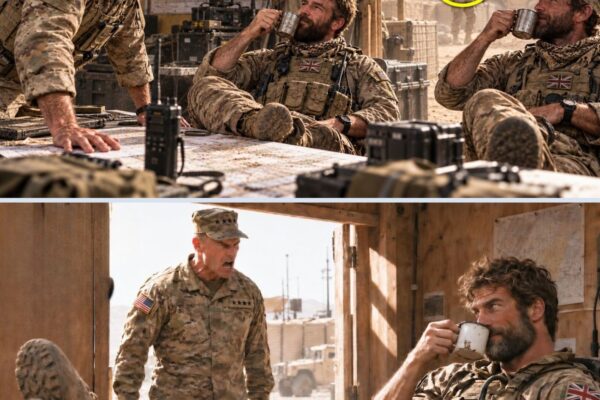
When German POWs Entered a British Pub For The First Time
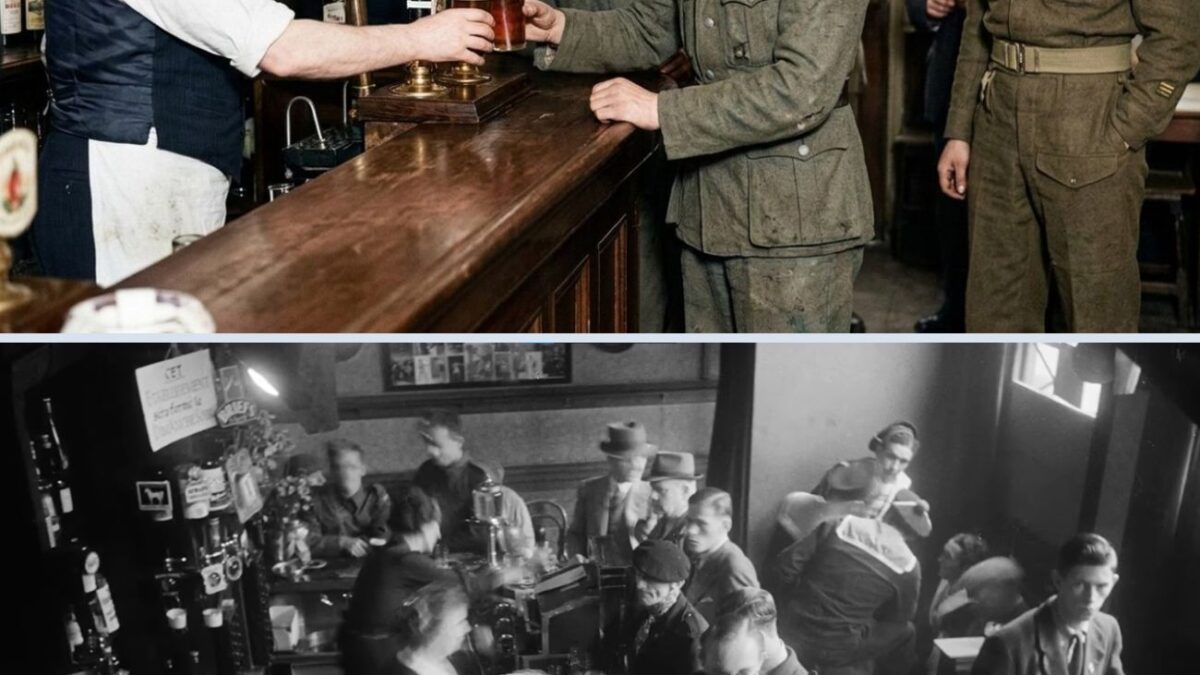
October 1944. A German soldier is standing outside a pub in rural England. He can hear laughter through the door, British voices, and civilians.
The British sergeant beside him is holding that door open, smiling, waiting for him to walk in. This man is a prisoner of war.
He has been on British soil for six weeks and he cannot work out if this is an act of kindness or the strangest trap he has ever seen. What he did when he finally walked through that door and what he kept in his wallet for the next fifty years because of that evening is a story that tells you something about Britain that almost no history book bothers to record.
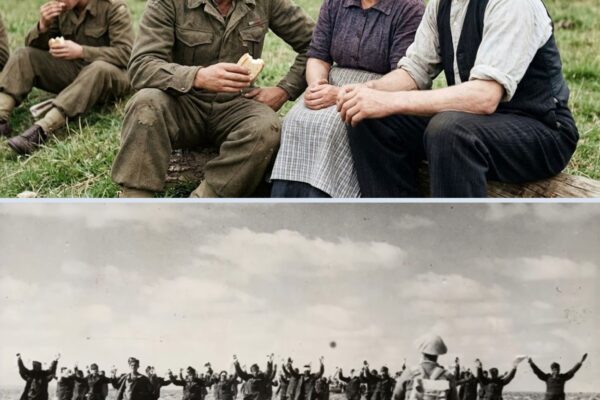
Most of the German soldiers who ended up in British camps in the autumn of 1944 came out of Normandy. Specifically, many came out of the Falaise Pocket, one of the most complete military collapses of the entire war.
Allied forces had encircled an entire German army group. The men trapped inside were being bombed from the air and shelled from three sides, ordered to hold positions that everyone on the ground knew were already gone.
When the breakthrough finally came and the soldiers raised their hands, they were not defiant. They were finished. And they had been told, most of them, exactly what to expect from the British: hostility, revenge, a country still burning with fury from four years of German bombing.
What they found instead began the moment they arrived on British soil and it confused them from the start. The trains moved through Kent and into the English interior, passing green fields, stone churches, and villages that looked untouched, going about their business as if the war were happening somewhere else entirely.
Germany had been bombing this country for four years. These men looked out the windows and expected to see evidence of that: damaged buildings, hostile faces, a country that looked like what it had been through.
Instead, they saw an England that was quiet and unbroken. And for many of them, that was the first crack in the story they had been told about what Britain was.
The camps reflected a policy built on Britain’s obligations under the 1929 Geneva Convention: adequate food, shelter, medical care, work with token payment, no torture, no execution, and treatment within the limits of wartime scarcity that assumed these men were human beings.
For soldiers who knew what was happening to German prisoners on the Eastern Front, this was almost impossible to process. The Soviet Union had not signed the Geneva Convention, and German soldiers captured by Soviet forces faced conditions that were, in many documented cases, deliberately catastrophic, including forced labor, extreme cold, starvation rations, and mortality rates in some camps exceeding fifty percent.
By late 1944, capture by Soviet forces was understood by most German soldiers to be a slower death sentence, and some German prisoners were not released from Soviet camps until the mid-1950s, a full decade after the war ended. The men who ended up in British camps had, in many cases, made a conscious calculation in their final hours before surrender about which direction to walk.
The ones in Northamptonshire, Yorkshire, and Kent had calculated correctly. And now they were harvesting wheat in the English countryside, sleeping in dry huts, eating vegetable soup and tea with milk, and trying to understand what kind of war this was.
Work on the farms began within days of arrival. The hours were long, from seven in the morning until five in the afternoon, but the logic of it became clear quickly because the quota was fixed.
Finish your section early and you rested. Men who had never thought of themselves as particularly hard-working became very efficient agricultural laborers very fast because efficiency meant ninety minutes under a tree before the truck came back.
The farmers were almost universally pragmatic. They needed labor, the prisoners provided it, and personal feelings about the war were secondary to getting the harvest in before the rain.
But here is what the official history leaves out, because what was happening on those farms was not just an exchange of labor for shelter. Something else was developing slowly and without anyone planning it that would eventually lead to the moment outside that pub door.
Some of the guards assigned to these prisoner groups were men in their fifties who had served in the First World War, men who had been captured themselves or who had known men who had been. One guard in Lancashire, captured by Germans in 1917 and held for nearly two years, was known to tell the prisoners he watched over that he had been treated decently in a camp near Hamburg.
He seemed to believe this created an obligation that ran in both directions. He was not their friend, he never pretended to be, but he treated them as he would have wanted to be treated, and after months of combat, that was something none of them had been prepared for.
It was guards like this man who began, without any official instruction, to extend small additional courtesies to prisoners who had behaved well: an extra half hour before the truck came, a walk to the farm pond and back without an escort, and then in some cases something that went considerably further.
The pub visits were never in any policy document. They happened because individual men decided on individual evenings that a small group of prisoners who had caused no trouble deserved a couple of hours out of the camp.
And in rural England in 1944, there was only one place to go for a couple of hours in the evening. Now here is the part that people find hardest to believe, and it requires you to understand one specific thing about the British pub, because without it what happened inside those doors makes no sense at all.
A British pub in 1944 was not simply a place that served alcohol. It was the social center of every village in England, the space where the unwritten rules of community were maintained.
And the most fundamental of those rules was this: anyone who came through the door, behaved themselves, and had money for a drink was welcome. The publican was the absolute authority, and while Parliament could pass what it liked, the pub had its own constitution.
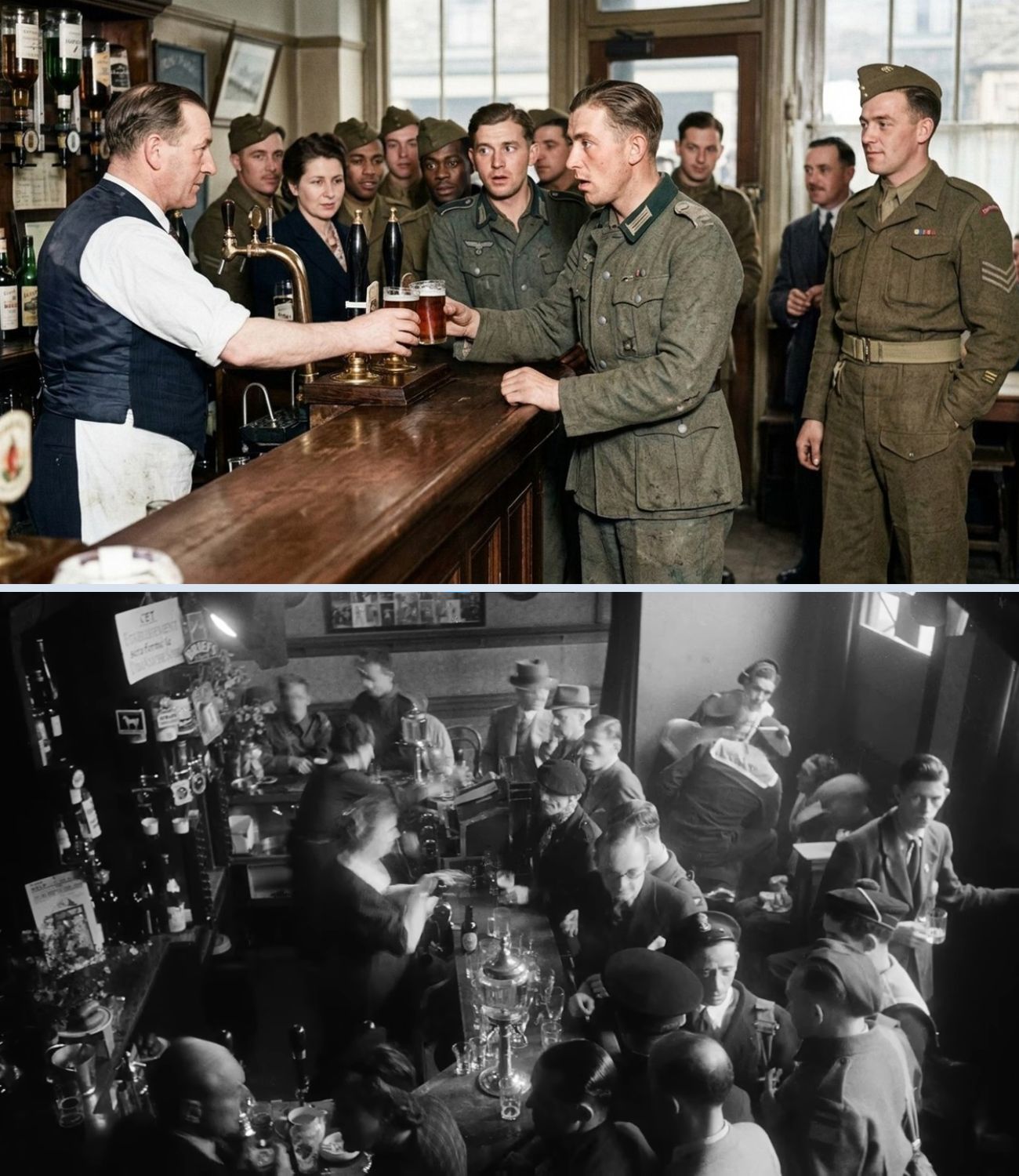
And when German prisoners walked through those doors in their dark brown uniforms with prisoner-of-war patches on their backs, the publicans of wartime England looked at them and made a decision. The conversation stopped when they entered, and that part was predictable, with twenty or thirty British civilians suddenly face-to-face with men whose country had been bombing their cities for four years.
The recognition was immediate, and the silence stretched. And then, almost always, it ended—not because anyone had forgotten anything, but because the publican had let them in, and in a British pub, that settled it.
The beer was warm, which was the first thing most prisoners mentioned afterward, since German lager was cold, filtered, and carbonated, while British bitter was room temperature, dark amber, and possessed a depth that was entirely unfamiliar. Most of them drank slowly, partly because one pint was the limit, and partly because they were watching everything in the room with the careful attention of people who could not quite believe what they were seeing.
The civilians who had looked up when they entered had gone back to their conversations, the barman was pulling pints, and the sound of laughter came from a table near the fire. And one prisoner, writing about that evening years later, described it as the most confusing two hours of the entire war—not because anything dramatic happened, but because nothing dramatic happened.
He had expected punishment, and he had been prepared in some part of himself for something worse than punishment, but he had not been prepared for a coal fire, warm beer, and British civilians ignoring him. It was, he wrote, like being allowed to be a person again.
What happened on those farms and in those pubs was only the visible surface of something much larger, because the relationships that formed during this period—between prisoners and farmers, between guards and the men they watched, and between young Germans and the British families they worked alongside—went considerably deeper than anyone had intended or expected. And some of them lasted for the rest of people’s lives.
Prisoners made things in the evenings: a sewing box carefully made from scrap wood given to a home guard officer’s wife on her birthday, a wooden cabinet shaped like a row of books presented to a Scottish family whose son had been assigned to watch over a group of prisoners, and toys carved in camp huts for children whose fathers were away fighting. These objects were kept, and some of them are still in existence today—small handmade things that represent an entire human relationship across the line of enmity sitting in drawers and on shelves in British homes long after the men who made them were gone.
There is one story from this period that stops people when they hear it. A German prisoner held in a camp on the south coast of England, a police officer from Munich in civilian life, was kept under investigation after the war ended while authorities checked whether he had been involved in any of the atrocities that came to light in 1945. He hadn’t been.
When the investigation concluded, a local family invited him to spend Christmas with them while he waited for repatriation. He arrived, met the children, pulled them through the snow on a toboggan, and taught the family a carol in German.
Then he went home and spent years trying to find them again, but he didn’t have the English vocabulary to trace them after they moved. It took until 1970 for the connection to be remade through a chain of police contacts across two countries, through records searched in Munich, and through a conversation in Dortmund between a British officer and German colleagues who knew where to look.
When they finally found him, he was elderly and overjoyed, and the families visited each other until he died, while the carol he taught them in 1945 became a regular party piece in that British household for decades afterward. This is not an unusual story; it is a representative one.
Across rural Britain—in Yorkshire, Somerset, Wales, and Scotland—men who had arrived as prisoners had, by the time repatriation came, built lives substantial enough that going back to the rubble of post-war Germany felt like the less real option. Some of them stayed, married, took on farms, and became part of communities that had once regarded them with suspicion and came, over years, to regard them as simply part of the place.
Their grandchildren are British today—people who sometimes discover, looking into family history, that the grandfather who never quite lost a trace of an accent had arrived in this country in 1944 in a dark brown uniform with prisoner-of-war patches on his back and had simply never left. And then May 1945 arrived and everything changed.
When the Allied armies entered Germany and found what the Nazi regime had built, the photographs reached Britain within days: Bergen-Belsen, Buchenwald, and the documentation of what the camps had been. The British public’s reaction, from people who had been, in many cases, treating German prisoners with something close to normality, was one of profound and furious horror.
Parliament demanded reduced rations for prisoners, and camp commandants received orders from London, turning the warmth that had developed over eighteen months, almost overnight, formal and distant. The pub visits stopped, and the prisoners sat with the photographs in the recreation huts.
Most of them claimed then and for the rest of their lives that they had not known the full extent of it, having only heard rumors and whispers about camps in the East, about transports, and about things soldiers were ordered not to discuss, having told themselves it was propaganda. And now the photographs were on the table and would not be argued with.
What that moment felt like for men who had worn the uniform of the regime responsible for those photographs is something that resists easy description. The reckoning was different for each of them, and for most it was not clean, quick, or complete, but rather something they carried home.
But here is the detail that the official histories miss: for some of those men—not all, not even most, but some—the experience of being treated as a human being in British captivity was the thing that made the reckoning possible at all. It was much harder, having experienced that treatment, to look at the photographs and argue that the people in them hadn’t deserved the same.
The British had not set out to teach that lesson, but some of the men sitting in British camps in the spring of 1945 learned it anyway. When they finally went home, they found a Germany that barely resembled the country they had left: cities in rubble, currency replaced by cigarettes, and families dead or missing.
They rebuilt in silence, most of them, and when people asked where they had been during the war, they said Normandy and left it at that. The pub visits were impossible to explain in the Germany of 1946; the warm beer, the coal fire, and the guard who thought past treatment created present obligation—none of it translated into a language still struggling to find words for what the country had done and been.
Yet they thought about it, and many of them for the rest of their lives thought about it. A man born in Germany in 1950, the son of a prisoner, wrote decades later that his father had spoken of the British throughout his childhood with a respect that was not sentimental, not uncritical, but genuine, and that visiting England for the first time as a young man had felt like coming home.
He eventually moved to Britain permanently and became a British citizen, stating that he could still find that end-of-war spirit in more of his fellow Brits than some would have you believe. What the German prisoners found in British captivity was not perfection, and the treatment was sometimes inconsistent, with camps that were better and camps that were worse, meaning the story is not simple.
But underneath all of it, something was there: a decision made at the level of policy and repeated at the level of individual human judgment across hundreds of farms and village pubs that these men would be treated as human beings, not because the war was forgotten, but because Britain had decided it would not become the thing it was fighting against.
The silence when the door opened, and then the silence ending. A German soldier sitting in the corner of an English pub drinking warm beer, watching an ordinary evening go on around him, trying to work out what kind of country does something like this.
He kept the beer mat in his wallet for fifty years. His family found it after he died and asked what it was.
His wife told them that the British had treated their father well, better than he had expected. She paused.
Then she said, “Better, perhaps, than he had deserved.”
You Might Also Enjoy


Mom Installed a Camera To Discover Why Babysitters Keep Quitting But What She Broke Her Heart

She Gave a Hungry Little Girl a Free Birthday Cake — The Next Morning, a Black Rolls-Royce Arrived