5 Things American Soldiers Found Strange About the British Army
5 Things American Soldiers Found Strange About the British Army
In 1942, an American soldier getting off a troop transport in Northern Ireland was given a pocket manual by his own War Department and told to read it before speaking to anyone. It was a guidebook to the country he had just arrived in, written by his own government, and it read less like a travel brochure than a briefing before a difficult meeting.
It was also, in some parts, a warning. Don’t brag about the United States. Don’t talk about money. Neither his nor yours. Don’t tell the British how to fight a war they’ve been in since 1939 and you’ve only been in it for 6 weeks. And don’t criticize tea, under any circumstances. The brochure even joked about it.
He said that the British don’t know how to make a good cup of coffee and that you don’t know how to make a good cup of tea. He called it a fair exchange. That sentence tells you what the whole document was for. Washington had concluded that the quickest way to lose a war fought from someone else’s island was to irritate the people who lived there.
And that 3 million young men, if left alone, would achieve it in less than a month . Nearly 3 million American soldiers and women would pass through Great Britain during the next 3 years. A friendly invasion of a country the size of Michigan that had already been at war for two and a half years. They arrived with chocolate, cigarettes, nylon stockings, and money.
And they were called, almost immediately, overpaid, hypersexual, and here present. The British responded with a joke of their own. They were underpaid, desexualized, and under Eisenhower’s command. But the jokes hid something real, and the newcomers noticed it within days. Two armies that spoke almost the same language, wore almost the same uniform, and fought against the same enemy, found each other baffling.
And Americans found five things about the British army strange enough to write home about. So tonight, we’ll go over those five things, ending with the one that no manual mentioned, because the U.S. War Department couldn’t bring itself to print it. Everything you will see here comes from what the men themselves wrote and said at that time.
Letters, official guides, and complaints from both sides. Some of this is comedy. The last one, it isn’t. One more thing about that pamphlet is worth mentioning, because it explains the tone of everything that followed. It was not written for diplomats. It was written for farm boys and office workers who had never left their state, about a country where the beer was lukewarm, money had no meaning, and the war had been going on since before they finished school. Number five.
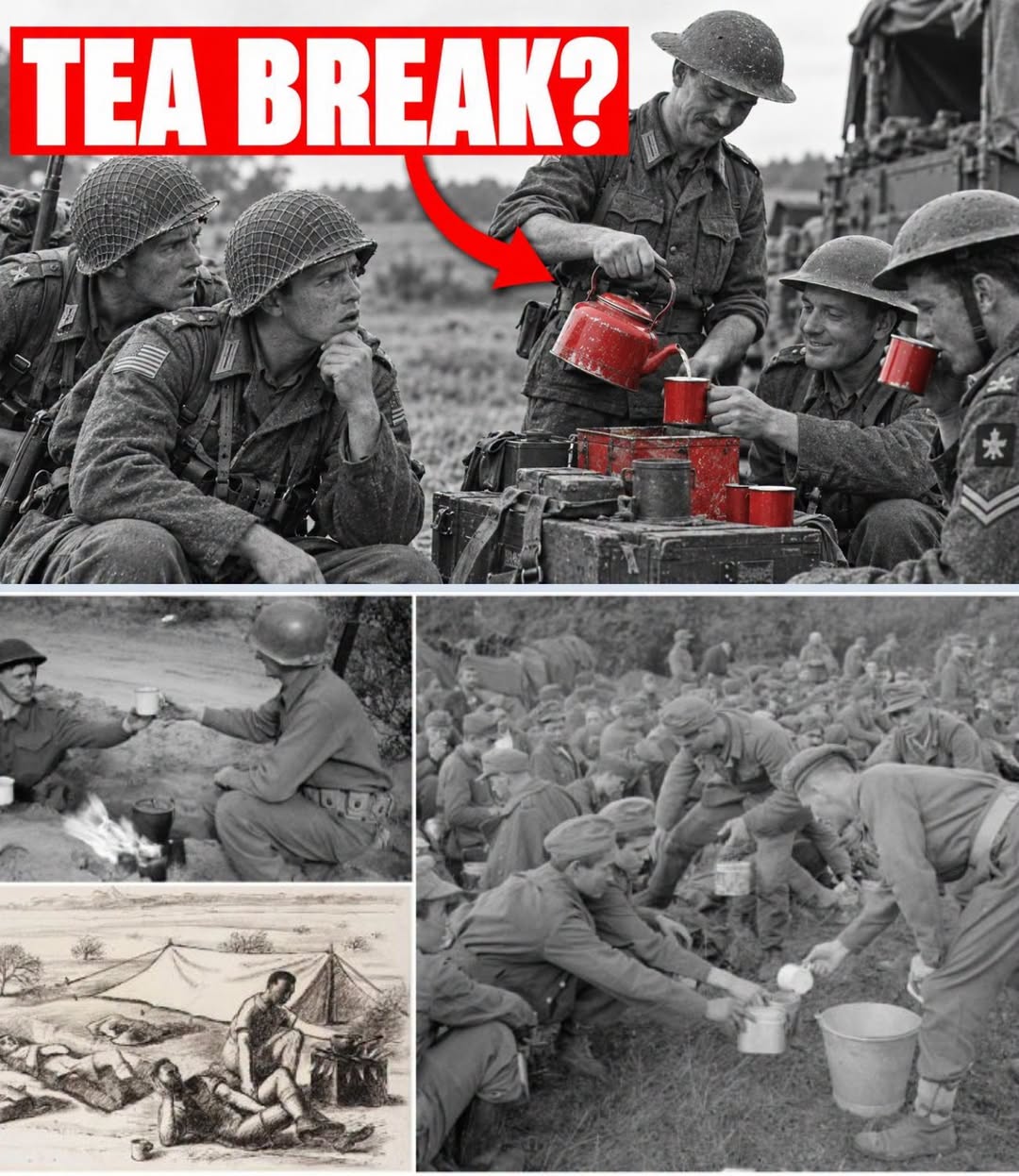
The war paused for tea. American soldiers had been told repeatedly and in writing that the British drank tea. What no one had explained was that the British army would drop what it was doing to prepare for it. In the middle of a task, an advance, sometimes in the middle of a battle, they treated the interruption as the most reasonable thing in the world.
An artillery crew that had been in action all morning got down from their guns, lit a fire in a cut-off gasoline can, and made tea. The officers were waiting. The sergeants were waiting, which in the British army is much more significant. In some units and under certain conditions, the enemy also waited, because the British discovered that men fight better after ten minutes of something hot.
To an American, this seemed like indiscipline disguised as tradition. For a British soldier, it was the essential ritual of the entire army. Ten minutes of normal life produced at will in a mud field in the middle of war, the only fixed point in a day that, otherwise, had no shape whatsoever. Americans got used to it faster than they ever admitted in writing.
By 1944, there were American units preparing tea in the British style, using their methods and complaining about British coffee while doing so. The habit survived war and peace in a good number of American families. And, to be fair, the complaint about the coffee too. It was easy to laugh at tea. The next difference caused real resentment, and it had to do with pay.
There is one more thing about infusion that Americans eventually understood. Actually, it wasn’t about the tea at all. It was a group of men standing together in the open air and behaving for ten minutes as if the war was something that happened to other people. One correction before we continue with the list, because tea makes the British army seem charming , and it wasn’t.
It was an organization with a savage disciplinary code, a class system they hadn’t even begun to correct, and three years of defeats behind them. The Americans weren’t arriving among saints. Number four, the pay. An American private earned several times what a British soldier did for being in the same field, under the same rain, and doing the same job. The gap was not subtle.
No army tried to hide it, and every soldier on both sides could do the math before breakfast. In practice, this meant that Americans could pay for the round, the dance entrance fee, the taxi, and the stockings, while the British could not . Every social event in wartime England had an implicit exchange rate, and everyone in the room knew that rate.
Americans found this more uncomfortable than pleasant. Many had been raised under the belief that a man’s salary reflected his worth , and here were professionals who had been struggling for three years and were earning a fraction of what a 19-year-old kid from Ohio was making just for showing up.
It wasn’t anyone’s fault, but it ruined so many evenings. The British soldiers dealt with it as they deal with everything: with a joke that concealed a sharp blade within. “Underpaid, sex-starved, and under Eisenhower’s command” was funny exactly once. After that, it became a stance. Because behind the money there was a difference that Americans never fully got used to, and it began the moment an officer entered the room.
The wage gap caused real harm. It fueled the jealousy that led to fistfights outside the ballrooms and the resentment that made a British soldier’s sarcasm sharper than he intended. Money was the only difference between the two armies that no amount of goodwill could hide. Number three. The officers had servants.
Every British officer of a certain rank had an assistant, a soldier assigned to look after his equipment, his boots, his tea and his clothes, and on the battlefield, to dig his trench and carry his equipment. The system was centuries old, perfectly normal for the British, and utterly astonishing for Americans, raised on the idea that no one should serve another.
The US military was not class-based. No one who has ever met a U.S. colonel believes that, but it wasn’t based on the idea that some men are born to be served. The British army, on the other hand, clearly descended from a society that did. Americans first noticed the accents and continued to notice them.
In the army of 1942, you could still guess a man’s school by his vowels, and that school had a lot to do with whether he received an official position. The British constantly discussed this and slowly corrected it, if at all . What confused Americans the most was that ordinary soldiers did not reject the system as much as an American would have .
They constantly mocked, completely obeyed, and saw no contradiction in doing both, which is a very old British arrangement that foreigners almost never get to understand. And there was a second part that visiting American officials reported home with genuine surprise. A British officer was expected to ensure his men ate before him, to make himself visible on the front line, and to lead from the front.
And British junior officers were dying at a rate that showed this expectation was real, and not just ceremonial. Thus, the Americans arrived expecting to find snobbery, and found a system that was both more snobbish and more dangerous for the top brass than their own. That contradiction was present in everything, even in what surprised them most about British confidence.
The Americans also noticed what the “batmen” system said about the British soldier’s view of himself. It’s not that he was humiliated, exactly. He had a job, a rank, a place, and a very clear sense of what was owed to him in return. And any officer who forgot the second part of that deal would quickly find out.
Number two: they had already lost, and it showed. The Americans arrived in 1942 with the enthusiasm of a country that had not yet been defeated by anyone in living memory. The British army they were joining had been repeatedly defeated before the eyes of the whole world. And it had the mannerisms of an organization that expects the worst because the worst keeps happening.
Dunkirk, Norway, Greece, Crete, Singapore; the largest surrender in British military history. And it had happened three weeks after the first Americans landed in Ireland. Tobruk, where 35,000 men were captured in a single day. That’s not a track record that breeds arrogance. It produces caution, thoroughness, and a deep suspicion of optimism.
British planning assumed that things would go wrong, anticipated it, and created reserves rather than plans, because, according to this army’s recent experience, they always went wrong. This was infuriating to the American officers. They interpreted British caution as pessimism, sluggishness, and an unwillingness to seize obvious opportunities while they were available.
Some said it out loud in rooms where they shouldn’t have . And several of the arguments between the two armies in 1943 were genuinely bitter. The British viewed American confidence as inexperience and said so privately, which is worse than saying it out loud, because it always ends up getting out. Desert veterans watched the fresh American units make the same mistakes they made in 1941, and they weren’t always kind about it.
Both sides were right, which is the most awkward outcome any argument can have. And they both learned. By 1944, the British had relaxed and the Americans had moderated, and the invasion was planned by men who had spent years annoying each other to the point of competition. Which brings us to the last point and the reason why the War Department manual did not continue. A U.S.
general summed up the difference in a sentence that both armies would have recognized. The British, he said, had learned to be cautious because they were forced to be. The Americans had not yet learned this lesson and would pay the price for it in Tunisia. Number one. The British army did not segregate. More than 100,000 of the American military personnel who arrived in Great Britain were black, and the army that sent them was segregated by law, by regulation, and by custom.
Black soldiers served in separate units under white officers and were mostly assigned to cargo, transport, and supply jobs. The work that keeps an army alive and that never appears in a photograph. The United States exported that system to Great Britain along with troops, trucks, and chewing gum. Separate camps, separate rest facilities, nights assigned to separate soldiers in the same village pub, according to a shift drawn up by an American officer and handed to an English pub owner who had never seen such a thing in his life. And
they arrived in a country that had never had those rules in its statutes, in an army that was not governed by them . Among civilians who had no idea what they were being asked to apply or why a man’s drink should depend on his face. The results were immediate and came from the grassroots. The pub owners made the white American soldiers wait behind the black ones.
The villages that were told which nights belonged to which troops ignored the instructions and attended to whoever came in . The dance halls were filled with people who wanted to learn the jitterbug and didn’t care at all who taught them or what the American officer at the door thought. George Orwell recorded the common British verdict of the time in a terse sentence.
The general opinion, he wrote, was that the only American soldiers with good manners were black soldiers. It went beyond manners. In 1942, Samson Morris, a black corporal in the British forces from the West Indies, was barred from entering a London restaurant by some American marines who told him he would not eat with them.
He told them in the street that he was a British subject from the West Indies and that they were not in the United States. The following year, Trinidadian cricketer Learie Constantine had his family’s hotel reservation in London cancelled after complaints from white American military personnel. He sued the hotel.
She won the compensation and the case was reported nationwide . And in June 1943, in Bamber Bridge, Lancashire, the friction turned into gunfire. The US military police tried to impose their own rules in a town that had openly sided with the black soldiers who drank in its pubs. A local tavern owner had put up a sign that read “black troops only”.
And the night ended in gunfire, courts-martial, and a dead soldier. For a white soldier from Alabama or Mississippi, this was as strange as anything he had ever seen in the entire war. An allied army in which a man’s skin color did not determine where he ate or who gave him orders.
And the civilian population treated the rules of their own country as a shameful foreign import . The British soldiers had their own view on the matter. And it wasn’t so much a noble vision as a practical one. They had spent the war alongside Indian divisions, West African brigades, Caribbean volunteers from the Royal Air Force, and Gurkhas from Nepal.
An army drawn from a quarter of the planet does not have the option of classifying its canteens by color. None of that turned the British army into a paradise. He turned it into an army that had already solved a problem that Americans had not yet acknowledged as such. And the solution had been reached for reasons of empire and manpower rather than principles.
To be honest, and it’s necessary because this is the point where the story could be told too comfortably. Great Britain in 1942 was the center of an empire that ruled hundreds of millions of people according to their race, ran colonies under that same principle, and had done so for centuries.
No one in it should receive a medal for tolerance. There was a racial barrier in parts of British life, in hotels, boarding houses, some workplaces, and some dance halls. Black soldiers from the Caribbean and Africa suffered a lot of prejudice in Britain, and many of them expressed it afterwards without mincing words. And the British government’s own record was not clean.
The ministers, led by the Foreign Secretary, discreetly attempted to limit the number of black American troops sent to Britain. And officials repeatedly chose not to confront Washington over incidents like the one at that London restaurant. What can be said is more limited, and yet it is still remarkable.
Faced with the segregation of others, imported and explained by an ally, ordinary British soldiers, tavern owners, farmers, and dancers largely refused to apply it. Not as a political statement, and not because they had thought it through carefully, but because they thought it was rude. That’s why the manual stopped where it did.
The War Department could talk to its men about coffee, money , accents, and tea. I couldn’t tell 3 million Americans that they were about to be judged by a country full of strangers, with rationed food and bombed streets, for the way they treated each other. So we go back to that soldier on the dock in 1942, with a leaflet in his pocket telling him not to brag , not to talk about money, and not to say anything about tea.
By 1945, he had learned the rest. She had learned to wait for the tea to be served and then to wish for one. He had learned what it means for a British soldier to describe a catastrophe as a minor setback. And he had learned that the army he was fighting with had been losing on and off for three years and had never considered surrendering.
And a good number of them learned something that the pamphlet never mentioned, because Washington couldn’t print it. The strangest thing about the British Army to a certain type of American in 1942 was that it had no rules about where a man was allowed to sit.