“Show Me Your ID, Tourist” — US Gate Guard Who Locked the SAS Out of Their Base, Then Needed Them
“Show Me Your ID, Tourist” — US Gate Guard Who Locked the SAS Out of Their Base, Then Needed Them
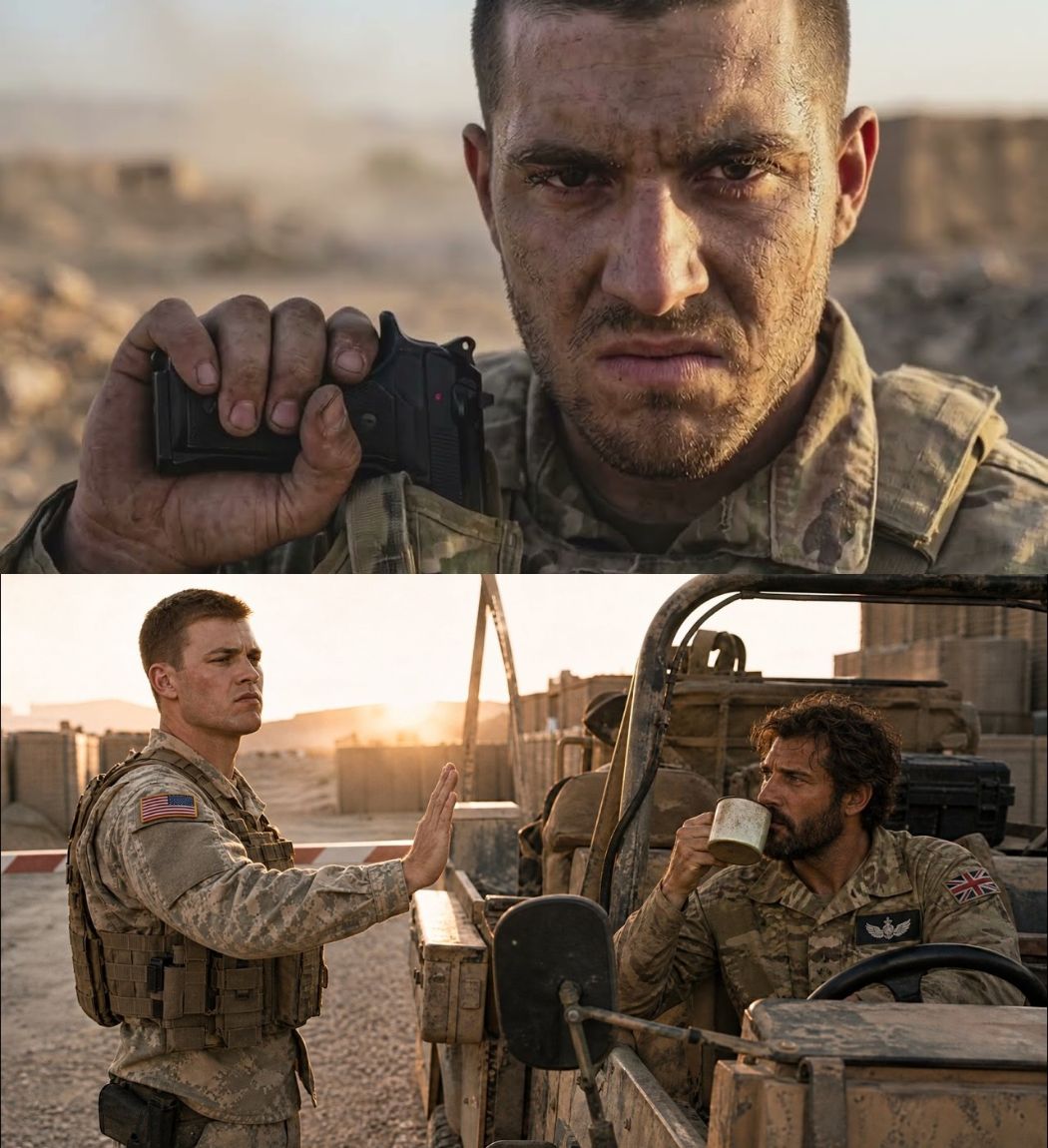
There is a photograph that never got taken of a 23-year-old American soldier standing in the dust at a gate in southern Afghanistan with his hand on the butt of his pistol telling three bearded men in dirty smocks that if they could not produce identification they could stand in the sun until they could. The sun was already low. The barrier arm behind him was painted red and white and the paint was coming off in strips.
One of the bearded men was holding a dented metal mug and had not drunk from it in a long time. The other two were simply looking at Brad Kiefer from Monongahela County in eastern Pennsylvania in the particular way men look at a thing they have already decided not to argue with. You do not know yet that you have met them. You will not know for another nine hours.
In the meantime, you are going to tell them in the voice your drill sergeant taught you to use at a checkpoint that this is a United States Coalition facility and that nobody comes through this gate without a card. And when the one in the middle, the one with the gray curling through the beard, lifts an eyebrow and says,
“Mate, we live here.”
You are going to say the word you will remember for the rest of your life. You are going to say,
“Show me your identification, tourist.”
And the three of them are going to look at each other and the one with the mug is going to pour a half inch of cold tea into the dust at your boot and they are going to turn around and walk back out into the wadi and you are going to feel for the first time that you have done something you cannot undo.
The men who came back from Rathbone the next morning only ever said one thing about that night. They said it quietly, the way you say the name of a dead relative. They said,
“You do not lock a door against the men who come through walls.”
Forward Operating Base Rathbone sat on a flat place 3 km from the edge of the green belt where the Helmand River pushed water up into the roots of the poppy and the maze, and made the only green thing for 40 miles in any direction. In the afternoon, when the wind came off the pan, the base smelled of diesel, of the plastic sheeting over the latrines, of the particular ammoniac heat that comes off a Hesco wall that has been baking since dawn.
The Hesco was the color of old bread. The sand bags were the color of old bread. The sky from about 1:00 in the afternoon until the light began to tilt was the color of a cheap enamel plate someone had left in the sink. There was nothing on that plate. No cloud, no bird, no aircraft trail. The sky at Rathbone was something you learned not to look at because looking at it did not give you anything back.
East of the wire, the ground fell away through a shallow depression that the maps called a wadi and the men on the ground called the ditch. And the ditch ran a long slow curve down towards the first of the compounds. The compounds were mud. Mud walls, mud roofs, mud yards with mud ovens. And in the yards, there were children and dogs and women in colors that the dust had eaten down to a sort of general brown.
The compound line was close enough that at night you could hear a man cough from the yards. It was close enough that at night, if a woman inside one of the compounds was grinding something in a stone bowl, you could hear the slow rasp of it the way you can hear a clock in a quiet room.
Rathbone was not a base in the way you might picture a base. Rathbone was a square of wire pushed up against a village that had been there before the prophet.
At night, the sound floor at Rathbone was a particular learned thing. There were the generators, two of them. One a steady lower note and one that hunted a little in its throttle. There were the dogs. The compound dogs started around dusk and did not finish until the small hours. And you could follow a man moving along the compound line by the way the dogs took him up, yard by yard, like a bucket being passed down a well.
There were the frogs in the irrigation ditches when the water was high, and in the summer the cicadas, and under all of that there was a sort of soft tectonic hum that the men put down to the river, though the river was too far to hear. If any of these things stopped, you knew. You did not know what you knew, but you knew. The men on the gate at Rathbone learned the sound floor the way a mother learns a baby’s breathing. They did not describe it. They simply noticed when it altered.
Private First Class Milo Rask, 19 years old, from a town in Nebraska that he was already starting to speak of in the past tense, had been in country four weeks and had not yet learned the sound floor. So Brad Keavney and Dare Ochiltree were teaching him by the simple method of standing beside him on the gate for his first few shifts and not telling him anything.
Rask had a photograph of a dog folded into the band of his helmet. The dog’s name was Dutch, and the dog was 15, and the dog was going to die while Rask was overseas, and Rask knew it. And he had not told anybody except Brad once, at 3:00 in the morning on a long shift when the generator had done something strange and Brad had not been able to sleep anyway.
Rask stood at the gate with his rifle at the low ready, and he watched the wadi because that is what you did at Rathbone. You watched the wadi, you watched the compound line, and you did not look at the sky.
Sergeant Dare Ochiltree, 31, from a parish north of Baton Rouge, was the shift sergeant, and he was teaching Brad in the same silent way Brad was teaching Rask. Ochiltree had been in Iraq twice already, and he had the slow motion of a man who had decided a long time ago not to spend energy he did not have to spend. The top joint of his left ring finger was missing. He did not talk about it. He did not talk about most things.
The one thing he had said to Brad on Brad’s first week at Rathbone was that there were two kinds of people who came through this gate, and that Brad would learn to tell them apart by the second kind not telling him anything about themselves. Brad had nodded and had not understood, and O’Trowl Tree had let him not understand because that is how you teach a man to watch for a thing he has not seen yet.
The world outside the wire at Rathbone was older than the wire. The world outside the wire did not care about the standing order, did not care about the sun. The world outside the wire was a long, slow, brown animal that had been there for a thousand years. In the afternoon of the day we are about to live through, the world outside the wire sent three men to Brad Keevney’s gate.
Captain Nasir Jadoun of the Afghan National Army had been attached to Rathbone for three months when Brad arrived, and he had been attached to other places with other names for most of the three decades before that. Jadoun was 38, and he looked 55. He spoke Pashto first and Dari second, and he spoke English in the careful courtesy of a man who had learned it in a classroom from Englishmen in the ’80s, and he used the English word gentleman in a way that no American officer had ever managed to earn from him.
He drank tea in a glass, not a mug, and he poured it from a height. He had seen the Soviets go. He had seen the Mujahideen eat each other. He had seen the Taliban, and he had seen what came after the Taliban. And when he looked at young Americans at Rathbone, he looked at them the way a schoolmaster looks at a class of boys who have not yet understood what the term is going to ask of them.
Jadoun was the one who, on an afternoon 3 weeks before Brad locked the gate, had seen four men in dust-colored smocks walking in from the east through the wadi with that particular unhurried stride of men who had been walking for days and had stopped mid-sentence in a conversation with Ochiltree and said under his breath,
“Angrez.”
Ochiltree had asked him what that meant. Jadoon had taken a long moment and poured his tea and said only,
“They are the English. They are not your English.”
Then he had gone back to his tea and Ochiltree had watched the four men walk through the wire with no identification shown and no challenge offered because the orders in that week had been that the bearded men came and went on their own authority.
Jadoon had looked at the four of them from under his cap and had not spoken to them and they had crossed the compound and disappeared into the small walled-off section at the far end of Rathbone that nobody from Brad’s unit had the key to. That was the closest Brad had come to the bearded men before the afternoon at the gate.
Lieutenant Colonel Harlan Vosburg, the base commander, was a paperwork officer. He had been promoted into a war he did not recognize. He was 44 and he had come up through logistics commands in Germany and Fort Hood and he believed, with the deep belief of a man whose faith had never been tested, that if the paperwork was correct, the war would be correct.
In the week after Jadoon had said “Angrez” under his breath, Vosburg had looked at the gate log and seen a number of entries marked unidentified allied personnel waved through and had not slept that night. The next morning he had issued a standing order. The standing order said that no personnel, regardless of nationality, regardless of mission, regardless of unit, were to be admitted to Rathbone without presenting coalition identification at the wire. The standing order was signed in blue ink. Vosburg had been pleased with it.
Ochiltree had read it on the notice board and had stood for a long time with his hands in his pockets and had then gone to find Jadoon. And Jadoon had read the order and had said one word in Pashto that O’Chaltree did not ask him to translate.
O’Chaltree, in the days after the standing order, had tried to say something to Brad. He had tried in the oblique way men like O’Chaltree try. On a long shift, somewhere around 2:00 in the morning, he had told Brad about a thing he had seen in Iraq that he was not going to describe in detail. He said only that there had been a compound and there had been a ring of men around it in the morning and that nobody from his unit had put the ring there. And that in the middle of the compound there had been a thing nobody wanted to look at. And that when a British officer in a soft cap had turned up at 10:00 and signed for the thing and taken it away, the officer had said,
“Thank you, lads. You were very patient.”
And had got in his vehicle and driven away.
O’Chaltree told this story and then he said,
“Brad, there is a kind of man you do not ask for his card. You just open the gate and you look at your boots.”
Brad had nodded. Brad had not understood. Brad was 23.
The three men came in at 20 past 4:00. The light had already begun to go yellow. They came in on foot, out of the wadi, with the dust still on them. The one in the middle, the one with the gray running through the beard, was in his late 30s and he had the slow, loose walk of a man who had been walking a long time and intended to walk a lot more. The other two were younger. One with a dark, curling beard and one almost sun-bleached. And all three of them wore the dust-colored smock that the Americans at Rathbone called a man dress. And all three of them had rifles on slings in a casual way that was not casual.
The one with the gray had a dented metal mug clipped to his belt. He unclipped it as he came up to the barrier. His eyes, under the brim of a soft hat, were a very pale blue and tired.
Brad put his hand on the butt of his pistol. He had been taught to do this at the checkpoint. He said in the voice his drill sergeant had taught him,
“Gentlemen, this is a United States Coalition facility. I need to see Coalition identification.”
The one with the gray looked at him. The two younger ones did not look at him. They were looking in a glancing unemphatic way at the HESCO behind him and at the roof of the guard shack and at the compound line to the east.
The one with the gray said in an accent Brad did not place and would later learn to place,
“Mate, we live here.”
Brad said,
“Sir, I have a standing order. I need to see identification.”
The one with the gray looked at him for a long moment. The pale blue eyes went over Brad in the way a man looks at a lock he is deciding whether to pick or walk away from. Then the man smiled, a small tired smile, and said,
“Fair enough.”
He tilted the metal mug and poured a half inch of cold black tea into the dust at the toe of Brad’s boot. He said,
“You have a nice evening.”
And the three of them turned around and walked back out into the wadi and the wadi took them and the dust closed behind them and Brad watched the place where they had been for a long time afterwards and did not know why his hands were shaking.
That was the only time anyone at Rathbone saw them clearly. The men in the dust colored smocks. Afterwards, in the stories when the men at Rathbone talked about that afternoon, they would always come back to one line of Ochol trees, which Ochol tree had said very softly to Brad as the shift ended and the three had been gone 20 minutes and the dusk had come.
Ochol tree had said,
“Son, you do not lock a door against the men who come through walls.”
Mullah Sabir Noorzai had been fighting in that valley since before the Americans had been born who were now standing at the Rathbone gate. He was in his mid-50s and he had the economical, patient, unspectacular competence of a man who had outlived three empires. He did not shout and he did not rush. He had been watching Rathbone for a month. He had sent in a boy with a bag of pomegranates to count the generators. He had sent in a shepherd’s wife to count the vehicles.
He knew the shift change at the gate and he knew that the men in the small walled section at the far end, the men Jadoun called the Angrez, had not been seen inside the wire for 3 days. His scouts had reported them walking east through the wadi at dusk on a Wednesday. His scouts had reported them not coming back. Sabir had looked at the map and he had decided that this was the week.
Abdul Hadi was the section leader for the approach. He was in his mid-30s, a good tracker, a confident one, with the lean readiness of a man who had taken many men into a bad place and brought most of them out. He had 13 men behind him. The 13th was a 17-year-old boy called Zmarai, who was carrying a light machine gun his father had carried and his father’s father had carried before that. And who had not slept well for a week because he was going to his first fight.
Zmarai did not say he was afraid. He said, instead, repeatedly, that the goats on the high ground had been quiet that afternoon and that he did not like it. And the older men had told him to be quiet himself. And Abdul Hadi had laid a hand on the back of his neck and had said,
“Brother, the goats will tell you when to be afraid. Until then, walk.”
They came in from the east, as Sabir had planned, in the hour after full dark, when the moon was down and the sky was that absolute Afghan black that has no bottom to it. They moved along the wadi because the wadi gave them the shape of the ground. The wadi ran a slow curve down towards Rathbone and it was deep enough in places that a man could walk upright and be invisible from the base. And in other places it shallowed and you had to go on your belly for 20 m with the stones under your ribs.
Abdul Hadi knew every meter of it. He had walked it in daylight six times in the last fortnight. He knew where the goat trail crossed it on the north side and where the irrigation cut came in on the south. And he knew the single dead poplar at the halfway point whose shadow in moonlight you did not cross because it put you against the skyline.
The first runners came at the dead poplar. Abdul Hadi, moving in the lead with Zmarai third behind him, dropped to one knee and raised his fist. And the column stopped behind him and settled into the dust without a sound.
Across the wadi, where the goat trail should have come down out of the broken ground on the north side, there was a goat trail coming down out of the broken ground on the north side. Which was correct. Which should have been correct. Except that it was in slightly the wrong place. It came down three paces further west than Abdul Hadi remembered it coming down. And the stones along its edge were turned. And the dust had a certain brushed quality to it.
And the trail stopped at the lip of the wadi and did not continue down. As if a goat had walked carefully in the dark on two legs to the edge of a drop and had then simply stopped existing.
Abdul Hadi crouched beside the lip of the trail for a long moment. He put the back of his hand against the dust. The dust was cool. The brushed quality was recent. He looked across the wadi at the others and he could not quite see them. He said under his breath in Pashto that it was a goat. Nobody answered him. He said it again. He was telling himself. The young one, Zmarai, was watching him in the dark.
Abdul Hadi stood up and moved on. And the column moved on behind him. And in his chest something had begun to tick that had not been ticking before. He put it down to the long walk and the cold and the fact that that had drunk two glasses of green tea before setting out and should not have.
The goats on the high ground were quiet. The dogs in the compound lying to the south were quiet. The wadi was quiet. Abdul Hadi, in the private place at the back of his head, where a tracker keeps his own counsel, began to count the sounds that were not there and did not like the number.
Inside the wire, at that same hour, Captain Jadoun was sitting in the small plywood office he had been given. With the Afghan army tactical radio turned low and a glass of green tea cooling on the desk at his elbow.
Jadoun had the radio tuned not to the coalition net, but to a village frequency his people used, and he was listening to the long slow nothing of a Helmand night with the odd click of a shepherd’s handset and the odd murmur of a woman calling a child in from a compound yard. And he was listening in the way an old man listens, which is for what is not there.
Somewhere east of the base, a dog had stopped barking that had been barking an hour earlier. A dog in that part of the green belt did not stop barking at that hour unless somebody had made it stop.
Jadoun set his tea down. He did not drink from it again. He sat very still and he listened. And a long way out across the dust, he heard, or thought he heard, the single thin sound of a stone being set down carefully on another stone by a hand that did not want to be heard.
He did not go to Vosburg. He did not go to Ochiltree. He went to the small wire-walled section at the far end of the base, the one with the key none of the Americans had, and he knocked on the plywood door, and there was no answer because the men who lived behind the plywood door had not been seen in 3 days.
Jadoun stood for a moment with his hand on the plywood. Then he went back to his office and he did not drink the tea. And he waited.
They moved for another 20 minutes down the wadi. And then Abdul Hadi called at the second bend where the ground opened a little and a man could crouch comfortably against the north bank and see both ways. He wanted to count his men. He had done this at every halt for 10 years, and he did it now by touch, by a quiet whispered number from each man as the hand went past his shoulder.
He counted to 13. He counted again. 13 was correct. He breathed out and he did not know he had been holding his breath.
On the dust at his feet, by the toe of his sandal, there was a mark he did not immediately recognize. It was a long, shallow, brushed oval, as if a palm had been laid down flat and then drawn back. It was the kind of mark a man makes when he is wiping something out.
Abdul Hadi stared at it for a long time, and then he stood, and he moved on, and he did not tell anyone about it.
Hamidullah was the man at the rear of the column. He was 42, and he had been with Sabir for 9 years, and he had three sons, and the oldest was going to be a doctor if God willed it. Hamidullah carried the long antenna radio and a Dragunov that had belonged to a Russian whose grave he had probably once walked past. Hamidullah was the rear guard because Hamidullah was patient and Hamidullah did not startle.
At the third halt, Abdul Hadi counted again from the front, and the count went 5 6 7 8 9 10 11 12, and the hand reached back for Hamidullah’s shoulder, and the shoulder was not there.
Abdul Hadi froze. He counted again. The 12th man, Sayed, whispered that Hamidullah had been behind him at the last halt and had not been behind him for perhaps 3 minutes. There had been no shout. There had been no shot. There had been nothing.
Abdul Hadi sent two men back along the wadi, quietly, with the quick nervous care of men who did not want to find what they were going back to find, and they came back after 4 minutes, and they said that there was nothing. No body. No blood. No sign. There was only the long low wadi and the faint smell of the irrigation cut, and the dust that had been brushed somewhere by a palm.
It was at this halt that Zmarai, the boy with the light machine gun, said again that the goats had been quiet and the dogs had been quiet. And this time no one told him to be silent because they had all begun now to hear what the boy had been hearing for an hour.
The dogs along the compound line to the south, the dogs that at this hour should have been taking a man along the yards, one at a time like a bucket being passed down a well, the dogs were not barking. There was no cough from any yard. There was no scrape of a stone bowl. There was no cicada under the dry grass. There was no frog in the irrigation ditch. There was only under all of it the thin high distant whine of the base generator at Rathbone, and the sound of 13 12 men breathing in the dark, and Abdul Hadi became aware in a way he could not have described to Zmarai, that the sound floor of the world had been removed, and that he was now standing inside a shape with no edges.
Noor Rahman was the man carrying the second rocket launcher. He was 28. He was the funny one. He had made the whole section laugh in the compound the previous week by tending to be an American general on a tour of inspection, and even Abdul Hadi, who was not a man to laugh, had laughed because Noor Rahman had the gift.
Noor Rahman had been fourth in the column after the Hamidullah count. At the fourth halt, moving on now with a tightness that had been loose only an hour before, Abdul Hadi reached forward for Noor Rahman’s shoulder, and his hand went through air.
He stopped. He turned. The man behind where Noor Rahman had been was Sayed, who was shaking. Sayed said in a whisper that was almost not a whisper, that Noor Rahman had been in front of him three steps ago. Three steps, not three minutes, three steps.
Abdul Hadi walked back the three steps, and the ground was dust, and the dust was undisturbed, and there was no Noor Rahman, and there was no sound. On the north bank of the wadi, at the exact spot where Noor Rahman should have been standing, there was a single thing on the ground, placed carefully in the dust, which Abdul Hadi almost did not see. It was a British Army issue field dressing still in its wrapper, laid flat, square to the compass.
It had not been there a minute ago. It had been placed. Abdul Hadi stared at it. His mind refused to make it mean anything. His mind told him it was something a goat had dropped.
He crouched. He touched it with one finger. The wrapper crackled softly. The sound in that absolute silence was enormous. He stood up, and he walked on, and he did not pick the dressing up. He did not pick it up because to pick it up would have been to admit what the dressing meant.
Zmarai saw the dressing as he passed it. Zmarai, 17 years old, who had never been in a fight and had always believed what the older men told him, looked at the small square object on the ground and understood, with the clean sudden understanding of the young, what it was and what it was for.
It was a field dressing from the people who treated wounds, and it had been placed square to the compass on the exact spot where Noor Rahman had stood a minute ago, and it had not been used, and Noor Rahman had not bled. And the dressing was therefore not for Noor Rahman. The dressing was a message. The dressing said,
“We were here. We were here, and we did not need this. The next one is for you.”
Zmarai began to cry very quietly as he walked. He did not stop walking because he did not know what else to do.
They lost the third man at the next bend. His name was Jamshid. Nobody saw him go. The column was moving in silence, no man talking, no man clinking. The only sound the soft brush of sandals and dust.
And when Abdul Hadi called the halt at the next bend and reached back and counted, there were 10 men behind him. 10, not 12, not 11. 10. The arithmetic was wrong and Abdul Hadi, who had been a tracker and a leader of men for most of his adult life, stood in the dark at the base of the wadi and did a thing he had never done in his life, which was to turn in a slow circle with his rifle up, pointed at nothing, pointed at everything, pointed at a dark that gave him back nothing at all.
There was no shot. There was no shout. There was no body. There was only now, somewhere out in the dust east of the base, the thin memory of a voice he had heard re- ported from the Rathbone gate, which he had not heard with his own ears, but which Sabir had reported to him laughing, the voice of a bearded foreigner saying,
“Mate, we live here.”
And the voice of a young American saying,
“Show me your identification, tourist.”
Abdul Hadi did not understand English. He understood now the shape of the thing he was inside. He turned to Zmarai, who was still beside him, and he opened his mouth to tell the boy to go back, to run. And he did not get the words out because somewhere, a long way behind him in the wadi, at the place where he had left the field dressing lying square to the compass, he thought he heard, he was not sure he heard, the single soft sound of a palm being laid flat on the dust and then drawn back.
You do not lock a door against the men who come through walls.
Brad Keavney was on the gate again at a quarter past 2:00 in the morning when he saw Captain Jadoun walking the inside of the wire with no light. Jadoun was not on duty. Jadoun was in a plain brown shawl over his uniform and he was moving slowly along the inside of the hesco with his hand brushing the wire as a man might brush the top of a long garden wall. He was not looking out. He was listening.
Brad watched him do a slow full circuit of the base which took the better part of an hour and when Jadoon came back around to the gate he stopped on the inside of the barrier arm and looked out through it past Brad into the wadi.
Brad said,
“Captain, is everything all right out there?”
Jadoun did not answer for a long time. Then he said in his careful English,
“I think everything is being made all right. That is a different thing.”
Brad said,
“Sir, I don’t follow.”
Jadoun said,
“No, you do not. That is not your fault.”
And then Jadoon looked at Brad for a moment longer and he said very gently,
“The three gentlemen you spoke to this afternoon, you were brave to speak to them in that way. I would not have been brave in that way.”
And he walked back into the base and did not look at Brad again.
Sergeant Ochiltree, who had been pretending to sleep on a cot in the guard shack for the last two hours and who had heard every word, got up at that point and came out into the dust and lit a cigarette and did not offer Brad one. He stood for a long time looking out past the barrier arm into the dark. Then he said without turning,
“Brad, do you remember what I told you about the compound in Iraq?”
Brad said he did.
Ochiltree said,
“The thing I did not tell you is that the ring of men around the compound was eight men. There were a lot more than eight bodies in the compound and they had been working for one night. That is all.”
He took a drag of the cigarette. He said,
“The three gentlemen you turned away at the gate this afternoon are out there right now, Brad. They are out there and they are not alone. And we are not going to see them tonight and in the morning we are going to pretend we did not need them. You understand me.”
Brad did not understand him. Brad nodded.
In the wadi, at the same minute, Abdul Hadi stopped walking. He stopped not because he had heard anything, because he had not heard anything, but because he had understood finally, with a clarity that was almost a relief, that he was not leading an attack on Rathbone, and had not been for an hour. He was being walked.
The dark around him was not empty. The dark around him had been there since the dead poplar, had been there since the brushed dust, had been there since the field dressing laid square to the compass, and the dark had let him come this far because the dark had wanted him this far.
Abdul Hadi, section leader for Mullah Sabir Noorzai, veteran of a hundred nights in this valley, understood that he was prey. He understood that he had crossed into the wadi believing himself the hunter, and that at some unknown minute, perhaps before he had even left the compound, perhaps before Sabir had decided this was the week, perhaps the afternoon the three bearded men had been laughed at at an American gate, at some unknown minute, the roles had been switched. And he had not been told.
He turned to look at Zmarai, who was still beside him, still crying very quietly in the dark, and he opened his mouth to say the word “Run.” He did not say it.
Inside the wire, Brad Keevny stood at the gate and tried to say the word he had used at 4:20 that afternoon. He mouthed it.
“Tourists.”
It was a word that had tasted of iron and swagger when he had said it in the sunlight. It tasted now, at 2:00 in the morning, of nothing at all. His tongue would not shape it a second time. Brad looked at his watch. 02:47. He looked at it again. 02:48. The second hand on the watch was an ordinary second hand on an ordinary cheap watch bought at a store in Fort Bragg. And in the particular silence of that night, it ticked once per second with the kind of audibility that silence lends to small objects. Brad counted the ticks. He did not know he was counting. He counted up to 120 and lost his place and started again.
Beside him, Rask was holding his rifle wrong, the butt against the wrong part of his shoulder, and did not know he was holding it wrong.
In the plywood office at the back of the base, Captain Jadoun had allowed his tea to go cold a second time and had not refilled it and was sitting with his hands flat on the desk and his eyes closed. He was praying in the kind of prayer that is simply the long slow repetition of a name in the mind. He was praying for Zammarai, whose name he did not know, and for Hamidullah, whose name he did not know, and for the three bearded men whose names he had never been told. He was praying because he was a man who at a certain age had understood that the only thing you can do when the quiet ones are at work is to pray for every man in the dark because you cannot afford to pick between them.
Out in the wadi, Abdul Hadi had been standing in the same place for 4 minutes. He had not told his men to move. His men had not asked him to move. His men were 10 now, counting himself and Zammarai. And the 10 of them stood in a loose, instinctive, inward-facing cluster with the shape of men who had understood in their bellies what their leader had understood in his head.
There was no sound. The sound floor of the valley had been gone for an hour. There was not even the distant whine of the generators now because the wind had shifted or because one of the generators had stopped or because the air had thickened in a way that air sometimes thickens in the hour before dawn when everything is held.
Abdul Hadi’s heart beat. He heard it. He had never heard it before in his life. He heard it in the particular small bones behind his ear, a slow, deep, two-stroke knock that he had carried inside himself for 35 years and had never heard once. And he heard it now because there was absolutely nothing else to hear.
Rask at the gate made a small sound. It was not a word. It was the sound a man makes when he is 19 and he has suddenly realized that the war is not a thing he came to and is a thing he is in. Brad put a hand on Rask’s shoulder without looking at him and Rask shut up.
Ochiltree three paces behind them did not move. The three of them stood at the gate of Rathbone and looked out at a wadi that gave them nothing back. The barrier arm was down. The paint on it was coming off in strips. Beyond it there was dust and dark and absolutely no information at all.
Somewhere in the compound line to the south a dog began very briefly to bark. It barked twice. On the third intake of breath before the third bark the dog stopped. It did not stop in the way a dog stops when it has lost interest. It stopped in the way a dog stops when a hand has been laid across its throat.
Ochiltree behind Brad exhaled very softly and said almost to himself,
“There they go.”
The men who came back from Rathbone the next morning only ever said one thing about that night. They said,
“You do not lock a door against the men who come through walls.”
It begins with a single sound that nobody at Rathbone will afterwards agree on. Brad calls it a cough. Ochiltree calls it a clap. Rask says it was like somebody breaking a short piece of dry wood over their knee. Jadoun in the plywood office calls it in Pashto the sound of a book being closed.
Whatever it is it comes from the wadi from a direction that is not quite east and not quite southeast and it is followed before any man at the gate has time to understand that he has heard it by a second one and a third and a fourth. All of them very close together in a run that is not a burst because a burst is one weapon and this is several. All of them doing the same quiet short thing at the same quiet short time.
Brad flinches. Rask does not flinch because Rask has not understood yet. Ochiltree steps forward quite deliberately, putting himself between the barrier arm and the two younger men and says,
“Stay on the gate. Stay on the gate. Do not fire. Do not fire.”
Out in the wadi, in the direction that is not quite east and not quite southeast, there is a very small flash, not even really a flash, a brief alteration in the quality of the dark. And then there is a longer silence, perhaps 3 seconds, and then there is another short run of the clapping cough sound, further away in a slightly different direction, as if the thing doing it has moved between the first run and the second, which is impossible because nothing moves that fast in that dark.
Then there is a longer silence, perhaps 8 seconds, and then there is a short cry, a man’s voice, cut off at the top of its arc. Then there is absolutely nothing again for a long time.
In the wadi, Abdul Hadi is still standing in the place where he has been standing. He is still standing because he has not been one of the first four. He has not seen the first four go. He has heard the sounds, the small coughs, and he has felt the air move twice past his left ear. And he has heard a man beside him, Sayed, he thinks, make a small surprised sound and sit down. And he has heard another man further back do the same.
He turns his head. The sound of a man’s own neck turning in that silence is enormous. He sees Zmarai. Zmarai is still standing. Zmarai is holding the light machine gun across his chest with both hands like a child holding a schoolbook. Zmarai is looking at him.
Abdul Hadi tries to say down. He gets the first consonant out. He does not get the vowel.
Then the dark around Abdul Hadi finishes what it has started in a very short time with a tidiness that will not become clear until first light.
At the Rathbone gate, Brad Keevney stands with his hand on the butt of his pistol that he has not drawn and listens to a silence that is now so complete that he can hear uh somewhere behind him in the compound who the generator that hunts a little in its throttle. The generator hunts. It settles. It hunts again. Nothing else moves. The war, which has been happening a quarter of a mile away for perhaps 30 seconds, has stopped happening.
First light at Rathbone came the way first light always came in Helmand, which was not as a sunrise but as a slow graying of the dust, a kind of leaking of color back into the world, so that for 20 minutes you were walking through a photograph that had not been developed yet.
The dogs along the compound line started up again at that hour, cautiously, 1 yd at a time in the shape of a thing resuming after it had been interrupted. The frogs did not come back. The frogs did not come back for three nights after that. The cicadas did not come back for a week. The sound floor of the valley around Rathbone was a quieter sound floor from that night forward, and it would stay quieter until well into the following summer, and nobody in any compound in that stretch of the green belt would ever quite be able to say why.
Lieutenant Colonel Vosburg ordered a patrol into the wadi at 0600. O’Toole Tree led it. Brad went with it because O’Toole Tree asked for him by name and did not say why. Rask stayed on the gate. Vosburg stayed in the operations room with his hand on the standing order that he had signed in blue ink and did not meet anyone’s eyes.
The patrol was eight men and they went out through the barrier arm with their rifles up and their mouths dry. And when they got to the dead poplar at the halfway point, they stopped because at the base of the poplar there was the first thing.
The first thing was a strip of dust about 4 m long that had been very carefully brushed smooth as if with the flat of a hand. And in the middle of the brushed strip, there was a single pair of boot prints. Not sandals, not the long low oval of a man dragging another man. Boots. One pair standing facing the base.
The boot was not an American boot. It was not a British boot that any of the men on the patrol recognized. The tread was shallow and clean and the print had been made deliberately in the middle of the brushed strip by a man who had wanted to leave exactly one.
Ochiltree looked at the print for a long time. He did not say anything. He stepped around it carefully the way you step around a sleeping snake. And he led the patrol on down the wadi.
They found the first body at the next bend. The second 10 paces further. The third against the north bank folded over with his rifle laid neatly across his back as if someone had put it there for him. They counted 13 in all. 13 was the number Sabir had sent out and 13 was the number they counted and the counting took the better part of an hour because the bodies were not in a group. They were spread out along 400 m of the wadi in a loose careful pattern that was not a firefight and was not a route. It was a pattern. It was the pattern of men who had been removed from a line one at a time over an hour or more and then placed afterwards where they had fallen or near where they had fallen in a way that was almost tidy.
There was no fire damage. There was no scattering of brass that an American or an Afghan patrol would have left. There were no spent cases of any kind that Ochiltree could see. And he looked because he had been in Iraq twice already and he knew to look. The men were simply gone in the quiet, efficient way that very few people in the world know how to end a man. And the men who had done it were not there. Had not been there for perhaps an hour, perhaps two. Had moved on in a direction nobody in the patrol was ever able to establish.
The smallest body was folded against the north bank. 17 years old, Ochiltree would have said if asked, and would not be asked. The boy had an old light machine gun across his chest, held in both hands, and a small photograph tucked into the inside of his vest that nobody looked at closely. On the dust beside him there was a British Army issue field dressing in its wrapper, placed square to the compass. The dressing had not been used. Nobody picked it up.
Brad looked at it for a long time, and then he looked at the boy. And then he looked away. His hands had begun to shake again in the way they had shaken when the three bearded men had turned around at the barrier arm and walked back into the wadi. And he put his hands under his armpits so that Ochiltree would not see.
When the patrol got back inside the wire at 0800, the small plywood door at the far end of the base, the one with the key none of the Americans had, was open. The plywood section itself was empty. The cots inside had been stripped. The small folding table had been wiped down. There was a dented metal mug sitting in the middle of the table. The mug had been washed. There was no note. There were no men.
The three bearded gentlemen Brad had turned away at the gate at 20 past 4:00 the previous afternoon. And the others who had been with them, whom nobody had seen clearly at all, were gone. As if they had never been there. As if the plywood section had been empty all along. As if Brad had imagined, in the sun of a long yellow afternoon. Three men in dust-colored smocks pouring a half inch of cold black tea into the dust at his boot.
Jadoun came out of his office and stood in the open doorway of the plywood section and looked at the dented mug on the table. And he reached out and he picked the mug up and he held it in both hands for a moment. And he closed his eyes and he put the mug down again very gently in the exact center of the table. Then he turned and he went away.
Vosburg never came down to look at the plywood section. The standing order was never rescinded. It was also never mentioned again.
Brad Keaveny finished his rotation at Rathbone six weeks later and finished his service two years after that and went home to Eastern Pennsylvania and did not talk about the night at the gate for nine years. When he finally talked about it in a long interview he gave to a man writing a book about the small shared outposts of the late Afghan War. He talked about it in a voice that the man writing the book described as a voice that had been kept in a box for a long time.
Brad said that he had turned three men away from a gate on a Tuesday afternoon in April of 2008 and that he had told them to show him their identification tourist and that the one in the middle had poured a half inch of cold black tea into the dust at his boot and had told him to have a nice evening. Brad said that at that time he had thought he was doing his job.
Brad said that he had not understood until the next morning when he had walked through a wadi full of 13 bodies that no American weapon had fired on what the three men had been and what he had done. He said that the thing that stayed with him was not the bodies. The thing that stayed with him, he said, was the dented metal mug on the folding table in the plywood section which had been washed. He said that whoever had washed the mug in the dark of that morning before leaving had used water they had carried in and had used time they had not needed to use. He said that was the thing he could not get past.
Captain Jadoun, interviewed by the same writer six years later in a small house in Islamabad after he had retired out of the Afghan Army and then out of Afghanistan altogether, was asked about the night at Rathbone and about the three men.
Jadoun drank his tea from a glass as he had always drunk it and he poured the writer a glass as well from a height. And he said in his careful English only this,
“There are some men in a long war who do a job that cannot be put into a report. We prayed for all of them, the ones they came for and the ones they came as.”
He did not say anything else about it. He asked the writer about his family. The interview was over.
In the village east of Rathbone, there had been one. There had been one of Mullah Sabir Noorzai’s section who had not gone down into the wadi because he had been told to stay back on the high ground with a radio and listen. His name does not survive in any western source. The village knew who he was and did not say what is known is that he came down into the compound at dawn after the long silence that had followed the clapping cough sounds in the wadi and that he was pale under his dust and that he was shaking and that when the elders asked him what had happened, he said in Pashto that he did not know, that he had heard nothing he could describe, that the whole section had simply gone into the dark and had not come back.
The elders asked him what he thought it had been. He thought for a long time. He said,
“And this is the sentence that was carried from compound to compound through the whole green belt that year. They were not men. They were a thing we had been told was men.”
He left the valley within the month. He did not fight again.
That is the flip. The 13 men who went into the wadi that night went in as hunters, confident, led by a good tracker. In the dark they had owned since before any of the Americans at Rathbone had been born. They did not come out as men who had lost a fight. They came out as men who had, at some unknown minute, perhaps before they had set out, been quietly changed into something else, and had not been told. The dark around them had never been theirs. The dark around them had been borrowed by permission.
Brad Keavney, in the long interview he gave 9 years later, finished with a sentence that he said he had got from his shift sergeant Dare Ochiltree, who had got it, he thought, from an officer in Iraq.
Brad said that in his first week at Rathbone Ochiltree had told him there were two kinds of men who came through the gate, and that he would learn to tell them apart because the second kind would not tell him anything about themselves. Brad said he had not learned it in time. He said he had learned it the next morning in a wadi, standing beside a boy of 17 with an old rifle across his chest, and a small square of unused dressing laid neatly in the dust.
He said the sentence he had carried home was this: You do not lock a door against the men who come through walls.