“You Lot Are Too Cautious” — When the British SAS Refused US Orders in Baqubah
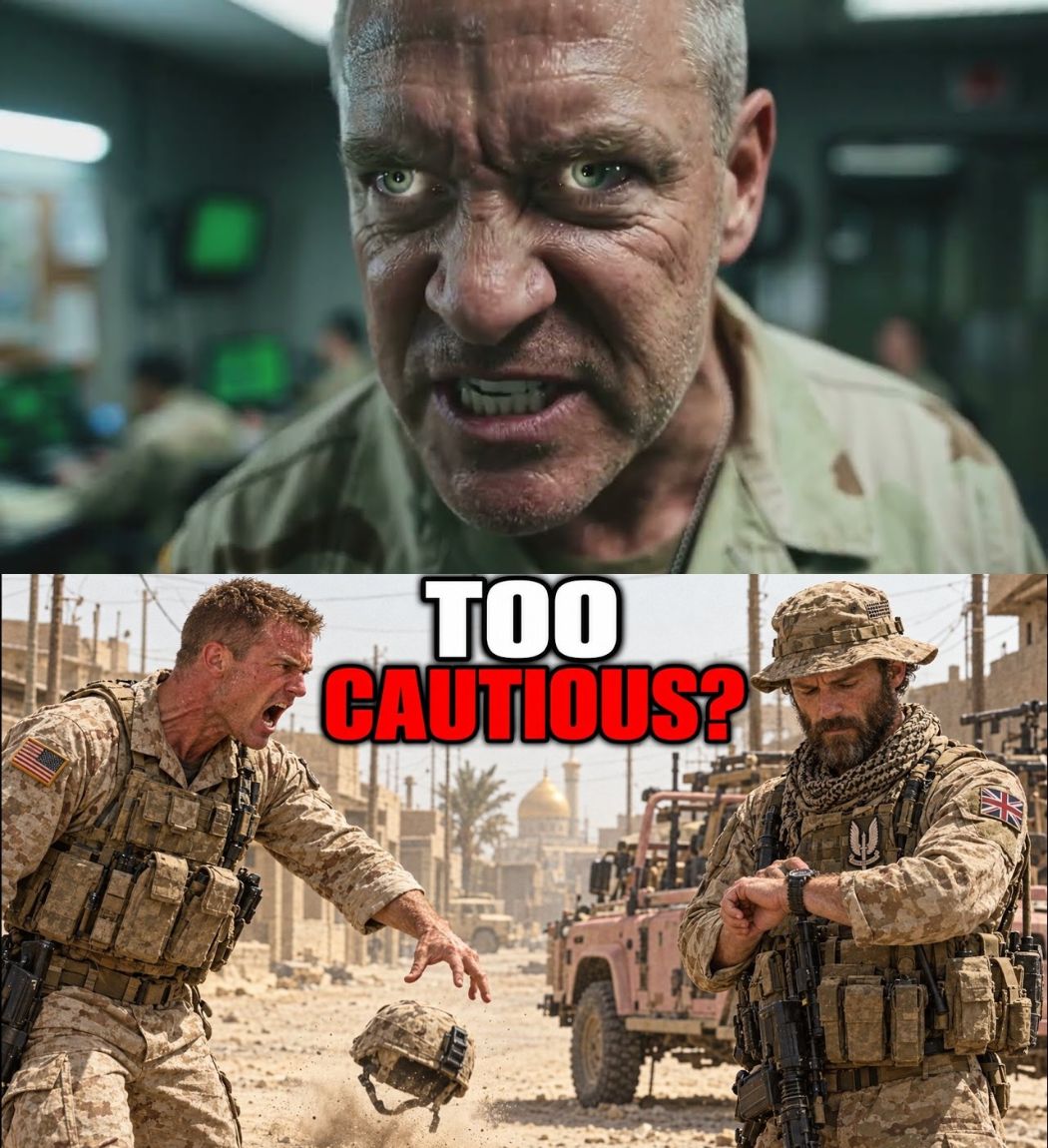
“You Lot Are Too Cautious” — When the British SAS Refused US Orders in Baqubah
Here is the complete, unedited story formatted according to your precise editorial requirements:
There is a plywood door, a map pinned to it with four nails, and the words that start the whole thing.
“You lot are too cautious. We’re going now.”
A colonel of the United States Army, two coffee cups deep at 9:00 in the morning, looks across that door at a British major with a green notebook and says, flat loud enough for the room.
The major does not look up. He finishes the line he is writing, one line per minute, and lets the sentence sit in the hot air of a converted schoolhouse in Baqubah while a generator coughs outside and a fly bats itself against the strip light above the map.
You are not reading about this later. You are standing in that room. The air smells of diesel and instant coffee, and the particular sun-baked plywood smell of a forward node in Diyala province in the summer of 2007.
The British officer who takes the sentence is not the one who gives the reply. His troop commander does, a captain whose name on the roster is Peak, two chairs down the trestle table, who looks at the colonel and says in the same even voice he uses to ask for a brew.
“Sir, 6 hours, last light. We take him breathing.”
He gives three reasons. The colonel gives none.
“We’re going now,” he says again.
He taps the map. The nail bends. He would remember saying it. He would be made to. By the end of that day, he would be standing on the edge of a landing strip while men he had called too cautious walked past him in file, counting themselves off a helicopter with a prisoner alive between them and a stopwatch in a British sergeant major’s hand reading a number the colonel would not be able to argue with for the rest of his career.
He would hear the number read in an after-action report he had co-signed. He would hear his own words quoted back inside it, verbatim, not out of cruelty, but because that is what after-action reports do. And he would say nothing because by then there was nothing to say.
That is where this goes. Not to a conversion, not to a handshake on a tarmac, not to a long and admiring tribute to the men he had misread. To a landing strip, a stopwatch, and a colonel with his mouth not quite closed, reading a line of print that had his contempt and the regiment’s answer on the same page.
4 minutes and change, five dead, one alive, nobody of hours hurt. That was the receipt. He had 6 hours worth of warning. He used none of it.
“You lot are too cautious,” he said at 9:00 in the morning in Baqubah, and by last light the slowness he had mocked would be the only reason any of them, including him, had a good day to write up.
Grant Fickery was not a fool, and the lane will fail if you decide he was. He had 24 years in the United States Army by the summer of 2007. He wore a Ranger tab he had earned at 23 on his second attempt, after breaking the small bones of his left foot on the first and refusing to quit the second until an instructor told him his boot was filling up with blood.
He had done two tours in Afghanistan, one as a battalion operations officer, and one as a deputy commander, and he had a Bronze Star with V device from a night outside Shkin in 2003 where he had, by every account, including the ones written by men who later disagreed with him, dragged two of his own soldiers out of a kill zone under direct machine gun fire.
He carried in his left breast pocket a laminated photograph of his son’s Little League team, nine small boys squinting into a Virginia sun, and he took it out and laid it on tables when he was thinking. He was not loud. He was not stupid. He was in a hurry for reasons that if you had been sitting across from him with a battle map, you would have found hard to dismiss.
The reasons were these. The man they were trying to catch, Yusuf al-Rawi, called Abu Rashid on every intercept, was an al-Qaeda in Iraq facilitator who had moved three vehicle-borne devices into Baqubah in the previous 6 weeks. One of those had gone off outside a market in April and had killed, among other people, the elder brother of a man called Hamid, who now worked as the interpreter attached to the British troop and did not speak of it.
The intelligence, said al-Rawi, was in a two-story house in the Mufraq district by 9:00 that morning. It said the window would close by noon because al-Rawi did not sleep in the same bed twice and the pattern of life watchers had learned that his car moved before the midday call to prayer every day for a fortnight.
Vickery had looked at that intelligence and done the honest arithmetic of a man who had buried soldiers over missed windows. He had said, “We go now with what we have in daylight and we accept the daylight cost because the alternative is nothing.”
The scene in which he said the sentence that gives this story its name is worth putting on the page in full because you need to see that it was not a cartoon. The operations room was the staff room of a confiscated schoolhouse, concrete floor, three strip lights, four trestle tables shoved together, maps on the plywood door that had been taken off its hinges and leaned against the wall.
There were nine Americans in the room and four British. Vickery stood at the top of the map. His intelligence sergeant, Master Sergeant Krasner, was reading the latest take off a signals intercept. His aide, Captain Del Corno, was writing on a legal pad. Lieutenant Colonel Osborne, his operations chief, a Fallujah hand who did not say much, stood with his arms folded.
The British were Major Edmund Thornbury, who was the squadron officer commanding and senior British officer in the building. Captain Henry Peak, the troop commander whose men were being asked to run through the door. The squadron sergeant major, a warrant officer named Lauriston, who had a sweet in his cheek and said nothing. And the staff sergeant who would be team leader on the ground, Reese Kerwin.
Peak asked politely for the hold. He gave three reasons. The compound had two covered approaches that were only usable in low light. The target had squatter roots north and east that the overwatch could not lock down in a daytime infiltration without being seen. And the house itself had, by the troops own reconnaissance from the night before, a staircase that one of their breaches believed was wired.
“6 hours, last light. We take him breathing,” Peak said.
He did not raise his voice. He put a hand flat on the plywood over the Mufrag district and left it there.
Vickery looked at Peak for perhaps 3 seconds. He looked at Thornbury, who was writing a line in a green notebook left-handed, and did not look up. He looked at Osborne, who said nothing. And then he said loud enough for the room.
“You lot are too cautious. We’re going now.”
He said it in the way a man says a thing he has been building up to all morning. Some of his own staff laughed, not meanly, the way men laugh when their colonel has finally said the thing they have been waiting for. One of them, Krasner, did not. Osborne did not. Thornbury wrote his line and turned the page.
That is the altitude. 24 years, a ranger tab, a decoration earned under direct fire, a reason for haste that any honest officer would at least have to argue with. And a room that half agreed with him. Build him there. Leave him there. He will fall from exactly that height.
Baqubah in 2007 was a city holding its breath between two bad ideas. The surge had put more American soldiers on its streets than at any point since the invasion. And the men who ran the Al-Qaeda in Iraq node in Diyala had not left. They had thinned, scattered into safe houses in the Mufraq and Khartoum districts, and were moving money and components by courier under the daytime cover of a city that still had to buy bread and bury its dead.
Two streets north of the schoolhouse the task force used, the golden dome of a shrine caught the morning sun and threw it back across the rooftops. You could stand on the roof of the operations building with a mug of tea and see the dome. And you could see, half a mile east, the compound in which that morning a man called Abu Rashid was eating breakfast and planning to be somewhere else by midday.
The British troop lived in a bashar that had been the schoolhouse’s dining hall. 12 cots, three plywood tables shoved into a U, a kettle that was always on, and a map board along the back wall that was more pencil than ink.
If you had walked in at 8:00 that morning, you would have found Carew sitting on his cot with his belt kit between his boots, checking the retention on every pouch for the third time. Trooper Oldfield at the map board with a pencil, drawing in a staircase from memory. Corporal Nern at the table nearest the window with a small blue notebook open, writing numbers in a column.
Nern had been up on a rooftop two nights running with a thermal and a wind meter, and the numbers in the column were the wind at four points of the compass at 20-minute intervals, each line timed. He did not call it the wind book. He did not call it anything. He wrote in it the way other men scrolled a phone.
Next door, through two layers of plywood, the Americans were loud. Not undisciplined, loud the way a bigger machine is loud when it is spooling up. Krasner was on a radio to hire. Del Corno was shouting at a printer. There was a laminator going. A little bird crew from the 160th Special Operations Aviation Regiment was in and out of the mess tent, drinking coffee that was legally too strong for a human being, and briefing a pilot called Tully who said about one word in 10, and whose one word was usually the right one, the tempo on the American side was a tempo of certainty. We have the target, we have the airframes, we have the window, we go.
The tempo on the British side was a tempo of a different kind. It was the tempo of a man checking a pouch for the third time, and a trooper drawing a staircase he had seen only in a thermal scope, and a corporal writing wind.
If you had asked Vickery at that moment what the British were doing, he would have said, honestly, nothing. He would have said, they are stalling. He would have said, they are brewing up and dragging their feet and talking to each other in that low voice they talk to each other in, and they are going to miss the window.
He would have been looking straight at the thing that was going to beat him, and he would not have seen it. Because the thing that was going to beat him did not look like preparation, it looked like idleness.
The staircase was the first loaded gun. Oldfield had been a Royal Engineer searcher for 4 years before selection, and the thing an Engineer searcher learns in his first 6 months is that staircases in Iraqi houses of a certain period, built to a certain pattern, have under-stair voids that are the single most reliable place in the country to hide a pressure plate device wired to a heavy machine gun round.
He had looked at the thermal from the reconnaissance the night before, and he had seen a hot spot at the base of the staircase that had no business being there. Not a radiator, not a kettle, not a person. And he had drawn it on the map board at 8:00 that morning with a question mark the size of his thumb.
He had not shouted about it. He had not written a memo. He had drawn it and said to Carewin, quietly.
“Boss, I want to go in top down.”
Carewin had looked at it for 2 seconds and said, “Yes.”
The second loaded gun was Nan’s wind book. Bacuba in July moved its wind twice a day, once at mid-morning and once at last light. And the swing at last light was the one that would let a round from a rooftop 260 m east of the compound travel to the window of the back bedroom without being deflected into the wall.
Naim had been reading it for two nights. He knew to within 4 minutes when the swing would come. He had learned the trick on his grandfather’s deer forest above Blair Atholl at the age of 11 lying on his belly with a wet finger.
And he had said to Peak the night before.
“Last light, sir. 20 past 7:00 give or take. The wind drops and comes round. Window opens for about 40 minutes.”
He had said it the way you tell someone the time.
The third loaded gun was the one in the room. Peak had asked for 6 hours. Thornbury in his notebook had written one line at 8:46 that morning. The line read, “HP requests hold to last light. Reason’s sound. Will support.” He underlined sound. He did not say it aloud. He did not need to.
The squadron officer commanding had been through selection in 1996 and a job in a market in Basra in 2005 that nobody wrote about. And when his captain said 6 hours, he wrote one word under it. And the one word was his vote.
The vote did not matter in the room where Vickery was speaking. It would matter later. The loaded gun this points at the next is simple. The British had in that Basra by 8:30 in the morning assembled a plan that would work. It required 6 hours of daylight to pass while they did visibly nothing.
They did not get the 6 hours. They got a colonel who looked at men checking pouches and reading wind and drawing staircases and said, “With 24 years of good service behind him, too cautious. Keep the plan in mind.”
The whole rest of the day is the plan trying to survive the Colonel.
The order went out at 9:40. Mount up. Vickery gave it standing at the plywood door with his thumb on the nail that held the Mufrag District to the wood.
Peak did not argue a second time. He turned to Kerwin and said, “Two words that are not operational jargon in any manual.”
“On the ground.”
And Kerwin stood up with his belt kit already on and his helmet in his left hand and walked out of the basher without hurrying.
Nan was already gone. He had left at 9:22 with Hamid behind him in a civilian pickup that belonged to a man in the Khatoun District who had been paid in cash the week before.
The Americans ran the approach the Americans had planned. Four Humvees up Route Gold, which was the city’s north-south arterial, lights off, speed up with a little bird holding at 200 ft over the river and Tully on the controls. The plan assumed that speed was its own concealment. And in a city where speed is the signature of a US convoy, that assumption was not quite the one Vickery thought it was.
By 9:46, the convoy was 800 m from the target compound and three men on three different rooftops in the Mufrag District were on three different phones. Krasner heard one of the calls because one of the phones was in the voice print library and the library pinged. He wrote it in his right in the rain and did not say anything because the convoy was already turning the last corner.
The British team ran their approach on foot. They came in from the south, two blocks away, through a courtyard that belonged to a man Kerwin had met twice, the second time with an envelope. The man had a gate. The gate opened at 9:38.
Kerwin’s team, four men including Oldfield, walked through it with their rifles slung muzzle down under light shawls and their plate carriers under loose shirts. And by 9:44 they were in the alley that ran behind the target compound’s north wall and Oldfield was on the wall with a gloved hand and his boot on a cinder block.
Looking at the top of the staircase through a cheap mirror on a stick, he was looking at the staircase from the top. The hot spot was still there. He said into his throat mic two words.
“Confirmed.”
Top down.
What happened in the next 90 seconds is the first blow and it is small on purpose. The Humvees arrived at the compound’s front at 9:47 and dismounted. The lead squad went for the front door. The front door was wired. It did not go off because the triggerman, the man on the rooftop opposite with the second of Krasner’s phones, hesitated.
He could see the dust from the convoy, but he could not see the four British men who had by then come over the north wall quietly enough that he had not thought to look there. He was looking at Americans. He did not press the button because he had not confirmed the picture he had been told to wait for, which was Americans inside the courtyard, not Americans at the gate.
At 9:48 Kerwin’s team was on the first floor of the compound by the top of the staircase, which they had not used. They had come down from the roof. They had the back bedroom door opened by Oldfield with a crowbar, not a charge, because Oldfield had said in the Basha, “Charges on this staircase, boss? No.” and Kerwin had said yes to that, too.
The back bedroom was empty. The bed was warm. Abu Rashid had moved rooms. They did not shout. They worked across the first floor, two men and two men in 45 seconds and on the far side of the first floor they found the stairwell to the roof that the Americans downstairs did not know existed and they stood at the top of it and listened.
Downstairs in the front of the house, an American sergeant was trying to get a locked interior door open with a boot. He got it open. The room behind it was a kitchen and the kitchen had a man in it who had a pistol in his hand and a knife on the counter and a decision to make and he made the wrong one and the sergeant and his number two put him down and did not get hit themselves. That was the first American contact.
By any sensible accounting, it was a success. The compound was being cleared. The intelligence was being proved. The convoy approach had, at a cost of one dead local combatant and no US wounded, put men inside the target.
What makes it the first blow is this. At 9:50, Kerwin’s team came down the back stairs into the kitchen the Americans were in. And the first thing they saw was the body on the floor and the second thing they saw was a hallway door the Americans had not yet got to.
And Kerwin stepped past the body and opened the hallway door and found, in the small room beyond, a radio still on, a half-eaten plate of flatbread and a staircase up to a room that had, in the ceiling, a hatch to the roof. Abu Rashid had not been in the back bedroom because he had been in the small room. He had gone up the hatch when the Humvees arrived. He had gone across two roofs. He was, at 9:52, on the back of a motorbike in the next street moving east.
The man who said the quiet thing first was Krasner. He said it on his own channel, intelligence to operations, which Vickery heard in the Humvee at the front.
“Sir, he’s squirted. The British boys are in the back of the house. They cleared top down. He went out a hatch.”
Vickery said, “What hatch?”
Krasner said, “The hatch they knew about last night, sir. That is the line.”
Vickery did not answer it on the net. He said, “Secure the compound. Debrief at the schoolhouse.”
The convoy sat in the Mufrad District for 40 minutes securing a house that no longer contained the target it had been sent to collect, and the British team sat on the roof in the shade of a water tank and drank from their CamelBaks and watched the little bird orbit and did not say anything because there was nothing yet to say.
That was the first time that day that the man who had said too cautious was wrong, and it was the smallest. It was so small that nobody and his staff would later write it down as the moment. The moment people would remember was still 6 hours away, but Osborne, in the second Humvee with his arms folded, said to no one in particular three words that his driver repeated to Krasner that night.
“They knew that.”
And that was only the first time that day he would be wrong.
The debrief at the schoolhouse was supposed to be short. Vickery stood at the plywood door again and said, “We regroup. We retask. We hit the next node on the list by 1300.”
Peak said, “Sir, with respect, he hasn’t gone far. He’s got a courier out of the corner of the Khatoun Road and the market street. We saw the handover pattern last night at the same time. If we hold position, we take the courier and the courier gives us the next house.”
Vickery looked at him. He said, “You want to sit on a rooftop and wait for a man who may not show.”
Peak said, “He will show, sir. 20 minutes.”
Vickery did not say yes. He did not say no. He said, “You have 22 minutes.”
He looked at his watch. He was giving the regiment, as he had called them, 22 minutes to produce something.
Nan had not come off the rooftop. He had moved. At 10:18, with Hamed in the stairwell below him keeping an eye on the street door, he was lying on his belly on the flat roof of a building on the Khatoun Road, 260 m east of the corner Peak had named, with his rifle rested on a folded jacket on a parapet he had chosen for its shade, and the small blue notebook open to the morning column.
The wind at 10:00 was not the wind at 1920. He knew that. He wrote it anyway. He wrote the number four left to right, and he wrote the time, and he watched the corner through the optic and waited.
At 10:39, a man in a gray shirt arrived at the corner from the north. He was carrying a plastic bag. He did not look at the street. He looked at the ground. Hamid in the stairwell breathed out through his nose.
On the net in Nan’s ear, Picaud’s voice said, “Confirmed courier.”
Nan said, “Confirmed. Gray shirt, bag, standing stair.”
He said it the way you tell someone the time. He said, after a 2-second pause, “Permission to engage on the handover, sir.”
Picaud said, “Granted.”
On the handover. Nan did not take the shot yet because the handover was the whole point. If you shot a courier before he had done his job, you got a dead courier. If you shot a courier at the moment of handover, you got a dead courier and a confused handler and a man you could follow for the next 30 minutes with a little bird.
The handover came at 10:41. A second man, blue shirt, walked past, took the bag by its handles, did not stop, and kept walking. Nan tracked the second man for three steps. He did not fire. The order had been on the handover. The handover was the moment the first man was no longer useful. He waited for the second man to clear his lane. He breathed out. He took the shot.
The round traveled 262 m in a crosswind of four, left to right, dropped 7 in, and struck the courier 2 in below the collarbone on the right side. The courier went down. He did not get up. The second man with the bag walked another nine steps before he realized that nobody behind him was walking anymore. And when he turned to look, his face was already being photographed by a little bird that Tully had brought in low and quiet over the river. And his face would be in a file in the schoolhouse in 11 minutes.
One round. One courier. The man with the bag, the next link in the chain, walking, trackable, alive, photographed.
Vickery heard the shot report over the net as one round, one down, follow on active. He heard Peak said calmly, “Second man moving east on the Khatoun road, in trace by air.” He heard Tully acknowledge.
He stood in the operations room with his hands on the plywood door, and he did not say anything for perhaps 6 seconds. Then he said to Delcorno, “Luck.”
He said it under his breath, but Delcorno heard it, and so did Osborne. He said it again, louder. He said, “That’s a lucky shot in that wind.”
Delcorno wrote it on his legal pad. Osborne looked at him and did not answer.
Krasner, in the corner, did not look up from his notebook. He had been on a rifle range at Bragg in 1998 with a man who could do what Naim had just done. And the man had been 42 years old and had learned it as a boy on a Scottish hill. And Krasner knew what he had just heard. He did not say so. He wrote in his write in the rain, “SAS sniper. 260 m crosswind, one shot. Not luck.”
The man the colonel had called too cautious had just in 22 minutes produced a dead courier, a live follow on, a photograph of a face, and the next house on a list he had been working for 3 weeks.
He did not say the phrase again that day. He did not need to. It had been said once, and the room remembered.
Lauriston, the squadron sergeant major, had been standing by the kettle during the debrief, and when the shot went in on the net, he moved the Werther’s Original from his right cheek to his left and said nothing. He had been doing both those things in different places for 21 years. He had moved the sweet because he was going to speak soon and he did not like to speak with it in. He did not speak yet. He put the kettle on. He looked out of the window at the dome of the shrine two streets north and the sun coming off it and he looked at the plywood door and the colonel at it and he moved the sweet back to the right cheek and left the kettle to boil.
The second house went on the board at 10:56. The courier with the plastic bag had led the little bird four streets east and south into a lane off the Cartoon Road to a two-story compound with a green gate and a date palm in the courtyard. And the signals from inside it in the next 12 minutes were the signals of a man who had just lost his courier and his money and was packing to run.
Krasner read the intercepts and said flatly, “Sir, second node live.”
Vickery looked at the clock and said, “We go.”
Peak tried once. He said, “Sir, the staircase in that house is the same build as the first. The one Oldfield flagged. We go in through the courtyard. We take the stairs. We are going up a loaded barrel. Give me 90 minutes to put a man on the roof opposite and clear the top first like the last one. 90 minutes.”
Vickery said, “He’ll be gone in 90 minutes.”
Peak said, “Then he’ll be gone, sir, and we’ll have him on the third house which the courier is also walking us to.”
Vickery said, “No, we go now. My men lead this one.”
He said it clearly. He said it the way a man says a thing he has been building up to since 9.
Osborne, by the door, uncrossed and recrossed his arms. He did not say anything. He had tried once already quietly at 10:00 and he was not going to try again in front of the room.
The entry went at 11:14. Two squads of American infantry, with Del Corno attached, assaulted the green gate under cover from a little bird on the riverside. The gate came off its hinges with a shaped charge. The courtyard was clear. The front door went in with a kick.
The man who had been packing, not Abu Rashid, the courier’s handler, a different man, less valuable, was coming down the stairs with a rifle, and he was dropped by the lead American before he reached the bottom step, and he fell forward, and his body landed on the fourth step from the bottom.
And the fourth step from the bottom was the one that was wired. The initiator was a pressure plate. The main charge was a heavy machine gun round buried in the void under the stair where Oldfield had drawn a question mark the size of his thumb on the thermal from a different house the night before.
The charge went off at 11:14 and 9 seconds, and it took the staircase and a section of the wall behind it, and threw them into the courtyard. And the lead American, who had just engaged the man on the stairs, was blown backwards into the doorway, and lived because the body of the man he had engaged absorbed the fragments for him. His number two was further back and took a fragment through the thigh. A third soldier, further back still, took a fragment through the ear and the cheek. Del Corno, by the gate, was knocked over, not hit. The compound filled with gray dust and the smell of burnt propellant and plaster.
The call came over the net at 11:14 and 20 seconds from Del Corno, who had his legal pad on the ground beside him and was lying on top of it. He said, “Contact IED. Two down, not critical, requesting medevac.”
He said it calmly. He had done it before. The two Americans, the number two and the third man, were both alive. They were both medevaced to the forward surgical by 11:32. Both of them walked under their own power onto the airframe. Both of them would, in the end, be fine. One of them would lose part of an ear. The other would walk with a limp for a year. Nobody was killed in the explosion. By the arithmetic of a war that had, by that morning, killed over 3,000 Americans in that country, the second house was not even a bad day.
By the arithmetic of the operations room, it was the worst thing that happened to Grant Vickery in his 24 years in the army.
Abu Rashid was not in the second house. He had never been in it. The handler had been. The handler died on the staircase under the body of his own man. The compound had, in a bedroom on the first floor, a laptop and a ledger and a photograph of Abu Rashid at a beach that nobody who worked the file had ever seen before. And all three of those would turn out to be useful. And all three of them would be in the after-action report. And none of them would be the number anybody remembered.
The number anybody remembered would be the one from the third house 6 hours later at last light. That had not happened yet.
Vickery stood in the operations room at 11:31 with Osborne beside him and Krasner behind him and the net on the table in front of him and the sound of the Medevac little bird going out over the river in the window. And he did not say anything for 1 minute and 17 seconds.
He looked once at Thornbury, who was writing a line in his green notebook left-handed, and did not look up. He looked once at Peak, who was on the net calmly directing the British team around the compound’s secondary clearance. Because the British team was in the courtyard now, having moved from the first compound the moment the gate went in. He looked once at the plywood door and the Mufraq district and the red circle around the house they were now standing in.
He did not look at the photograph of his son’s little league team, which was on the table under his hand. He did not take it out. He did not put it away. He stopped arguing.
That is the beat. He stopped arguing at 11:31, and he did not start again. The rest of the day happened to him, not with him.
At 12:40 in the schoolhouse, Vickery signs the plan Peak had briefed at 9:00. He does not say he is signing it. He pushes the paper across the plywood with the side of his hand and says, “Your call, Major.”
Thornbury says, “Thank you, sir.” He does not say anything else.
The plan is the plan from the morning. 6 hours, last light, overland infiltration through the cartoon courtyard, top-down entry, Nian on the rooftop with the wind book, Oldfield on the staircase, the target taken breathing.
At 18:30, Carwyn’s team is on the move. They walk. They do not drive. Four men, light order, the primaries slung muzzle down under the same shawls as the morning. Oldfield with a pry bar wrapped in cloth under his jacket, Peak with them. Hamid is with them to the cartoon courtyard and no further. He has family on the next street and the troop does not take him past where he can be seen.
The courtyard owner opens the gate without a word. He has been paid twice today. He will be paid a third time. The team moves through the courtyard and out the back and across a lane and over a wall and across a flat roof and down into the alley behind the third compound at 18:52.
The third compound is in a different district, closer to the river, and the house is a single-story with a flat roof and a staircase that is a different build from the first. Two.
At 19:18, Nian is on the roof of a building 190 m east of the third compound. He has moved three times today. The wind book is open to a new column. He has written at 19:15 the word turn and underlined it. The wind that was running six, left to right, has gone slack and in the next two minutes it will come round and run three, right to left. And in the window of those two minutes a man with a rifle on a parapet can put a round through any window on the back wall of the compound in front of him with a confidence a man without a wind book cannot have.
At 19:20 the entry goes.
Oldfield is on the back wall. He is over it in 4 seconds. Carwin is behind him. Two more men behind Carwin, they do not use the staircase. They use the back wall, the water tank, the roof hatch, the hatch Oldfield had seen on the thermal at 18:04. They come down into the house from above.
The first man they meet is on the first floor landing with a pistol and he does not get the pistol up and the suppressed carbine in Carwin’s hands makes a sound like a hard back book being shut and the man goes down. Second man, in the bedroom to the left, armed, down. Third man, in the bedroom to the right, armed, down. Fourth man, in the back bedroom moving for a window, the window Nance wind has just come round for, gets to the window, puts his hand on the shutter and the shutter is punched in from the outside by a round that does not come from any of the four men inside the house.
Nance at 190 m has fired through the shutter at the sound of a hand on wood and the fourth man goes down inside the room. On the net Nance says one word.
“Window.”
It is the only word he says for 40 minutes.
At 19:22 Carwin is in the ground floor room at the back of the compound and the man on the floor is Yusef al-Rawi, Abu Rashid, the man they came for and he is alive. He is on his face with his hands behind his head and he He alive. He has a cut on his forehead from where Oldfield’s boot has gone past his ear on the way to the floor, and he has a tin in his left hand with his money and his phone in it, and he is alive.
Kerwin, kneeling with a knee between his shoulder blades, says into his throat mic the two words the whole day has been waiting for.
“Jackpot.”
Breathing. He says it the way you tell someone the time.
In the schoolhouse operations room, Lauriston clicks a stopwatch and reads the number out.
“4 minutes 41 seconds.”
He says it to the room. The room is Thornbury at the plywood door, Osborne by the kettle, Krasner at the map board, Del Corno on his legal pad, and Vickery with his hand on the plywood and his son’s Little League team under it.
4 minutes 41 seconds from the moment the first man came over the back wall to the moment Kerwin said breathing. Five men inside the compound, four dead, one alive. No British wounded, no American wounded because there were no Americans inside the compound.
Thornbury writes a line in the green notebook left-handed and underlines one word. The word is jackpot. He turns the notebook so that it is facing Vickery across the plywood. He does not say anything.
The number is in the room. It is in the air. It is in the net. It is on Lauriston’s stopwatch, which he does not click off because the clock is still running on the exfiltration. And the exfiltration is Tully bringing a little bird in over the river to the lane behind the compound at 19:26, and the whole team, including the detainee, is wheels up by 19:28. And the number on Lauriston’s stopwatch when he finally clicks it off is 8 minutes 19 seconds from first man over the wall to last man off the ground.
Read that number again. 8 minutes 19 seconds, including the exfiltration for a target the colonel had said would be gone by noon.
Vickery does not say anything. He is looking at the plywood door. He is looking at the red circle around the third compound, which is in a different district, by the river, where the dome of the shrine is not visible from the roof. He is looking at the line in Thornbury’s notebook across the table from him, and the one word underlined in it.
Osborne, by the kettle, says to Krasner, in a voice the whole room hears because the whole room is listening.
“That’s the one.”
He says it the way a man names a thing he has seen before and recognizes. Krasner writes it in his right in the rain.
At 1950, Vickery is standing at the edge of the forward landing strip in the dust the little bird has thrown up in a wind that smells of jet fuel and the river. With his hands at his sides and his helmet in his left hand. He is not required to be there. He has walked there from the schoolhouse without saying where he is going. Osborne has walked with him. They have not spoken on the way.
The men past him in file, Oldfield first, with the pry bar still under his jacket, dust on his face and the cheap mirror on the stick folded into a pouch. Nance second, with the wind book zipped into his breast pocket. Carewin third, with his hand on the shoulder of Yusuf al-Rawi. Abu Rashid, who is alive, who is hooded, who is walking under his own power, whose tin with his phone and his money is now in a plastic bag in Krasner’s left hand. Peak fourth, Lauriston behind him.
The sergeant major, as he passes Vickery, moves the Werther’s Original from his right cheek to his left and does not look at him and does not stop. He does not have to. The stopwatch is on a cord round his neck and he has not clicked it off and it is still running. A small pointless rebellion against a day Vickery has not yet learned the length of.
The after action report is written on the plywood table at 2040, Krasner writes it, Del Corno types it, Thornbury signs it, Vickery signs it because he is the senior American officer at the forward node, and the paper requires his signature. He reads it before he signs it.
He reads in paragraph one, under heading one, the words “Request from troop officer commanding at 0846 for 6-hour hold to last light overland infiltration. Top-down entry.”
He reads in paragraph two, “Request declined by Task Force Forward Commander at 0904.”
He reads in paragraph four, the words he said at 9:00, in quotation marks, because that is what after action reports do. “You lot are too cautious. We’re going now.”
The quotation marks are not cruelty. They are procedure. He reads them twice. He does not move his face. He signs. The pen is a cheap blue Biro that belongs to Del Corno. He puts it down on the plywood and does not pick it up again.
Osborne names it. He waits until Vickery has signed, and then he waits until the room has four people in it instead of nine, and then he says to Vickery, in a voice that is not raised.
“Grant, they were right. We were lucky in the second house. Two of ours are coming back because the British team was in the courtyard before the smoke cleared, and because the fragments went into a dead man instead of our boys. We had no business running at the first house in daylight, and we had less business running at the second one the same way. You will not say that in the report, but I need to say it to you in this room once.”
He says it the way a Falluja hand says a thing he does not expect to have to say again. Vickery does not answer. He looks at the plywood. He nods once. Osborne leaves the room.
The photograph is on the plywood table under Vickery’s hand. He takes it out at 21:12, nine small boys squinting into a Virginia sun. He looks at it for perhaps 40 seconds. He does not put it back in his pocket. He puts it on the table face up and leaves it there. And he leaves the room.
He does not become a disciple. He does not go and find Peak. He does not shake Thornbury’s hand. He does not spend 15 years telling the story in a reverent voice at staff colleges. He walks out of the schoolhouse into the dust and the diesel smell and the generator cough. And he is a smaller man leaving than he was arriving. And that is the whole of it.
Hamid, at the back of the compound, hears the little bird going out over the river and does not say anything about his brother or the market in April. There is nothing to say that the day has not already said for him. He was right about the clock. He was wrong about the men on it.
A fast colonel in Baqubah had looked at men checking pouches and reading wind and drawing staircases and he had called it caution. And he had been right that it was caution. And he had been wrong about everything else he thought caution meant.
Caution, in the hands of men who had been through the Brecon Beacons and the fan dance and selection and a market in Basra and a night in Belfast and 21 years with a sweet in the cheek was not slowness. It was the shape of a plan that would not need to be apologized for. It was six hours used instead of six hours lost. It was Oldfield’s question mark on a thermal and Nans’ column of wind and Peak’s three reasons said quietly over a plywood door. It was the thing the colonel could not read because he had decided at 9:00 in the morning that it was not worth reading.
4 minutes, 41 seconds, five men in a compound, four dead, one alive. No British wounded. Two Americans coming home with limbs because the men the colonel called too cautious were in the courtyard before the smoke cleared in a house they had told him not to enter. One name on a hood walking past him on a dust strip. One stopwatch still running round a sergeant major’s neck. One line in a green notebook, underlined.
Thornbury’s notebook is in a box in a storage room at Credenhill now with the other green notebooks from that squadron’s tours. One line per minute in a hand that is slightly left leaning and slightly difficult to read. The line from 1924 on that evening in Baqubah is still legible. It is three words. It says, “Jackpot. Breathing. Home.”
The man who wrote it never showed it to anyone outside the regiment because inside the regiment the line was not special. The whole book is full of lines like it. The slow men were faster because the clock they watched was the right one and the right clock does not run at the speed of a colonel’s coffee.
There are more of these to tell and they get told the way they happened, not the way the loudest man in the room remembered them.