“Take That Rag Off Your Head”: Why the British SAS Laughed at a US General’s Dress Code Order
“Take That Rag Off Your Head”: Why the British SAS Laughed at a US General’s Dress Code Order
There is a sentence a three-star American general said out loud in daylight on a dusty strip of concrete in western Iraq in front of 40 men who heard every word.
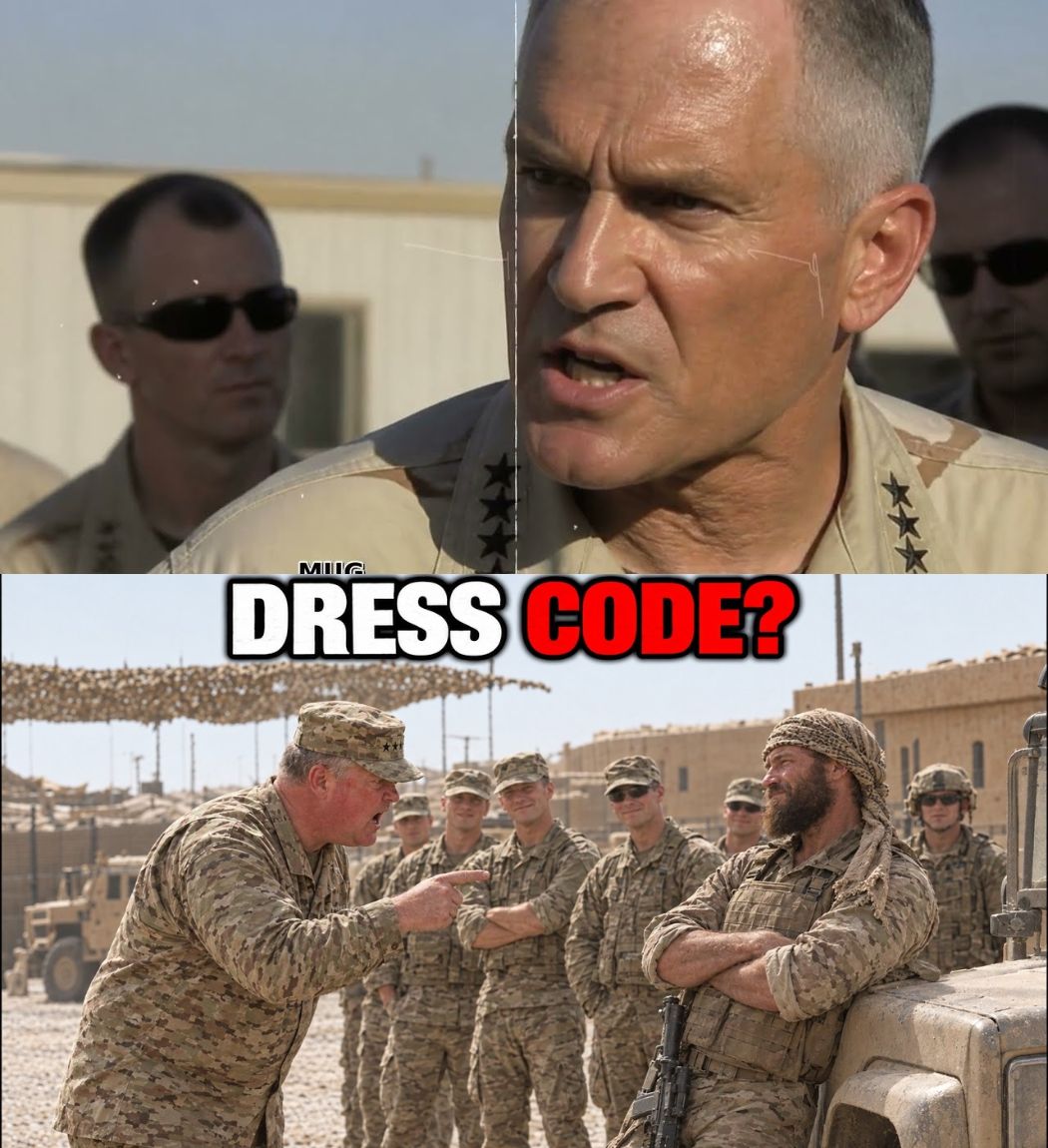
“Take that rag off your head, soldier. This isn’t a costume party. You’re on my base, you’ll look like a soldier or you’ll get the hell off it. Tea-drinking amateurs in fancy dress, that’s all you people are.”
He said it to a bearded man leaning against a Land Rover in the shade of a camouflage net. A man who did not straighten, did not salute, and did not take the shemagh off his head.
The general was Lieutenant General Harlon W. Breck, deputy commander Multinational Corps, three silver stars on his cap, and a laminated grooming card in his breast pocket. The bearded man was a staff sergeant in the Special Air Service, Hereford, visiting a joint base on a quiet morning that was not going to stay quiet.
Breck would remember saying it. He would be made to.
By last light that same day, he would be standing at the edge of a different strip of concrete in a different light, watching the men he had just called amateurs walk back out of a Hilux with a British aid worker alive between them, and he would be holding a single sheet of paper with a single number on it, and he would not be able to make his mouth work.
The staff sergeant with the shemagh would walk past him without looking at him. The staff sergeant would not need to.
That is the end of the story. This is the start of it.
You will hear in the next hour exactly what the general said and exactly what the general was shown. You will hear the voice of the man who kept the shemagh on and the voice of the American master sergeant who stood 20 ft behind his own general and did not blink. You will hear the clock. You will hear the number. You will hear the one line from a United States Army career officer in that general’s own core that put a name on what happened to Harlon W. Breck between a 9:00 dressing down and a 4:00 extraction.
Because here is the thing about the rag: the rag was not a costume.
The rag was the reason a British aid worker named Thomas Easterbrook came home to his wife with his wedding ring still on a bootlace around his neck. And it was the reason three men who intended to film his death did not get to film anything. And it was the reason a 4-minute 11-second breach-to-extraction time ended up in an after-action report that Harlon Breck was invited, politely and in person, to read.
He had called them tea-drinking amateurs in fancy dress at 9:00 in the morning. By last light, he was in a room with the tea, the men, and the dress, and he could not look at any of it.
That is where we begin.
To understand how badly a sentence like that aged in 9 hours, you have to understand the man who said it, because Harlon W. Breck was not a fool.
Breck was infantry. Breck had earned his Ranger tab the hard way at Fort Benning in a year when the course was eating people. And he had carried a rifle company through two tours in the first Gulf when the sand was still new to the American Army. He had a Bronze Star with V device for a night at a crossroads south of Basra where he had done, by every honest account, exactly what a company commander is supposed to do when the plan comes apart in his hands.
He had made full colonel on time. He had made brigadier on time. He had made his second and his third star without stepping on anybody’s throat, which in the modern US Army is itself a kind of achievement.
And by 2006, he was deputy commander of Multinational Corps Iraq, which meant that on paper he ran garrison discipline for roughly 150,000 American soldiers scattered across a country that was coming apart in slow motion.
He believed in standards. He believed, with the honest conviction of a man who had buried soldiers, that the standards were what kept the soldiers alive. He believed in haircuts, in clean-shaven jaws, in the regulation wear of the army combat uniform, in the exact way a cap sat on a head, in the exact way boots were bloused, in the exact way a man addressed a general officer. He believed these things not because he was vain about them, but because, in his experience, the unit that let the small things slide let the big things slide. And the unit that let the big things slide got people killed in rooms. He had, in his own career, seen it happen.
He was not wrong about any of that.
He had also been told repeatedly by officers he respected that the British Special Air Service were the finest small unit soldiers in the Western world. He did not disbelieve them. He simply did not care.
Breck’s view, stated privately in his own officers’ mess, and not so privately in the corridor outside his office, was that the regiment had become a cult of personality dressed up as a regiment, that they wore whatever they liked, grew whatever they liked, slept where they liked, and used the word operator the way a teenager uses the word artist, and that the only reason anyone put up with it was that the British press had turned them into pantomime heroes after the Iranian Embassy siege, and nobody in the chain of command had the nerve to tell them to put a cap on and sign in like a soldier.
“Fancy dress,” he had said more than once at his own breakfast table, “with a 9-mm on the hip.”
So, when he landed at the joint base west of Ramadi at 8:40 on a Tuesday morning in April, in the second year of a war he was personally responsible for parts of, and when he walked across the strip from his Black Hawk and saw, parked under a camouflage net in the lee of a Portakabin, three unmarked Land Rovers and a knot of bearded men in mismatched trousers drinking tea out of enamel mugs with a kettle on a jet boiler and nobody standing to attention and nobody wearing a cap and nobody as far as he could see wearing a rank slide—he did not take a breath and he did not ask.
He walked straight across.
The man leaning against the nearest Land Rover was wearing a tan shemagh wound loosely around his head and the lower half of his face, a Diemaco C8 slung muzzle down on a single-point sling, a plate carrier over a sand-colored smock, and civilian cargo trousers. He had a dark beard trimmed close. He was looking at nothing in particular in the middle distance. He did not turn his head when the general’s boots came within 2 m of him.
Breck’s aide, Colonel Dale Hodgson, caught up a half step behind, already knowing what was coming and already thumbing his West Point ring the way he did when he knew what was coming.
The general stopped. He tapped the laminated card in his breast pocket, the one he was known for, the one with the regulation on it. He raised his voice to a parade-ground pitch that carried across the strip to every man standing under that camouflage net and every man standing in the motor pool 20 m beyond it.
“Take that rag off your head, soldier. This isn’t a costume party. You’re on my base, you’ll look like a soldier or you’ll get the hell off it. Tea-drinking amateurs in fancy dress, that’s all you people are.”
The staff sergeant did not move. Behind him under the net, nobody laughed. Nobody had to.
One of them, a staff sergeant with Welsh in his face and his left wrist turned slightly so you could just see the ink there, lifted his mug an inch, drank from it, and set it down again on the Land Rover’s bonnet, and that was the only sound anyone made for a full 3 seconds.
And in those 3 seconds, Harlon Breck believed, with every honest fiber of a man who had earned his tab the hard way, that he had just corrected a group of grown men who badly needed correcting.
He was wrong about that. He was about to be wrong about it in daylight, repeatedly, in front of witnesses for the rest of the day.
The base sat on a dogleg of the main supply route west of Ramadi, 3 km from a town that was, in April 2006, not under anybody’s full control. From the air, it looked like a scatter of Hesco walls and canvas and corrugated roofs with a short strip running northeast. From the ground, it looked like what it was, which was a staging post.
A US infantry battalion held the perimeter. A company of Iraqi army occupied one side of the inner compound. A small US special forces team from 10th Group ran their own patch in a wired-off corner. And, as of 2 days earlier, a visiting British troop from B Squadron had rolled in off the desert and parked under a camouflage net while they waited on a piece of intelligence that was still being chased.
They were commanded that week by Major Dominic Thorne. Thorne was 38, slight, quiet, a mobility troop officer who had come up through the parachute regiment, and walked, if you watched him long enough, with a small limp on the left side from a Land Rover roll in 2003 that had put him in Selly Oak for a month. He did not talk about it.
His squadron sergeant major, Warrant Officer Class 2 Alistair Gage, was taller, gray at the temples, and could roll a cigarette one-handed off a kit bag at full tilt.
His senior staff sergeant on the ground was Rhodri Price-Jones, Welsh, quiet, with his daughter Carys’s name tattooed on the inside of his left wrist in a thin cursive line.
His breacher was Corporal Jamie Underhill, who chewed cinnamon gum constantly and folded the wrappers into small triangles and put them in a pocket, never the ground.
His sniper pair was led by Sergeant Elliot Marchwood, who read O’Brian novels in his basher when nobody was watching, and marked his place with a strip of green masking tape.
And his youngest man, Trooper Finley Oakhurst, 19 months in the regiment, had grown up in a fishing town in Fife and had learned conversational Pashto and workable Arabic from a shopkeeper on his high street as a teenager, which is the kind of thing that in a conventional army is a curiosity, and in the regiment is the reason a man gets fast-tracked through selection in the Brecon Beacons.
The man Breck had stopped in front of was Price-Jones.
The reason Price-Jones did not take the shemagh off his head was that Price-Jones was due to leave the wire at midday in a civilian pickup with two other men to drive slowly to a petrol station on the edge of the town, 3 km away, where an Iraqi who did not want to be seen talking to the Americans was going to walk past the pickup and drop a folded piece of paper through the open window.
The shemagh was not fashion. The shemagh was the reason Price-Jones would not get recognized from the air or from a rooftop as a European face in the cab of a civilian truck in a town where European faces in cabs got filmed and uploaded within the hour. The beard was for the same reason. The civilian trousers were for the same reason. The Diemaco under the seat was for the same reason.
The kettle on the jet boiler, the enamel mugs, the slouch against the Land Rover, those were not for any reason. Those were just how they were.
Breck did not know any of this because nobody had told him, and nobody had told him because he had landed 40 minutes earlier on an unscheduled stop, and nobody in the chain of command above him had thought to flag the British troop in the morning briefing because the British troop had asked politely not to be flagged. Thorne had asked for that in writing. The request was sitting in Hodgson’s folder, two documents down, unread.
So, when the general finished his sentence and the staff sergeant did not move, what Breck saw was insolence.
What was actually happening was more interesting.
And the person who understood it best was standing 20 ft behind the general’s left shoulder, out of his eye line, with his arms folded.
Master Sergeant Rayford Keen, United States Army Special Forces, 10th Group, four tours on the clock, had been running the team’s half of the base for 6 weeks. Keen knew the British troop. Keen had drunk tea under that net the day before yesterday. Keen knew who Price-Jones was, knew why he was wearing the shemagh, knew where he was going at noon and roughly who he was going to meet, and knew, because Keen was a professional, that the single worst thing anyone could do to that man’s afternoon was to put his face on a photograph next to a three-star American general in a public corner of a shared base at 9:00 in the morning.
Keen did not say any of that. Keen was a master sergeant. Keen watched his general dress down a British staff sergeant and said precisely nothing. And the only thing that moved on Keen’s face was a small slow tightening at the corner of the jaw that nobody who did not know him would have noticed.
The Canadian intelligence liaison, Captain Mireille Dussault, noticed. Dussault had been attached to the task force for 3 months, carried a spiral notebook she kept half in French and half in English, and had learned early that the way to read a room with Americans and Britons in it was to watch the Americans who were not speaking. She wrote one word in her notebook: Bad.
Price-Jones, for his part, waited until the general had been standing in front of him for a count of six, which was long enough for anyone watching to understand that the staff sergeant had considered the order and declined it, and then said, in a quiet Welsh voice that did not carry past the Land Rover, “Sir, with respect, I can’t do that this morning.”
He did not say why.
The general’s face went a different color.
Thorne appeared at Price-Jones’s elbow then from somewhere behind the Land Rover where he had been talking to Oakhurst and the interpreter about a word on a map. He arrived without hurry. He did not salute because he was in theater and he was not wearing a cap and the regiment did not on operations perform garrison courtesies on open ground where a sniper might be watching for the man everybody saluted.
He said, “General Breck, Major Thorne, B Squadron. If I can have a minute of your time in the Portakabin, sir, I can explain the dress of my men.”
Breck looked at him. Breck said, loud enough for the motor pool to hear, “Major, I don’t need a minute. I need a haircut, a shave, and a cap on every man under that net before I come back off this strip. Are we clear?”
Thorne said, “No, sir, we are not clear, but I’d like us to be in the Portakabin in private in a minute.”
That was the moment the day turned. Thorne’s “no, sir” was not loud and it was not the kind of refusal that American officers were used to hearing from men two ranks below their own, and because it was none of those things it landed harder than a shout would have landed, and Harlon Breck, who had been expecting the shout and ready for the shout, found himself walking across the strip towards a Portakabin he had not planned to enter, following a British major who walked with a slight limp and did not look back.
Keen watched them go. Keen did not uncross his arms. He had seen Harlon Breck make a mistake just now and he was not, he decided, going to be the man who told him so.
The Portakabin was 8 m by 3, hot already at 9:00 in the morning, with a map of the governorate pinned to one wall and a plastic kettle on a camp table. Thorne closed the door. The air inside was still. Hodgson came in behind the general. Keen did not come in. Keen stood outside with his back to the wall and his arms folded and looked at nothing.
The regiment’s visiting commanding officer, Lieutenant Colonel Peter Vaughan-Hale, who had flown in with the troop two days earlier from Hereford for a four-day visit, was already in the Portakabin, sitting on a plastic chair with his father’s parachute regiment wings in a brown leather wallet open on his knee because he had just been checking the time against the pocket watch his father had carried at Arnhem.
He closed the wallet when the general came in. He stood up. Vaughan-Hale was a lieutenant colonel. He outranked Thorne. He did not outrank Breck. He was in command of a saber squadron detachment visiting an American base in an American theater of operations, which meant that in the strictest reading of the chain, Harlon Breck could have had him on a plane to Baghdad by lunchtime if he had chosen to make an issue of it.
Breck opened his mouth to make an issue of it.
Thorne spoke first.
He said, “Sir, at 1200 hours today, Staff Sergeant Price-Jones is driving a civilian vehicle 3 km beyond this wire to collect an intelligence product from a source we have been working for 7 weeks. The source will not approach a man he recognizes as European. The shemagh, the beard, the civilian trousers, and the posture under that net are the kit required for that movement. Removing them this morning in front of an audience that includes the Iraqi army liaison, two local nationals employed on this base, and anyone with a long lens on the ridge north of the perimeter, loses us the source, loses us the product, and loses us, almost certainly, the man we are chasing with it, who took a British aid worker off the Baghdad road 48 hours ago and is currently keeping him alive, we believe, in a building we have not yet identified.”
He stopped. He said, “That is the dress code, sir. That is why.”
Breck said, “You could have told me that on the strip.”
Thorne said, “Not in the hearing of the Iraqi liaison, sir. No.”
Vaughan-Hale said nothing. Vaughan-Hale was watching the general’s face.
Hodgson, the aide, was looking at the floor between his boots because Hodgson had understood, roughly four sentences in, that his general had just walked onto a strip and shouted at a man who was 2 and a half hours away from putting his unshaven face in a cab in a town where that face being recognized would get a British civilian killed on camera, and that the shouting had happened within earshot of an Iraqi army liaison who had, at that moment, been standing 15 m away with his back politely turned.
The general said, “The Iraqi liaison.”
Thorne said, “Captain Aboud, sir. He’s a good man. He is also a man with a cousin in the town. We do not assume the cousin is clean. We do not assume the captain is clean. We work on the assumption that anything said in open hearing on the strip has reached the town by lunch. That is the standard we operate on, sir, and it is why my staff sergeant did not take the shemagh off when you asked him.”
The general said, “I didn’t ask him.”
Thorne said, “No, sir, you didn’t.”
That was the first blow and it was quiet and it landed exactly where blows of that kind land.
The general’s jaw moved. He did not say anything for a count of four. Hodgson, behind him, kept his eyes on the floor. Vaughan-Hale sat down again slowly and reopened the wallet on his knee and closed it again because the gesture gave him something to do with his hands that was not watching an American three-star receive a correction from a British major in a hot Portakabin at 9:00 in the morning.
The general said, “The source. What’s the product?”
Thorne said, “Location, sir. Hopefully, we’ll know at 1200.”
The general said, “The hostage.”
Thorne said, “Dr. Thomas Easterbrook, British water engineer, lifted from a convoy on the Baghdad-Ramadi road on Sunday morning. Wife and two children in Oxford. We are working off a short clock. Our best estimate is 72 hours from lift to video, which puts the video, if we don’t move, somewhere around 2200 tonight.”
The general looked at the map on the wall. The general had, let the record show, done this kind of maths before. He had sat in rooms like this one, with maps like this one, and short clocks like this one, in a different uniform and a different decade. And he knew exactly what 72 hours meant, and exactly what a video on an Arab satellite channel at 2200 local meant in the political weather of April 2006.
He also knew, because he was not stupid and had never been stupid, that he had, 9 minutes ago, come very close to breaking the operation that was going to prevent that video.
He said, “You should have led with the hostage, Major.”
Thorne said, “Sir, with respect, the hostage is not your business and was not going to be your business. And I asked, in writing, that we not be flagged in your briefing. The reason I asked that is that the fewer people on this base who know Dr. Easterbrook’s name this morning, the more likely it is that Dr. Easterbrook sees Wednesday. I regret that you heard it in this room. I would have preferred that you did not.”
The general looked at him. Then the general did something that Hodgson, in 9 years of serving him, had never seen him do.
The general sat down. He sat down on the plastic chair across from Vaughan-Hale, and he did not say anything for 10 seconds.
And then he said, “What do you need from me?”
Thorne said, “Nothing, sir. We have what we need.”
That was the first blow. It did not look like a blow.
The general had walked into the Portakabin with his back straight, and he was still sitting in a plastic chair in it when Price-Jones, outside, unshaven and in his shemagh, climbed into the cab of a battered white Toyota Hilux at 11:40 with Underhill in the passenger seat and Oakhurst in the back under a tarp, and rolled out through the gate for the petrol station.
And that was only the first time that day Harlon Breck would be wrong.
Breck did not leave the base. Breck should have left the base. His schedule had him in Al Asad by 1300 and in Baghdad by 1700. But Breck told Hodgson in the Portakabin with the door closed that he would wait until the pickup came back in.
Hodgson, who had been thumbing his West Point ring the entire morning, stopped thumbing it then because Hodgson had understood that his general was staying not out of concern for Dr. Easterbrook, whose name he had learned 9 minutes ago, but because he, Harlon Breck, had just been told very politely by a British major that he had almost killed a man he had never met. And Harlon Breck, infantry, Ranger-tabbed, needed to stand on the strip at the end of the day and see the pickup roll back in and see the man he had almost killed come out of it alive. And he needed to see it with his own eyes.
That is who Harlon Breck actually was under the laminated card and the parade-ground voice. Hodgson knew it. Keen outside did not know it yet.
Hodgson rescheduled the Al Asad meeting.
The pickup came back in at 13:20.
Price-Jones, Underhill, and Oakhurst got out of it the way men get out of a vehicle when they have not been shot at: slowly, without hurry, without talking.
Price-Jones walked into the Portakabin without taking the shemagh off and he put a folded piece of paper on the camp table in front of Thorne. And he said, in his quiet Welsh voice, “He walked past. He dropped it. We rolled.”
Thorne unfolded the paper. The paper had, in a schoolteacher’s careful Arabic, an address and a sketch.
The schoolteacher was Jalal al-Rawi, the interpreter who stood in the corner of the Portakabin with his hands folded in front of him in the way that interpreters stand when they are about to be useful, and he read the address aloud to Thorne in English, and he read the sketch aloud, and then Oakhurst—19 months in the regiment, 19 years old when he started learning Arabic from a man who sold him tins of Irn-Bru after school in Fife—said in his soft Fife-inflicted Arabic two sentences to Jalal, and Jalal nodded, and Jalal said in English, “Yes, that is also what he has written at the bottom. He has written the building with the blue door, upper room. The man with the limp is in charge. There are three others. They are tired. They are not sleeping in shifts.”
Oakhurst had read it off the paper before Jalal translated it because Oakhurst could read it off the paper.
Breck, who was standing by the map, saw Oakhurst do it. Breck had 3 hours earlier looked at Oakhurst under the camouflage net and seen a bearded 19-year-old in a dirty smock drinking tea out of an enamel mug and had thought specifically, That boy belongs in a barber’s chair.
The boy had just read a handwritten Arabic note off a piece of paper in a dialect Breck’s own interpreter at corps headquarters—a man with a doctorate and 20 years of service—would have asked for a second pass.
Breck said to Oakhurst, “You read that.”
Oakhurst said, “Yes, sir.”
Breck said, “Where?”
Oakhurst said, “Fife, sir. Mr. al-Hadri’s shop, three doors down from my mum’s.”
He said it exactly the way a 19-year-old who did not know he had just embarrassed a three-star general for the second time that morning would say it, which is to say politely, with his cap tucked into the back of his belt because he still was not wearing one.
Breck looked at him. Breck did not answer. Hodgson was thumbing the ring again.
Thorne, who had been watching the exchange out of the side of his vision, let it sit for a second and then said, “Sir, we are going to go tonight. We have a window from 2200 to 0400. We are going to put a sniper pair on the roof of the building opposite for the last 4 hours of that window to confirm life, to confirm the man with the limp, and to confirm the hostage. If we confirm all three, we will breach at 0337, which is the moment the local power station cycles its backup, and the whole quarter goes dark for about 90 seconds. If we don’t confirm, we don’t go, and Dr. Easterbrook probably dies on camera at 10:00 tomorrow night. Those are the two outcomes.”
Breck said, “The power station?”
Thorne said, “Yes, sir.”
Breck said, “How do you know about the power station?”
Thorne said, “Marchwood, sir. Marchwood sat on a different roof for a different reason 3 weeks ago, and Marchwood counted.”
Marchwood, who was sitting on the step outside the Portakabin reading a book, did not know he had been named. He turned a page. The green masking tape marker moved forward one chapter.
Breck looked at the map. The map showed the quarter, the building with the blue door, the power station, the sniper position, and three ingress routes: two for the element and one dotted for the exfil. He looked at it the way a man who has run operations looks at a plan, which is to say he looked for the thing that was wrong with it because that is how infantry officers read maps, and he did not find anything that was wrong with it.
The plan was not clever. The plan was not fancy. The plan was the plan a Ranger-tabbed US infantry officer would have drawn—if a Ranger-tabbed US infantry officer had Oakhurst and Marchwood and Price-Jones and 90 seconds of dark on the power station cycle, which Ranger-tabbed US infantry officers typically did not.
Breck said, “Who’s your assaulter in the room?”
Thorne said, “Price-Jones.”
Breck looked at the Welsh staff sergeant who had taken the shemagh off finally inside the Portakabin and was drinking water out of a bottle. Price-Jones’s left sleeve was pushed up to the elbow and his daughter Carys’s name was visible on the inside of his wrist in cursive, and Harlon Breck, who had two daughters himself, saw it.
Breck did not say anything about it. He did not say anything to Price-Jones at all. He had by this point in the day understood that the quickest way to make the operation worse was to add his voice to it, and he was infantry enough and self-aware enough to shut up, which was the second thing Hodgson had never seen him do.
He said to Thorne, “I’ll be on the strip when you come in.”
Thorne said, “Yes, sir.”
That was the second blow. It had not been loud, either.
Breck walked out of the Portakabin, and Keen, still against the wall, still with his arms folded, watched him go. And for the first time that day, the corner of Keen’s jaw relaxed by about a millimeter because Keen had just seen Harlon Breck receive a 19-year-old Scottish trooper reading classical Arabic in a shemagh and had seen Harlon Breck not say the thing Harlon Breck would 2 hours ago have said.
The schoolgirls, he had called them. The schoolgirl had just read him a kidnapper’s address out of a folded note. The schoolgirls, he had called them. The schoolgirls were about to go to work.
The sun went down at 18:41.
The temperature on the strip dropped from 38 to 26 in the first hour of dark and kept dropping. The call to prayer from the town 3 km away came in on the wind at 1900 and finished at 1905. And after it finished, the base went quiet in the particular way bases go quiet when something that is not routine is about to happen inside the wire that nobody is going to say out loud is happening.
Breck sat in the ops tent next to the Portakabin from 2000 onwards. Hodgson sat next to him. Keen, at Thorne’s quiet request to Vaughan-Hale, had come in and was standing against the far wall. Dussault, the Canadian captain, had been invited and had come in with her notebook. Vaughan-Hale was in the ops tent in his smock with no rank slide and a radio headset on one ear.
The ops tent had a bank of screens on one side showing a drone feed in black and white. And on the smaller screen, the view from Marchwood’s position on the roof opposite the building with the blue door, which was a thermal image in white-hot that showed, when Marchwood went live at 22:14, exactly what Jalal the schoolteacher had written down.
There were four heat signatures in the upper room. One of them was lying on the floor against the wall and not moving. Three of them were upright. One of them was moving around the room on an irregular stride that favored the left leg, which is the gait of a man with a limp.
Marchwood, over the radio in a voice so flat it sounded bored, said, “Confirmed man with limp. Confirmed hostage posture. Four signatures. No shift rotation. Three awake, one down. Easterbrook is the one on the floor against the wall. I can see the bootlace at his neck.”
Thorne, somewhere in the dark 3 km away in the back of a civilian pickup pulled up in an alley two blocks from the blue door, said over the radio, “Marchwood, confirm bootlace.”
Marchwood said, “Confirmed. Wedding ring on a bootlace. White male. Breathing. Alive at 22:16.”
Breck closed his eyes for half a second. Hodgson saw it. Keen saw it. Dussault wrote one word in her notebook: Alive.
The window ran from 2200 to 0400.
For the next 5 hours and 21 minutes, Breck sat in a canvas chair in an ops tent in a camouflage shirt he had been wearing since 5:00 in the morning in a different time zone. And he watched a thermal screen on which four human beings continued to exist. And he listened to a radio on which men he had that morning called tea-drinking amateurs in fancy dress did none of the things he had expected men like that to do.
Nobody chatted on the net. Nobody double-clicked for the sake of being heard. Nobody announced their position. The radio was mostly silence broken every 20 or 30 minutes by Marchwood confirming four signatures and the hostage still breathing in the same flat voice as if he were reading out a cricket score.
At 01:47, one of the three upright signatures left the room and went down the stairs and out of the building and walked in the thermal view from the drone three doors up the alley and relieved himself against a wall and came back. He was gone for 4 minutes and 11 seconds.
Nobody in the ops tent said anything, but Breck noted the number because Breck was infantry and Breck noted numbers. 4 minutes and 11 seconds was how long it took one man to walk 30 m, do what he was doing, and walk back. Breck filed it. He did not know yet that the same number was going to come back at him before the sun came up.
At 02:55, Marchwood said over the radio, “Shift change not happening. They are not sleeping in rotation. Two of them are nodding. The limp is still upright. He is drinking something hot.”
Thorne said, “Copy.”
At 03:20, Price-Jones, who had been sitting in a doorway two blocks from the blue door for an hour and a half, moved. The drone saw him move.
Breck did not see him on the drone because Price-Jones, in his civilian jacket over his plate carrier, with the shemagh wound back around his lower face against the night, was indistinguishable from any other man sitting in any other doorway in that quarter, which was precisely the point. The thing Harlon Breck had called a rag at 9:00 in the morning was, at 03:20 in the morning, the reason the man in the doorway was still a man in a doorway and not a target.
Breck, in the ops tent, understood this. He understood it the way a man understands a thing he has been told three times and has, the fourth time, been shown. He did not say so. He had, by this point, said nothing for about 6 hours.
At 03:35, Marchwood said, “Power station cycle in 2 minutes.”
At 03:36, the lights in the quarter went out in a long, slow brownout as the local grid cycled to its backup generator and the backup generator took the 90 seconds it always took to come up to full load. The drone’s night vision feed, which had been fighting the ambient light of the town, cleaned up to a sharp white and gray. The thermal view on the smaller screen did not change because thermal does not care about street lights.
At 03:37, Price-Jones went through the blue door.
Breck, in the ops tent, leaned forward in his canvas chair. Hodgson stopped breathing. Dussault’s pen stopped on the page. Keen, against the wall, uncrossed his arms for the first time in 16 hours.
The thermal screen showed the upper room: three upright signatures, one on the floor. And then moving up the stairwell from the ground floor at a speed that was not fast but was not slow, four new signatures in a stack with the lead signature’s arm extended to a slight downward angle, which is the posture of a man moving through a doorway behind a Diemaco C8 with a suppressor on the muzzle.
The ops tent heard over the radio exactly four words.
Price-Jones said, “Going.”
And then the ops tent heard the thing that was the third blow, the worst blow, and the one Harlon Breck would remember for the rest of his career, which was the thing it heard next, which was nothing.
The ops tent heard nothing.
For 11 seconds the radio was dead silence, and on the thermal screen the four new signatures entered the upper room, and the three upright signatures went down, and the signature on the floor against the wall did not move. And the whole thing happened in a silence so complete that Hodgson afterwards said he had been able to hear the canvas of the tent moving in the wind outside.
Then Price-Jones said in his quiet Welsh voice over the radio, “Easterbrook, Thomas, we’re British, we’re taking you home. Stand up for me, sir.”
Breck put his hand over his mouth. He did not know he had done it. Keen saw him do it.
It is 03:38 in the morning in western Iraq. The ops tent is lit by the glow of two screens and a red map lamp. Harlon W. Breck, Lieutenant General United States Army, three stars, Deputy Commander Multinational Corps, is sitting in a canvas chair with his hand over his mouth, and he does not know he has put it there.
The man he has been calling in his own head for the last six hours—Thorne, simply Thorne, no rank, the way infantry officers refer to other infantry officers they have begun to respect—is standing over the drone screen with a radio headset on one ear, listening.
The radio says, in Price-Jones’s voice, “Easterbrook up. Easterbrook walking. Three hostiles down. One hostile taken, bagged, moving.”
Thorne says, “Copy. Exfil.”
The thermal screen shows five signatures leaving the upper room, down the stairwell, through the ground floor, out of the blue door. Four of the five are upright and moving at a controlled pace. The fifth is being supported between two of the others. The sixth signature, bagged and bound at the wrists, is being walked between two more.
On the drone feed in night vision, which has cleaned up as the local grid finishes its backup cycle and the street lights come half back on, you can see them come out of the door and turn left and walk, not run, down the alley towards the pickup.
The pickup moves at 03:39.
The pickup leaves the quarter at 03:41.
The pickup is on the main supply route back to the wire at 03:44.
The pickup is through the gate of the base at 04:06.
Harlon Breck is on the strip at 04:06.
He has walked out there at 03:58 in a camouflage shirt that is too thin for the pre-dawn cold, with Hodgson behind him and Keen behind Hodgson and Dussault behind Keen. And he has stood at the edge of the strip in the cold with his hands at his sides and watched the twin headlights come down the track from the gate towards the camouflage net where the Land Rovers are parked and where, at this hour, the kettle is already on because Gage has put it on because Gage knows when his troop is coming in and Gage puts the kettle on.
The pickup stops under the net.
Price-Jones gets out of the driver’s seat. He is still wearing the shemagh. He has not taken it off in 19 hours. His face below the eyes is the color of a man who has been awake since 5:00 the previous morning, and his eyes are the color of a man who has just walked through a door with a suppressed C8 and done the thing he was sent to do.
Underhill gets out of the passenger seat and goes around to the back and opens the tailgate.
Oakhurst and Marchwood get out of the covered bed.
Between them, with his wedding ring on a bootlace around his neck and his hands shaking and a blanket round his shoulders that Underhill has put there, is Dr. Thomas Easterbrook, water engineer from Oxford with a wife called Rebecca and two children called Pippa and Noah, and a left eye that is swollen almost shut and a right eye that is working.
The right eye is looking at the strip, at the lights, at the camouflage net, at Harlon W. Breck in his thin camouflage shirt, and the right eye does not know who Harlon W. Breck is because it has never seen him and will never see him again and does not need to.
Thorne gets out of the back of the pickup.
Thorne walks across the strip towards Breck. He walks with his small limp. He is holding a single sheet of A4 paper folded once in his left hand.
He stops in front of Breck. He does not salute. He hands the general the paper.
Breck opens it. The paper has, in Thorne’s own handwriting, the following lines which Thorne has written in the back of the pickup on the drive-in while his breathing was still coming back down to normal:
Operation summary.Time on target: 0337.Breach to extraction: 4 minutes 11 seconds.Hostile killed in action: three.Hostile captured: one.Friendly killed in action: zero.Friendly wounded in action: zero.Hostage recovered: one alive walking (Dr. T. Easterbrook).Source product confirmed accurate.Operation complete.
Breck reads it. He reads it twice because the first time he reads it his eyes come to rest on “4 minutes 11 seconds” and his mouth does something small and involuntary that Hodgson sees, because 4 minutes 11 seconds is the number Breck himself clocked at 01:47 for the time it took one tired kidnapper to walk 30 m to relieve himself against a wall and come back. And the number is now also the time it took four men in shemaghs to go through a blue door, kill three armed men, capture a fourth alive for intelligence, locate a hostage against a wall, confirm his identity, stand him up, and walk him out of a building in a town that was not under anybody’s full control.
And the number is the same number, and Harlon Breck is infantry, and Harlon Breck notes numbers, and the number does to him what the number was always going to do to him.
He reads it a second time. He does not say anything.
Thorne says, “Sir, if you’d like to meet Dr. Easterbrook before the medics take him, he’s under the net.”
Breck looks at the net.
Under the net, in the half-light, in the camouflage shadow, there is a kettle on a jet boiler, and six bearded men in shemaghs and plate carriers drinking tea out of enamel mugs around a British water engineer in a blanket who is drinking tea out of the seventh enamel mug and crying in the quiet way that men cry when they have not yet understood that they are going home.
Gage is standing next to him with one hand on his shoulder, rolling a cigarette one-handed off a kit bag with the other. Nobody is talking. The tea is in the mugs. The dress is on the men. The amateurs are drinking the tea.
Harlon Breck looks at it for a long time. He does not go under the net.
He hands the sheet of paper back to Thorne. His hand is not entirely steady.
He says, “Keep it, Major. It’s yours.”
Thorne says, “No, sir. It’s a copy. The original goes to Hereford. This copy is for you.”
Breck takes it back. He folds it once carefully along the line Thorne has already folded it along, and he puts it in the breast pocket of his shirt, which is the pocket on his garrison uniform that normally holds the laminated grooming card. He is not wearing the garrison uniform. The grooming card is in his quarters in Baghdad. He does not reach for it. He does not think of it.
He stands on the strip in the cold and he watches under the camouflage net the six men he called tea-drinking amateurs in fancy dress drink their tea in their dress with the man they went out at 4:00 in the morning to bring back alive, and he does not say anything, and the sun begins slowly to come up over the ridge north of the perimeter, and the light finds, among other things, the shemagh on the back of Rhodri Price-Jones’s neck as he turns to pour Dr. Easterbrook another mug.
The rag. The rag is the reason the man is drinking the tea. Breck knows it now.
Harlan Breck did not say anything on the strip for a long time. He stood in the cold in his thin shirt and he watched the men under the net, and he did not go under the net because he understood in a way he had not understood at 9:00 the previous morning that the net was not his to walk under. The men under it had not invited him. He had 19 hours earlier in open hearing called them amateurs in fancy dress on the strip he was now standing on, and the apology for that was not available to him this morning because the apology for that would have required him to walk under the net and say the words in front of Dr. Easterbrook, and Dr. Easterbrook had been through enough in the last 72 hours without being made to witness a three-star American general apologize to the men who had just saved his life for having insulted them before they went to save it.
Breck understood this too.
Hodgson standing behind him understood that his general understood it because Hodgson in nine years had learned to read the back of his general’s neck, and the back of his general’s neck was the color of a man who had been shown the shape of his own mistake in the clearest light available to him and was waiting now for someone else to say the thing he could not say out loud.
The someone else was Master Sergeant Rayford Keen.
Keen had been standing on the strip since 03:58. He had not spoken for 19 hours. He had watched his general dress down a British staff sergeant at 9:00 in the morning, and he had watched his general sit in a canvas chair for 6 hours with his hand over his mouth, and he had watched his general stand on a strip in the cold and read a single sheet of paper with a single number on it, and Keen had, by the end of all of that, come to the view that the only service he could do his general—the only service in his 22 years in the United States Army that he had ever been in a position to do a general officer—was to put a name on it now where Breck could hear.
Keen said in his dry Louisiana voice, loud enough that Hodgson heard him, and loud enough that Dussault heard him, and loud enough that Breck heard him, “Sir.”
Breck turned his head.
Keen said, “That is the finest small unit operation I have personally witnessed in four tours. 4 minutes 11, zero friendly. Hostage walking. That is what right looks like, sir. That is what the rag is for.”
He did not raise his voice. He did not elaborate. He turned, and he walked back towards the team’s wired-off corner, and he did not look at Breck again.
And that was, in a career of 22 years, the first time Master Sergeant Rayford Keen had ever spoken on his own initiative to a general officer, and it was also the last, because Keen did not do things twice when the thing had been done.
Breck watched him go. Breck looked at the sheet of paper in his breast pocket. Then Breck did the thing that Hodgson afterwards said he would remember for the rest of his own career, which was that Harlon W. Breck, Lieutenant General, Deputy Commander, Multinational Corps, Bronze Star with V, Ranger-tabbed, three stars on his cap, walked across the strip in the pre-dawn cold towards the camouflage net, and he stopped 3 m short of it—which was outside the net and outside the circle of men under it, but inside their line of sight—and he raised his right hand, palm flat, to the brim of a cap he was not wearing.
And he held the salute for the count of three, and he dropped it, and he turned, and he walked back to the ops tent, and he did not say a word.
He saluted the net. He saluted the dress.
Under the net, nobody saluted back because the regiment did not salute on operations and did not salute men who had insulted them, and because the man in the blanket drinking tea did not know what the salute was for, and because Gage, who did know what the salute was for, had decided in the quarter-second between seeing it and reacting to it that the correct response from the regiment to a three-star American general finally understanding what he had just been shown was to continue rolling his cigarette one-handed and not look up.
Thorne looked up. Thorne caught Breck’s eye for about half a second. Thorne nodded once, small, and that was all the acknowledgement the regiment gave him, and all the acknowledgement in the circumstances that the regiment was willing to give him. And it was, in truth, more than Harlon Breck had earned.
Breck walked back to the ops tent. He did not come out of it for an hour. When he did come out of it, Dr. Easterbrook was gone: to the medical bay, to the Chinook, to Balad, to Birmingham, to Oxford, to a kitchen in a terraced house where a woman called Rebecca was going to open the door at some hour of some day and find her husband on the step with the wedding ring still on the bootlace.
And the Land Rovers under the net were being quietly reloaded for the next move. And the kettle was off the jet boiler, and the mugs were being washed in a plastic basin by Oakhurst, who was humming something under his breath in a language Breck could not identify.
Breck did not try to identify it. Breck got into his Black Hawk at 0912 and lifted for Baghdad and did not look down. The grooming card was still in his quarters. He never put it back in the pocket of a field shirt again.
Harlon Breck did not become an admirer of the Special Air Service. He did not fly to Hereford. He did not write a foreword to anybody’s memoir. He did not in the years that followed become the kind of man who told the story in officers’ messes because the story was not the kind of story Harlon Breck told. He finished his tour. He went home. He retired on time. He did the things men like Harlon Breck do when they retire on time, which is to sit on two boards and give three speeches a year. And in none of those speeches did he mention a Tuesday in April 2006, or a Welsh staff sergeant in a shemagh, or a sheet of paper with a number on it, because the story did not belong to him and he knew it did not belong to him. And that, in the end, was the most honest thing about him.
Hodgson told the story once, years later, to Dussault, who had kept her notebook. And Dussault had the word bad at the top of one page and the word alive at the top of the next. And between them, in her careful bilingual hand, she had written the number 4:11.
The number was the number. The number was Dr. Easterbrook walking out of a blue door in a town that did not love him with a bootlace at his neck and a wife at the other end of the flight. The number was the men in the shemaghs who went in and came back out. The number was what the general was shown.
Harlon W. Breck had stood on a strip in western Iraq at 9:00 in the morning and he had called them tea-drinking amateurs in fancy dress. And he had been right about the tea and he had been right about the dress. And he had been catastrophically, publicly witnessed wrong about the men who drank the tea and wore the dress. And the correction had been administered in 4 minutes and 11 seconds in a room 3 km beyond a wire he had walked in through that morning, and he had been invited politely to read the correction on a single sheet of paper on the strip at 4:00 in the morning, and he had put the paper in the pocket where the grooming card used to live, and he had never taken it out.
The rag was not a costume. The rag was the kit. The men were not amateurs. The men were the regiment.
And somewhere in Oxford, in a kitchen that smelled of toast, a water engineer with a swollen eye poured tea for his wife out of a kettle, and his daughter asked him why he was crying, and he said he was not crying, and he was, and the ring on the bootlace was in a drawer upstairs where she would one day find it and ask about it, and he would one day tell her.
And the end, when he told her, was that a quiet Welshman had stood him up off a floor in the dark, and that the quiet Welshman had been wearing over his face a piece of cloth that a very important American had that same morning called a rag.
That is the story. Keep the kettle on. The men under the net have another one to tell.