8 Things Only SAS Point Men Know (And Never Talk About)
8 Things Only SAS Point Men Know (And Never Talk About)
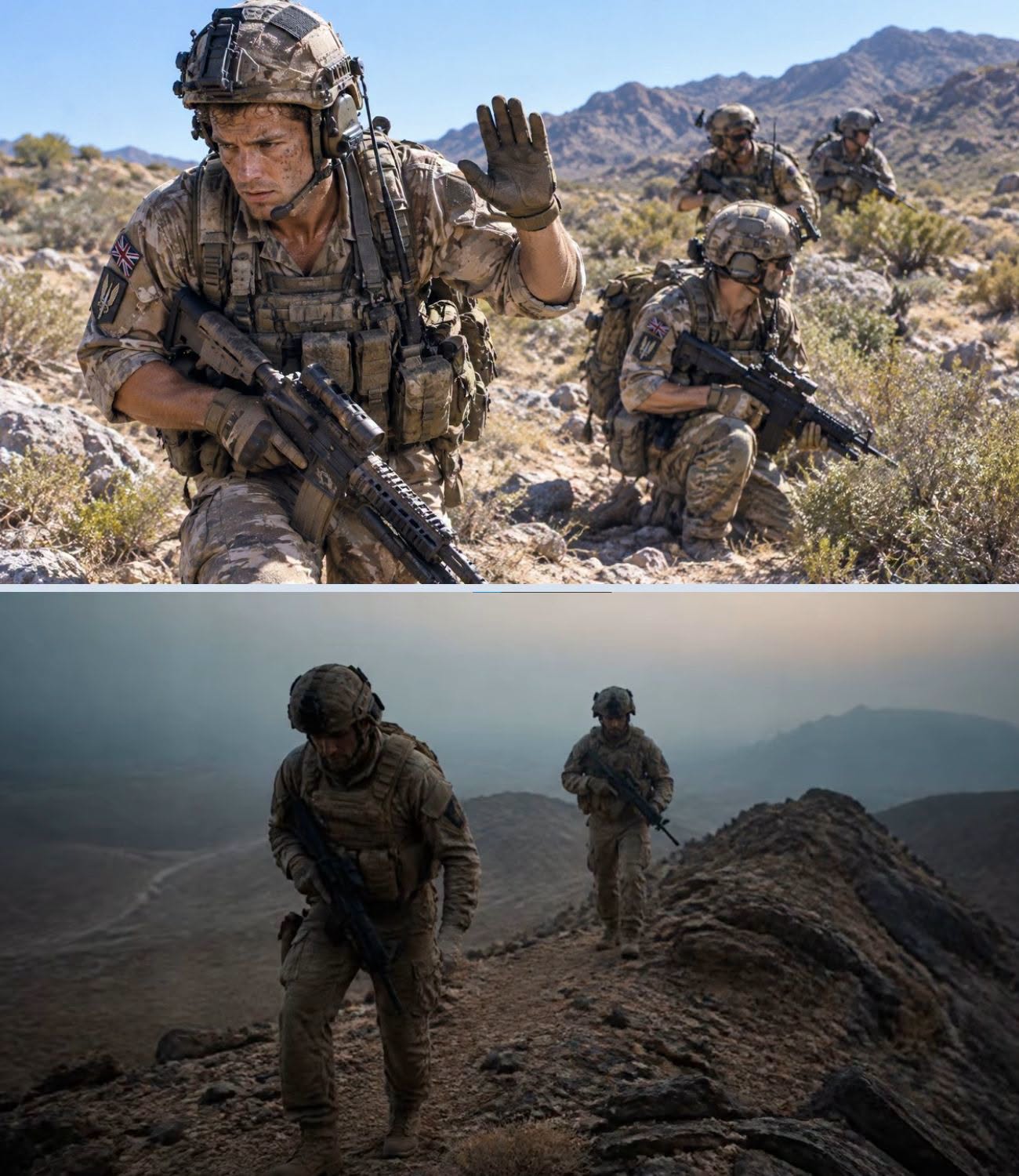
A hand is raised in front of you , although you did not see it rise. You are Master Sergeant Elias Rock, 34, 1st Special Operations Group Delta , and you are on a ridge above a wadi in northern Jordan, an hour before the sun rises over the eastern horizon. The air smells of cold stones and diesel from a car 3 km behind.
Your carbine is raised. Your breathing is even, as it should be. You’ve made this transition or one similar to it 47 times in your career, and you’ve never been the second to notice. This hand belongs to Staff Sergeant Yol Preduch of the Mountain Unit of the 22nd Special Airborne Service Regiment . It clenches, then opens with its palm facing the ground, and the entire patrol behind you stops without a sound.
You didn’t hear him move. You didn’t see him pick her up . You look right at him and can’t tell when it happened. He’s not looking where you’re looking. You follow his gaze and see 60 meters to the left a patch of shadow under a rock that has an irregular shape for a shadow . Once you see it, you can’t “unsee ” it.
A man’s shoulder, a rifle barrel, a piece of cloth that is not the color of the earth, but at the same time exactly the color of the earth, until you know where to look. You didn’t notice that. He saw it from a greater distance than you, in worse lighting and with a bunch of obstacles. He didn’t even turn his head. He didn’t say anything on the radio.
Actually, he doesn’t do anything at all . But the four people behind you are no longer on their feet, but pressed into the ground, and the patrol has now become something else. No longer moving, no longer visible—a silhouette that blended into the hillside as if it had always been there. You take out a small green notebook that you keep in your left pants pocket.
You don’t make notes in it . You are looking at the person in front of you who has just effortlessly , without noise, without a single word on the radio seen something that you did not see. And you realize that there are things he knows that you weren’t taught. You want to know what these things are. They won’t tell you.
Elias Rock was not a man to be easily impressed. And it wasn’t because he chose to be difficult. This was because the road that brought him to the ridge in Jordan at the age of 34 was the kind of road that devastates a man of what he can afford to lose. He grew up in a small town in western Pennsylvania known for a steel mill that closed the year he was born.
His father was a ranger and, for reasons Ro never asked, didn’t want his son to follow in his footsteps. Rohr enlisted anyway, joined the infantry, became a Ranger, served two rotations in Anbar Province with the 2nd Ranger Battalion, and then, at age 26, was selected for the 1st Special Operations Command, Delta Force , because a Ranger sergeant major once looked at him in a fleet and quietly said, “You’ll make it.
” He passed. He passed the stress test phase in Appalachia and operator training courses in North Carolina. He joined his squadron and did a full rotation in the Korangal Valley, a place that argues with man for its own reasons. He returned, became a group commander, then a squad sergeant, and this year, a master sergeant with a certain reputation.
The reputation was about shooting . By the internal standards of a unit that doesn’t flaunt its performance, Rohr was… one of the best rifle shooters in his squadron. He went through the scenario twice in the training house during which time the instructor would come to watch afterwards, arms at his sides.
During his second deployment, he fired three bullets at a moving target from 140 meters, using a mechanical sight because he had no other. He was a master. He knew he was a master. He earned this knowledge. He also believed—and this belief would be shattered over the next 50 minutes of his life—that any trade worth learning could be taught.
That any skill is fundamentally a procedure. That every procedure can be described, and that every described procedure, given time and repetition, can be instilled in another person. It wasn’t arrogance on his part. This was a basic principle of the American special operations forces , in which he grew up. An enterprise that took 18-year-old boys from farms and social housing estates and, through a system of published standards and measured exercises, created fighters capable of hitting a target the size of a mug from a football field away
after three days without sleep. It worked. He saw how it worked. He was a product of that efficiency. In his room at Fort Bragg, he kept a shelf of small green notebooks in a locked closet. Each of them contained a report on a task they had completed or observed . Standard, time, shooter, number of rounds, type of error.
He believed that if you wrote enough of these notebooks, you would become better. He believed in it because it had been proven in practice. What he had not yet encountered, what awaited him on the Welsh hillside, in the Herefordshire training house, and on the ridge above the wadi—was an art that did not fit into a notebook.
An art whose deepest level was not procedure but knowledge, and whose keepers, when asked, could not explain what that knowledge was, because telling destroyed its essence. You can’t learn this art from a manual. You learn by following the one who possesses it and by remaining silent. The bell rang on a Tuesday in February, and Sergeant Major Ray Halcom didn’t start with, ” Hi, Rore, it’s the Sergeant Major.
” “You’re going to Hereford.” Rock was in the kitchen at the time , standing over a cup of coffee that had cooled while he was reading something else, and it took him a moment to respond because he hadn’t expected that phrase. Delta conducted exchanges. It maintained close and long-term exchanges, especially with the Special Airborne Service, who were older than most of the fighters participating in them.
And every year, one or two operators set off in each direction . Rohr did not file his candidacy this year. In fact, he was using it for something else. “Sergeant Major , I…I know what you applied for.” “This is better .” “You will be seconded to the Saber Squadron for three months.” ” You will do what they do.
” “You will come back and write me a report.” “About what?” Hulk was silent for a moment . Then he said, “About what they do differently.” “It’s not about the equipment, it’s not about the organizational structure, it’s about how they think on the battlefield.” Rock, who had never been to the United Kingdom, who had trained with SEAL Team 6, the French GIGN, and the Polish GROM, who had a rough map in his head of what the world’s first-tier units looked like when you approached them, uttered a phrase he would later recall on a
ridge in Jordan. ” Sergeant Major, I trained with everyone.” “How different can [ __ ] be on a Welsh field, really?” Hulk was silent for so long that Rock thought the connection had been lost. Write me an article, Elias. “He flew into Bree Norton on the last day of the month. He was met by a Land Rover.
The driver, a corporal, had said hello after lunch and then remained silent all the way to Herefordshire, and Rock, accustomed to the units he visited either greeting him or throwing a ” hazing party” and mentally preparing for both, felt uneasy that neither happened . Late in the evening they left the motorway and entered a country of small fields, low hedges and stone farmhouses on the hills, and the corporal unceremoniously turned into an unmarked gate , drove past a flagless guardhouse and pulled into a car park behind the walls of Stirling Lines, home of the 22nd
Special Airborne Regiment at Creden Hill, in the English county of Herefordshire , about 40 miles east of the Welsh border , which he would soon learn very well. There were no ceremonies inside either . He was taken to a room. He was told the time to be at the briefing the next morning. He was left alone. He unpacked his equipment.
He put down his notebook. He noticed and wrote down that the base was quiet, in a way that is not always quiet at American bases. No music from the open windows of the barracks. No one shouted across the parking lot. No engines roaring for no reason. He noticed that the people he saw moving between buildings walked like people hurrying to work, not like soldiers pretending to be military.
And he wrote it down too. He wrote: “First impression—they don’t show off.” He looked at the sentence for a moment. He crossed it out. Instead, he wrote: “First impression—they don’t show off.” “And I suspect that’s the first thing.” He did n’t know what he meant by that then . He will find out what that means over the next 12 weeks.
And the man who was supposed to start his training, without explaining anything, was already walking that evening across the parking lot under Rock’s window, holding a cup of black tea with two spoons of sugar, and walking, as usual, the long way so that when he sat down in the dining room, he could lean his back against the wall.
The briefing was at 07:30. The rock was ready at 07:00. He entered the room five minutes early and saw four men there, none of whom had gotten up. He recognized one of them, the captain, by the way the other three had positioned themselves around him, seemingly without trying to do so. It was Captain Rowan Aldridge, commander of the mountain detachment, 31 years old, a former cavalryman, and Rohr did not learn this from the words of others.
Aldridge identified himself only by his first name and did not mention his title. Rohr determined his rank by the way the others were holding themselves and by the pencil in Aldridge’s hand, who was writing something in a notebook without closing it when Rohr entered. The other three were older. The largest of them, a broad-shouldered man of about forty with a weathered, calm face, was drinking black tea from a battered mug.
He looked up when Rohr entered, nodded once, and returned to his tea, and Rohr understood without a word that this was the man he would have to convince. Master Sergeant Rock, Aldridge said, “You’re welcome.” This is Squadron Sergeant Major Gaverin. He leads the squadron. You will be with the mountain unit for the first 3 weeks.
The Pred Intelligence Staff Sergeant will be your on-site contact. He is not here this morning. He is already on the hill. Yes, sir. Rohr said. Gaverin, without looking up from his tea, said that Feng was fine. Rohr didn’t immediately realize that it was my name. Gaverin said: Fan. Sergeant Major, if you must.
With the guys, but Feng is normal. Yes, Sergeant Major. Gaverin allowed himself a barely noticeable movement of his mouth, which was not a smile. The briefing was not at all what Rock had expected based on previous briefings. First, Aldridge didn’t get up. There were no slides. There was no board. Aldridge simply dictated the squadron’s plan for the next 3 weeks, based on his pencil notes.
And then he paused and asked if Rock had any questions. Rohr had a lot of them. He asked the two most important ones: “What do you expect from me while I’m here, sir?” “I want you to be on time,” Aldridge replied. And that you write down everything you notice. That’s all. And people, what did you tell them about me? Gaverin answered this.
He put down the cup. That you are a Delta operator on secondment. That your standards are our standards. That you can’t be spoken to in a condescending manner, and you can’t be lectured. That you get in the car when we get in and get out when we get out . And we’ll see there. Yes, Sergeant Major. Hair dryer. Yes, Fen.
The teacup rose again. Within an hour, he was loaded into a Bedford truck with 11 men whose names he had heard only once and whose faces he immediately began to recognize from the way they arranged their equipment. No one spoke in the truck. The two men were sleeping. One was reading a paperback . One was looking out the back of the truck at the road that stretched out behind him, not looking at anything in particular, and Ro, watching him, realized that the man was actually looking at everything, but he chose to appear indifferent.
This was the second observation. The truck took them west. The terrain has changed . The small English fields were left behind. At some point, unnoticed by Rock , they were replaced by something older and harsher. And then the road went uphill, and the light in the truck changed from gray to even grayer. When the stern was lowered, Rock stepped out into the wind blowing from the top of the hill, with nothing between him and that wind except the 3,000 miles of ocean he had traveled to get here.
They were in the Brecon Beacons in Wales, at a training ground where the regiment had been training since the 1950s, and the man waiting for them by the roadside— short, dark, and silent, with a knapsack slung over his back and trousers soaked to the knees with mud—was Eolo Predk. He didn’t shake Roku’s hand. He looked him up and down , appreciating the American pallbearer, the new shoes, and the way Rock stood, and then said in an accent that wasn’t “Welsh” in the sense that English television uses it, but sounded older, somewhere deeper
in his throat: “Okay, let’s go.” He left. Rock followed him. It was two hours before Predk spoke again, and when he did, he simply said, “Here,” sat down on a rock, and took off his backpack. And Rock, who had climbed out of the truck, confident that he could keep up with the pace of any British Army soldier, found himself, for the first time in his adult life, quietly and completely outpaced by someone who did n’t even seem tired.
By the next day, Rock had already changed his expectations. This was not a test of physical endurance . He was in shape. On the first day, he climbed the north face of Pen-y-Fan with a 50- pound pack and descended, barely out of breath, while Prive watched without a word, which, Rock now realized, was the Ancestor’s particular style of commentary .
The test was navigation. On the third morning they were heading north from a landmark they called “fan-4,” in weather that had descended on the hill during the night and now lay on it like a wet rag on a rock. Rock could see from his place about 8 meters away. He had a map. He had a compass. He received the coordinates of the assembly point, which he was supposed to reach at 11:00, and had to cover 6 km through terrain he had not walked before.
Sergeant Tam Kinross from the air squadron came from another training exercise to conduct this session with them. He was a short, dark-haired man from Aberdeen who spoke very softly and wore a silver compass around his neck , older than Rock; as Rock learns much later and by chance, the compass belonged to Kinross’ father, who was on a regimental assignment in Oman in the 70s.
“You lead,” Kinross said. We are following you. Yes, Sergeant Tam. Yes, Teme. Rock set the azimuth. He set off on his journey. On paper, he was quite good at navigation. He completed a special purpose course and passed the orientation stage on the first attempt. He chose a pace that he considered sustainable.
I checked my compass every 100 meters, counted my steps using the double-strike method I learned at the Makau camp, and advanced north into the clouds. He reached the assembly point at 11:14. This was not the right place. He ended up 700 meters east of the desired point. Kinross said nothing as Rock, standing on a rocky ledge that did not match the outline on the map, realized his own mistake.
Predak, who was 10 meters behind, sat on his backpack and drank water from a bottle. None of them suggested the right path. Rock listed the route. He set a new azimuth. He walked 700 meters west. He arrived at a small pool of standing water near a broken fence post , which was the correct point. At 11:33, Kinross looked at his watch.
He did n’t write anything down. Elias, he said, “how did you know to go west?” Counting steps, the contours did not match. I missed going east. Good. Do it again during the day and I’ll give you a harder task. That day was harder. It was a 9-kilometer march in dense fog with a change of direction midway that Rock had to determine on his own .
And Rock, working carefully, checking and rechecking, arrived at the finish line an hour and 20 minutes after Predak, who had completed the same route without a map. This is the sentence that broke him. Rock wrote it that night, sitting on the edge of a camp bed in a tin-roofed hut in Beacons, to the sound of rain on the roof and a cup of tea cooling beside him.
Pred went through it without a map. He went through it without a map because he did n’t need one. He did n’t need it, because he was reading the earth itself. The earth was telling him things that Rock’s eyes were not trained to see. Which side of the hill the wind had been blowing from for the last hour, where the sheep trails turned, and therefore where the water flowed, and where there was a lowland that would n’t be marked on the map at all.
Which part of the fern was crushed in the direction of the route, and which was crushed by the weather. The way the light reflected off the wet rocks at an angle that told him, even without words, whether he was north or south of the ridge , which he couldn’t see through the clouds. Rock had asked him about it that week, sitting by the stove at the end of a long day, and Pred had answered by going into detail about something entirely different.
And Rock emerged from that conversation 20 minutes later with a great explanation of how to choose an ambush position, and no answer at all to how the man had navigated the compass without a compass. And it was that evening, sitting on the bed, that Rock felt for the first time with his whole gut, if not his head, that the answer was not hidden.
It was given. He simply couldn’t accept it. This knowledge was in the very act of walking. It wasn’t about talking about walking. He made a note in a notebook. First, the earth speaks to you. But only if you listened to it for a long time. He doesn’t want to tell me how to listen. He crossed out “doesn’t want to.
” He wrote: “He can’t. ” Keen Ross came in from the rain, ducked his head under the low door frame, sat down on the bed opposite Rock, took off his shoes, and, without looking at what Rock was writing, said, “How are you, Elias?” Rock thought about it. “I realize,” he said, “that I’m slower than I thought.
” “Yes,” said Keane Ross. This is the first part.” And what is the second part? Keen Ross considered the question, then did something Rock had never seen British soldiers do before —he smiled genuinely, right down to his eyes. The second is to stop counting. He didn’t explain what he meant . He rolled up a pair of dry socks, put them under his pillow , lay down, and fell asleep in about 90 seconds .
And Rock sat there in the light of the single lamp hanging from the ceiling, writing in his notebook, ” Stop counting,” and stared at it for a long time before closing the book and putting it away. The rain continued outside. Somewhere on the hill above the cabin, Pred had already gotten up and walked out, circling the area he had already explored in his head that evening, and now wanted to feel with his feet at night, because that was the difference between knowing the area and actually knowing it.
And this was also something the scout knew, but would n’t have mentioned if asked. Back at Seddon Hill, he did what people always do when they are humiliated—he made a plan. The plan was that navigation was just one skill among many . The plan was that he had never claimed the title of Britain’s fastest wet slope runner, and that was not why the unit had sent him here.
The plan was that shooting was his thing, that this ashen house was a training ground on both sides of the Atlantic, that standards were standards, and when the squadron moved into the close combat phase at the end of next week, he would stop being the man following the scout and become himself again. He wrote this plan down in a notebook.
One evening in the dining room, while he was writing, Howeran sat across from him with a fresh cup of black tea, looked at the notebook, pretending not to look, and said not a word about it . How is the hill there? “ Wet, Sergeant Major,” replied Howeran. —Fen, can I ask a question? Tell me. How does he do it? Prev— navigation without a map.
Haueran took a long sip of tea. He put down the cup. He looked at Rock for a full second longer than Rock thought a Briton should look at another Briton. And then he said, “Yolo has been walking those hills since he was seven .” His father placed a lamb on his shoulders when he was nine and told him to find his mother.
He found her. And he has been looking for her ever since. —This is not a technique. No. Then what do you teach newbies? We teach them the technique, then we take them out into the hills for three years, and we let the hills teach them what the technique can’t teach . And those who allow themselves to be taught by them, we leave behind .
And those who need us to voice it. And Gaveran didn’t finish the sentence because he did n’t need to. He picked up the tea. He looked over Rock’s shoulder. And Rock, without turning around, realized that Gaveran had done what he always did when entering a room: he stood with his back to the wall and his eyes on the door, and that never once seemed like a choice.
As he left the dining room, Ro passed a counter with backpacks hanging on hooks for the next morning. His own, new, clean, and American, hung at the end. Nearby hung Prodx’s backpack, older than Rohr’s marriage , if Rohr had been married, and fixed on the shoulder with a piece of green ribbon, which itself had already been patched and patched.
And Ro looked at it for a moment and realized something about what a backpack was , because it had nothing to do with its price. And then I moved on and did n’t think about it anymore. He slept poorly that night. He dreamed that he was following a bearing in the clouds and would never get there . He woke up at 04:00, lay staring at the ceiling, and thought about the training complex.
And he told himself with that honest little reassurance that a person gives himself when he needs it: a paper target is still a paper target, and eventually in the room he will understand what he is worth. He was wrong about that too. But it will take him four days to find out. The Murder House on Sedden Hill is just an ordinary ugly building.
It has been rebuilt several times since its construction in the 1970s, changing its configuration to meet different threats; and by the time Rohr entered it on a damp Tuesday in the fourth week that year, the building had taken on a layout that, from above, would have resembled the corridor of a cheap hotel with rooms on either side and a stairwell in the middle.
There was a faint smell of gunpowder and the paint the regiment used to cover up bullet holes at the end of each week. Rock had already gone through it the day before during a check-up with Corporal Danny Okonkwo of the Boat Company—a Londoner in his thirties who was quiet on the ground but, as Rock would later learn , was remarkably accurate in his analysis of flights.
Okonkwo explained the plan to him, showed him the switch, showed him how the squad would line up, where the group of four would split up, and where the second pair would go , and finally put him in the corridor and said, ” Yes, tomorrow is live.” Your second number, Yo, is the main one. Rohr replied, “Understood.
” Okonkwo said, “Everything will be fine.” He did n’t say it gently. He stated it as a fact. Now Rock is in the hallway. He is wearing his own body armor with his carbine, an L11 9A2, which the squad has provided him with for temporary use. Close enough to his own weapon, so he accepted it without argument.
He is after Preduc, and Okonkwo is after Rok . And behind Okonkwo is a corporal named Meagan, whose name Rock doesn’t know. The team lined up. The door in front of them is closed. Somewhere behind the door is the target, a single hostage figure, and a plan that was changed overnight without warning them of what exactly had been changed.
The hand of the Preduc is raised . Two fingers, a knock on the doorframe. The doors open. They break in . What Rock sees in the room corresponds to what such a room should look like. A table, a chair, three human silhouettes with weapons, one silhouette without them. What Rock does in the room is what he was taught for 15 years in American training centers .
He defines his sector. It detects threats in its sector. He opens fire. He is moving. He shoots fast. He’s the second to go in, and by any standards he’s still quick on target. The two targets in his sector fall in what he calculates is 3/4 of a second. He is proud of this. This is a good time. That’s a time he would have been praised for at Fort Bragg.
Preduk did not shoot. Rock notices this in the hallway , in the four-second pause before the squad lines up for the next door. Preduk was the main one, he led the group, but he didn’t fire a single shot. He didn’t need to. There was one target in his sector, which Okonkwo, who was walking behind, took out before Preduc had even fully crossed the threshold, because—and Rock only realizes it on second glance.
Only during the movement did Predark, entering the room, by the angle of his body and the position of his weapon, without a word, tell Okonkwo which target he should be working on, and Okonkwo hit it; and Predark moved deeper into the room to the door on the opposite wall— the very door the second couple would have to pass through in the next two seconds, because the layout of the room had been changed overnight, and there was another room beyond them.
None of them went there yesterday. Number one didn’t shoot, because his job in this room wasn’t to shoot. His task was to see the room. They pass through three more rooms. Rock performs well in all of them. He is constantly aware that he is shooting accurately, and he is equally aware that what is being checked is not the accuracy of his shooting at all.
In the fourth room, there is a hostage at the table, one of the targets between Rock and the hostage; and Rock, having entered, in the split second it takes for the brain to decide whether to shoot, hesitates exactly as much as it takes a person to make a decision. Predark ahead had already passed to the left and cleared his sector.
Okonkwo behind cannot fire through Rock. This hesitation is real. It is short-lived. This is the length of one held breath, and in a real room with real people, this is enough time for an armed person to raise a rifle and shoot a hostage . And Rock knows it, and Predark knows it, and Okonkwo knows it, and no one talks about it in the hallway after training, because a debriefing is a place for words, not a combat situation.
And in a combat situation, there are no words. At the debriefing, Okonkwo, who is leading it because it is the boat group’s room and he was the second in seniority in the bunch, shows the team the entrance frame by frame from the ceiling camera. He doesn’t raise his voice. He doesn’t mention Rock’s name .
He points to the still frame at 4 seconds and says, “Number two, the moment of hesitation. Because Rock is talking about the hostage angle. I couldn’t safely fire a shot at that time, right. How can I not hesitate? Okonkwo looks at him for a moment. He glances briefly at Predark, who is sitting at the back of the room, his elbows resting on his knees, with a cup of coffee he never finished.
And Pred, without looking up, barely nods, and Okonkwo turns to Ro and says, “You’re not checking the corner in the room. You check the angle by the way you enter. If Yolo goes left, you go right. And a hostage should never be behind your goal. You hesitated not because you were slow. You hesitated because you entered the door like you would enter a regular American door.
” He said it without anger. He stated it as a fact, just as he had said the day before that everything would be okay. And at that moment, Ro realized that the work of the leader in the group, the entire entrance, the entire configuration of who goes where and who shoots at whom, was determined by Predark: not in the room, but in the door; and not at the door, but in the corridor; and not in the corridor, but during the round the day before; and not even during the detour.
And in ten years of passing through doors like this and not like this, until the doors themselves became a language that Privark could read just as he could read the hill. Rock wrote it down in his notebook that evening. Point four: the room is decided before you enter it. Point five: the main one is the one who chooses not to shoot.
He stared at the second sentence for a long time. That night, Rock didn’t go to the dining room. He sat in his room with an open notebook on his lap and a cup of coffee that had cooled down two hours earlier on the table next to him, staring at the two sentences he had written and adding nothing more.
Outside the window, Credenhill was doing what he usually did at night, which was almost nothing. One set of headlights appeared on the road below, turned into the parking lot, and went out. Somewhere in the apartment block, a door opened and closed. The wind from the fields behind the base rushed in and rattled the metal frame of the window in a rhythm that Ro , who had lived in barracks all over the world, recorded as new to him and thought of nothing else.
Instead, he was thinking about the fourth room. He thought about the time between the door opening and the moment his brain told him: the angle was wrong. That was the right thought. In itself, that was a good, sober thought under pressure. And this was in the context of penetration with the wrong thought at the wrong time, because the entire architecture of penetration was designed by the man before him so that Rok wouldn’t have to think about it at all .
Pred went left so Ro could go right. Preduc went to the left because during his inspection the day before he had seen the shape of the fourth room and understood— not consciously, not in words, but with that part of his being that read the hill—that whoever entered second on the right would be responsible for the sector with the hostage, and if the second man didn’t know the door, he would hesitate, so the first had to make sure that this hesitation didn’t matter.
Pred did not protect Ro’s pride. He was protecting the hostage from Ro. This thought lodged in Ro’s chest and wouldn’t go away. He stood up. I walked down the hall to the small kitchen at the end of the block, made another cup of coffee, which I didn’t finish, and stood by the kitchen window, staring into the darkness, thinking about the hill.
He was thinking about the stage that took place 90 minutes after Preduk. I thought about how that man read the beacon signals like another would read a book. I thought about how Preduk, without effort, without words, without any of the leadership attributes that Ro had been taught to display, led a group of four through four rooms so that Ro’s shooting—his real, measured, respectable, exemplary shooting—became merely a decoration of the operation, not the operation itself.
He remembered his father for a moment and his silence about the Rangers. And for the first time in his adult life, he thought that his father could have remained silent not because of disappointment, but because of realization: his father knew that there was a flaw in everything that Emanuel could teach, and his son would either find it and stand up to it, or not.
And saying this out loud wouldn’t help anyone. He returned to his room. I looked at the notebook. He didn’t write anything in it. I closed it, put it on the table, and turned off the light. In the darkness, the wind on the window frame continued its new rhythm. He thought: there are things he does without realizing it.
If I ask him, he won’t know. If I follow him, he wo n’t show anything. There’s only one way to learn it— to follow it your entire career, and I do n’t have a whole career. I have eight weeks left. Eventually he fell asleep. He didn’t dream. The turnaround, when it came, came without any signs of turning. Three days later they were on a live- fire exercise on Ministry of Defence land somewhere south of Salisbury Plain.
Squadron level. Six cars, working out the contact, everything was going as it should, and Rock was sitting in the back of the Jackal with the Minimi on his lap, and the rain was dripping down his collar. When Pred, who was in the lead car four cars ahead, ordered the stop over the radio, there was no explanation .
The entire convoy stopped, the engines continued to run, the rain continued to fall. Two minutes passed, during which nothing happened, and Rock, who had been in enough American convoys to have an opinion about stops and to know that he was right, was about to ask the commander of the nearby vehicle what was happening when the lead vehicle moved off, followed by the entire convoy.
And 40 seconds later the lead car came around the bend and drove past a field gate on the right, where a farmer stood in a Barbour jacket and rubber boots with a dog at his feet. The farmer was not visible when the command to stop was given. At the moment the stop was announced, the farmer was still on the other side of the hedge, walking towards the gate, invisible from the road.
I haven’t seen him before . Pred knew he was there. Rock didn’t know where it came from then. He would understand this later, and it would turn out that it was all about the dog, whose barking at a certain pitch and at certain intervals reached Pred through the open window over the roar of the engine, and told him that the man was leading the dog on a leash to a gate by the road, and that a column of six armoured cars, coming round the bend at that speed, would meet him at the gate with their guns at eye level from the roof of the main Jackal, and
that this was not the sort of thing to do to a farmer in the county where the regiment lived. Predur stopped the column for 2 minutes so that the farmer could reach the gate first , so that the lead vehicle would approach the turn at a walk , holding its weapon to the side, so that the farmer would raise his hand and Predur would respond in kind , and this is exactly what their meeting would look like.
None of this was on the air. None of this was in the report. Rok understood everything as he stood in the light rain at the edge of the field, watching Predur talk to Halaran about something completely different. The older man, holding his cup as always, stood with his back to the Land Rover wall to see who was coming and going.
And Ro realized at that moment that the man in front of him had wasted a 2- minute stop during squadron training to protect the dignity of an old man he had never known and would never meet again. He realized at that very moment that he had been comprehensively and imperceptibly cared for during the previous four weeks; that Predur was doing for him on the Welsh field, in the training house, and in the corridor between them what he had just done for the farmer—arranging the world so that Roe’s dignity was preserved, regardless
of his level of competence. At the end, he approached Predur, but did not say a word of what he was thinking . He said, “Yole, thank you.” Pred looked at him. He didn’t ask why. He replied, “I am.” And he returned to his equipment, and Ro, looking at him, felt something in his chest that neither then nor later could he give a name to.
He never asked Pred about the farmer. Two months later they were in Jordan. It was a squadron exercise with an elite Jordanian unit in a stretch of land north of Amman that seemed to Roxy more like New Mexico than something he expected to see in the Middle East. The thin, bright air of the wadi and the sun, which rose heavily above the eastern horizon every morning at 05:47 .
The training had its own scenario: a long walk to a complex built specifically for this purpose in the wadi. Dawn assault, retreat to evacuation point. 3 days of walking. Ro was on Pred’s patrol, which was in charge, which meant Predur was ahead. They departed from the drop -off point at 02:00. At 04:30 they were on the crest of the ridge.
At 04:30 the light was what a photographer would call pre-dawn: gray that wasn’t quite gray, stone that wasn’t quite stone. Predur is 15 meters ahead of Rok on the ridge, Rok’s carbine at the ready, his breathing even; For two hours now, he has been following the man ahead with such vigilance, instilled by the understanding that following this fighter is a discipline in itself.
He doesn’t see the hand rise. He sees her already up. First clenched into a fist, then open, palm facing the ground—and the four people behind Rock were already in cover before his body fully realized what his eyes had seen. He falls. He follows Privurch’s gaze. 60 meters to the lower left, he notices a patch of shadow that does not look like a shadow in shape.
He sees the shoulder and the fore-end of the weapon and understands that they have come upon the edge of the enemy’s screen, which the organizers of the exercise have placed further out than the plan had anticipated , and that Predur noticed this from afar, in worse lighting than Rohr’s, and silently moved the entire patrol.
Anbar didn’t teach him this. Pred shows two fingers and makes a gesture that calls for a detour. The patrol changes position. Two fighters retreat to the left along the back slope of the ridge. Two more remain. Roku is motioned to approach Pred’s shoulder. He crawls. Without turning his head, Pred points his gun barrel not at his shoulder in the shadows, but at a patch of land 80 meters to his right.
A small hollow leading down to a wadi. Rohr sees her. There should be a second number from a pair of observers in the hollow. On the map, Rock would place it on the ridge above. Predur on the ground placed it in a hollow, because that ‘s where a radio operator would be stationed if his task was to lie in a wadi in Jordan for 6 hours, watch the ridge, and remain undetected.
Predur is right. After 4 minutes, Rock watches through the optics as a second figure changes position in the hollow, confirming Predur’s calculation. They come in from the flanks. They are doing what they came for. A pair of observers were neutralized according to the terms of the exercise: they were discovered and removed from the game exactly 14 minutes after the hand was raised .
And the patrol crosses the ridge and descends into the wadi before the sun has fully risen. The assault on the complex takes place at 06:11. This is the cleanest entrance that Rock has had to participate in in his entire career. He is third in the Predur group. Doors fly off, rooms are cleared. Rock shoots twice in the second room— accurate shots.
And they are, and he understands it now in a way he didn’t understand in February at Creddinhill. Good, because Pred set up the room so that Ro’s shooting was exactly what the room needed, not something Ro happened to be good at. On Xfill, a patch of high-altitude desert an hour’s warp from base, waiting for a helicopter due to arrive low from the north, Keen Ross sits on his backpack next to Ro, takes the compass from around his parents’ neck, looks at it for a moment, and puts it back.
Elias, Tam, you didn’t count. Rock thinks about it. No, he says, I didn’t count. Keen Ross nods. He looks at the wadi, which is golden under the sun, which has already risen. —he says quietly in a voice that contains Abedin and something else. Something older, coming from a man in Oman in the 70s.
This is the second part. He doesn’t say anything else. He does n’t need to. Rock sits on his own backpack in the sun, takes out his little green notebook and opens it. He looks at the page. In 3 months, he filled 91 pages of a notebook with observations, time calculations, diagrams, sketches, and excerpts of overheard conversations; and none of them , none, contain the sentence that he now understands is the only important one: that the man before him, a small, quiet boy, the son of a Welsh farmer , who has been walking the hills since he was seven
and who, without ever saying a word about it, has kept Rock alive and useful for three months, does not know how he does it, and could not explain it to Rock even if he tried. And this is not a flaw of this person, but the deepest feature of the craft. Rock closes the notebook. He puts it in his hip pocket . He doesn’t write in it again until the end of the trip.
The helicopter arrives from the north at 07:24. Years later, at a small conference at Fort Bragg dedicated to the exchange programs of allied special operations forces, Elias Rock, by then a sergeant major, a Bragg man with four more tours under his belt and a knee that could sense the weather, was asked from the audience what he had learned from his three months in the Special Airborne Service .
The account of what he said that day, recorded by a young captain who sat in the third row and, as was the custom of his generation, kept his own notebook, is the only account we have. Rock pondered the question long enough for the room to fall silent . He remembered for a moment a phrase he had once said on the phone in a kitchen in Pennsylvania about “blos,” but he didn’t repeat it out loud.
Then he said, “And here’s this part that the captain wrote down verbatim. I came to Hereford believing that any trade worth learning could be described in an instruction manual. I came back knowing that the deepest skill in our profession is the one that doesn’t fit into it. I followed a Welshman for three months over hills and doors.
And I saw him make decisions that saved my life and the lives of the people I served with. And I have asked him more than once to tell me how he does it. He couldn’t. He didn’t hide it. He just didn’t know. This knowledge was in his body, in the ground itself, and in the doorway before we even approached him.
And there was no phrase he could have said to me that would have transferred this knowledge from his body to mine. There are eight things an advanced scout knows, and the people who taught me them won’t say any of them out loud. That was the lesson: the realization of what cannot be described in words. The captain wrote it down.
He emphasized the last sentence. He looked at Rock, who was standing in front of the audience, his hands in his pockets. And the captain, who was preparing for selection himself next year and did n’t yet know how much time in the next 10 years he would spend learning to read the terrain the way another person reads a book, asked the question that everyone in the room wanted to hear.
Sergeant Major, what are these eight things? Rock smiled at that. It was a small smile, he said. If I told you, I would be lying. Not because it’s a secret, but because it’s not words. I can tell you what he did. I can’t say he knew. If you want to get this list, you’ll have to go and walk after it.
And he, unfortunately for both of us, is not the kind of person who allows himself to be followed . That’s all the captain wrote down. Later, after his own selection and deployment, after three months of walking behind silent men across damp fields, he would say that Ro added something else at the very end of the conversation : a personal list of eight points that he had made for himself on the flight home from Jordan and had never written down in full.
The captain heard them and remembered their meaning, although he could not swear afterwards that he remembered them in the correct order or in the exact words that Rock had spoken. They went something like this : the earth will tell you where you are if you listen long enough; the fate of the room is decided before you even enter it; the main one is the one who chooses not to shoot.
The fact that people behind your back carry the fear that you took from them without their knowledge. The world is quietly arranged so that the dignity of others remains intact, regardless of your skill; you stop counting; The deepest lesson a soldier learns is the silence of a better man ; and the eighth point, which Ro, according to the captain, said last, looking at the floor: you won’t come back the same , but you’ll leave anyway.
In the conference room, he didn’t list them; said only one sentence, the same about eight things and people who would not want to name them. Then he stepped down from the podium, the next speaker was announced , and the captain closed his notebook, put it in his pocket, and sat for a long time, staring at the empty chair that Rock had left behind.
Outside, the afternoon in North Carolina was hot and bright. A helicopter was landing somewhere nearby . The captain, who had grown up thinking he would learn the trade from books, realized then—though it would take him another ten years to finally believe it—that books were only the beginning, and the crux of the matter was and always will be the man in front, who had to be followed quietly.
Rock wrote his report for Ray Halcom. In the end, it was 12 pages long. It didn’t have any graphs. It did not have any organizational charts. There was not a single sentence in it that mentioned the word ” cost”; and Halcom, reading it in his office at Fort Bragg with the door closed and the telephone off the hook, realized on the third page that Roe had returned with something completely different from what the exchange program was intended for, and on the seventh that Halcom would send him back.
Rohr returned to Credynhill twice more in the following years , both times for shorter periods, and both times not as a student but as an equal. He had last seen Predark in the parking lot at Sterling Lines in the light rain at the end of a two-week training exercise, and Predark, as leisurely as ever, had walked up to Rohr’s car and said, “Elias.
” And Rohr replied: “Yolo.” And the two men stood in the rain for perhaps a minute, not saying another word, then Predark nodded and walked away, and that was all goodbye. Danny Okonkwo, as punctual as ever in his reporting, was promoted to warrant officer two years after Rohr returned home, and Rohr learned of this from a letter from Gaueran, which consisted of three sentences: one— Okonkwo’s greeting, one—an unprompted comment about the weather, and one— Gaueran’s usual farewell, which consisted of one word: goodbye.
On a ridge in Jordan at 04:30, in the predawn twilight. The hand rose, and Rohr didn’t notice how it happened. By the time he realized it had happened, the patrol had already moved out of sight into cover, and the fight was already being won by the man who was doing something he couldn’t name. It is to that morning that Rohr returns most often when he remembers the past.
Looking back on it , he no longer feels the humiliation he might have felt at 28 . Instead, he feels that special gratitude that a person feels for having had the privilege, once in her life, of following in the footsteps of someone who was better than her in the deepest aspects of her own profession, and being quiet enough to notice it.
There are eight things that a scout knows going forward. He won’t name them. His officer won’t name them. The people following him won’t name them either. And when it is their turn to go ahead, they will do so in the same silence, for silence is the last of the eight things and at the same time the first. That’s the lesson .
If you’ve read this story to the end, stay with it for a while. A picture of a hand rising on a spine, a man who did n’t see it, and a craft that, for good reason, remains beyond words. There are many more stories like this worth telling.