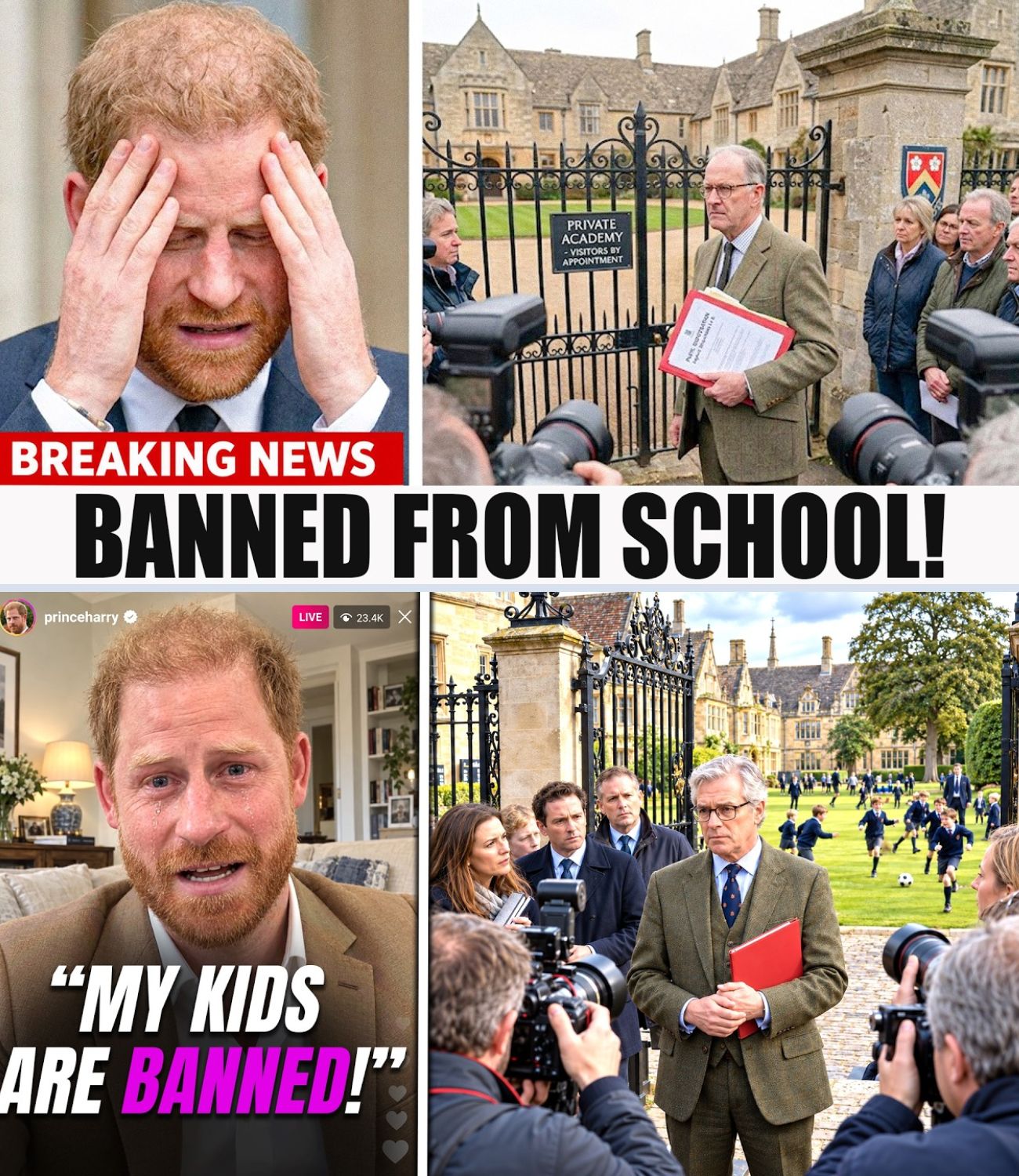
Buzzed Out! British Headmasters Shamelessly Slam Gates on Archie and Lilibet in Brutal Cotswolds Snub!
The Bombardier Global Express lifted off from a private airfield north of Los Angeles as the sun dipped toward the Pacific, carrying a cargo that its passengers hoped would rewrite the final chapters of their tumultuous exile. Twelve hours later, the aircraft greased onto the tarmac at Birmingham Airport just before midday. There were no flashing blue police escorts waiting on the perimeter, no ceremonial red carpets rolled out across the concrete, and no phalanxes of palace aides holding umbrellas against the grey Midland drizzle.
Instead, a family that had spent six continuous years insisting to the global media that they wanted nothing to do with Britain stepped out into the wind with two young children, twenty oversized suitcases, and an air of nervous expectation. Within ninety minutes of those wheels touching down, nearly every senior royal correspondent across Fleet Street and Mayfair received the exact same briefing memo directly from the Sussex communications camp.
The official narrative was polished, frictionless, and entirely unambiguous. The family had relocated exclusively for the children. Prince Archie, now seven, and Princess Lilibet, five, were supposedly scheduled to walk through the front gates of an elite preparatory academy in the heart of the Cotswolds the following Monday morning. The spokesperson framed the transatlantic move as a whirlwind triumph, claiming those coveted classroom desks had been officially confirmed just ten days prior.
To anyone casually scrolling through morning headlines, it sounded like the ultimate fairy-tale redemption. But to anyone who understands the intricate, unyielding machinery of British private education and statutory law, the story was an absolute impossibility.
You do not casually pick up an admission letter to an elite English prep school ten days before the autumn term commences. In the traditional English shires, competitive school places are locked down months—often years—in advance, with aristocratic and high-net-worth families routinely transferring massive, non-recoverable deposits a full year ahead of schedule. You cannot simply touch down in late August with twenty stray suitcases and expect customized uniforms, private desks, and assigned lockers to magically materialize out of thin air.
Behind the high stone walls of a rented estate tucked deep into the Gloucestershire countryside, the reality waiting for the Duke and Duchess of Sussex was not a triumphant homecoming. It was sheer, unadulterated panic.
The Administrative Brick Wall: Regulation 8 and the Birth Certificate Chaos
The flight had landed; the luggage had been unpacked. But when Monday morning arrived, the children could not set foot on school grounds.
The headmaster of that prestigious Cotswolds academy had kindly, politely, but immovably refused to sign the statutory pupil admission register. He did not slam that gate because of tabloid gossip, intrusive paparazzi lenses, or palace pressure. He halted the entire enrollment process because the mandatory legal documents required to admit those children were fatally, irreconcilably compromised.
Two parents with virtually unlimited wealth, expensive global advisers, and chartered private jets had crossed an entire ocean only to watch their grand return grind to a shuddering halt against a locked administrative office. The public was initially fed the line that this was merely a minor administrative misunderstanding that could easily be smoothed over with a polite telephone call. But behind closed doors, that headmaster was staring at official civil records that contradicted each other so deeply that signing his name would have violated national child safeguarding legislation and exposed him to direct criminal prosecution.
To understand why that headmaster could not simply look the other way, one must examine the strict regulatory vice known as Regulation 8 of the School Attendance (Pupil Registration) (England) Regulations—a statutory instrument significantly tightened by Parliament. Regulation 8 demands something brutally straightforward: every educational institution across England must keep a permanent admission register by law. That register requires the child’s verified civilian name, sex, date of birth, home address, and, most crucially, the verified legal civil names and permanent addresses of both parents.
It does not ask for aristocratic courtesy styles or commercial global trademarks. It demands the mother and father’s actual, verified civilian identities permanently entered into a state-monitored database.
For ordinary families, this routine takes ninety seconds. But for the Sussex children, the paper trail was a bureaucratic minefield. Archie Harrison Mountbatten-Windsor was born in London in May 2019. On his original state registration, his mother was entered as Rachel Meghan, Her Royal Highness the Duchess of Sussex. Yet, nineteen days later, an extraordinary amendment wiped out the civilian name Rachel Meghan entirely, leaving only a decorative royal title.
Cross the Atlantic to Lilibet Diana Mountbatten-Windsor, born in California in June 2021. California law strictly mandates recording a mother’s maiden name, registering her as Rachel Meghan Markle. But in the father section, the entry read strangely: the father’s first name recorded as “The Duke of Sussex” and his surname recorded as “His Royal Highness.” There was no Henry, no Charles, no Mountbatten-Windsor. Put plainly, the father’s civilian surname did not legally appear anywhere on his own daughter’s birth certificate.
Two full siblings held entirely contradictory paper identities for their mother, while the father vanished behind decorative royal styles. Harry knew this deadlock was coming. Years earlier, he had attempted to find workarounds, even asking relatives if the children could adopt alternative family names. But when faced with an official school registrar in rural England, ordinary channels were closed. Harry could not walk into an admissions office with conflicting paperwork and expect a headmaster to commit professional suicide.
He needed an overwhelming royal backdoor. And that is precisely why a very heavy international courier package was dispatched straight to Gatcombe Park.
The Desperate Gamble at Gatcombe Park
Two weeks before that private jet ever lifted off from California, a heavy package arrived at the private security gates of Gatcombe Park, Princess Anne’s private working estate nestled deep in the Gloucestershire countryside. The parcel had not travelled through standard royal post; it had been dispatched by an expensive international courier directly from Montecito, marked exclusively for the personal attention of the Princess Royal.
When staff carried the box into her private study, the presentation inside was immaculate. Wrapped in dark tissue paper was a bespoke, leather-bound photo album stamped with gold lettering. It contained dozens of glossy, sun-drenched pictures of Archie and Lilibet playing in California gardens. And tucked neatly into the front sleeve was a four-page letter written entirely in Harry’s own handwriting.
The first two pages read like an emotional family appeal. Harry poured out his heart about wanting his children to experience a traditional British education just as he and William had enjoyed. He repeatedly invoked the memory of his late mother, Princess Diana, reminiscing about how she took them to public theme parks and hospices, emphasizing that Diana would have desperately wanted her grandchildren to know their homeland.
To anyone else, it looked like pure family affection. But when Anne turned past those sentimental opening pages and reached page three, the tone abruptly shifted. What began as nostalgia curdled into an audacious institutional power play that stopped her cold.
Page three revealed the scheme in concrete detail. Harry openly acknowledged the conflicting paperwork on the birth certificates, admitted the Cotswolds enrollment was completely gridlocked, and then delivered his demand. He asked Princess Anne to issue an official crown directive commanding the local council and the school governors to admit Archie and Lilibet under their royal titles, entirely bypassing verified civilian documentation. In plain English, he was asking his aunt to order British educators to break national child safeguarding laws.
The photo album was not a keepsake; it was emotional collateral.
Anne already knew the real reason behind their frantic relocation. It was not a planned pilgrimage, but an emergency escape from an educational collapse in Montecito, where ongoing friction with wealthy local parents over armed motorcades and missed school terms had made staying in California untenable.
Without uttering a single angry word, she closed that leather-bound folder, set her pen down, and reached for her telephone. The instruction issued from Gatcombe Park was absolute, clinical, and completely irreversible. There would be no backdoor conversations with the Department for Education, no private telephone calls placed to the Gloucestershire County Council, and no letters of royal sponsorship or executive intervention delivered to the governing board of that Cotswolds prep school.
When Harry discovered that his four-page plea had run straight into a concrete wall, he panicked. Sitting inside his rented Gloucestershire manor with twenty unpacked suitcases and a ticking autumn calendar, he decided to take the ultimate gamble. He picked up his mobile phone and placed an urgent, high-priority call north to Balmoral Castle in Scotland, where King Charles III was spending his late summer retreat.
Harry wanted his father to step in over Anne’s head. He desperately wanted the sovereign to issue an emergency executive waiver, override his sister’s authority, and command the headmaster to sign the register before Monday morning.
King Charles’s response was devastating in its simplicity. He refused to pick up the receiver. Instead, his senior private secretary dispatched a short, unyielding message straight back to Gloucestershire: all family matters, protocol decisions, and royal regulations on British soil were the sole, uncompromised responsibility of povisioning authorities like the Princess Royal. The monarch made it crystal clear that he would not lift a single finger to shield his youngest son from the legal consequences of his own administrative negligence.
The Social Rejection and the Collapse of Old Alliances
While the institutional doors slammed shut, the local social landscape proved equally inhospitable. The Cotswolds are packed with generational wealth, ancient titles, and international celebrities where Range Rovers and private bodyguards are mere background furniture. Nobody freezes when a famous face walks down the street.
Yet, according to local eyewitness accounts, Megan treated an ordinary shopping trip like an imperial state visit. During a visit to the famously exclusive Daylesford Organic farm shop, she reportedly arrived during prime Saturday morning shopping hours surrounded by an aggressive security bubble that pushed ordinary shoppers out of the way and shooed customers trying to buy bread—only to walk out having purchased a single item.
Soon after, a lunch outing at the Three Horseshoes, an 18th-century pub near Burford alongside Ellen DeGeneres and Portia de Rossi, drew immediate local amusement as an obvious tourist trap. Worse still, reports surfaced that several staff members flatly refused to serve their table. When broadcaster Megyn Kelly subsequently dismantled the photo opportunity on television, highlighting the bitter irony of figures famous for workplace bullying huddling together in a village pub, the public relations maneuver lay in ruins.
Locals looked away; nobody asked for selfies, and nobody was dazzled by royal titles. The community simply closed its doors.
Simultaneously, Harry’s safety nets were disintegrating. For nearly thirty years, Sir Elton John had served as his ultimate emotional and financial benefactor, absorbing criticism and funding private jet travel out of love for Princess Diana. But when Harry touched down in Birmingham and immediately messaged Elton demanding a private jet for a weekend trip to Scotland and France, things fractured permanently.
When Elton hesitated, Harry pushed the emotional button, claiming his mother would have understood why he had to keep fighting his legal battles. Elton cut him off coldly: “Do not use your mother to ask me for money.” When Harry and Megan subsequently showed up uninvited at Elton’s Holland Park residence, David Furnish barred the entrance on the pavement, delivering a final verdict: “You have had years, Harry. Friends do not treat kindness like an account they can keep drawing from.”
The Ultimate Legal Trap: How Harry Walked Into a Cage
While the social and financial walls closed in, Harry’s impulsive scramble had inadvertently walked his marriage and family straight into a profound international legal trap.
For six consecutive years inside their walled estate in Montecito, Megan had held an unassailable legal advantage under California state law, which prioritizes maternal stability and restricts foreign relocations. But to enroll two young children in an English school, residency had to be established. Harry signed a long-term lease on a sprawling Gloucestershire estate, shipped twenty oversized suitcases of personal property across the Atlantic, and formally submitted application dossiers to a British educational establishment.
In doing so, Harry legally established what international family law defines as habitual residence in the United Kingdom.
That single miscalculation tore down six years of carefully built legal protection. Under international civil conventions, once children are habitually resident within Britain, domestic jurisdiction over custody, schooling, and guardianship instantly shifts across the ocean. It no longer belongs to family judges in Santa Barbara; it belongs exclusively to the High Court of Justice in London.
In a California courtroom, Harry was a foreign prince navigating an American legal system. But inside the High Court in London, Harry is a sovereign son backed by the crown’s legal apparatus and centuries of institutional precedent that tilt toward keeping royal offspring within the realm. If tensions between the couple ever boil over into a legal separation, Megan can no longer simply pack up the children and fly back to California. English family courts routinely issue immediate emergency injunctions preventing the removal of minor children from British jurisdiction once habitual residence has been established.
The irony is almost too painful to contemplate. Megan had spent years calculating every public move, yet because Harry panicked over his collapsing finances and tried to bulldoze an admissions office, he surrendered their most vital territorial shield. They had arrived in England expecting royal deference and rules to bend. Instead, they discovered that the ancient British constitution does not yield to modern Hollywood entitlement—leaving them stranded between two continents with nowhere left to run.