“Cowboys With Tea Mugs” — The US Army Lawyer Sent to Rein In the SAS, Flown Home in a Week
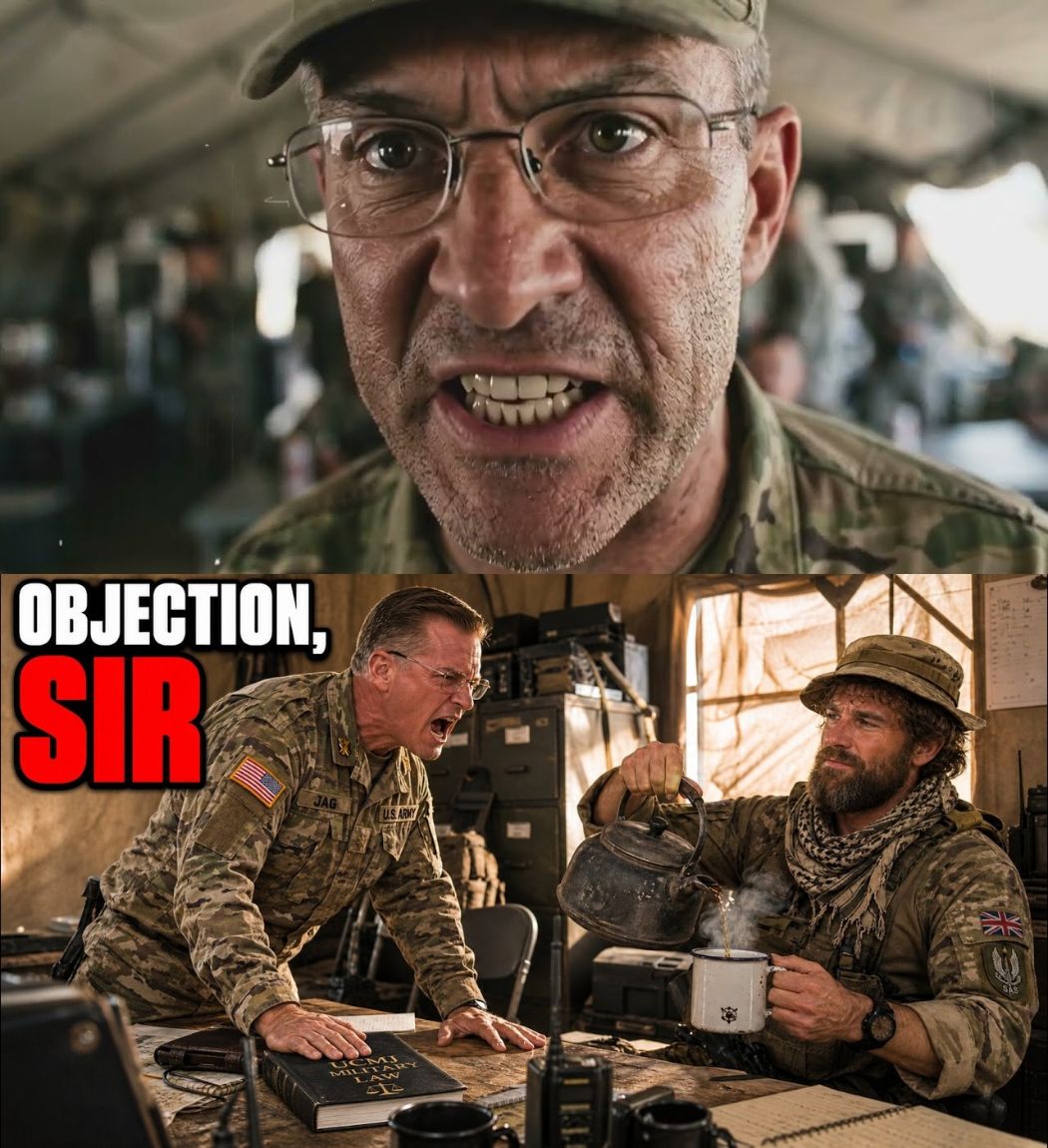
“Cowboys With Tea Mugs” — The US Army Lawyer Sent to Rein In the SAS, Flown Home in a Week
There is a sentence that was said out loud in a mess tent west of Ramadi at 9 minutes past 11:00 on a Tuesday morning in the autumn of 2006 by a United States Army colonel wearing a crisp set of multicam, a pair of rimless glasses, and the black and gold tab of the Judge Advocate General’s Corps on his left breast.
He said it loud enough that the four men nearest him stopped eating. He said it looking directly at a British major who was pouring hot water into a chipped white enamel mug from a dented metal teapot, and he said it like a man who had rehearsed it in the mirror.
“They’re cowboys with tea mugs, not soldiers. Cowboys.”
His name was Colonel Daryl W. Pettigrew. He had 26 years in uniform and a bronze star and a chair when he was not here at the Judge Advocate General’s Legal Center and School in Charlottesville, Virginia, where he taught young captains the law of armed conflict. He had been flown into the coalition compliance cell to tighten what somebody at a headquarters a long way from the dust had called irregularities in a British Special Air Service element working the Haditha corridor.
He believed that morning that he had been sent to a problem. He believed the problem was in front of him pouring tea. He would remember saying it. He would be made to.
In 7 days, he would be on a C-17 going the other way out of Al Asad with his duffel in the hold and his hardback copy of the Uniform Code of Military Justice closed on his lap and the leather bookmark still at Article 134 where he had left it that Tuesday morning. In a sealed envelope in the duffel, there would be a single sheet of paper signed by a brigadier general he had not met before the week began, and the paper would use the phrase “no longer required in theater.”
He would not open the envelope on the plane. He would not need to. He already knew what it said because by then he had seen it happen in daylight in front of 31 witnesses with a stopwatch in his own captain’s hand.
He would not get to tell the story later the way he wanted to tell it. Nobody would ask him. The men he had called cowboys would not say a word about it to his face. They did not have to.
Seven days, one sentence, and in between a quiet, counted, methodical dismantling of every certainty a man picks up in 26 years of being right in classrooms.
The major pouring the tea heard him. He did not look up. He set the teapot down on the folding table, lifted the enamel mug by its wire handle, took a slow pull, swallowed, and said nothing at all. That was the beginning.
To understand why what happened to Colonel Pettigrew was humiliating, you have first to understand that he was not a fool. He had earned every inch of the uniform. He had gone through the Judge Advocate General’s Officer Basic Course in 1982, and he had never left the core. He had done a tour as a legal advisor to a brigade in Mogadishu in the autumn and winter of 1993, which is a tour that still means something to the men who were there.
He had done a second tour in 2004 as the senior legal advisor to a division headquarters in Baghdad, where he had sat in on every targeting board and signed off on every strike package, and come home with a bronze star and a reputation for being the man who kept commanders out of federal court. He had published articles. He had taught three times as a visiting instructor at Charlottesville, and the young captains who sat in his seminars remembered him as hard, fair, and absolutely certain of what the law required of a soldier.
He read the Uniform Code of Military Justice the way a priest reads scripture, and he carried a hardback copy of it everywhere he went with a thin strip of brown leather marking Article 134. The general article, the catch-all, the paragraph that lets a commander prosecute almost any conduct that discredits the armed forces. He kept the bookmark there deliberately.
He had been pulled in September of 2006 into a thing called the Coalition Compliance Cell, which was a small interservice office at Al Asad Airbase run by a brigadier general named Walter Coin, whose job it was to make sure that nothing any coalition unit did in Anbar Province ended up on the front page of the Washington Post.
Pettigrew’s specific tasking, written on a single sheet of paper that he kept in a plastic sleeve in his cargo pocket, was to review and where necessary constrain the operational practices of a British Special Air Service Detachment that had been working out of a shared compound north of Haditha for 11 weeks. Somebody at a headquarters in Baghdad had used the word “cowboys” in a secure email. Pettigrew had read the email. He had packed his bag. He had a basis for his contempt. That is the thing to understand.
When he walked into the shared compound on his first morning, what he saw was a group of men in beards and civilian trousers and chest rigs that did not match, with hair that would have failed an inspection in any American unit he had ever served in, drinking tea from mismatched mugs and speaking a slang he could not entirely pass. He saw a sergeant in flip-flops. He saw a staff sergeant with a scarf that looked to his eye like a costume.
He saw a major, their major, pouring tea at 11:00 in the morning as if he were in a garden in Surrey. He saw no formation, no saluting, no clear chain of command visible to a stranger, and no immediately obvious respect for the compliance brief he had come to deliver. He had been told these men were operators. What he saw looked to a man who had spent 26 years in the United States Army like a camping trip with weapons.
He said so that morning in the mess tent with his deputy Captain Marissa Lynn at his elbow with her green notebook open and her pen moving, and with Major Earl Dobson, a Ranger Liaison Officer attached to the cell, standing two paces behind him with his hands in his pockets. Dobson had three combat tours. Dobson knew exactly what he was looking at when he looked at the men in the beards. Dobson did not say anything. He would not say anything in Pettigrew’s defense for six more days.
“They’re cowboys with tea mugs,” Pettigrew said, loud enough to carry, looking straight at the major with the enamel mug. “Not soldiers. Cowboys.”
A couple of American contractors near the coffee urn laughed. One of them said under his breath, “Finally.”
Captain Lynn wrote the sentence down and underlined it twice. Dobson looked at his boots.
The British major—his name was Henry Allston, and he was the officer commanding the A Squadron detachment, a man who had done selection in the winter of 1996 and had been in the regiment for 10 years—took a slow pull of his tea, set the mug down on the folding table, and said in a voice that was almost cheerful, “Right. Shall we get you a brief, Colonel?”
That was all he said. He did not defend himself. He did not raise his voice. He gestured to the door of the briefing tent and he waited politely for the American Colonel to go first.
Pettigrew went first. He thought he was walking into a meeting. He was walking into a week.
The compound sat on a bend of the Euphrates about 14 km northeast of Haditha inside a shared forward operating base the Americans called FOB Timber and the British called, with no particular affection, the yard. It was a cluster of Hesco walls, three hardened buildings, two large general purpose tents, a motor pool full of up-armored pickup trucks the Special Air Service had modified with mounts for general purpose machine guns and Minimis, and a sand-colored container that served as the squadron operations room. On the wall of the ops room in the corner where no visitor would see it from the door, somebody had taped a photograph of Craden Hill in the rain and written under it in black marker, “Home.”
Colonel Pettigrew, inside the ops room, saw none of this. He saw a map, three laptops, a whiteboard with call signs on it in a shorthand he could not read, and Major Alston pulling out a plastic chair for him with the casual courtesy of a man receiving a cousin he does not much like.
What Pettigrew did not see, because he could not see it yet, was that the room had been tidied for him. The whiteboard he was reading was the public version. The real one lived in a locked side office he was not shown. The men who had been in the ops room when he arrived had drifted out one at a time in no particular order, each with a plausible reason to leave.
By the time Pettigrew sat down, there were four men in the room: Alston, Squadron Sergeant Major Ian Brody, Captain Lynn with her green notebook, and Pettigrew himself. Dobson had, in a quiet piece of judgment that Pettigrew did not register, stayed outside.
Brody was the thing in the room most people noticed last and remembered longest. He was 50 years old. He had been in the army since he was 17 and in the regiment since he was 26, which is to say he had been doing this specific job for 23 years. He had a thin pink scar that ran from the lobe of his right ear down to the hollow of his collarbone, and he did not explain it to anyone who had not earned the right to ask. He stood against the back wall with a mug in his hand—a different mug from Alston’s, dark green, chipped on the rim—and he watched Pettigrew the way a farmer watches weather.
Pettigrew began his brief. He had a stack of printed slides. He walked them through in the clear, careful voice of a man who had taught law at Charlottesville, detailing the specific concerns the compliance cell had identified: proportionality in direct action tasks, the documentary requirements for detainee handling under the memorandum of understanding with the host nation, the rules of engagement card every operator was required to carry on his person, the chain of custody for seized materials, the recording and reporting of weapons discharges.
He spoke for 41 minutes. Alston listened without interrupting. Brody did not move. Lynn wrote everything down.
When Pettigrew finished, he closed his folder and said, “I want to be clear. I’m not here to make your lives difficult. I’m here to make sure that when this ends, nobody goes to prison for how it was conducted.”
Alston nodded. He said, “Understood, Colonel. Sergeant Major, show the Colonel the troop.”
That was how Pettigrew came, in the back half of his first morning, to be walked through the lines of the detachment by Brody, who said almost nothing and gestured a great deal.
What Pettigrew saw: men cleaning weapons on ground sheets in the shade, each man working alone and in silence. A staff sergeant with a Welsh accent—this was Rhod Vaughan—stripping an L115A3 sniper rifle on a folded blanket, cleaning each part with a toothbrush and setting it down in exactly the same place he had taken it from. Sergeant Oliver Keen, sitting on an upturned ammunition crate reading a paperback thriller, and not looking up when they walked past. The youngest man in the squadron, Trooper Peter Finchley—Finch, everybody called him—doing pull-ups on the frame of a tent in a pair of PT shorts, counting under his breath in a voice that did not change speed. Three men in a huddle around a laptop looking at satellite imagery and speaking in a shorthand Pettigrew could not follow. The local interpreter, Youssef, drinking tea with two of the operators and laughing at something the taller of the two had just said in what sounded impossibly like competent Arabic.
What Pettigrew did not see, because contempt flattens detail, was that every one of these men was already working. Vaughn was not cleaning a rifle. He was zeroing it for the night’s task, which he already knew about and Pettigrew did not. Keane was not reading. He was waiting out the heat of the day because his assault team was moving at 0100 and he intended to sleep from 1500 until midnight. Finchley was not showing off. He was keeping his heart rate up because he had just come off a 16-hour observation task and his sleep rhythm was wrecked. The three men at the laptop were building the target pack for compound 14. Youssef was being handled gently by two operators who had decided a month earlier that he was trustworthy and were now in the slow business of proving it to themselves one more time.
Pettigrew saw tea mugs and beards. The whole room ran on tradecraft. Every one of its casualnesses a form of discipline so complete it had become invisible to the people practicing it.
Brody, walking two steps behind the colonel with his green mug, saw a man who was going to make a mistake and could not be told so in words.
They came back to the ops room. Alston was still there with Lynn. Pettigrew sat down and said, with what he thought was reasonable firmness, “Major, I’d like a schedule of all planned direct action tasks for the next 7 days with target packs, and I’d like to review the rules of engagement card every one of your men is carrying.”
Alston said, “Of course, Colonel. Sergeant Major will have the schedule to you by 1600. The men carry the card the regiment issues. I’ll have one brought to you.”
Pettigrew said, “I may need to adjust the card.”
Alston said, “You may.”
Brody, from the back wall, did not smile, but he shifted his weight very slightly from his left foot to his right, and he looked at Alston for exactly 1 second. And Alston looked back at him for exactly 1 second. And in that 2-second exchange, a decision was made that Pettigrew would not understand for 6 more days.
The gun was loaded. Nobody told him it was pointed at him.
The first blow landed on day two, in the late afternoon, and it landed because Colonel Pettigrew did exactly what a man who has taught law at Charlottesville for a decade would do. He adjusted the rules of engagement card.
He had taken the regiment-issued card back to his desk the previous evening, and he had sat with it for 3 hours. The card was a folded laminated sheet about the size of a passport, printed in small, clear text on both sides. It covered positive identification, hostile act, hostile intent, graduated response, and the circumstances in which deadly force was authorized. It was, as a piece of legal drafting, careful and clean, and exactly what Pettigrew would have written himself if he had been asked.
He read it twice. Then he found, on the reverse, a short paragraph on the handling of weapons found in the possession of detained persons at a target location. And he decided it was too permissive.
He crossed out two sentences. He added three. He had Captain Lynn type the new version. By 0800 on day two, he had placed a stack of 30 new cards on Alston’s desk with a note that read, “Please ensure these are issued to all operators prior to the next task.”
Alston read the note. Alston read the new card. Alston said nothing to Pettigrew. Alston walked across the yard with the stack of cards in his hand, found Brody, and gave the stack to him.
Brody read the top card. Brody said, “Right.”
Brody walked into the lines and he issued the new card to every man on the detachment, personally, and he said to each of them in exactly the same words, “Colonel’s new card. Learn it. We’re using it tonight.”
Pettigrew heard through Dobson that a direct action task was going ahead that night. He insisted on being present at the briefing.
Alston said, “Of course, Colonel.”
Pettigrew sat at the back of the briefing tent with Lynn and her notebook and he watched Keen, the sergeant with the paperback, give the orders group for a lift of a mid-level improvised explosive device facilitator at a farmhouse 11 km north of the compound.
Keen spoke for 22 minutes. He covered the ground, the entry, the actions on, the extraction, the medical plan, the loss of comms plan, the rules of engagement and—here he paused, picked up the new card, read Pettigrew’s revised paragraph aloud, word for word, and said, “This is the Colonel’s card. We use it tonight. Clear?”
The eight men on the team said, “Clear.”
Keen put the card down. He said, “Any questions?”
There were none. The briefing ended.
Pettigrew turned to Lynn and said quietly, “That was professional.”
Lynn wrote it down.
The task went in at 0240. By 0415, the team was back inside the wire. They had lifted the facilitator, two of his associates, and a quantity of partially assembled devices in a plastic drum under the kitchen floor. They had not fired a round. One of the associates had reached for a weapon inside a wardrobe during the clearance. Finchley, the youngest man on the detachment, had put a knee on his back and a hand on the pistol before the man’s fingers had closed around the grip. The pistol had been bagged and tagged in accordance with Pettigrew’s revised paragraph, and the chain of custody form had been filled out by Keen in his own hand under a red torch in the back of the pickup on the way home.
Pettigrew was in the ops room when they came back. He had stayed up. He wanted to see the paperwork.
Keen handed him the paperwork. Pettigrew read it. Then he read it again. Then he looked up and said, “This is… This is exactly right.”
Keen said, “That’s the card, sir.”
Pettigrew said, “Where did you fire from when the associate reached for the weapon?”
Keen said, “We didn’t fire, sir. Trooper Finchley took his hand off it before he got to it.”
Pettigrew said, “You didn’t fire.”
Keen said, “No, sir.”
Pettigrew said, “At all?”
Keen said, “No, sir. Not tonight.”
There was a pause in the ops room that lasted about 6 seconds.
Brody, from the back wall with his green mug, watched Pettigrew’s face. Dobson, in the doorway, watched Pettigrew’s face. Lynn, with her green notebook, watched Pettigrew’s face.
Pettigrew was looking at the chain of custody form Keen had just handed him. And the form was filled out in a neat, tight hand. Every box ticked. Every signature in place. And at the bottom, in the line reserved for rules of engagement applied, somebody—Keen, in the back of a moving pickup—had written out in full the paragraph Pettigrew had added to the card the day before. Word for word.
Pettigrew said, “Thank you, Sergeant.”
Keen said, “Sir.” Keen went to bed.
Pettigrew sat in the ops room for another 20 minutes with the form in his hand. Dobson, who had three combat tours and had seen a great many forms filled out in the back of a great many pickups by a great many men, said nothing. Lynn wrote in her notebook. What she wrote she did not show the Colonel. She showed it three days later to Dobson, and Dobson did not comment, but he kept the page.
What she had written was this: “Colonel’s card worked. Team followed it to the letter. No shots fired. Target lifted. Paperwork perfect. Team is faster, cleaner, and more disciplined than any American unit I have ever observed. First night.”
Pettigrew went back to his tent at 5:15 in the morning. He did not sleep. He read Article 134 again with the leather bookmark in his lap. He was looking for something he could not quite name. He did not find it, and that was only the first time that week he would be wrong.
The second blow came on day three in the heat of the afternoon on the makeshift range the detachment had built along the inside of the eastern Hesco wall, and it was a kind of humiliation that did not involve paperwork at all.
Pettigrew had asked over breakfast whether the detachment conducted regular live fire sustainment. He had asked it in the tone of a man who already suspected the answer was no.
Alston, pouring tea from the dented metal pot into the chipped enamel mug, said that the men shot every day they were not on task and that if the Colonel would like to observe, Staff Sergeant Vaughn was running a sniper sustainment at 1500 and would be delighted to have company.
Pettigrew heard the word “delighted” and could not tell whether Alston was being polite or being funny. Alston was being both.
At 1500, Pettigrew walked out to the eastern wall with Lynn and Dobson.
Vaughn was already there. He had the L115A3 laid out on a sandbagged firing position with a bipod, a suppressor, and a Schmidt and Bender scope. He was lying prone behind it in a set of civilian trousers and a tan-colored t-shirt, with his boonie hat pulled low and the keffiyeh he wore in the lines knotted loosely around his neck. The eastern wall threw a hard black shadow at this time of day. The air shimmered. A hundred meters down the inside of the wall, a steel plate the size of a dinner plate hung from a wooden frame.
Vaughn said, over his shoulder, “Afternoon, Colonel.”
Pettigrew said, “Staff Sergeant.”
Vaughn said, “First one’s a cold bore, sir. Hundred meters for the plate.”
He fired. The plate rang. He worked the bolt without taking his eye off the scope.
Dobson, who had done his young soldier days as a marksmanship instructor at Fort Benning before he went to Ranger School, said under his breath to Pettigrew, “Watch his hands.”
Pettigrew watched. Vaughn’s hands did not seem to be doing very much. He was fluid in a way that looked, to a man who had never watched a working sniper for an afternoon, like laziness.
Vaughn said, “400.”
A second plate rang further out. Pettigrew had not seen the plate.
Vaughn said, “600.”
The plate rang.
Vaughn said, “800. Winds picked up. Give me a second.”
He lay still for about 11 seconds. Then he fired. The plate rang.
Vaughn said, “Right. The Colonel wants to see something harder. Finch, you ready?”
Trooper Finchley, 40 m behind them, was crouched by what Pettigrew now realized was a radio-controlled servo attached to a small steel plate on a wire.
Finchley said, “Ready.”
Vaughn said, “Run it.”
Finchley pressed a button. The plate began to move, left to right, at the walking pace of a man.
Vaughn fired. The plate stopped moving.
Vaughn said, “Reset.”
Finchley reset. The plate moved.
Vaughn fired. The plate stopped.
He did this nine times. He missed once on the seventh, and he said the word “wind” without any particular feeling, and then he hit the eighth and the ninth. And the plate at the end of the ninth was pocked across its face in a pattern no wider than the diameter of the enamel mug on Alston’s desk.
Pettigrew said, “At what range?”
Vaughn said, “600, sir.”
Pettigrew said, “And the moving plate?”
Vaughn said, “Walking pace. Sorry, sir. You asked about sustainment. I can show you the proper shoots, if you’d like.”
Pettigrew said, “The proper shoots?”
Vaughn said, “The ones we train for, sir. The ones we don’t do on the range.”
Dobson, next to Pettigrew, took a slow breath in through his nose and let it out slow through his mouth, which was the thing he did when he was impressed and did not want to show it.
Lynn wrote in her notebook—and this is the part where he was still a man and not yet a cautionary tale.
Pettigrew said, “You missed one.”
Vaughn said, “Yes, sir. I did.”
Pettigrew said, “Would you miss in action?”
Vaughn sat up on his elbows. He thought about the question for a moment. He said, “I have, sir. Twice. Both times, I had a follow-up round away inside 2 seconds, and the second one landed. If you want to see the log, sergeant major keeps it.”
He said it without defensiveness. He said it the way a man says something he has already made peace with.
Brody’s scar—visible under the fluorescent ceiling light in the ops room later that evening when Pettigrew would ask to see the log, and Brody would open a hardback green notebook and show him every round Vaughn had fired in the previous 11 weeks—had been earned in a stairwell in Basra in 2004, which the log would eventually explain in Vaughn’s own hand, two pages in from the back.
Pettigrew, the Charlottesville lecturer, the Bronze Star, the man who had written a crisp paragraph about weapons handling in the back of a wardrobe, looked at the plate at the end of the ninth shot. He looked at Vaughn, who was now checking his bolt. He looked at Finchley, who was coiling the servo wire. He looked at Dobson, who would not meet his eye.
He said, “The cowboy line was a figure of speech.”
Nobody responded. Dobson looked at his boots. Lynn wrote the sentence in her notebook.
Vaughn broke his rifle down into its component parts and laid each piece on the folded blanket in exactly the same place he had taken it from, in silence. The way he had done on the first morning Pettigrew had walked past him and seen a man cleaning a rifle and thought nothing of it.
Later in the log, Pettigrew would see that the previous 11 weeks of Vaughn’s shooting included 41 engagements at distances between 100 and 1,700 m, with a hit rate in Brody’s black ink of 94%. He would see in a different column the two misses Vaughn had mentioned, both annotated in Vaughn’s own hand with a single word: “wind.”
Pettigrew closed the log. He did not say anything. He went back to his tent. He opened Article 134 and he closed it again. The bookmark had not moved.
“Cowboys with tea mugs.”
He did not say the phrase out loud again that day.
The third blow landed on day five and it took from Colonel Pettigrew the one thing he had still believed on the morning of day four, which was that even if these men could shoot and even if their paperwork was impeccable, he, Pettigrew, understood the law of armed conflict better than they did.
He had come to the compound believing this. He left the compound not believing it.
The transition happened on a Thursday evening between 1700 and 1740 in a side room of the ops container in the presence of five people. What happened was a question. Pettigrew asked it. He thought it was a trap.
The detachment had, that afternoon, received intelligence that a vehicle moving south from the Syrian border was carrying a specific individual whose name appeared on a coalition targeting list, and that the vehicle was going to pass through a stretch of road outside a village called Al-Baghdadi at approximately 2100 that night. Alston had briefed a two-pronged response: a mobility troop element to interdict the vehicle at a predetermined point, and a sniper overwatch (Vaughn’s team) on a low ridge 800 m from the interdiction point.
Pettigrew had sat in on the brief. Pettigrew had, in his new habit, reviewed the rules of engagement paragraph being used for the task.
At 1700, Pettigrew asked to speak to Alston privately.
Alston said, “Of course, Colonel.”
They went into the side room. Pettigrew brought Lynn. Alston brought Brody. Dobson stood in the doorway with his hands in his pockets, which was his position for the week.
Pettigrew said, “Major, the individual in the vehicle, if he does not present a hostile act or hostile intent at the moment of interdiction, the card does not authorize lethal force.”
Alston said, “Correct, Colonel.”
Pettigrew said, “The sniper overwatch, as briefed, is pre-positioned to engage. That reads to me like a pre-authorized killing of a listed individual, regardless of his conduct at the point of interdiction. That is not what the card says, and it is not what the law allows.”
Alston said, “Correct again, Colonel, which is why Staff Sergeant Vaughn’s team will not engage unless the interdiction team on the ground calls for support in response to hostile act or hostile intent. Vaughn will have positive identification, and he will have the shot. He will not take it unless the ground team calls it. If the individual surrenders, we take him. If he fights, we have the overwatch. The card governs. The list does not override the card.”
Pettigrew said, “That is not how this task was described to me.”
Alston said, “It is how it was briefed, Colonel, if I may.”
He turned the laptop on the side table around and he played back from a secure folder the audio of Keen’s orders group from 2 hours earlier. Pettigrew heard, in Keen’s own voice, the exact phrase: “Overwatch is on call. Overwatch does not engage unprompted. The card governs. The list does not override the card.”
Alston paused the audio. He said, “We record every orders group, Colonel. The sergeant major keeps the drive.”
Pettigrew said, “Why do you record them?”
Alston said, “So that when a lawyer asks what we told the men, we can play him what we told the men.”
That was the first blow of the evening. It was not the worst.
Pettigrew sat with this for about 30 seconds. Then he said, “The list. The listed individual. Who approved his placement on the list?”
Alston said, “A targeting board in Baghdad chaired by a two-star American general with legal review by a judge advocate general colonel named, I believe, Pettigrew. Signed in June.”
Pettigrew went still.
Alston said, “I’m sorry, Colonel. I thought you’d been told. The man we’re interdicting tonight is on a list you signed off on in your previous tour. We received the list. We received the legal review. And we have been working within it for 4 months. We have not, in those 4 months, engaged a listed individual who was not actively taking a hostile act or demonstrating hostile intent. We have taken 14 of them alive. The paperwork is in the sergeant major’s folder. He will show you.”
Brody, from the wall, opened a green hardback folder—a twin of the shooting log Pettigrew had read on day three—and laid it open on the side table. The top page was a photocopy of a targeting authority signed in June of 2006 in Baghdad. The signature on the legal review line in blue ink was Pettigrew’s own.
Pettigrew looked at his signature for a long time. A kind of thought passed across his face that a man has only two or three times in a career.
Lynn did not write anything in her notebook. She had stopped writing somewhere in the first exchange and she did not start again.
Pettigrew said, “I signed that in Baghdad. I was told it would be executed by—”
He did not finish the sentence. He did not need to. He had been told in Baghdad in June that the list would be executed by competent, disciplined, rules of engagement-compliant forces, and he had signed on that understanding. He had come to Anbar in September to constrain the men he was now standing in front of, who were, in fact, on the paperwork in front of him in his own signature, the competent, disciplined, rules of engagement-compliant forces he had trusted with his name four months earlier. He had come to constrain the men he had already authorized.
Alston said very quietly, “We don’t need the card changed, Colonel. We’ve been using your card—yours—from June.”
Dobson in the doorway did not look at Pettigrew. Brody closed the folder. Lynn closed her notebook.
Pettigrew sat down in the plastic chair against the wall and he put his hands on his knees and he did not say anything for about 90 seconds.
At the end of the 90 seconds, he said, “I’d like to attend the interdiction tonight.”
Alston said, “Of course, Colonel. We leave at 1900.”
Pettigrew went to the interdiction. He saw the vehicle stopped. He saw the listed individual pulled out alive and plasticuffed and read his rights in Arabic by Youssef from a laminated card that was also, in a very real sense, written in Pettigrew’s own hand. He saw Vaughn’s overwatch team walk down off the ridge at the end, rifles slung, having not fired a round. He saw it. He stopped arguing that night. He had nothing left to argue with.
The decisive proof came on day six, inside a walled compound on the edge of a village the maps called Compound 14, 3 km east of the Haditha Dam, at 0211 in the morning, with the Colonel standing on the roof of a Mastiff 200 m back and Captain Lynn beside him, holding a stopwatch she had not asked for and had been handed in silence by Brody 9 minutes before the breach.
Here is how it goes:
The target is a mid-level emir, two of his bodyguards, a cache of partially assembled devices, a laptop, and, as the intelligence picture has resolved in the previous 40 hours, nine other individuals in the compound, of whom at least four are expected to be non-combatants.
The task is to clear the compound, detain the emir alive, secure the materials, and remove the non-combatants without harm.
The task has been briefed under the rules of engagement card Pettigrew wrote in Baghdad in June and refined in Anbar on day one.
The assault team is eight men: Keen leading, Finchley on the breach, five more blades, and a troop sergeant Pettigrew has not been introduced to.
Overwatch is Vaughn 800 m south on a low rooftop.
The cordon is mobility troop in four pickups.
The command element is Alston in a Mastiff with Brody, with Pettigrew, with Lynn, with Dobson, who has come up for the night at Pettigrew’s request.
Lynn is holding the stopwatch. She does not know at the moment she takes it that she is holding the receipt for a debt Pettigrew does not yet understand he owes.
Alston says into the radio in a voice that would not raise a dog from a chair, “Call sign one, move.”
Keen says, “Moving.”
The breach is a shaped charge on the courtyard gate. Finchley sets it. It goes off at 0211 and 17 seconds.
Lynn presses the stopwatch. The clock starts: 00:01.
The gate is gone and the assault team is through it.
The courtyard is a rectangle of hard-packed earth with a date palm in the far corner and a doorway on the right into the main house and a second doorway on the left into an outbuilding. Keen’s hand signals are visible in the green of the Mastiff’s night optic to Pettigrew on the roof 200 m back.
He has never watched a British assault team work before. He has watched Americans. He expected it to look similar. It does not.
There is no shouting. There is not—this is the thing he will not be able to explain to his wife 3 weeks later when she asks him what the men were like—there is not any shouting at all.
The team moves in two pairs and a four, each pair covering the other. The only sound Pettigrew can hear across 200 m of desert is the single flat womp of a flashbang in the main house, and 2 seconds later, another flashbang in the outbuilding, and the suppressed cough of a single rifle shot once from inside the main house, which Keen will later log in his own hand as a defensive engagement against the first bodyguard who presented a weapon on the stairs.
00:54. The emir is on the ground floor hallway, face down, hands behind his back, plasticuffed. Finchley has his knee on the base of the man’s spine and his hand on the back of his neck. The second bodyguard is sitting on the floor of the kitchen with his hands on his head and a blade standing over him with a rifle at the low ready. The first bodyguard, the one shot, is on the stairs. The medic is already on him with a chest seal.
01:20. The non-combatants—a woman, three children, two older men—are being moved calmly by a blade who speaks enough Arabic to say “sit, please, you are safe,” and whose voice is low enough that the youngest child, a boy of perhaps six, does not cry. The woman is crying. The boy is holding her hand. The blade kneels down. He says something to the boy that Youssef, listening on the Mastiff radio, translates for the record as the word “safe,” said three times.
02:05. The laptop is bagged. The partially assembled devices are photographed in place and bagged. Each bag is numbered. Keen writes the numbers on a wristband in red marker as he moves.
02:40. The first bodyguard is stabilized. He will live. He will be flown to a facility by the end of the day, and he will, in Pettigrew’s own written record a week later, be listed as “detained, wounded, medically treated under coalition protocols.” That line will become relevant.
03:10. Keen says into the radio, “Collapse.”
03:40. The team is coming out of the compound in the same order they went in: with the emir on his feet, with the second bodyguard on his feet, with the first bodyguard on a stretcher, with the non-combatants left in the care of the woman and the two older men inside their own house, with the laptop and the devices in numbered bags. And—
Pettigrew sees this and does not initially understand what he is seeing: a tray of three unfinished glasses of tea on the kitchen table, left exactly where they were when the breach went in.
04:11. Keen’s last man is through the gate.
Lynn presses the stopwatch. 4 minutes, 11 seconds.
She reads it off the face of the stopwatch out loud because Brody next to her has said very quietly, “Read it, Miss.”
She reads it. “4 minutes, 11 seconds.”
Alston says into the radio, “All call signs reset. Good work.”
Pettigrew does not say anything.
Vaughn, 800 m south, has not fired. The overwatch log for the night will read in Vaughn’s own hand: “Zero rounds expended. Positive identification maintained throughout. Cordon stable.”
The assault team log will read in Keen’s hand: “One round expended. Defensive against identified armed combatant in accordance with rules of engagement paragraph four subsection B. Pettigrew, June. 11 detainees. Zero friendly casualties. Zero non-combatant casualties. Zero rounds expended in error. One wounded combatant treated. The whole task from the breach to the last man through the gate in 4 minutes and 11 seconds. Under the rules of engagement card the colonel standing on the roof of the Mastiff wrote with his own hand in Baghdad in June, refined in Anbar on his first morning, and watched executed to the letter.”
On his sixth evening, the debt is paid.
Captain Lynn, holding the stopwatch with her green notebook closed in her other hand, looks at Pettigrew. Dobson, next to him on the roof of the Mastiff, looks at Pettigrew. Brody, at the foot of the Mastiff, with his green mug steaming in the cold night air, does not look at Pettigrew at all. He is already walking to the next vehicle.
Pettigrew is still looking at compound 14, which is now dark and quiet and in the possession of a woman and two old men and three children who are, as of 4 minutes and 11 seconds ago, alive.
He says very quietly—the only thing he says on the roof of the Mastiff that night—he says, “Jesus Christ.”
The after-action meeting happened at 0900 on day seven in the ops container, and Colonel Pettigrew was in it because he had asked to be.
He sat in the plastic chair against the wall, not at the table, which was a choice he made himself, and Alston did not correct him. On the table were Keen’s log, Vaughn’s log, the chain of custody sheet for the laptop and the devices, the medical record for the first bodyguard, a one-page summary of the non-combatants, and the stopwatch, which Lynn had placed down carefully next to her green notebook, which was closed.
Alston read the figures aloud, flatly, the way a man reads a shipping manifest.
“4 minutes, 11 seconds, 11 detainees, zero friendly casualties, zero rounds expended in error, one defensive round, one wounded combatant treated to standard, rules of engagement applied as issued, documentation complete, materials in evidence, operation closed.”
He stopped. He said, “Colonel, anything to add?”
Pettigrew held the hardback copy of the Uniform Code of Military Justice on his lap, closed, unopened. The leather bookmark was still at Article 134 where it had been on the morning of day one.
He said, “Nothing to add, Major.”
Alston said, “Any changes to the card going forward?”
Pettigrew said, “No changes, Major.”
Alston said, “Thank you, Colonel.”
The meeting ended. Men filed out. Dobson stayed. Lynn stayed. Brody, with his green mug, nodded to Alston and went outside.
Alston stacked the logs, placed the stopwatch on top of them, and walked out carrying the lot in both hands, like a man carrying a tray of plates.
Pettigrew stayed sitting against the wall with the hardback on his lap.
Dobson said, “Daryl.”
Pettigrew looked up.
Dobson said, “I’ve known you a long time.”
Pettigrew said, “You have.”
Dobson said, “I’m going to say the thing nobody else in this room will say. Nobody out there will say it to your face, either, which is a courtesy. But I’m going to say it because you’re going home tomorrow, and you ought to carry it with you properly.”
Pettigrew did not speak.
Dobson said, “You called those men cowboys with tea mugs on your first morning in front of their major, in front of my captain, in front of me. I didn’t correct you then, and that’s on me. I’m correcting you now.”
He paused. He said, “I have never, not in three tours, watched any unit, American or otherwise, run a task like the one I watched last night. The paperwork alone would stand up at The Hague. The shooting was a single defensive round against a man with a pistol on a staircase. The non-combatants were left in a house they still live in this morning. The time on the stopwatch was 4 minutes and 11 seconds. The card they used was the card you wrote. They used it to the letter. They didn’t need you here, Daryl. They have never needed you here. Somebody in Baghdad made a mistake sending you, and I think in your bones, you know who the mistake was.”
Pettigrew did not answer.
Dobson said, “The general flies in at 1400. You know what he’s going to tell you.”
Pettigrew said, “I know.”
Brigadier General Walter Coin landed at Al Asad at 1350. He came to the compound in a convoy. He met with Alston alone for 11 minutes. He met with Pettigrew alone for four. He did not raise his voice. He did not open a folder. He slid a single sheet of paper across the table, and he said, “Daryl, I need you back at Charlottesville effective tomorrow.”
Pettigrew signed the paper without looking at it.
He said, “You are no longer required in theater.”
Pettigrew said, “Yes, sir.”
Coin said, “The card you wrote in June is excellent work. We’re going to keep using it.”
Pettigrew said, “Yes, sir.”
That was the whole conversation.
At 1700, Pettigrew walked across the yard to the C-17 pad with his duffel in one hand and the hardback in the other. And he walked past the lines of the detachment: where Vaughn was cleaning a rifle on a folded blanket; where Keen was reading a paperback thriller; where Finchley was doing pull-ups on the frame of a tent in a pair of PT shorts, counting under his breath in a voice that did not change speed; where Brody, with his green mug, looked up from a hardback green folder for exactly 1 second and looked back down; and where Alston, in the shade by the ops container with the dented metal teapot and the chipped white enamel mug on the folding table beside him, raised the mug an inch in a gesture that was not quite a toast and not quite a wave, and took a slow pull of his tea, and said nothing at all.
Pettigrew did not stop. He walked onto the C-17. The ramp came up. The aircraft rolled.
By 2000, he was airborne with the sealed envelope in his duffel in the hold, with the hardback closed on his lap, and the leather bookmark still at Article 134, where it had never moved.
Seven days, one sentence in between—by any count that mattered, an undoing.
He had been right about the tea. That is the thing worth saying at the end, because it is the only thing he had been right about.
There was tea. There was a dented metal pot and a chipped white enamel mug and a Welsh staff sergeant with a boonie hat and a scarf and a bearded major who poured hot water at 11:00 in the morning as if he were in a garden in Surrey. All of that was true. All of it was there in front of him on his first morning, and he saw it, and he named it, and he was correct as far as the surface went.
Right about the tea, wrong about the men who drank it.
What he had not seen, because contempt flattens detail, was that the tea was not a performance. It was a punctuation mark. It was the thing a man does in the 10 minutes between finishing one piece of impossible work and beginning the next, because he has been doing this for 10 years, and he has learned that if he does not sit and drink something hot in those 10 minutes, he will not last the fortnight.
He had not seen that the beards were cover, and the scarves were cover, and that mismatched kit was cover, and that cover is not the opposite of discipline. Cover is a form of discipline so complete it has become invisible to the people practicing it.
He had not seen that the paperwork he had come to tighten had been written, in a very real sense, by the same careful hand that was now pouring the tea. He had not seen that the men he had called cowboys had, in the 11 weeks before he arrived, taken 14 listed individuals alive under rules of engagement he himself had signed.
He had not seen any of it.
And then, in 7 days, he had seen all of it. And he had sat in a plastic chair against a wall with the hardback closed on his lap. And he had said nothing because there was nothing to say. They did not need him to say anything.
That is the quiet, hard center of this story and the reason it is worth telling. The men who took compound 14 in 4 minutes and 11 seconds did not require a confession from the man who had called them cowboys. They did not require an apology. They did not require him to come back in a decade and shake their hands and say he had been wrong. They required nothing from him at all, and they got exactly that, which is the deepest form of a reckoning there is: to be made irrelevant by the people you tried to constrain.
A chipped enamel mug on a folding table in the shade of an ops container, with steam coming off the top of it, and the man holding it looking at nothing in particular, and the C-17 climbing out over the desert behind him, and the next task already briefed, and the sergeant major somewhere in the yard already walking towards it.