Delta Force Demanded the SAS Prove Themselves. They Regretted Asking Within the Hour.
Delta Force Demanded the SAS Prove Themselves. They Regretted Asking Within the Hour.
The complex is still cracking as it cools. Somewhere behind him, a piece of rebar compresses from contact with the concrete, making a sound like the shutter of a rifle. Elliot Vance, out of habit, turns to the sound before his brain catches up with him and says, “No, this fight is over.” Dust hangs in the air, like after a controlled demolition of a building—in slow horizontal layers that won’t settle for another twenty minutes.
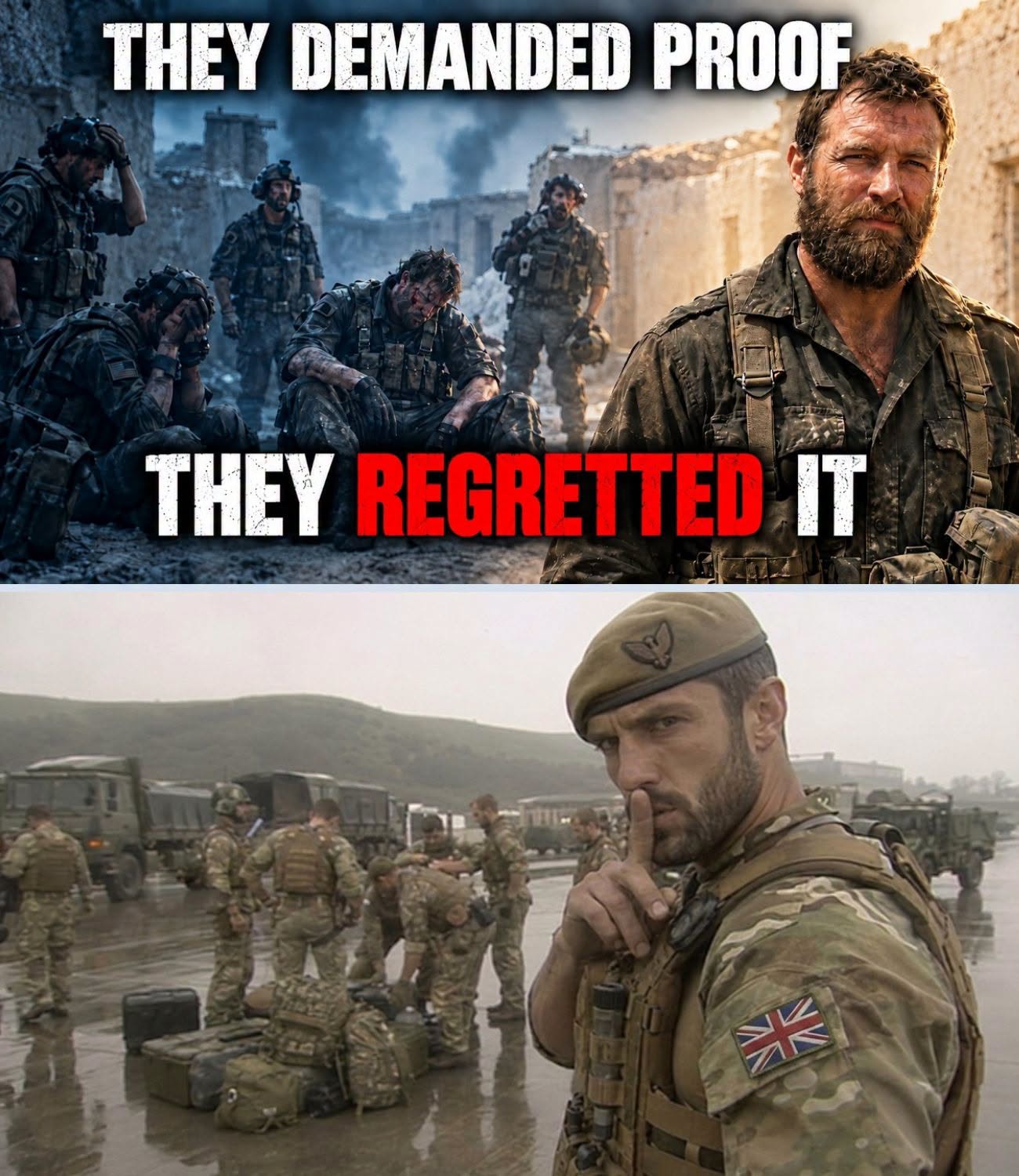
His beard turned gray from him . His bulletproof vest was covered in a gray coating. The straps of the equipment had taken on the color of old bone. He looks at his people. Halloran sits with his back against the collapsed cinder block wall, his elbow on his knee, his palm pressed firmly to his forehead, the way a person presses a wound to keep it from hurting.
Ortiz is on the ground next to him, his head pulled into his shoulders, his face covered by his hands, and there is blood on his knuckles , and it is not his. A third operative, whose name you haven’t heard yet, stands a few steps away, holding his helmet by the strap like a bucket he doesn’t know where to put. None of them were seriously injured.
None of them are talking. This is the best light infantry the United States has ever had, and 47 minutes ago they asked the British sergeant standing next to Vance to show them what he could do. He showed them. You watch Delta fighters trying to control their faces, and they can’t . “Prove what you are capable of.
” Vance said it that morning with a smile, with the slight disdain of a man who trained with everyone and was inferior to no one. The British sergeant, that quiet lad, the son of a farmer from the Perthshire hills, looked at him the way one looks at a dog that has dared to bite someone bigger than itself, and said, “Okay.
” Give us an hour.” It didn’t take him an hour, and the question Vance now carries with him—out of that compound, back on the plane, home across the Atlantic, and on through his career—is a question he will answer in one sentence for years to come. What in God’s name did he just see? To understand who Master Sergeant Elliot Vance was before one day in the Middle East changed him, you have to know what he had already been through to end up there in the first place.
At that time, he had already been in the First Special Operations Unit ” Delta” for 14 years. He had taken the operator training course while it was still going on during the North Carolina winter, when people were losing their toenails in the woods outside Fort Bragg and the instructors at the range were spotting every entry to the tenth of a second.
He passed the stress training phase on his first try—something people who have passed it don’t brag about, because there’s nothing in the unit worth bragging about. You are either there or you are not. Three rotations to Afghanistan, one to Iraq before that, and a series of shorter trips to places that are not listed in his official documents and about which he said almost nothing to his wife in 14 years.
He was a group commander in “C” Squadron. Not the youngest, not the oldest. The rank is between who conducts training , gives orders, and eats last. The sergeant major of his squadron considered him, by a small margin, the best assault and marksman he had. The indicator Vance trusted in himself was real. By range standards during operator training, a timed progression of live fire through a series of rooms with ” no-shoot” targets weeded out shooters .
All this was recorded on a timer, which was personally signed by the chief warrant officer; Vance has consistently been in the top 5% of the division over the past 18 months. He passed this standard on adrenaline, passed with a hangover on the last morning of vacation, and the results did not change. It was what he knew about himself.
His hands didn’t tremble under the pressure. Under the pressure, his hands became more still . The conviction that was to be taken from him over the next few weeks was small and specific, and he had never questioned it because no one in his professional life had given him reason to. This belief was that the difference between being very good and being the best at what he did was measured by equipment, funding, and repetitions.
That anyone who trains as hard as Delta, with the money Delta has for training, will achieve about the same results as Delta. That there are no secret doors. That the limit is known, he stands at it, and no higher level exists. In the left breast pocket of every shirt he owned, he carried a small green notepad the size of a playing card.
He wrote in it only with a pencil, because once a beautiful notebook with ink notes was washed up in a river in the Kunar Valley, and he lost a week’s worth of notes, so he swore to himself on the way back that he would never trust ink again. The notebook contained times, distances, the names of people he trained with, and a diagram of a doorway in Baghdad that he unsuccessfully entered in 2009.
He wrote in it before and after each training block . This was , as he would only later realize, the embodiment of his professional confidence. Numbers on paper, written down, checked. This notebook will lie in his breast pocket, unopened, for most of what happens next. He would reach for it several times in Wales and Herefordshire, and later in the dust of a closed facility, and each time would decide not to open it.
This, to some extent, is history, but we are getting ahead of ourselves. The program itself was routine. She always was, long before either unit wanted to admit it. Delta and the 22nd Special Airborne Regiment maintained rotations with each other. People were seconded in pairs or threes, sent overseas for two weeks or a month, inducted into Sabre squadrons for training, and sometimes for something much more serious.
There is a plaque in the hallway at Credenhill that Delta fighters sometimes photograph without permission. There is a corresponding wall at the base in North Carolina , which the regiment’s fighters treat with the same silent respect. This relationship is long-standing and neither party becomes sentimental about it, but neither party has ever underestimated the other during professional briefings.
On the other hand, individually— in the bar, in the truck, on the way to the training ground —fighters on both sides constantly underestimate each other. This is one of the small human comforts of this business. Vance flew into Brize Norton on a gloomy Tuesday in early fall with Galloran and Ortiz, and a rental car took the three of them west along the freeway into a landscape that, to a man from Piedmont, Carolina, looked like a country entirely covered in hedgerows.
Hereford is in England, which was not a fact that Vance had ever had reason to clearly assimilate, and Stirling Lines is located north of the city, at Credenhill, on grounds that look like any other British Army camp from the road. Bricks, wire, a red and white barrier, a bored soldier with a tablet—and no hint of who lives inside.
The Brecon Beacons, where the qualifying courses are held, where Pen-y-Fen rises above a landscape of black moors and low clouds , are another hour west of that place, across the border in Wales. These are two different places. People who write about the regiment confuse them. Those who were there, no. On the first evening, in the dining room with its cheap chairs and kettle, Galloran took a cup of tea and asked Vance what he thought of it.
Vance walked around the perimeter, inspected the ranges, and shook hands with the officer in the sweater, who introduced himself as Major Ashcombe, with the perfectly ordinary handshake of a man who had nothing to prove by force of pressure. Vance said what he sincerely thought. He said this into his tea, laughing slightly, for Galloran was the kind of person to whom you could say anything.
I trained with everyone, Wes. GIGN in Sator, GSG9 in the forests near St. Augustine, Poles in Lublin, Australians in Swanbourne. Each of them is world-class in their own way, without question. But I have to tell you … He nodded at the rain outside the window, at the dim sodium light above the parking lot, at the whole gray, damp reality of this place.
How different can a bunch of guys in a Welsh field really be? Galloran, who was older, slower, and had a missing fingertip, which he would explain later that week, thought for a moment and didn’t answer. Vance will remember this lack of response. The essence of what was to happen to him was already in the room. He didn’t hear it because it wasn’t voiced .
But if you wanted to write it down on a piece of paper and stick it above the kettle in that dining room, this is what it would be . The advantage at the level these men worked at was not in what you carried with you. And in what you no longer need. Vance carried a lot with him. He was proud of what he carried . And over the next three weeks, he would meet people who, one by one, had put it all aside.
They met the squadron on Wednesday morning on a wet field behind one of the ranges . And everything didn’t go as Vance expected, because of one small detail that was etched in his memory. He had been on many such dates. Two units meet, both elite, both aware of it. This has its own etiquette. Handshakes that last half a second longer than necessary.
Names are called , and then the call sign is specified . A joke, usually about the weather or food. Heading to coffee— Vance had already danced this dance in five countries and was waiting for it here. Instead, this is what happened: eight men in various civilian clothes, without any insignia or identifying elements, walked out the door, nodded to the three from Delta, and simply got to work.
They did not introduce themselves. They did n’t ask questions. They opened the hard cases, took out their weapons, radios, and gear, laid everything out on a plastic mat in a certain order that Vance noticed was the same for everyone, and began their day. It was Halloran who leaned over and said quietly, “It’s them, Elliott.
“This is acquaintance.” Vance almost laughed. That year, Halloran turned 51. He was the type of American sergeant whose voice had become soft—not because of a soft nature, but because of the confidence of a man who hadn’t had to raise his rank in 20 years. He lost the tip of the ring finger on his left hand in Mosul in 2016, pinched by a door during a hasty entry at three in the morning, and showed it to a young Ranger officer as a joke about vigilance , never mentioning it to anyone else again.
He was Vance’s squad sergeant during this mission, and Vance trusted him the way a good commander trusts the man standing half a step behind. The staff sergeant assigned to accompany them for the week finally introduced himself : he walked up to their equipment and said his name so quietly that Vance had to ask for it to be repeated.
Ross Kilbride. That’s all. No unit, no position , no “nice to meet you.” He was a stocky man, no taller than Vance, with a weathered face and hands that had been used to hard labor outdoors before he had even begun working indoors. He was wearing civilian pants, a fleece jacket, and old boots. His Scottish accent was such that Vance couldn’t tell where he was from.
Halloran would later tell him that Kilbride had grown up on a farm in the hills near Aberfeldy in Perthshire, had joined the regiment through the parachute landings, and that his father still kept the same farm. But that morning, all Vance had was a voice so quiet that the three men had to bend down to hear. The misunderstanding occurred 10 minutes into the training ground.
The first training session was simple—a fire check that every Delta operator had performed a thousand times. Movement, work, transition, movement. Vance did so because Kilbride gestured for him to do it first. He did everything cleanly. He knew the pattern of his movement before he even started, and it matched what he knew.
Fast, aggressive, confident— just the kind of thing that would make a chief warrant officer nod in North Carolina. Then Kilbride did it. Vance stood behind the security line, watching, and what struck him—the first little thing—was that Kilbride wasn’t moving faster than he was. He didn’t move any slower. He moved at the same speed, but somewhere in the movement itself there was less effort, less shrugging of the shoulders, less shifting of the legs.
His transition from carbine to pistol occurred while he was still walking, without any of the hesitation that most people have when switching weapons. When he started hitting the second target, he didn’t stop. When he hit the fourth one, he did n’t stop either. His body continued to move, his hands did their thing, and they didn’t interfere with each other.
Vance was a professional. He instantly understood what he was seeing. It was n’t that Kilbride was faster. The point was that he had rejected something that Vance, it turned out, was still carrying around with him. He reached for his notebook. He did n’t open it. He put his hand back. Galloran beside him said nothing.
The next day they set off west. The briefing was banal: a march-throw through part of the Brecon Beacons in patrol formation with a backpack, unloading, and weapons. Kilbride said the word “tab” and didn’t explain. Galloran, who had done a similar march with the Rangers 10 years earlier, looked at Vance and said in his slow, dry manner, “Now they’re going to take us for a walk.
” Vance passed the stress test stage during the selection for Delta. He was, one might say, thrown into the Yuvarri forest with a compass and a stone, and he came out of there on the other side. He made that 60-mile march that the books write about. He was 178 cm tall, weighed 82 kg, had strong muscles, and could carry his weight for long periods over rough terrain.
He looked at the map Kilbride had placed on the hood of the Land Rover , did the math in his mind, and thought, “I can do this.” He thought this with that special calm confidence of a man for whom weightlifting had been his professional calling card for a decade. The backpacks they were given at the start weighed 35 kg.
Vance weighed his. He had that habit. 35 kilograms is about 77 pounds, more than his weight at selection but less than the heaviest combat gear in Korengal, and it was exactly the load his body knew. He nodded to himself. He moved second, Kilbride in front, Halloran and Ortiz behind, and the two regimentals closing the line at a distance that seemed both casual and quite correct.
The first hour went well. The peaks in early autumn are not the same peaks as in the summer photos. Fern the color of old copper. The paths, where they exist, are peat, and peat has turned to black liquid under the feet of ten thousand boots that have passed to you. The wind blows from the peaks, meeting no obstacles , and by the time it reaches you, it is already bringing rain for the next hour.
You enter the clouds sooner than you expect. You come out of the clouds—and back into the clouds. Vance has worked in bad weather all over the world, but the weather on the peaks has a special character: it never stops raging. She is so devoted to her ugliness that soldiers from arid lands rarely encounter.
He noticed it at two o’clock. Not that he gave up. He did n’t give up. His pace was confident. The weight distribution was correct. He packed his backpack the way he had been taught in North Carolina: the heaviest items on top and closest to his back, and he sat on his hips exactly as he was supposed to .
With his feet in the boots he had been wearing for two years, everything was fine. Everything was fine with Ortiz, who was walking behind . Galloran, a little older, was breathing harder than Vance would have liked to hear , but it was Galloran, so it was okay. Who he paid attention to was Kilbride. Kilbride, who was in front, was moving at exactly the same pace he had taken from the car, not an iota slower.
On the climb, where Vance’s own stride shortened by two inches to protect his knee—a small, automatic adjustment the body makes— Kilbride’s stride did not shorten. On the section of the descent on wet slate, where Vance put out his hand to grab a rock, Kilbride did not put out his hand. He didn’t stop to drink water.
He didn’t stop to check the map. He looked at the ground twice an hour: once at the fog ahead, and once at his feet, and that was all his neck could do. His backpack sat on him like a coat on a person who doesn’t complain about discomfort. By three o’clock, Vance felt pain he had not expected at all. Kilbride, when he did speak, talked about his father’s sheep.
It happened unexpectedly, during a stop somewhere north of a lake whose name Vance couldn’t even pronounce. Kilbride, without turning his head, recalled that he grew up on a farm near Aberfeldy in Perthshire, and that his father, at 71, still went up the same hill every winter to herd the sheep before the snow covered the ground.
He said it the way a person remembers the weather. He spoke in such a low voice that Vance had to close the distance between them by a meter to hear. And this reduction in distance by a meter cost Vance more effort than he had expected, and Kilbride, without looking back, imperceptibly increased it by another meter.
That’s when Vance first understood. He assumed that the test was one of endurance. He thought the test was how much you could carry, how long you could carry it, and how much air your lungs could pump under load. He assumed, for these were statements his training never contradicted, that the most resilient go the furthest.
Kilbride was resilient. Kilbride was certainly very hardy, but on that hill he was doing something that wasn’t just endurance. Kilbride moved as a person moves when movement is not a job to be done. Kilbride moved as his father had moved on the same terrain. Kilbride was, in a precise and undeniable sense, at home.
He didn’t spend anything that didn’t need to be spent. They walked 22 km according to the map, but in reality it was more, and ended up on the side of the road, where a Land Rover was waiting for them with a thermos of tea. Vance sat in the back of the car, drank a cup of tea, and was silent for 11 minutes. He reached for his notebook.
He only managed to unbutton his pocket. Then he did what he did several more times over the next two weeks: he zipped his pocket back up without taking out his notebook, because he realized he did n’t know what to write about yet . He assumed that the test was one of endurance. Okay . He was wrong about the exam, but there was another one he really excelled at, and it was 3 days away.
He kept repeating this to himself on the way back from Wales, while the janitors were working, Galloran was sleeping, leaning against the window, and Ortiz was calmly shifting gear in the back seat for the fourth time that day . TAR was a Welsh hill in autumn. TAR was their territory. Let them just try to step on his territory.
His territory is the rooms. His territory is the tenths of a second that pass between the decision to move and the moment when the shoulder passes through the doorway. The choreography of two people entering a space that is trying to kill them. This was the territory of the ” Delta”. This was the ground on which the entire meaning of the unit’s existence was carved over 40 years.
This was an area where Vance himself was in the top 5% of the unit’s fighters, which, by his own professional assessment, was at the top. Let them try. The next morning he met Ewan Prothero in the dining room over an argument over tea. Protheroe was a Welshman from the town of Machynlleth, whose name Vance could not pronounce even after hearing it four times.
And Protheroe had a moral principle: adding sugar to tea is a habit of those who have not yet grown up. He said this to Galloran, who set down two spoons with such pleasant seriousness as if he were preaching. To his annoyance, Halloran placed a third spoon. Prothero laughed his whole face off, and then, without changing his tone, informed Vance that on Thursday at 08:00 they would be at the “killing house ” and the training would be combat.
That was another thing Vance noted that first week— noted it only once, never coming back to it again because it wasn’t the main thing. The equipment that the regiment’s soldiers spread out on their plastic mats morning after morning was old. Not bad, not poor quality, and not underfunded , but older than his own. Boots that had been repaired twice, backpacks that had been to secondhand stores, scopes with a scratch on the lens— one of them, when Vance asked, replied that it was from a brick fragment in Basra in 2007, and he wouldn’t replace it because
the scratch didn’t interfere with aiming. Vance’s equipment was newer. Vance’s equipment has been newer throughout his career. This was not a criticism of either side. It was a statement of fact about two different procurement systems, he mentioned it to himself that Wednesday evening and didn’t return to it again, because that wasn’t the point.
The point was in the people. The impetus for action was in his own head, and it went like this : on Thursday morning he would enter the “killing house” and he would show class there. He knew what the class would show there. He will show class there. What he didn’t know yet was what “class ” meant on this earth, in this room.
The “Keeling House” in Craden Hill is not a house. This is a purpose- built facility for close- quarters combat, where the interior walls can be moved on rails between iterations. Ceilings can be lowered, and the entire layout can be reconfigured 90 minutes before the session so that no one who walks in knows its geometry in advance .
The cartridges are live ammunition. The walls are lined with a rubber composite that absorbs bullets without ricocheting. This building has been an integral part of the regiment’s mythology since the 1970s, and has been rebuilt many times since then. Vance has been in a similar version before, on paper. He had never been there in person.
He met Deacon Shaw on the path near the entrance. Shaw was a sniper corporal and was not at all like the people Vance had met in the American sniper community. He was tall and thin, and in the back pocket of his pants he had a paperback book, the binding of which had been carefully torn off. Vance asked him what he was reading.
Shaw replied without turning around: “Nothing. ” And Vance realized in a moment that the cover had been removed specifically to prevent the very conversation he had just tried to start. Shaw smiled quite benignly and said, “It’s not about the book, it’s about the peace and quiet.” Vance took note of this. They first performed the American exercise at Kilbride’s suggestion, using a diagram that Vance had familiarized himself with.
He performed it with Galloran and Ortiz. The two of them are going to attack, the third one is covering, hit six targets in four rooms, don’t touch the two “non-targets”. He did it the way he had done it for a decade. The structure is tightly pressed against the wall. Ortiz’s hand is on his shoulder.
The door is blown out by a small explosive charge that Ortiz has placed with the composure of someone who has done it thousands of times. Through the doorway. From the wall. First goal. Second goal. Turn on the leg. Third. Galloran’s carbine in his field of vision moves with him, neither ahead nor behind. Fourth goal. Fifth.
“Do not shoot” is omitted. Sixth. Purely. Movement. Second room. The same rhythm. Third. Fourth. Purely. He came out, and Kilbride, holding the stopwatch, said only, “Yes, that’s clear.” And then Kilbride handed the stopwatch to Prothero, and Prothero handed it to Shaw. And the four soldiers of the regiment standing on the observation bridge disappeared for 6 minutes while two civilians in overalls rearranged the walls.
And Vance stood outside in the rain with Galloran and Ortiz. And none of them said a word. Now look. Four people, no instructions. They line up at the door, the configuration of which they are seeing for the first time. Equipment on them. The weapon is ready. No countdown. No preparation. A slight nod from Kilbride, and the door opens.
They are inside. The first, Protheroe, is already moving away from the wall while the second is still going through the door. His carbine rises simultaneously with his stride. First shot, the barrel doesn’t bounce. He is already around the corner. The second is Kilbride. Kilbride doesn’t follow Prothero. Kilbride goes the other way, into the mirrored part of the room, and his bullet hits a target that Prothero has not yet seen and could not hit.
The third—Shaw, and Shaw looks up at the ceiling niche, because in this configuration there is a target there that no one has been told about, and Shaw looked, because Shaw is always looking. His bullet is the third in a row. The fourth is a fighter whose name Vance doesn’t know yet, a quiet guy, and he’s already in the second room.
They do n’t talk. They don’t touch each other’s shoulders. They are not giving any signs. They don’t signal. Everyone knows where everyone else is, at every moment, without confirmation, because they have built a shared picture of space that is updated in real time from their every sound. A step, a breath, a shot—and they act according to a pattern, not on command.
Second room. Kilbride near the far corner, even before Prothero had finished his second step. Third room. “Do not shoot” hits Shaw’s sector, and Shaw’s finger doesn’t move, his gaze doesn’t stop, and the shot he fires rings out a moment later, hitting a target behind “do not shoot,” which Vance didn’t see until the bullet hit it.
Fourth room. Silence. Purely. They are leaving. Their breathing is even. Their equipment is untouched. Kilbride, without looking at Prothero, hands him a bottle of water. Protheroe drinks half and hands it back. Vance suddenly realizes that his mouth is open . During a further analysis of flights in a trailer with a board that no one uses, Eshkom analyzed the training in 90 seconds.
He named two things they did well and one they did not do very well. What they did n’t do very well was delay the fourth fighter by half a second in the corner of the third room . The fourth fighter nodded and did not make excuses. That’s the whole analysis. The debriefing of Vance’s team’s flights lasted 11 minutes.
He sat on a plastic chair , listening to the rain on the roof of the trailer, and realized something else . He believed his shooting was world-class. His shooting was world class. This was not a false assumption. The assumption that world- class shooting was the main thing in that room was wrong. What was important in that room was that the four men created a shared sense of space and acted accordingly, without needing any clarifications out loud.
And this feeling had been formed elsewhere, years earlier, in the hills, in the barns and corridors where it was not there. And it wasn’t something he could instill in his team in two weeks, a month, or a year of trying. His hand reached for the notebook. He left it in his pocket. He didn’t go to the dining room that evening.
He walked the perimeter of Sterling Lines in the rain, wearing a fleece jacket, without a rifle, without a walkie-talkie, and without company. And I walked like that for an hour and a quarter. Security lighting created halos in the wet air. A guard on one of the corners nodded at him without saying a word. A dog was barking somewhere beyond the fence, and at that hour it sounded as if the whole dark Herefordshire countryside was complaining.
His boots got wet. His hair was wet. He didn’t adjust his hood. He was thinking about the room in Sanguine. This was the particular room he visited in 2011, on a night that, by all standards, was an extremely successful one for his career. Three men in a room who shouldn’t have survived after that. They all survived .
Two militants were killed. There are no losses among our own. For this, he was informally presented with a coin. He described that room in a notebook as he returned to bed. And the note stretched to two pages, which was a lot for him , because there was a lot to say about the angle of view, about the doorway , about how Halloran, without a word, turned the corner where Vance was about to go himself, because Halloran saw something that Vance didn’t see and made a decision half a second before Vance would have, and that half a second
would define the whole night. That night, Galloran made this decision without asking permission. Vance confided in him without asking questions. There was no confirmation. He stopped on the perimeter road in the rain. He was that person. He was on the side that got the overall feel of the room. He entrusted the person next to him with a decision he could not verify, at a speed at which verification was impossible.
For they had spent years building the picture he had just seen four Britons reenacting in a trailer in Herefordshire. The difference, the difference that mattered, was that in 2011 he was doing it with Galloran, because he had done it with Galloran hundreds of times. And those four soldiers of the regiment that morning did it together in a configuration none of them had seen before, on a plan that no one had instructed, without any signal, and they did it not because they had been in this room before, but because they had gone through all the rooms together before
, so that the four of them merged into a single organism that solved problems faster than his best evening in Sanguine. He wasn’t out of his depth. He was doing the same thing as these people. It was the same craft. And it was terribly worthy. If it were any other craft, he might just shrug. It was the same craft, and they had advanced him further along the same path he had taken, and done it with less equipment, in worse weather, in quieter voices, and done it as best he could understand, discarding the superfluous,
needing less, trusting more. He returned to his room. He sat on the edge of the bed with the lights off, took his notebook out of his pocket for the first time in 5 days, and opened it to a blank page. He held the pencil over her for a long time. He did n’t write. He closed the notebook. He placed it on the bedside table.
He leaned back on the bed in his wet fleece and stared at the ceiling for a while, then laughed quietly , to himself, in the darkness. It wasn’t a bitter laugh. In the morning he would go find Ashcombe and ask the question he had n’t planned to ask, and it would be the one that would dispel the rest of what had happened.
That’s the twist. By the end of the third week, they would be at a base in a country where, as neither the American nor British governments had officially confirmed, neither of them had been that fall, and Vance would have an answer to a question he hadn’t asked in a decade. The rest of what he was to see he would earn in Ashcombe’s office on Friday morning over a cup of tea, and it would be eight sentences.
He knocked on Ashcombe’s door at half past eight. Ashcombe waved him in without raising his head. Vance was standing because there was only one free chair, but there was a folder on it . In a moment, Ashcombe finished the paragraph, looked up, and put down his pen. Vance said, ” Sir, I want to ask you something, and please be honest with me, because I’ve been polite for two weeks, and I think my politeness is running out.
” Ashcombe smiled faintly and said, “Go on.” How did your people do this in the house yesterday morning without any signal? Ashcombe thought for a moment . He was fifty- four that year. He wore an old wristwatch, face- in, on a brown leather strap, with a plain dial, and Vance hadn’t thought about it before because it didn’t look like a watch that wanted to attract attention.
It was actually the watch his grandfather had worn during the landing at Arnhem, and Ashcombe never mentioned it to any officer of the regiment except one. And now he hasn’t told Vance about it either. He simply raised his wrist to check the time, the glass caught the light from the window for a moment, and he lowered his hand.
He said: ” They spent four years in the same room.” Vance asked, “And that’s all?” Ashcombe replied : “That’s most of it.” And the rest is that when they weren’t in the same room, they were together on a hill, or on a boat, or in the back of a truck in Baghdad, or in a canoe on a Norwegian fjord. They know each other in a way that people outside of this business find it mystical. This is not true.
It’s simply time well spent. Vance thought about it. Eshkom said, “Your people know each other just like that. I have seen your work. Halloran and you, how long? Nine years. Nine years. So, you know. I know. Then the only thing that can be said is that this squadron has been together in one form or another for much longer than others, and we have spent that time “in the field” rather than in the classrooms, and we have spent it mostly without much ado.
That’s the whole answer. There is no methodology here, there is a price, and we paid it. Vance looked at him for a moment and was silent. Ashkom returned to his papers. Vance left the office, walked down the corridor to the car park, stood for a moment in the light rain, looking up at the sky, and something calmed within him that had been restless since that time in Wales.
He did not feel the humiliation that would be like defeat. Instead, he looked at his own career the way a person looks at a map that they thought was complete and then realizes it was only part of a longer journey. The road continued. It didn’t end where he stood. He went and found Galloran. He said, “Wes, I owe them an apology and I know how to do it.
” The assignment that came in that Friday night was genuine, it doesn’t appear in any official reports, and by all the rules of what people in Vance’s profession say or don’t say, the version told here is what Vance told years later to someone he trusted, and it’s adapted accordingly. An object, a specific person inside, a time frame set by intelligence that no one in the room created, and the clock has already started ticking.
The joint unit, three Delta operators and eight B Squadron fighters, was the closest resource capable of action. Eshkom conducted the briefing in 7 minutes. Kilbride, standing over his shoulder, added two sentences. The last thing Kilbride said in that voice that had to be listened to was: ” When we get there, there will be nothing but dust.
” Just be prepared for dust. They arrived by helicopter at sunset and covered the final distance on foot with night vision devices. The landing took place as landings usually do, when all participants have done it before. No conversations, no lights, the distance sometimes increased, sometimes decreased depending on the terrain.
Vance was in the second group, behind Prothero. And he moved just like Prothero, because he had been watching Prothero move for the past three weeks. He carried his own weapon. The L11A2 carried by the British was also on their shoulders. And inside the compound, later, when a bullet flew past his ear from somewhere he had not yet had time to identify , its crack and the crack of the return shot from Kilbride’s carbine were indistinguishable to him .
They go on the assault at 04:14 local time. There’s an explosion and a wall of dust, and Ortiz is already inside. Vance goes second, with Kilbride somewhere on his left flank, although he was n’t asked to. The first room. The picture of the room that Vance has does not match the one he formed after the briefing. The picture updates as he moves.
A man stands in the corner with something in his hands. This ” something” is not a weapon. Vance’s finger doesn’t move. Kilbride, on the left, sees it too, and Kilbride’s finger doesn’t move either. And neither of them told the other about it. But there was no need. Second room, contact from above.
The complex has a second floor, accessed by an internal staircase that Vance did not see in the aerial photos. The bullet pierces the ceiling. Prothero climbs the stairs without asking permission. Shaw is downstairs, aiming his gun at the platform, and his bullet enters the doorway before Prothero has even risen, and the doorway is no longer a problem.
Protheroe goes to the right. Kilbride walks past Vance and climbs up behind Prothero, and Vance follows them, finally realizing with all his body that going with them is the point . Third room, the target is standing against the wall. The target is reaching for the hand. This is not an attempt to give up. Ortiz shouts an order in English, then in a language that Vance thought Ortiz didn’t know.
The target does not stop moving . Kilbride’s bullet does its job. It was one shot. The movement stops. All of this, from the start of the assault to the command “clean”, took 4 minutes and 12 seconds. Vance knows this because Galloran was on the first floor doing the counting, and Galloran has never made a mistake in his calculations.
They are leaving. They leave the same way they came in: in silence, keeping their distance. The helicopter returns, as promised, picks them up, and the ground falls away from under their feet. Vance sits in the doorway, legs dangling, gun on his lap. He watches as the complex below gets smaller and smaller. From this height , he sees a fresh ring of gray dust settling around him like a flower. 47 minutes.
That was all. From the landing of the first helicopter to the takeoff of the second. 47 minutes passed, and during those 47 minutes, 11 men broke into someone else’s facility at night, took it over, took the person they came for, packed the person on the other side of the exchange into a bag, and left. Vance, by his own count, fired once and had no need to fire a second time, because Kilbride had already done everything necessary.
In the helicopter, Galloran leaned over and said something that Vance couldn’t hear over the noise of the propellers. Vance leaned closer. Galloran repeated it again. Galloran said, “Elliot, you asked them to prove it.” Vance nodded. Galloran said, “They proved it.” They didn’t speak again for the rest of the flight.
When they landed at the base, the sun had already risen. The Delta trio descended the ramp into the same yellow dust that was at the facility. Ortiz sat on the ground, covering his face with his hands, as the adrenaline rush overtook him at that very moment ; Galloran leaned against the Gesco bastion, pressing his palm to his forehead the way a man presses a wound to stop it from hurting, while a third operative, whose name is not mentioned in this story, stood aside, holding his helmet by the strap and staring at his own
boots. None of them were injured. Vance stood before them , dust in his beard, on his equipment, and on his unloading straps ; he looked at his three fighters and then glanced at Kilbride, who was 30 meters away, drinking water from a bottle that Proffer had given him . This is the image with which the story began.
This is the image that this hour has created . Years later, in a bar in Fayetteville, North Carolina, Elliot Vance was sitting with a young operative preparing to join the regiment for the first time , and the guy asked him over a beer he had barely had what he should expect. Vance thought about the question for a long time before answering.
He repeatedly gave roughly the same answer to several people in the community when asked about it . The following is his story. He will not confirm the transaction . He won’t name the country. He won’t name the person in the third room. He would call the sergeant, and only by his last name, because the sergeant was already retired and in a Christmas card he hadn’t expected, he had said he didn’t mind.
Vance said this: “Do you want an honest answer or a polite one?” Okay, I’ll give you an honest one, because you’ll get a polite one from your group commander. The honest answer is that I came to Creedon Hill, having served in the unit for 14 years, thinking I had a pretty accurate map of what the top of this thing looked like.
I thought the map ended somewhere near my feet. On the very first evening, over a cup of tea in a room with a bad kettle, I said to my sergeant: “How different can the boys of the Welsh field really be?” ” I said it.” I remember saying that . I remember Wes not answering me. I thought about this lack of response for the rest of my career.
On the fourth morning of the third week, I was standing outside a compound in a country I wo n’t name, dust on my beard, and three of my best men were sitting on the ground behind me, trying to control themselves, and I realized something that I want you to understand before you get on the plane, because it will save you two weeks of useless pride.
That morning, before leaving, I asked them to prove their mettle. I said it as a joke. I said that as a professional courtesy. I said, “We watched for three weeks.” “Show what you’re capable of on the day of surgery.” And the sergeant, Kilbride his name was, the son of a farmer from the hill above Aberfeldy.
He looked at me the way you look at someone who has just written a check they can’t pay and said, “Okay, give us an hour.” It didn’t take him an hour. It took him 47 minutes from the time the wheels of the first plane separated to the time the wheels of the second touched down. And in those 47 minutes, I saw eight men do what my unit has been learning for years, and they did it with less noise, less equipment, less signals, less confirmation, and less of anything that could be called ” trick” than I’ve ever seen in this
business. I fired my gun once . I shot correctly. This had no effect on the outcome, because the outcome had already been determined by the people who had spent the previous four years in the same rooms and built between themselves something for which I have no words and, I think, never will. You asked me what to expect.
I’ll tell you what to expect. Expect respect for yourself. Expect to be treated like a professional. Expect no one to raise their voice at you . Expect no one to tell you that you are wrong. And then expect that calmly, in 3 weeks or 2 weeks or two weeks, you will realize that the ceiling that you thought you were standing on is actually the floor.
And that there is a whole other building above it. And people there don’t brag about living there. They just live there. The lesson I learned is short. The advantage at this level is not in what you carry. It’s in what you no longer need. These people don’t need to scream anymore. They no longer need to signal.
They don’t need to prove anything anymore. They don’t need to talk about themselves anymore. And what they have left is all the skill, reduced to a fifth of its original volume, moving around the room at exactly the speed it demands. I asked them to prove their ability. For an hour I regretted asking. And the only reason I’m not embarrassed about asking this question is because on the way home, the sergeant told me in that voice you have to listen to, “Don’t take it to heart, Elliott.
Everyone asks. “Everyone is sorry.” And then he smiled once and didn’t say another word for the rest of the flight. The junior operative at the Fayetteville bar didn’t drink his beer. He said, “Thank you, Master Sergeant.” Vance replied, “Don’t thank me. “Go easy.” After that fall, Elliott Vance served in the unit for another 6 years.
He became a sergeant major. He led a squad, then a squadron group, and then took the instructor’s chair at the training center and stayed there until his knees decided the argument for him. People who were trained by him in those years noted, without knowing why, that he conducted flight debriefings more calmly than his predecessor.
He named two things they did well and one they did less well. He did not interrupt them during their conversation. He wrote very little on the whiteboard. When one of the new instructors once asked him about it, he only replied that he had learned it from a sergeant on a mission many years ago and saw no reason to change anything.
He did not mention the name of that sergeant. There was no need for this. The relationship between the two units did not change because of the events of that fall, because relationships between units do not change during one short mission. But the people who were in the training house that Thursday and those who left the complex at 05:01 the following Friday maintain a special silent respect for each other that they don’t speak out loud, because voicing it would be a betrayal.
And now Christmas cards are traveling back and forth across the Atlantic that would otherwise never have been sent. Prothero retired to his hills. He took a T- shaped ruler with him. The image that began the story— a man standing in the dust of a destroyed compound while three of his best fighters struggle to control themselves—is exactly what Vance recalls when the young operative asks what he learned in Herefordshire.
He doesn’t describe it. He never said it out loud, except once in a bar in Fayetteville to a man who had n’t even drunk his beer. The lesson, if there was one , and Vance was always cautious about drawing conclusions, was what he saw on the hill in Wales: Kilbride had stopped needing anything. It was that he saw four men building silently in a room in England.
It was what he felt in his own body, moving behind Prothero’s shoulder in the compound at four in the morning, taking one well-aimed shot and realizing that the outcome had been determined before he arrived. The advantage at this level is not what you have with you. And in what you no longer need. If you want more stories like this, the ones that can only be told because the people who lived them are willing to tacitly agree to distort the details in order to preserve the essence of the truth, then the shelf is filling up,
and each new story appears when it is ready, and not before. I would say that it doesn’t matter whether you sign or not. Kilbride, in his voice that you can’t help but listen to, would say the same thing, and he would mean it, and you would listen anyway . Take fewer things.