Doors Slammed Shut: British Headmasters Humiliate Harry and Meghan by Locking Archie and Lilibet Out of Cotswolds Schools!
The Cotswolds Catastrophe: Inside Harry and Meghan’s Humiliating Return, Slammed School Gates, and the Royal Stonewall That Ended an Era
The luxury Bombardier Global Express lifted off smoothly from a private airfield north of Los Angeles as twilight settled over the California coast, its engines humming a quiet tune of privilege and escape. Twelve hours later, the aircraft touched down on the tarmac at Birmingham Airport just before midday, greeted by no flashing blue police escorts, no welcoming party of state dignitaries, and no fluttering palace banners. A family that had spent six continuous years broadcasting their utter disdain for British institutions had slipped back into the West Midlands carrying twenty oversized suitcases, two young children, and an immense cargo of uncalibrated expectations.
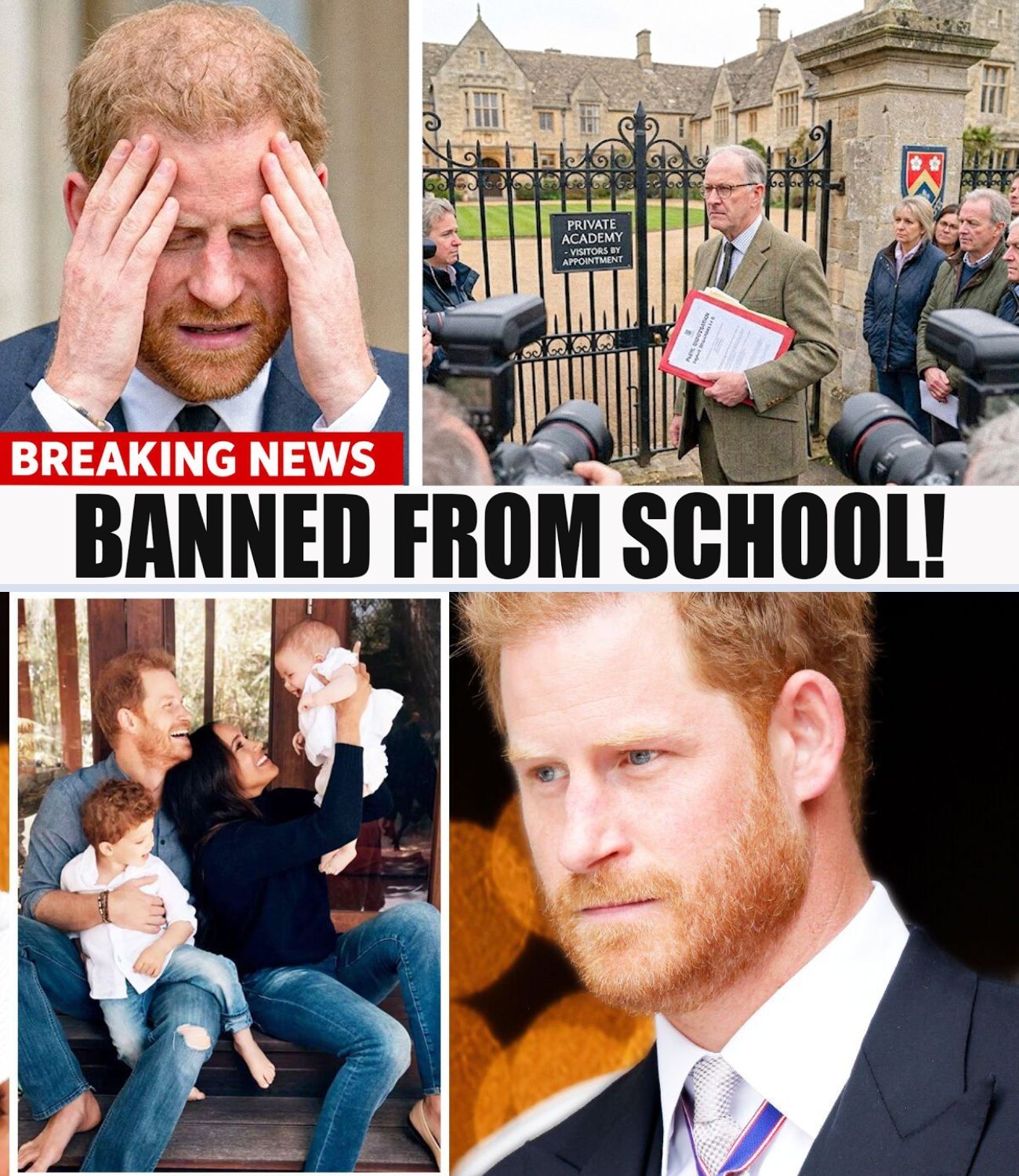
Within ninety minutes of those landing gear wheels biting the British asphalt, senior royal correspondents across Fleet Street received an identical, highly polished briefing memo straight from the Sussex communications camp. The narrative was sleek and meticulously packaged: the transatlantic relocation was undertaken entirely for the children. Prince Archie, now seven years old, and Princess Lilibet, five, were supposedly scheduled to walk proudly through the wrought-iron front gates of an elite preparatory academy tucked deep within the Cotswolds the very next Monday morning. The spokesperson framed the entire cross-continental upheaval as a whirlwind triumph, claiming those coveted classroom places had been locked down just ten days prior.
Anyone with even a passing familiarity with elite British independent schooling immediately recognised the fiction. In the rarefied world of English country prep schools, competitive admissions places are secured many months—sometimes years—in advance, backed by substantial, non-refundable deposits and months of uniform fittings. You do not simply drop out of a Californian sky in late August, pitch up with twenty suitcases, and expect customized lockers, tailored blazers, and assigned desks to materialise out of thin air.
Yet that was the immaculate fairy tale fed to the global press. Behind the high stone walls of a rented estate in Gloucestershire, the reality was not a triumphant homecoming at all. It was sheer, unadulterated panic.
The Slammed Gate and the Administrative Trap
The flight had landed, the luggage had been lugged inside, and the children stood ready, but the school gates remained firmly padlocked against them. The headmaster of that prestigious Cotswolds academy had politely, quietly, but utterly immovably refused to sign the statutory pupil admission register. He did not slam the door because of petty royal gossip, tabloid photographers peering through hedges, or palace intrigue. He halted the entire machinery because the mandatory legal documents required by British law to enroll those children were fundamentally, irreconcilably compromised.
Two parents equipped with global advisers, chartered aircraft, and unlimited wealth had crossed an entire ocean only to watch their grand return grind to an abrupt, grinding halt in a Gloucestershire administrative office. While the public was fed lines about a minor clerical misunderstanding easily smoothed over with a polite phone call, that headmaster was staring at official civil records that contradicted one another so profoundly that signing his name would have meant violating national child safeguarding legislation and exposing himself to direct criminal prosecution.
To understand why that headmaster could not simply wave a hand and look the other way, one must examine the strict realities of British school law. Governed by the school attendance pupil registration England regulations—significantly tightened by Parliament—educational institutions operate under a brutal regulatory vice known as Regulation 8. Every single school across England must maintain a permanent admission register containing verified civilian names, exact dates of birth, home addresses, and, crucially, the verified legal civil names and permanent addresses of both parents.
The statutory wording demands real civilian identities entered into a state-monitored database, not aristocratic courtesy titles or commercial global trademarks. When an admission record lists unverified information or conflicting documents, headmasters risk devastating financial penalties, immediate loss of academic accreditation from Ofsted, and personal criminal liability. The headmaster was protecting his career, his institution, and his freedom.
When the paperwork was laid bare, the administrative chaos became glaringly obvious. Archie Harrison Mountbatten-Windsor was born in London in May 2019, with his original state registration listing his mother as Rachel Meghan, Her Royal Highness the Duchess of Sussex. Yet nineteen days later, an extraordinary amendment wiped out the civilian name Rachel Meghan entirely, leaving only a decorative title. Cross the Atlantic to Lilibet Diana Mountbatten-Windsor, born in California in June 2021: California law strictly mandated recording her mother as Rachel Meghan Markle, but the father section recorded the father’s first name as “The Duke of Sussex” and his surname as “His Royal Highness,” leaving no Henry, no Charles, and no Mountbatten-Windsor.
Two full siblings held entirely contradictory identities for their mother, while their father hid behind floating royal styles. Harry knew this deadlock was looming. He had previously fought passport officials over surnames and even approached Earl Charles Spencer asking if the children could adopt the Spencer name. Ordinary channels had failed. He needed an overwhelming royal backdoor, and he had already dispatched a desperate missile toward Gloucestershire.
The Social Ice Age in the Cotswolds
While the educational battle lines were drawn, the local community in the Cotswolds was offering its own unique brand of frozen indifference. The Cotswolds are packed with generational wealth, ancient titles, and international celebrities; Range Rovers and private security details are standard background furniture there. Nobody freezes in their tracks when a famous face walks down a village lane.
Yet, according to local eyewitness accounts, Meghan chose to treat an ordinary shopping trip like an imperial state visit. At the Daylesford organic farm shop—a famously high-end market where wealthy locals quietly grab their organic vegetables—Meghan reportedly arrived during peak Saturday morning hours surrounded by a tight ring of private bodyguards. Shoppers described an aggressive security bubble marching through the produce aisles, elbowing ordinary people aside and hushing customers who were merely trying to buy artisan bread. After turning the organic market upside down, she allegedly walked out having purchased one single item. As one local source bluntly noted, the frustration wasn’t about her money or fame, but the sheer, exhausting inconvenience of empty posturing.
Then came the disastrous pub outing. Meghan was photographed having lunch at the Three Horseshoes, an eighteenth-century pub near Burford, alongside Ellen DeGeneres and Portia de Rossi. On paper, it was supposed to look like a relaxed countryside gathering of glamorous American friends. In reality, locals instantly mocked the location as an obvious, tacky tourist trap, and reports quickly surfaced that several staff members flatly refused to serve them. When broadcaster Megyn Kelly dissected the photographs publicly, she highlighted the bitter irony of two women dogged by persistent workplace bullying allegations huddling together in a village local. The community simply closed its doors, looked away, and went about its day. Nobody asked for autographs; nobody was dazzled by titles.
Elton John Cuts the Cord
As social isolation settled over the Cotswolds, an even more devastating financial blow was landing behind the scenes. For nearly thirty years, Sir Elton John had served as Prince Harry’s ultimate emotional and financial safety net. Dating back to September 1997, when Elton sat at the Westminster Abbey piano singing farewell to Princess Diana, a personal promise had been forged to protect her sons. When Harry faced intense backlash in 2019 for flying on private jets while lecturing the public on climate change, Elton publicly absorbed the criticism, paid carbon offsets, and shielded him.
Harry assumed that loyalty was absolute. Thus, the moment his chartered flight touched down in Birmingham, Harry messaged Elton directly, asking for the use of his private jet for a weekend trip to Scotland and France. Just one more flight.
This time, Elton said no. Harry was genuinely stunned. Accessing Elton’s wealth had long ceased to feel like a favour and started feeling like an entitlement. When Harry complained to Meghan, she reportedly advised him not to push, remarking that Elton was old, needed to feel useful, and was easily managed when Diana’s name was invoked.
She had no idea David Furnish saw that message. David quietly ordered Elton’s travel managers to pull every invoice connected to the Sussexes’ flights. What emerged was staggering: deep cleaning bills after trips with children and security, cabin repairs, excessive crew overtime, and thousands in repositioning fees when Harry changed departure airports at whim. When Elton asked how much Harry had paid, David delivered the blunt truth: almost none of it. Elton had absorbed it all out of love for Diana.
Facing catastrophic legal bills from his losing press lawsuits, Harry called Elton privately asking for a “financial bridge.” When Elton hesitated, Harry reminded him they were in the lawsuits together. Elton fired back coldly that they shared a lawsuit, not a bank account. Desperate, Harry pushed the emotional button, claiming his mother would have understood why he had to keep fighting.
That was the exact moment thirty years of friendship died. Elton cut him off, telling him never to use his mother to ask for money. Days later, when Harry and Megan arrived uninvited at Elton’s Holland Park residence, David Furnish barred the entrance, looked Harry in the eye, and told him that kindness is not an endless bank account. The private jet was gone; the financial lifeline was snapped.
The Four-Page Plea to Princess Anne
Completely stranded, Harry turned toward the one royal figure he thought he could still intimidate: Princess Anne. Two weeks before the private jet lifted off from California, a heavy package arrived at the private security gates of Gatcombe Park, Princess Anne’s working Gloucestershire estate.
The parcel contained a bespoke leather-bound photo album stamped with gold lettering, filled with glossy pictures of Archie and Lilibet playing in California gardens. Tucked into the front sleeve was a four-page letter written in Harry’s own handwriting. The opening pages were soaked in sentimentality, invoking Diana’s memory and reminiscing about public theme parks and hospices.
But page three revealed the true mission. Harry acknowledged the conflicting birth certificate paperwork, admitted the Cotswolds school enrollment was gridlocked, and issued his demand: he asked Princess Anne to issue an official crown directive commanding the local council and school governors to admit Archie and Lilibet under their royal titles, bypassing verified civilian documentation entirely. In short, he was asking his aunt to order British educators to break national child safeguarding laws.
Anne saw the mention of Diana for what it truly was—a cynical, emotional lever pulled to force her hand. Without a single word of hesitation, she closed the leather-bound folder, set her pen down, and reached for her telephone.
The instruction issued from Gatcombe Park was decisive and completely irreversible. There would be zero backdoor conversations with the Department for Education, zero private calls to Gloucestershire County Council, and no letters of royal sponsorship for the Cotswolds prep school. Her constitutional position was absolute: the British monarchy exists to defend the statutory laws of Parliament, not to manufacture private exemptions for estranged relatives.
The King’s Silence and the Iron Wall
Panicking as the autumn calendar ticked down, Harry placed an urgent, high-priority call north to Balmoral Castle, where King Charles III was spending his late summer retreat. Harry wanted his father to step in over Anne’s head and issue an emergency executive waiver commanding the headmaster to sign the register.
King Charles’s response was devastating in its simplicity: he refused to take the call. Instead, his senior private secretary dispatched a short, unyielding message back to Gloucestershire making it crystal clear that all family matters and royal regulations on British soil were the sole responsibility of the Princess Royal. The monarch would not lift a single finger to shield his son from the consequences of his own administrative negligence.
The final public blow was delivered on the morning of September 4th at the annual gathering of the Blues and Royals Regimental Association in central London. At seventy-six years of age, Princess Anne stepped out of her state car wearing full, immaculate military uniform, her service medals gleaming under the grey London sky. Ignoring shouting reporters calling out about her nephew and the Cotswolds school gate, she walked with measured military precision, communicating an unmistakable message: duty matters, rules matter, and no individual is bigger than the uniform.
Simultaneously, Buckingham Palace authorized a crushing background briefing delivered to Britain’s major broadsheets. It contained exactly ten words: “The crown does not make exceptions to child safeguarding laws.”
The Sussex publicity machine was utterly incinerated in a single morning. With the legal deadline passing and the Gloucester County Council requiring verified civilian identities under Regulation 13, the Cotswolds headmaster quietly locked the red admissions folder in a steel cabinet and reassigned the desks to local families who followed the rules.
In their bid to force the British establishment to bow to Hollywood entitlement, Harry and Megan had instead walked straight into an institutional trap, inadvertently establishing habitual residence in the UK and shifting custody jurisdiction straight to the High Court of Justice in London. The grand Cotswolds campaign was dead, proving once and for all that the ancient British constitution does not yield to celebrity demands, and that some doors, once slammed shut by the rule of law, can never be opened again.