“Half of Them Look Homeless” — Why a Marine Recon Team Regretted Mocking the SASf
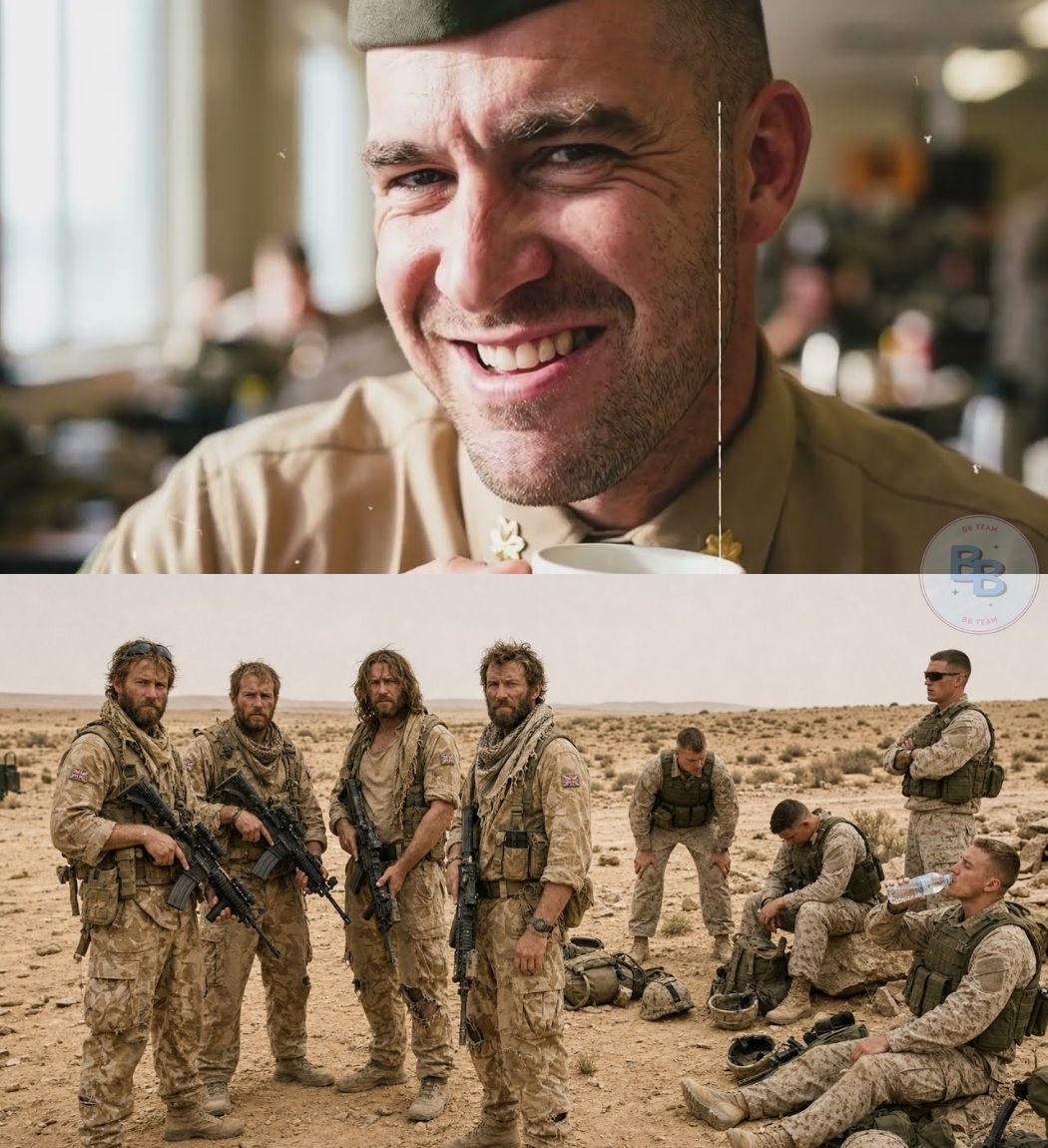
“Half of Them Look Homeless” — Why a Marine Recon Team Regretted Mocking the SAS
“Half of them look homeless. I’ve seen better turnout at a bus station.”
That is what the American major said in a mess hall in Herefordshire at 9 minutes past 9 on a gray Tuesday morning with a coffee cooling in his hand and 11 of his own men within earshot. He was not finished.
“You want me to believe these tea-drinking amateurs are the best in the world? Send them in first. See what falls off.”
His name was Brandt Kestler, Major United States Marine Corps, Second Force Reconnaissance Company. He said it loud enough to carry to the serving hatch. He said it looking directly at the four bearded, unshaven, differently dressed men who had just walked in for breakfast at the far end of the room, one of whom was carrying his Bergen by a single strap because the other had frayed through in the night and he had not bothered to fix it yet.
The men at the far end did not look up. One of them said something quiet to the man next to him. The man next to him laughed once, short, through his nose and went back to his eggs. That was the entirety of the response and Kestler took it correctly as confirmation. If they had been the best in the world, he would have known. There would have been a shape to them. There would have been something to see. There was not. Not at 9 minutes past 9, not at the serving hatch, not to a man with two Iraq tours and an Afghanistan behind him and a Bronze Star with a small bronze V pinned to a ribbon in a drawer at home.
He knew what elite looked like. He had spent 15 years being it and what he was looking at across a British mess hall on a wet Tuesday morning was not it. He would remember saying it. He would be made to. Not by a lecture and not by a speech and not by anything a man in his position would have accepted as an argument. By a clock. By a stopwatch on a paracord loop that would, before last light, be sitting in his own palm. And by a number on its face he would have to read twice because the first time he would think he had misread it. By a hill in Wales. By a shot he did not believe was possible until he watched the round land. By 12 doors and a hostage count and the quietest 4 minutes he had ever stood next to.
He had 11 hours left before the first of those things happened to him. He spent them well. He had another coffee. He told the story twice more to different audiences and it got a little sharper each time. By lunch, half the American contingent had heard the bus station line and most of them thought it was funny. And one of them, his Gunnery Sergeant, chewing a cinnamon toothpick by the window, did not laugh at all and only looked out at the rain.
What Kessler had said in a room, on a morning, in front of witnesses, what he was about to be shown. Between those two things, one long day.
Brant Kessler was not a fool and the story only works if you understand that first. 39 years old. 15 years in the Marine Corps. All of it in the direction of the sound. Two tours in Anbar in the bad years. One of them running deep reconnaissance north of Ramadi with a six-man team and a call sign the battalion learned to trust. One tour in Helmand as a company adviser. Walking ground that killed better men than him and coming home lighter by two friends and one and a half toes. Force Reconnaissance qualified. MARSOC selected as an instructor before he turned down the billet to stay operational. A Bronze Star with a Combat V for an action outside Sangin he did not talk about in mixed company. And a Purple Heart he talked about even less. He kept a laminated card of his tour dates in his breast pocket, and when he was thinking hard about something, he would tap it twice against the tabletop without noticing he was doing it.
His contempt was not stupid, either. He had spent a career being told that the Special Air Service were the best in the world, and he had also spent a career watching Allied units cash the reputation of their forebears without paying the bill. He had worked with British infantry in Iraq who were superb, and British infantry in Iraq who were not. He had watched officers from famous regiments try to look famous and only succeed in looking tired. He believed in evidence. He believed in the stopwatch and the paper target and the after-action report. He had not yet seen anything from a British special forces man that had made him lean forward.
What he had seen, walking into breakfast that morning, was four men in mismatched fleeces and a beard between them that could have hidden a small dog, and a fifth man behind them in a woolen hat. And one of the four carrying his Bergen by a single strap. That was the scene, 9 minutes past 9:00 on a Tuesday in early October. Rain on the mess windows, the smell of bacon fat and industrial coffee, the low unbeautiful hum of a hundred men eating before a day of work. Kessler’s team of 11 plus two officers from the coordinating headquarters, plus a British Army Lieutenant Colonel Court Hollister at the next table who was pretending very politely to read his newspaper.
Kessler put his cup down. He said the first line about the bus station, and the two Marines nearest him laughed. He said the second line about the tea and the amateurs, and three more laughed. He said the third line, the one about sending them in first to see what fell off, and by then the whole table was laughing except the man at the end, the Gunnery Sergeant, who was not.
The four bearded men, 20 m away, did nothing measurable in response. One of them, a broad man in his early 40s with gray coming through the stubble at his jaw and eyes that seemed to sit a little too deep in his face, glanced up once and back down. Another said something in a Cornish accent that his neighbor laughed at, a short single syllable laugh, and returned to his eggs. That was all. Kessler took it as the answer.
The gunnery sergeant’s name was Wade O’Hanian. He had been in the Corps for 19 years and in Force Recon for nine of them, and he did not laugh at the bus station line for a reason he could not have articulated at the time. Later, sitting on a wet bench with a cinnamon toothpick between his teeth, watching a Welsh hillside disappear into its own weather, he would work out what it was. The four men had not looked up. Elite units, in his experience, always looked up. Rangers looked up. SEALs looked up. His own men in a British mess hall in October would have looked up. These four had not, and it was not indifference. He had seen indifference, and this was not that. It was closer to the way a working dog looks at a room it has already cataloged. There was nothing new to see.
O’Hanian would not say any of this to Kessler. Kessler was his major, and Kessler was talking, and Kessler had a Bronze Star with a V, and the story of that action, which O’Hanian had heard, was a good one. So, O’Hanian chewed his toothpick and looked at the rain, and Kessler told the story of the four homeless-looking men to a colonel from the coordinating cell over lunch. And by 2:00 in the afternoon, the phrase tea-drinking amateurs had made it back through three different mouths to a British warrant officer class two called Trevaskis, who received it standing in the armory holding a cleaning rod, and who blinked once and then went back to what he was doing.
What Trevaskis was doing was building the day. The reason both units were on the same wet acre of Herefordshire that October was a joint exercise, one of the quiet, unadvertised ones scheduled every few years between Allied Special Operations formations to compare methods and to keep the working relationships that matter warm. A troop from B Squadron was hosting a force package. Shared range work, a joint tapping serial in Wales, sniper serials, and a full close-quarter battle run through the shoot house at the end of the week. Nothing operational. Nothing that would appear in anyone’s medal citation. But real work with real ammunition and real timings, watched by real staff officers, and the results, though nobody said so out loud, would be discussed for years by the men who saw them.
Ian Trevaskis was the Squadron Sergeant Major, Warrant Officer Class 2, 41 years old, on his fourth pair of soles in the same pair of boots. The boots were the story. He had bought them 9 years ago in a shop in Hereford that no longer existed, and he had resoled them three times and would resold them again. They were part of him in the way certain objects become part of certain men.
He was in the armory at half past nine that morning laying kit out on a long steel bench when the American major’s line about tea and amateurs reached him through the third mouth. He did not look up from what he was doing. He was checking a Diemaco C8, the L119A2 in service parlance, the regiment’s primary long, running a rod through the bore, holding it up to the light in the fluorescent tube overhead, laying it back on the poncho he had spread on the bench. He did this 11 times, one weapon at a time, for 11 of his men. When he was finished, he checked the suppressors and then the sights and then the magazines.
He said nothing about the American major. He did not appear to have registered the sentence at all, but the trooper who had brought him the line noticed that the pace of Travaskis’s hands, which had been unhurried, did not change. That was the thing about Travaskis. His hands did not speed up.
The three others in the armory that morning were Al Ed Prentiss, a staff sergeant from Mountain Troop, with a Cornish accent broad enough to unsettle a linguist, who was making tea in an aluminum mug with a bent handle. Fergus Doole, a sergeant from Air Troop, missing the top joint of his left little finger from a training door he refused to talk about, cleaning his weapon on the far end of the bench with the concentration of a man restoring a watch. And Thomas Beddow, a corporal from Mobility Troop, sitting on an ammunition crate reading a dog-eared paperback western with his kit already on the floor beside him, ready.
The fifth, the youngest, was Kit Large, 23, the newest badged man in the squadron, whose mother still sent him fruitcake through the post and who was pretending not to be nervous by making himself very small in the corner and checking, for the third time, that his magazines were seated properly in his chest rig. Nobody was looking at Large. Everybody was aware of him.
None of them looked homeless exactly when you sat with them for 10 minutes, but none of them looked, at first glance, like what the recruitment posters would have you expect, either. Prentiss had a jumper with a hole in the sleeve. Doole’s beard was the size of a small ambition. Beddow wore a knitted hat the color of wet slate that he had, he said, inherited from a great uncle. Their kit, when they laid it out, was immaculate. Their persons, until they were doing the work, were not. This was a choice, in a way none of them could have explained if you had asked. The performance of eliteness was, in this room, the mark of an amateur.
Down the road, in a hangar the Americans had been given for prep, Kessler’s men were laying out their own kit, and it was, to any onlooker, more impressive. Uniform patrol caps, matching plate carriers, clean rifles, a neat rank of 11 bergens against the wall, each with the same knot in the same paracord loop at the top. Gunnery Sergeant O’Hanian was going through the morning brief with his sniper pairing, Staff Sergeant Levi Marchetti and his comms man, Sergeant Danny Ruiz, and he was doing it with a battered Casio watch on a paracord loop around his neck that he used for physical training timings, and had worn every day for 11 years. He looked at it without noticing twice while he talked. It kept time to within 3 seconds a month. He would not, that morning, have imagined the watch would be the object at the center of the story by nightfall.
Here is what the American major, walking through the shared briefing at 10:00, could not see. He could see the beards, the mismatched fleeces, the aluminum mug of tea. He could see the trooper carrying a bergen by a single strap because the other had frayed and he had not fixed it. He could see, in short, what he had told the mess hall he was seeing. Unimpressive men doing unimpressive things in an unimpressive way.
What he could not see was that not one of them was performing for him. Not one of them had adjusted anything, said anything, or looked at him because of who he was or what he had said about them. The absence of reaction was the reaction. The refusal to perform was the tell. And a man whose whole career had been spent reading the performance of soldiers correctly as data could not read the absence of one because he had never in his life been in a room with the absence of one before. That was the loaded gun. It would, in the course of the day, be fired four times.
The first time was on the range at 11:00. The range they used was a covered 1,000-m facility on the edge of the training area, damp under the eaves, floor of packed gravel, targets at 100, 200, and 300 m with a further set of static steel plates at 500 for the second half of the morning.
The stand was ordinary. 10 rounds standing, 10 kneeling, 10 prone, cold barrel, no siters on a 5-in bull. It was the sort of thing regular infantry did to keep their hand in. It was also, precisely because it was ordinary, the fastest way to see who was actually current on their weapon.
The Americans shot first, and they shot well. Ruiz put nine of 10 in the black at 200 standing, which was the sort of shooting that in most units would attract a compliment. Marchetti, the sniper, did what snipers do with a service rifle and made it look joyless and correct. O’Hanian, the gunnery sergeant, put a group into the 300-m bull that a man could have covered with the base of a mug. Kessler shot last of his men, and Kessler shot as well as his resume had implied he would. He was inside the black on every round. Three of his kneeling rounds touched. He was, by any reasonable measure, an excellent marksman, and he knew it. And when he stepped off the mat, he looked, once, without meaning to, at the four bearded men waiting at the back of the range, and he permitted himself the small internal ceremony of already having won.
Larch went first for the British, 23 years old, newest badged man. He walked to the mat without hurrying and without dawdling, which is a specific gait it takes about 2 years to learn, and he settled into the standing position with the economy of a man who had done it more times than he could count in the last 12 months. He shot 10 rounds, one every three or four seconds, in a rhythm that did not vary. He was not fast. He was not slow. He was inside the rhythm of his own breathing and outside everyone else’s.
When the range officer walked down to check his target at 200, he came back and did not say anything, only nodded at Trevaskis, and Trevaskis nodded back. Larch had put all 10 into a group that measured, when they finally put a ruler across it, 4 and 1/2 cm corner to corner at 200 m standing, cold. He then knelt and did it again, slightly smaller. He then went prone and did it a third time, and by the third target the American range officer had stopped talking mid-sentence to watch.
Nobody on the British side said anything about it. Larch, when he stood up, went straight to the back of the queue behind Doole and drank from a canteen with the same expression he had worn walking on. Kessler, at the firing point, tapped the laminated card in his breast pocket twice against nothing, and did not, this time, appear to notice he was doing it.
Prentice shot next, the Cornishman, the tea mug, the hole in his sleeve. He walked to the mat, said something to the range officer that made the range officer laugh, and shot. His group at 300, kneeling cold, was a ragged hole a 20 p piece would have hidden. He did it again with no visible effort in a rhythm that seemed unrelated to anything as urgent as competition. When he stood up, he said something else to the range officer, and the range officer laughed again, and Prentice walked past Kessler on his way to the water table without looking at him.
Duel put his 10 prone rounds through what appeared from where Kessler was standing to be a single hole. Beddow from Mobility did the same thing left-handed because he had cross-dominant eyes and had trained the other side for a year on principle.
Trevaskis, when his turn came, did not shoot the stand. He looked at his men, looked at the range officer, and said quietly, “They’re good. I don’t need to.”
The range officer nodded and marked the sheet. It was not a boast. It was scheduling.
The Americans watching did the arithmetic. Kessler was still the best individual American shooter of the morning by every objective measure. He had also, and this was the thing that started to press on the inside of his forehead in a way he did not like, been outshot by the youngest man on the British side, and by the man with the tea mug, and by the sergeant with the missing finger, and by the corporal reading Westerns. The American group laid alongside the British group would have looked to a stranger like the work of two different professions. It was.
O’Hanian saw it first. He saw it while Larch was still shooting, and he saw it more clearly while Prentice was. And by the time Duel was on the mat, he had put a fresh cinnamon toothpick between his teeth and was looking at his major with a specific stillness.
Kessler, for his part, was doing the internal work every competent man does in that situation, which is to find the reason it did not count. The range was covered. The wind was still. The bulls were generous. Anyone could shoot well here. The four bearded men, homeless-looking, tea-drinking, bus station, were shooting a controlled stand on a clear morning. It proved nothing. It was one data point. He would keep his line about amateurs because it was still in his mind correct. It was only that he would not, perhaps, say it again on the range.
The score sheet, when it was pinned to the board at the end of the morning, was one piece of paper with two columns of numbers on it. The columns were not close. The bronze star major stood in front of it for 11 seconds, which O’Hanian, who was counting without meaning to, would later remember exactly, and then he turned away and said to nobody in particular that the real work started in the afternoon.
And that was only the first time that day he would be wrong.
The tab was framed in the brief as an assessment day. 40 km timed over the Brecon Beacons from a start point in the Talybont Forest, over the ridgeline that includes Pen y Fan and Corn Du, and the lesser tops between, and out into a rendezvous on the western side, with bergans weighed at the start to 55 lb dry before water and personal ammunition. It was not the Fan Dance, which is a specific and shorter and more famous route with its own history in selection. It was longer, lower profile, and understood by the British side as a warm morning’s work. It was not so understood by anyone else.
They started at first light. It was raining the specific Welsh rain that is smaller than rain and wetter than it looks, and the tops were in cloud from the moment they left the tree line. The pace, set by Trevaskis, was not fast. It was, and this is a specific technical thing, unrelenting. He did not push, and he did not slow, and the tab, when the Americans looked back on it three days later, would be remembered not as a fast march, but as a march in which nothing ever stopped. Bergens on. Bergens off for water only. Water taken standing. Felt kits adjusted while walking. Prentice, at one point in the second hour, ate an entire wrap without breaking stride.
The Americans were fit. They were more than fit. Force Recon is a fit unit, and Kessler’s men had done selection and workups that would have broken most human beings. And they had done them again for currency in the previous 6 months. They kept up for the first 2 hours without difficulty.
In the third hour, the ground began to bite. The path off Crabin was greased with wet peat, and Ruiz, the comms man, went down on one knee hard enough to bruise the cap, and did not say anything, and got up and kept going. Marchetti, the sniper, developed a hot spot on his right heel that would, by the end of the day, be a coin-sized weeping thing he would not show anyone until they were in the truck home.
Kessler, who had done longer marches in worse places, was in one sense fine. He was also, and he was too honest with himself not to notice, working harder than the man in front of him. The man in front of him was Trevaskis, and Trevaskis was walking uphill with the exact same stride he had used on the flat. And the boots on his feet were the same boots he had been wearing for 9 years. And they moved as if the ground beneath them had been laid for their convenience.
O’Hanian, at the top of Pennyfan, in clouds so thick it wet his eyelashes, took his cinnamon toothpick out of his teeth for the first time in 3 hours, and looked, actually looked, at Trevaskis’ boots. There was a specific dark line where the fourth resole had joined the upper. The boots were older than some of the equipment in his own hangar. They were also, and this was the thing O’Hanlon could not quite get past, moving in a way his own new boots were not. He put the toothpick back in his teeth and did not say anything.
The rendezvous was in a lay-by on a B road on the western edge of the training area. And the British came off the last descent at a pace that had a runner in it. Because Trevaskis had, without saying so, decided to make a point of the last kilometer. They arrived at the rendezvous 9 minutes inside the maximum time for a selection standard on that route, with all 11 men still in a group and no one being carried and no one having fallen out.
Prentice made tea in the aluminum mug on a small stove out of his belt kit before the last of them had finished loosening their burgons. Larch was standing next to the truck eating a chocolate bar with his rifle still slung and his eyes on the middle distance. Unbothered. Doel took his boots off and appeared to have no blisters at all, which no one on the American side later in the truck believed, but which was true.
The Americans came in 11 minutes behind in ones and twos, with Marchetti last, hobbling on the heel he would not show, and O’Hanlon second last because he had waited for him from the last summit. They came in inside the time limit. They came in as a unit that had done a hard day’s work. They also came in to the sight of British men who were already eating, already resting, and already, in Beddoes’ case, reading a paperback western with the pages held against the wind by a thumb.
Nobody said the word “amateurs” on the road. Nobody had to. Kessler, sitting on the tailgate of the truck with his boots off and his feet in the cold air, tapped the card in his breast pocket twice without noticing and worked in his head through the reasons. They were on home ground. This was their route. They had presumably walked it a dozen times. The weight was the same, but the familiarity was not. It was, in the language he could still use with himself, not a fair test. He would remember later that he thought this. He would remember that he needed to think it.
Ohanian, on the far side of the tailgate, was watching him without watching him. And Ohanian did not say anything, either. The tea drinkers, he had called them. The amateurs. And the amateurs had walked him over a mountain in the rain, and then made tea and read paperbacks while they waited. He would keep that thought to himself. He would need his voice for later.
Later was the sniper stand. The sniper stand was in the afternoon, on a range at the edge of the training area that had an 800 m lane and a mechanical mover. A target on rails that crossed the lane at a variable speed set by the range officer. The stand was cold bore. One round, one target, moving. The convention on a joint serial is that each unit brings its own pairing forward, its own rifle, its own dope. It was, at that range, a hard shot. It was not an unreasonable one.
Marchetti, the American sniper, went first. He was carrying a rifle he had been running for 4 years, and for which he had a dope book he had built himself, and he was a genuinely good shooter, better than his understated manner in the truck home would suggest. He set up. He read the wind, which was quartering from the left at 4 to 6 knots. Gusting. He waited for the mover to run its second pass. He fired. The round struck the target within a hand’s breadth of center, low and slightly forward of the intended point of aim. It was, on any range in the world, a shot that would have earned a nod. The range officer marked it and said without emphasis, “Good hit.”
Kestler, watching, felt the small internal readjustment that comes when a man has been quietly waiting for his own side to do something impressive and has now seen it done. He said, “That’ll do.” to Marchetti without looking at him, which is the highest compliment kind of officer gives.
Doel was offered the shot next. Doel had left his own rifle in the armory because he had not been briefed to expect a sniper serial that afternoon and because Doel, whose specialism was actually breaching and not long-range shooting, had assumed one of the troops’ dedicated sniper pairings would be forward. Travaskis, who had known there would be a sniper stand and who had also known Doel was on the range that afternoon, said nothing. He offered Doel the L115A3 the range had made available, a rifle Doel had not fired in 6 months, chambered in .338 Lapua Magnum with a dope card taped to the stock that the previous shooter had made.
Doel looked at the rifle. He looked at the range card. He looked at the mover, which was on its third pass by then, and he asked the range officer, in a Yorkshire accent, whether the mover speed was constant or programmed to vary.
The range officer, who had the panel in front of him, said it varied on a random cycle between 2 and 4 m per second.
Doel nodded and lay down. He did not read the wind for as long as Marchetti had. He did not appear to consult the dope card at all. He settled into the rifle, adjusted his elbow twice, and asked for one more pass of the mover to watch. The mover ran. Doel watched. He said quietly, “On the next one.”
The next one came. He fired. The round traveled the 800 m in something under a second. In that second, the mover moved. In that second, the round dropped and drifted and did all the small things a heavy round does at that range in a quartering 4 to 6 knot wind. In that second, nobody on the range was breathing.
The round struck the target dead center on a moving mover on a cold rifle Doull had not fired in 6 months with a dope card he had glanced at once. It struck it centrally enough that the range officer went silent, walked down the lane to look at the target, walked back and said, “And this is the sentence O’Hanian would remember for the rest of his career. That’s a training round I’ll be dining out on.”
Doull was already sitting up. He handed the rifle back to the range officer. He said, “Cheers.” In the way a man says it who has been handed a cup of tea. And he stood up and walked to the back of the firing point and lit a cigarette. That was all. He did not look at Kessler. He did not, so far as the record shows, look at anyone in particular. He smoked his cigarette and then he put it out on the sole of his boot and pocketed the stub because he was, for all his beard and his knitted hat, the kind of soldier who did not leave litter on ranges.
Kessler said nothing. He tapped the card in his breast pocket once and stopped himself doing it a second time. Marchetti, who had shot well and been comprehensively outshot, said to no one, “All right then.” O’Hanian took the cinnamon toothpick out of his teeth and threw it into the bin by the range hut and did not put another one in for the rest of the afternoon.
The homeless-looking men. The bus station. The narrator will not restage the line here because the line has been restaged enough. What can be said is this, by the end of the sniper stand at 4:15 on that October afternoon, Brandt Kestler had stopped constructing sentences in his head. He had shifted, without meaning to, from a man who was compiling reasons to a man who was waiting for the next thing.
The next thing was the shoot house.
The shoot house was a purpose-built 12-room structure on the edge of the training area with concrete walls, live fire capable hostile and non-hostile targets on rails and drops, an overhead observation gantry with catwalks that ran the length of the building, and a system of head cams and boundary microphones that meant every entry, every shot, every voice call could be reviewed frame by frame afterwards. It was the piece of infrastructure the regiment used to keep the skill that had made them, in the popular mind, what they were. It was not glamorous. It was concrete and rubber and paint, but it was, in the way certain rooms are certain rooms, the room the day had been walking toward since 9 minutes past 9 that morning.
The American recon team ran first. They ran well. They cleared the building in 7 minutes 12 seconds with all hostiles down. One hostage grazed by a wall’s ball, which counted, in the rules of the house, as a hostage wounded but not a hostage killed. It was a genuinely good run. Kestler, watching from the gantry, felt the small warm rise of a commander whose men have not embarrassed him. His own runs, over years, had been faster in some houses and slower in others. 7 minutes 12 was a working professional’s time on 12 rooms live. He was, in the ordinary way of things, satisfied.
Travaskis climbed the gantry ladder without speaking. He had the battered Casio on the paracord loop in his hand, the one O’Hanlon had been wearing that morning, borrowed for the run. He held it out. He said, “You keep the time.”
Kessler took it. He did not, at that moment, understand why the squadron sergeant major had handed him the watch and not one of the American observers or the range staff. He understood later, on the drive back. He understood it was the exact moment the debt began to be paid, and he understood it was Travaskis’ decision to make him hold the instrument that measured it, because there is no argument with a number you have read off a watch in your own hand.
Below, the 11 British men are forming up at the front breach point. Large is first man. This is deliberate. Large is 23, and this is his fourth live house since he badged. He is not the best breacher in the troop. He is the newest, and the standard the troop wants to prove is that the newest man they have is enough. Doole is behind him with Beddow, with Prentice, with the rest, in an order Travaskis has walked out with them once in the car park and never mentioned again.
They stack. They do not speak. The count is a hand signal from Doole, and the door goes.
Large is through the door and left, and his first round is in the first hostile before Kessler on the gantry has registered the door has opened. The second man is through and right. The third is through and center. The room is clear in under 2 seconds. A voice below says, “Clear.” Once. Quietly. Nobody shouts. Nobody in the entire building is going to shout in the next 4 minutes.
The next door opens by boot, and the second room is clear before the boot has finished coming down. A hostage on a drop panel in the corner is left standing untouched, marked on the head cam later as correctly identified in point six of a second.
Third room. Fourth. Two hostiles, one hostage. All three targets registered and resolved inside a single held breath.
Fifth room. Up a short internal staircase to what in this country is called the first floor, and which the American observer in the gantry is, in his head, calling the second.
Sixth room. A longer corridor. A hostile behind a table, dropped by Beddow left-handed because he had trained the other side for a year on principle.
Seventh. Eighth. Ninth. The watch in Kessler’s hand is ticking, and Kessler is not looking at it. Kessler is watching the head cam feed on the small monitor bolted to the gantry rail. And Kessler, who has run this kind of building his entire adult life, is watching a thing he has never seen. He is watching men do a thing at a pace he did not know the thing could be done at, with a quietness he did not know the thing could be done with. And he is watching them do it in a rhythm that appears to be indifferent to the presence of the walls. The building is not slowing them down. The building is a set of rooms they are moving through the way water moves through a hose.
10th room. 11th. The 11th room has two hostiles and one hostage on a moving rail. And Doull, who is now second man in the stack because the order has shifted twice since the door, drops both hostiles inside a single trigger cycle and does not touch the hostage. And Prentice behind him calls clear so quietly the boundary microphone will later have to be turned up in the review.
12th room. The last hostile is behind a mattress leaned against a wall. And Larch, who is back at the front of the stack because the order has shifted a third time, puts a single round through the mattress at the height of the target’s chest, and the target drops, and the room is clear.
The last man out is Travaskis, who has walked through the whole building behind them without firing a round. He steps out of the exit door and looks up at the gantry. He does not say anything. He nods once to Kessler.
Kessler looks at the watch in his hand. It reads 3 minutes 41 seconds. He looks at it for a long time. Then he looks at it again because the first time he read it, he thought he had misread it. He has not misread it. It says 3:41, 12 rooms, live, all hostiles down, all hostages alive. The youngest badged man in the squadron first through the door.
The American best that morning was 7 minutes 12. The difference is 3 minutes and 31 seconds. In a 12-room house, live 3 minutes and 31 seconds is not a margin. It is a different profession.
The gantry is silent. The range staff are silent. The American observer on the far catwalk is looking at his own boots. The number is on the watch, and the watch is in the Bronze Star Major’s hand, and there is no one in the building who can argue with either. He is holding it. 3 minutes 41 seconds.
For 11 seconds after the last British man walked out of the shoot house, Brandt Kessler did not move. Ohanian, who was again counting without meaning to, would remember the number because it was the same number Kessler had stood in front of the score sheet for on the range that morning.
Kessler stood on the gantry with the battered Casio on the paracord loop in his hand and looked down at the concrete apron below, and he did not tap the laminated card in his breast pocket because the small unconscious ritual by which he had all day been steadying himself had, at some point in the last 4 minutes, deserted him. His hand hung at his side, his mouth was slightly open. He closed it.
Below, the British were doing what men do after a house run, which is to say nothing and to check their weapons and to drink water. Travenski had not looked up at the gantry a second time. Duel was rolling a cigarette. Prentice had, from somewhere, produced the aluminum mug with the bent handle and was again making tea. Large, the 23-year-old, was standing on his own by the wall, looking at nothing, letting his heart rate come down in the way he had been taught. They filed, in ones and twos, past the base of the gantry ladder toward the range hut. They did not look up.
Kessler on the gantry watched them go. He was still holding the watch.
Colonel Merrick Vance, the senior American liaison officer, an old friend of Hollister’s and a man whose career had been longer and quieter than Kessler’s, came up the gantry ladder without hurrying. Vance was 52 and had, in his own time, done work not unlike what he had just watched. He stood next to Kessler for a moment. He looked down at the apron and at the men filing past. He did not look at Kessler when he spoke.
He said, in an unhurried voice, “I’ve watched a lot of units work. I have never watched one work quieter than that.”
Kessler said nothing.
“I heard what you said this morning,” Vance said, “in the mess.”
Kessler said nothing.
Vance nodded once, as if to himself, and went back down the ladder.
The Bronze Star with a small bronze V is a real decoration for a real action, and the action Kessler had done to earn his was a real one, and the men whose lives he had saved on that action were real men who had gone home to real families in Ohio and North Carolina. And none of that, standing on a gantry in Herefordshire in October with a stopwatch in his hand that read 3 minutes 41 seconds, was any use to him at all. The ribbon was in a drawer at home. The card in his breast pocket had the tour dates on it, and the tour dates were true. Everything he had ever done that had made him think he had the right to say what he had said that morning was still true. It was only that none of it on this gantry in this hour meant what he had thought it meant.
He walked down the gantry ladder eventually. He walked past the British in the range hut without looking at them, and none of them looked at him because they had not been looking at him all day, and they were not going to start now. He handed the watch back to O’Hanian at the door.
O’Hanian, who had been carrying a cinnamon toothpick between his teeth for 19 years of service, and had not put one in since the sniper stand, did not put one in now. He took the watch. He said quietly, “Sir.”
Kessler nodded. He walked out into the rain.
He did not apologize. This is the thing that will not be softened because the softening is the trap. He did not go over to Trevaskis in the car park and shake his hand and say he had been wrong. He did not become, over the following months, a public admirer of the regiment. He did not name his son after Doull. He was diminished in the specific technical sense that a thing had been taken from him that he could not get back, and the diminishment was permanent, and it was also private.
What had happened in the shoot house in front of witnesses at 3:41 on a watch he had held in his own hand was a fact about the world that he now had to live inside for the rest of his career. Vance had named it. The watch had timed it. The men he had called homeless had done it. That was the reckoning. It did not require his repentance to be complete.
That evening in the mess in Herefordshire, the rain had thickened into the kind of steady soft rain that empties car parks, and Kestrel sat at the same table he had sat at that morning, and he drank his coffee and did not speak. And at the far end of the room, the four bearded men, plus Larch, plus the rest of the troop, came in for dinner in ones and twos. And one of them was carrying his bergen by a single strap because the other had frayed, and he had still not fixed it.
Nobody in the room looked at Kestrel except Vance, who did once, and O’Hanlon who did not.
Half of them looked homeless. The bergen strap was frayed. The beards were in one case ambitious. The jumper had a hole in the sleeve. The mug was aluminum and had a bent handle, and it was, as it had been that morning, full of tea.
The major had, in his mess hall sentence, been correct about every surface he had described. What he had been wrong about, catastrophically and on the record and in front of witnesses and a Casio watch and a colonel from his own service, was what any of it meant. Right about the tea, wrong about the men who drank it. Right about the bus station, wrong about what walks out of one.
The men in the corner did not know they had made a point. They were, so far as they were concerned, having their dinner. Prentice was making a joke in Cornish that Beddow was laughing at in Welsh, which Dooley did not understand in Yorkshire, and Larch in the middle of it was cutting his food and eating it with the calm of a man who had, that afternoon, been first through the door of a 12-room house and lived the rest of his life on the far side of that fact.
The rain sounded on the mess windows. Somewhere down the corridor, the aluminum mug clinked once against a table and did not clink again.
There is another story worth telling next, the one about the Delta officer who told a British sergeant that the Special Air Service were living on a reputation their granddads earned. He said it in a briefing room in North Carolina. He said it once.
What happened next is a longer walk than the one Kessler took, and it ends in a room quieter than a shoot house at 3:41. And it will be told here in its turn for anyone who still thinks the men with the frayed strap and the aluminum mug are the ones who ought to be worried.