He Mocked the SAS for Being Too Old. Then the ‘Old Men’ Carried His Team Off the Mountain.
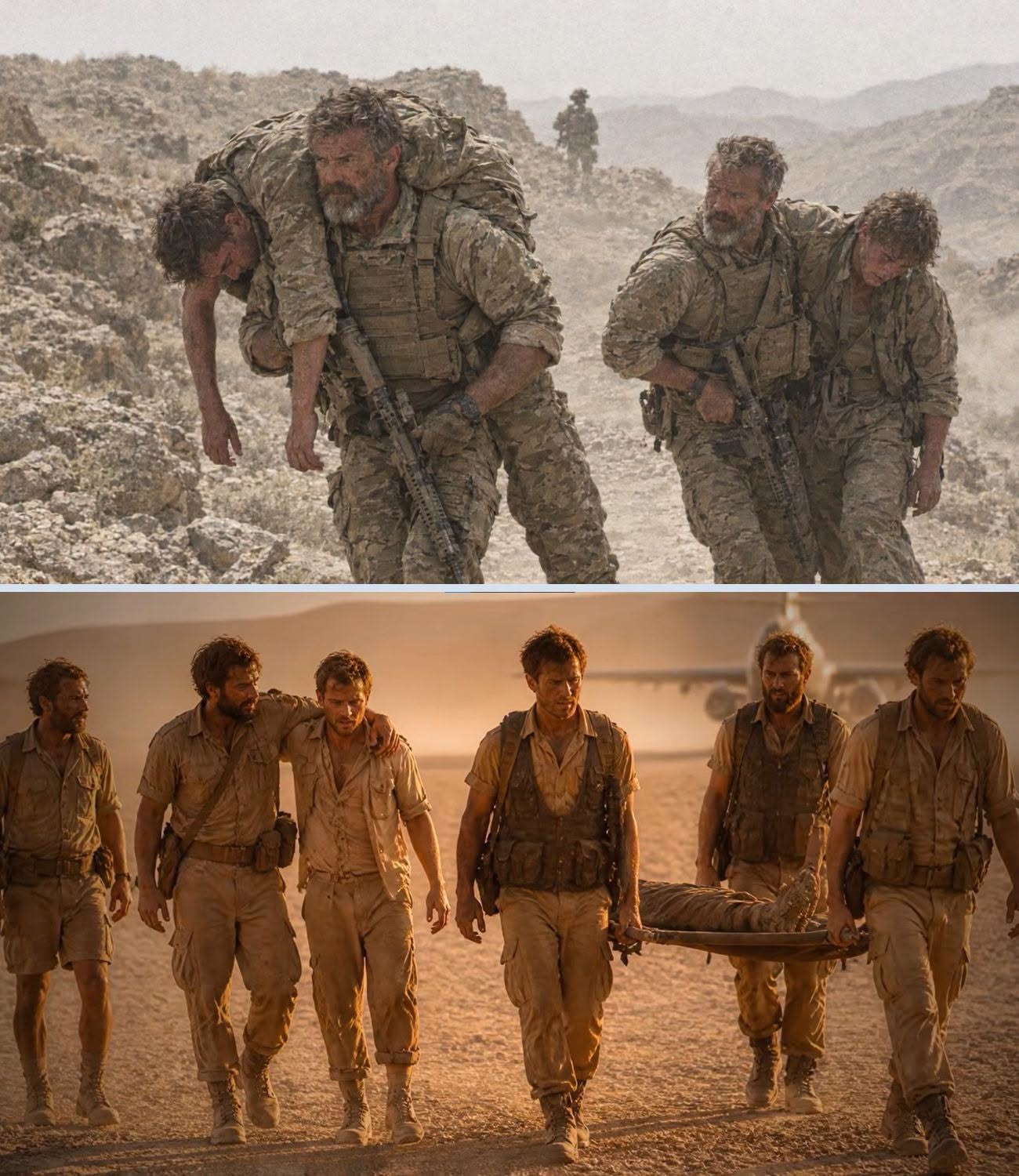
He Mocked the SAS for Being Too Old. Then the ‘Old Men’ Carried His Team Off the Mountain.
There is a sentence that a person utters only once in their life, and the rest of the time they try to go back on it. Lieutenant Colonel Brandt Vossler said it at 9:10 a.m. in a canvas mess tent on the edge of the coalition range, where dust drifted in slow, pale streams through the vents, and he said it so loudly that the men at the far end of the tent stopped chewing to listen.
He looked across the trestle table at the four British soldiers who had arrived by transport the night before and said in the even, shrill voice of a man who didn’t care who was listening: “You’re going to bring me a squad of pensioners, with gray beards, sore knees, and Zimmer frames. My younger one will take yours down from that hill before lunch .
” He was a special forces officer in the United States Army. He was on the tail end of his third combat tour . He wore the Silver Star Ribbon, which he earned in Kandahar in 2009. And he spent two of the last five years leading the evaluation cadre that made and broke up the Green Berets. He tapped twice on the breast pocket of his uniform, where a laminated card with the time of his last marathon printed on it lay near his heart.
And he repeated the sentence more quietly, as if he were doing them a favor by repeating it. The young sergeants at his table laughed the way young sergeants laugh at a colonel’s joke. That’s right, half a second, no more . The four British men did not laugh. They didn’t respond either. The oldest of them, a broad-shouldered ensign with gray hair slowly appearing through his beard, silently set his mug down on the overpass and looked at the colonel the way a mechanic looks at an engine that has just made a sound it shouldn’t
make. And then he picked up the mug again and drank the rest of the tea standing up. Keep the sentence in your ear . He will keep it in his possession. By sunset that day, on a hill 11km from that mess tent, the two youngest men in his command would be strapped to casualty bags on the shoulders of the men he had just called pensioners.
And the youngest on his own team won’t be dragging anyone anywhere, because the youngest on his own team will be one of two in the sacks. He will remember saying that. He will be forced. The watch will be kept by his own operations officer. The line will be read to him from a page he won’t be able to throw away.
That’s what he said, and that’s what this day did with it . Brandt Voster was not a fool, and it’s important to say that at the beginning, because the story doesn’t work if he’s a fool. He was 41 years old . He served in the Ranger Regiment in his youth, transferred to Special Forces in his late 20s, and was commissioned as a Lieutenant Colonel 3 months before arriving at the range.
His first tour of duty was in the eastern provinces of Afghanistan in 2007 . His second was the service that earned him a Silver Star in the area outside Kandahar in the summer of 2009 , when he led a team through a courtyard under fire and pulled two wounded men from a room he had no right to survive. His third assignment was newer and more classified, and the men in the tent that morning knew enough about him to know they didn’t need to ask.
For two years between tours, he led the assessment team for the Special Forces Qualification Course in the piney land of North Carolina, where American selection ends , and the cadre he led had a reputation for letting good people through the sieve and leaving those who came out on the other side. He was, by any standards a professional soldier would use, a good soldier.
He was in shape. He kept the laminated PT card in his breast pocket the way another man keeps a photo of his children. And he earned the right to keep her there. This is the person who said this sentence. Understand this and the rest of the day will make sense . On paper, this exercise was simple. A three-week joint train to the coalition’s mountain training ground.
20 days from Hereford for the British contingent, which involved resupplying personnel in the high, arid, rocky terrain. Vossler’s two “Alpha” task forces, 12 men each, with an average age of 26, all of whom had served within 18 months of their assignment or course of which they were proud, were to lead the assault and carry out the mission.
Four men from Squadron D of the 22nd Special Aviation Regiment, mountain troops specialists deployed for this operation, were to support the evacuation task. The Americans controlled these exercises. The British, in Vosler’s opinion, were there as advisors, and he didn’t want them. The British side was Warrant Officer 2nd Class Iain Ballantyne, Squadron Leader Sergeant, 47, who was on his third continent that calendar year.
Staff Sergeant Padraig Mulker, Senior Mountain Trooper, 44, from Belfast, with a deviated septum following a fight he lost in 1998 and has since beaten everyone. Sergeant Wilkes Threlfall, 41, a military medic who kept a folded photo of his daughter, who had been missing for 9 weeks , in his jacket pocket.
Corporal Danny Horse, 39, a left-handed sniper who wore his father’s watch on the inside of his wrist. They got off the transport at half past two in the morning, and by 6:00 they were already at the shooting range, getting ready, walking around the field while Vossler’s men were still having breakfast. He said this because they were older than his people and quieter than him, and did not play for him.
He said this because the average age of his group was 26 , theirs was 43, and he had spent his career learning to read the body across the room, thinking he could read what was inside it. He said this in the cafeteria because his own team was in the cafeteria, and the verdict, at least in part, was in their favor.
His operations officer, Captain Orin Coltrider, a decent man of 38 who then thought about the sentence for several more months, was not laughing. His squad sergeant, Tal Berringer, wasn’t laughing either. The young sergeants next to Vosler did it, in the correct half-second, and Sergeant Cade Rustin, 26 years old and the strongest man on his team, laughed the loudest.
Rustin was to be the first to fall. Valentin put his mug on the trestle and finished the rest of his tea standing up, because sitting would push his back away, and he didn’t want the colonel to see him shiver. He did n’t answer. None of them answered. Mulker hummed very softly , two bars of the same melody before each stack.
Threlfall looked at the map on the far wall of the tent. Hawes, a left-handed man, adjusted the watch strap on the inside of his wrist. The four men, with a combined 173 years of military service, listened as the colonel called them retirees and said not a word. They did n’t need to do that. The mountain had to say it for them.
The ridge was located on the western slope of a rocky, arid massif that stretched from north to south throughout the day’s ride. It was low, as is the case with ridges. The highest ridge on the exercise map was 1100 m above the valley floor, and the routes the exercise covered were between 8 and 9. However, it was steep, like hills that don’t look steep from the road, become steep themselves once you step on them.
Long, uneven, with false ridges, loose underfoot and hot. At 10:00 a.m., the air above the scree shimmered like a wet road. By noon the wind had risen from the south and was carrying fine, pale dust across the wadi in slow, dry curtains that fell into the eyes, rifle barrels, and muzzles. It was not a mountain in the Alpine sense.
She was worse than a mountain. It was a hill that pretended nothing existed until three o’clock, and then took away what man had brought with him but had not packed properly. Four British men stood at the back door of a Land Rover at half past six that morning and did four little things that Vossler, leaving the dining tent an hour later, would never have thought to notice.
Ballantyne unbuckled and refastened the shoulder strap of his Bergen twice, shifted the folded sweater from the bottom of the pack to the top, and then rolled the top down two turns so the weight was higher on his back and closer to his spine. Mulker took off his right shoe, peeled a strip of zinc oxide tape from the roll on his waistband, placed it along the outside of his heel, where he knew from 22 years of walking that a blister would form by the fourth kilometer, and put the shoe back on .
Thralfall filled his two bottles with water from the canister on the back door, drank half of the first while standing, refilled it, and hid it , for he knew the difference between drinking water and carrying it. Haworth, left-handed, checked the tension of his rifle strap, tightening it one hole, then loosening it one hole again.
Neither of them spoke while they did this. In total, it took 4 minutes. 20 meters away, Rustin lifted his own Bergen onto his shoulders in one smooth motion. with the weight that belonged to him, he set off up the first slope at a speed that a 26-year-old man could maintain for an hour. His team followed him. They carried more ammunition than the British.
The Americans decided to bring extra ammunition and a second bursting charge, reasonably believing they were an assault force, and carried them by the younger men. And this was seen in a positive way. At 7:00 AM, they talked as they got up. They joked about the pensioners at the back gate. Rusty, whose lungs were the best on the team, called over his shoulder that the Colonel had said lunch, and it was still 5 hours until lunch .
And one of the other sergeants, 28-year-old engineer Holden Frost, laughed and told him not to waste everything on the first mile. He will remember Frost saying this later, when Frost is the second one to come down. Captain Orin Kaltrider walked in the middle of the American series and watched both groups because that was his job.
He was a decent officer and careful, and at 9:00 he noticed a thing he didn’t yet know what to call. The British trailed behind the Americans on the rise. They had been following them from the beginning. They never once tried to close the gap. They were marching at a speed that Kaltraider saw was slower than the pace of his own men, and they were marching without change.
The same pace up the shallows, the same pace on the steep slope , the same pace on the loose scree above the second wadi, where his own men shortened their steps and breathed through their teeth. Ballantyne, who led the British foursome, set the pace with his boots, not his lungs. His breathing, when Kaltrider was close enough to hear him, was the same at 9:00 as it was at 7:00.
Kaltrider realized that he had deliberately walked slower than he could. He was walking at a speed that a 47-year-old man could still be walking in 6 hours. Kaltrider didn’t know how to say it yet, so he remained silent. He watched as Mulker stopped at the top of the second false ridge, took off his right boot again, adjusted the lace by half an inch, and put the boot back on .
He watched as Threlfall drank from his bottle in three small sips, rather than one long one. He watched Hoare look at the sky, at the wind, and at the ground beneath his boots in that order, and adjust his rifle strap not much at all. He watched the four of them arrive at the first checkpoint 11 minutes behind his team, and he watched them arrive, breathing through their noses.
And he watched Rustin at the checkpoint take off his helmet and pour half of his second bottle of water over his head. And he thought, not wanting to think about it , that his own team had already spent something that the British had not yet touched. He didn’t know what to call the thing he saw. He will learn her name later that day.
She didn’t have a specific name. It was the pace, and it was the load, and it was the strip of tape on the outside of the heel at half past six in the morning. It was a discipline of men who had been doing it longer than his youngest sergeant had been alive. Above them, a ridge awaited. At half past ten they emerged from the third wadi onto a long open shoulder that stretched up and north, and the terrain changed.
Below the shoulder the climb was steep in places, with flat sections where you could rest. There were no flat areas above it. The shoulder extended for 400 m with a slope that a hiker would not call dangerous, but a mountaineer would call it fair. And above the shoulder, the real spine began. And above the ridge rose the target, a mock-up of burlap and cinder blocks in a saddle between two false peaks.
The exercise plan called for two American troops to be on the slopes of this saddle by 2:00 p.m. By any reasonable estimate, it was possible. This would have been possible if you had n’t spent the first 4 hours of the day walking as if the fifth hour would never come. Rustin came off the shoulder halfway.
He didn’t fall. He simply stopped and put one hand on his knee, then the other hand on the other knee. And stood there for 11 seconds with his head down while the rest of his team walked past him. And when he straightened up, his face turned pale gray, which means that the person has eaten himself and doesn’t yet realize it.
He caught up. He caught up because he was 26, he was strong and didn’t let himself be the first to fall behind. And catching up cost him the next hour of the day. Kaltrider, who was 10 meters behind , saw this. Beringer , the team sergeant, saw it. Vossler, who had contacted the range controller by radio ahead , did not see.
Ballantyne saw it too. He didn’t slow down. He didn’t speed up. He took eight steps up the curb, came to a large flat stone, stopped, and did the same thing he had done at the back gate at half past six. He unbuckled the shoulder strap of his Bergen, adjusted the backpack two turns, and refastened it. It took him 14 seconds.
Then he set off again at the same pace he had been walking all morning. Mulker behind him didn’t stop, because Mulker did n’t need to . Frelfall drank three small sips of water without slowing his pace. Jose looked up at the sky. Couchrider watched Ballantyne for 14 seconds and for the first time all day realized what he was looking at.
The old man did not stop to rest. He stopped to correct the load, which had shifted by a centimeter. He did this because he intended to go up for another five hours, and a centimeter of displacement in five hours was the difference between arriving able to do his job and arriving able to sit down. Caltroda looked at Rustin, who stood 12 meters in front of him, sweat seeping through the back of his shirt in a dark, ugly stain in the shape of a fist , and looked at the man with the silver star ahead on the walkie-talkie
. And he realized that the Colonel had been wrong about something specific in the mess hall that morning, and he didn’t know yet how much. Vostler turned back along the line as they crossed the shoulder. He was in shape. You could see he was in shape, judging by the way he moved over the loose ground, and he was pleased with the pace set by his own men, which was even faster at that point in the day.
He approached Ballantyne and, without looking at him, said, “You’ll want to lift this if you want to have lunch at the top. ” He said it in the voice of someone doing a favor. Ballantyne, also without looking at him, said, “We will go, sir,” in the tone of a man refusing a second cup of tea, and walked away at the same pace he had been walking all morning.
Vossler laughed. It was a real laugh. It was the laughter of a man who had uttered that sentence three and a half hours ago and had seen nothing on the hill since that time that could make him doubt it. He patted Ballantyne on the shoulder once, and a colonel’s pat on the shoulder of an ensign is not a gentle thing in any army, and moved on along the front line.
Ballantyne, without slowing his pace, without looking at anyone, reached back and corrected the roll of his Bergen by a quarter turn, for the splash had displaced it. Kaltrider saw a quarter turn. He will remember little about the middle of that day later when he writes a report. He will remember a quarter turn. He would remember thinking at that moment that the ensign had not taken the slap as an insult, and that it was the most disrespectful thing one soldier could do to another, and that the colonel had not seen him do it. He
will remember the shape of the sweat stain on Rustin’s back. He would remember Ballantyne’s breathing at half past ten in the morning, the fourth hour of the ascent, and the fact that it was the same breathing as at 7:00, and it was only the first time that day that the Colonel would be wrong. At 12:00, the training moved into the tracking phase, and ground tests began testing another skill.
The plan called for a pair of snipers from each unit to advance from the main assault line, take up an observation position on a hill 600 m from the target, and register three targets on the outer wall of the compound. This was not a test of accuracy in the strict sense. Shots will not be fired before the assault begins, but pairs will be judged on time to reach position, quality of camouflage, and issued range card.
Cal Trider, whose duties included counting shots , had a stopwatch and a tablet. An American couple, a nice, well-trained couple, both under 30 , went first and did the job the way they were trained, which is, quickly, low, and competently. They took up position and began aiming in 19 minutes. And Cal Trider, peering through his telescope from the assault line, could see the top of one of their helmets against the pale rock and saw, though he had not yet told them, that they had chosen a patch of ground with the sun behind them, which cast a
shadow on their glass at this time of day. Hawes went there with Mulcair as his observer. Cal Trider clicked his stopwatch. Then he lost them. He lost them at minute 4 and didn’t find them again until the range card came through the net at minute 28, and even then he couldn’t see them until Mal Kerr in the net told him where to look.
They were 40 meters to the left of the position the Americans had chosen in a fold of land that was not visible on the map , with the sun shining in front of them, the wind blowing in their cheeks, and no shadow on the glass. Hawes, a left-handed man, built a stance around the way he shouldered his rifle, something the American pair, both right-handed, didn’t think about because they didn’t need to.
The range map he sent back was accurate to within a meter on all three targets. The American map was accurate to within 3 meters on two of them and to within eight on the third, which was the distance from a person’s head to where a folding wall would place it . Kaltrider marked the sheet. He has n’t said anything to Vossler yet.
He did n’t need to. Berringer, who was standing next to Vossler, was looking through a telescope at the patch of land where the British couple was supposed to be, and also said nothing . Berringer was a Green Beret for 14 years. He saw both good and bad stems, and taught people to do both . And now he was looking at a patch of land where he could see, from a distance of 600 m in daylight, absolutely nothing.
Vossler took the telescope from Boehringer’s hands. He looked through it for a long time . Then he said, and said it in a voice that had already been working a little: ” Pensioners.” He called them. And now he had two more words for which he had to make room. “This is the position that is taught in courses. My boys fight unfairly.
“They fight according to the program.” He returned the telescope to Boehringer. He said: “In a theater of war, they would n’t have time.” Behringer did not answer. Beringer pondered how long Gose actually took, 28 minutes, which was 9 minutes longer than the American pair needed, and which, according to the program Vossler had referenced, would have been underrated for slowness.
The old man spent 9 extra minutes being invisible instead of speed. He chose a trade that the colonel’s boys had not yet learned to choose . The wind increased in the second hour of the stem phase. It was blowing from the south, low and steady, and carrying pale dust across the wadis just as it had at noon the previous day, and would do so again the next day, for it was the wind that was blowing on that ridge.
He also lowered the temperature by a degree, and then by two . And the light changed, and the shadows on the wall of the compound moved, and Gose, in his fold in the ground, adjusted his range map once. The American couple on their hill, without asking, did not do this because the sun was behind them and they could not see the shadows moving.
Above them, at the top of the ridge, a patch of loose earth, which the map called .427, waited its turn. This was a piece of land that the assault was to cross at 3:00 PM on its way to the compound. It was a patch of ground that Rustin, who had burned his shoulder at half past ten, and Frosh, who was already carrying more water than might be expected from his weight, were not going to descend on foot.
The colonel didn’t know this yet . He was still talking about the curriculum. .427 was not marked on the map with anything other than a dot elevation and a small group of contour lines that a person who had not walked it would call unremarkable. On the ground it was a 200-meter strip of loose scree on a 30° slope, running through the only viable approach to the complex, and it was the kind of terrain that a sturdy young man would cross, relying on his legs and moving quickly, and the kind of terrain that an older man would cross,
relying on nothing and moving deliberately. The exercise plan called for the assault line to cross it at 3:00 p.m. daylight in a diamond formation with a supporting element on the flank. The plan did not take into account the fact that at 3:00 PM the temperature at this elevation on this slope would be 34°, and a southerly wind would blow on this slope for 3 hours, and the loose soil would be looser than it was at noon.
Rustin fell first. He didn’t fall on the scree. He fell 20 meters below its peak onto flat ground, and he fell like a man whose body was finally allowed to stop. One knee, then the other, then the side, and then the ground. He was conscious. He couldn’t figure out what to say. Threlfall, the medic, was at his side in 11 seconds, which was faster than anyone on his own team.
And by the time Beringer arrived, Threlfall had felt a pulse in Rustin’s neck and was already speaking the word Kalthrider didn’t want to hear, namely heatstroke, not exhaustion. And the difference between these two words on the ridge at 34° is the difference between an hour of shadow and a helicopter.
After 4 minutes, Frost descended to the top of the scree, returning to help. He didn’t come down from the heat. He descended from the earth itself. A piece of loose rock the size of a plate popped out from under his left shoe as he tried to stop himself over the slab, and he flew sideways with it 10 meters down the scree, unable to stop the slide.
And he hit a boulder, his shin was at an angle that meant his tibia and fibula had come apart . He didn’t scream. He clearly said the word “no” three times, then closed his eyes. Cowrider was on the radio. Vossler was next to Kautrider. The nearest evacuation point was the test range runway, 11 km along the ridge top and then down a long ridge into the valley.
And the helicopter that could have reached there was at that time 230 km away, performing another task. It will be 4 hours before the helicopter can climb over this strip. Rustin, with a body temperature that Threlfall called 41°, wouldn’t have survived 4 hours if he had stayed on the ridge. Frost, with an open fracture that Threlfall was already dressing, had time, but he had it the way a person in shock would, that is, he had it if he was moved before the shock did what the fracture did not.
Vossler said, “We’re waiting for the bird.” And his voice was not a voice from the dining room. He was quieter. It was the voice of a person who performs arithmetic calculations for his team throughout the day and discovers that the arithmetic does not close. He said this because he had no more sentences to say. He looked at Beringer.
Beringer looked at the ground. Ballantyne, who had climbed the plain behind Threlfall, no one having noticed his arrival, set up his Bergen. He said nothing to the colonel. He told Mulker: ” Both are wounded.” Carry high. Paddy is on the front lines. Danny is behind. I have the same one . Wilkes constantly takes the boy’s temperature .
Mulker, who had said almost nothing all day, hummed two bars of the same tune he always hummed before the stack. A short, unmusical hum , the same two bars, the same order, and he unbuckled his Bergen and began to unfold the folded stretcher. Threlfall was already cooling Rustin with water from his own bottles, deliberately pouring small amounts on the pulse points of his neck and groin.
Pause, a lefty, radioed the range controller, relaying grids and timing that the American network had yet to think of. Vosler watched them for eight seconds. Then he said, and it was the last thing he would say for a long time, “You’re not going to pull him off that ridge.” Ballantyne did not answer. He was already lifting.
They lift at 3:22 p.m. Ballantyne carries Rustin on a high stretcher over his shoulders, because Rustin is the heavier of the two and Ballantyne is the widest of the four, and because a high stretcher on rough terrain allows the bearer to see his own feet. Mulcair takes up a point 10m ahead, picking a line, pointing at every loose piece of rock with the muzzle of his rifle so the man behind him can see it.
Frelfall constantly takes Rustin’s temperature. One hand on the pulse on the neck. One bottle in the other hand. One small portion every 90 seconds. No more, no less. Because more is a shock, and less is not enough. Hawes closes the line with Frost on two stretchers with the stretchers folded. One strap over Hawes’ shoulder, one over Berringer’s shoulder, who has unwittingly grabbed onto the other strap and is walking at the pace Hawes sets, not the pace he would set himself.
The pace is Ballantyne’s pace. walked all day. They take turns at the first kilometer. Mulker takes Rustin from Ballantyne without stopping, tumbling across the plain over scree, and Ballantyne moves to the point without a word. They alternate again at the second kilometer. And on the third, and on the fourth. Each turn costs them 9 seconds.
Threlfall does not rotate. Threlfall keeps Rustin’s temperature up for the entire 11 kilometers, and his water bottles are emptied and refilled from the bottles of the men who take turns. At the sixth kilometer, his folded photo of his daughter, whom he hasn’t seen in 9 weeks, falls out of the map pocket of his shirt, and Hoare wordlessly picks it up and puts it back.
And Threlfall, who has his hands full, nods once, and they keep moving . The wind remains southerly, the dust remains in the wadi, the light begins to change at the seventh kilometer. Captain Orin Cult Ryder is on the rotorcraft runway as they descend from the top of the final ridge at the ninth kilometer. He had been on the lane for 40 minutes because he was running in a straight line on the map while the carrier was walking the walking line, and he was on the lane with a stopwatch that he started at 3:22 PM when Valentine picked it up,
and he now holds it in his hand with the display raised. He sees them descending the last two kilometers in slow, deliberate column, and he sees Rustin’s hand moving on Mulcahy’s shoulder, which means Rustin is conscious, which means Thrall’s fall has been stopped, and he sees Fosse’s legs straightened up against the folded stretcher, and Fosse’s face turned to Hawes’ shoulder, and he sees that the man at the front of the stretcher, next to Hawes, is the sergeant of his own team.
Vosler is also on the lane. He arrived 4 minutes ago. He is not standing next to Kaltrider. He stands at the edge of the site, where there is the most dust, with his arms at his sides. They depart from the ridge at 19:41. Ballantyne, at point guard , runs the last 200 meters up the court without changing his pace. Mulker, with Rustin on his shoulders, follows the same path.
Threlfall, one hand still on Rustin’s neck, follows the same path. Hawes and Berringer, with Frost between them on a stretcher, follow the same path. The helicopter has been on the site for 3 minutes. The medical watch that the flight medic brought out to measure Rustin’s body temperature shows, when Threlfall hands over, 38.
4°, which is below 41, which means the person will survive. Caltreader clicks the stopwatch. He looks at him. He walks 11 steps to the edge of the court where Vossler stands. And he doesn’t hand him the watch. He holds it in front of him at the height of the colonel’s chest and says in the even voice of a person reading the fact: “11 km, 4 hours, 19 minutes.
” “Both wounded were brought back alive.” The average age of the carrier group is 43 years. “The colonel doesn’t say anything. Kaltrider says: “Cor Rustin has dropped 3°.” “Frost’s leg is straight. He speaks. The colonel says nothing. Kaltrider says : “You said it was lunch time, sir.” “Rotary lifts.
Rustin is on it . There is Frost on it . Dust rises from the site during the war, and four British men stand on its edge, squinting against the sand. And Ballantyne, 47 , lowers his Bergen for the first time in 5 hours , and then very deliberately sits on it. This is the first time all day that he has sat down. His back, as men who know him will point out, will be a problem throughout the week.
Read the number again. 4 hours, 19 minutes, 11 km, two young men alive, carrying four men, whose age was 171 years. Pensioners, he called them. The debriefing took place at 9:00 PM in the same tarp tent where Vosler delivered his sentence at 9:10 AM that morning. The trestle table was the same trestle table. The mugs lay on it in the same places.
The men were, most of them, the same men, except for two who were on the operating table at the…” coalition field hospital, and both would be back on their feet the next day. Colonel Piers Tookes, the British liaison officer from the Joint Staff, had come over from another camp and was sitting at the far end of the table, arms crossed.
Major Ewan Craggy, the officer commanding D Squadron, arrived on the same plane as Tux and sat next to him, saying almost nothing for the entire hour. Cowrider wrote a report. He read it aloud. He read the routes. He read the time. He read the temperature , pulse rate, fracture assessment, rotation schedule, and water rationing on board.
He read the average age of the group on board. He read a phrase from the flight medics’ log: ” The wounded were taken to the outpatient clinic nearby.” Both survivors expected to return to duty. He read the figure 4 hours 19 minutes twice because it appeared in the report twice, once as the elapsed time and once as a deviation from the planned casualty evacuation profile for this ridge, which was 6 hours.
He didn’t edit. He read what was on the page. Vossler, who was sitting at the head of the table, as the head of the table meant, did not look up while Kaltraider read. He sat with his hands on the stool in front of him on either side of the mug he had not yet drunk from, and looked at the mug. At the point where the report noted that the sergeant of the American team had unannouncedly strapped himself onto the second strap of the stretcher for the wounded and walked the last 6 km at the pace set by Corporal Danny Hoare, Kaltrider
paused. He looked at Berringer. Berringer sat three seats below the colonel, his usual seat. Beringer, without looking at Vossler, said in the voice of a man who had spent four hours thinking over a sentence and had arrived at its shortest version: “Sir, they took our boys off that mountain.” He said it once. He didn’t repeat it again.
He looked at his hands after saying that. Vossler did not answer. He didn’t answer for a long time. He didn’t respond when Cowrider finished his report. And he did not respond when Tukes, at the far end of the table, thanked the American captain for his full and accurate report. And he didn’t answer when Craigie , next to Tukes, nodded to Ballantyne across the tent.
And Ballantyne, who was standing because he was sitting, pushing him away with his back, nodded in return. He didn’t answer as the tent began to quietly empty. He sat at the head of the trestle table , his hands on either side of the mug he hadn’t yet drunk from, and looked at the mug and the laminated card from his latest marathon that lay in the breast pocket of his uniform, where it had lain all day, and that evening it meant something different than it had meant that morning.
It was a piece of laminated card in a pocket. It was a past performance by a person who had used it that morning to say a sentence she couldn’t take back. Cal Trider didn’t hand him the stopwatch. Cal Trider placed it on the table in front of the mug, raising the display. 4 hours, 19 minutes, 11 seconds.
He quietly set it down. Then he left the tent. The colonel sat for a long time , keeping watch in front of him . He spoke of Zimmer’s gray beards, sore knees and frame at 9:10 a.m. in a tent- dining room on the edge of the coalition training ground. He said his younger son would take his beards down the hill by lunchtime.
He was right about the gray beards. He was right about the knees. Ian Ballantyne’s back was a problem the day after the transfer and next week’s physiotherapy journal at Credenhill will have his name on it. He was right about the surface of what he was looking at across the trestle table. He was disastrously wrong about what that meant.
His younger son did not take his beards off the hill . Theirs, 171 years of soldier service on four, average age 43, a midshipman who drank his beer standing up because his back wouldn’t let him sit, carried his in 4 hours 19 minutes down an 11 km ridge at a temperature of 34°. Both boys are alive. They left the field at 1946.
First Ballantyne, then Mulker, then Threlfall, then Gose. No one spoke to them as they walked. The colonel still stood at the edge of the field in the last dust, watching them go. And he did n’t say anything to them because he couldn’t say anything that wouldn’t make the situation worse. They walked in the same order they had walked all day, at the same pace, and they walked in silence.
And one of them hummed two bars of the same melody very quietly. And one of them was left-handed, and one of them had a folded photo of his daughter in the card pocket of his shirt , which he hadn’t seen in 9 weeks. And one of them, standing in front, was already thinking about his next morning drink, which he would drink while standing.
An old man in a real craft is not a weak thing. He is a compressed man. What time takes away from his appearance, he puts on the inside in the form of a ribbon on his heel at half past six in the morning. And a quarter turn on the Bergen shoulder strap . And the pace is maintained for 11 km without change.
And my hand on the pulse for 4 hours without a break. The colonel looked at the appearance of four such men and thought he was reading them. He didn’t read them. He was reading the cover of a book whose pages he had never turned. If you want to hear about the craft of a quiet, unhurried professional, stick around. There is still a lot to go through in this area.