King Charles CRUSHES Harry’s SECRET Scheme To Oust William! SHOCKING Royal BLOW Delivered!
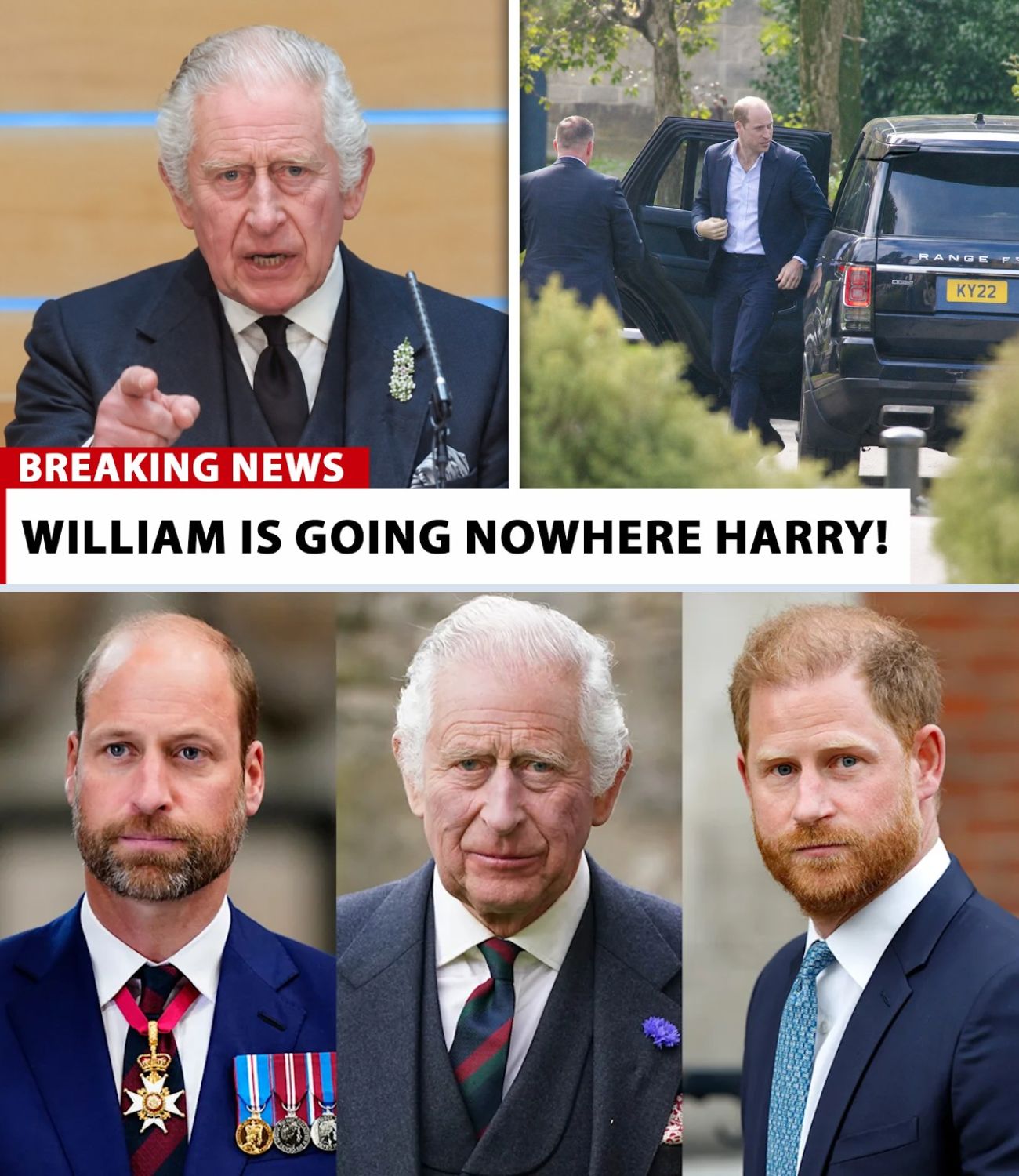
The Van on the Pavement
There is an invisible, centuries-old machinery that governs the movements of the British royal family—a frictionless, well-oiled apparatus of sovereign protection, vetted diplomatic routes, and immediate passage through international borders that most members take entirely for granted. For thirty-five years, Prince Harry lived inside this cushioned sanctuary, where every practical obstacle of daily existence was smoothed away before his boots even touched the ground. Yet, when his flight touched down at Heathrow Terminal, the stark reality of his exile struck with brutal precision.
There was no royal limousine idling on the tarmac, no senior equerry waiting with a meticulously organised schedule, and no police motorcycle escort to carve a path through London traffic. Instead, the fifth-in-line to the throne emerged from a regular commercial arrival gate, accompanied solely by two private American bodyguards whom he pays out of his own pocket. Standing on an ordinary pavement under a grey English drizzle, forced to wait while his personal security details were scrutinised at street level, Harry looked around for a familiar face from the royal household that never arrived.
What he did not know as he navigated the customs queue was that a constitutional storm had already swept through Buckingham Palace days before his wheels touched British asphalt. A multi-layered, highly aggressive pressure campaign engineered across the Atlantic had brought the monarchy to the precipice of total surrender—until a hidden legal dossier upended the entire chessboard in a single afternoon.
The Illusion of Proximity and the California Vise
To understand why the stakes had reached such a fever pitch, one must examine the foundational business model that sustained Montecito’s grand ambitions since the dramatic departure of 2020. For years, multi-million-dollar entertainment deals, corporate sponsorships, and global philanthropic partnerships were secured not merely on the strength of two individual names, but on the implicit promise of an ongoing, unbreakable connection to the British crown. Corporate executives in Los Angeles and New York parted with eye-watering sums because they operated under the assumption that no matter how turbulent the public family squabbles became, the palace would ultimately intervene to protect its own.
By 2026, however, the financial and operational vise gripping the Sussex household had tightened into an intolerable squeeze. Stalled production contracts, astronomical private security overheads running into millions annually, and fading commercial novelty collided with mounting domestic pressures. When traditional Hollywood funding began to dry up, the strategy shifted from brand-building to institutional leverage.
Working alongside top-tier American crisis managers and entertainment attorneys, a multi-pronged offensive was mapped out to force the royal household into submission. Rumours of explosive, unreleased memoirs and detailed diaries documenting every candid moment behind palace doors began to circulate in industry circles. But the true teeth of the campaign lay in the legal arena. Montecito’s legal advisors made it abundantly clear that if a formal separation or financial renegotiation failed, California divorce proceedings would not remain private. Under American community property laws, the sprawling discovery process could open the door to subpoenas demanding the inspection of royal financial records, private family trusts, and historic sovereign financing structures in a Los Angeles court.
The prospect of a British monarch’s private fortune and centuries-old institutional assets being dragged into an American courtroom sent genuine panic through the upper echelons of the establishment. Palace legal advisors, reviewing the impending litigation with characteristic caution, delivered a sobering assessment to King Charles: the crown could not survive an international legal war played out across American tabloid headlines. Their formal counsel was defeatist yet pragmatic—negotiate a settlement, provide structured annual compensation, quietly reinstate security subsidies, and buy their silence before the first subpoena hit the public record.
The King’s Dilemma and the Ghost of 1992
Deeply fatigued and burdened by ongoing health treatments, King Charles viewed the unfolding crisis through the lens of a distressed father. He remembered the tragic aftermath of the 1990s wars that nearly tore the House of Windsor apart, and his paternal instincts urged him to keep a back door open. Charles privately argued with senior courtiers that a complete, unyielding withdrawal would drive Harry into an even more volatile state of public conflict, permanently staining the crown’s reputation. He leaned toward offering a quiet financial lifeline—a secret trust or an informal consulting channel—to give his youngest son a bridge home.
Yet, standing in stark opposition to the King’s sentimental inclination was the future monarch. Prince William viewed any gesture of appeasement not as an act of mercy, but as an existential threat to the survival of the institution.
For William, the ghosts of the 1990s carried a different, much heavier lesson. As a schoolboy walking the ancient stone corridors of Eton, he had witnessed firsthand the devastating consequences of feeding the media beast. He had watched his mother, Diana, convinced that survival required collaborating with biographers and inviting journalists into private living rooms, only to realise too late that when personal grief becomes a public commodity, the machine demands everything until nothing remains.
When William observed the strategy unfolding from California—televised interviews, calculated victimhood narratives, and the strategic leaking of private conversations—he did not see a brother rebelling against protocol. He saw the catastrophic mistakes of his parents’ generation repeated in high-definition digital surround sound. William understood that if the palace capitulated to threats and paid off the blackmailers, the demands would escalate exponentially every five years. He made a silent, unshakeable vow: never again would the institution bleed in public for the sake of temporary appeasement.
The Red Dossier and the Habitual Residence Trap
As senior lawyers prepared to draft the surrender documents, and while Charles quietly explored avenues to fund a private safety cushion, Princess Anne entered the sovereign’s private office bearing a confidential legal dossier that altered the entire geopolitical landscape.
The documents within the file revealed a meticulous, long-term operational footprint established by Meghan’s representatives on British soil. Over preceding months, administrative steps had been quietly completed: formal enrolments at elite British preparatory schools, long-term residential rental agreements, National Health Service registrations, local bank account openings, and the retention of central London-based family law solicitors.
It was a comprehensive paper trail designed to project a normal daily existence in the United Kingdom. But in laying out this evidence, the architects of the California strategy had inadvertently sprung a monumental legal trap upon themselves.
Under international family law and binding multinational treaties, once minor children are formally integrated into a jurisdiction through school enrolment and established daily routine, that country’s legal system assumes the status of habitual residence. The moment those legal thresholds were crossed, California courts lost automatic, unchallenged jurisdiction over custody and marital disputes. The battlefield instantly shifted from the permissive discovery laws of Los Angeles to the rigid, centuries-old precedents of British family law, where royal confidentiality rules and the immense weight of the Crown hold absolute sway.
The dossier did not merely provide William with a tactical advantage; it completely obliterated Montecito’s leverage. The threat of American subpoenas evaporated overnight. For nine months, the Sussex camp had dictated the timeline through fear; the moment Princess Anne’s folder touched the mahogany table, the initiative passed irrevocably into the hands of the future King.
The Administrative Quarantine
Realising that his father was still vulnerable to emotional appeals, William moved swiftly to neutralise any backdoor financial channels. Discovering that tentative steps were being made to establish an independent trust fund, William scheduled an immediate, unannounced meeting with the Lord Chamberlain, the chief administrative officer of the royal household.
Backed by constitutional lawyers who confirmed the Crown had zero legal obligation to negotiate, William authorised a comprehensive set of operational instructions. There were no press briefings, no fiery public declarations, and no emotional confrontations. Instead, a full institutional quarantine was formally enacted.
The consequences rippled through the administrative machinery within forty-eight hours. When Harry arrived in London for his public engagement, the physical reality of the quarantine was laid bare. Instead of the traditional motorcade with flashing blue lights and motorcycle outriders, an unmarked civilian van deposited him on a public pavement. Because his private American bodyguards lacked diplomatic credentials and firearms licensing on British soil, they were powerless to clear his path. Harry stood shoulder-to-shoulder with ordinary commuters, waiting while regular Metropolitan Police officers checked his credentials against the venue’s guest list.
The visual broadcast of a prince of the realm stranded on a London street corner sent shockwaves through international newsrooms.
The Weapon of Absolute Silence
In Montecito, the reaction was swift, panicked, and predictably aggressive. Crisis managers and public relations specialists scrambled to mount an immediate counter-offensive, briefing American entertainment outlets that if security payments were not instantly restored, an unprecedented cache of confidential audio recordings, personal diaries, and uncensored manuscript drafts would be released to the global press.
Yet, the anticipated media firestorm met with an impenetrable wall. William issued a single, unyielding directive to all communications teams across Buckingham Palace and Kensington Palace: absolute and total silence.
Media blackmail relies entirely on the panic of the opposing party; it requires an institution desperate to avoid scandal to sit at the negotiating table. When Meghan’s team looked across the Atlantic, expecting the palace to tremble and issue defensive statements, they encountered a profound, chilling void. No anonymous quotes were leaked, no frantic late-night phone calls were placed, and no concessions were whispered.
Without royal outrage or public panic to fuel the narrative, the threat simply starved of oxygen. Major American television networks that had cleared prime-time slots for the anticipated exposés found themselves empty-handed. Corporate executives quietly pivoted to other ventures as they realised the primary spectator—the British crown—refused to watch the performance.
The Final Purge and the Unbroken Normality
With the bluff exposed and the legal leverage utterly dismantled, William delivered the final, definitive administrative stroke.
On a quiet Tuesday morning, working in direct consultation with the Lord Chamberlain’s office, a senior clerk at Buckingham Palace sat at a terminal and systematically purged every operational link connecting the Duke and Duchess of Sussex to the central administration. Internal access codes allowing foreign private secretaries to interface with palace planning servers were permanently revoked. Reserve apartments traditionally held for royal visits were formally reallocated, and their names were scrubbed from government distribution lists.
At Frogmore Cottage, a contracted team bound by strict non-disclosure agreements packed the remaining personal belongings into plain wooden crates. The final set of keys was slipped into a thick paper envelope, sealed with red wax, and formally handed over to the Crown Estate office. The residence, once envisioned as a permanent base for an alternative royal court, was returned to the institution—empty, dark, and entirely silent.
That same afternoon, the Prince and Princess of Wales maintained their rigorous public schedule across central England. Flanked by cheering crowds, smiling warmly, and discussing community mental health initiatives with local volunteers, William and Catherine projected an image of absolute, unshakable normality.
The contrast could not have been starker. On one side of the ocean, a commercial strategy built on grievances, legal bluffs, and media ultimatums had burned through its final reserves without extracting a single concession. On the other, the future sovereign demonstrated that the ancient machinery of the monarchy does not stutter or halt in the face of private hostility.
The battle for the soul of the British monarchy did not conclude in a courtroom or under television studio lights. It was settled in the quiet, dust-free archives of a palace office where a line was deleted, a directive was filed, and an iron door swung shut in complete, enduring silence.