“Let Them Surrender” — The US Captain Who Ignored the SAS Warning About a Fake White Flag
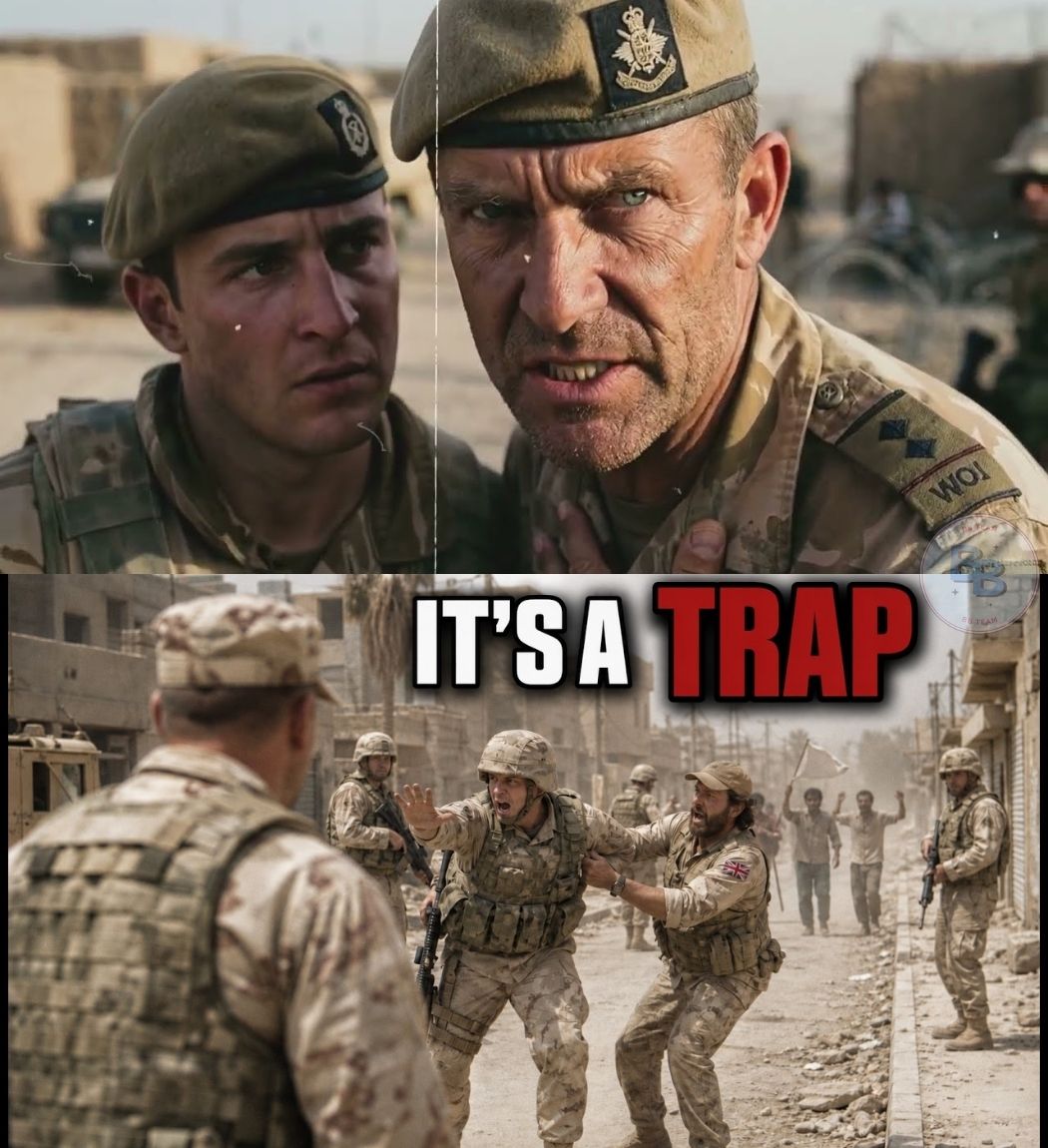
“Let Them Surrender” — The US Captain Who Ignored the SAS Warning About a Fake White Flag
There is a street in western Iraq that a United States Army captain owned at 9:00 in the morning and did not own at 9:00 the next time anyone bothered to look. Three men are walking up it toward his cordon with their hands in the air and a white sheet tied to a broomstick and the British warrant officer standing beside him is saying quietly and clearly that the hands are wrong.
“Let them surrender.”
That is Captain Dale Ricket, Ranger tabbed, bronze starred, two Afghan tours and one before this, speaking to a man he was introduced to 40 minutes earlier.
“They have got their hands up. You British see a ghost in every doorway. Stand down, sergeant major. That is an order.”
He will remember saying it. He will be made to.
The warrant officer does not argue. He does not raise his voice. He keys the radio clipped to his plate carrier, says six words into it that the Americans cannot hear over their own idling diesels and then he does the thing that in his trade passes for shouting, which is to go very still and watch. Beside him, a bearded staff sergeant with a union flag on his sleeve takes a short half step forward and sets his left hand on the warrant officer’s elbow, not pulling him, just there, the way a man steadies another man who already knows what is coming.
The three men on the market road keep walking. The sheet lifts in the hot wind. One of them is smiling. Two of them are not.
What Ricket does not know in the last unspoiled minute of his career is that the corporal from the regiment lying behind a parapet 200 m up the street has already counted the fingers on each of those raised hands and has already told his sniper partner in a voice flatter than paper which man is going to drop his arm first and which way the broomstick is going to fall when he does.
What Rickert does not know is that his own interpreter, a Baghdadi who had been a dentist until the war took the city from him, has heard one of the men on the cordon’s edge mutter a word in Arabic that is not a word a surrendering man uses.
What Rickert does not know is that the warrant officer beside him has been doing this specific job, reading other men’s hands before they can lie with them, for longer than Rickert has been in uniform.
What Rickert knows is that he has a Ranger tab, a company, and an order to accept surrenders when they are offered. He gives the order to stand down. The warrant officer does not stand down. The staff sergeant does not stand down.
And 5 seconds later, on a street in a town called Al Rafain that nobody at home will ever learn the name of, three raised hands come down together and the morning stops belonging to the United States Army. The warning was given. The order to ignore it was given louder. The rest of this is what it cost.
To understand why Captain Dale Rickert said what he said, you have to understand that the man saying it was not a fool. He was, by every measurement his army used, a very good officer. 31 years old, West Point class of 1998, Ranger School on the first attempt, three combat tours before he put on his captain’s bars, two in Afghanistan, one in Iraq, the second of them in the Korengal in 2006, where he had led a platoon up a terraced hillside under fire for 90 minutes to recover two wounded and the body of a third, and had come down the other side with a bronze star with the V device for valor, and a line in his jacket that said, in the army’s careful language, that this was an officer who would run toward the sound of guns.
He had the tab, the medal, the command, and the respect of the men he had brought with him into Anbar. He was not a man accustomed to being told he was wrong by anyone who had not outranked him for a decade. He was also that late summer bone tired. His company had lost four men in nine weeks to roadside bombs. Three of them from the same squad. And the fourth was a boy from Georgia whose mother Ricket had telephoned personally from the forward operating base and whose voice on the other end of the line he had not been able to stop hearing since.
Inside the band of his helmet he carried a laminated photograph of two small girls, his twins, which he showed to no one and which he tapped twice before every patrol. He had come to Ar-Rafa’in with a reinforced platoon and a specific task, hold the market quarter while the civil affairs team pushed a reconciliation message to the shiekhs. And he had come with the quiet certainty of a man who had decided somewhere between calls home that he was not going to lose another soldier on this tour by failing to accept a hand when it was held out to him, which is where the British came in and where the trouble began.
Six men. Two stripped Land Rovers with the doors off and the roll bars black with dust. A warrant officer in his 40s with the sun bleached look of a man who had worked in deserts since Ricket was in high school. A staff sergeant with a beard the regulations did not forgive. And a Union Flag Velcroed to his left sleeve. Three troopers who moved around their vehicles the way longshoremen move around a dock without speaking and without wasting a step. And a sniper pair who had already walked off into the town before the Americans had finished parking.
The warrant officer’s name was Easton Price. He was a Welsh speaker from the Swansea valleys. A squadron sergeant major in B squadron of the Special Air Service. 19 years in the regiment, five selections run as directing staff on the Brecon Beacons. Four previous rotations in Iraq. He had been attached to Ricket’s operation at the request of the coalition task force in a liaison role the paperwork described as advisory. Which is the word armies use when they would prefer not to say supervisory.
He had introduced himself to Ricket at the forward operating base that morning with a nod and a handshake and a single sentence, which was:
“If the hands are wrong, we hold.”
Ricket had said he understood. He had not understood. He had seen six quiet men in dusty kit with no visible rank with weapons he did not immediately recognize. The DM L119 is not an M4, though it looks like one if you do not know what you are looking at. And he had seen the kind of understatement that his service trained on a different idiom read as softness. He had seen the beard and heard the accent and watched the warrant officer decline an offered coffee with the words:
“I’m all right. Thanks.”
And he had slotted all of it into the category he had been carrying since Fort Benning, which was allies, pleasant, not the main effort. Six men in two Land Rovers against his reinforced platoon. And the point of it, he thought, was that his platoon was the point of it.
So when they rolled into Al Rafain and the three men came up the market road with the white sheet and the raised hands and Price leaned in and said in that same quiet voice:
“Captain, I would hold them at the limit of the cordon and strip them one at a time. Their hands are not sitting right.”
Ricket heard it as caution for its own sake. He heard it as a British habit. He heard it as the warrant officer’s reflex to turn every civilian into a threat because the warrant officer had been doing this too long and had stopped seeing people.
And he answered, loud enough for his platoon sergeant and his executive officer and specialist Dupart on the near 50 caliber to hear him clearly:
“Let them surrender. They have got their hands up. You British see a ghost in every doorway. Stand down, Sergeant Major. That is an order.”
First Lieutenant Garrett Hobel, his executive officer, muttered something in Latin under his breath that nobody caught. Sergeant First Class Dale Oxbrow looked at the ground. Price said nothing at all, because Price had already keyed his radio.
That is the man who said it. That is the morning that said it. Now watch what happens next.
Al Rutbah in late August 2006 was a town the war had half forgotten and half remembered at inconvenient moments. It sat on a wadi south of the Euphrates, 40 km from anywhere a journalist went. The buildings were the color of weak tea, two stories mostly. Their roofs a flat crust of concrete and rebar left poking up for a second story nobody had ever built. A line of date palms ran down the eastern edge of the market road, dusty gray in the heat. And at the far end of that road, the half-finished minaret of a half-finished mosque threw a short, sharp shadow onto a wall nobody had painted.
The air smelled of diesel, of goat, of the sweetest rot of fruit that had sat on carts too long. A ginger cat watched the convoy roll in from the top of a parapet and did not move.
The Americans dismounted in good order. Ricketts’ platoon knew its drills. Hobel pushed the first fire team to the north corner. Oxbrow set the 50 on the lead Humvee with specialist Renee Dupart behind it. And the second squad fanned out to establish the cordon on the market road at 150 m. Rickett himself took his place at the center of the stick behind the lead vehicle with Price two paces to his left and Farris Aldulaimi, the interpreter, three paces behind. It was textbook and the textbook was correct for what the textbook had seen.
The men from the regiment did none of it the way the Americans did. Staff Sergeant Hollis Travaskis, the bearded second-in-command, had put one Land Rover at an oblique angle to the first so that from the market road the two vehicles made a shallow V that would funnel anyone who tried to run through them into a crossing field of fire without anyone on the British side needing to move. He had done it without being asked, without speaking, and without, so far as Rickett could tell, looking at either vehicle while he did it. In his thigh pocket he carried a battered tobacco tin he had not opened in four years.
Trooper Edris Bickwell, the youngest of them, had drifted 12 m off the near corner of the compound to Rickett’s right and was standing in a doorway that no American on the cordon had cleared because Bickwell had already looked inside it and knew who was in it, which was a woman and three children and a goat on a rope. The woman had seen him and had seen that he had seen her and had gone back to grinding something in a bowl, which was the only review of a soldier’s work that mattered in a town like this. Bickwell, who had learned his Pashto from a shopkeeper in Cardiff and still wrote to him, said nothing to her because he did not need to.
The sniper pair, Sergeant Marek Oval and Corporal Noah Lyndon, had vanished. They had vanished in the specific way of the regiment, which is not to hide but to go to a place a casual eye does not travel to. Lyndon, the spotter, was lying on the flat roof of a building that was not quite the tallest on the market road, but was the one with the best cross view of both ends of it. With his Bergen as a rest and his elbows on a folded shemagh, so the hot concrete did not burn through his sleeves. Taped inside the lid of his range card wallet was a milk tooth his daughter had left in a saucer six months before.
Oval, the shooter, was 2 m behind him with the L115 on its bipod and the muzzle in deep shadow, which is the only thing that matters at distance. In his left breast pocket folded flat was the same battered Patrick O’Brian novel he had carried on every tour, never read past chapter nine. Neither of them had broken sweat getting there. They had been in position before Ricketts’ lead Humvee had come to a full stop. They would be in position if nothing happened for the next five hours. They would be in position if something happened for the next five seconds.
Price was standing beside Rickett and saying nothing, which was a thing Price did on purpose. In his left breast pocket, under the plate carrier, was a thumb-worn Swansea City badge his son had given him before his first tour, and which he had not yet seen a reason to remove.
Farris, who had been attached to the British element for the week, drifted over to Price under the pretext of asking whether the warrant officer wanted water, and Price, who did not want water, took the bottle anyway, because Farris never asked that question when he did not have a reason.
The two men stood a moment at the edge of the vehicle. Farris with his hand up to shield his eyes against the sun. Price chewing the inside of his cheek. And Farris said in English quiet enough to belong to only them:
“The man in the blue shirt at the second stall. He is watching our vehicles, not our weapons.”
Price nodded once, the way a man nods when he already knows.
“And the hands,” he said, almost conversational.
“The hands,” said Ferris.
“Civilians who have come to give up,” said Price. “Hold their hands like they are showing you they have dropped something. Palms out, fingers wide, elbows loose. Men who are hiding something behind their back hold them like they are still holding it. Fingers tucked, palms angled, elbows locked. You can see it from a long way off if you know to look.”
Ferris did not look at Price. He looked at the market road. Then he looked at the man in the blue shirt. Then he said:
“The men who are coming, if they come—”
“If they come,” said Price, “you watch the hands.”
Rickert, 4 ft away, did not hear this. He heard the end of it, the words watch the hands, and he filed it in the same drawer where he had filed the warrant officer’s “I’m all right, thanks.” And he turned to Hobal and asked for a situation report from the north corner.
Up on the roof, Lyndon’s voice went into the net at a volume that would not have carried across a kitchen.
“Nine, spotter. Three figures, 270 m, Market Road, moving on cordon. One has a stick with a sheet on it, white, hands up.”
Price keyed his set and said:
“Hands?”
There was a pause of perhaps 2 seconds.
Lyndon said:
“Reading.”
Another pause, then:
“Wrong.”
Price closed his eyes for 1 second and opened them again. He said into the net:
“Hold. Confirm.”
Oval this time, flat as a plank:
“Confirmed. Left-hand man, fingers closed, right elbow locked. Center man, broomstick is in the wrong hand for a right-hander. Right-hand man, left wrist is behind his hip when he thinks nobody is looking. All three wrong.”
Price opened his mouth to speak to Ricket, and Ricket, who had seen the warrant officer’s lips move, and who had already decided that he knew what the warrant officer was about to say, cut across him:
“Stand them down to the cordon. Hands high. Farris, tell them in Arabic to keep them up and keep walking.”
Farris looked at Price. Price said, in English the Americans could hear:
“Captain, I would hold them at the limit and strip them one at a time. Their hands are not sitting right.”
The three men on the market road were 180 m out now and closing. The sheet lifted in the hot wind. Somewhere a goat complained. The ginger cat on the parapet stood up, turned round twice, and sat back down with its back to the whole scene, which was the last unsentimental review Captain Ricket’s morning was going to get.
Ricket looked at the three raised hands, and he saw hands. Price looked at the three raised hands, and he saw the lie.
The three men on the market road were 150 m from the cordon when Price said, for the second time:
“Captain.”
He said it the way a man says the name of a horse that is about to step on a nail. Ricket did not turn his head.
“Sergeant Major, I have given you an order.”
“The order,” said Price, “is going to kill one of your soldiers in about 40 seconds, sir.”
That got Ricket’s head around. It did not get him to change his mind. He had been in command for 7 months. He had been under fire a dozen times, and he had never, not once, been spoken to by a non-commissioned officer in the tone the warrant officer had just used. The tone was not insolent. That was the problem. The tone was the tone a doctor uses when he tells a patient flatly what is about to happen if the patient does not sit down. It was a tone that assumed the room already belonged to the person speaking, and Rickett, who had earned his room one Afghan hillside at a time, did not care to lose it to a man in a dusty beard who had not even bothered to put a rank on his sleeve.
“Let them surrender,” he said loud now, so that Hobal heard it, and so that Oxbrow heard it, and so that Specialist Dupard on the 50 heard it. “They have got their hands up. You British see a ghost in every doorway. Stand down, Sergeant Major. That is an order.”
Price did not stand down. He keyed his radio instead, and he spoke into it the sentence that would be read aloud 3 weeks later in a conference room in Baghdad with a colonel who had never been to Al Raffahine presiding, and with Rickett sitting in the second row and not looking up:
“Sun Ray Charlie, this is nine. Hands are wrong. Repeat, hands are wrong. Hold the stick in the open. Over.”
The sniper pair acknowledged with two clicks. Trevaskis acknowledged by stepping, without hurry, from the near Land Rover to a position 6 ft closer to Rickett’s executive officer, so that when the thing happened, he would be between Hobal and the market road. Bickwell, in the doorway, moved his weight off his back foot. The woman grinding in the bowl had already taken her children into the inner room, because Bickwell had, with a small movement of two fingers, told her to.
Rickett saw none of this. He was watching the three raised hands 120 m… 100.
The center man with the broomstick was smiling now, broadly, the kind of smile that in a market town is reserved for a cousin seen after a long absence. He was calling out something in Arabic. Farris, standing behind Rickett, translated in a tired voice:
“He is saying, ‘We are peaceful. We are peaceful. Do not shoot. We are peaceful.'”
“See?” said Rickert.
He did not quite look at Price. Price did not answer.
“80 m, 70.”
The left-hand man’s right elbow had still not moved, not once. A man who has been walking 300 m with his arm in the air moves that arm. He shifts it. He changes shoulders. He lets the elbow bend when he thinks nobody is close enough to see. This man had not. His arm was up because something behind him required it to be up. And the thing requiring it was not relief at the sight of American soldiers.
“60 m. Up on the roof.”
Lyndon said very quietly:
“Second man, waistline, under the sheet, printing.”
Oval said:
“Seen.”
Price said into his radio:
“Permission to engage on movement.”
Then, aloud to Rickert:
“Captain, their hands are coming down in 3 seconds. You need to tell your 50 to traverse left on my call.”
“Belay that,” snapped Rickert. “Nobody fires. These men are surrendering.”
Specialist Dupard, 19 years old, who had been looking down the length of the market road through the ring sight of his heavy machine gun, and who had not been in Iraq long enough to have earned opinions, said in a small voice:
“Sir, the left guy’s elbow.”
Rickert said:
“What?”
Oxbrow, his senior noncommissioned officer, who had been looking at the same elbow, said:
“One word.”
“Captain.”
That was the word that mattered, not Price’s. Oxbrow’s. Because Oxbrow had been with Rickert for 11 months, had taken a round through the ceramic plate for him in the Korengal, had never once questioned an order in front of men. Oxbrow said captain the way Price had said it, and Rickert heard for the first time the thing in the air that everybody but him had been hearing for a minute and a half.
He opened his mouth to say stand down, meaning it this time, meaning it for everybody.
The hands came down.
They came down together, the way hands come down when three men have been counting under their breath. The broomstick dropped sideways. The center man was no longer smiling. The left hand man’s right hand went behind his back and came out with a long-barreled Kalashnikov that had been slung down his spine under the dishdasha and had been visible had anyone been looking at the shape of his back rather than his face for the entire approach. The right hand man produced a second one from the same place. The man with the broomstick dropped flat.
Specialist Dupard did not fire. Dupard had not been told to fire. Dupard was 19 years old and his captain had just told him that nobody fired.
The rifles opened up from 50 m away on full automatic at the cordon. The noise was the hard dry stutter of poorly cleaned Kalashnikovs at close range and the air above the Humvee filled with the dust that rounds kick off a sun-cracked bonnet. Dupard took a round through the plate carrier at the collar seam and went backwards off the gun. Two more rounds walked up the engine block of the lead vehicle and killed the radio in Hobel’s hand.
“From the roof,” Linden said. “Nine, spotter, engaging.”
And from 52 seconds of absolute stillness, Oval squeezed off one round that took the left hand man through the base of the throat and dropped him like a sack.
The second shooter turned to run. Travaskis, who had crossed the 20 m between the Land Rover and the near Humvee without anyone registering him move, put two rounds from his L119 through the second man’s hip and shoulder from a kneeling position Rickert had not seen him take.
The man with the broomstick, flat on the road, started to crawl.
Price stepped past Rickert, not around him, past him. Close enough that his shoulder brushed Rickert’s plate carrier, and he walked out from behind the Humvee toward the man on the ground. And he did it at the pace a man walks to pick up a dropped tool.
Behind him, Bickwell was already out of the doorway and moving on the flank. Within 40 seconds, the man with the broomstick was zip-cuffed, face down with Price’s knee between his shoulder blades, and Price was speaking to him in Pashto by habit before he corrected to Arabic through Faris. And the broomstick was lying in the dust with the sheet still attached because nobody had yet bothered to pick it up.
Specialist Dupard was alive. The plate had held. The round had cracked his collarbone and knocked the wind out of him and left a bruise he would carry for a year. But he was alive. And he was alive because Price had told Travaskis to be 6 ft closer to the executive officer, and because Oval had already decided which throat to shoot before the throat had decided to shoot.
Rickert stood where he had stood. He was still holding his radio. Hobel, his executive officer, looked at him once, and Hobel’s face in that 1 second was the face of a man who had just understood, in advance of his captain, that the morning now belonged to somebody else, and that was only the first time that day the captain would be wrong.
In the 3 minutes after Dupard went off the heavy machine gun, Captain Rickett did the thing his training told him to do, which was to seize the initiative. He called for his platoon to push up the market road in a two-squad bound with the heavy gun in Overwatch to clear from the cordon to the first hard corner by the shuttered pharmacy and to secure the half-finished mosque at the end as the limit of exploitation.
It was a textbook assault order. It was the order he had given in a different valley 2 years earlier and had been decorated for giving. It was the wrong order for Al Rafain because Al Rafain was not a hillside. Al Rafain was a town and the men who had set the ambush had not set it with three gunmen on a market road. The three gunmen on the market road were the trigger. The ambush was waiting for Rickett’s response to the trigger for the exact push-up, the exact street the textbook called for and it was waiting in windows and doorways and on rooftops Rickett had not cleared because Rickett had been dealing with the surrender he had been promised.
Price, kneeling over the zip-cuffed man with the broomstick, saw the order go out across the net and lifted his head.
“Captain,” he said in that same patient voice, “do not take your men up that road.”
Rickett, who had just had a specialist shot in front of him on an order he had given, was in no mood.
“Sergeant Major, I need to clear this town. I am not going to sit at this cordon while whoever did this walks out the back.”
“They are not walking out the back,” said Price. “They are waiting for you to walk in the front. You have at least four shooters in the first floor windows between here and the pharmacy and a belt-fed on the mosque roof. I can see two of them from where I am kneeling.”
“Then designate them and I will put the 50 on them.”
“The 50,” said Price, “will not get a round off before the belt-fed opens up on your lead squad. You need the roof first. You need to take the roof with men they are not watching for. Your men they are watching for.”
Rickett’s jaw set. He had somewhere between Dupard going down and this conversation moved from certainty to a different kind of certainty, which was the certainty of a man who has made one mistake and is determined not to make the second one by appearing to be led.
“Then I will clear the roof,” he said. “Oxbrow, take first squad.”
“Captain,” said Oxbrow.
It was the second time. Oxbrow was not a man who said captain twice in a day.
Price did not wait. He keyed his radio.
“Nine nobility, push the two over to the back of the row. Take the roof of the pharmacy from the alley. Spotter, hold on the mosque belt fed. Engage on my call. Faris, with me.”
Travaskis was already moving. He crossed the road in a dead sprint that nobody on the first floor would see because nobody on the first floor was watching the Land Rovers. They were watching the Humvees. Bickwell went with him. The third trooper, a tall man named Carrew who had so far done nothing but stand very still, peeled off to the alley.
Within 40 seconds the three of them were in a doorway Rickett had not known existed and within another 90 seconds they were on the roof of the pharmacy. Two floors above the market road and Rickett, standing by his Humvee, heard three suppressed shots in rapid succession from somewhere up and to his right.
Lyndon on the far roof said into the net:
“Pharmacy roof clear. Two down, one secured.”
Travaskis from the pharmacy roof:
“Visual on the mosque belt fed. He has not seen us.”
Price:
“Hold.”
He turned to Rickett.
“Captain, now you push. With the pharmacy roof holding your right flank and the sniper pair holding the mosque, the belt fed is yours when you want it.”
Rickert looked at Price. He looked at the pharmacy roof. He looked at the mosque. He looked at the half-dozen windows between him and the end of the market road, and he counted in his own head how long it would have taken his first squad to clear them in a frontal bound. The honest answer was that his first squad would not have cleared them. His first squad would have taken three casualties in the first 30 m and would have been pinned at the pharmacy corner. And the belt-fed on the mosque roof would have had enfilade on them for as long as the ammunition held out, which, based on the rate of fire that was waiting to be unleashed, would have been long enough.
He did not say any of this. He said:
“Push on my mark.”
And he gave the order to his first squad to bound with the pharmacy roof holding the right.
The squad went. They took the first house in 60 seconds. They took the second in 40. The belt-fed on the mosque never fired because Oval took the gunner through the mouth from 420 m before the gunner had the chance to understand that his line of sight was no longer his own. Two more shooters tried to open up from a first-floor window 20 m into the push and were cut down by Trevaskis from the pharmacy roof in a cross-shot that Rickert, if he had been looking, would have found hard to believe.
Rickert was not looking. Rickert was listening to his radio and watching his map and holding his jaw very carefully because he had just been handed a correct order by the man he had, 40 minutes earlier, told to stand down, and because he was keeping his face still enough that nobody would see him think about it. Hobel, beside him, muttered something in Latin. Oxbrow, on the other side of the Humvee, said nothing at all.
The schoolgirls in shorts, he had called them, back at the forward operating base that morning, not out loud, not to Price, but to Hobel over coffee. When the British element had been pointed out to him across the motor pool, schoolgirls in shorts, the phrase came back to him now standing in the shade of his own Humvee, listening to the suppressed cough of a Diemaco from a rooftop he had not thought to clear. As his first squad advanced up a street he had, 4 minutes earlier, been willing to walk them into blind. He did not say it again.
The first squad reached the pharmacy corner at 12 minutes past 10. By then, two of Rickett’s men were down. A specialist named Keen with a round through the thigh who was being dragged into a doorway by his squad leader, and a private named Olmos who had taken a ricochet in the face and was bleeding into his cupped hands with the particular silence of a man trying very hard not to scream. Neither was going to die. Both of them were going to remember the morning for the rest of their lives.
Rickett pushed up to the pharmacy corner himself because that is what the kind of captain he had decided to be did. He took Hobel and Oxbrow with him and two riflemen, and he moved 120 m under the overwatch of the pharmacy roof in bounds of five and 10. And he was good at it because he had done it before on worse ground. When he reached the corner, he knelt by the shutter and he keyed his radio and he asked Price over the net for an update on the mosque end of the street.
Price did not answer. Trevaskis answered instead from the pharmacy roof directly above him:
“Captain, the mosque end has two shooters still active in the courtyard and we have a casualty. One of yours in the street between us and them. He went forward on the last bound and he has not moved.”
Rickett’s stomach dropped a floor.
“Who?” he said.
“Can’t identify from here, sir. Young lad. He is in the open about 40 m this side of the mosque gate. Not moving. We have eyes on.”
Rickett twisted and looked back down the market road toward the cordon and the picture of his platoon that he had been carrying in his head, Keane, Olmos, Dupard already down, two squads in the middle buildings. First squad forward with him rearranged itself and he could not immediately find the face that was missing. Then he could. Then he knew.
Specialist Renee Dupard was 19 from a town in Louisiana Rickett could not have found on a map and he wrote his mother every Sunday on paper because he had not grown up with the habit of a phone. Dupard had been knocked off the gun in the opening volley by the round that had cracked his collarbone and Dupard who had been patched by his platoon medic and told to stay at the cordon had chosen somewhere in the chaos of the push that he was not going to stay at the cordon. Dupard had come forward with second squad and had on the last bound run past his own fire team’s limit of advance and gone another 20 m on his own because he had seen movement in a window and because he was 19 and because somewhere in him he had decided that having been knocked down once that morning he was not going to be knocked down again.
He had been knocked down again. He was alive. Travaskis could see him breathing through the scope. But he was in the open in direct line of two active shooters in the mosque courtyard and the moment anybody from the pharmacy end tried to go and get him both of those shooters were going to open up because they had been watching Dupard breathe for 90 seconds and they were waiting for the second American to come to him.
Rickett said into his radio:
“I am going to get him.”
Price came up on the net instantly:
“You are not, Captain. Listen to me. If you go up that road, they shoot you. Then they shoot him. Then they shoot whoever comes for you. We will get your soldier. Hold your position.”
“He is my man. He is my job,” said Rickett.
“Captain,” said Price for the next 6 minutes, “hold your position.”
Rickard held his position. He held it because Oxbrow put a hand on his webbing and did not take it off. He held it because Hobel, beside him, had already drawn his Beretta and was watching the mosque end of the road through the shutter gap and was saying under his breath the kind of Latin a man says when there is nothing else left to say. He held it because he had, in the course of 90 minutes, finally understood that the warrant officer whose order he had countermanded at 9:00 was running the fight he, Captain Dale Rickard, had started and could not finish.
He watched. What he watched was this.
Price came up the market road, not along it, but through it, through a wall, in fact, because Bickwell had, in the previous 30 seconds and without being asked, taken a sledge to the back of a courtyard three buildings in from the pharmacy and had opened a mouse hole into the next compound and the next.
Price moved through four compounds in 2 minutes without ever showing himself on the market road. On the fourth, he came out into a doorway 12 m from Dupard with Travaskis’s voice in his ear telling him where the two shooters were looking, which was still at the pharmacy end, because the two shooters had not yet understood that the man they were waiting to kill was no longer coming from the direction they were watching.
Oval, from the far roof, took the first shooter through the air at 400 m. The second shooter had 1 second in which to decide what had happened. In that second, Price stepped out of the doorway, closed the 12 m to Dupard at a pace that was not quite a run, got Dupard under the arms, and dragged him backward into the doorway without once breaking the line of sight that Travaskis had been holding on the second shooter’s position.
The second shooter stood up to engage the moving target. Travaskis took him through the sternum from the pharmacy roof.
Dupard, whose eyes were open and whose mouth was moving, was inside the compound in 43 seconds total from the moment Price had stepped out of the mouse hole. The medic reached him from the pharmacy end 2 minutes later and said the words:
“He will live.”
In the hearing of three American soldiers who passed them along the net in the order in which they heard them. Rickett heard them on his radio. He did not key the net to acknowledge. He put the handset down on the cracked concrete beside the shutter, and he looked at his boots for perhaps 6 seconds, and when he looked up again, Hobel, who had been his executive officer for 7 months and who had so far on this tour done nothing but his job, was not looking at him. Hobel was looking down the market road at the mosque, and Hobel’s mouth was moving, and the Latin he was muttering now was not nervous. It was a prayer for Dupart, possibly, more likely from the look on his face, for the man who had just gone to get him.
That was the moment Rickett stopped arguing.
By 10:34, the first element of the United States Task Force Quick Reaction Force is pulling into the staging area a kilometer east of Al Rafain, and Major Brennan Vail, the operations officer of the task force to which both Rickett’s company and the British element are attached, has his boots on the ground and his hand on the hood of a Humvee and a stopwatch which he carries by habit in his left palm.
He was a West Point man, Vail. He was a goalkeeper once. He still catches dropped mugs midair without thinking about it. He has read the net traffic coming in from Al Rufain for the last 41 minutes and he has made in the course of that drive a decision that under other circumstances would take a colonel a week.
The decision is this: town is going to be cleared now before whoever set the ambush consolidates. It is going to be cleared by the element that has been running the fight on the ground for the last half hour and the captain whose cordon it is going to be cleared from is going to stand at that cordon and watch because the captain has a wounded man in a doorway and two more at a casualty collection point and because the task force Major Vail has decided in the quiet of his own head is not going to lose a seventh soldier in Al Rufain to a plan it is already very clear the captain does not have.
He takes Ricket aside at the cordon. He does it with his back to the men so that nothing in the body language can be read by the platoon. He says flat:
“Captain, your element holds the cordon. The British element clears from pharmacy to mosque, both sides of the road, seven buildings. Warrant Officer Price commands the clearance. I am going to time it because head shed in Baghdad is going to ask me how long it took and I am going to tell them.”
Ricket says:
“Sir.”
Vail says:
“Do you have anything to add, Captain?”
Ricket says:
“No, sir.”
He walks back to the cordon. He stands at the near Humvee next to Oxbrow where Dupard went off the gun at 9:00 in the morning. His hand goes by reflex to the band of his helmet where the laminated photograph of his two daughters sits where he has carried it on every patrol for 16 months. He taps it once. His hand stops. He does not tap it the second time.
At the pharmacy end of the market road, Price lines his element up without speaking. Travaskis on left-hand assault with Bickwell and Carew, Price center with Ferris three paces back. Oval and Lyndon on long overwatch from the far roof. Six men, counting the interpreter, against seven buildings, two confirmed belt-fed positions, an unknown number of shooters, and a street that has already taken four American casualties in 40 minutes.
Price does the orders group in a voice Ricket 240 m away at the cordon cannot hear. It takes him 40 seconds. He has run it in some form in a Welsh forest, in a Herefordshire killing house, in a dozen towns like this one, several hundred times.
Major Vail is standing 20 m from Price with the stopwatch in his left hand. Price looks at him. Vail nods.
Price says:
“On me.”
Vail clicks the stopwatch.
What happens in the next 6 minutes and 41 seconds is not a battle in the sense Ricket has been trained to understand a battle. It is a sequence. Each movement cues the next. Nobody shouts. Nobody fires an unaimed round.
The two long guns on the far roof account for four shooters in the first 90 seconds at ranges of 300 and 420 m through windows that from the market road look identical to every other window. Travaskis’s team takes the first house in the stack with a flash bang and three rounds in that order. And the first floor shooter in the second house, who is leaning out to see what has happened in the first house, is already down by the time Travaskis’ second man comes through his door. Because Oval has taken him through the base of the skull at the exact moment Travaskis’ boot has touched the floor below him. Which is not luck, it is sequence.
Price enters the third house personally with Bickwell on his hip and he does it through a mouse hole Bickwell has opened with a sledge. Because Price has decided that the front door of the third house is the kind of front door that has a wire on it. He is right. The wire runs to a buried artillery shell dug into the floor of the hallway. And the shell does not go off because Price comes in through the kitchen.
Travaskis clears the fourth. Carrew clears the fifth.
The sixth house is the one with the belt-fed gunner on the roof who has been waiting since the opening volley at the cordon for a target he has not yet been able to see. And Oval from 400 m puts a round through the base of the gunner’s throat at exactly the moment Price’s team enters the ground floor. Because Oval has been holding on that gunner’s throat for the previous 20 minutes and has been waiting only for the moment the gunner’s hands would come up to the gun.
The seventh building is the mosque courtyard. There are three men in the mosque courtyard and when Price’s element comes through the back wall of the compound next door because Price has decided correctly that nobody who sets a false surrender ambush expects an assault through the back wall of a mosque courtyard.
The three men put their hands up. Price reads their hands in half a second. He reads them twice because he will not make in the other direction the mistake Ricket made at 9:00. He reads them a third time. Their hands are right. He takes them alive.
“The men on their knees are not fighters,” Faris says after a minute, kneeling while Travaskis and Bickwell clear the inner building and Carrew holds the back wall. “They are the brothers of the man with the broomstick. They have been locked in the mosque storeroom since first light. They are,” Faris translates, “very frightened.”
Price lets them stand up.
Behind him, at the cordon, Major Vail is looking at the stopwatch in his left hand. The number on the stopwatch reads 6 minutes and 41 seconds.
20 m from Vail, Captain Rickett is standing with his hand not quite on the band of his helmet, and his eyes not quite on the mosque, and he is listening to the voice of Hollis Trevaskis on the net saying the words that Hollis Trevaskis has said at the end of 41 previous clearances in his career:
“Last building clear. Four US wounded recovered alive. Enemy count 11. No friendly casualties.”
Vail says aloud to nobody and to everybody:
“6:41.”
He does not look at Rickett. He does not need to. He writes the number down on the back of his left hand with a marker pen because he does not trust the stopwatch to hold it. And because he is going to carry that number into a conference room in Baghdad in 3 weeks and read it off his own skin.
The warning had been given at 9:00. The order to ignore it had been given at 9:00. The street had been retaken at 10:41. 6 minutes and 41 seconds from the click of the stopwatch to the end of the net call.
“The hands,” Price had said at 9:00, “were wrong.”
The hands at 10:41 were right. The difference between the two was the morning Captain Dale Rickert was going to spend the rest of his career not talking about.
They made him watch. Not by design. Nobody in Price’s element wasted a word on Rickett in the hour after the mosque was cleared. Nobody looked at him. That, in its way, was worse than being looked at.
The British element did what the British element did at the end of every clearance, which was to consolidate, to photograph, to search, to tag, to call for a helicopter for the wounded, and to walk the ground once more, slowly, in case the ground had anything else to say.
Price did not come down the market road to the cordon. He stayed at the mosque end, kneeling by one of the men they had taken alive, with Farris at his elbow. And he talked to the man for 20 minutes in the low, patient voice of a man who was in no hurry.
Rickett stood at the cordon. He watched the stretcher parties bring his wounded out. Dupard went past him on a litter, awake, pale, with the medic walking alongside holding a drip. Dupard looked at his captain and did not say anything. Keen was next, then Olmos with the bandage on his face. Each of them was carried past Rickett at a slow walk, and Rickett held his face still for every one of them, because that was the one thing left in the morning that was still his to do.
Major Vail came and stood beside him at some point. Vail did not look at Rickett, either. Vail was looking down the market road at the mosque with the marker number still on the back of his left hand, and after a while he said, in a voice that would not have carried past the hood of the Humvee:
“Captain, there is going to be a review. You are going to be invited to it. The review is going to find a number of things. One of them is going to be that you countermanded, in front of your own soldiers, a correctly given warning from a liaison officer with 19 years of specialist experience in exactly the scenario that then occurred. Do you understand me?”
Rickett said:
“Yes, sir.”
Vail said:
“I am not going to say any of the other things right now. You can hear them in Baghdad.”
He walked away.
Farris came up from the mosque end about 10 minutes later. He had not been asked to. He stood beside Ricket for a long moment holding a small notebook open against his thigh, and he said, in the careful English of a man who had learned the language in a dental school in Baghdad before the war took the city from him:
“Captain, the man we took alive, the one who was in the mosque courtyard, he was the brother of the man with the sheet on the stick. He has told the warrant officer how the ambush was arranged. He said something I should tell you.”
Ricket said:
“Yes.”
Farris said:
“He said they were told by the man who paid them that the Americans always accept a surrender. He said they were told the British would not, but the British were only six men, and the Americans would be in command, and so the surrender would be accepted. He said, ‘This was the plan.'”
Ricket said nothing.
Farris, after a moment, closed the notebook and walked back towards the mosque.
The last thing that was said to Ricket in Al Rafain that afternoon was said by Sergeant First Class Dale Oxbrow, who had taken a round through the plate for Ricket in the Korangal, and who had served under him for 11 months, and who had not, in all of that time, said anything to him that was not within an inch of regulation. In his thigh pocket, Oxbrow carried three batteries he did not need, a habit left over from a friend who used to ask for them.
Oxbrow said:
“Sir, I will go with you to Baghdad.”
Ricket said:
“You don’t have to, Dale.”
Oxbrow said:
“No, sir. I know.”
That was the end of the conversation.
Three weeks later, in a conference room in Baghdad with a map of Al Rafain on the wall, and Major Vail’s marker-stained hand holding a stopwatch for a colonel who had never been there, the after-action report was read aloud by a staff officer in a flat voice from a thin folder.
The report had been written by the British element and co-signed by their commanding officer, a Lieutenant Colonel Horace Fenniman, who had signed it in fountain pen, which was his habit, and which in the head shed at Credenhill was his alone. The report ran to 11 pages. Only one line of it survived the review intact because the colonel presiding read it twice to make sure of it. The line was Horace Fenniman’s. It said:
“The warning was given at the correct volume. The order to ignore it was given at the wrong one.”
Rickett, in the second row, did not look up. He kept his command. The army does not relieve a Bronze Star captain over one bad morning, if the morning did not end with American dead. He kept his command, and he kept his tour, and he went home at Christmas. And he did not, so far as anyone who served with him afterward could tell, ever again in his career tell a noncommissioned officer that he was seeing a ghost in a doorway.
He did not become a disciple of the regiment. He did not visit Hereford. He did not write Price a letter. He did not need to. The lesson had been administered where lessons administered to captains tend to stick, which is in front of their platoons.
The man who had said, “Let them surrender,” on a Tuesday morning in August, had been shown inside two hours what the hands of men who were not surrendering looked like. He had been shown by the man he had told to stand down. He had been shown in front of his executive officer, his platoon sergeant, his operations officer, and the stretcher case who used to man his heavy gun. The showing was the sentence.
He had said that morning that the British see a ghost in every doorway. He had been right about the surface and catastrophically wrong about what it meant. The British he had met did not see ghosts in every doorway. They saw hands. They saw elbows. They saw the way a right-handed man carries a stick that does not belong to him and the way a left-handed man forgets which hip his wrist is behind. They saw, in the specific sense that a trade learns to see, the one doorway in a hundred where the ghost was actually standing.
The warrant officer who had told him to hold the stick in the open had not been afraid of the market road. He had been reading it. The staff sergeant who had put his hand on the warrant officer’s elbow had not been restraining him. He had been placing him the way an electrician places a wire where the current would need him in six seconds. The six men who had taken the street back had not been the schoolgirls Ricket had muttered about over coffee. They had been the men whose job was to be unreadable to the people reading them.
He had seen a ghost in every doorway, the captain had said. The ghost had been in only one.
That was Al Rafain, a town the war had half forgotten, a street a Bronze Star captain had held at 9:00 in the morning and did not hold at 10:00. A number on the stopwatch that a major carried into Baghdad on the back of his left hand because he did not trust the stopwatch to hold the number without him. Four wounded Americans alive, 11 dead on the other side. One line in a report signed in fountain pen by a colonel who had never been there that said the warning had been given at the right volume and the order given at the wrong one.
In a camp at Credenhill three months later, a Welsh-speaking warrant officer took a thumb-worn Swansea City badge out of his left breast pocket, looked at it for a moment and put it back. The habit of some men’s trade is to keep the small things in the small places and do the large things where the large things need doing without any ceremony about either.
The lesson of a morning like that one is not that one army is better than another. It is older than that, and smaller than that, and worth saying once, and then letting lie. It is that contempt, the specific contempt that mistakes a quiet man for a soft man, and a patient voice for a frightened one, is the most expensive mistake a commander can make in a town he does not understand.
Captain Rickert made it at 9:00 on a Tuesday. By 10:41, Major Vail had the number on the back of his hand.