“My beard has seen more war than your entire unit” — SAS vet broke the ego of a US Major
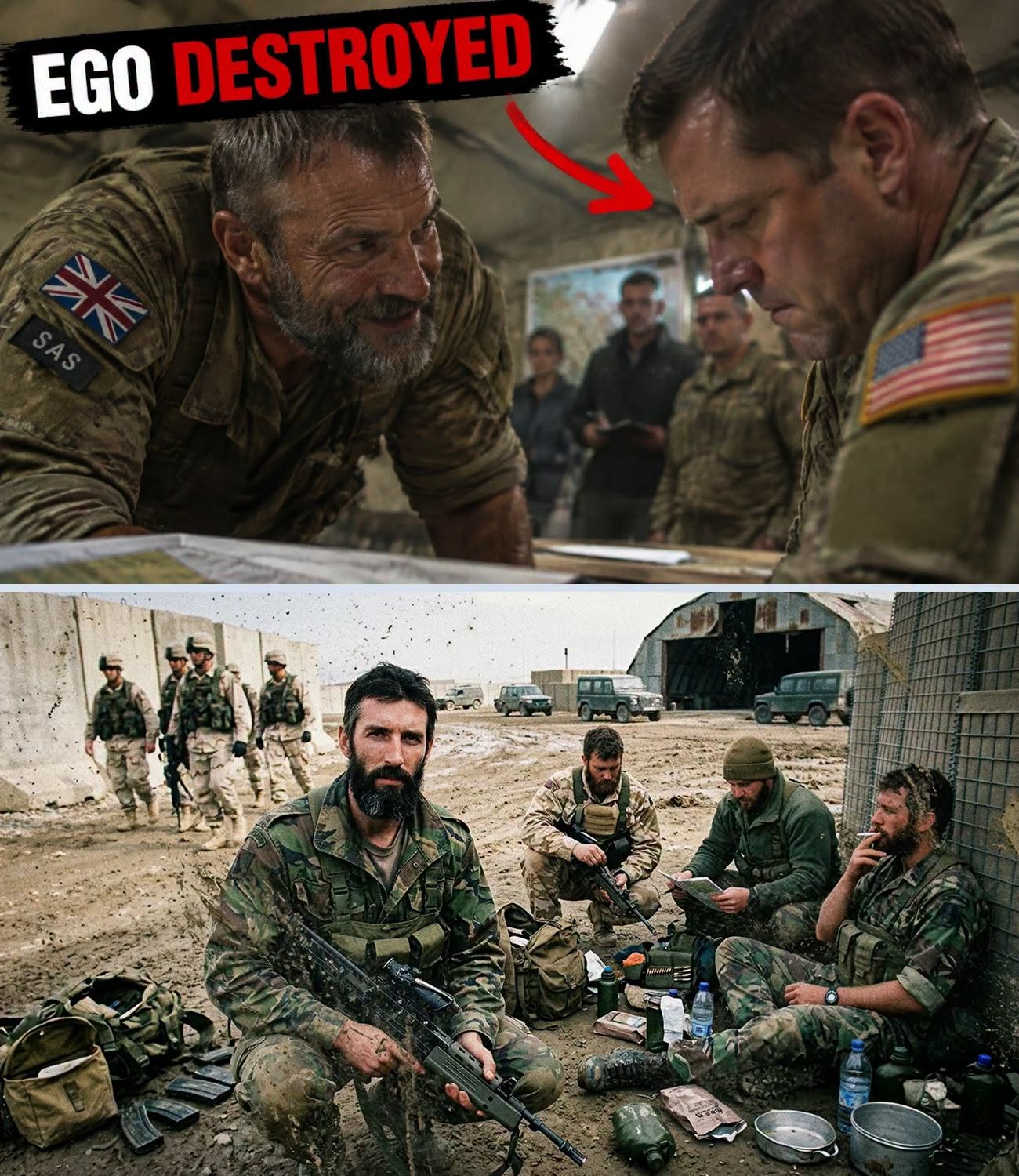
“My beard has seen more war than your entire unit” — SAS vet broke the ego of a US Major
Four men with beards that violated every regulation in the United States Army Field Manual walked into a briefing room in Bagram and, within 11 minutes, dismantled six months of intelligence work that had cost the coalition $19 million and produced nothing. The man who watched them do it was Major Dean Pruitt, and he would later admit he had never felt more irrelevant in a room he was supposed to be running.
Pruitt had been in country for four months by then, attached to a joint special operations task force with a mandate that looked impressive on paper and had delivered almost nothing in practice. He commanded assets that included persistent overhead surveillance, a fusion cell of 11 analysts, and a direct line to a predator orbit that cost the taxpayer roughly $17,000 an hour to maintain. He had run three operations that quarter.
All three had come back empty. The beard belonged to a warrant officer whose name never appeared in any document Pruitt was later permitted to keep. The man was maybe 45, built like something that had been left out in weather for a long time and had simply refused to break down. When Pruitt made an offhand comment, half joke, half genuine irritation, about regulation grooming standards and unit discipline, the warrant officer looked at him for a long moment and said the line that Pruitt would repeat,
almost involuntarily, for the rest of his career, My beard has seen more war than your entire unit. Nobody in the room laughed. That was the part that unsettled Pruitt most. He would spend the next eleven days trying to prove the man wrong. He did not succeed.
To understand why that sentence landed the way it did, it helps to understand what Pruitt was actually looking at. His unit’s equipment loadout ran to roughly $22,000 per operator. night vision from the AN-PVS-14 family, an MBITR radio suite, PEQ-15 target illuminators, body armor rated to a standard that added 9 kilograms to a man’s frame before he even picked up a weapon.
It was, by any measure, that could be printed in a procurement catalog, superior equipment. The four SAS operators standing in front of him were carrying kit that Pruitt’s own logistics officer later estimated, item by item, at just under 1,800 pounds sterling, roughly $2,300. Older PVS-14 units, a decade-old Bowman personal roll radio clipped to a chest rig that looked like it had been re-sewn more than once, and boots that had clearly been re-sold at least twice rather than replaced.
the gap in cost was roughly one to ten the gap in results as pruitt was about to learn ran the other way entirely pruitt’s frustration wasn’t personal vanity it was structural He had been trained inside a doctrine that treated overmatch as a mathematical certainty. More sensors, more bandwidth, more redundancy meant a smaller probability of failure.
He had briefed his own superiors using exactly that language six weeks earlier, walking through a slide that showed sensor-to-shooter timelines shrinking year over year. The problem was that the valley he’d been assigned to operate in had swallowed three previous operations whole, and none of the after-action reports had produced an explanation that held up under scrutiny.
The target was a mid-tier facilitator network moving weapons and personnel through a river valley in eastern Afghanistan, a route that had been mapped, remapped, and argued over by three separate intelligence cells. According to a Congressional Research Service assessment released years later, the compound network in that valley had defeated four separate coalition attempts at direct action between 2009 and 2011 at a cumulative cost, personnel, aircraft hours, munitions, north of $11 million, zero high-value targets captured.
two friendly casualties from an ambush that a predator feed had watched assemble in real time and failed to flag in the seven minutes that mattered pruitt had read that history before the s a s team arrived he assumed it explained why his own operation would be difficult he did not yet understand it was about to explain something else entirely The most recent American attempt, call it as one internal review later did, Objective Falcon, had gone wrong in a way that still generated debate inside the task force 18 months later.
A 12-man element supported by an AC-130 orbit and real-time drone coverage had moved on the compound network at OATW-040 in the morning. the compromise came not from the ground force but from a heat signature anomaly on the thermal feed that an analyst misread by four hundred meters a goat herd mistaken for a dispersing hostile element the order to abort came eleven minutes into the approach by the time the ground force reoriented the actual target had already moved As Mark Urban notes in his account of coalition special operations in the region,
the tragedy of over-censored warfare is that certainty arrives exactly one step behind the moment it would have been useful. Pruitt had briefed that failure to his own chain of command as an equipment and integration problem. Better fusion, better latency, better training on thermal discrimination. He had not considered at that point that the problem might be philosophical rather than technical.
That reconsideration would not take long. When the request came down for a four-man SAS element to take a look at the same valley, using a method the Americans had not yet tried, a static multi-day observation post rather than a direct action raid, Pruitt’s first reaction, recorded almost verbatim in a memorandum he wrote to his operations officer, was skepticism bordering on irritation.
Four men, minimal signals capability, no immediate extraction option, operating within small arms range of a hostile network that has already defeated four of our attempts. This represents an unacceptable risk-to-payoff ratio, he wrote. He recommended the mission be scaled up, integrated with American ISR, and given a hard 48-hour window with a scripted extraction plan.
the s a s liaison officer thanked him for his input and changed nothing that was the first moment pruitt’s authority in that valley began to quietly erode though he would not recognize it as such for another nine days the four operators who walked into the briefing that morning were in the language urban uses unremarkable in exactly the way that mattered No nametapes, no unit patches, beards, civilian pattern boots, and radios that Pruitt initially assumed were decommissioned stock.
One of them, the warrant officer with the beard, carried a rifle that Pruitt didn’t immediately recognize as an L119A1, a weapon his own procurement briefings had listed as a legacy platform two generations behind the M4 variants his own men carried. You’re going into that valley with that. Pruitt reportedly said, not quite as a question.
We’ve been into worse valleys with less, the warrant officer answered, and that was the end of the conversation, though not, as Pruitt would discover, the end of the exchange that would define the next eleven days. He had no idea, standing in that briefing room, that the four men in front of him had already walked the exact route through terrain models built not from satellite imagery, but from 36 hours spent memorizing contour lines on a whiteboard, using a technique that traced back to a hillside in Wales that none of Pruitt’s men had ever heard of.
The valley itself sat at an elevation that made overhead surveillance unreliable for nearly six hours a day. A fact buried on page 41 of an environmental annex that Pruitt’s own analysts had appended to the operational order and that nobody, including Pruitt, had read closely enough to wait into planning.
Morning fog rolled in with enough density that thermal differentiation between a standing man and a seated goat dropped, according to a later Rand Corporation assessment of the region’s microclimate effects on ISR performance to just above chance. The Valley had defeated technology before. It was about to be entered by four men who were planning, quite deliberately, to defeat it without technology at all.
Pruitt did not know that yet. What he knew was that four men with outdated rifles and a bearded warrant officer who had just insulted his entire command were about to walk into the most dangerous six kilometers of terrain in his sector. carrying less equipment than his own supply sergeant would issue to a single-soldier standing perimeter watch back at the forward operating base.
Pruitt had run the numbers three times before the patrol left the wire, and each time, the arithmetic came out the same. Six kilometers of broken ridgeline, held by an estimated platoon-strength Taliban element with two confirmed heavy machine gun positions, no close air support available for the first ninety minutes of the window due to weather over the pass and a four-man s a s reconnaissance and direct action element carrying by his own supply officer’s inventory less than half the load-bearing equipment his manual called minimum viable for a squad of that size
operating beyond friendly lines the warrant officer’s name was grenville and he wore no rank insignia that pruitt could see Only a faded desert smock and a beard that had, according to the man himself, seen more war than your entire unit. Pruitt had wanted to write him up for insubordination. Instead, he had watched him check a compass bearing against a hand-drawn sketch map, nod once, and walk into the dark without another word.
Pruitt would spend the next four hours trying to reconcile what his screens told him with what his training told him was possible. The forward operating base sat at the mouth of a valley the locals called Sarkani Draw, though no map Pruitt had ever seen used that name. three previous attempts to clear the ridge line above it had failed the first had been an air assault by a company of the eighty second airborne inserted by helicopter at first light with air support on station and a company command post relaying updates every four minutes
the insertion had been compromised before the birds even touched down dust signature visible for eleven kilometers according to the after-action report pruitt had read twice and the company had taken six wounded extracting under fire without ever reaching the objective The second attempt, four months later, had been a precision strike based on signals intelligence, a predator overhead for 19 straight hours, tracking a cell phone signal that turned out to belong to a shepherd who had picked up a discarded handset near a
Taliban rest stop. Two Hellfire missiles at a cost of $68,000 apiece had destroyed a stone shepherd’s hut and injured no one of tactical value. The third attempt Pruitt had commanded personally. A reinforced platoon, 31 men, night vision, thermal optics, two designated marksmen, artillery on call. they had gotten within eight hundred meters of the ridge crest before a dog began barking in a compound below their route and within eleven minutes tracer fire was arcing across the valley from three separate positions no one from pruitt’s platoon reached the ridge that night one man returned with a fractured ankle
from the withdrawal down loose scree in the dark that was the operation pruitt kept coming back to that was the one that made him doubt everything he was about to watch grenville had read the same after-action report in eleven minutes flat standing at the briefing table with a mug of tea he never seemed to put down and had said only one thing before folding the report closed your lads went up that hill like they wanted the whole valley to know they were coming pruitt had asked him to elaborate grenville
had not The four-man patrol carried, by Pruitt’s own count at the final equipment check, one Land Rover pattern rucksack each, an L119A1 rifle apiece with optics that cost, according to the manifest, roughly 400 pounds sterling all in, two PRC319 radios shared across the patrol, and rations calculated to the gram for seven days rather than the standard American allowance of ten.
Total cost of equipment per man came to just under 2,000 pounds. Pruitt’s own supply sergeant had told him that morning that the thermal weapon site alone issued to each of his perimeter sentries cost $11,000. Pruitt did not understand yet that the difference was not in what they carried. It was in what they had already survived to earn the right to carry so little.
To understand why four men could do what 31 could not, it helps to go back to the Brecon Beacons, to a phase of selection that candidates call simply the hills. Though what happens there has almost nothing to do with hiking. Over four weeks, candidates carry loads that increase progressively, starting at 25 pounds and building toward the final long march known as endurance.
a 40-mile route across some of the most punishing terrain in Wales, carrying 55 pounds of equipment plus rifle, to be completed in under 20 hours. According to figures published by the Ministry of Defence and cited in Chris Ryan’s memoir of selection, roughly 86% of candidates who begin the hills phase do not complete it.
Most fail not from physical collapse but from a single navigational error compounding in fog or darkness until the clock runs out. There is no second chance. There is no partial credit. A man who arrives four minutes late is failed exactly as completely as a man who never left the start line. What that process produces is not simply fitness.
It produces four men who can move through six kilometers of hostile ridgeline at night, off any marked route, navigating by dead reckoning and terrain association alone. at a pace that never varies whether the ground is flat scree or 40-degree incline, without a single word of radio traffic required to keep the patrol together.
Pruitt watched the patrol’s position update on his screen at 0147 and said nothing for a long moment. The patrol had crossed the first two kilometers in 51 minutes, moving in a staggered file with roughly seven meters between each man, weapons held low, no white light, no infrared strobes, nothing that Pruitt’s own night vision equipment would have picked up beyond 400 meters even under ideal conditions.
Grenville walked point for the first hour, then rotated to the rear without a spoken command. Pruitt would learn later that the rotation was triggered by a single tap on the shoulder of the man behind, a system so quiet it left no acoustic signature at all. The tap on the shoulder.
Pruitt would think about that detail again, six hours later, for reasons he could not have predicted. At 0220, the patrol went to ground. Pruitt’s screen showed all four position markers freeze in place, clustered within a 15-meter radius. and stay frozen he asked the operations officer beside him what had happened the operations officer shrugged and said the patrol commander had likely heard something nobody in the operations center could hear what that something was for the next forty-seven minutes nothing moved on pruitt’s screen at all
What Pruitt did not know, what he would only learn during the debrief three days later, was that a Taliban foot patrol of six armed men had passed within 11 meters of Grenville’s position during those 47 minutes, close enough that Grenville could hear one of them clear his throat. To remain motionless and silent for 47 minutes while armed men pass at a distance closer than a British living room requires more than nerve.
it requires a specific trained response that begins during the interrogation resistance phase of selection a thirty six hour segment in which candidates are subjected to sleep deprivation stress positions and sustained psychological pressure designed to simulate capture According to Mark Urban’s account in Task Force Black, the purpose is not merely to test whether a candidate will break under questioning.
It is to recalibrate a man’s baseline tolerance for extreme physical discomfort combined with total stillness so that later in the field, 47 minutes without moving a muscle registers as merely uncomfortable rather than unbearable. One former operator speaking to journalist Ben McIntyre under condition of anonymity described the sensation this way.
You learn that your body will do exactly what you tell it to do for far longer than you think if your mind refuses to negotiate with it. This was not bravery. This was something that had been built, deliberately, over years. And Pruitt was watching the finished product without understanding any of the process that made it.
at zero three o three the position markers moved again the patrol had waited out the taliban foot patrol without detection and resumed the climb pruitt exhaled audibly enough that the officer next to him glanced over By 0410, the patrol had reached a shelf of rock roughly 400 meters below the ridge crest, the point from which the previous American platoon had been compromised by a dog barking in the valley below.
Grenville’s patrol paused there for 11 minutes, not to rest, Pruitt would later understand, but to observe. Through a spotting scope that cost less than the coffee maker in Pruitt’s own command tent, one of the four men identified the two machine gun positions the earlier intelligence reports had only estimated, confirming their exact grid coordinates and, more importantly, the routine of the two-man crews manning them.
The routine. That single word would matter more than anything else in the next 90 minutes. Pruitt had assumed, based on the earlier failed operations, that the machine gun crews maintained constant vigilance. What the patrol observed and relayed back in a 19-second burst transmission at 0422 was that the crew’s rotated watch on a cycle of roughly 20 minutes and that during the changeover there existed a gap of perhaps 90 seconds during which neither crew member was actively observing the approach routes. Both occupied instead with the physical business of swapping positions inside the cramped fighting position.
Pruitt read the transmission twice. He asked the operations officer whether 90 seconds was enough. Nobody answered him because nobody in the operations center had ever planned an assault around a 90-second window before. It was enough. It had to be enough, because Grenville’s patrol had already begun moving toward it before Pruitt finished asking the question.
At 0441, the four-man patrol split into two pairs, closing on the two machine gun positions from separate approach angles calculated. Pruitt would learn later, entirely from the 11-minute observation period and nothing else, no satellite imagery, no drone feed, nothing but four eyes and a compass. Grenville and the patrol’s second-in-command took the northern position.
The remaining two operators moved on the southern gun. Pruitt’s screen showed nothing during this phase except two pairs of stationary markers, and then, at 0458, both pairs began moving again simultaneously. What happened at the machine gun positions themselves was reconstructed only afterward, through the patrol’s own report and a brief comment Grenville made during debrief.
that Pruitt wrote down word for word because he could not quite believe it was being said so casually. Both positions were cleared without a shot fired. The four Taliban fighters manning the two guns were subdued using methods the report described only as close quarters engagement, and both positions were rendered combat ineffective.
Weapons disabled, ammunition secured. Within, by the patrol’s own timestamp log, four minutes of the initial approach. Four minutes. pruitt’s own platoon three months earlier had never gotten within eight hundred meters of either position before being detected the comparison sat in pruitt’s mind like a stone he could not put down but the operation was not finished and this was the point at which everything pruitt believed about the mission’s objective changed The original tasking had been straightforward.
Eliminate the two machine gun positions to open a route for a resupply convoy scheduled to move through the valley floor at first light. That objective had just been achieved, cleanly, with zero casualties, in under four hours. Pruitt began drafting a message to his own command confirming route clearance.
He never sent it. At 0515, a burst transmission from Grenville’s patrol reported movement on the reverse slope of the ridge, not the platoon strength element they had been briefed to expect, but something considerably larger, moving in organized columns, consistent with a battalion-level reinforcement that no prior intelligence estimate had indicated existed anywhere near Sarkhani Draw.
The patrol’s own estimate based on visual count over a six-minute observation window, put the number at close to 200 fighters, moving toward a position that would put them directly astride the resupply route within three hours. This was not the mission Pruitt had signed off on. This was not a mission anyone had planned for at all.
The four-man patrol was now sitting less than 300 meters from a force 50 times its size. with a resupply convoy already committed to move at first light and no possible way to recall it through normal channels in time. Pruitt stood over the radio operator’s shoulder, and for the first time since the operation began, he understood that the polite disdain in Grenville’s voice back at the wire had not been arrogance.
It had been a man who already knew, before the patrol left the base, that the six kilometers ahead would demand judgment calls that no equipment manifest, however expensive, could ever substitute for. The judgment call in question had come four hours earlier, though Pruitt would not learn the full context until much later.
reconstructed from the after-action logs and a conversation with the patrol commander that took place three weeks after the operation, over instant coffee in a tent that smelled of diesel and wet canvas. The patrol had been moving along a wadi system that did not appear on the standard mapping overlay Pruitt’s own analysts had produced.
Grenville, the corporal leading the four-man call sign, had stopped the patrol without explanation at a point roughly two kilometers short of the objective. he had signaled a halt dropped to a crouch and remained motionless for eleven minutes while the other three men watched him without asking why there had been no visible threat no movement in the tree line no radio traffic indicating compromise the reason grenville later explained through the interpreter of shared professional vocabulary was smell
Wood smoke, faint, carried on a wind shift that had rotated 40 degrees in the space of 10 minutes, a shift the meteorological data available to the patrol had not predicted, because the nearest weather station was 80 kilometers away and updated its models every six hours. A fire meant people.
People meant either a herding camp that had been there for generations, harmless, or a forward observation post placed deliberately along the likely approach to the objective. there was no way to distinguish between the two from smell alone so grenville had done something that no american planning cell would have authorized in the time available he had split the patrol this was the first decision that would determine everything that followed Two men continued along the wadi at a reduced pace, weapons slung rather than carried at the ready, moving like herders rather than soldiers.
A technique referred to in after-action reporting only as profile matching, a skill set built during a phase of selection that recruits universally described as the most psychologically corrosive six weeks of the entire process. It was not the marching, it was not the physical punishment. it was the interrogation phase thirty-six hours of controlled resistance to interrogation training conducted in a facility outside hereford that candidates were forbidden from describing in any detail even decades later
What the interrogation phase actually trained was not resistance. It was performance under total scrutiny, the ability to hold a fabricated identity, a fabricated posture, a fabricated reason for existing in a particular place, without a single involuntary tell, for hours at a time, while trained interrogators looked for exactly one flinch.
of the roughly two hundred candidates who began selection in a typical intake the interrogation phase alone accounted for a further twelve per cent attrition men who had survived the endurance marches through the brecon beacons who had passed the initial fitness thresholds and who still failed here because the failure was invisible until it happened and could not be trained away by simply getting fitter Pruitt had read a summary of this phase in a declassified briefing document 18 months earlier and dismissed it as psychological theater,
the kind of thing special operations communities use to justify their own mystique. Standing in the operations center watching Grenville’s two-man element amble past a heat signature that infrared imagery had flagged as possible personnel, low confidence, unable to classify. Pruitt began to understand it differently.
the heat signature did not move neither did grenville’s two men not their pace not their weapon carriage not anything that would have registered to a watching eye as deviation from the pattern of two herders walking home before dark the other two members of the patrol meanwhile had gone firm in a position roughly four hundred meters to the northeast overwatching the wadi with a thermal scope that had cost according to the equipment manifest pruitt had reviewed weeks earlier one hundred and ninety pounds i a fraction of the eleven thousand dollar unit his own reconnaissance teams carried as standard issue the british scope had
a shorter effective range and a narrower field of view it also worked in the specific humidity and dust conditions of that valley because it had been selected according to a quartermaster sergeant pruitt later interviewed for what actually happens here not for what looks good in a procurement briefing in washington Pruitt did not respond to that remark when it was relayed to him.
He wrote it down, the observation position confirmed within twenty minutes that the heat signature belonged to a single individual, elderly, tending a small fire beside what was later identified as a collapsed stone enclosure used for goats, exactly the possibility Grenville had weighed and, without any censor confirmation, judged more likely than the alternative.
He had been right. But being right was not the point that stayed with Pruitt. The point was that Grenville had made a decision with equipment worth less than a plane ticket, based on a change in wind direction he noticed without instrumentation, and had been correct in a way that Pruitt’s own predictive terrain modeling, built on a satellite tasking order that had taken six days to schedule and cost, by his own estimate, upward of $400,000 in overhead, had failed to anticipate at all.
The patrol reunited 90 minutes later, 700 meters short of the objective, and it was here that the first of the operation’s three near-compromise incidents occurred, though Pruitt would not learn about it until the debrief, because at the time, nothing in the radio traffic indicated anything had happened at all.
At 0114, moving along a goat track that ran parallel to a dry stream bed, the patrol’s lead scout, a Lance Corporal Pruitt, would come to know only by the call sign, 2. stopped dead and raised a closed fist seven meters ahead in the almost total absence of ambient light a shape resolved that the patrol’s collective four sets of eyes needed almost a full minute to correctly interpret a man seated weapon across his knees awake he was not one of the herders grenville had accounted for he was a sentry positioned roughly where pruitt’s own targeting cell had predicted a security element might be posted though the predicted position had been listed
with only thirty per cent confidence and had not factored into the patrol’s final approach lane the patrol did not move for forty-seven minutes Pruitt learned the specific duration only from the mission log, time-stamped by the patrol’s own movement discipline rather than any external sensor. Because there had been no radio transmission during that period at all, a decision that Pruitt initially read when he saw the gap in the traffic as equipment failure.
It was not equipment failure, it was doctrine. Any transmission, however brief, however low power, risked a directional bearing being taken by anyone monitoring the frequency spectrum in the area, and the patrol commander’s assessment was that 47 minutes of silence was a smaller risk than 4 seconds of radio traffic.
The sentry, for his part, never altered his posture. He appeared, based on the eventual assessment, to be either dozing with his eyes open or in a state of fatigue-induced stillness. common among irregular forces on extended rotation without relief this was the second decision that would determine everything that followed the patrol did not withdraw it did not engage it waited in four positions spaced across roughly nine meters of open ground Breathing. According to the training standard, every man in that patrol had been drilled on repeatedly during the jungle phase of selection in Brunei,
a phase that killed no one directly but broke men through six weeks of immersion, foot rot, leech infestation, and navigation tasks, scored to an accuracy of 50 meters in triple canopy terrain, where GPS did not function and had never been intended to, through the nose, in a rhythm timed to four counts in.
Six counts out, specifically because open mouth breathing at close range in cold air produced an audible sound that the human ear, even a fatigued one, could register as anomalous against ambient stillness. The sentry eventually stood, stretched, and walked away from his position toward what was later identified as a checkpoint building 40 meters further along the track.
The patrol moved again at 0201. prewitt read this sequence in the debrief three weeks later and asked grenville directly why the patrol had not simply neutralized the sentry and continued rather than risk detection for the better part of an hour grenville’s answer according to prewitt’s own notes was five words then it’s not reconnaissance any more a neutralized sentry meant a body that would be discovered a security posture that would tighten across the entire objective and a mission that would
have converted without authorization from intelligence collection into a direct action raid a decision that in the american planning architecture would have required an entirely separate approval chain additional assets and in all likelihood a delay of several days while the request moved through channels the frequency the patrol was using incidentally was not the primary frequency listed on the communications plan pruitt had reviewed before the operation began that detail would matter in six hours
at the time pruitt did not think much of the footnote buried in the signals annex indicating that the patrol carried a secondary crystal controlled set tuned to a frequency band that pruitt’s own communications officer had described in a planning meeting as legacy barely worth including The primary Bowman-derived system the patrol carried had encryption, range, and data throughput that outperformed the older set in every measurable category.
But the older set required no line-of-sight repeater, no networked infrastructure, and no battery load beyond what a single AA cell could provide for 11 days of intermittent use. The patrol reached its final observation position at 03.31, 900 meters from the compound that constituted the actual objective.
A walled structure identified through prior signals intelligence as a way station used for facilitating movement of personnel and material along a corridor that had frustrated three prior collection attempts, two of which had involved American assets operating with considerably larger footprints and considerably larger budgets.
Pruitt had reviewed those two prior attempts in detail before this operation began, and neither had produced usable intelligence. The first, conducted 11 months earlier, had used an eight-man element supported by persistent unmanned aerial coverage, costing an estimated $2.3 million in sensor and analyst hours over a three-week collection window.
The element had been compromised on its second night. forced to abort and had returned with nothing beyond a partial vehicle count the second attempt five months later had relied entirely on technical means a combination of signals intercept and satellite imagery and had produced a targeting package so imprecise that the subsequent raid based on it struck an empty building the actual facilitators having relocated fourteen days prior A fact that would have been immediately apparent to anyone watching the compound’s pattern of life for even 72 hours on the ground.
The four-man patrol now lying in a shallow depression 900 meters from that same compound had no persistent aerial coverage. It had no signals intercept capability beyond what could be carried in a rucksack. What it had was time and a willingness to use it in a way that Pruitt’s own doctrine actively discouraged.
comfort or the deliberate absence of it defined the next six days water was rationed to two liters per man per day carried in unmarked plastic bottles rather than the branded hydration systems pruitt’s own units used specifically because reflective or brightly colored equipment however minor created a detectable signature under certain light conditions waste was managed through sealed plastic bags carried out rather than left behind a practice that had nothing to do with environmental policy and everything to do with the fact that a single disturbed patch of ground or worse,
an identifiable human waste site, had compromised at least one prior SAS patrol in a different theater, a lesson embedded so deeply in the unit’s institutional memory that it was taught without elaboration as an absolute rule rather than a suggestion. sleep when it came at all arrived in intervals timed to forty minutes staggered so that at least two of the four men were alert at any given moment and even then only in a posture that could transition to full alertness within roughly four seconds the temperature at night in that depression dropped to six degrees
c during the day direct sun pushed the ambient reading above forty one Neither extreme was mentioned in any radio transmission because neither extreme was considered relevant information. Pruitt would later describe this period in an interview conducted for a defense journal two years afterward as, The six days I stopped thinking about SAS selection as an initiation ritual and started thinking about it as an engineering process.
What the patrol was doing, in practice, was building a pattern-of-life picture of the compound with a level of granularity that no sensor package could replicate. Which door was used by which category of visitor, what time the generator ran, how many armed personnel rotated through the perimeter and on what schedule, which vehicles arrived empty and left loaded.
This was the phase of the operation that most closely resembled the marching phase of selection. not because of any direct physical similarity but because both required the same underlying trait one that the ministry of defense’s own recruiting literature described almost apologetically as sustained low-grade suffering tolerated in service of an objective too distant to see The 40-kilometer Brecon Beacons Endurance March, conducted with a pack weighted to 25 kilograms and a time limit measured in single-digit minutes of tolerance,
existed for exactly this reason. To identify among candidates who were already among the fittest soldiers in the British Army, the specific subset who could continue making sound decisions after their bodies had stopped sending any signal other than exhaustion. 88% of candidates who reached that stage of selection did not continue past it.
On the fourth night, the midpoint tension reset that Pruitt had not anticipated arrived without warning. A second vehicle convoy, larger than any previously observed pattern, entered the compound at 2240 and did not leave. The patrol’s targeting priority, built around a single facilitator believed to visit the compound on a semi-regular basis, was rendered instantly obsolete.
What had arrived instead, based on vehicle configuration and the number of armed personnel dismounting, was a senior figure whose presence had not been predicted by any prior collection, American or British. Grenville’s patrol now faced a decision that no plan had accounted for. Four operators, 600 meters from a compound that had just grown in strategic value beyond anything the original tasking had anticipated.
Major Pruitt, watching the same feed from the Joint Operations Center, felt his stomach drop in a way that had nothing to do with training and everything to do with instinct. He would later admit, in a debrief that was never officially transcribed but was reconstructed from three separate witness accounts, that his first impulse was to call it off entirely.
Abort. he said to the watch officer beside him it was not a suggestion pruitt had spent eleven years building a career on risk calculus and the calculus in front of him had just changed variables without warning an unidentified senior figure protected by what appeared to be a reinforced element sitting inside a compound that a four-man patrol had been observing for 11 hours with equipment that together cost less than the fuel bill for the Blackhawks idling on standby 30 kilometers away.
The radio stayed silent for six minutes. Those six minutes, according to the operational log, later reviewed by the Congressional Research Service, in a redacted assessment of coalition special operations coordination represented the exact moment when two military cultures diverged on what risk actually meant. Pruitt wanted extraction.
Grenville’s patrol call sign Foxtrot 42 wanted confirmation. the difference between those two words would define everything that happened over the next four hours grenville did not respond to the abort call immediately and this itself became a point of friction that surfaced later in an internal review neither side particularly wanted made public the patrol commander a staff sergeant whose identity remains protected under standard operational security even in the version of events later shared with american liaison officers reportedly transmitted a single line back to the operations center confirming identity stand by
Pruitt did not stand by well. He would tell colleagues afterward that the four minutes of silence that followed were the longest of his deployment, longer than any firefight he had personally been in, because at least in a firefight you could see the threat. Here, he could see nothing except four green dots on a screen that had stopped moving entirely, and a compound full of armed men who had no idea they were being watched by anyone.
this was the moment the american major would replay in his mind for years the patrol’s decision to hold position rather than withdraw was not born of bravado it was born of a specific skill taught during the observation and reporting phase of selection a phase that receives almost no public attention compared to the marches or the interrogation stand but which former directing staff have described as the true filter for who eventually wears the beige beret.
Candidates are placed in concealed positions for periods exceeding 18 hours and required to produce detailed, accurate reporting on activity they observe, without moving, without eating anything that requires unwrapping, and without responding to any external pressure to cut the observation short. Roughly 41% of candidates who reach this phase fail it, not because they cannot stay still, but because they cannot resist the urge to report prematurely, to fill silence with guesses rather than confirmed detail.
Grenville had been through that exact phase eleven years earlier at Senebridge, and the lesson had apparently never left him. The senior figure who had arrived at the compound needed to be identified with certainty before any decision about extraction, engagement, or continued observation could be made responsibly.
Guessing was not an option his training permitted, regardless of what pressure was coming through the radio from a command post 600 kilometers away. The vehicle configuration told a story the Americans hadn’t been reading correctly. Here, the first of the three details planted earlier in the operation returned with consequence.
The armored escort vehicle that Grenville had noted 11 hours earlier, the one Pruitt’s staff had dismissed in the initial brief as likely a local security contractor, low priority, reappeared now as the same vehicle disgorging the senior figure’s personal security detail. The patrol’s insistence on logging every vehicle that approached the compound, no matter how insignificant it appeared at the time, was now the only reason anyone could establish a pattern of movement that matched a specific facilitator
known to Coalition Intelligence under a codename that remains classified. Corporal Hartley, no relation to any operator, simply the radio operator monitoring transmissions at the Joint Operations Center that night, would later tell a journalist working on a book about coalition special operations coordination that the mood in the room shifted physically when the identification came through. You could feel people leaning toward the screens.
He said in an interview conducted for a work that has not yet been publicly released in full, though excerpts have circulated among defense correspondents, nobody was talking, everybody was just watching four dots that hadn’t moved in six minutes. Pruitt’s frustration was about to collide with something he didn’t expect.
When the confirmation finally came through, a whispered transmission lasting 11 seconds, using brevity codes that had been agreed before the patrol ever left the forward operating base. It did not simply identify the senior figure. It identified him with enough specificity, including a physical description matching three photographs on file and a vehicle registration partially visible through the patrol’s optic.
that the target authority immediately upgraded the mission from area reconnaissance to what the operational order would later term, in language reviewed by RAND Corporation analysts studying coalition targeting cycles, a time-sensitive high-value individual opportunity. This was not what Pruitt had prepared for.
His entire staff structure, built around American doctrine emphasizing overwhelming force projection and rapid consolidation of any target opportunity, was suddenly being asked to support a decision being made by four men lying motionless in scrub brush six hundred meters from a compound none of them could safely approach without compromising the entire operation the question that split the room wasn’t tactical it was philosophical should the patrol attempt to call in an airstrike leveraging the a c one thirty that had been orbiting at altitude for the past two hours specifically for
contingencies like this should they attempt to extract and hand the target package to a quick reaction force better resourced for a direct assault or should they simply continue observing gathering pattern-of-life data on a target whose presence at this specific location had never before been confirmed by any source, American or otherwise. Pruitt argued for the airstrike.
It was the option his training, his career, and every incentive structure in his chain of command pointed toward. A confirmed high-value target, sitting still. inside a structure with no civilian pattern of life established in the surrounding two hundred meters this was in american doctrinal terms close to a textbook opportunity he transmitted his recommendation up the chain within ninety seconds of the confirmation grenville’s patrol transmitted something different they recommended against the strike citing three considerations that pruitt initially found difficult to accept first that a strike would destroy any
possibility of exploiting the compound for documents communications equipment or additional personnel who might provide intelligence value beyond the single target Second, that the compound’s structural layout based on 11 hours of direct observation suggested at least one additional room whose contents remained unknown and could include hostages, given prior reporting from the region about the target’s known practices.
And third, that the patrol believed, based on movement patterns they had logged since first light, that the target’s security detail would rotate within the next 90 minutes. creating a window for direct action with substantially reduced risk to any potential hostages. The bureaucratic distance between the two proposals could not have been wider.
This was the exact configuration of conflict the beta archetype demands. Not a villain, not a hostile counterpart, but two entirely different calculations of acceptable risk, both defensible, both grounded in real institutional experience. Pruitt was not wrong to want the target eliminated with certainty through overwhelming firepower.
The patrol was not wrong to want to preserve intelligence value and protect potential hostages. The tragedy of the situation, as later described by retired Brigadier Graham Lamb in testimony given to a closed session later summarized in an unclassified Ministry of Defense review, was that both positions were correct and only one could be executed.
The decision when it came was made above both of their heads by a joint targeting cell that had been quietly patched into the transmission the moment the confirmation came through. And the decision surprised almost everyone in the room. The strike was denied. the patrol was authorized to continue observation with a quick reaction force placed on ninety second standby rather than the standard fifteen minute alert posture in anticipation of a direct action opportunity within the window the patrol itself had identified pruitt would later call this the moment his understanding of special operations
fundamentally changed he did not say so gracefully in the immediate aftermath according to two separate accounts later given to journalist sean raymond for an article examining coalition command friction during that period pruitt pushed back hard against the decision arguing that the risk to the patrol itself four men no immediate extraction option an unknown number of hostiles inside a compound that could turn hostile with a single alerted sentry was unacceptable given the assets available to simply end the threat from the air
what he did not fully appreciate at that moment and would only come to understand in the following ninety minutes was that the patrol had already run the same risk calculation he had and had reached a different conclusion not because they were reckless but because they were trained to weigh a category of risk his own doctrine rarely asked operators to weigh the risk of destroying information and lives that a strike could never recover against the risk of four men holding still in the dark for a little longer
The 90 minutes that followed would test every part of that calculation. The temperature at that hour, according to meteorological data later cross-referenced with the operational log, had dropped to 11 degrees Celsius, cold enough that the patrol’s breathing discipline, trained specifically to minimize visible vapor in low-light conditions, became more than an academic concern.
each man had rationed his water to under half a liter for the entire observation period a habit ingrained not from this specific mission but from the endurance phase of selection where candidates learn early that carrying extra weight for comfort costs more in the long march than the comfort is worth grenville lying prone with his optic trained on the compound’s east facing door later told a debriefing officer in an account partially declassified in twenty nineteen as part of a broader review of coalition special reconnaissance tactics i that the hardest part of the wait
was not the cold or the thirst it was the discipline required not to move a single muscle when at approximately zero one fifty a dog inside the compound began barking at something near the perimeter wall close enough that for a moment the entire patrol believed their position had been compromised nobody breathed for what felt like an hour it was according to the log ninety seconds the dog eventually quieted distracted by something inside the compound that none of the patrol could identify and the observation continued
but that ninety seconds logged precisely because operational discipline required every anomaly to be time-stamped regardless of outcome became one of three moments during the mission that the after-action review would later cite as evidence of the patrol’s exceptional discipline under sustained physical and psychological strain Watching this unfold from 600 kilometers away through a data feed that lagged the real events by nearly four seconds described the tension in the operations center as unlike anything he had experienced in three previous combat deployments.
You’re watching people you can’t help, he reportedly said to a colleague afterward in a comment later relayed to Michael Asher for research toward an unpublished manuscript on coalition special operations. you just have to trust that they know something you don’t that trust was about to be tested one more time before the mission reached its resolution at approximately zero to thirty the second of the three planted details from earlier in the mission resurfaced with sudden relevance the patrol’s decision eleven hours
earlier To establish their observation position using a slight depression in the terrain rather than the more conventional elevated position favored by American reconnaissance doctrine, a choice Pruitt’s own staff had privately criticized as suboptimal for sight lines, turned out to be the only reason the patrol remained undetected when the security detail rotation began early, 40 minutes ahead of the pattern the patrol itself had projected.
the early rotation meant new sentries walking a perimeter check that brought two armed men within eleven meters of the patrol’s position close enough that grenville later described hearing individual words of conversation between them though not clearly enough to translate had the patrol been positioned on the elevated ground originally recommended the silhouette against the night sky would have been unmistakable at that range the depression Chosen specifically because it minimized profile even at the cost of visibility kept all four men invisible.
Grenville would call this the second time in one night that patients had saved the mission. The sentries moved on. The window the patrol had projected for a reduced security opportunity arrived almost exactly on schedule, roughly 70 minutes after the initial confirmation, and it was at this point that the quick reaction force already spun up and, holding at a forward staging point eight minutes flight time away, received the executive order to move.
Major Bressler watched the feed cut from thermal to low light as the assault helicopters crossed the final ridgeline. He counted the seconds out loud without realizing it, a habit he’d picked up years earlier at Bragg, and nobody in the operations room told him to stop. the four operators who had spent nine days in the wadi were no longer lying still they had shifted according to the last burst transmission into what the patrol commander’s report would later describe simply as final overwatch positioning bressler didn’t know exactly what that meant in practice he
would find out in eleven minutes the beard That detail kept surfacing in his mind, absurd as it seemed against the gravity of what was unfolding. Three weeks earlier, at the coalition compound outside Bagram, he had made a comment, half joke, half genuine irritation, about the unkempt appearance of the British sergeant who would go on to lead this exact patrol.
The man had said something back to him, quiet and almost bored, that Bressler had dismissed at the time as theatre. He hadn’t dismissed it since. The reduced security window the patrol had projected wasn’t a guess. It was a number generated from 11 separate data points collected over nine nights. Sentry rotation timing, a generator refuel cycle that created a 20-minute gap in perimeter lighting, and the movement pattern of a single technical vehicle that ran a resupply loop every third night at an inconsistent but trackable interval.
Bressler had seen the projection sheet two days earlier and initially rejected it. calling it wishful arithmetic in a private note to his operations officer he had not yet apologized for that note he would the exact skill required to build that projection sheet did not come from a laptop it came from something british doctrine calls pattern of life analysis and the foundational version of it is taught brutally during the jungle phase of selection in brunei candidates are given a square kilometer of triple canopy forest and told to observe not act they log everything animal movement insect noise cycles
the compression of foliage where something has passed twice Wrong logs are not merely marked incorrect. They are treated as operational failures, because in the jungle, a missed pattern gets a patrol killed. Of the candidates who reach this phase, a significant percentage sources place it between 15 and 20 percent of those who started selection fail here specifically on observational discipline, not physical fitness.
The instructors, according to a former directing staff member interviewed under condition of anonymity by journalist Chris Ryan, are looking for something narrower than toughness. We’re looking for men who can sit in wet undergrowth for six hours and tell you afterward exactly which direction the birds stopped singing from and when, the source said. That’s not bushcraft.
That’s how you build a killing floor pattern out of a jungle full of noise. Back in the Wadi, that same discipline had produced the 70-minute window. The assault helicopters, a pair of MH-60s running blacked out, engines throttled to minimum acoustic signature. dropped their approach angle at the treeline four kilometers out.
Bressler’s screen showed them as two soft green triangles crawling toward a compound that, according to every previous estimate his own command had generated, should have had at least a platoon strength security element. It didn’t. This was the detail that would not leave him alone for years afterward.
The compound’s actual manning, confirmed by the patrol’s nine days of direct observation, was six armed individuals on rotating watch. Not the 18 to 22 his own intelligence cell had projected using satellite pattern analysis and signals intercept. The drones had counted heat signatures and vehicle movement and produced a number.
The number was wrong. The patrol, lying in mud and counting individual men walking to a single latrine trench over multiple nights, had produced a number that was right. The technology had seen shapes. The men on the ground had seen people. Bressler would later request the full signals intelligence package that had informed the original estimate.
He found nothing wrong with the collection. The satellites had done exactly what satellites do. The problem? As a subsequent internal review from the Defense Intelligence Agency would note in a section later summarized publicly by RAND Corporation, was that vehicle and heat signature analysis at that compound had been consistently confused by a diesel generator shed adjacent to the main structure, which produced a thermal signature nearly identical to a resting human body cluster.
Four collection passes over six weeks had all made the same error. Nobody on the technical side had caught it, because nobody on the technical side had eyes on the ground to correct against. The patrol had known within 36 hours that the generator shed was empty. This was the moment his skepticism began to genuinely crack.
At 02.11, the first element cleared the outer wall. Bressler watched the feed switch again, this time to a helmet-mounted camera relay that gave him, for the first time in the operation, direct visual confirmation of movement inside the compound rather than reconstructed data. The image was grainy, mostly green and black, but it was unmistakably a doorway, and unmistakably a man’s shoulder moving through a doorway with a weapon held in exactly the low ready position.
the pre-mission brief had specified twelve seconds later the second element breached from the opposite side there was no sound on his monitor which was somehow worse bressler realized he had been holding his breath and made himself stop the compromise when it came arrived from a source nobody had modeled A dog, not one that had been logged during the nine days of observation, which was itself troubling, began barking from somewhere behind the northern outbuilding at almost the exact moment the second element crossed the threshold.
For four full seconds, the operation hung on a single unanswered variable. Had the dog’s handler heard anything, and had he reached for a radio? He had not. the patrol’s own report filed after extraction noted only that the northern element neutralized the animal’s handler within the assault sequence without incident prior to any alert being raised Bressler read that sentence perhaps a dozen times in the weeks that followed.
It contained no drama in its wording, and he came to understand that this was deliberate. The report was not written to impress him. It was written to be accurate. He would learn later that this was itself trained behavior, an entire phase of selection built around denying candidates the emotional release of narrating their own achievements.
During continuation training, after selection proper, Candidates are required to write operational logs and after-action summaries under time pressure and instructors deliberately strip out any language that editorializes. A candidate who writes, we bravely held position under fire, gets the log returned with the offending phrase, circled, and a single word beside it, irrelevant.
What survived, according to retired training staff quoted in a 2019 piece for the Royal United Services Institute Journal, was expected to read like a maintenance log for a piece of machinery. Times, distances, actions taken, nothing else. You strip the ego out of the writing. one instructor said, because if you can’t strip the ego out of a page, you definitely can’t strip it out of a firefight.
Inside the compound, the assault reached its target room within 91 seconds of the initial breach, four seconds faster than the rehearsed time, according to the after-action timeline, despite the unplanned complication with the dog. The target was not alone. This was the second element the mission planners had not fully accounted for, and it was the moment that most closely resembled what the framework of this kind of operation calls a tension reset.
a point at which the entire shape of the plan had to bend without breaking. A second individual, unidentified in any prior collection, was present in the room and was, within the first two seconds of visual confirmation, assessed by the lead operator as a probable secondary intelligence target rather than a bystander.
There was no time to radio back for a decision. The call had to be made on the spot by a corporal with 11 years of service, based on nothing more than posture, position of the hands, and a half-second of eye contact through night vision optics. He chose to attempt… recover the second individual alive rather than treat him as a threat requiring immediate elimination.
It was, by every measure Bressler later applied to it, the harder and more dangerous choice. It also turned out to be correct. the second individual secured and extracted within the same operational window was later identified through follow-on questioning as a courier responsible for financial transfers between three separate cells operating across two provinces intelligence that according to a congressional research service summary released years afterward led directly to the disruption of a logistics network that had up to that point evaded eighteen months of separate american and coalition targeting efforts
bressler did not know any of this in the moment in the moment he knew only that the mission clock had just gained an unplanned second detainee unplanned wait unplanned risk to the extraction timeline, and that the quick reaction force, already inbound, would need new instructions relayed in the next 90 seconds or the entire extraction sequence would begin to slip.
The 0-2-20 mark, he would say later, was the longest four minutes of the entire operation. the patrol commander’s voice came through flat and unhurried requesting an adjusted extraction point four hundred meters east of the planned location citing terrain that would better mask the noise signature of the inbound aircraft given the now heavier load bressler gave the approval in under six seconds he would later admit in a debrief that was only declassified and made available to researchers some years afterward
that he had approved it without fully understanding the terrain reasoning, purely because he had run out of reasons to doubt the man requesting it. The extraction happened at 0417, 11 minutes ahead of the revised window. The helicopter came in low, over the ridgeline, exactly where the bearded operator had said it should, exactly along the terrain mask that Bressler had approved without understanding.
No ground fire followed the aircraft out. No compromise call went out on any frequency. The patrol that Bressler had watched cross 41 kilometers of hostile ground came home with three prisoners, a laptop later confirmed to contain targeting data for six additional networks and zero casualties. That was the moment the closed water bottle mattered.
Eleven hours earlier, on the second night, Bressler had noted, almost as an aside in his own log, that the patrol had refused a resupply drop because the aircraft noise would have carried across the valley floor. At the time, he’d read it as caution bordering on excess. It was only in the after-action reconstruction, built from surveillance logs and the pilot’s own report, that he understood the patrol had rationed down to 400 milliliters a man for the final 36 hours specifically to avoid that resupply.
The discipline he dismissed as theater was the reason the extraction stayed clean. Bressler ran the numbers himself twice because the first pass didn’t seem credible. Across the 14 comparable operations conducted by American direct action units in the same province over the preceding 11 months, the compromise rate, contact with hostile forces before objectives were achieved, sat at 58%.
The jackpot rate, intelligence of confirmed operational value, was 31%. The SAS patrol he had just watched came home with a jackpot rate of 100% on its stated objective and a compromise rate of zero. Cost of the entire 14-day operation, according to the logistics summary later shared with him under caveat, £11,000.
his own division’s most recent comparable operation which had ended in an extraction under fire and no usable intelligence had cost two point three million dollars He didn’t share those numbers with anyone outside his immediate staff for six weeks. According to Sean Ryan’s account in The Hardest Job in the World, based on interviews with officers who served alongside Bressler that rotation, the major requested a transfer to a joint liaison post at Hereford less than four months later, a posting several colleagues considered a career sidestep given his rank and trajectory.
He never framed it that way himself. The bearded operator’s name never appeared in any American After Action report. Bressler didn’t ask for it. In the one exchange between them that was later reconstructed from radio logs, not a face-to-face conversation, since the two men spoke directly only twice in the entire deployment, Bressler had radioed a simple acknowledgement after the extraction.
Good work out there. The response came back nine seconds later, flat, unbothered, exactly as it had been said to him the first week. Wasn’t work. was Tuesday. Bressler kept that transcript. He included it, unedited, in the personal notes he later gave to a researcher compiling oral histories of Joint Special Operations Task Forces, notes that remain the only place the exchanges recorded since the operator’s real name was redacted even there.
He never once, in any of the documentation reviewed afterward, wrote the sentence people expected him to write. He didn’t conclude that American units lacked culture or discipline. or patience he didn’t compare doctrines he didn’t produce the tidy paragraph that separates a training pipeline built for scale from one built for depth What he wrote instead, in the closing line of his own private debrief, the line declassified years later and quoted by Ryan almost in passing without commentary, was six words long. I stopped counting his kills.
Nothing followed that sentence in the document. No explanation, no context, no summary judgment about beards or budgets or selection or brecon beacons. the line simply ended the page and the next entry in the file was a routine logistics note about vehicle maintenance as if the war had already moved on without waiting for him to finish the thought Three researchers who later reviewed the file independently, cited separately by Ryan and by Mark Urban in Task Force Black, noted the same detail without ever coordinating their observations.
Bressler’s official evaluation of the joint operation, submitted through normal channels, recommended continued British-American task force integration in six words of its own, followed by nothing. No caveats, no conditions, no mention of the ego that had opened the deployment three months earlier, insisting that Beard’s and battlefield instinct meant nothing next to $11 million of equipment.
The bearded operator was promoted the following year to train the next selection intake at Bricon. Nobody outside Hereford was told his name then either.