Royal Betrayal: The Secret Anne-William Pact That Left Camilla Powerless and the Palace in Absolute Chaos
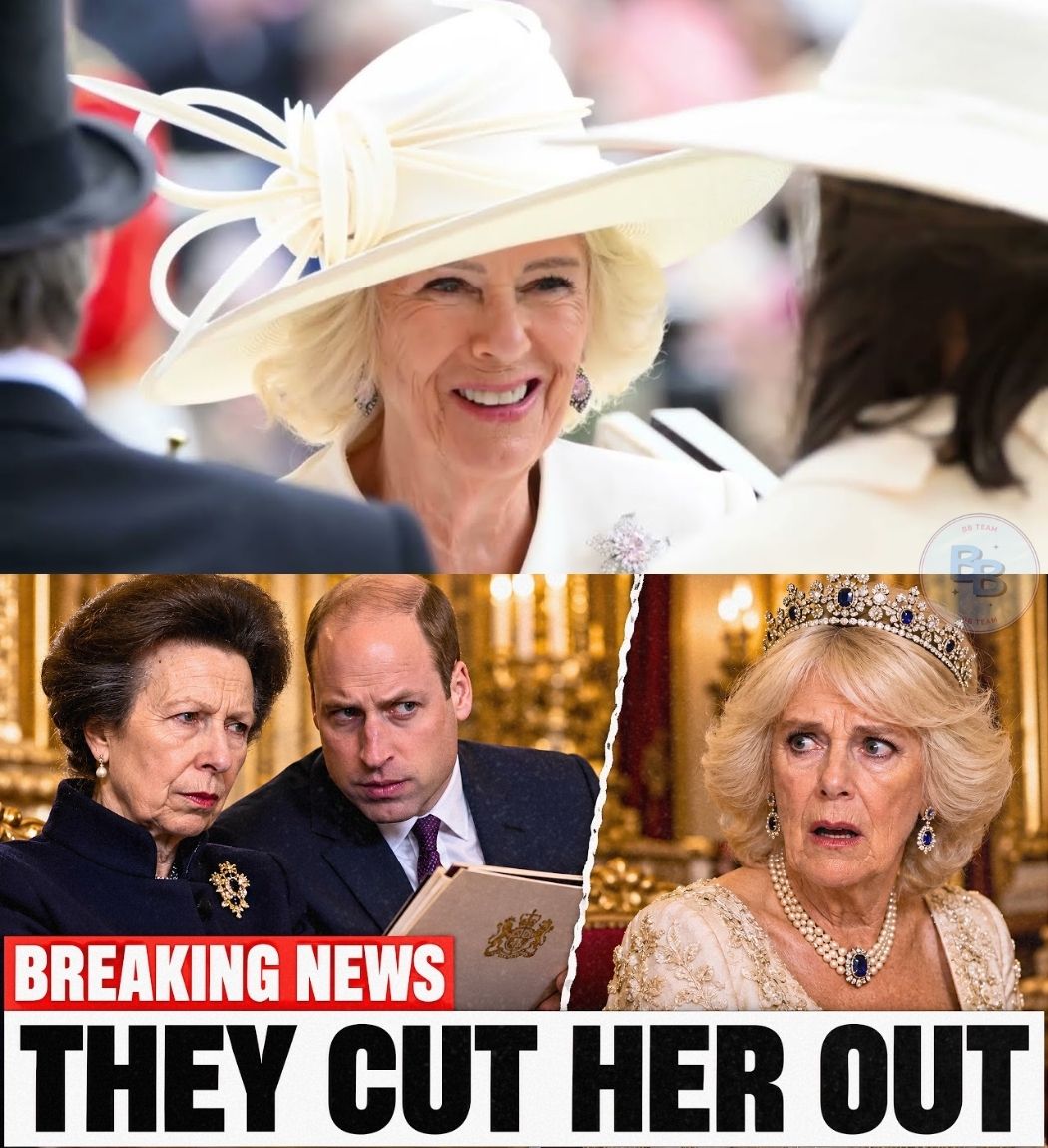
Royal Betrayal: The Secret Anne-William Pact That Left Camilla Powerless and the Palace in Absolute Chaos
The Shattered Peace of Highgrove
The morning air at Highgrove House was uncharacteristically heavy, hanging with the suffocating tension of an impending storm. To the outside world, the British Royal Family had settled into a period of cautious stability following the monumental transitions of recent years. King Charles III, steering the ship of state through turbulent modern waters, frequently relied on the steady, comforting presence of Queen Camilla by his side. Camilla had fought a decades-long battle for public acceptance, transforming from public enemy number one into a cornerstone of the modern monarchy. Yet, behind the polished oak doors and centuries-old portraits, a tectonic shift was occurring—one masterminded not by the King, but by two of the most formidable figures in the House of Windsor: Princess Anne and Prince William.
For months, whispers had circulated through the gilded corridors of Clarence House and Kensington Palace. Staff members spoke in hushed tones of late-night meetings, encrypted communications, and a chillingly deliberate freezing out of the Queen consort’s inner circle. But what began as mere court gossip exploded into undeniable reality last Tuesday evening, culminating in a confrontation so fierce it reportedly left Camilla physically shaking with fury.
The alliance between the Princess Royal and the Prince of Wales is unprecedented. Historically, royal factions formed along generational or ideological lines, but Anne—the fiercely traditional, workaholic backbone of the family—and William—the forward-thinking, PR-conscious heir to the throne—have forged a tactical partnership born of absolute necessity. They share a singular, unyielding vision: the survival of the institution at any cost. And in their calculated roadmap for the future, Queen Camilla’s influence is viewed not as an asset, but as an acute vulnerability.
The Anatomy of an Alliance
To understand how this seismic rift came to pass, one must look at the divergent philosophies colliding within the royal household. Since ascending the throne, King Charles has leaned heavily on Camilla for emotional ballast. Her counsel has been instrumental in shaping his daily schedule, staffing decisions, and public messaging. However, critics within the inner circle—spearheaded by Prince William—have long argued that this reliance has created an unhealthy echo chamber.
Prince William, deeply protective of his late mother’s legacy and fiercely analytical about public perception, has watched with growing alarm as traditional boundaries blurred. He believes that the monarchy cannot afford the luxury of personal favoritism or entangled loyalties in an era of intense economic scrutiny and declining public patience. Every misstep, every perception of self-serving palace management, threatens to unravel the fragile thread connecting the crown to the British public.
Enter Princess Anne. Known universally as the hardest-working royal, Anne possesses a razor-sharp intellect and zero tolerance for nonsense. While she and Camilla have maintained a polite, public-facing camaraderie for decades, private tensions have always simmered beneath the surface. Anne has never forgotten the collateral damage of the past, and her loyalty has always belonged exclusively to the Crown itself, rather than to any individual monarch or consort.
When William approached his aunt with a dossier outlining structural vulnerabilities within the current palace administration—specifically pointing to decisions influenced by Camilla’s long-standing loyalists—Anne did not hesitate. She recognized the threat immediately. Together, the aunt-and-nephew duo drafted a classified blueprint: a silent, systematic reclamation of royal power designed to strip away the consort’s administrative reach and pivot the monarchy back toward a strict, bloodline-centric hierarchy.
The Secret Meeting at Gatcombe Park
The turning point of this covert operation occurred on a rainy Thursday night at Gatcombe Park, Princess Anne’s sprawling Gloucestershire estate. Eschewing the formal protocols of Buckingham Palace, William drove himself to the secluded property, bypassing standard security details to ensure complete operational secrecy.
Over a quiet dinner, away from the prying eyes of courtiers and secretaries, Anne and William laid out their strategy. The plan was as brilliant as it was ruthless. They would exploit upcoming restructuring phases within the royal households to quietly reassign key personnel loyal to Camilla, replacing them with seasoned, independent civil servants and trusted aides vetted exclusively by William and Anne. Furthermore, they resolved to veto several high-profile patronages and initiatives that Camilla had spent months curating, redirecting those resources toward youth outreach and mental health initiatives overseen directly by the Prince and Princess of Wales.
Insiders report that the meeting was characterized by a chilling clarity of purpose. Neither Anne nor William harbored personal malice toward Camilla; rather, they viewed her as an obstacle to modernization and institutional survival. They concluded that if the House of Windsor was to withstand the coming decades of intense public scrutiny, the power dynamic must be irrevocably recalibrated.
Crucially, the strategy involved maintaining a facade of absolute normalcy in public. The public would see unity, handshakes, and shared balcony appearances, while beneath the surface, the operational machinery of the monarchy was being entirely re-engineered.
Camilla Discovers the Trap
No secret of this magnitude can remain buried forever, and the facade began to crack during a high-stakes budget and staffing review at Clarence House. Queen Camilla, accustomed to having direct oversight over administrative appointments and scheduling priorities, noticed an alarming pattern of institutional resistance. Key memos were being delayed; requests for staff reassignments were being quietly blocked by officials citing “new overarching directives from the Prince of Wales’s office.”
When Camilla demanded an emergency audience to address the bottlenecks, she was met not with compliance, but with a united front. Rather than dealing with a deferential bureaucracy, she found herself facing a fait accompli. The structural changes had already been rubber-stamped, backed by legal precedents and constitutional advisors who answered directly to the operational authority of the heir apparent and the Princess Royal.
The realization hit the Queen like a physical blow. This was not a bureaucratic error or a scheduling oversight; it was a coup. The realization that her stepson—a man she had watched grow up, a man she had supported through his own turbulent family crises—had systematically outmaneuvered her alongside Princess Anne sent shockwaves through her private apartments.
Witnesses to the aftermath describe a tense atmosphere at Clarence House, where the Queen’s frustration boiled over during a private briefing. To Camilla, this was a profound betrayal—an invalidation of her years of service, her emotional labor, and her hard-won standing within the royal family. She had endured public hostility, tabloid persecution, and the grueling demands of public life, only to find herself sidelined by a cold, calculated administrative maneuver executed by her own family.
The King’s Dilemma
At the epicenter of this royal civil war sits King Charles III, caught in an impossible, agonizing conflict between his wife and his bloodline. Charles has always been a man of deep sentiment, prone to emotional attachment and heavily reliant on the emotional security that Camilla provides. Yet, as reigning monarch, he is also bound by the ancient, unwritten laws of institutional preservation.
When Camilla brought her grievances to the King, demanding a formal rebuke of both William and Anne, she expected immediate support. Instead, she encountered a weary, conflicted sovereign who understood the harsh mathematical reality of his son and sister’s argument. Charles knows better than anyone that the monarchy is walking a political tightrope. He recognizes that public sentiment is fickle, and that the younger generation—represented by William and Catherine—holds the ultimate key to the institution’s long-term survival.
Sources close to the King indicate that while Charles attempted to soothe Camilla’s wounded pride, he ultimately refused to intervene or overturn the structural adjustments. His refusal was not a rejection of his wife, but an admission of defeat. He realized that fighting Anne and William on this front would trigger a catastrophic public schism, tearing the royal family apart on the global stage and handing critics the ammunition they had been waiting for.
By refusing to take a side, Charles effectively surrendered control of the transitional roadmap to the Anne-William alliance. It was a silent acknowledgment that the future of the crown no longer belonged to him and his consort, but to the ruthless pragmatism of the next generation.
The Fallout and the New Order
The shockwaves of the Anne-William strategy have already begun to reshape the daily operations of the British monarchy. At Buckingham Palace, long-serving aides who once looked to Camilla for career advancement are quietly updating their resumes or seeking lateral transfers to other departments. The power vacuum left in the wake of the restructuring has been swiftly filled by loyalists appointed directly through the joint oversight of Kensington Palace and the Princess Royal’s office.
For the public, the transition appears seamless. Royal engagements continue without interruption, charity work is highlighted across media channels, and the smiling faces on the front pages of newspapers suggest a family firmly united in purpose. But behind closed doors, the dynamic has fundamentally shifted. Camilla’s role has been subtly marginalized, reduced from a powerful co-architect of royal policy to a traditional, ceremonial figurehead whose influence is strictly monitored and contained.
This development has sent ripples of anxiety through the wider royal establishment. Courtiers who built their alliances on the assumption of a permanent, Camilla-centric power structure are now scrambling to realign themselves with the new power brokers. They have learned a harsh lesson: in the modern House of Windsor, sentimentality is a luxury, and survival belongs exclusively to those who control the levers of institutional strategy.
A Dangerous Precedent
The secret strategy engineered by Princess Anne and Prince William sets a profound and dangerous precedent for the future of the British monarchy. It demonstrates that the institution is willing to transcend personal loyalties, emotional attachments, and even the comfort of a reigning consort to protect its own self-interest.
This ruthless pragmatism may very well save the crown from future scandals and operational stagnation, but it comes at a steep human cost. It exposes the cold, mechanical reality of a family bound not just by blood or affection, but by an ancient, unrelenting corporate duty.
As Queen Camilla navigates this new, diminished reality within the royal household, the message to everyone else in her orbit is crystal clear. The monarchy has entered a new era—one where Princess Anne and Prince William hold the reins of power, and where crossing their strategic vision is a game no one can afford to lose. The crown has been secured for the next generation, but the battlefield is littered with the silent casualties of a royal coup that changed the House of Windsor forever.