ROYAL RUPTURE: Prince William’s Ruthless Confrontation Exposed as Prince Harry Driven to Tears by Hostile Public Backlashf
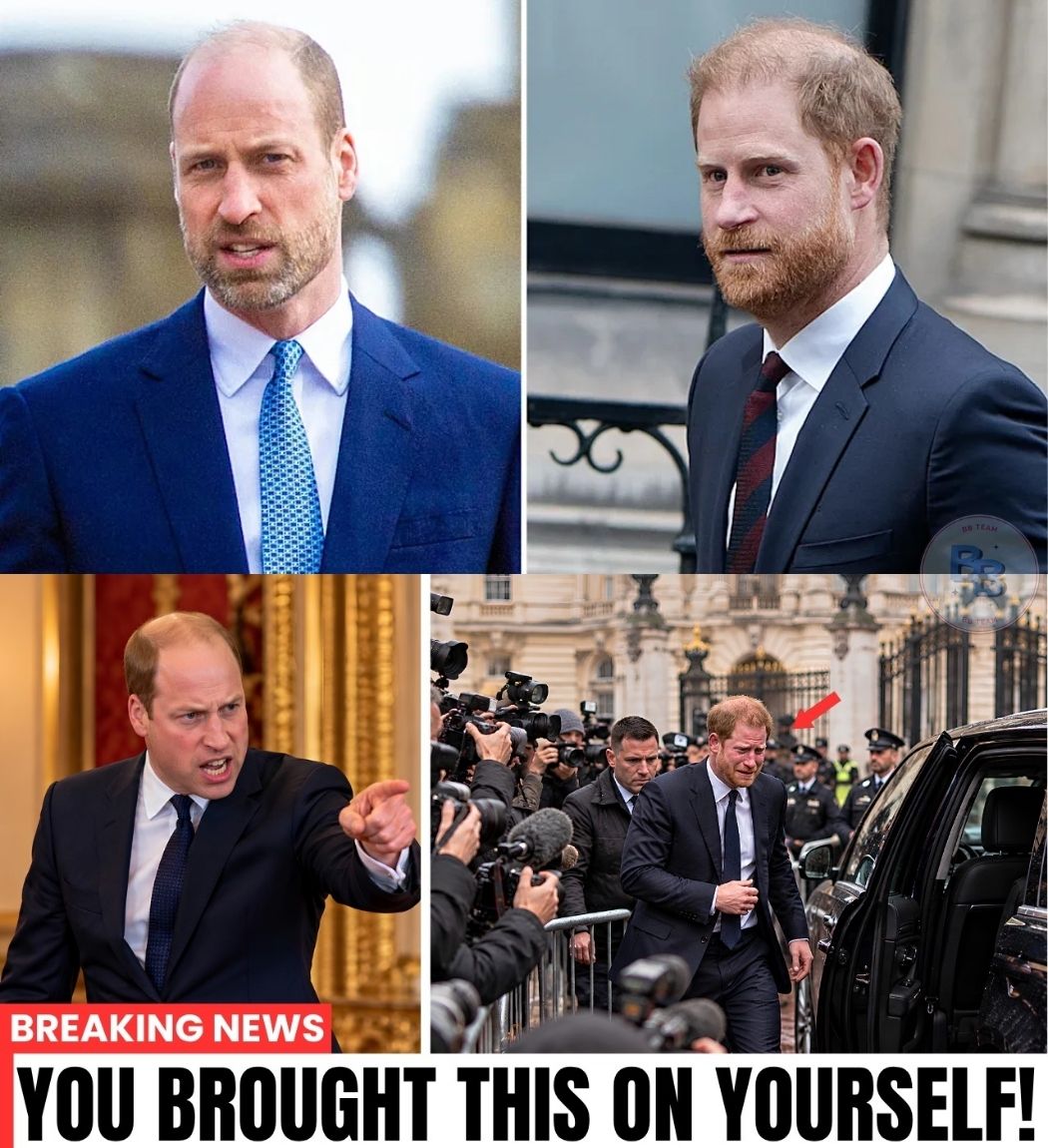
ROYAL RUPTURE: Prince William’s Ruthless Confrontation Exposed as Prince Harry Driven to Tears by Hostile Public Backlash
LONDON — The air inside the private reception suite at St. James’s Palace was thick with an unsettling silence—the kind of quiet that precedes a catastrophic storm. Outside, the distant roar of London traffic hummed against the stained-glass windows, but inside, two men stood on opposite sides of an unforgiving emotional chasm.
Prince William, the Prince of Wales, stood near the marble hearth, his posture rigid, his jaw set in a hard, unyielding line. Opposite him stood Prince Harry, the Duke of Sussex, visibly shaken, his face pale, his hands trembling slightly as he tried to compose himself following one of the most agonizing public humiliations of his adult life.
Just forty-five minutes earlier, Harry had stepped out onto the red carpet at a major UK charity gala—his first major solo appearance on British soil in months. What he anticipated as a quiet, respectful reception instead erupted into a wall of sharp, unified disapproval. As the flashbulbs strobed, a loud chorus of boos, jeers, and harsh taunts echoed from the crowded perimeter. For a prince who had spent the better part of three decades wrapped in the warm, unquestioning affection of the British public, the harsh hostility cut deeper than any tabloid headline ever could. Witnesses near the red carpet reported seeing the Duke’s eyes welling with tears before he was hastily ushered inside by security personnel.
However, if Harry expected sanctuary, solace, or sympathy behind the royal security cordon, he was gravely mistaken.
The Confrontation in the Shadows
According to multiple high-level royal aides and eye-witnesses speaking on condition of absolute anonymity, the tension had been building for hours. William had initially resisted attending the event altogether, eager to avoid a forced photo opportunity that might overshadow the cause itself. But duty demanded his presence.
When Harry retreated into the VIP holding area, visibly distressed and fighting back tears, William did not offer a comforting shoulder. Instead, the atmosphere turned instantly arctic.
“You really expected them to applaud after everything?” William’s voice tore through the quiet room, devoid of warmth, according to a senior staffer who overheard the encounter from an adjacent hallway. “You destroyed every ounce of trust this family built over generations, threw dirt at our grandfather’s legacy, humiliated our father on global television, and now you sit here looking surprised that the public remembers?”
Harry, attempting to defend his position, insisted his public statements and tell-all memoirs were simply his attempt to speak “his truth” and protect his immediate family from systemic mistreatment.
“Your truth?” William shot back, his voice rising in an explosive burst of anger that shocked even veteran royal bodyguards. “There is no ‘your truth’—there are facts, and there is betrayal! You brought this entirely on yourself! Stop playing the victim!”
The outburst marked a watershed moment in the fractured relationship between the sons of King Charles III and the late Princess Diana. For years, media observers speculated about whether a reconciliation remained possible. But in that private suite, as harsh words echoed off the gilded walls, any remaining lingering hope of brotherhood appeared to disintegrate completely.
A Public Reckoning Years in the Making
To understand the sheer volatility of the confrontation, one must look back at the dramatic trajectory of the Sussexes’ departure from working royal life. When Harry and his wife Meghan Markle announced their step-back in early 2020, the move sent shockwaves through the constitutional establishment. What began as a plan for a hybrid royal-commercial life rapidly evolved into an all-out media war.
From the explosive television interviews in California to high-profile documentary series and intimate memoirs, the couple laid bare the inner workings of the royal household. They alleged institutional neglect, media collusion, and a lack of emotional support during critical moments.
While those revelations earned them millions of supporters and lucrative media deals across the Atlantic, the reaction in the United Kingdom was vastly different. Polls consistently reflected a steep decline in popularity for the Duke and Duchess of Sussex among the British public. For millions of traditionalists, the attacks on the monarchy were viewed not as brave self-expression, but as a deep disrespect toward the late Queen Elizabeth II and the institution itself.
The hostility that boiled over at the London gala was not an isolated incident—it was the culmination of years of suppressed public frustration.
“When Harry stepped out onto that carpet, he wasn’t just walking into a camera line,” explained royal historian and veteran commentator Arthur Croft. “He was walking into a wall of public sentiment that feels profoundly aggrieved by his actions over the last several years. For a long time, Harry lived under the protection of royal PR and an affectionate public memory of his youth. That shield is entirely gone now. What happened on that red carpet was the reality of his new standing in Britain.”
The Breakdown of Brotherhood
The relationship between William and Harry was once heralded as the crown jewel of the royal brand. Bound together by the tragic, untimely death of their mother, Princess Diana, in 1997, the brothers formed a tight-knit duo that seemed unbreakable. They shared living quarters, launched joint charitable initiatives, and navigated the intense spotlight of global fame together.
Yet, behind the scenes, cracks had begun forming long before the formal split. Insiders note that differences in temperament, duties, and future destinies slowly drove them apart. As the heir to the throne, William was raised with a strict adherence to duty, institutional preserve, and long-term constitutional stability. Harry, as the second son—the so-called “spare”—often struggled with the constraints and scrutiny of his role.
When Meghan Markle entered the picture, long-standing anxieties surfaced. Clashes over staff, media strategy, and royal protocol accelerated the wedge between the households. By the time the formal separation occurred, communication between the brothers had shrunk to formal messages routed through attorneys and senior private secretaries.
“William feels a deep sense of personal and institutional betrayal,” stated a source close to the Prince of Wales. “He watched his father work tirelessly during a difficult health battle, he watched the institution endure immense pressure, and he feels that Harry’s actions made everything infinitely harder for personal gain. When William told him ‘you brought this on yourself,’ it wasn’t just anger from one evening—it was years of pent-up grief and disappointment coming out all at once.”
Tears Behind the Scenes
For Harry, the evening was a devastating reality check. Witnesses described the Duke as looking profoundly isolated during the brief minutes following the altercation.
“Harry was genuinely shaken,” noted an event staff member who witnessed the aftermath. “He has always believed that deep down, the British public still loved him, that the hostility was just noise created by newspapers and commentators. But hearing thousands of people booing him directly to his face… it shattered that illusion. You could see the realization hitting him in real-time.”
After the intense exchange with William, Harry did not stay for the main dinner. Escorted by his private security detail, he exited through a private side doors into a tinted SUV, leaving the venue long before the official speeches began.
The image of a prince—once the most popular member of the royal family—leaving a London charity event in tears and solitude offers a stark, tragic metaphor for the current state of the House of Windsor.
The Fallout at the Palace
The aftermath of the encounter has left palace officials scrambling to manage the narrative. Senior aides spent the late hours of the night attempting to downplay the severity of the argument, issuing standard statements emphasizing the success of the charity gala itself and declining to comment on private family matters.
However, behind closed doors, the mood is described as grave. King Charles III, who has consistently expressed a desire to keep the door open for his younger son, is reportedly deeply saddened by the escalating hostility between his children.
“The King is caught in an impossible position,” said a former palace official. “He loves both of his sons deeply. He wants peace in his family, especially at this time in his life. But William is the heir. William represents the future of the monarchy, and William’s stance on this issue is absolute. There can be no official return to the fold without accountability and trust—two things that feel entirely out of reach right now.”
A Divided Legacy
As news of the dramatic confrontation spreads, public opinion remains sharply divided. Critics of Prince Harry point to the evening as a long-overdue moment of accountability, arguing that freedom of speech works both ways and that public figures cannot escape the consequences of their public actions.
Conversely, supporters of the Sussexes argue that the harsh treatment of Harry demonstrates the exact toxicity and hostility that forced him to leave the country in the first place. They maintain that Harry’s candid disclosures were a necessary step toward personal healing and independence, and that the public backlash is driven by unfair media narratives.
What remains undisputed, however, is that the rift between the royal brothers has reached a point of no return.
As the night drew to a close in London, the contrast could not have been starker. Inside the glittering halls of the palace, Prince William resumed his duties, mingling with donors and civic leaders, executing his role with flawless composure. Outside, speeding toward an airfield on the outskirts of the city, Prince Harry sat in the dark interior of a car, left alone with the echoes of a hostile crowd and the burning words of a brother who has closed the door for good.
The fairy-tale image of the two young princes walking shoulder-to-shoulder behind their mother’s coffin is now officially a memory of a bygone era. In its place stands a harsh, unforgiving reality: a house divided, a public divided, and a brotherhood shattered beyond repair.