“The Claridge’s Cover-Up: How Malala Was Ambushed in Meghan’s Calculated Paparazzi Trap—And the CCTV Proof That Changes Everything!”
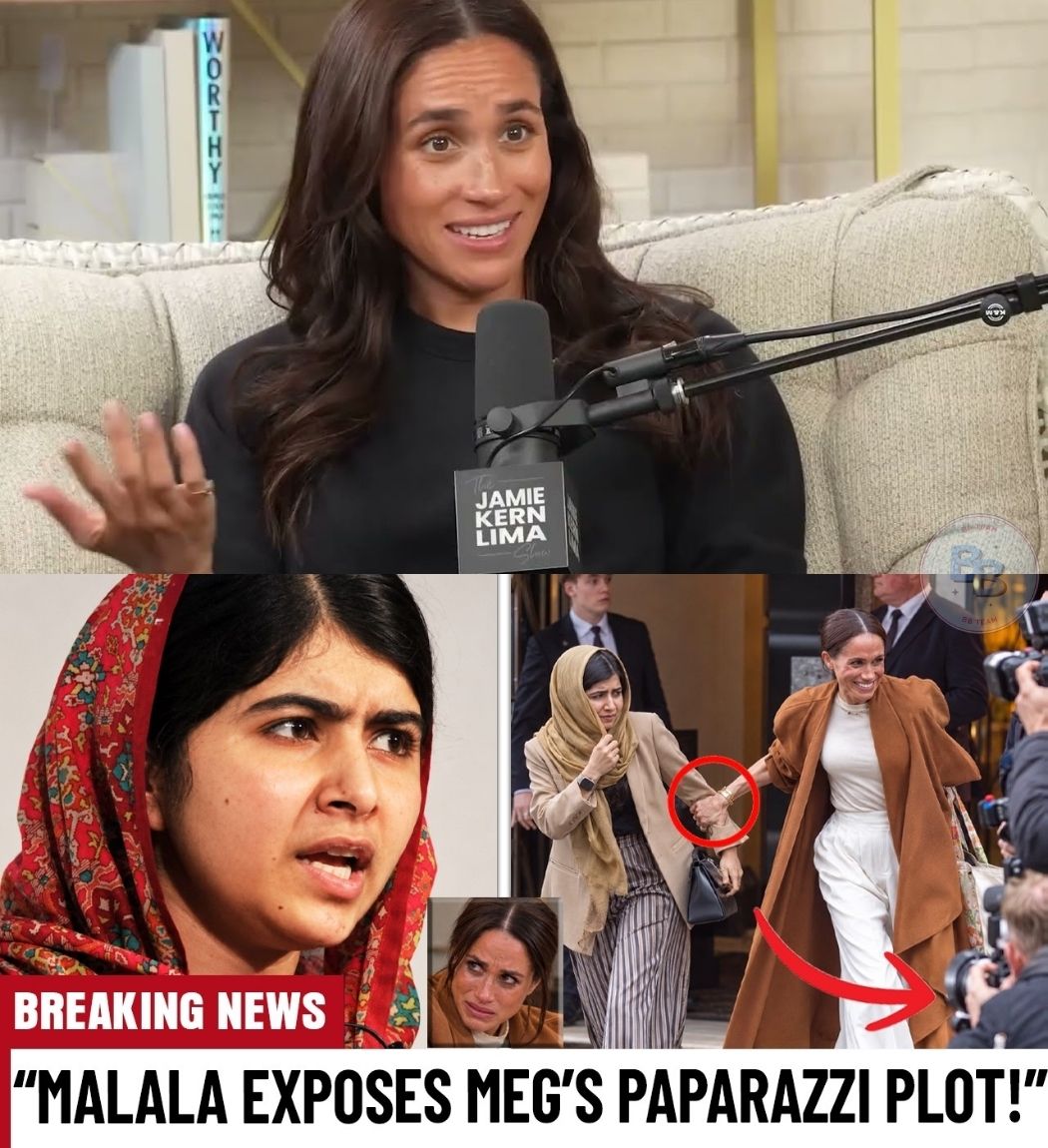
“The Claridge’s Cover-Up: How Malala Was Ambushed in Meghan’s Calculated Paparazzi Trap—And the CCTV Proof That Changes Everything!”
The autumn air outside London’s iconic Claridge’s hotel was crisp on that fateful Tuesday evening, carrying the usual murmurs of high society, slipping chauffeurs, and the distant, rhythmic hum of London traffic. It was supposed to be a private gathering of global change-makers, a sanctuary of intellect and quiet philanthropy. But within minutes of the doors swinging open, the tranquil evening transformed into a media circus of blinding flashbulbs, shouted questions, and a fabricated storm of controversy. At the center of the tempest stood two women whose public personas could not be more starkly contrasted: Malala Yousafzai, the Nobel Peace Prize laureate whose life has been defined by quiet courage, resilience, and genuine global impact, and Meghan Markle, the Duchess of Sussex, whose every move continues to polarize public opinion across continents.
For hours, the narrative spun by mainstream tabloids and social media echo chambers was swift and unforgiving. The headlines shrieked of another manufactured celebrity sighting, a carefully choreographed photo opportunity designed to keep the Sussex brand relevant in an increasingly cynical media landscape. Commentators across digital platforms tore into Meghan, accusing her of exploiting Malala’s pristine global reputation for a calculated PR redemption arc. Public outrage swelled instantly; Twitter threads erupted into fiery debates, TikTok creators dissected every micro-expression, and royal commentators branded the encounter as a desperate, staged maneuver.
Yet, beneath the glossy sheen of manufactured outrage and viral speculation lay a much darker, far more calculating reality. Hidden from the immediate view of the public and the swarming paparazzi was a web of pre-arranged communications, secret logistical briefings, and a security apparatus that had been quietly compromised from within. The narrative that Meghan was merely caught off guard by aggressive photographers quickly began to unravel. Confidential leaks from venue insiders, combined with an undeniable piece of high-definition digital evidence, have now blown the lid off the entire affair. This was never a chance encounter. This was a trap.
To understand the magnitude of the Claridge’s betrayal, one must examine the meticulous choreography that preceded the event. Industry insiders with direct ties to high-end London hospitality have revealed that the gathering at Claridge’s was subject to rigorous, non-disclosure-level privacy protocols. Guests of Malala’s stature do not simply walk into public lobbies without comprehensive security sweeps and advance coordination. Every arrival is timed down to the minute; every exit route is scouted to safeguard high-profile attendees from security vulnerabilities and unsolicited media intrusions.
On the evening in question, however, those protocols experienced a catastrophic, unexplained failure. Security logs from the hotel’s private back-of-house entrances indicate that alternative, secure departures were explicitly bypassed. Instead, whispers from production assistants and event coordinators suggest that a sudden, last-minute directive was issued from within the Sussex camp, steering the group directly toward the primary, media-saturated foyer.
Witnesses on the scene noted the uncanny, almost supernatural precision of the paparazzi presence. These were not freelance photographers casually loitering on the off-chance of scoring a lucky shot. They were positioned with professional lighting equipment, standing in pre-calculated arcs that maximized lens exposure, perfectly framing both women against the iconic backdrop of the hotel entrance. The telltale rapid-fire shutter clicks did not sound like the chaotic scramble of a surprise ambush; they resonated with the rhythmic, synchronized cadence of a professional photo call.
As the flashbulbs illuminated the grand foyer, the body language between the two figures told a silent, agonizing story. Malala, who has spent her life navigating high-stakes geopolitical arenas and speaking before world leaders, appeared visibly disoriented, her polite smile masking an unmistakable confusion as she realized the intimate gathering had been weaponized into a media spectacle. Beside her, Meghan moved with the practiced grace of a seasoned Hollywood veteran, seamlessly angling her body toward the primary camera lenses, projecting an aura of composed serenity that felt entirely detached from the sudden chaos enveloping the room.
For nearly twenty-four hours, the public accepted the surface-level drama. The internet raged against the perceived narcissism of the spectacle, with critics arguing that Meghan had once again overshadowed a champion of human rights for her own personal gain. But behind closed doors, a digital reckoning was quietly taking place. Malala’s inner circle, fiercely protective of her global mission and integrity, immediately launched an internal inquiry into how a private philanthropic dinner had devolved into a tabloid ambush.
That inquiry led directly to the security control room of Claridge’s hotel, where state-of-the-art closed-circuit television cameras record every square inch of the premises in pristine, high-definition clarity. What the security footage revealed has sent shockwaves through elite circles in both London and Los Angeles, permanently altering the narrative of the evening and exposing a level of strategic manipulation that stunned even the most cynical media observers.
The CCTV footage, fragments of which have been described by multiple independent sources with direct access to the investigation, provides an undeniable smoking gun. Far from being an accidental convergence in a crowded lobby, the video timeline documents a deliberate sequence of events orchestrated by members of Meghan’s immediate entourage.
The recording captures a senior member of the Sussex communication team engaging in direct, animated conversations with known tabloid photographers stationed outside the primary perimeter more than twenty minutes before Malala even arrived at the venue. The footage shows explicit hand gestures mapping out entry points, blocking schedules, and specific positioning requirements to ensure optimal visual framing. Most damningly, the video records a digital transmission—a real-time update sent from inside the private VIP holding area to the photographers outside, signaling the exact second the doors would open and specifying which direction the women would walk.
When confronted with the implications of this digital evidence, the facade of coincidence crumbled entirely. This was not a passive byproduct of fame; it was an active, premeditated production. Meghan had not merely tolerated the cameras—she had hired them, orchestrated their placement, and maneuvered Malala Yousafzai into the line of fire without her knowledge or consent.
The revelation has ignited a firestorm far more severe than the initial wave of social media criticism. For Malala’s supporters, the incident is viewed as a profound betrayal of trust—an egregious violation of professional ethics where a respected global icon was weaponized as a prop to generate positive engagement and rehabilitate a slipping public image. Humanitarian organizations and educational foundations closely aligned with Malala have expressed quiet outrage, noting that public figures who lend their platforms to collaborative ventures expect basic professional courtesy and respect for boundaries, not clandestine media setups.
Conversely, the fallout for the Sussex camp has been swift and merciless. Crisis management teams in California have reportedly entered emergency mode, scrambling to draft statements and suppress the spreading details of the CCTV bombshell. Yet, in the digital age, information travels faster than PR spin can neutralize it. Major news outlets that previously offered sympathetic coverage are now reassessing their relationships with the Sussex brand, recognizing that participating in such manufactured spectacles compromises journalistic integrity.
The broader cultural implications of the Claridge’s incident extend far beyond the immediate personalities involved. It serves as a sobering case study in the modern attention economy, where genuine human rights advocacy and superficial celebrity culture collide with devastating consequences. In an era where algorithms reward sensationalism and outrage, authenticity has become a rare, endangered commodity. The manipulation of a Nobel laureate for the sake of a fleeting headline highlights the desperate lengths to which modern public figures will go to maintain relevance in a saturated media landscape.
As the dust begins to settle on this explosive chapter, the damage to public trust appears irreversible. The narrative has shifted permanently from a simple celebrity sighting to a calculated breach of ethical boundaries. Malala Yousafzai continues her vital global work, rising above the noise with the dignified silence that has always defined her character, untainted by the manufactured drama that sought to exploit her.
Meanwhile, the shadow of the Claridge’s CCTV bombshell looms large over the future of the Sussex brand. It serves as an unshakeable reminder that in the age of digital surveillance and relentless media scrutiny, secrets cannot remain buried forever. The cameras may have been hired, the angles may have been practiced, and the trap may have been set with surgical precision—but the truth, captured in cold, unblinking high-definition, has finally broken free, exposing the mechanics of fame at its most ruthless and calculated. The public will not forget this betrayal easily, and the ripples of that single evening will continue to reshape the landscape of celebrity journalism for years to come.