The Royal Erasure: Charles Bans Diana’s Portrait as William Triggers a 20-Year Palace War
The Royal Erasure: Charles Bans Diana’s Portrait as William Triggers a 20-Year Palace War
Introduction: The Ghost That Still Haunts the Monarchy
Beneath the glittering chandeliers and the centuries-old tapestry of solemn tradition that defines the British monarchy, a silent, bitter war has been quietly raging for two decades. It is a conflict fought not with swords or open declarations of hostility, but with closed-door decrees, frozen silences, cold-shouldered public appearances, and strategic leaks to a hungry global press. At the epicentre of this quiet tempest stand two towering figures of the House of Windsor: King Charles III, the reigning sovereign burdened by the complex legacy of his past, and Prince William, the Prince of Wales, a fiercely protective son caught between loyalty to the Crown and devotion to the eternal ghost of his mother, Diana, Princess of Wales.
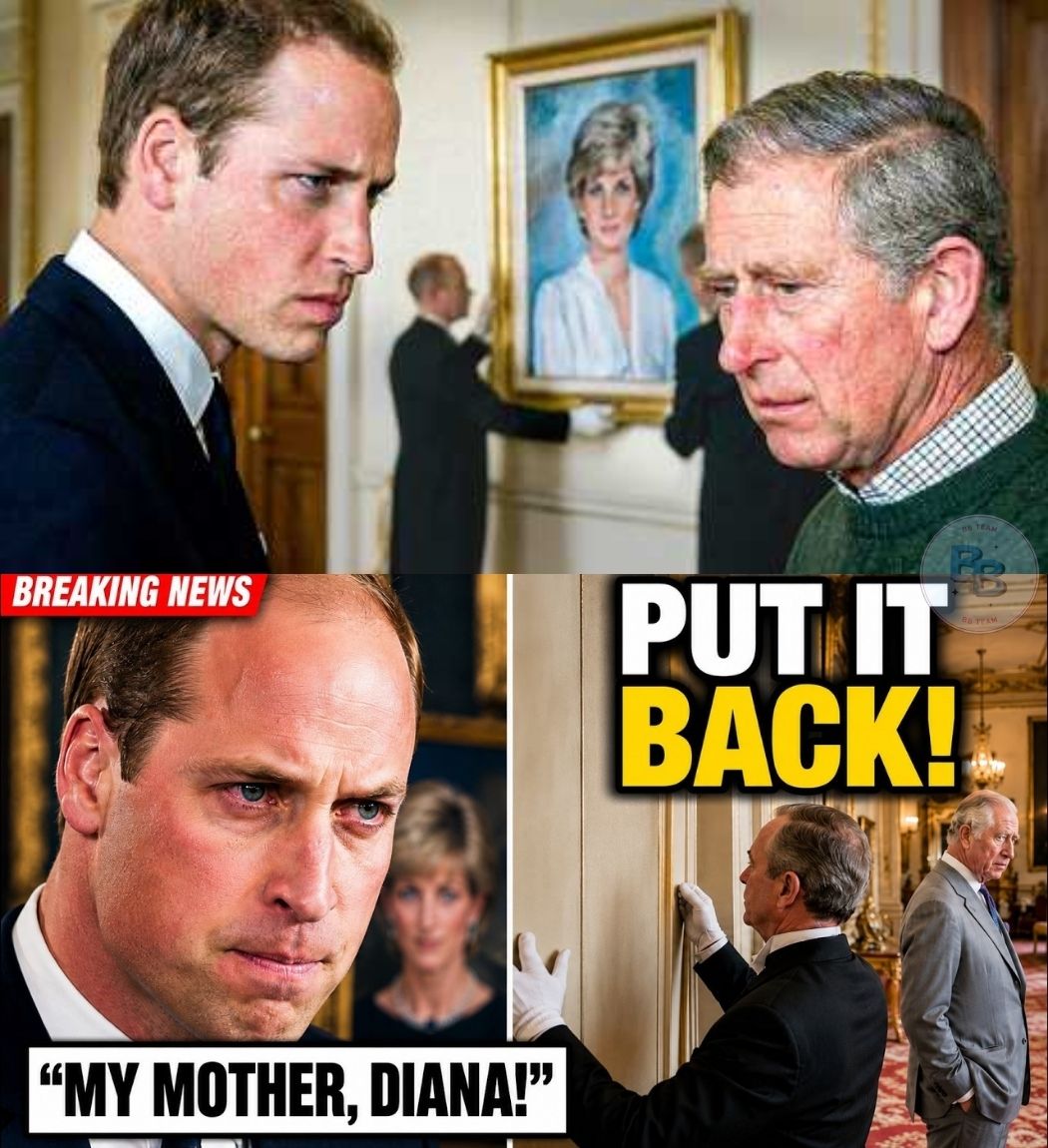
The fragile peace that has long held the royal family together fractured irreparably behind the heavy oak doors of Clarence House and Buckingham Palace. Rumors had circulated for months within high-society circles, whispered behind gloved hands at royal garden parties and murmured in executive boardrooms. Yet, no one outside the innermost circle of courtiers was prepared for the sheer audacity of the royal decree: King Charles reportedly ordered a deeply revered, historic portrait of Diana, Princess of Wales, to be permanently removed from public exhibition spaces and relegated to the deep, lightless vaults of the royal archives.
To the sovereign, this was framed as a necessary administrative realignment, a quiet curation of gallery space for a modernizing monarchy. To the rest of the world, however, and most violently to Prince William, it was interpreted as something far more sinister: an institutional attempt at historical revisionism, a final, spiteful act of erasure aimed at banishing the People’s Princess from the very institution she helped modernize and rescue from irrelevance. What followed was not mere disagreement, but an absolute structural shockwave—a confrontation so intense it threatened to permanently fracture the father-son bond and lay bare the deep, unhealed fractures running through the heart of the British Crown.
The Secret Decree: Rewriting the Royal Gallery
The genesis of this explosive showdown can be traced back to a quiet Tuesday morning inside the private administrative offices of the royal collection. For years, curators and senior advisers had debated the layout of the state rooms across the royal residences, weighing historical significance against modern public appeal. However, the decision regarding Diana’s portrait was far from bureaucratic; it was deeply personal and politically charged.
The portrait in question was no ordinary piece of art. Painted during the height of Diana’s global influence—a breathtaking oil-on-canvas masterpiece that captured both her vulnerable melancholy and her magnetic charisma—it had served as a pilgrimage point for millions of tourists and admirers from across the globe. For decades, standing before her likeness felt like an unspoken acknowledgment of her enduring spirit within the palace walls.
According to high-ranking palace insiders who spoke on the condition of strict anonymity, the directive came directly from the King’s private office. Charles, acutely sensitive to his public image and determined to cement his own legacy alongside Queen Camilla, reportedly viewed the prominent display of his late first wife as an unwelcome distraction from his current reign. Court sources whispered that every time foreign dignitaries or high-profile guests toured the private wings, conversations invariably drifted away from Charles’s environmental initiatives and modernizing reforms, returning instead to the enduring mythos of Diana.
For a monarch striving to project absolute authority in an era of intense public scrutiny, this perpetual eclipse by a ghost proved intolerable. The order was given with cold administrative efficiency: remove the portrait, catalog it, and secure it in the climate-controlled archives where only archivists and trusted curators would ever lay eyes on it again. But in a digital age where nothing stays hidden for long, the disappearance of the canvas did not go unnoticed. Within forty-eight hours, sharp-eyed royal watchers and palace staff realized the painting was gone, sparking an immediate firestorm of speculation, outrage, and institutional panic.
Prince William’s Fury: The Heir Strikes Back
If King Charles anticipated a quiet, compliant acceptance of his executive decision, he severely miscalculated the emotional fortitude and political maturity of his eldest son. Prince William, who has spent his entire adult life guarding his mother’s legacy like a sacred trust, did not learn of the removal through official bureaucratic channels. Instead, he discovered the empty wall space during an unannounced private visit to the residence, accompanied by senior aides.
Eyewitnesses to the immediate aftermath describe a scene of chilling, controlled fury. Unlike his younger brother, Prince Harry, whose public outbursts often involved television interviews and tell-all memoirs, William operates with the calculated precision of a future king. Yet, the raw emotional weight of the insult proved staggering. To William, removing Diana’s portrait was not merely an interior design choice; it was a direct, calculated assault on the memory of the woman who birthed the future of the monarchy, a woman whose tragic death left a permanent scar on his soul.
William immediately demanded an emergency audience with his father. What transpired behind closed doors during that fateful summit has been fiercely guarded by palace PR teams, but multiple sources close to both households have confirmed that the confrontation was the most violent verbal clash the father and son have ever experienced.
William reportedly accused the King of petty jealousy, institutional cowardice, and an inability to escape the shadow of the past. He made it unequivocally clear that attempting to erase Diana from the historical narrative of the Windsor family would not only fail, but would actively trigger a devastating public relations catastrophe for the Crown. William’s argument was sharp and pragmatic: the public does not forgive attempts to rewrite history, and any perceived cruelty toward Diana’s memory would instantly alienate the younger generations of Britons who view her as a saintly martyr.
The standoff reached a boiling point when William reportedly delivered an ultimatum: either the decision regarding the historical curation of royal portraits is handled with transparency and mutual respect, or the Prince of Wales would find a public platform to make his own stance unmistakably clear. Faced with the very real prospect of an open, explosive family civil war that could shatter the monarchy from within, the King’s advisors scrambled for damage control. Yet, the damage to their relationship was already done, deepening a rift that has quietly defined their dynamic for years.
The Twenty-Year Power Struggle: Two Visions for the Crown
To fully understand the magnitude of this portrait dispute, one must examine the twenty-year cold war that has simmered between Charles and William. This is not merely a clash of personalities between a father and son; it is an ideological war over the very survival and soul of the British monarchy in the twenty-first century.
Ever since the tragic events of August 1997 in the Pont de l’Alma tunnel in Paris, the House of Windsor has operated under a constant state of siege. Charles spent decades painstakingly rebuilding his public reputation, moving from a deeply unpopular divorced prince to a respected monarch. His vision for the monarchy has always been traditional yet adaptive—a slimmed-down core of working royals, focused on institutional longevity, grand statecraft, and dignified continuity. Charles views the institution as a sacred, unbroken chain of sovereignty where individual personalities must ultimately serve the greater glory of the Crown.
Prince William, however, represents an entirely different philosophical paradigm. Shaped profoundly by Diana’s hands-on, empathetic, and radically human approach to public service, William views the monarchy through the lens of modern relevance and emotional authenticity. Where Charles sees protocol and tradition, William sees accessibility and mental health advocacy, homelessness initiatives, and direct connection with ordinary citizens.
This ideological divergence has repeatedly manifested as a silent turf war. Over the past decade, William has systematically asserted his independence, demanding greater financial autonomy through the Duchy of Cornwall, building his own formidable team of seasoned advisors, and frequently bypassing traditional Clarence House channels to chart his own course.
The battle lines have thus been drawn along generational and philosophical lines. Charles, surrounded by traditional courtiers who remember the turbulent years of the War of the Waleses, remains fiercely protective of his own historical narrative. He wants his reign to be remembered for his decades of environmentalism, his championing of multi-faith harmony, and his successful ascent to the throne alongside Queen Camilla.
William, conversely, acts as the vigilant guardian of the Diana doctrine. He understands that the modern monarchy cannot survive on pomp and circumstance alone; it must ground its legitimacy in the populist, emotional connection that his mother perfected. Every time Charles attempts to minimize Diana’s footprint within the institutional memory, William perceives it as an existential threat to the very foundation upon which his own future popularity rests.
The Public Outcry and the Media Firestorm
As word of the portrait’s disappearance leaked from palace corridors to the front pages of national newspapers, the public reaction was instantaneous and unforgiving. Social media platforms erupted with viral threads, trending hashtags, and fierce debates over the ethics of royal historical curation.
Royal commentators and historians were sharply divided. Traditionalists argued that a reigning monarch has absolute prerogative over the decoration and curation of private royal residences, asserting that constant public fixation on Diana prevents the current King from establishing his own independent identity. They contended that keeping her likeness omnipresent traps the institution in an eternal loop of 1990s trauma and scandal.
On the other side of the spectrum, populist commentators and royal experts unleashed blistering critiques against the Palace. They pointed out that Diana remains the single most globally recognized and beloved figure in modern British history, and any attempt to sanitize her from the royal narrative plays directly into accusations of institutional insecurity and callousness. Editorial boards questioned the wisdom of alienating the millions of loyal subjects who still leave floral tributes outside the gates of Kensington Palace every year on the anniversary of her passing.
The mainstream media’s relentless focus on the feud placed unprecedented pressure on Buckingham Palace’s communications team. Refusing to issue a direct denial, the Palace resorted to vague, carefully worded statements emphasizing that “continuous curation and rotation of artwork within the Royal Collection is a standard, ongoing procedure designed to preserve and showcase the vast historical artifacts of the nation.”
However, this diplomatic boilerplate failed to quell the storm. The public saw right through the corporate-speak, interpreting the defensive posture as confirmation of internal discord. Insiders reported that the King was deeply rattled by the intensity of the backlash, realizing too late that underestimating public devotion to Diana’s memory is a fatal political miscalculation.
Conclusion: The Unbreakable Shadow
As the dust begins to settle over the grand halls of the royal residences, the fallout from this twenty-year power struggle leaves the British monarchy at a fascinating and perilous crossroads. The attempted removal of Princess Diana’s portrait was intended as a quiet administrative housekeeping measure by King Charles III, but it instead ignited a roaring bonfire that illuminated the deep, unresolved trauma at the core of the Windsor family.
More than anything, this crisis has demonstrated the unyielding reality of Diana’s enduring legacy. Nearly thirty years after her tragic death, she remains the most powerful ghost in British history—a magnetic force capable of shaking the throne to its foundations and driving a wedge between a reigning monarch and his heir.
Prince William’s fierce, unyielding defense of his mother’s memory sends an unmistakable message to the establishment: the future of the monarchy belongs to those who embrace its modern, emotional reality, not those who seek to lock the past away in dark vaults. As William prepares to eventually inherit the crown, the shadow of Diana will not fade into obscurity; rather, it stands as the ultimate benchmark by which his own reign will be judged.
The throne may belong to Charles today, but the soul of the modern British monarchy, anchored securely in the memory of the People’s Princess, remains fiercely guarded by her eldest son. The war between the old guard and the new era is far from over, and the ghost of Diana continues to rule from the shadows.