The SAS Operation So Secret, Even The Americans Were Only Told The Body Count
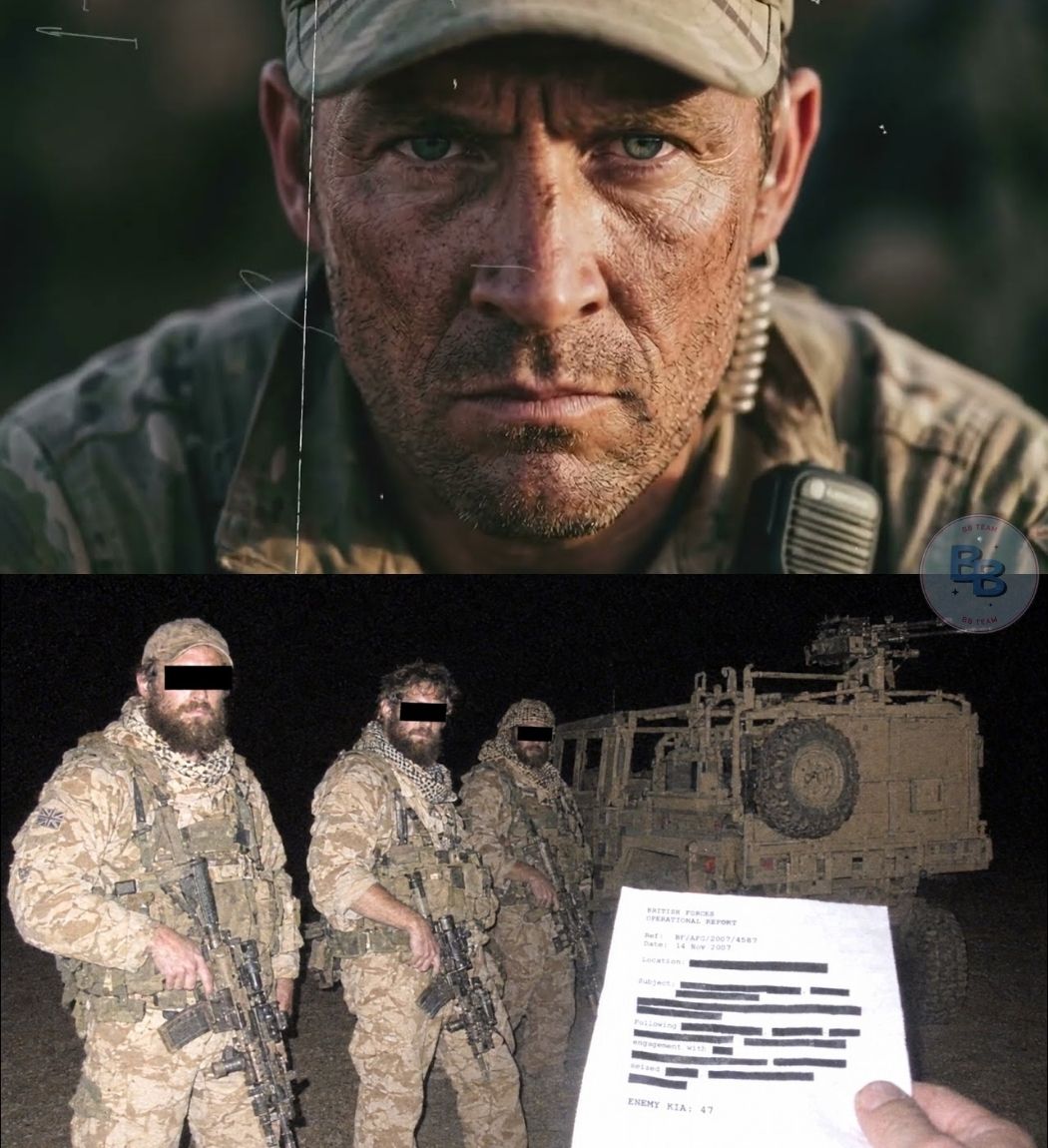
The Ghost Protocol: Inside the Ultra-Secret SAS Mission So Dangerous Even the Pentagon Was Only Handed the Body Count
The briefing room in Hereford was always cold, but on that October night in 1988, the chill had nothing to do with the weather and everything to do with the silence. There were no maps pinned to the corkboards. There were no aerial photographs of enemy compounds, no designated landing zones, and no tactical withdrawal routes. There was only a single man standing at the head of the long oak table: Commander Arthur Vance, a senior official whose very presence meant that whatever was about to be discussed existed in the absolute darkest corners of statecraft—the space where international law dissolved and survival was the only metric that mattered.
Twelve men sat before him. They were veterans of the Falklands, Northern Ireland, and covert operations across the globe whose names and service numbers had been scrubbed from standard military registries. They were the tip of the spear, the British Special Air Service’s most lethal subterranean unit. Vance did not waste time with pleasantries. He opened a plain brown Manila folder, slid twelve identical photographs across the polished wood, and spoke the words that would rewrite their understanding of warfare.
“Gentlemen, forty-eight hours ago, an experimental British reconnaissance payload vanished inside a contested border zone in Eastern Europe. More importantly, a rogue faction within a hostile intelligence network has secured a biological agent so volatile it could render an entire capital city uninhabitable within hours. The official diplomatic stance is that we have no personnel in the region. The Americans have been informed that we are observing the perimeter. That is a lie. The Americans do not know what you are walking into, and under no circumstances will they be told. Your objective is total containment. If you encounter resistance, eliminate it. If you are captured, Her Majesty’s Government will disavow your existence before your boots hit the ground. Your only communication back to command will be a numerical code representing total operational status. If the mission succeeds, the world will never know. If it fails, your families will be told you died in a training accident. God help you all.”
This was the genesis of Operation Nightfall—a mission so profoundly classified, so legally and morally radioactive, that even the United States, Britain’s closest intelligence ally, was kept strictly in the dark. The CIA station chief in London was fed fabricated satellite telemetry indicating minor border skirmishes, while the true operators moved like ghosts across invisible lines. The Americans were given only one thing as the hours ticked down: a secure teletype feed that would receive nothing more than a running body count. No explanations. No tactical updates. Just numbers ticking upward in the dark.
To understand why Operation Nightfall demanded such extreme compartmentalization, one must look at the shifting tectonic plates of the late Cold War. The collapse of the Soviet Union was not happening overnight; it was fracturing from the inside out, creating black markets where nuclear triggers, chemical weapons, and high-tech espionage gear were being auctioned off to the highest bidder. The British government had received intelligence that a syndicate of rogue former military officers and deep-cover operatives had established a subterranean laboratory inside an abandoned Soviet-era bunker complex buried deep beneath a remote mountain range.
The facility, known internally as “Object 77,” was built to withstand a tactical nuclear strike. It was shielded from electronic surveillance, making conventional drone reconnaissance or satellite imaging completely useless. The only way to verify the threat—and neutralize it—was to send boots on the ground. But sending regular military forces would trigger an international incident of catastrophic proportions. Sending conventional intelligence agents would result in a bloody execution in a basement. The only viable option was the SAS, operating under a mandate of absolute deniability.
The team was led by Captain Marcus “Mac” Vance, a seasoned operative whose cold exterior masked a tactical brilliance forged in the crucible of urban counter-terrorism. Under his command were eleven specialists: breaching experts, communications ghosts who could tap into encrypted analog lines without leaving a trace, medics capable of battlefield surgery in pitch darkness, and marksmen who viewed combat as a science of pure mathematics.
Their infiltration began under the cover of a freezing, moonless night. Strapped into the back of a modified, unmarked RAF transport plane flying at treetop level to evade radar detection, the team performed a high-altitude low-opening (HALO) jump into a dense, unforgiving pine forest miles away from Object 77. The descent was harrowing. Gale-force winds whipped through the mountain canyons, threatening to slam the operators into jagged rock faces before their chutes could deploy. Sergeant Thomas “Sully” Sullivan, the team’s veteran Pathfinder, touched down first, instantly rolling into a deep snowdrift to absorb the bone-jarring impact. One by one, the shadows descended, packing away their nylon wings with practiced efficiency, checking their suppressed carbines, and vanishing into the freezing wilderness.
The trek to the objective was a grueling twelve-hour march through hostile territory. They moved in staggered columns, stepping only on stone or frozen earth to avoid leaving footprints in the fresh snow. Every breath turned to thick plumes of white vapor that vanished into the howling wind. They communicated entirely through hand signals and subtle clicks on their throat-mic radios. There was no room for error. A single cough, a single snagged strap on a pine branch, could alert the mechanized patrols roaming the outer perimeter of the valley.
By dawn, they reached the cliffside perimeter of Object 77. The entrance was disguised as a derelict maintenance shack used by local forestry workers, but beneath the rotting wooden floorboards lay a heavy hydraulic blast door secured by a digital keypad and a pneumatic locking mechanism.
This was where the mission’s technical genius came into play. Corporal David “Byte” Miller, the team’s signals intelligence specialist, stepped up to the panel. Instead of trying to hack the encrypted system—which would have tripped a silent alarm at a regional command post miles away—Miller deployed a custom-built, hand-cranked electromagnetic pulse generator designed to short-circuit the locking relays without cutting power to the internal security cameras. With a dull, metallic thud, the pneumatic bolts retracted. The heavy steel door groaned open, releasing a wave of stale, chemical-tainted air from the subterranean depths below.
The descent into Object 77 was like stepping into the mouth of an industrial beast. The complex was a labyrinth of echoing concrete corridors, flickering fluorescent lights, and humming ventilation shafts. The team moved with lethal fluidity, clearing intersections in pairs, slicing the pie of every doorway, and sweeping rooms with practiced precision. For the first two hours, the facility was eerily quiet. The workstations were abandoned mid-shift, coffee cups still half-full on metal desks, computer monitors glowing with endless lines of incomprehensible Cyrillic code.
However, as they descended deeper into the sub-levels, the atmosphere changed. The air grew thick, heavy with the unmistakable metallic tang of ozone and biological preservatives. The hum of the ventilation system gave way to a low, rhythmic throbbing sound—the sound of heavy industrial machinery operating in the deep bowels of the mountain.
It was on Sub-Level 4 that the silence was shattered.
As the lead element rounded a corner leading to the central containment lab, a pair of armed guards wearing unmarked black tactical gear stepped out from an alcove. There was no hesitation. Captain Mac Vance’s suppressed carbine coughed twice. The guards dropped before they could raise their weapons. But the sound, muffled though it was, echoed down the long concrete corridor, triggering an automated klaxon. Red emergency lights flashed to life, casting a bleeding, demonic hue over the sterile white walls.
The element of surprise was gone. Object 77 was waking up.
Within seconds, the facility transformed into a shooting gallery. Armed mercenaries—mercenaries belonging to a private military corporation tied to international arms syndicates—poured out of side barracks and security checkpoints, firing blindly down the narrow corridors. The SAS operators immediately dropped to prone positions, utilizing corners and steel door frames as cover.
“Contact left! Contact front!” Sullivan roared over the tactical net, his rifle barking rhythmically as he laid down suppressive fire.
What followed was a brutal, close-quarters firefight fought in the blinding glare of strobe lights and the deafening roar of automatic gunfire. In the tight confines of the subterranean bunker, bullets ricocheted off concrete walls with terrifying velocity, sending jagged sparks flying through the air. The operators moved with chilling synchronization, bounding forward in pairs—one firing to pin the enemy down while the other maneuvered to flank their position.
Room by room, corridor by corridor, the SAS carved a path through the resistance. The mercenaries fought with fanatical desperation, clearly aware that failure meant execution by their own employers. But they were facing a unit whose members had trained for years in the art of surgical violence. Every corner was cleared with a flash-bang grenade and a precise double-tap. Every doorway became a killing zone.
Back at the command bunker in Hereford, and inside the secure monitoring room at the CIA’s Langley headquarters, the reality of the engagement was measured in cold, sterile digits on a screen.
The CIA station chief stared at the encrypted teletype terminal as the first update printed across the glowing green phosphor display:
OP-NIGHTFALL: ENGAGEMENT CONFIRMED. HOSTILE CONTACT. STATUS: ONGOING.
Ten minutes later, the first numerical update arrived:
BODY COUNT: 4
The American officers exchanged uneasy glances. They had been told the British were merely conducting a reconnaissance sweep of an abandoned listening post. Reconnaissance sweeps did not generate four enemy fatalities within the first twenty minutes. The station chief immediately drafted an urgent request for clarification, sending it up the chain of command. The reply from London was swift, cold, and absolute: Maintain observation posture. Do not intervene. Await further instructions.
Back inside Object 77, the battle was reaching its climax. Captain Vance and his remaining operators had fought their way to the primary research laboratory on the lowest subterranean level. The lab was a massive, vaulted chamber dominated by a cylindrical glass containment vessel at its center. Inside the vessel, swirling in a dense, pale green mist, was the biological payload—a pathogen designed to attack the respiratory system with terrifying speed.
Guarding the laboratory control console was the commander of the syndicate forces—a scarred, cold-eyed former Spetsnaz officer named Colonel Yuri Volkov. Standing beside him was a terrified civilian scientist whose hands hovered over a self-destruct keyboard linked to a chemical dispersal charge.
“Stop right there, Captain!” Volkov shouted in heavily accented English, his pistol pressed firmly against the scientist’s temple. “One step further, and I release the valve. Within thirty seconds, this entire mountain will become a mass grave, and the toxic plume will reach the border towns by morning.”
The team froze. They were spread across the entrance of the lab, weapons trained on Volkov and his remaining two bodyguards. The air in the room was suffocatingly tense. A single stray bullet could shatter the glass cylinder or trigger the dispersal mechanism, turning the mission into an apocalyptic disaster.
Captain Vance lowered his rifle barrel just an inch, his eyes locked onto Volkov’s. His voice was steady, utterly devoid of fear. “You think you can use that as leverage, Colonel? Let me explain something to you about the men standing behind me. We aren’t conventional soldiers. We don’t negotiate with terrorists, and we don’t play politics. If you touch that keyboard, the last thing you will see is a bullet tearing through your skull before you even finish drawing your breath. And your employers? They aren’t going to rescue you. They already wrote your names off the ledger the moment we breached the perimeter.”
Volkov’s expression flickered for a fraction of a second—a micro-expression of doubt that betrayed his facade of absolute control. It was all the opening the team needed.
In a movement so fast it defied human reaction, Sullivan—positioned on the upper catwalk above the lab—dropped from the railing, his combat boot slamming directly onto Volkov’s wrist. The pistol spun away across the polished floor. At the exact same microsecond, Vance’s rifle fired once.
Volkov slumped backward against the control console, lifeless before he hit the ground. The two bodyguards tried to raise their weapons, but a coordinated volley from the doorway neutralized them instantly. The civilian scientist dropped to his knees, sobbing hysterically, hands clasped over his head.
The threat was neutralized. The biological payload remained intact inside its armored glass tomb.
Within minutes, the team had secured the laboratory, locked down the containment vessel with heavy-duty titanium override clamps, and bundled the shivering scientist into a portable containment suit for extraction. The surviving mercenaries in the upper levels had either been eliminated or scattered into the freezing tunnels, leaderless and broken.
As the operators prepared for exfiltration, gathering their wounded and securing their gear, Captain Vance walked over to the secure satellite radio transmitter wired into the bunker’s emergency communications trunk. He punched in the final operational status code—a sequence of numbers that translated not just success, but the final, definitive ledger of the operation.
Back in Hereford, and across the Atlantic in the quiet, sterile monitoring room at Langley, the final teletype transmission printed out onto the paper roll:
OP-NIGHTFALL: OBJECTIVE SECURED. CONTAINMENT SUCCESSFUL.
FINAL BODY COUNT: 28
The CIA station chief stared at the number twenty-eight, realizing with a cold jolt in his stomach that an entire private army had been utterly dismantled in the span of three hours in a place that officially did not exist, by a unit whose names would never be written in any history book.
To this day, official military archives in both the United Kingdom and the United States contain no record of Operation Nightfall. The files remain locked behind the highest tiers of security classification, accessible only to a select few individuals within the highest echelons of government. The operators who walked out of that frozen mountain valley returned to their lives as ghosts, their heroic sacrifice buried beneath layers of bureaucratic denial and state secrecy.
And that is how the myth of the modern special operator was truly forged—not in the glory of public parades or presidential medals, but in the absolute silence of the dark, where the only thing that mattered was the mission, and the only thing left behind was a number on a screen.