“They Burned Their Own Vehicles” — The British SAS Escape Tactic That Left US Command Speechless
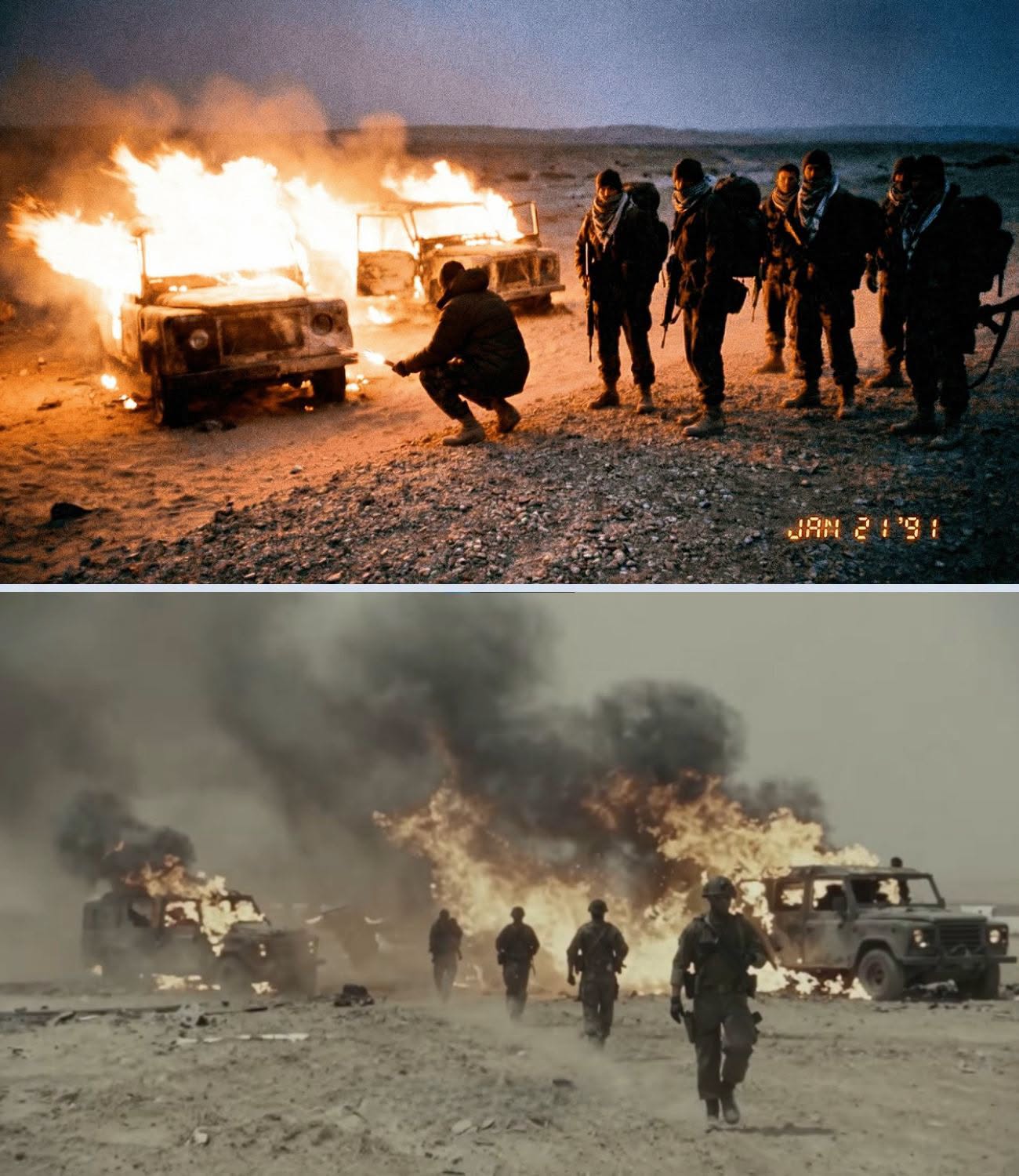
“They Burned Their Own Vehicles” — The British SAS Escape Tactic That Left US Command Speechless –
Somewhere in the western Iraqi desert, on the night of the 29th of January 1991, a column of four Land Rover 110s sat in a shallow wadi 14 km south of the main supply route connecting Baghdad [music] to the Jordanian border. Their engines were cold. Their fuel tanks were 3/4 full. >> [music] >> Their mounted Browning .
50 caliber machine guns were loaded, belted, and ready. And the eight men standing around them in the frozen darkness were about to set all of it on fire. [music] Not because they’d been overrun. Not because they were retreating. Not because they’d failed. They were about to incinerate four vehicles, [music] 1,600 L of diesel, 8,000 rounds of linked ammunition, four Milan antitank missile [music] systems, and 240,000 lb worth of modified desert patrol equipment because the mission required it, because the vehicles had become a problem instead of
a solution, and because the unwritten rule drilled into every man who’d survived selection at Hereford [music] was absolute. You leave nothing behind that the enemy can use. Nothing. Not a map. Not a frequency list. Not a tire track that tells them which direction you’re heading. One of the patrol members, a staff sergeant with 11 years in the regiment, crouched beside the lead vehicle [music] and pressed a thermite grenade into the engine block.
The magnesium compound would burn at 2,200°C, [music] hot enough to melt through the aluminum casing, the steel chassis rails, and the encrypted communications equipment bolted beneath the dashboard. He looked at the man next to him. “30 seconds,” he said. “Then we walk.” They didn’t [music] jog. They didn’t run.
They walked 72 km across open desert, carrying everything they needed on their backs, through terrain that American planners at Special Operations Command [music] Central had assessed as impossible without vehicle support. When the after-action reports reached Riyadh [music] 3 weeks later, a US Army colonel attached to SOCCENT threw the file across his desk [music] and said two things. The first was unrepeatable.
The second was, “Those crazy [music] bastards actually made it work.” It is not a story about heroism in the way Hollywood understands it. There are no last stands, no dramatic rescues, no flag-waving. It is a story about professionalism taken to its logical, brutal, uncomfortable extreme. The idea that nothing matters except the mission, and that everything, including your own equipment, your own comfort, and your own survival odds, is expendable in service of that principle.
To understand why eight men destroyed their own transport in the middle of the Iraqi desert, you have to understand what was happening in the Persian Gulf in January 1991. And specifically, why the western desert of Iraq became the most politically dangerous piece of ground on Earth. When Saddam Hussein invaded Kuwait on the 2nd of August, 1990, the coalition response was overwhelming in scale.
[music] By mid-January, the United States had deployed 543,000 personnel to the theater. The British [music] contribution was the 1st Armoured Division, roughly 35,000 troops, Challenger tanks, Warrior infantry fighting vehicles, and a substantial logistics tail staged through Saudi Arabia. The air campaign, Operation Desert Storm, began on the 17th of January with over 1,000 coalition sorties in the first 24 hours.
By any rational military analysis, Iraq was outmatched in every measurable category: air power, armor, >> [music] >> precision munitions, intelligence, logistics, training, and command structure. But Saddam >> [music] >> had one card that could fracture the entire coalition overnight, and he played it within the first 72 hours.
On the 18th of January, Iraq launched modified Al Hussein ballistic missiles, Scud variants with an extended range of 650 [music] km at Tel Aviv and Haifa. The warheads were conventional, but the political payload was nuclear. If Israel retaliated, the Arab members of the coalition, >> [music] >> Saudi Arabia, Egypt, Syria, the UAE, would face impossible domestic pressure.
[music] No Arab government could be seen fighting alongside Israel against a fellow Arab state. The coalition would collapse. The war would become something entirely different. And Saddam knew it. The Scud launchers were mobile. They operated from modified MAZ-543 transporter erector launchers, eight-wheeled Soviet-designed vehicles that could set up, fire, and relocate within 90 minutes.
The western desert of Iraq, the vast Al Anbar province stretching from Baghdad to the Jordanian and Syrian borders, was essentially a Scud sanctuary. Flat, >> [music] >> featureless terrain, minimal population, hundreds of kilometers of hardened road and improvised launch positions scattered across an area the size of Switzerland.
Coalition air power, for all its precision, could not find them reliably. The F-15E Strike Eagles [music] flying Scud-hunting sorties from Tabuk in Saudi Arabia were hitting decoys, empty launchers, fuel trucks that looked [music] like tails on thermal imaging, and occasionally genuine targets, but not fast enough. Between the 18th of January and the 25th of February, Iraq launched 88 Scud missiles, 46 at Saudi Arabia, 42 at Israel.
One of them hit a barracks in Dhahran on the 25th of February and killed 28 American soldiers from the 14th Quartermaster Detachment. The Israeli government was running out of patience. American Patriot missile batteries deployed to Israel were performing far below the publicly stated intercept rates. The pressure on General Norman Schwarzkopf to solve the Scud problem was immense, and it was coming directly from the White House.
Schwarzkopf famously did not like special forces. He’d had bad experiences in Vietnam, distrusted what he considered their cowboy culture, and believed the war would be won by conventional power applied with overwhelming force. He was not wrong about the last part, but the Scud problem was not a conventional problem.
It was an intelligence problem operating in terrain that conventional forces could not reach without a ground offensive that wasn’t scheduled to begin until late February. The solution came from an unlikely advocate, Lieutenant General Sir Peter de la Billière, the senior British military commander in the Gulf, and himself a former commanding officer of 22 SAS.
De la Billière understood what the regiment could do in the desert because he’d done it himself in Oman, in Aden, [music] in operations that remained classified decades later. He went to Schwarzkopf personally and made the case, [music] “Put SAS patrols into the western desert. Give them vehicles, communications, and freedom of movement.
They will find the launchers, call in air strikes, and cut the supply routes that keep the Scud operation functioning.” Schwarzkopf was reluctant. De la Billière was persistent. The compromise was grudging. [music] The SAS would deploy, but under the operational coordination of SOCCENT, the US Special Operations Command Central, [music] which meant American oversight of British operations in a way that Hereford found uncomfortable [music] and Washington found insufficient.
The regiment deployed two types of operations into western Iraq. The first were static observation posts, small teams inserted by helicopter to fixed positions overlooking known or suspected Scud operating areas. These were the missions that produced the most famous story of the war, Bravo Two Zero, the eight-man patrol that was compromised, scattered, [music] and suffered catastrophic losses in the freezing desert.
The second type were mobile fighting columns, half-squadron strength patrols mounted on specially modified Land Rover 110s, carrying enough firepower, fuel, and supplies to operate independently behind enemy lines for weeks. [music] It is this second type that concerns us here because it was one of these mobile columns that made the decision, deep in the Iraqi desert, >> [music] >> to destroy their own vehicles and complete the mission on foot, a decision that would generate fury at SOCCENT headquarters and quiet respect in every
special operations unit that heard about it afterward. The vehicles themselves deserve attention because understanding what was destroyed helps you understand the magnitude of the decision. The Land Rover 110s used by 22 SAS in the Gulf were not standard military vehicles. They were stripped, reinforced, and rebuilt specifically for desert long-range patrol operations, a lineage that stretched directly back to David Stirling’s Long Range Desert Group vehicles in North Africa >> [music] >> in 1942. Each vehicle had its doors,
windscreens, and roof removed to reduce weight and improve visibility. The chassis was reinforced with additional crossmembers to handle the stress of high-speed desert driving over broken ground. Each carried a front-mounted GPMG, general-purpose machine gun, and a rear-mounted Browning M2 .50 caliber heavy machine gun, capable of engaging targets at ranges beyond 1,800 m.
Some carried Milan antitank guided [music] missile systems. The navigation suite included military GPS units, early Magellan models that were notoriously unreliable, supplemented by traditional desert navigation equipment, silver compasses, >> [music] >> sun compasses, and the accumulated experience of men who’d trained in Oman, Kenya, and Belize.
Each vehicle carried 200 L of water in jerrycans, 120 L of fuel beyond the main tank, ammunition bins containing a minimum of 2,000 rounds of 7.62 mm link for the GPMG, and 800 rounds of 12.7 mm for the Browning, personal weapons and ammunition for each crew member, demolitions equipment, medical supplies, rations for 14 days, sleeping bags rated to minus 20°, camouflage netting, and [music] critically, encrypted Clansman radio sets and TACBE tactical beacons for emergency communication with coalition aircraft. The estimated replacement cost
of each fully equipped vehicle, according to a logistics assessment [music] prepared for the Ministry of Defense in February 1991, was approximately 60,000 lbs. Multiply by four, add the weapon [music] systems, the communications equipment, and the classified code books and frequency lists carried in the lead vehicle, the patrol was driving a quarter of a million pounds worth of equipment through the Iraqi desert, and every item in it was a potential intelligence windfall for Baghdad if captured. The men of the patrol, we will
call it Delta 4-0, though the actual designation remains classified, crossed the Saudi border into Iraq on the night of the 22nd of January, six days after the air campaign began. [music] The column comprised four vehicles and 16 men, four crews of four. The patrol commander was a sergeant major with 14 years in the regiment and three operational tours in Northern Ireland, where he ground close target reconnaissance operations against Provisional IRA active service units in South Armagh. His second in command was
a staff sergeant who’d served with the mountain troop and had completed the full military freefall course, the combat survival course, and two rotations through the regiment’s counterterrorism team >> [music] >> at the killing house in Hereford. The remaining 14 men included a demolition specialist, two signallers, a qualified combat medic, and soldiers drawn from every Sabre squadron.
Men whose average age was 32 [music] and whose average time in the regiment was seven years. Several had served in the Falklands. One had been at the Iranian Embassy siege in 1980. All had passed the same selection course, a process that breaks roughly 90% of the candidates who attempt it, most of whom are already experienced soldiers from elite regiments.
Men of Delta 4-0 were not selected for physical strength, 64 km march with a 25 kg Bergen plus weapon and belt kit completed in under two hours alone, with no support, no encouragement, and no indication of how far you’d gone or how far you had left. The pass rate for SAS selection in the early 1990s hovered between 8 >> [music] >> and 12%.
The men of Delta 4-0 were not selected for physical strength alone. [music] They were selected for the ability to make decisions under pressure, to function when exhausted, to operate independently without orders, and to prioritize the mission above everything, including their own survival. The column moved northwest [music] from the border crossing point, navigating by GPS and dead reckoning across terrain that was nothing like the rolling sand dunes of popular imagination.
The western Iraqi desert is a flat, hard gravel plain, hamada, broken by shallow wadis, >> [music] >> occasional rocky outcrops, and vast stretches of nothing. In January, [music] daytime temperatures hovered around 4° C. At night, they dropped to minus 10, sometimes minus 15. The wind came from the north, constant and cutting, carrying fine dust that worked its way into weapons, engines, eyes, and lungs.
The sky was enormous, the stars were vivid, and the sense of exposure was total. There was nowhere to hide a four-vehicle column in daylight. The patrol moved exclusively at night, covering between 80 and 120 km per movement phase, then lying up during the day in whatever concealment the terrain offered.
A wadi deep enough to hide the vehicles below the horizon line, a cluster of rocks large enough to break the silhouette, or simply a depression in the ground covered with camouflage netting that matched the gray-brown surface. For the first four nights, the patrol operated according to plan. They moved northwest toward the main supply route, MSR 2, the highway connecting Baghdad to the Jordanian border, which intelligence assessments identified as the primary logistics artery for Scud operations >> [music] >> in the southern sector of the western
desert. Their tasking was threefold: locate and report Scud launch positions for air interdiction, >> [music] >> interdict resupply convoys on the MSR, and gather intelligence on Iraqi military disposition in the area of operations. On the third night, the 25th of January, the patrol identified and reported a suspected Scud launch site, a cluster of vehicles and support equipment in a prepared position 11 km north of their route.
The sighting was passed via encrypted burst transmission to the SAS tactical headquarters at a forward operating base in Saudi Arabia, which relayed [music] it to the Joint Air Coordination Center. An F-15E Strike Eagle sortie hit the position six hours later. Post-strike assessment confirmed the destruction of one MAZ >> [music] >> 543 TEL and two support vehicles.
The system worked. The patrol was delivering exactly what de la Billière had promised Schwarzkopf. Then, the desert [music] intervened. On the night of the 26th of January, the column was moving through a stretch of broken ground approximately 190 km inside Iraq when the lead vehicle’s front differential failed.
The Land Rover 110’s permanent four-wheel drive system could not be switched to rear-wheel only in the field. Without front drive, the vehicle could not maintain traction on the loose gravel surface, and it certainly could not handle the steeper wadi crossings that lay between the patrol’s current position and the MSR. The patrol commander made his first critical decision, redistribute the lead vehicle stores, weapons, and crew across the remaining three vehicles, >> [music] >> and destroy the disabled Land Rover.
The demolition specialist placed two thermite grenades on the engine block and one inside the communications compartment. Thermite, a mixture of aluminum powder and iron oxide, ignites at approximately 1,500° [music] C and burns at over 2,000°, producing molten iron >> [music] >> that destroys anything it contacts.
The grenades were initiated with a 30-second delay fuse. The patrol withdrew 200 m and watched. The vehicle burned white-hot for approximately four minutes. When the fire died, the engine block was a fused mass of slag. The radio equipment was destroyed beyond recovery, and the chassis was warped and blackened. >> [music] >> An Iraqi patrol finding it would recover scrap metal, not intelligence.
The loss of one vehicle compressed the patrol from four crews of four into three vehicles carrying 16 men plus the redistributed stores. Each remaining Land Rover was now overloaded by approximately 200 kg beyond its designed desert patrol weight. The suspension sat lower, the tires compressed further into the gravel, fuel consumption increased.
The patrol was still operational, but the margin had narrowed. The sergeant major noted in his operational log, recovered and partially declassified in 2006, that the remaining vehicles were carrying more than selection Bergens and handling like shopping trolleys. Two nights later, on the 28th of January, the column was approaching a position 12 km south of MSR 2 when the second vehicle began losing oil pressure.
The diagnosis was a cracked sump, likely caused by a rock strike during the previous night’s rough terrain. Oil was leaking at a rate that would empty the sump within three to four hours of driving. The crew topped it up from their reserve supply, but the reserve was limited. The patrol had enough oil for perhaps one more night of movement.
The same night, the column’s lead signaller reported a concerning development. During their last scheduled communication window, the tactical headquarters had passed a warning that Iraqi patrols in the area had increased significantly. Coalition signals intelligence had intercepted Iraqi military communications referencing foreign vehicles operating south of the MSR.
The patrol had not been visually detected as far as they knew, but the Iraqis were looking. The combination of factors, a crippled vehicle, increased enemy activity, and the operational load now compressed onto three overweight Land Rovers, created a situation that the patrol commander assessed with brutal clarity.
He gathered the senior NCOs and presented the mathematics. Three vehicles, 16 men, one vehicle mechanically compromised, enemy awareness of their general presence confirmed, distance to the primary objective area approximately 35 km, distance to the emergency extraction point, a prearranged helicopter landing zone in the southern desert, approximately 170 km.
The vehicles could probably reach the objective area. They probably could not reach the extraction [music] point, not with a cracked sump leaking oil and three overloaded chassis hammering across broken ground at night with increased Iraqi patrols converging on their operating area. And if the vehicles broke down in contact with the enemy or within detection range of an Iraqi position, >> [music] >> the result would not just be the loss of the patrol, it would be the loss of every piece of intelligence, equipment,
and classified material the vehicles contained. It would hand Baghdad a propaganda victory >> [music] >> and a signals intelligence windfall. It would compromise frequencies, code books, and operational patterns [music] that could endanger every other SAS patrol operating in the Western Desert. The sergeant major’s decision was made within 30 minutes.
>> [music] >> They would destroy the remaining three vehicles, cache what they could carry, and complete the mission on foot. The patrol’s demolition specialist later told a debriefing officer at Hereford, “He didn’t agonize over it. He looked at the vehicles like they were already gone.
He’d written them off in his head before he’d finished the brief. The destruction was methodical. Thermite grenades were placed [music] on each engine block, inside each communications compartment, and on the weapons mounts. The Milan systems were disabled by removing the guidance units and smashing them with a rock. Then the launch tubes were placed inside the vehicles before the thermite was initiated.
Ammunition that could not be carried was scattered and buried there. Fuel was drained onto the ground around the vehicles to accelerate the burn. Maps, code books, and frequency lists were burned separately in a small fire that the patrol monitored until every page was ash. At 01:15 hours on the 29th of January, three thermite charges were initiated simultaneously.
The desert >> [music] >> lit up white. For approximately 90 seconds, the three Land Rovers burned with an intensity that was visible, the patrol estimated, >> [music] >> for at least 5 km across the flat terrain. It was a calculated risk. The brief flare of destruction versus the permanent risk of intact vehicles falling into enemy hands.
The patrol did not watch for long. They shouldered their burgans and moved. Each man carried approximately 45 kg. Personal weapon, either an M-16 with M203 grenade launcher or a Minimi light machine gun. Ammunition, a minimum of 300 rounds per rifleman, 600 rounds for the Minimi gunners. Water, 8 L per man, >> [music] >> sufficient for approximately 36 hours of hard movement in cold conditions.
Rations, 48 hours of Arctic ration packs stripped of packaging to save weight. >> [music] >> Navigation equipment, two GPS units for the patrol, four silver compasses, one set of [music] maps. Medical kit, one comprehensive trauma kit and individual [music] first aid kits for each man. Communications, one PRC-319 radio set [music] and two TACBE beacons. Sleeping bags, none.
They were left behind to save weight. In minus 12° nights, the logic was simple. If they stopped long enough to sleep, they were already dead. The plan was to move on foot to the MSR, >> [music] >> conduct the interdiction mission, and then tabulate south-southeast toward the emergency extraction point, a total distance of approximately 205 km across open desert.
American planners at SOCCENT had designated the patrol’s area of operations as vehicle-dependent terrain, meaning their assessment was that [music] the distances, the exposure, and the logistics requirements made foot movement operationally non-viable. The SAS [music] did not share this assessment, or rather, they acknowledged it was correct for most military units >> [music] >> and irrelevant for them.
The first night on foot, the patrol covered 38 [music] km. They moved in two groups of eight, staggered 200 m apart to reduce the chance of the entire patrol being engaged [music] simultaneously. Navigation was by GPS and compass, with the lead man checking bearing every 400 m. The ground was hard gravel, easier to walk on than sand, >> [music] >> but brutal on feet.
Every man wore standard-issue desert boots that had been individually broken in over months of training. Even so, by dawn on the 30th of January, seven of the 16 men had [music] blisters that required attention. The combat medic treated them with Compeed plasters and tape. And the patrol lay up for the day in a shallow wadi that [music] offered perhaps 1 m of concealment from the surrounding terrain. They did not sleep.
They rested in 2-hour shifts [music] with half the patrol on watch at all times. Weapons oriented north [music] toward the MSR and the direction of greatest threat. On the second night, the 30th [music] of January, the patrol reached a position 4 km south of MSR [music] 2. Through binoculars and a thermal imaging sight salvaged from one of the destroyed vehicles, one of the few heavy items the patrol commander had insisted on carrying, they observed the highway for 6 hours.
During that window, they [music] counted and logged 47 vehicles moving west along the MSR, including eight military trucks matching the profile of Scud support vehicles, fuel tankers, command vehicles, and heavy transporters. They identified a pattern. The convoy traffic moved primarily between 0100 and 0400 hours, suggesting the Iraqis were timing their logistics movements to avoid coalition air patrols that were most active around dusk and dawn.
The intelligence was passed by burst transmission during the patrol’s next communications window. The tactical headquarters confirmed receipt and relayed the information to the Joint Air Coordination Center within 40 minutes. Two nights later, coalition aircraft interdicted a convoy on that section of MSR 2, destroying 11 vehicles, including three confirmed Scud support assets.
The patrol had delivered precisely what it was sent to deliver, even without the vehicles that were supposed to make delivery possible. But the patrol was not finished, [music] and their situation was deteriorating. Water was the critical constraint. 8 L per man was sufficient for 36 hours. They had been on foot for 40 hours.
Resupply was not possible. The nearest known water source [music] was a Bedouin well approximately 28 km to the southeast, but approaching it meant risking contact with local civilians who might report their presence to Iraqi military authorities. The patrol commander made a decision that several members later described as the hardest of the mission.
They would bypass the well and ration their remaining water to last another 48 hours. This meant each man would consume approximately 1 L per 24-hour period, less than half the minimum recommended intake for moderate activity in cold desert conditions. Dehydration degrades cognitive function, physical performance, and decision-making.
The sergeant major knew this. He also knew that compromised by a civilian contact could bring an Iraqi mechanized patrol down on them within hours, >> [music] >> and 16 men with 300 rounds each and no vehicle-mounted heavy weapons would not survive a sustained engagement against armored vehicles.
They moved [music] south. The third night, the 31st of January, they covered 29 km. Slower now, the pace dropping as water rationing took effect. The fourth night, the 1st of February, they covered 23 km. Men [music] were stumbling. Lips were cracked. Concentration wavered during the navigational checks. The combat medic quietly informed the sergeant major that two men were showing early signs of moderate dehydration, [music] headaches, dizziness, reduced urine output.
The sergeant major’s response, according to the medic’s debriefing statement, was, “They can be dehydrated when we cross the border. They can’t be dehydrated [music] and captured.” On the fifth night, the 2nd of February, the patrol reached the emergency extraction coordinates. [music] They were 37 hours behind the original timeline, the timeline calculated assuming vehicle movement to the extraction point.
They had covered approximately 208 km [music] on foot in five nights, carrying 45 kg loads, on rationed water, in freezing temperatures, without sleeping bags, through terrain that American special operations planners had categorized as requiring vehicle support. The extraction helicopter, a Royal Air Force Chinook from 7 Squadron, operating from a forward base in Saudi Arabia, arrived at the landing zone at 02:45 hours.
The crew later reported that the patrol walked to the helicopter in formation, loaded their equipment methodically, and were airborne within 4 minutes of touchdown. >> [music] >> No panic, no relief visible on their faces. The loadmaster said afterward, >> [music] >> “They looked like blokes coming off a long shift. Tired, dirty, professional.
One of them asked if we had any water. That was it.” The after-action process that followed Delta 40’s return generated paperwork that moved through three separate military bureaucracies and created friction at every level. The immediate debrief at the SAS forward operating base was standard. Operational details, intelligence gathered, equipment status, personnel condition.
The patrol had achieved its primary mission, locating and reporting Scud-related targets and MSR traffic patterns that directly contributed to coalition interdiction operations. The intelligence on convoy timing alone was assessed by the Joint Air Coordination Center as having enabled the destruction of at least 14 Scud support vehicles over the following week.
The patrol had suffered no casualties, no men captured, no classified material compromised. By every operational metric that mattered to Hereford, the mission was a success, but the vehicles were gone, and the vehicles had been allocated [music] through SOCCENT, American coordination, American logistics chain, American accountability.
When the equipment loss report reached the Special Operations Command Central Headquarters in Riyadh, >> [music] >> the reaction was precisely what the SAS chain of command had expected, cold fury. A US Army logistics colonel >> [music] >> responsible for equipment allocation to coalition special operations forces reportedly described the destruction of four Land Rovers and their associated weapons and communication systems as the most expensive bonfire in the history of special operations.
The cost assessment prepared by SOCCENT logistics staff valued the destroyed equipment at approximately 243,000 pounds or roughly 370,000 US dollars [music] at 1991 exchange rates. The Browning machine guns alone were valued at 14,000 each, the Milan systems at 26,000 each, the encrypted radio sets at 31,000 each. The American position was not unreasonable.
Equipment [music] allocated to coalition partners was expected to be used, maintained, and returned. Destroying it voluntarily, rather than as a last resort under direct enemy contact, appeared to American planners as [music] reckless, wasteful, and evidence of a cavalier attitude toward coalition resources. The British response, delivered through the SAS chain of command to SOCCENT, was polite, >> [music] >> detailed, and unyielding.
The patrol commander had made a field decision based on operational security considerations that [music] were, in the regiment’s doctrinal framework, non-negotiable. The vehicles had become a liability, mechanically compromised, detectable, and carrying classified material that could not be allowed to fall into enemy hands under any circumstances.
The decision to destroy them was consistent with SAS standing operating procedures, which stated explicitly that equipment destruction was preferable to equipment capture. [music] The intelligence value of intact SAS vehicles, weapons, communications equipment, and [music] codebooks to the Iraqi military and intelligence services was assessed as significantly exceeding the replacement cost of the equipment itself.
A classified annex to the British after-action report, partially released under Freedom of Information in 2009, stated the compromise of encrypted communications equipment and frequency allocation documents would have necessitated a theater-wide communications refit for all coalition special operations forces operating in Iraq.
The estimated [music] cost and operational disruption of such a refit was assessed at approximately 12 million US dollars and a minimum 72-hour communications blackout across the Western desert area of operations. The destruction of four vehicles at the cost of approximately 243,000 pounds prevented this outcome. The American complaints subsided.
[music] They did not disappear. The logistics Colonel reportedly maintained until his retirement that [music] the SAS should have attempted to recover the vehicles or called for extraction before destroying them, but the operational logic was difficult to argue against. The mission was achieved, the intelligence was delivered, nothing was compromised.
The cost was metal and rubber. What resonated beyond the bureaucratic friction was something harder to quantify >> [music] >> and impossible to invoice. The demonstration of a doctrinal commitment that most military organizations profess, that very [music] few actually practice. The SAS doctrine, embedded in training, reinforced [music] by selection, validated in operations from Malaya to the Falklands to Northern Ireland, held that the mission was the only thing that mattered.
Equipment existed [music] to serve the mission. Vehicles existed to serve the mission. Comfort, convenience, [music] and institutional expectations existed to serve the mission. And when any of those things stopped serving the mission and started threatening it, they were eliminated with the same decisiveness applied to an enemy position.
A US special forces warrant officer attached to SOCCENT as a liaison officer wrote in a personal assessment that was later quoted in a restricted distribution study on coalition special operations during the Gulf War, the British approach to operational security is absolute in a way we don’t fully replicate.
We train our guys to protect equipment and recover assets because the taxpayer paid for them. The SAS trains their guys to protect the mission and assumes the taxpayer will buy new equipment. It’s a philosophical difference. And in this case, the British philosophy produced the better operational result. The broader implications of what Delta 4-0 achieved extended well beyond one patrol’s decision [music] in one wadi on one night.
Their mission and the destruction of their vehicles became a reference point in the internal debate within [music] US special operations about the balance between asset preservation and operational security. The doctrine of leave no trace, which the SAS [music] practiced with an intensity that sometimes baffled their American counterparts, was studied, >> [music] >> discussed, and in some cases adopted by US units in subsequent operations.
The principle was simple and its execution was ruthless. If something you’re carrying can tell the enemy who you are, where you’ve been, what you know, or what you’re going to do next, and you cannot guarantee its security, you destroy it. You don’t cache it. [music] You don’t hide it. You don’t trust that the enemy won’t find it.
You reduce it to slag and you move on. The American frustration was real and it was understandable. [music] The United States military operates within a framework of accountability >> [music] >> that extends from the battlefield to the congressional appropriations committee. Every rifle, >> [music] >> every vehicle, every encrypted radio has a serial number, a property book entry, and a chain of custody that leads ultimately to a line item in the defense budget.
[music] Destroying functional equipment, even for sound operational reasons, generates paperwork, investigations, and questions from people who were never cold, never 190 kilometers behind enemy lines with a cracked sump and Iraqi patrols converging. The British system, at least at the regimental level, operated with different assumptions.
The commanding officer of 22 SAS had delegated authority to patrol commanders to make destruction decisions in the field. The assumption was that the man on the ground with the information available to him was better placed to judge the risk than a staff officer in Riyadh reading a message 3 hours after it was sent. This is not unique to the SAS.
Most special operations forces operate with some version of decentralized command authority, but the degree to which the SAS trusted its NCOs to make irreversible expensive decisions without consultation was, in 1991, exceptional. The men of Delta 4-0 returned to the United Kingdom in March 1991. No medals were awarded for the mission.
The regiment’s policy on awards was and remains deliberately sparse, reflecting the institutional belief that the work itself was the recognition. Several members of the patrol went on to serve in further operations in the Balkans, Sierra Leone, and Afghanistan. The sergeant major retired in 1998 with 17 years of service and according to a former colleague interviewed for a regimental history project in 2011, >> [music] >> went completely quiet.
Didn’t talk about the Gulf, didn’t write a book, didn’t do the circuit, just disappeared into civilian life like he’d never been in. >> [music] >> That’s the regiment. The ones who did the most say the least. Staff sergeant served two further tours in Iraq in 2003 and 2005 and reportedly used the Gulf War experience as a teaching example for younger operators >> [music] >> preparing for vehicle-mounted operations in Al Anbar province, the same desert where he’d [music] burned his Land Rover 14 years earlier. The equipment is not
your friend, he told them, according to a soldier who attended the briefing. The equipment is a tool. When the tool breaks, you carry on. When the tool becomes a threat, you eliminate it and you never, ever look back. The thermite grenades that burned through those engine blocks in the Western Iraqi desert consumed metal, fuel, rubber, and classified paper.
They did not consume the mission. They did not consume the patrol. They They did not consume the intelligence that enabled the destruction of 14 Scud support vehicles >> [music] >> and the disruption of an entire logistics corridor. That is the calculation. >> [music] >> That is the doctrine. And that is the gap.
Not between British and American capability, >> [music] >> because American special operators are among the finest in the world, but between two philosophies of what matters most when everything goes wrong 190 kilometers behind enemy lines. One philosophy counts the cost of the vehicles. The other counts the cost of the mission.
On the night of the 29th of January 1991, in a shallow wadi in the Western Iraqi desert, >> [music] >> eight men chose the mission. The vehicles burned at 2,200 degrees and the men walked home.