TREASON IN THE SHADOWS: Inside Prince Harry and Earl Spencer’s Shocking Secret Plot to Decimate King Charles and Bring Down the Royal House
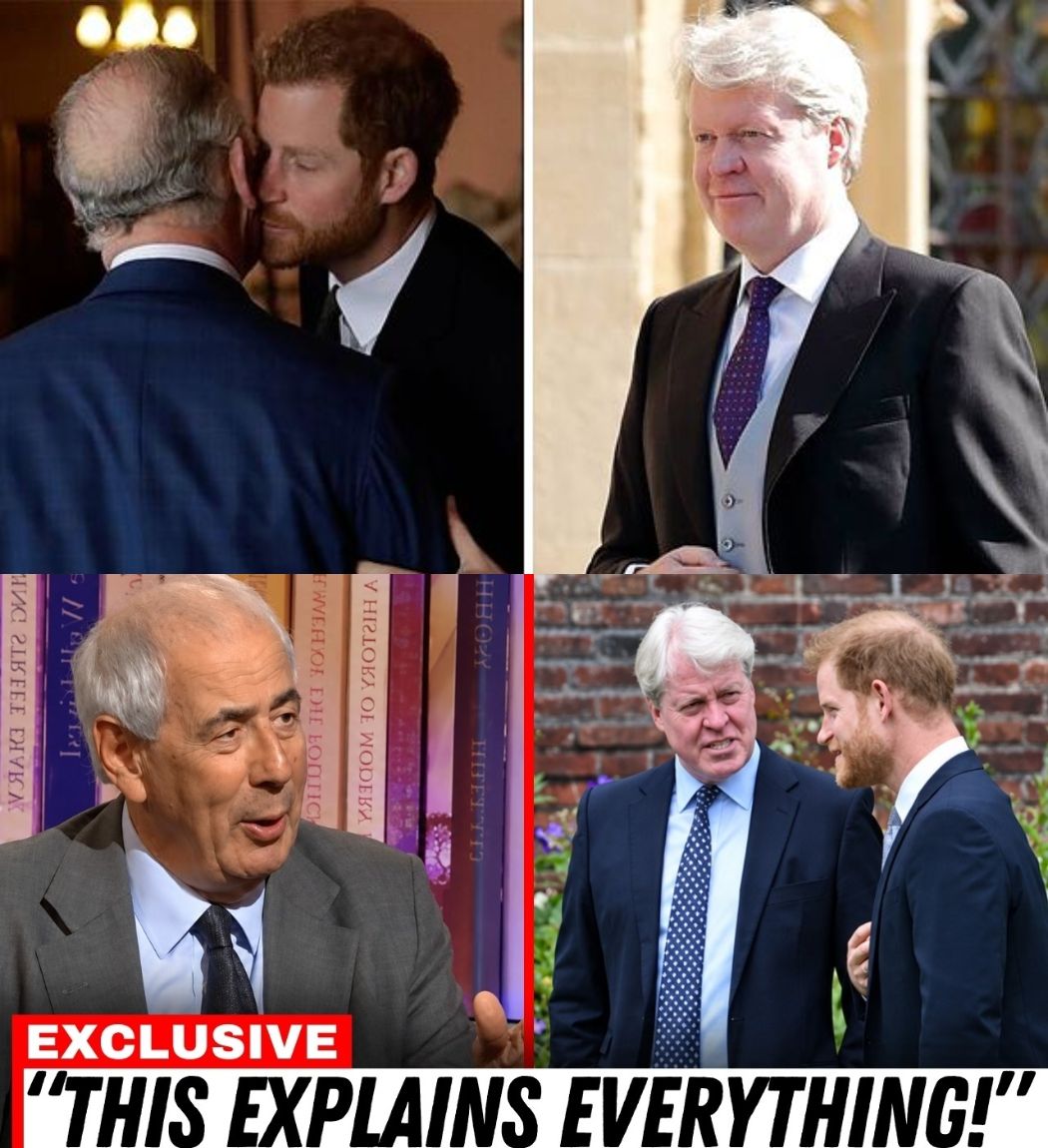
TREASON IN THE SHADOWS: Inside Prince Harry and Earl Spencer’s Shocking Secret Plot to Decimate King Charles and Bring Down the Royal House
The gilded gates of Buckingham Palace have weathered centuries of political intrigue, foreign wars, and marital scandals, but behind the velvet curtains today lies an operational war room consumed by sheer panic. According to razor-sharp revelations made by renowned royal biographer Tom Bower, a dark and treacherous plot has been quietly coalescing in the shadows of the British countryside. It is not an attack mounted by anti-monarchist activists or foreign adversaries, but rather a calculating, coordinated strike originating from the monarchy’s own fractured inner circle: a covert alliance forged between Prince Harry, the Duke of Sussex, and his uncle, Charles Spencer, the 9th Earl Spencer.
For months, whispers of strategic coordination between Montecito and Althorp House were dismissed by palace aides as mere family sympathizing. However, Bower’s explosive findings paint a far more sinister picture. This is not a story of estranged relatives sharing grief over the past; it is a calculated campaign aimed directly at the foundation of King Charles III’s sovereign authority. Fueled by decades of deeply internalized resentment, historical grievances, and an insatiable desire for personal vindication, Harry and Earl Spencer have allegedly aligned their resources, public platforms, and media influence to dismantle the reign of the reigning monarch.
To fully comprehend the magnitude of this bombshell, one must look back to September 1997, when a young Prince Harry walked behind his mother’s coffin through the weeping streets of London. Next to him walked Charles Spencer, a man who famously delivered a fiery eulogy at Westminster Abbey that fired a shot directly across the royal bow, promising that Diana’s “blood family” would protect her sons from the cold detachment of the Windsor establishment. While the public viewed that speech as a brother’s poignant farewell, inside royal circles, it was recognized as the opening salvo of an enduring vendetta against the House of Windsor and, specifically, against Charles, the Prince of Wales.
Over the succeeding two decades, that anger did not dissipate; it simmered beneath a veneer of aristocratic decorum. Earl Spencer, custodian of the Spencer legacy at the ancestral Althorp estate, watched with bitter detachment as the palace managed Diana’s memory, recalibrated Queen Camilla’s public image, and solidified Charles’s path to the throne. Meanwhile, Prince Harry grew increasingly isolated within the institutional machinery of the monarchy. When Harry made his earth-shattering exit from frontline royal duties alongside Meghan Markle in 2020, the traditional media portrayed it as a break driven by American influence. What was hidden from public view was the masterful hand of Earl Spencer, who stepped into the void as Harry’s ideological mentor, confidant, and strategist.
According to insider accounts highlighted by Bower, the alliance deepened significantly as King Charles ascended the throne. Earl Spencer provided Harry with something the prince had long lacked: an intellectual blueprint for challenging royal authority without appearing merely petulant. Spencer possessed the historical weight, aristocratic pedigree, and media savvy to transform Harry’s emotional grievances into a structured campaign. Together, the uncle and nephew realized that while Harry possessed the global star power and media megaphone, Spencer possessed the archival knowledge, establishment connections, and ancestral authority necessary to inflict lasting damage on the King’s legitimacy.
The true turning point occurred during a series of clandestine rendezvous held at Althorp House during Harry’s sporadic, secret visits to the United Kingdom. Away from the watchful eyes of royal protection officers and palace courtiers, Harry and Spencer mapped out an aggressive strategy designed to undermine King Charles’s reign at its most vulnerable juncture. Palace insiders report that these clandestine meetings were characterized by intense strategic planning, focusing on the timing of media releases, high-profile court battles, and targeted leaks designed to keep the royal family perpetually on the defensive.
The strategic objectives of this alliance are both brutal and comprehensive. The primary goal is not merely to voice displeasure with royal protocols, but to systematically erode public confidence in King Charles III as a moral and institutional leader. By constantly juxtaposing the King’s public engagements with dramatic media interventions, legal challenges over security, and intimate personal tell-alls, the duo seeks to project an image of a monarch who is cold, unfeeling, and fundamentally incapable of unifying his own family, let alone the nation and the Commonwealth.
Central to this campaign is the weaponization of Princess Diana’s memory—a strategy that Earl Spencer has perfected over decades. By ensuring that Diana’s tragic fate remains central to the public discourse surrounding the monarchy, Spencer and Harry seek to cast a permanent shadow over King Charles and Queen Camilla. Every public appearance by the King is meticulously audited by the duo’s circle to identify moments where historical contrast can be drawn. When Charles seeks to highlight his philanthropic work or environmental stewardship, fresh details regarding past marital grievances or palace betrayals conveniently find their way into international headlines, effectively hijacking the news cycle and neutralizing the King’s institutional momentum.
Moreover, the psychological toll of this alliance on King Charles III cannot be overstated. Sources close to the sovereign reveal that the King feels profoundly betrayed not only as a monarch but as a father and a brother-in-law. Charles had long hoped that time and distance would heal the wounds between Montecito and London. However, discovering that his younger son is actively conspiring with Earl Spencer—a man Charles has long viewed with deep suspicion—has shattered any remaining illusions of reconciliation. The King finds himself facing a two-front war: managing the heavy responsibilities of the Crown while defending his personal legacy against a relentless war of attrition waged by his own flesh and blood.
The mechanics of this covert war are intricate and highly sophisticated. Rather than relying solely on direct public statements, which can be easily dismissed or countered by Buckingham Palace press secretaries, the Harry-Spencer alliance operates through a networked web of sympathetic journalists, documentary filmmakers, and high-level media executives across North America and Europe. Information is leaked with surgical precision—a personal letter quoted here, an unrecorded private phone call referenced there—creating a constant state of anxiety within the palace walls. Courtiers are forced to operate in a perpetual state of red alert, never knowing where or when the next explosive narrative will detonate.
One particularly terrifying prospect for Buckingham Palace is the existence of unreleased material and private documentation preserved at Althorp House. Earl Spencer, a meticulous historian and author in his own right, has assembled an extensive archive of correspondence, private notes, and recorded conversations spanning decades of Spencer-Windsor relations. Royal commentators warn that if these documents were ever published or adapted into a coordinated multimedia project alongside Prince Harry, the damage to the reputation of King Charles and the future of Prince William’s monarchy could be catastrophic and irreversible.
The tactical coordination also extends to legal battlegrounds. Harry’s relentless lawsuits against major British newspaper groups have served as a persistent thorn in the side of the royal establishment, breaking traditional constitutional taboos regarding royal neutrality in legal matters. Behind the scenes, legal advisers connected to the Spencer network have provided guidance and encouragement, viewing these high-stakes courtroom battles as an effective tool to force the royal family’s private communications into the public domain through discovery processes, thereby keeping the palace in a state of perpetual legal and public relations exposure.
Inside the royal quarters at Windsor and Buckingham Palace, Prince William is said to be incandescent with rage over these revelations. As the Prince of Wales and heir to the throne, William views the Harry-Spencer pact as a direct threat to his own future reign and the stability of the institution he is born to inherit. Unlike his father, who has occasionally favored a softer, parental approach toward Harry, William has reportedly urged a total, uncompromising severance of ties. William views Earl Spencer’s influence as manipulative and toxic, believing that his uncle is utilizing Harry as a proxy weapon to settle old family scores that should have been buried decades ago.
This internal rift has effectively split the broader British aristocracy into opposing factions. Traditional royal loyalists view Earl Spencer and Prince Harry as dangerous renegades driven by personal bitterness and commercial greed, willing to burn down the historic institution for personal vindication. Conversely, a faction of modern critics and Diana loyalists view their partnership as a righteous crusade against an archaic, unyielding establishment that destroyed a beloved princess and drove a young prince into exile. This ideological divide threatens to undermine the very social fabric that has historically anchored the British monarchy.
As King Charles continues his reign amidst ongoing health challenges and constitutional duties, the pressure exerted by this covert alliance grows heavier by the day. Tom Bower’s bombshell revelations have pulled back the curtain on a game of thrones playing out in real-time, where emotional trauma, historical vengeance, and high-stakes media strategy intersect. The palace can no longer afford to treat Prince Harry’s grievances as isolated outbursts of an alienated son; they must now confront a structured, highly intelligence-driven campaign masterminded by one of the premier peerage families of the realm.
The ultimate question haunting the corridors of Buckingham Palace is how far Harry and Earl Spencer are willing to go. Will they be satisfied with keeping the King in a state of perpetual distraction, or is their ultimate goal to force a constitutional crisis that forces the monarchy to its knees? With additional media projects rumored to be in development and historical archives remaining unsealed, the royal family stands on the edge of a precipice. The dangerous pact between the exiled prince and the vengeful earl has set off a ticking clock, and the resulting explosion may forever alter the history of the British Crown.
The battle lines have been drawn, the strategies finalized, and the covert war for the soul of the monarchy has officially begun. As Buckingham Palace prepares its defense against the next wave of coordinated strikes, the public remains transfixed by the unfolding drama. What began as a familial tragedy has morphed into an unprecedented institutional crisis—a chilling testament to what happens when royal blood and aristocratic vengeance join forces in a war that shows absolutely no sign of mercy.