“We Don’t Answer to You” — Why the British SAS Defied US Command in Baghdad
Introduction: The Breaking Point in the Green Zone
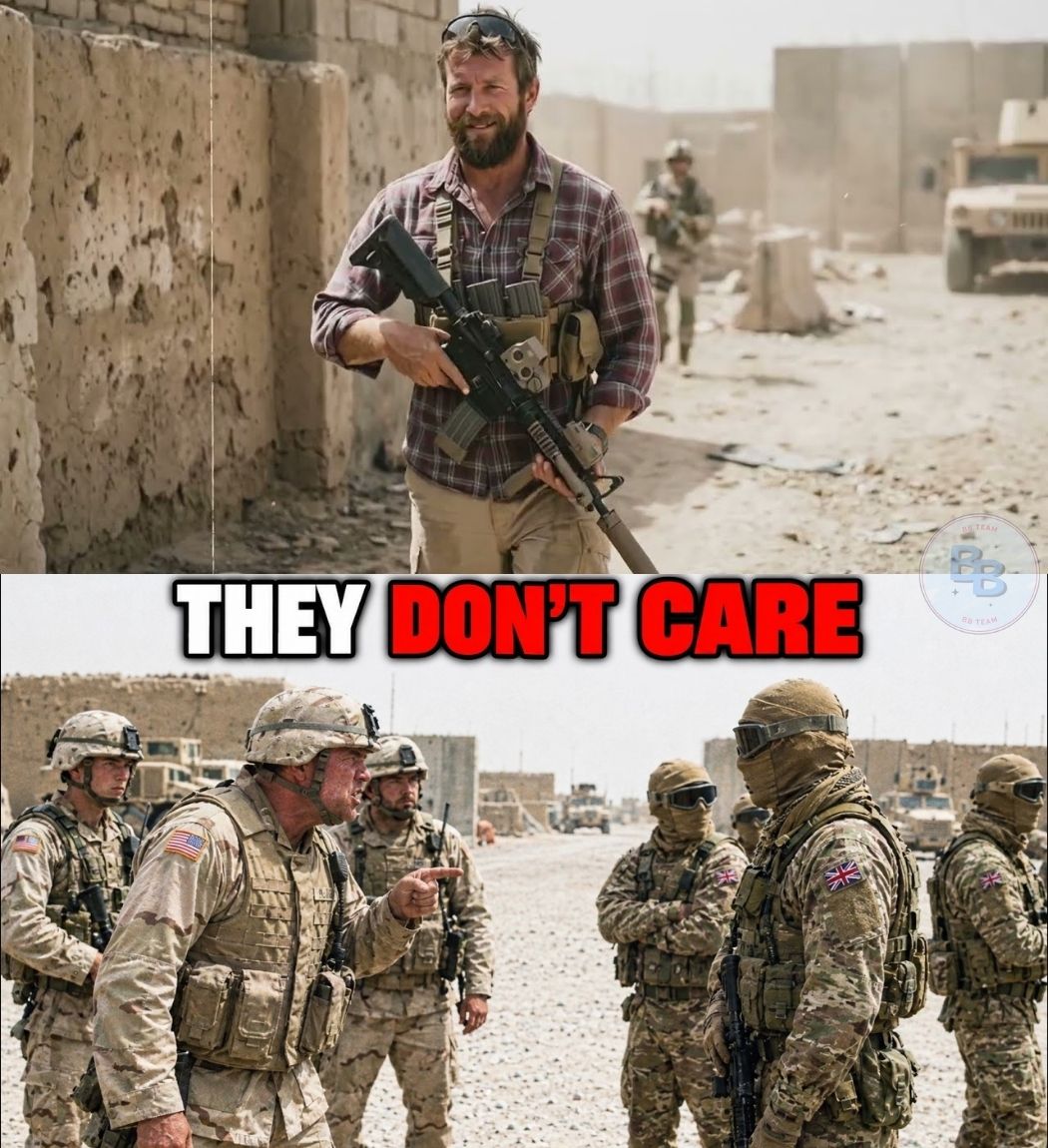
The air inside the Combined Joint Operations Center in Baghdad’s Green Zone was thick with the scent of stale coffee, ozone, and rising panic. It was 03:14 hours on a moonless night in 2005. Outside, the sprawling Iraqi capital was a chaotic labyrinth of insurgent safehouses, sectarian flashpoints, and shifting frontlines. Inside the heavily fortified command bunker, a high-ranking United States Army General slammed his fist onto a stainless-steel briefing table, rattling the tactical displays.
“I am giving you a direct order, Major,” the General barked, his face flushed with fury. “Stand down the extraction team. The political fallout of this breach is catastrophic. You do not move without Pentagon clearance.”
Standing across the map-strewn table was a veteran British Special Air Service (SAS) Squadron Commander. His uniform was dust-stained, his face weathered by months of relentless nocturnal hunter-killer operations, and his eyes were ice-cold. He looked at the American commander not with the deference expected of a coalition partner, but with an unyielding, disdainful silence.
The British officer reached down, unclipped his secure tactical radio handset from his chest rig, and tossed it onto the desk. It clattered against the metal surface, the green encryption light blinking mockingly in the fluorescent gloom.
“With respect, General,” the SAS commander said, his voice flat, quiet, and razor-sharp, “we don’t answer to you.”
Within seconds, the British team turned their backs on the highest command authority in the theater, walked out of the bunker, climbed into their unmarked armored Land Rovers, and vanished into the Baghdad night. What followed over the next six hours was not just a daring hostage rescue, but a profound constitutional and military crisis that exposed the raw, fractured fault lines at the very heart of the US-UK coalition. It was an incident that military historians would later whisper about as the night the special operations alliance nearly tore itself apart.
Anatomy of an Alliance: Two Worlds Colliding
To understand how a coalition of two of history’s closest allies could reach such a volatile breaking point, one has to examine the secretive, high-stakes ecosystem of occupied Baghdad. Following the 2003 invasion, Iraq had devolved into a complex insurgency. While conventional US forces grappled with securing vast territorial sectors and counter-IED operations, specialized task forces hunted high-value targets (HVTs) across sectarian divides.
The British SAS and US Tier One units—such as Delta Force and DEVGRU—frequently operated under joint command structures, nominally reporting up through theater commanders like General Stanley McChrystal or regional theater leads. Yet, beneath the veneer of shared intelligence and joint briefings, a profound philosophical and operational chasm existed between American and British special operations cultures.
American doctrine favored massive, overwhelming force, expansive technological dominance, meticulous bureaucratic approval chains, and rigid adherence to strategic political oversight. Every raid of significant consequence required layers of sign-offs from legal advisors, intelligence chiefs, and regional combatant commanders.
The British SAS, by contrast, operated on a legacy rooted in the jungles of Malaya, the streets of Northern Ireland, and long-range reconnaissance in the Falklands. They trusted small-team autonomy, aggressive speed, minimalist footprints, and a willingness to exploit operational gray zones. To the SAS, rigid American command chains were often slow, bureaucratic choke points that got good men killed.
By late 2005, these underlying cultural frictions were exacerbated by a catastrophic intelligence failure involving a deep-cover MI6 asset embedded within a high-level foreign insurgent network operating out of the volatile Dora district of Baghdad.
The Asset, the Trap, and the Ultimatum
The crisis began forty-eight hours before the midnight raid. An elite British intelligence operative, working under deep cover within a transnational terrorist cell supplying foreign fighters and advanced explosives, sent an emergency burst transmission. The cell had discovered his true identity. He was being held in a fortified subterranean basement beneath a derelict textile factory in southern Baghdad, scheduled for a brutal, televised execution at dawn.
Worse still, the captive British agent possessed a securely encrypted thumb drive containing the real names, safehouse locations, and operational networks of over two dozen deep-penetration SAS and SIS informants across the Middle East. If the cell extracted those codes, the entire British human intelligence network in the region would collapse overnight, resulting in dozens of assassinations.
The SAS squadron stationed at Camp Hotel immediately drafted a high-risk, precision hostage rescue plan. The objective was simple: insert two troops via fast-roping helicopters and ground assault vehicles, breach the compound, secure the asset and the data drive, and extract before the local insurgent reinforcements could mobilize.
However, there was a massive geopolitical obstacle. The textile factory was located in a densely populated civilian sector immediately adjacent to a sensitive diplomatic compound controlled by a regional ally. Furthermore, the broader quadrant fell strictly under US operational command authority.
When the British submitted their emergency raid plan to the Combined Joint Operations Center, it hit a brick wall of red tape.
A senior US political advisor and an American three-star general reviewed the proposal and immediately flagged catastrophic risks. The political fallout of a botched raid in that specific sector could trigger a diplomatic crisis with neighboring states. Furthermore, US satellite intelligence indicated that the target building might be mined with secondary explosives, and insurgent reinforcement routes were heavily populated by non-combatants.
The verdict from US command was absolute: Abort the direct-action raid. Instead, the Americans ordered a 72-hour intelligence-gathering freeze, combined with a request to route negotiations through local Iraqi police units to avoid escalating tensions.
For the SAS leadership, waiting seventy-two hours meant signing a death warrant for their brother-in-arms and handing state secrets to international terrorists. Time was measured not in hours, but in minutes.
The Midnight Mutiny and the Forbidden Insertion
When the order to stand down came down from the American general, the British squadron commander did not argue, negotiate, or file an appeal. He recognized that traditional military bureaucracy had prioritized political optics over human lives and operational security.
At 23:45 hours, the British operators executed a textbook silent mutiny. They systematically severed their digital feeds to the joint coalition tracking systems, powered down their blue-force tracker transponders, and locked their tactical radio frequencies to a secure, independent channel known only to their squadron.
Two Royal Air Force Chinook helicopters spooled up on a darkened pad at an isolated forward operating base, completely unannounced to flight control. A convoy of heavily modified, sand-colored Land Rover WMIKs (Weapons Mounted Installation Kit), bristling with General Purpose Machine Guns and heavy anti-material rifles, rolled out of the motor pool without clearance logs.
As the convoy departed, a junior American liaison officer realized the screens had gone dark and rushed to the operations desk.
“Sir, the British squadron—they’re moving. Their beacons just went dead!”
The American general’s face drained of color. “Stop them! Issue a red-con recall order immediately!”
It was too late. The radio waves returned only static. The SAS had officially gone rogue, executing a high-risk combat mission inside an active war zone in direct defiance of their superior coalition command.
Inside the Dora District Massacre
The insertion into the Dora district was violent, chaotic, and executed with terrifying precision. As the two Chinook helicopters hovered low over the abandoned textile factory, door-gunners laid down a suppressive wall of lead to clear the rooftops, while thirty SAS operators fast-roped directly onto the concrete structure.
Simultaneously, the ground assault force smashed through the perimeter wall in their armored Land Rovers, crushing insurgent guard posts before the enemy could man their heavy weapons.
Inside the compound, the resistance was fierce. The insurgent cell was well-armed, utilizing Kalashnikovs, RPGs, and improvised grenade launchers from fortified positions behind cinder-block interior walls. But they were entirely unprepared for the speed and brutality of an SAS close-quarters battle assault.
Moving room by room through pitch-dark corridors illuminated only by weapon-mounted flashlights and infrared laser designators, the operators cleared the facility with brutal efficiency. Flashbang grenades detonated with deafening concussions, shattering windows and blinding defenders.
In the subterranean basement, the team located the captive British operative. He was chained to a concrete pillar, badly beaten, and mere hours away from execution. The encrypted data drive was discovered sitting on a wooden desk next to a laptop already hooked up to an external satellite uplink—the data transfer was already at 87 percent.
An operator lunged forward, physically ripping the power cord and USB drive from the machine just seconds before an automated purge script could wipe the hardware.
With the asset secured and draped over the shoulders of a medic, the extraction call was blasted over the radio. But the delay had given the local insurgent quick-reaction force time to respond. Dozens of armed fighters poured into the surrounding narrow streets, setting up firing positions on balconies and rooftops, unleashing a devastating crossfire of small-arms and rocket-propelled grenades.
The SAS rear guard formed an impenetrable wall of steel, laying down continuous suppression fire while the assault element scrambled back into the vehicles. One Land Rover took a direct RPG hit to its rear cargo bed, blowing out the tires and wounding the driver. Without hesitation, the lead vehicle hooked up a tow strap under heavy enemy fire, dragging the disabled rig out of the kill zone while the door gunners cut down wave after wave of advancing insurgents.
Within twenty-five minutes of the initial breach, the extraction choppers touched down, loaded the wounded, the rescued operative, and the retrieved data, and blasted back into the dark sky toward a secure British-controlled airstrip.
The Fallout: Diplomatic Shockwaves at Dawn
By sunrise, the magnitude of what had transpired overnight hit the upper echelons of the coalition like a shockwave.
In the Green Zone, American commanders were incandescent with rage. The unauthorized raid had violated multiple operational protocols, bypassed multinational command chains, and created a massive diplomatic firestorm when local authorities reported civilian property damage and structural collapses in the Dora district.
Pentagon officials immediately launched a high-level inquiry, demanding the immediate court-martial and repatriation of the SAS squadron commander and his senior officers for gross insubordination and breach of coalition discipline. British military police were placed on standby to arrest the operators upon their return to camp.
However, behind closed doors in London and Washington, the geopolitical reality quickly shifted the narrative.
When MI6 and British intelligence chiefs presented the recovered data drive to Prime Minister Tony Blair’s national security cabinet—revealing that the raid had successfully prevented the compromise of deep-cover assets spanning multiple allied nations—the political calculus changed overnight.
An open, public court-martial of the SAS operators would expose the severe dysfunction within the joint command structure, spark a massive public relations disaster, and publicly humiliate the Pentagon’s operational oversight in Iraq.
Diplomatic pressure from Whitehall quietly neutralized the American demands for disciplinary action. The threatened court-martial was quietly downgraded to a confidential internal review. The SAS commander was formally reprimanded on paper for “procedural non-compliance,” a slap on the wrist that was promptly filed away in a classified cabinet drawer and never acted upon.
Conclusion: The Legacy of the Rogue Operators
The incident in Baghdad remains one of the most controversial and fiercely guarded secrets of the Iraq War. To this day, military analysts debate the line between lawful obedience to coalition command and the moral obligation of special operators to protect their own at all costs.
For the United States military establishment, the midnight raid was viewed as a dangerous and arrogant breach of discipline—a stark reminder that allied cooperation had its limits when rogue units placed national loyalty above unified command.
For the British SAS, however, the operation became legendary—a defining modern chapter in a long history of independent daring. It cemented their reputation as a force that answered ultimately to the crown, to the safety of their operatives, and to an unwritten code of brotherhood that no multinational bureaucracy could ever override.
In the brutal, shadowy world of modern asymmetric warfare, protocols and chains of command are designed for peacetime armies. But when the midnight hour strikes and lives hang in the balance, history proved that some soldiers will always choose to tear up the rulebook and fight in the dark alone.