“Wear Your Helmet, That’s an Order” — When the British SAS Refused US Orders in Ramadiff
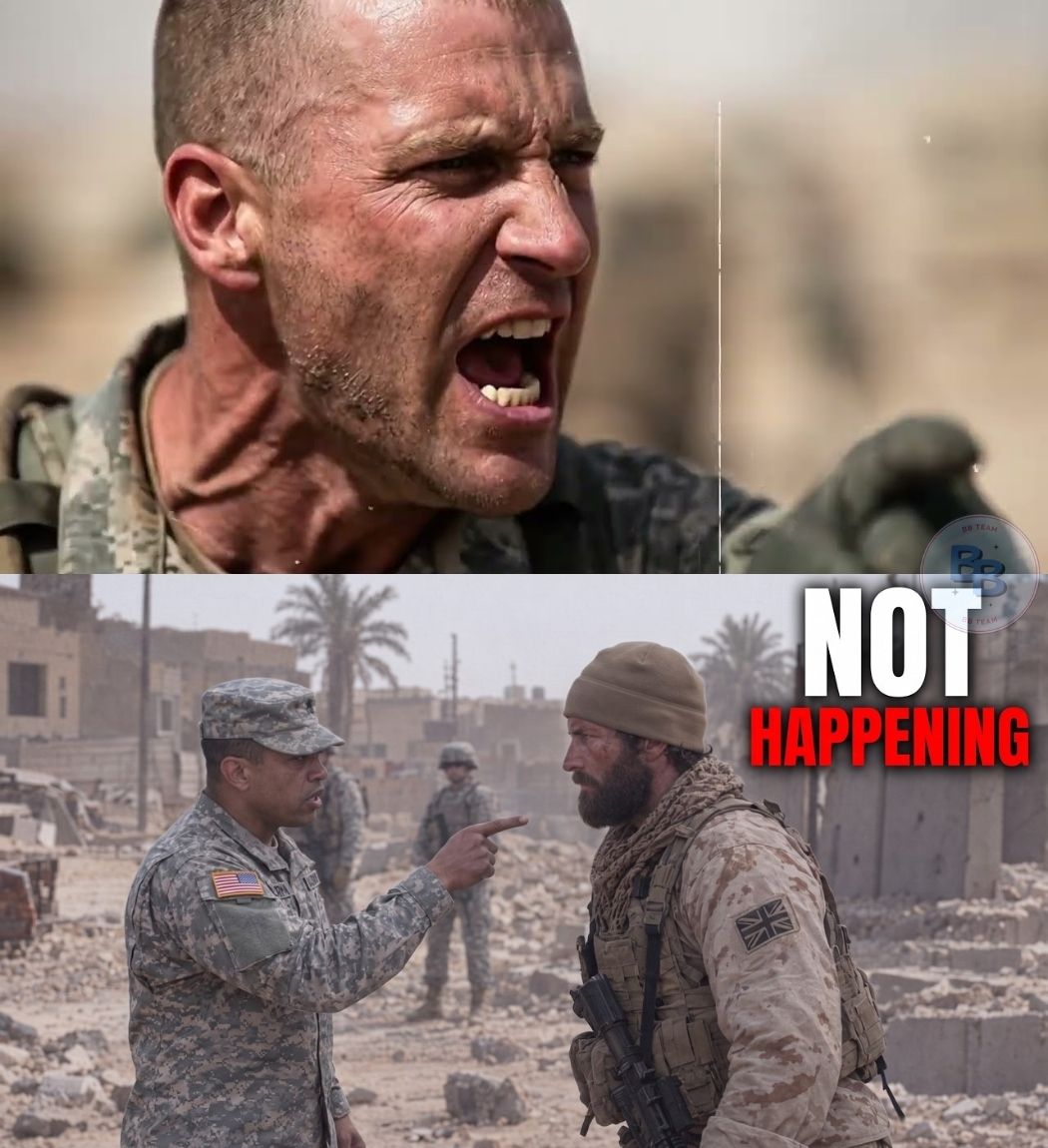
“Wear Your Helmet, That’s an Order” — When the British SAS Refused US Orders in Ramadi
There is a major in digital camouflage standing on a vehicle strip in western Ramadi in April of 2006 and he is pointing his right index finger at a bearded man in a tan beanie and telling him loud enough for his own captains to hear it that he will put a helmet on his head or he will not go through the gate.
“Wear your helmet. That’s an order.”
The bearded man does not move. He has a Union Jack sewn in subdued thread onto the right shoulder of a tan and brown smock, a plate carrier worn close over it, a rifle slung muzzle-down across his chest, with the sling tight to the body the way men wear a weapon they have carried for years, and a scarf wrapped once around his neck against the dust. He is looking at the major the way a tradesman looks at a man explaining the trade to him.
He says nothing.
The major taps the laminated roster in his left breast pocket twice and leans in.
“You are not elite. You are a joke in a knitted hat.”
Two of his own soldiers standing further back on the strip with their rifles across their chests and their helmets buckled hear him say it. One of them, a staff sergeant with a Special Forces tab, closes his eyes for a half second and opens them again. The other, a captain, looks at the ground.
Behind the bearded man, three other men in the same tan smocks and the same beanies are standing in a loose, unbothered half circle, and none of them turns his head.
The bearded man answers the major in a voice so level it sounds for a moment like agreement.
“We’ll be going as we are, sir.”
He does not say it as a refusal. He says it as a fact about the weather. Then he turns and the four of them walk back towards their vehicles the way men walk who have already finished the conversation.
The major watches them go and his jaw works once and the finger that was pointing comes down slowly and he does not know yet that he has just said the two sentences he will have to live inside for the rest of this day. He will remember saying them. He will be made to: by last light he will be standing on this same strip with a stopwatch in his hand that is not his, listening to his own assault team leader read a number off a clearance log, and the four men in the beanies will be walking past him in the opposite direction and he will not be able to work his mouth around any of the words he knows.
Everything that happens between now and then is the bill coming due.
19 rooms, one compound, one number he does not yet know. One order he gave on a strip in Ramadi in front of witnesses that he was about to be proven wrong about in a way he could not walk back. He had said it out loud. That was the problem.
To understand why the major said what he said, you have to understand that he was not by any ordinary measure wrong to say it.
Elias Vasquez was 38 years old in the spring of 2006 and he had been in the United States Army for 16 of those years. He had enlisted into the 75th Ranger Regiment out of Fort Benning in 1990, served his first combat tour as a very young man in a very short war, come back, and stayed. He had been a squad leader in 2/75 before his 30th birthday, a platoon sergeant before his 33rd, and he had taken a late commission through Officer Candidate School because an infantry sergeant major told him he was wasting himself in the ranks. He had done his captaincy in a line battalion of the 1st Armored Division and he had been through Fallujah twice: once in April of 2004 and once again in November when the city burned house by house for 6 weeks.
On his personal awards rack he carried a Bronze Star with the V device for valor, pinned to his chest by a brigadier in a dusty hangar in the spring of 2005. Men who had served under him respected him. Men who had served over him trusted him with their rosters. He had the Ranger tab on his left shoulder and the combat patch on his right, and he wore both the way a man wears the things he has paid for. He was, in the plain reading of the word, a competent officer.
He had buried soldiers. He had carried a wounded private four city blocks under fire in Golan in 2004. He had sat in rooms with Iraqi colonels and in rooms with American ones, and he had learned which one of them to lean on, and when. He had earned his seat at the table in Ramadi. And when he sat at it, he kept a laminated roster in his left breast pocket of every American soldier under his operational control. And he tapped that roster twice when he was angry, because to him the roster was the point.
Those names, that number, those mothers. That was the frame he brought with him to the strip.
He had buried soldiers in Fallujah because men took rounds to the head they would not have taken if their heads had been inside a Kevlar helmet. He had written the letters. He had signed in his own hand the forms. He had been standing on the far side of an up-armored Humvee in 2004 when a lance corporal from Ohio was shot through the temple below the lip of a soft cap; he had been told twice to swap out, and that lance corporal had died in the gutter in the time it took the medic to run 11 m, and Vasquez had kept the kid’s blood-tape in a drawer in his quarters at Camp Ramadi for the entire 13 months since.
So when he walked out onto that vehicle strip in April of 2006 and saw four men in tan smocks and tan beanies climbing out of a pair of pinzgauers to join his task force for a joint clearance of a compound south of Route Michigan, he did not see what you see. He saw four men with no helmets. He saw his own corporals and sergeants looking at them. And he saw his own corporals and sergeants wondering in that half second whether the rules were the rules.
He had been told in a briefing earlier that morning that the attached British element would be an element from the Special Air Service out of B Squadron Mobility Troop—blades under a staff sergeant named Marwood—operating under a quiet little acronym he did not have clearance for and did not need. He had been told they were self-contained. He had been told politely that they tended to run their own kit. He had nodded, and he had said politely that on his vehicle strip the kit rules were his. And when they stepped onto it in beanies, he said the thing he had been building towards all morning. He said it loud. He said it in front of his own men. He said the second sentence, the one about the joke in the knitted hat, because the first one had not moved them, and because he had never, in his 16 years in the army, had a man in a tan smock look at him on a strip in Iraq like he was a civilian explaining weather.
Behind him, Master Sergeant Luther Hoy, the Special Forces liaison, took him gently by the elbow and said in a voice pitched low enough that only Vasquez would hear it:
“Sir, I would let them wear what they wear.”
Vasquez pulled his elbow back.
“On my strip,” he said, “they wear what I wear.”
Hoy let it go. He had tried. He had done his duty by the man, and the man had refused the courtesy. And that was the last warning Elias Vasquez was going to get that day.
Everything after that, the day administered itself.
The Americans and the British went inside out of the sun to brief. The room was a plywood-walled operations cell at Camp Ramadi with a Toughbook on a folding table, two acetate-covered maps pinned above it, a printer that had been overheating since February, and the low, constant hum of a generator two walls away.
Vasquez stood at the head of the table with his hands on his hips, his helmet on the chair behind him, the laminated roster in his pocket, and his assistant S-3, Captain Dale Brickman, standing at his left elbow with a clipboard he had already written on in three colors. Hoy stood at the back with his arms crossed. The task force assault team leader, Sergeant First Class Dean Robichaud, stood against the wall in his plate carrier with his helmet hooked by its chin strap over his wrist, chewing a toothpick slowly.
The British came in last, because the British always come in last. Staff Sergeant Marwood led. He did not take off the beanie. He did not take off the plate carrier. He walked to the map, put one gloved finger on the compound south of Route Michigan, read the grid off the acetate without blinking, and then stepped back and let the other three fill in behind him, the way a rugby backline fills in behind the 10.
Sergeant Rod Penarrow, the sniper, took the far corner of the room where he could see both the door and the map, and he leaned there, and he did not speak. Corporal Ike Threlfall, the breacher, took up a position by the printer—which he liked because it meant nobody could get behind him—and he began, without appearing to look at it, to peel a length of green sniper tape off the roll in his left hand and wind it slowly around the muzzle cap of his rifle by feel. Trooper Finley Oakshot, the youngest of the four, the medic, stood by the door with his thumbs hooked into his belt kit, humming very quietly a tune nobody in the room could place.
Vasquez briefed them.
The compound was a two-story farmhouse walled on three sides with a courtyard and an outbuilding and a crop of palm trees along the eastern approach. The target was an Al-Qaeda in Iraq facilitator the task force had been building a case against for 11 weeks, suspected of running the car-bomb financing for the stretch of the river between Habbaniyah and Khalidiya. He was known by two separate human sources to sleep in the ground-floor rear room of the main house with a GPMG machine gun and a boy of about 15 on the stairs. The task force would roll in on armor, dismount at a 200 m offset, go through the courtyard gate with a breach, and clear the house room by room: 19 rooms by the overhead and by the source. Ground floor, first floor, outbuilding. H-hour at 0147.
Marwood listened to all of it, standing exactly where he had stopped. When Vasquez finished, he said very mildly:
“Sir, we’ll take the overwatch and the back wall.”
He said it the way a man orders coffee. It was not a request. He traced a line on the map with his gloved finger from a date-palm cluster on the eastern side to a low mud-brick building 260 m out, tapped it twice, and said, “Rod will sit here. I’ll sit with him. Ike and Finley will drop onto the back wall and go in through the rear courtyard the moment you breach the front.”
Then he waited.
Vasquez looked at Brickman. Brickman looked at the map. Robichaud, against the wall, took the toothpick out of his mouth and put it back in. Hoy, at the back, said nothing at all, which was the loudest thing he had said all morning.
“Fine,” Vasquez said after a measurable pause. “Overwatch and the rear. You go in behind my stack alongside—”
“Sir,” Marwood said, and he was not correcting the major; he was describing the geography. “Through the back. As you go through the front, we’ll be inside before your second man clears the hall.”
Vasquez’s jaw worked once. “We’ll see.”
That was the last English word spoken in the room for about 40 seconds, because the generator two walls away chose that moment to cough and change pitch, and because Threlfall had finished taping his muzzle cap and started on a magazine, and because Penarrow had been chewing the inside of his left cheek for the whole brief and no one had noticed until he stopped.
What Vasquez did not see, what Hoy saw, and what Brickman would understand later in a porta-cabin with a mug of coffee in his hand that he was not going to drink, was that in the time he had been talking, the four men in the tan beanies had done four separate, quiet pieces of professional work in his operations cell:
Marwood had read the entire acetate map, including the two features Brickman had drawn in last night in green that nobody else in the room had been told about yet.
Penarrow had identified three fields of fire out of the single window in the plywood wall, and he had placed himself where he could cover all three without turning his head.
Threlfall had taped two separate pieces of kit by feel without once looking at his hands, which meant he was watching the door and the map at the same time.
Oakshot had at some point during the brief moved from the door to a position two paces inside the door, which meant that if anybody came through it in a hurry, he would have the first man by the throat before the second man had cleared the threshold—and he had done it without any of the Americans noticing him move. He was still humming.
They were not performing. They were not showing off. They were doing in a plywood briefing room in Camp Ramadi the thing they did everywhere they stood, which was to behave at all times as if the room they were in was already contested, and to make themselves economical inside it.
Vasquez, standing at the head of the table with his hands on his hips, saw four men without helmets. Robichaud, chewing his toothpick against the wall, saw something else. He did not say what he saw. He put the toothpick in his breast pocket and let his hand rest for a moment on the chin strap of the helmet hooked over his wrist. He was a senior non-commissioned officer in a very good American task force, and he had worked with men like these twice before in his career, and he knew the look of a four-man team that did not need to be told what to do by a major with a roster.
The brief ended. The task force moved out onto the strip to mount up for the stand-to and the final rehearsal, and the four British blades walked out ahead of them, past the major, still in their beanies.
Vasquez watched them go, and he tapped the laminated roster in his left breast pocket twice, and said something under his breath to Brickman that Brickman did not answer.
The gun was loaded.
Before the task force rolled, Vasquez took them to the 25 m range. It was a packed earth lane behind the HESCO barriers on the east side of the camp with four plywood targets stapled to timber frames and a berm behind that caught the rounds. He had scheduled a confirmation shoot for his own stack because he confirmed zeros before every operation. It was one of the rules he was known for, and it was one of the rules he was right about.
Robichaud’s team went first. Four men up, each firing a five-round group at 25 m from the prone, calling corrections, adjusting, firing a confirming group. The groups were tight. These were good shooters, and they shot like good shooters, with that unhurried economy you want in a man who is going to be in a hallway with you in 6 hours’ time.
Vasquez told the British to shoot after.
Marwood looked at him for a beat. “Yes, sir,” without inflection.
And the four of them walked onto the lane together with the ease of men who had done this on a hundred ranges in a dozen countries and had stopped finding it interesting at some point in the previous decade. Threlfall was still peeling tape off his roll.
They did not shoot from the prone.
Penarrow set up on the 25 with his L119A2 on a shortened sling, standing, and he put five rounds into a group you could cover with the pad of a thumb, called it, re-engaged from the kneeling, re-engaged from the standing with the weapon canted at the awkward angle you have to use inside a doorway, and his group grew by about a centimeter, and then he stopped and looked at Marwood.
Marwood nodded once. Penarrow stepped off the lane.
Threlfall went up. He walked onto the 25 with the roll of green sniper tape still in his left hand, took a knee, fired a five-round group one-handed with his right, standing the weapon on its magazine against his thigh, re-engaged left-handed, and when Marwood lifted his chin at him, Threlfall walked down range, laid the roll of green tape over the two groups on the plywood, and both of them disappeared under the width of the roll. Then he taped the roll to the side of the target with a 2-in. tab, so that for the rest of the rehearsal window every American on the range who looked at that target saw a roll of green tape pinned to the plywood where the groups should have been.
Oakshot went up third. He fired a confirmation group one-handed because he was carrying a med pouch in his left, and he had decided, apparently, that he would like to see what the group looked like if he did not put the pouch down. The group was wider than Penarrow’s and tighter than any of the Americans had been from the prone.
Marwood went up last, fired nothing, cleared his weapon on the lane, checked it, slung it, and said to Robichaud, who had come up beside him with the toothpick back in his mouth:
“We’re good.”
Robichaud took a long time to answer. He was looking down range at the roll of green tape pinned over the groups.
“Yeah,” he said finally. “You are.”
Vasquez had been standing 12 paces back behind the firing point with Brickman at his left shoulder. He had watched the entire sequence from behind. He had not been able from where he was standing to see the groups themselves; he had seen four men without helmets shoot standing and kneeling and one-handed at a 25 m target without any ceremony, and he had watched one of them pin a roll of tape to the plywood as if that were how one marked a zero.
He walked up to the firing point when the British had cleared it, and he walked down range with Brickman, and he looked at the plywood with the roll of tape on it, and the thing he said to his captain, in a voice that was almost casual, was:
“Pull that tape off.”
Brickman pulled the tape off. Underneath the roll on the plywood, there were two overlapping groups the size of a British 50p piece. Five rounds. Five rounds. Standing, kneeling, one-handed, 25 m. One of the groups had a single hole that was slightly out and to the right by about a thumbnail’s width, which Penarrow had called on his second shot and which he had corrected on his third. The other group was round. Both of them were tighter than anything Vasquez had put on paper in the last 12 months.
Brickman stood there with the roll of tape in his hand and did not say anything. Vasquez did not say anything either. He stood looking at the plywood for the length of time it takes a man to make a decision about how he is going to carry a piece of information for the next several hours. And then he turned and he walked back to the firing point.
And he said to Robichaud: “We’re done. Mount up.”
Robichaud took the toothpick out of his mouth, put it in his breast pocket next to the one that was already there, and said, “Yes, sir.” He did not look at the British. He did not need to; he had looked at the plywood. The toothpick was the look.
Hoy, who had been standing off to the side the whole time with his arms crossed, did not say, “I told you so.” He did not have to. He had told him so on the strip an hour and 20 minutes earlier, and the day was simply going to continue to tell him so in different handwriting until last light.
As they walked back towards the vehicles, Vasquez tapped the laminated roster in his left breast pocket twice, and the taps were slower than they had been on the strip. Brickman kept the roll of green sniper tape. He did not know why. He put it in his cargo pocket, and he carried it there for the rest of the operation, and later in the porta-cabin he would take it out and put it on the desk between himself and Robichaud, and neither of them would pick it up.
Behind them, the four British had already climbed back into the lead pinzgauer. Threlfall was taping a radio battery to the inside of his plate carrier so it would not rattle when he ran. Penarrow was chewing the inside of his cheek again. Oakshot was humming. Marwood was reading his watch.
The man with the V device, the Ranger of 12 years, the officer who had buried the Ohio boy under the lip of a soft cap, walked back to his own Humvee and climbed up into it and did not say the thing he was thinking, which was that he had just been shown something he had not been expecting to be shown on his own range in front of his own captains.
That was only the first time that day he would be wrong.
They staged out of Combat Outpost Falcon just after midnight. The compound was 90 minutes east on foot from the drop-off and 3 minutes south on armor, and the plan was for the four British to insert on foot an hour before the task force rolled so that by the time the Humvees broke the 200 m offset, the overwatch would already be in and the two assaulters would already be against the rear wall.
Vasquez did not like it. He said to Brickman within earshot of Marwood that he did not like inserting a four-man element onto a target an hour ahead of the main effort, because an hour was an hour and anything could happen in it.
Marwood did not react to the sentence. He pulled his beanie down a half inch over his ears, checked that his sling was tight, and walked out of the wire without looking back, and the other three went with him in a staggered single file that the American sentry on the gate watched for about 4 seconds before he realized the fourth man had already passed him and he had not seen him move.
Vasquez and Brickman followed by road. They had been granted by Marwood a position on a low roof 200 m back from the overwatch itself to observe. Vasquez had asked for it, and Marwood had said mildly, “Of course, sir,” and had meant it, because what Marwood had understood an hour earlier on the range, and what Marwood was going to do all night, was let the day teach the major itself. That was the staff sergeant’s single luxury that evening, and he was taking it.
They came up onto the roof an hour before H-hour. Penarrow and Marwood were already in position 260 m from the compound in the lee of a mud-brick outbuilding that in daylight you would have called an animal pen. From the American roof with a night-vision device, Vasquez could see them only because he knew where to look. Penarrow was in the prone on a folded Bergen, his rifle on a bipod, a soft focus of thermal signature where his cheek met the stock. He had been in position by Brickman’s watch for 38 minutes. In those 38 minutes, he had not moved. He had not shifted his hips. He had not scratched his nose. He had not spoken on the net.
Marwood lay beside him, half a meter to his left, with a spotting scope on a short tripod and his own rifle on his back. He was speaking very occasionally in a flat, half-whisper the American net could not hear because it was on a British frequency Marwood had been given permission to use and had then, with great politeness, not told Vasquez he was using.
“Rod,” Marwood said once. “Window two, first floor right.”
“Window two, on it,” Penarrow said, and his voice on the British net came through Marwood’s earpiece so quietly that Marwood heard it more than received it. “Male adult. GPMG on the sill. No belt.”
“Confirm.”
“No belt. Confirm. No belt. He’s showing me the feed-tray cover. It’s closed. He hasn’t loaded it.”
Marwood keyed back. “Hold.”
That was the entirety of the exchange for the next 19 minutes. What Vasquez could see from the American roof through his own device was two still shapes in the lee of a wall. What Vasquez could not see was that between those two still shapes, over the course of 94 minutes, Penarrow built by eye and by whisper a complete range card of the compound: three windows, two doors, one roof hatch; the GPMG on the first-floor sill; the boy on the stairs who came up at 0122 and went down again at 0129; the goat tethered in the courtyard that would have to be accounted for in the breach; the single hanging bulb on the outbuilding that was the only source of visible light within 400 m; and the one man—not the facilitator, a cousin, a watcher—who was sitting in a plastic chair against the eastern wall of the courtyard where he could see the eastern approach and could not see anything else. He was asleep by 0141.
Brickman, lying prone on the American roof beside the major, finally said under his breath:
“Sir, ask him for a count.”
Vasquez had been thinking the same thing. He keyed over to the British net through the comms link Marwood had set up and he said:
“British overwatch, this is Phoenix 6. Give me a count of personnel in the compound.”
There was a pause of about 1.5 seconds. Then Penarrow’s voice came back, flat, no inflection:
“Seven. Four adult males in the main house: three on the ground floor, one on the first floor by the window with the GPMG. One adolescent male on the stairs between floors. One adult male asleep in a chair in the eastern courtyard. One adult male in the outbuilding on the mat under the window. Seven total. One high value. One shooter. Five others.”
Vasquez waited for him to add something. He did not.
Brickman turned his head half an inch on the roof and looked at the major.
“Confirm,” Vasquez said into the net. “Confirm seven.”
“Seven,” Penarrow said.
Vasquez had been in Fallujah twice. He had watched American scout snipers build range cards from overwatch positions. He knew what the work was. He knew what the breath control was. And he knew, lying on that roof in Ramadi at 6 minutes past midnight, that he had been shown a count he had not asked for in the way he had asked for it, and that the man who had given it to him had not guessed a single number. The GPMG had no belt on it. The adolescent was on the stairs. The watcher was asleep. Seven, not six, not eight: seven. The joke in the knitted hat.
He did not say the sentence that was in his mouth. He turned to Brickman instead and he said:
“H-hour in 6 minutes. Get Robichaud on the net.”
Brickman reached for his handset. In his cargo pocket, the roll of green sniper tape pressed flat and small against his thigh.
The gun was aimed now.
The two assaulters moved at H-minus 4. Marwood’s call came across the net in his flat, half-whisper:
“Ike, Finley, go.”
That was the entire order from the American roof, 200 m from the overwatch and 320 from the back wall of the compound. Brickman had his night-vision device trained on the lee of the animal pen where the two assaulters had been crouched for the previous hour. Vasquez was watching the back wall of the compound through his own device, because that was where he expected them to appear. Robichaud on the ground at the 200 m offset with his stack was watching the front gate.
Brickman saw Threlfall and Oakshot leave the lee of the animal pen. Then he did not see them again for 92 seconds.
He kept the device on the ground between the overwatch and the back wall. He swept it twice, left and right, slowly, the way he had been trained to sweep for a moving man. He saw the goat in the courtyard turn its head, which was the only moving thing in his field of view for the first 40 seconds. He saw a sheet of corrugated tin on the far side of a crop ditch shiver in a gust of wind. At the 52-second mark, he did not see two men crossing 200 m of open ground in soft kit with suppressed rifles.
At the 92-second mark, he saw Threlfall’s left shoulder appear against the back wall of the compound, flush with the mud brick in the exact spot Marwood had tapped on the acetate map in the briefing room 11 hours earlier.
Oakshot was already beside him. They were kneeling. Threlfall had the roll of green sniper tape out and was taping a small charge of plastic explosive flat against the base of the wooden rear gate of the courtyard. He taped it in three quick passes, laid the dead cord down into the dirt, and then he and Oakshot both went completely still against the wall, and became, in Brickman’s thermal device, two warm shapes that could have been anything.
“Jesus,” Brickman said quietly on the roof.
Vasquez did not answer. He had been watching the back wall for 92 seconds, and he had seen them appear against it the way a stain appears on a shirt: one moment the wall was wall and the next moment there were two men against it and he could not have told any man alive how they had got there.
He thought afterwards about what he had been looking for. He had been looking for two shapes crossing open ground. He had been looking for the thing he knew. He had not been looking for the thing he was shown, which was two men who had for 92 seconds treated 200 m of Iraqi farmland the way a surgeon treats a scalpel—as something you move through without pressing. He did not know how they had done it. He did not know whether they had crawled or walked bent double in the lee of a crop ditch he had not seen on the map, or paused in a dead spot of ground he had not registered, or all three. He did not know, and he was not going to be told, because men like these did not explain their legs to officers like him.
What he knew was that his own thermal device mounted on the roof of a two-story building 200 m from an overwatch position had failed to track two of his attached assault element across a flat open patch of ground in Anbar—not because the device was bad, but because the men had been better than the device.
Trooper Oakshot had been humming when they left the overwatch. Brickman had heard it on the open net for a half second as Oakshot keyed up and keyed down without meaning to: a snatch of something old, Welsh, a male-voice choir line about a river. The humming had stopped at the 90-second mark. Brickman noticed. Vasquez did not.
On the ground at the 200 m offset, Robichaud’s stack was ready at the front gate. Robichaud had the breach team up. He was holding the task force stopwatch—a cheap digital thing with a split-time function that he had carried through every clearance for the last 14 months—in his left hand with the lanyard around his wrist, because that was what he always did at H-hour, so that when the breach went in, he could thumb the start button in the same motion as calling it.
In Vasquez’s left breast pocket, the laminated roster sat flat against his chest. He reached up to tap it twice because that was the habit. His hand went up and his fingers found the pocket and then they did not finish the motion. He lowered the hand. He did not know he had not finished the motion. Brickman, lying beside him on the roof, saw it, and he carried that image with him for the rest of his career.
Marwood’s voice came across the net, flat and quiet:
“Set.”
Penarrow’s voice came across the net immediately after, flatter, quieter:
“Set. G[P]MG sill. Shooter has not moved. Adolescent on stairs. Courtyard watcher asleep. One in the outbuilding. Seven.”
Robichaud at the front gate keyed his own net:
“Phoenix 6, Phoenix stack is set.”
Vasquez lay on the roof and stared at the back wall of the compound where the two warm shapes had been, and where he could now see nothing, because Threlfall and Oakshot had made themselves disappear again against the mud brick, the way a man disappears against the dark side of a wall when he has decided to.
He keyed his handset. “All stations,” he said, and his voice was level, because he was a competent officer who had been through Fallujah twice. “All stations, Phoenix 6, execute.”
Robichaud’s thumb hit the start button on the stopwatch at the same instant that Threlfall’s dead cord blew the rear gate at the same instant that the task force breacher at the front gate put a shotgun slug through the Acorn padlock on the courtyard chain.
The clock started. The man who had called them a joke in the knitted hat had stopped tapping his pocket.
The rear gate goes at 0 seconds. The charge is small: it is the smallest charge that will take the hinge pins off a wooden gate in a mud-brick wall. And Corporal Threlfall has placed it inside the width of a roll of green sniper tape. And when it goes, it goes with the dry, low thud of a seasoned breach, not a bang. The gate falls inwards flat. Threlfall is through it before it has stopped moving. Oakshot is behind him. They are in the eastern courtyard.
At 0+2 seconds, the sentry in the plastic chair—the watcher—is waking. He does not finish the motion of standing. Oakshot puts him down with two rounds to the upper chest from a Glock 17 held in the left hand because the right is on the sling, and the rounds are suppressed, and the chair tips sideways and the watcher is on the ground. The goat does not move. Oakshot does not slow.
At 0+4 seconds, the front gate at the 200 m offset blows. Robichaud is through it with his stack. The stopwatch is in his left hand. The split button is under his thumb.
At 0+11 seconds, Threlfall is at the rear door of the main house. The door is wooden, bolted on the inside. He does not blow it; he places a boot on it at the bolt line, and the frame gives because mud-brick frames give. He is through. Oakshot is on his shoulder.
On the first floor, the shooter on the GPMG hears the front breach and swings the gun towards the stairs. The GPMG is not belted. Penarrow in the overwatch at 260 m has been on his crosshair for 94 minutes, and when the shooter’s head rises above the lower sill of the window, Penarrow puts a 5.56 round through the base of the skull, and the shooter goes down behind the sill, and the GPMG falls with him and does not fire. Penarrow does not key the net he holds. He has 19 more rounds in the magazine. He is chewing the inside of his left cheek.
At 0+22 seconds, Threlfall and Oakshot are in the rear ground-floor hallway. There are two doors. Threl takes the right; Oakshot takes the left. The right-hand door opens into a store room. Oakshot’s door opens into a sleeping room with two adult males, both reaching for weapons on the floor, and he puts both of them down with four rounds total before either has his hand on a stock. He calls clear one syllable on the British net.
At 0+34 seconds, Robichaud’s stack hits the front of the main house. The breacher takes the front door with a mechanical ram. Robichaud is second man; his stopwatch in his left hand reads 34. He thumbs the split. The split records.
At 0+41 seconds, Threlfall and Oakshot meet Robichaud and his two-man element in the central ground-floor hall. There is one moment—half a second—where four rifles cover each other across a hallway in the dark. And then Threlfall says, “British, British,” in his flat Lancashire voice, and Robichaud says, “Clear, you’re clear,” and the two elements split. Robichaud takes the stairs. Threlfall takes the ground-floor front rooms. Oakshot covers the rear of the stair with his rifle pointed up at the landing.
At 0+58 seconds, Robichaud’s pointman meets the adolescent on the stairs. The adolescent is not armed. He is on his knees. Robichaud’s pointman puts him flat on the stair treads and secures him with a zip-cuff, and the stack goes over him and up.
At 0+1 minute and 16 seconds, the facilitator—the high-value target, the man the task force has been building a case against for 11 weeks—is pulled out of the ground-floor rear room by two of Robichaud’s assaulters. He is not shot; he is on the floor with a knee in his back. His GPMG gunner is dead on the first floor. The boy on the stair is secured. He has in the last 76 seconds lost his war.
At 0+2 minutes and 9 seconds, the first floor is cleared: three rooms, all empty except the room with the shooter, who is dead and whose weapon has been made safe by Robichaud’s number-three man.
At 0+2 minutes and 44 seconds, the outbuilding is cleared by Threlfall. The man on the mat under the window surrenders. He is bound. He is the second detainee.
At 0+3 minutes and 31 seconds, the courtyard is cleared. The eastern watcher is dead. The goat is still tethered.
At 0+3 minutes and 58 seconds, Robichaud calls on the task force net:
“All rooms clear. Compound secure. Two detainees. Four EKIA. One HVT confirmed. No friendly casualties.”
At 0+4 minutes and 11 seconds, Robichaud lifts his thumb off the stopwatch.
4 minutes, 11 seconds. 19 rooms, one compound, two detainees, four enemy killed in action, one high-value target confirmed and secured. Zero friendly casualties. One shot fired at range by the overwatch—one shot that mattered, a round through the base of a skull at 260 m in the dark with a suppressed L119A1 by a sergeant who had been on his cheek weld for 94 unmoving minutes.
Captain Brickman on the roof is writing it down as he hears it on the net. He writes it in blue pen in his own hand on the clipboard he has carried since the briefing: the split times, the casualty count, the detainees, the HVT, the time on target: 4 minutes 11 seconds. He writes the number twice because he wants it to be in two places.
Vasquez is lying beside him. He is not writing anything. He is looking at the back wall of the compound where the hole where the rear gate used to be is faintly lit by a chem-light somebody has cracked and dropped on the courtyard flagstones, and he is not moving.
On the ground at the front of the compound, Staff Sergeant Marwood has walked up out of the dark from the overwatch with Sergeant Penarrow at his left shoulder. Marwood is pulling his beanie down a half inch over his ears against the night cold. Penarrow has the rifle slung muzzle-down across his chest, and he is still chewing the inside of his cheek. They stop at the gate.
Marwood says something to Robichaud quietly that nobody on the American net picks up. Robichaud nods. Robichaud in his left hand is still holding the stopwatch, and the stopwatch is still showing in digital seconds 0411. He walks it slowly across the 200 m of ground back to the base of the roof.
He looks up at the two shapes on the roof, and he lifts the stopwatch in his left hand, and he reads aloud in his flat Louisiana voice the number on the digital face:
“4:11.”
He holds it up for a long time. Vasquez on the roof sees the number.
They were back on the strip at Camp Ramadi by 6 in the morning. The sky was the color of wet sand. The air still had the dust in it that had been there the day before and would be there the day after. The task force vehicles were coming in off the road one by one: Humvees first, then the two British pinzgauers at the back of the serial.
The men were dismounting in the same loose, unhurried order they had mounted in, except that Robichaud’s stack was now carrying the two detainees in zip-cuffs between them, and the facilitator was walking with his head down and his hands bound at the small of his back, and the task force had its man.
Vasquez stood on the strip in the same place he had stood 18 hours earlier. He had the laminated roster in his left breast pocket. He had the Bronze Star with V on the rack of his service uniform in a locker in his quarters, and he had 16 years of army behind him, and he had buried in his career more than one man under the lip of a soft cap, and none of that was going to help him in the next 90 seconds, because what was about to happen on the strip was that the four men he had called a joke in a knitted hat were going to walk past him.
They came off the second pinzgauer in the order they always moved in: Marwood first, Penarrow at his shoulder, Threlfall behind them with the roll of green sniper tape clipped to a loop on his plate carrier, Oakshot last with his thumbs in his belt kit, humming again, very quietly, the same old Welsh river line he had hummed on the approach.
They walked past the major.
Marwood did not look at him. He did not pause. He did not nod. He walked past the major the way he had walked out of the briefing room the night before, which was the way a tradesman walks past a man he has already answered on a question the man did not know he was asking.
Penarrow did not look at him either.
Threlfall glanced at him once flatly and went on.
Oakshot, the youngest, the medic, met the major’s eye for a half second with no expression on his face at all, and then walked on.
Vasquez did not say anything. His hand went up towards the laminated roster in his left breast pocket, and it stopped halfway, and it came back down.
Robichaud walked up behind the British with the stopwatch in his left hand. He stopped two paces from Vasquez. He held the stopwatch out, screen up. The digital face still read 0411, because Robichaud had not reset it, because Robichaud wanted the number to be seen.
“Sir,” Robichaud said, and his voice was level and empty of any grade of feeling. “That’s the time on target. 4:11. 19 rooms, one HVT, two in cuffs, no British, one round at distance by the overwatch.”
He paused. He added: “Thought you’d want the number for the after-action.”
Vasquez took the stopwatch. He looked at the face of it. He looked for a long moment at the digits as if he were reading a word in a language he once spoke and no longer quite remembered. He did not say anything.
Behind him, Captain Brickman stepped up and took the clipboard out from under his left arm. He held the clipboard out to the major with the blue-ink after-action log on it, and he said the sentence Vasquez could not.
“Sir,” Brickman said quietly, so that only the three of them, and Hoy standing six paces back, could hear it. “They went in behind our stack and came out ahead of it. And every number on this page is theirs.”
Vasquez took the clipboard. He read the first line. He read the second. He read the fourth. He stopped at the time on target. He did not read any further.
Master Sergeant Hoy, six paces back, did not say, “I told you, sir.” He did not say anything. He uncrossed his arms after a long moment and he walked away towards the operations cell, because the day was over and he had other work.
The four British were already at their own porta-cabin on the other side of the strip. Marwood pulled his beanie off finally and ran a hand through flat hair and said something to Penarrow that made Penarrow show his teeth for the first time in 18 hours. They went inside and shut the door.
Vasquez stood on the strip with the stopwatch in one hand and the clipboard in the other. He had said it out loud. He had said it in front of witnesses. He had said two sentences on this strip at 9:00 in the morning the day before, and he was standing now on the same strip with the number on a stopwatch in his left hand that disagreed with both of them.
He did not say anything. The strip was quiet.
In the porta-cabin that evening, Lieutenant Colonel Ainsworth, the squadron officer commanding on the ground, sat down with Major Vasquez at a plywood desk with two mugs on it that neither of them drank from, and he said two sentences. The first was about kit, and the second was about the rest of the tour. Nobody who was in that room has ever written down what either sentence was, because the sentences did not need to be written down.
The porta-cabin door was closed for 7 minutes, and when it opened the two officers walked out side by side, and the strip rules at Camp Ramadi were quietly adjusted for the attached British element the following morning, and no further order about helmets was ever given to any man in a tan beanie on that strip for the remainder of Vasquez’s command.
Captain Brickman kept the roll of green sniper tape in his cargo pocket for the next 11 weeks. He never told anyone where he had got it. When his tour ended, he moved it from the pocket to a drawer in his quarters at Fort Hood, and then from the drawer to a tin on a shelf in a house in Kerrville, Texas, and he still had it 8 years later when he made major himself. And when a captain of his asked him once what the roll of tape was for, he said, “It’s a reminder,” and did not elaborate.
Staff Sergeant Marwood went home to Hereford at the end of the rotation and gave the tan beanie to his daughter who had knitted it and told her it had worked. She asked him what it had worked for, and he said, “Keeping my ears warm, love,” and left it at that. He was back in Iraq in 6 months. The beanie went with him.
The major had said on a vehicle strip in western Ramadi in April of 2006 in front of his own captains that the four men in front of him were not elite, that they were a joke in a knitted hat, and that they would wear helmets or they would not go through the gate. He had been right about the hats: the hats were knitted; Marwood’s daughter had knitted them. He had been right about the tea, too, in a general way: the men drank tea when they could get it, and they drank it strong. He had been right about the surface of what he was looking at.
He had been catastrophically wrong about the men inside it.
The helmet was never the argument. The man inside the helmet was.
That was the thing the stopwatch said, and the clipboard said, and the roll of green sniper tape in a tin in a house in Kerrville said, and the four men in beanies walking past him on a strip at Camp Ramadi at 6 in the morning said, without any of them opening their mouths:
4 minutes, 11 seconds. 19 rooms.