What British Commandos Said After One Night With the U.S. Soldiers
What British Commandos Said After One Night With the U.S. Soldiers
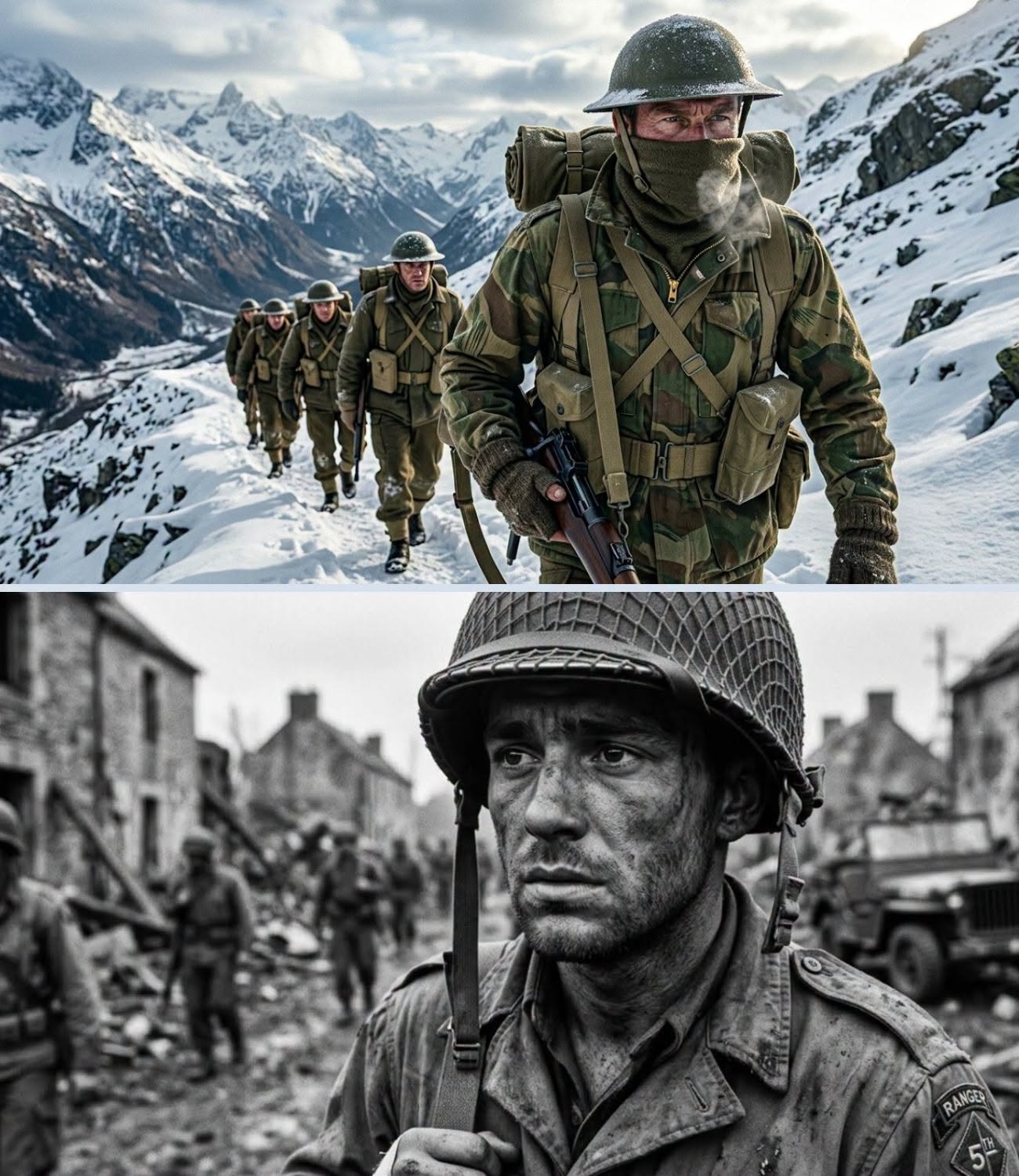
Night of September 13, 1943, Tunisi Pass, 600 meters above the road leading from Naples to the Salerno Plain. There are about 400 soldiers holding the defense here —a battalion of American Rangers and a detachment of British Marines, who have taken up positions designed for three times that number of men, preparing for a German counterattack that will throw more armored vehicles onto the bridgehead below them by dawn than the Allies could even foresee.
Somewhere on that slope, a Scottish lieutenant colonel carries a longbow, bagpipes, and a Scottish broadsword instead of his standard service weapon. And when this night is over, the American Ranger who fought alongside him for two weeks will decide that there are no polite words to describe what he saw, so he won’t even try.
If you want to hear the version of events near Salerno that remains in memory —the one where the US 5th Army was almost thrown back into the sea, and naval artillery saved it at the last moment. This story is true, and it is ahead. But it was written almost exclusively by those whose survival it explains, and there is another, harsher account of those two weeks from the British commandos who held the heights above the bridgehead all this time, which for some reason no one mentions in the official history .
If you are interested in the unsung sides of this war, liking and subscribing will help more people see this story. So do it now, because the pass will soon be tested. The history of Salerno as preserved in most sources is American, and within the limits of its description it is accurate. Operation Avalanche lands the US 5th Army ashore on September 9, 1943, under the command of General Mark Clark, on beaches that turn out to be more open and better fortified than anyone could have planned.
And within four days, the German 16th Panzer Division amassed enough armored vehicles to split the bridgehead in half and throw the entire landing force back into the water. Clark was a hair’s breadth away from ordering a partial evacuation. The naval artillery , which was brought up so close that the shells landed within a few hundred meters of the American positions, is considered crucial in stopping the German attack in the critical days that followed.
And history subsequently took the form of an American near- disaster, salvaged by American determination and firepower. None of this is untrue. What remains out of focus is who stood over this battle for two weeks before the crisis, holding the very area that prevented German reinforcements from reaching the bridgehead any faster.
And this story mostly belongs to the combined forces of the American Rangers and Royal Marine Commandos, who had never fought together before the landings. Who held the mountain pass with a force of about one battalion against constant reconnaissance attacks? And who later wrote about each other with such directness that there is no obvious place for it in the official American narrative ? Let’s go back two years, to the Achnacurry training center in the mountains on the west coast of Scotland, where the British had been training
commandos since 1942 in conditions deliberately worse than anything the fighters could face in combat. Live ammunition fired over the heads of people crawling under the wire. Forced marches with full equipment through mountainous terrain in weather no one would have chosen. When the United States decided to create its own equivalent of a commando force that same year, it sent its first volunteers to train at Achnacurry under British instructors.
And the unit that emerged from there, the 1st Ranger Battalion under the command of Regular Army officer William O. Darby, was modeled after the Commandos, borrowed their training methods, and at the time of deployment considered itself almost a sister unit to those who trained them. By September 1943, Darby commanded three battalions of Rangers, and when the plan for the Salerno landings was developed, his men were tasked with landing well north of the main beachhead, capturing the town of Maiori and climbing the hills above it to take the
Chiunzi Pass— the only road junction on which German reinforcements from Naples could reach the Salerno battlegrounds quickly. Alongside them, landing at Vietri-sul-Mare a few miles along the coast, were the 2nd Commando and the 41st Royal Marines— British units with their own separate orders whose missions eventually overlapped with the Rangers at the same altitude a few days after the landings.
The 2nd Commando Squadron was commanded by Lieutenant Colonel John Malcolm Thorpe Fleming Churchill, known to almost all who served with him as ” Mad Jack”—a name he had earned even before Salerno and did nothing to disprove. He had fought in the Norwegian raid on Vogsey two years earlier, armed with the same weapons as in Italy: a Scottish broadsword at his belt as part of his standard equipment, a longbow with a quiver of arrows that he actually used in battle, and a bagpipe that he played personally under fire, believing that a
commando unit needed music as much as ammunition during an assault . His official explanation, recorded more than once in his own words, was that any officer who goes into battle without a sword is dressed improperly. On paper, it sounds like a theatrical performance. Everyone who served under his command insisted that this was not the case.
Beside him on the pass was Darby , seven years his junior, a West Point graduate, with none of Churchill’s eccentricities but with the same willingness to lead into battle. They both effectively commanded a joint defense force, which neither army planned to deploy on the same mountainside. The pass itself explains most of the events that took place there, so it’s worth describing it before the fighting begins.
Chiunzi is located approximately 600 meters above the coastal road, which was the only real route for German armor and reinforcements moving south from Naples to the bridgehead near Salerno. Whoever held these heights could see everything moving along the road and direct artillery and naval fire at targets. Whoever did not hold them back would have allowed German reinforcements to reach Salerno in a matter of hours, not days.
In the simplest sense, it was the most valuable piece of terrain in the entire landing zone, and since the second week of September it had been held by forces that, on paper, had no chance of holding out against anything the Germans could theoretically put against them . A few companies of Rangers, a detachment of Royal Marines and a handful of auxiliaries, dug in on the crest of the ridge with no reserves behind them and with a bridgehead below that was itself in crisis and had almost no resources to help.
During the second week of September, the Germans constantly probed the pass, probing the perimeter with infantry attacks, looking for a weak spot, but they never found one. Not because the position was strong in the usual sense, but because the people who held it simply did not back down. Churchill’s method, according to all the recollections of those who served under his command, was to respond to aggression with even greater aggression, rather than dig in and wait.
More than once that week he led small groups beyond the perimeter into German-occupied territory, rather than waiting for the attack to reach their wire fences . It was a counterattack that stunned the attackers, who were used to commandos and rangers only reacting, not acting first. The most documented of these raids occurred on the night when the pass was under the greatest pressure: Churchill, along with a single corporal, advanced in the dark, passed through a village occupied by the Germans, and returned at dawn with a group of
prisoners, including an entire mortar crew, captured not at the sight of rifles but at the sight of knives—the combat knives that each commando carried on his belt. Fairbairn-Sykes, a blade designed specifically for this kind of close-quarters, quiet work. 42 prisoners is the figure most often mentioned in reports, although not all sources agree on the exact number, and this discrepancy should be stated frankly, rather than artificially eliminated.
All the testimonies agree on one thing: one officer and one private entered the occupied territory and returned with more prisoners than there were people on their patrol. The reaction of the Americans who watched this is more important than the raid itself, because it is from it that the evidence on which this story is based comes.
The Rangers, who trained under British instructors and considered themselves close in spirit to the commando traditions, watched a British lieutenant colonel play the bagpipes under fire, take up a sword in modern combat, and return from a night patrol with prisoners captured at knifepoint, and realized that the usual vocabulary of praise was not enough here.
One of the rangers who served alongside the commandos on the pass describes how he observed the actions of Churchill’s men and concluded that none of the standard set of words—brave, aggressive, disciplined— applied to what he saw. The closest he could come was that the British seemed to be fighting a different war than everyone else on this slope, by older rules that somehow still worked.
This is not a compliment in the usual sense . It’s more of a transformation of embarrassment into respect, which is usually more reliable than anything else, because no one is making up embarrassment for the record. The crisis came on September 13-14, when the German counterattack on the main bridgehead reached its peak, and Clark’s Fifth Army found itself closer to being thrown into the sea than official history likes to recall.
Every account of those two days, focused on the beachhead itself, understandably, is devoted to the beachhead, the naval fire, the near-total collapse, and the American units holding on with their last strength. What these descriptions usually fail to take into account is that while all this was happening below, the mixed forces at the Kyonzi Pass still remained on that ridge, holding the only road that would allow German reinforcements to reach the crisis point more quickly, under constant pressure, with no spare forces and no real expectation of help
should the position fall. She didn’t fall. The pass was held for the better part of two weeks during the worst phase of the crisis at Salerno and beyond, until the bridgehead stabilized and the advance north to Naples could begin in full . And the men who held it did so as a truly mixed force: Rangers and Royal Marines in the same positions under arrangements for which there was no name in the military doctrine of any peacetime army .
What the British wrote about the Americans later, and what the Americans have preserved about the British, is almost exactly what you would expect from people who went through a trial together, where only each other’s lives were at stake. Darby’s own comments about the commandos, recorded by his subordinates, emphasize specific practical details rather than general praise.
That the British moved at night as his own rangers were trained to do, without needing to be repeated twice. For a commander who had built his unit’s reputation on this skill, this was perhaps the highest praise he was capable of. On the British side, respect for Darby’s Rangers is recorded in equally unsentimental statements .
It’s not that the Americans were brave in an abstract sense, but that they held their ground like professionals do , without needing to be re-explained. Two units, built using the same training method, tested on the same slope, independently reached the same conclusions about each other. Such an agreement, reached separately by people who had no reason to flatter each other’s credentials, commands more credibility than the testimony of one of the parties.
It’s worth following the further fate of the people in this story, because none of this ends just like that on that ridge. Churchill continued to fight for another year, leading raids in the Adriatic, still carrying his sword, still playing his bagpipes during the fighting, until May 1944 on the island of Brač off the coast of Yugoslavia, when his position was overrun and he was captured, reportedly playing “Will ye no come back again?” on their bagpipes when the position fell, being the last to resist after everyone nearby had been killed
or retreated. Eventually sent to Sachsenhausen, he escaped from German captivity before the end of the war, walked over 100 miles to reach Allied lines, and survived the war in its entirety. One of the few people in this entire narrative whose story doesn’t end on a list of casualties. Darby’s story is over. He was killed by a German shell in April 1945 in the final weeks of the war in Italy, a few days before its end , posthumously receiving the rank of brigadier general—the only American officer in that theater of operations to
receive a posthumous general’s star. The Rangers he had formed at Acnacerra and led through Sicily, Salerno, and Anzio had effectively ceased to exist as a fighting unit before the end of the war in Europe, having been absorbed and reformed so many times that the unit that Darby personally formed barely outlived its creator.
The Cuenca Pass is barely mentioned in most American accounts of the Salerno operation ; it’s a note to the crisis at the beachhead he helped endure, held by people whose own track records mostly don’t reflect the true cost of those two weeks. Whether the pass is remembered or not, what happened there does not fit neatly into the Salerno version of either army individually .
American history is the story of a bridgehead that was almost lost and the general who refused to surrender it. British history, if it survives at all, is the story of a ridge that had no chance of being lost because the men who held it—commandos and rangers who trained under the same instructors in the same Scottish hills and had never fought together before that battle—simply did not back down.
A lieutenant colonel who dressed for battle as if the last three centuries had not existed, and an American colonel who watched it all and realized that words about ordinary courage were too small for what he actually saw. “Any officer who goes into battle without a sword is dressed improperly,” Churchill said this more than once, and he meant it , not as a joke his men were to laugh at and forget.
He didn’t put on a theatrical show for effect. He simply discovered over the years of such battles that the old methods worked, and trusted his own results more than anyone else ‘s ideas about what modern warfare should look like. What the Americans who fought alongside him took away from those two weeks was not a story of eccentricity.
It was a harder, simpler observation: when British commandos appeared next to you on a ridge with only a battalion of men and no reserves behind them, the position would hold for reasons that had less to do with equipment or doctrine than with stubbornness, for which there was no category in any statute . Salerno is usually described incorrectly.
But that’s exactly how it really happened, according to those who were actually on that slope .